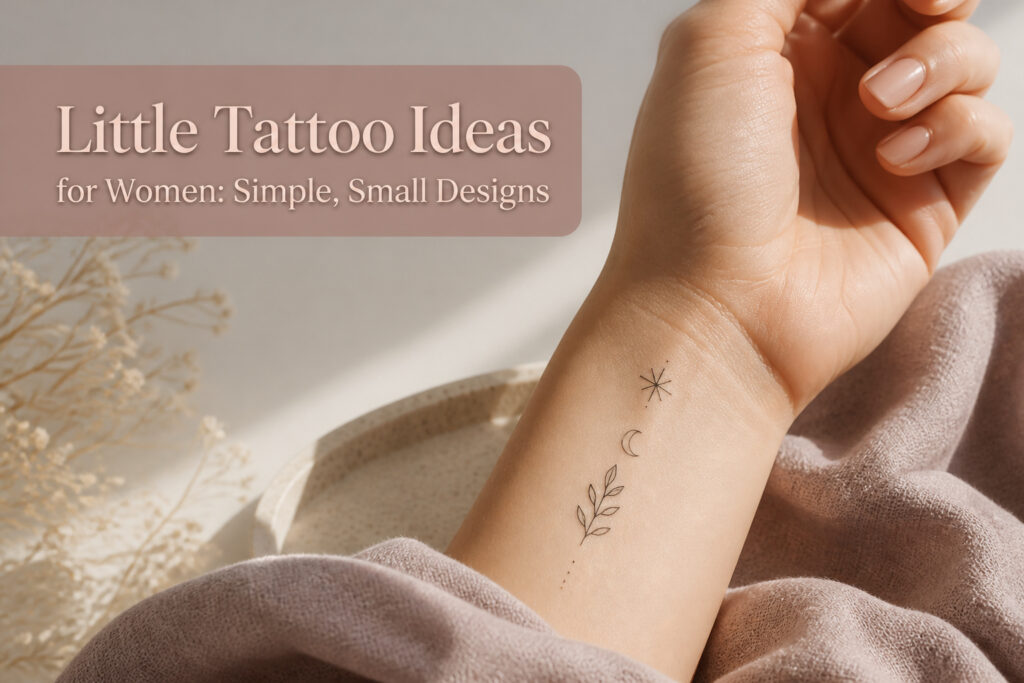
Small tattoos range from a single needle’s width to the size of a coin, and the deciding factor is not how much space you have but how much detail your design can survive losing. A line-art butterfly behind the ear reads instantly at under an inch, while a dog portrait at the same scale will blur into an unrecognizable smudge within a few years. The twelve ideas below all share one trait: they hold their shape when the canvas shrinks.
1. Butterfly
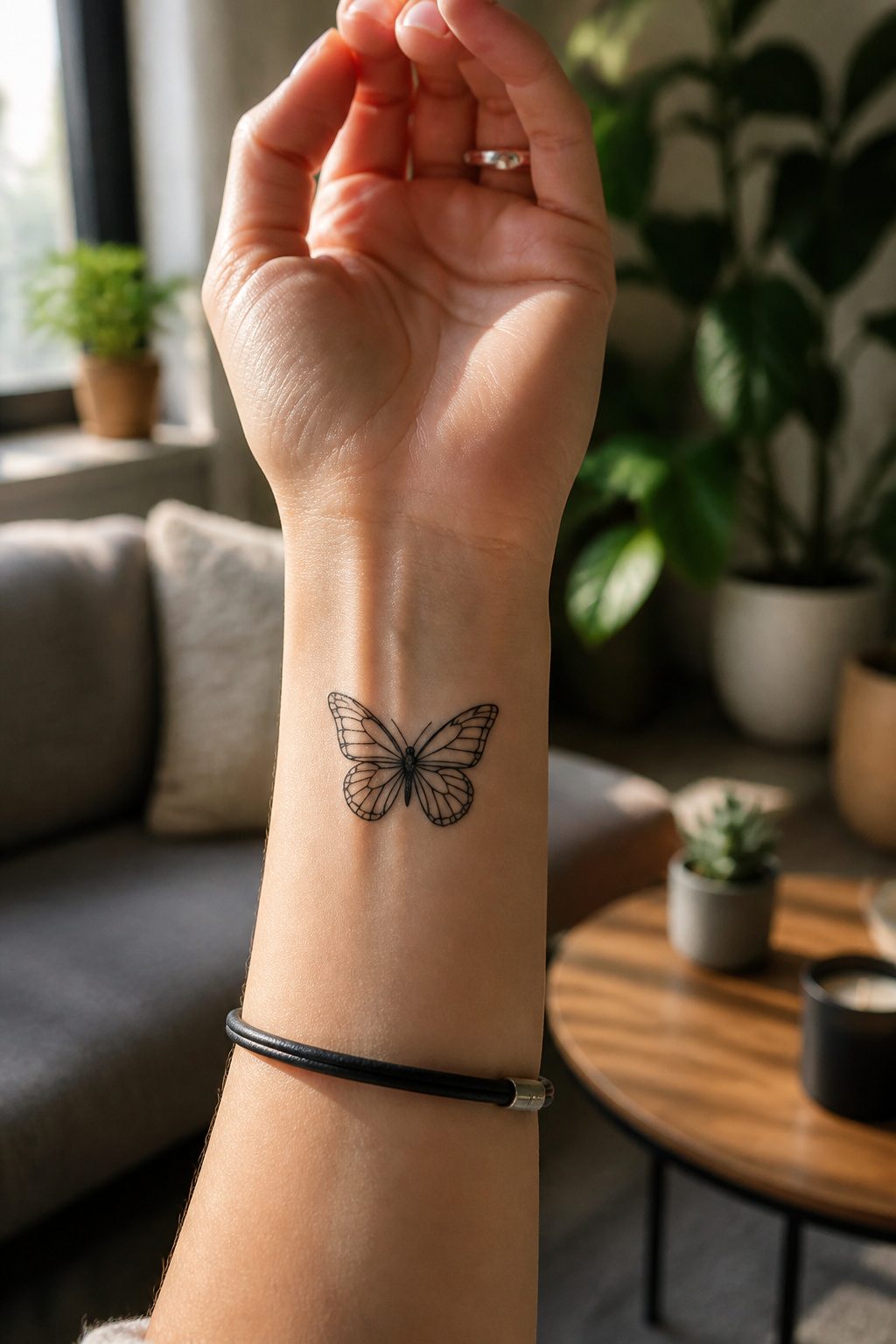
A butterfly ranks among the most requested little tattoo ideas for women, and the staying power makes sense once you sit with it. The shape reads instantly even at a small scale, which matters when you are working with limited canvas. Wrist, ankle, and behind the ear all carry it well; those placements let the wingspan stretch naturally without crowding, and a line-art piece behind the ear can disappear under hair for anyone still deciding how visible they want their ink to be.
The symbol itself carries weight without needing explanation. Transformation and freedom are the meanings most often attached, and clients tend to arrive with a specific season of change in mind rather than choosing it for the aesthetic alone. I have watched this design hold steady across age groups for years, something few other motifs manage. A twenty-three-year-old and a fifty-two-year-old may request the same butterfly outline for entirely different reasons, but both leave with something that does not read as dated or locked to one generation. That cross-age appeal is rarer than shops admit.
2. Heart
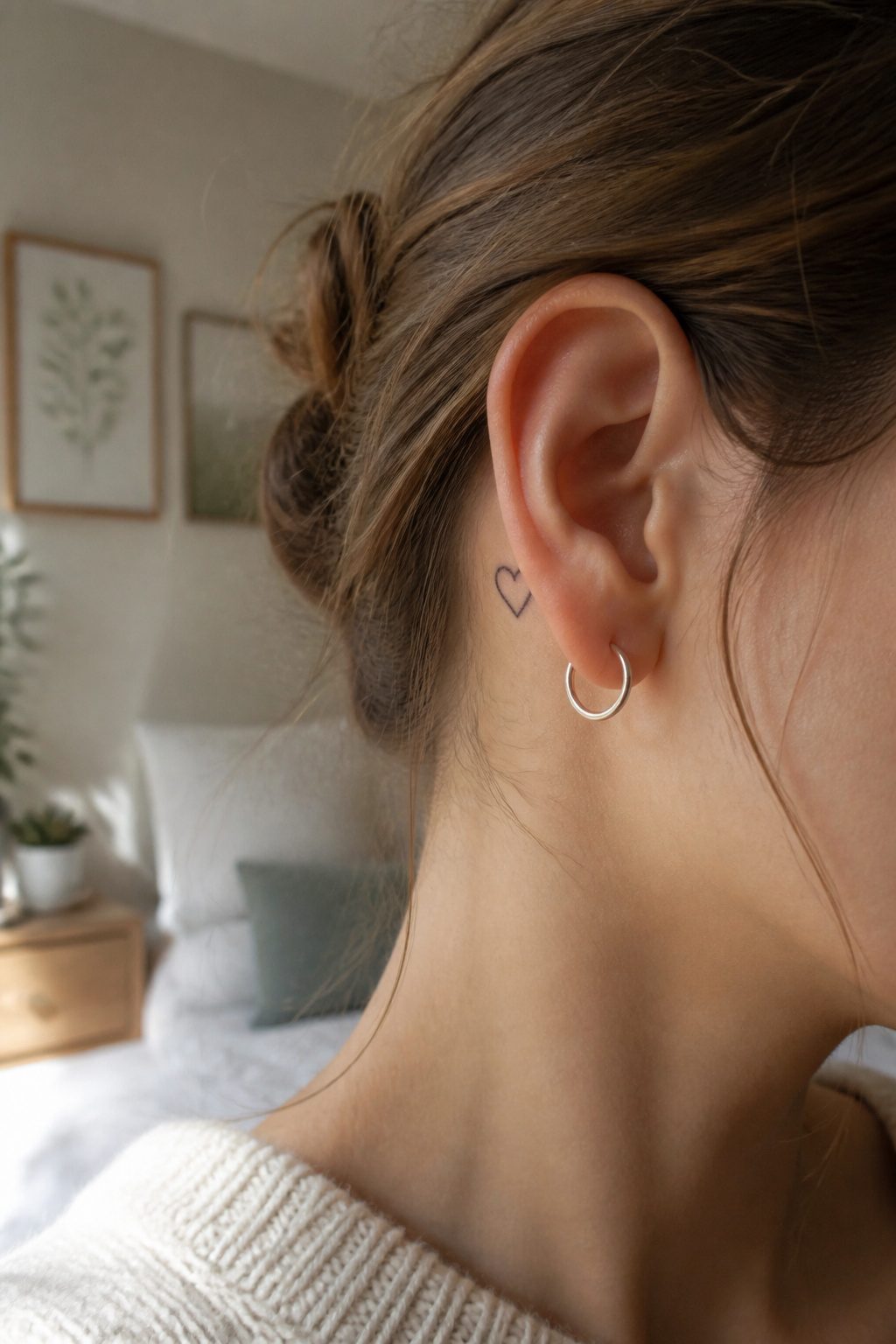
A heart tattoo is still the first shape most artists sketch when someone asks for something small and meaningful. The design carries its own weight; it does not need a name or a date beside it to remind you of someone you love, though plenty of people add one.
What keeps this shape popular is how little it needs to read cleanly. A single-line outline, maybe two centimeters tall, sits perfectly on a finger or behind the ear. Slight variations save it from looking like clip art: a heartbeat line running through it, a tiny crack, or two hearts interlocked. I have seen artists charge the same for a plain heart as for a tiny portrait because the technical work is identical, but the heart heals faster and holds its color longer on spots that move, like the wrist.
Placement follows the same logic as other small tattoos. The finger shows it off but fades sooner from washing hands. The wrist and collarbone last better and still read at a glance. A heart behind the ear stays hidden until you tuck your hair back, which some people prefer.
The meaning is broad enough that you will not explain it twice. Love, grief, a person, a reminder to yourself; the shape covers all of it without asking for detail you might later regret.
3. Flower
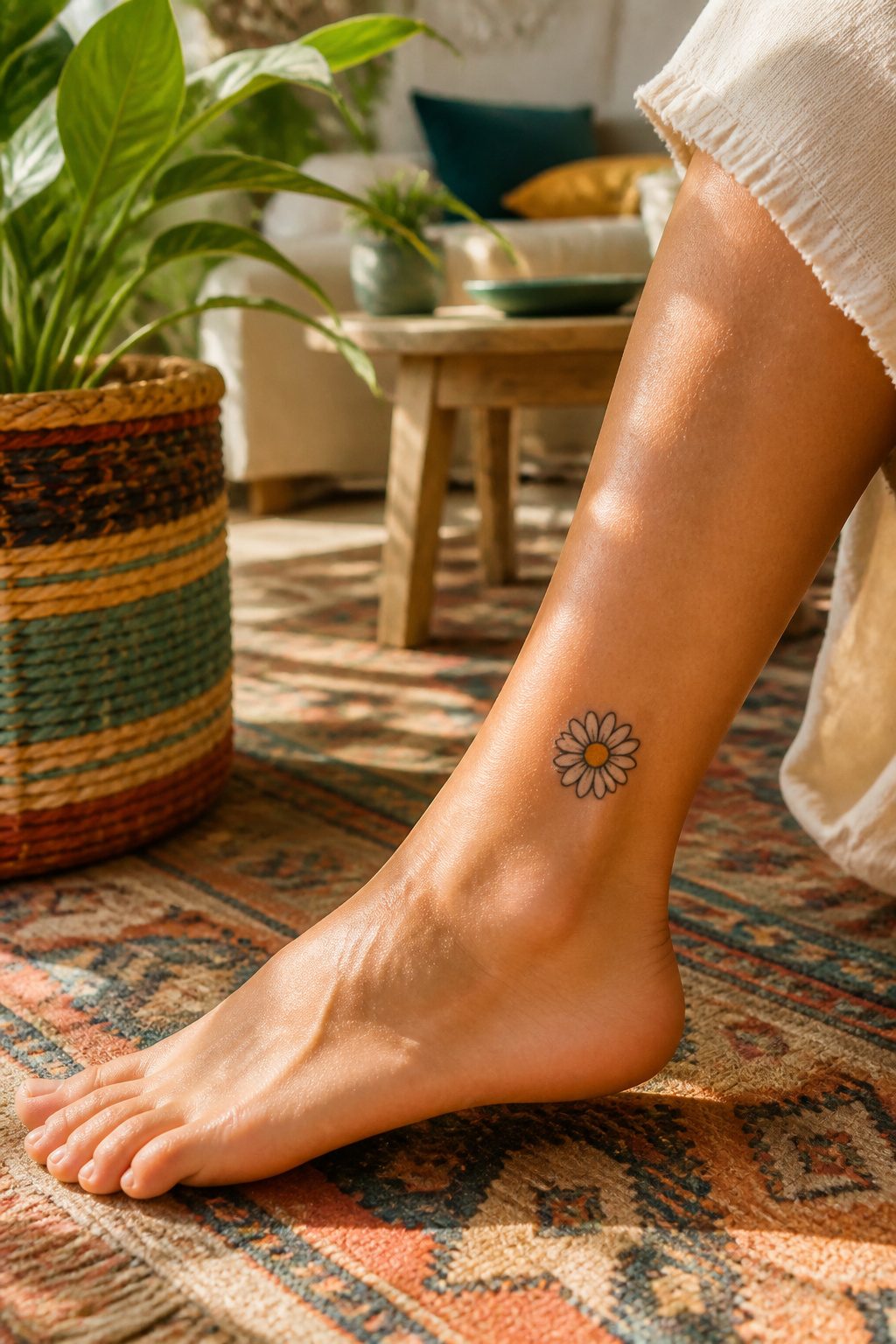
Small flowers translate better to skin than almost any other subject because their real structures already work at reduced scale. A daisy’s radiating petals, a rose’s layered cup, a tulip’s clean bell, each keeps its identity even when the whole design sits under a coin. The meaning shifts with the bloom itself. Cherry blossoms remind you time is short. Roses carry the weight people have given them for centuries. Daisies read lighter, more open. That range lets the tattoo do something personal without requiring extra symbols around it.
The wrist and the ankle are where these designs settle most often. Both spots give the natural line of the stem or the curve of petals a frame that feels intentional rather than squeezed in. A flower’s silhouette, not its shading, is what reads from across the room, and small scale rewards the artist who commits to that single clean outline. Color works if you want it, but the shape does the job alone.
4. Star
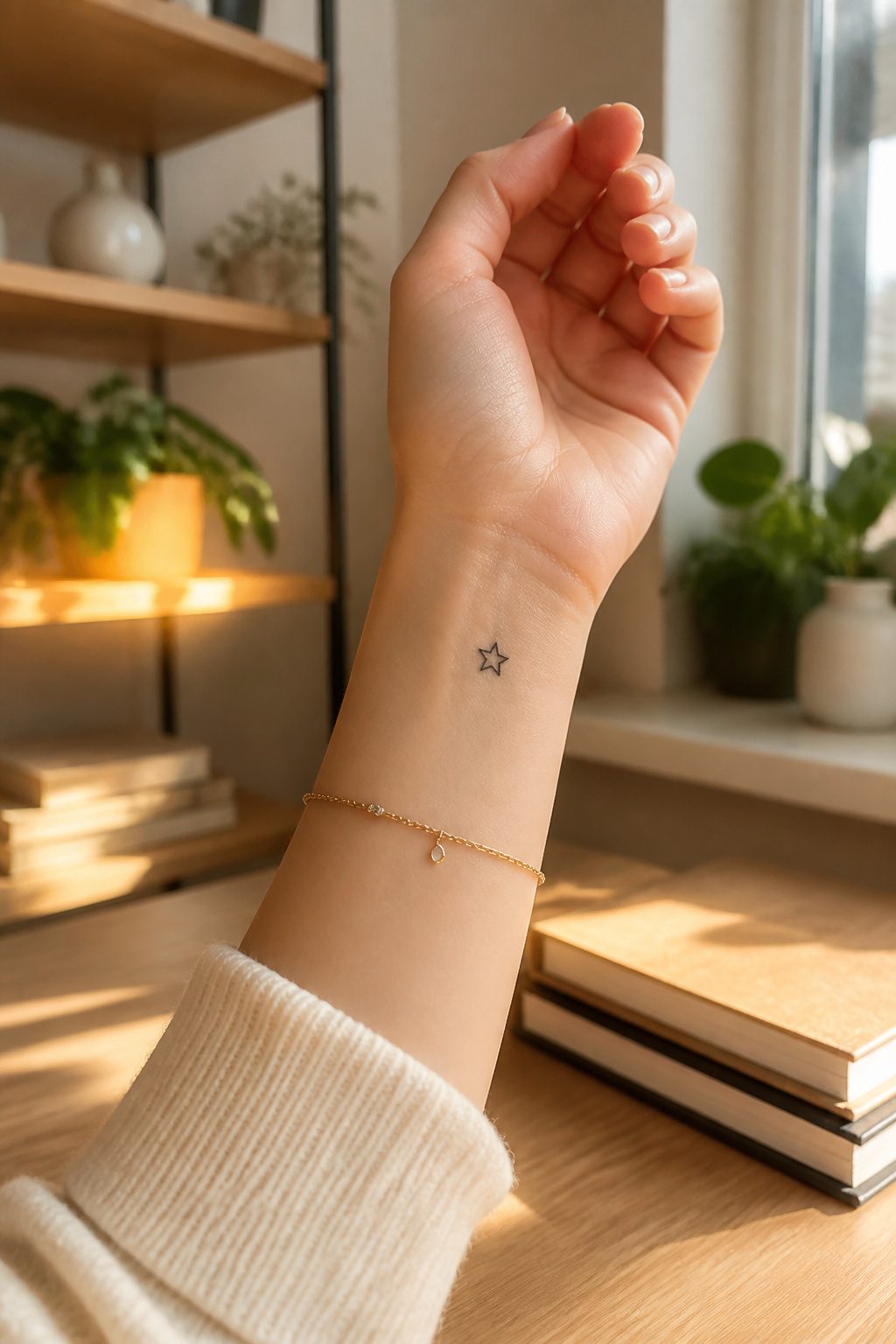
A star is one of the easiest shapes to scale down without losing its meaning, which is why it keeps showing up in books of little tattoo ideas for women. The five points read clearly even at thumbnail size, and the line weight can stay fine without the symbol collapsing into a blur.
The meaning stays flexible in a way that works for private ink. Stars carry wishes, guidance, light, and hope. Some women choose them as a quiet nod to someone watching from above. Others treat the shape as a personal milestone marker, one point per goal met or per year passed.
Placement tends toward the spots where a small tattoo can hide or show in the same motion. The wrist works for quick visibility, the area behind the ear keeps it nearly invisible under hair, and the collarbone frames the shape when a neckline drops. Each location lets the star do its job as a minimal design that still carries weight.
5. Moon
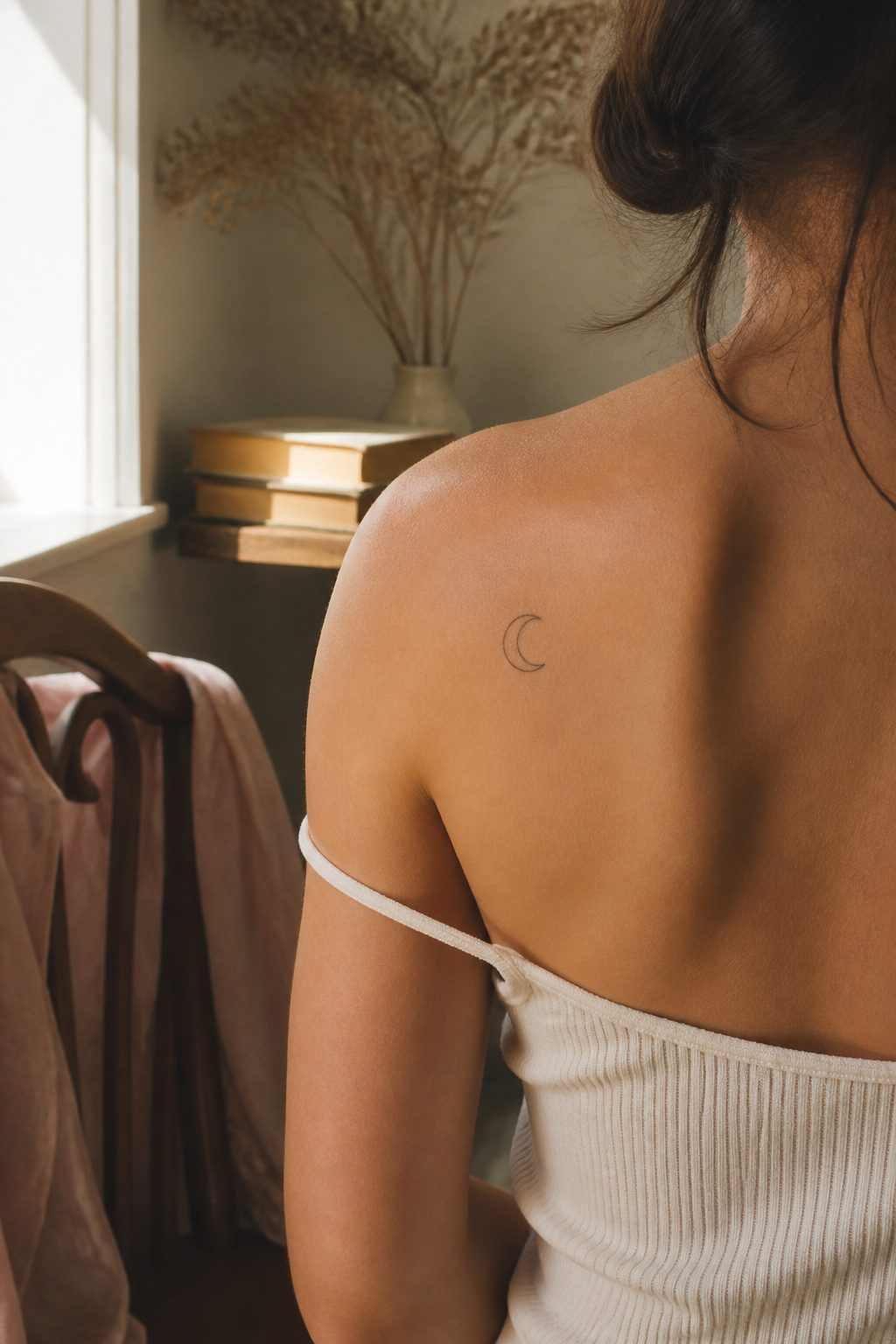
A crescent moon carries more weight at a small scale than a full disk ever could. The thin curve leaves negative space that keeps the line crisp even when the whole thing sits under an inch, and that same openness lets skin breathe through the design so it reads as part of you rather than sitting on top. I have watched clients hesitate between the two shapes, and the ones who choose crescent almost never come back to darken it into something heavier.
The moon works because the meaning stays yours. Change, cycles, the particular month that turned everything around, none of it needs explaining to anyone who sees it. A friend of mine has one tucked just behind her earlobe, visible only when she tucks her hair up, and another placed hers along the inner wrist where she catches it typing. Both placements stay professional without erasing the thing entirely.
The crescent wins for healing too: less ink means the skin closes faster, and the simpler shape holds its geometry where busier designs blur. If you are choosing between meaning and readability at small scale, the moon gives you both without asking you to pick.
6. Quote or Word
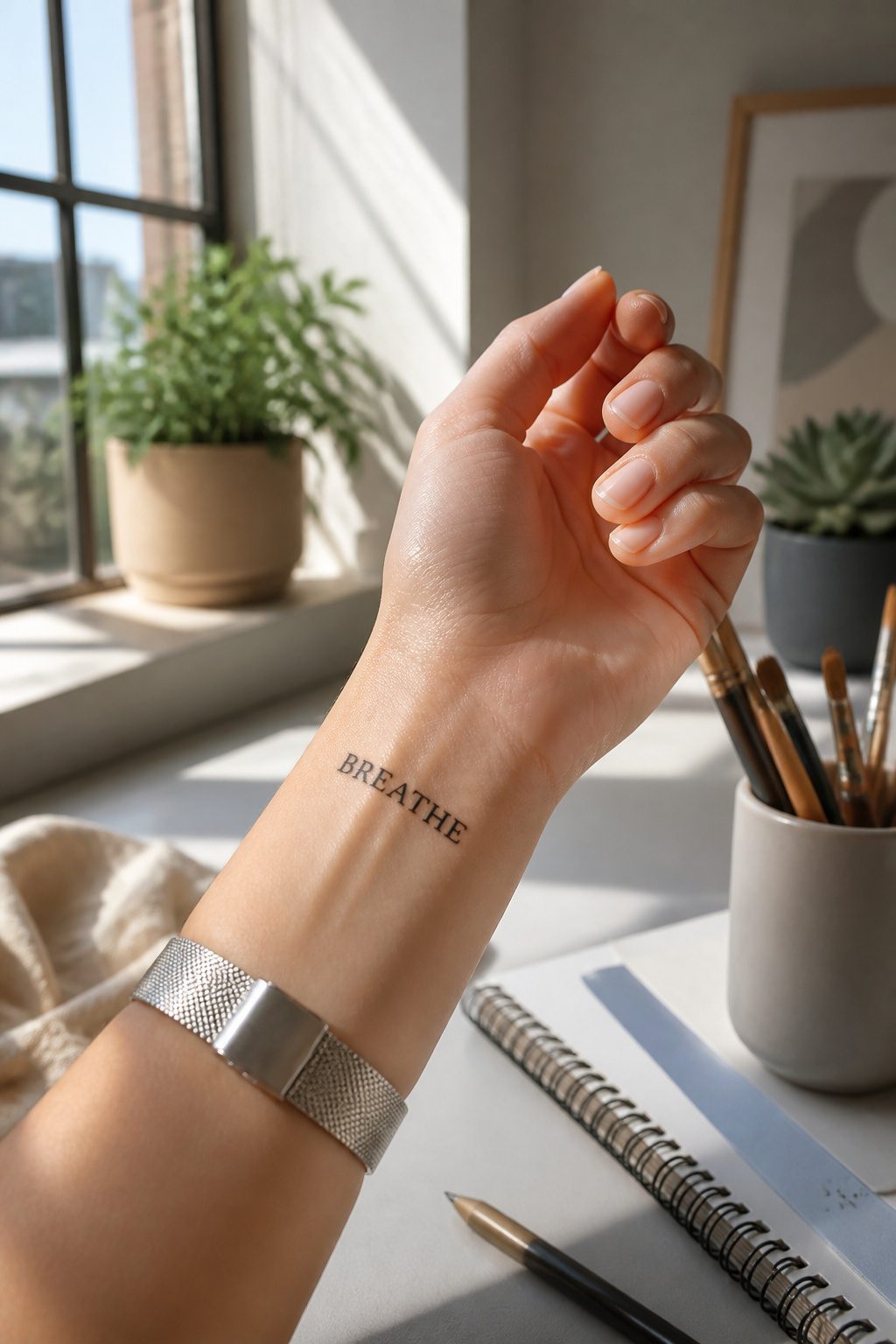
A single word on skin reads cleaner than any phrase. Short words work better because letterforms stay legible at small scale; "breathe," "hope," and "free" each hold their shape without the crowding that turns longer quotes into gray smudges over time.
Font choice matters more than the word itself at this size. Script styles with thin upstrokes blur after a few years, especially below an inch in height. I learned this watching clients return for touch-ups on ribcage pieces where a delicate line had settled into something unreadable. A slightly bolder sans-serif or a clean serif survives the healing process and the decades after.
Placement decides whether the tattoo functions as a private reminder or a daily nudge. The inner wrist puts the word in sight every time you check a phone or reach for a mug. The ribcage hides it under most clothing, which suits a word meant more for the wearer than the viewer. The foot offers a long, flat plane where a horizontal line sits cleanly, though skin there thickens and fades faster than spots closer to the heart.
The line itself needs space to breathe, ironically. A word crammed against bone or joint distorts with movement. Let it rest where the skin stays relatively still.
7. Animal
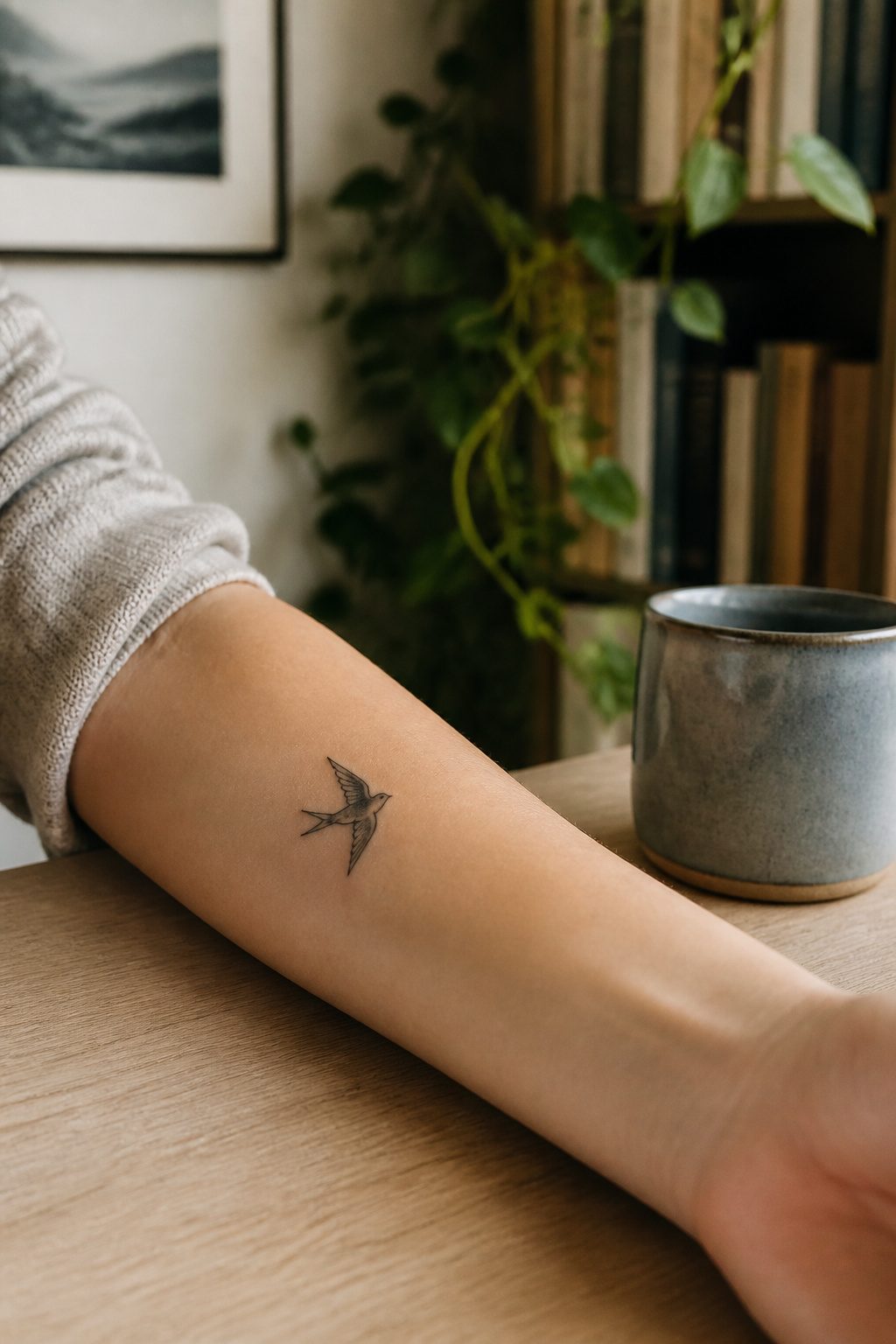
Cats, birds, and butterflies are the animals that survive the shrink to small scale without turning into unrecognizable blobs. A cat silhouette needs only the ear notch and tail curve to read instantly; a swallow in flight keeps its identity with a forked tail and two wing angles. Birds and cats are what artists sketch most often when someone says "small and simple," and for good reason. The shapes carry emotional weight that survives the loss of detail.
The species you pick usually maps to something lived, not just liked. A bird on a wire with three dots beneath it can mark years with someone gone; a single flying bird can mark the moment after. A small cat might be the one that sat on your lap through a hard winter, or just the animal you have always been in company with. Butterflies work because the wing pattern simplifies to a few lines and still signals change, though they read more decorative than the others and carry less specific story weight.
Placement matters for how much narrative you want. A bird circling a wrist invites the eye to travel; the same bird behind an ear hides until you tuck your hair. The smaller the tattoo, the more the placement becomes part of what it says.
8. Symbol
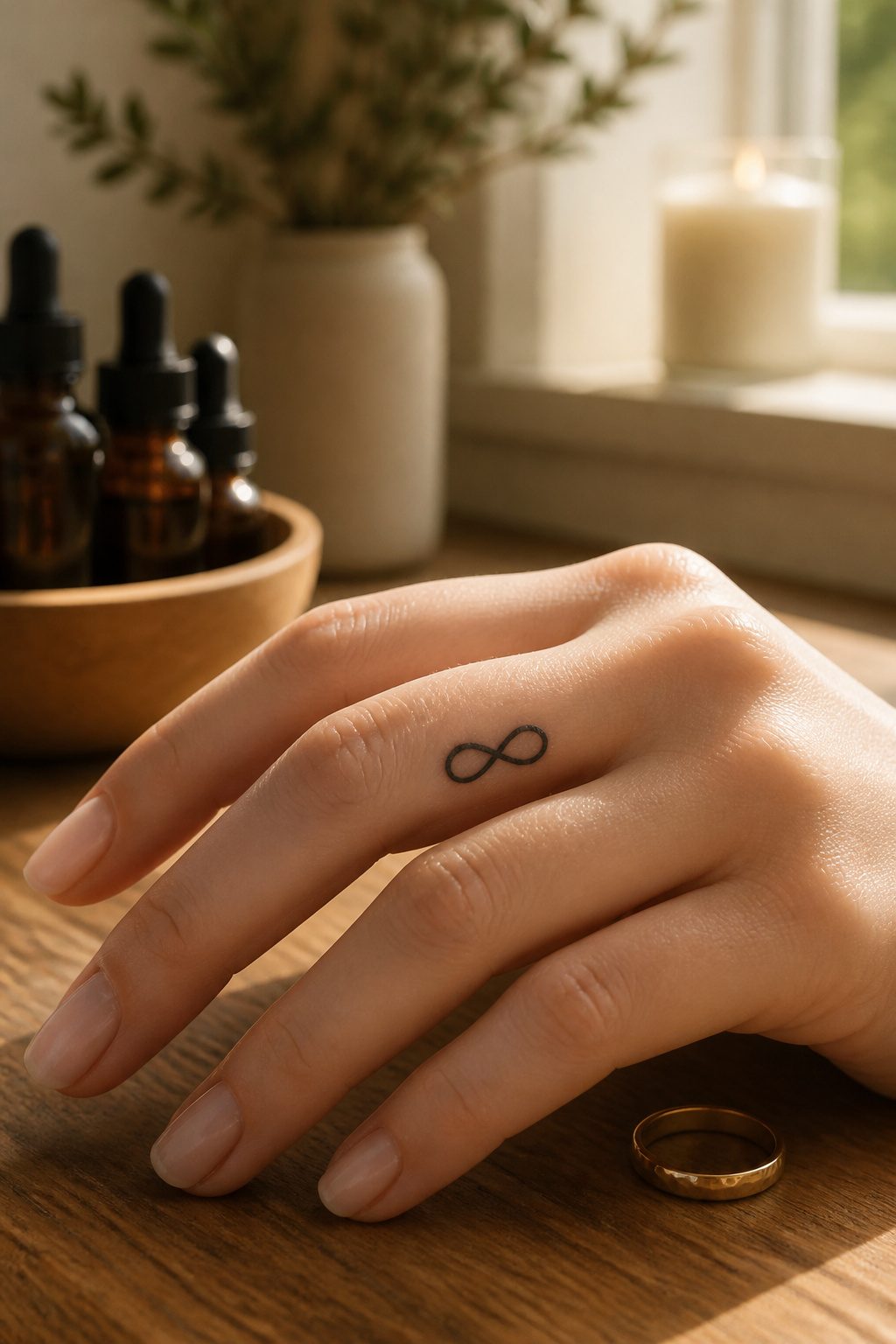
Symbols carry weight without taking up space, which makes them a practical place to start if you are new to tattooing or adding to scattered work. An anchor, an infinity sign, a simple arrow: each one reads instantly from across a room but fits on a finger, the wrist, or behind the ear without fighting for room.
That compact shape matters. A symbol on the inner finger stays almost private, visible mainly to you. The same design behind the ear hides under hair for work and shows when you tuck it back. Wrist placement sits in between: easy to glance at, easy to cover with a watch or bracelet if the situation calls for it.
The infinity sign works this way especially well. It began as mathematical notation, but over time it has picked up the meaning of endless cycles, eternity, a belief held without reservation. That is a lot of meaning for a shape that can be inked small enough to miss if you are not looking for it.
For a first tattoo, symbols let you test the experience, start to finish, without committing a large area of skin. If you plan to build a collection, placement becomes part of the strategy. A symbol tucked behind the ear or on a finger leaves your outer arm free for larger work later, keeping your options open as the collection grows.
9. Celestial Bodies
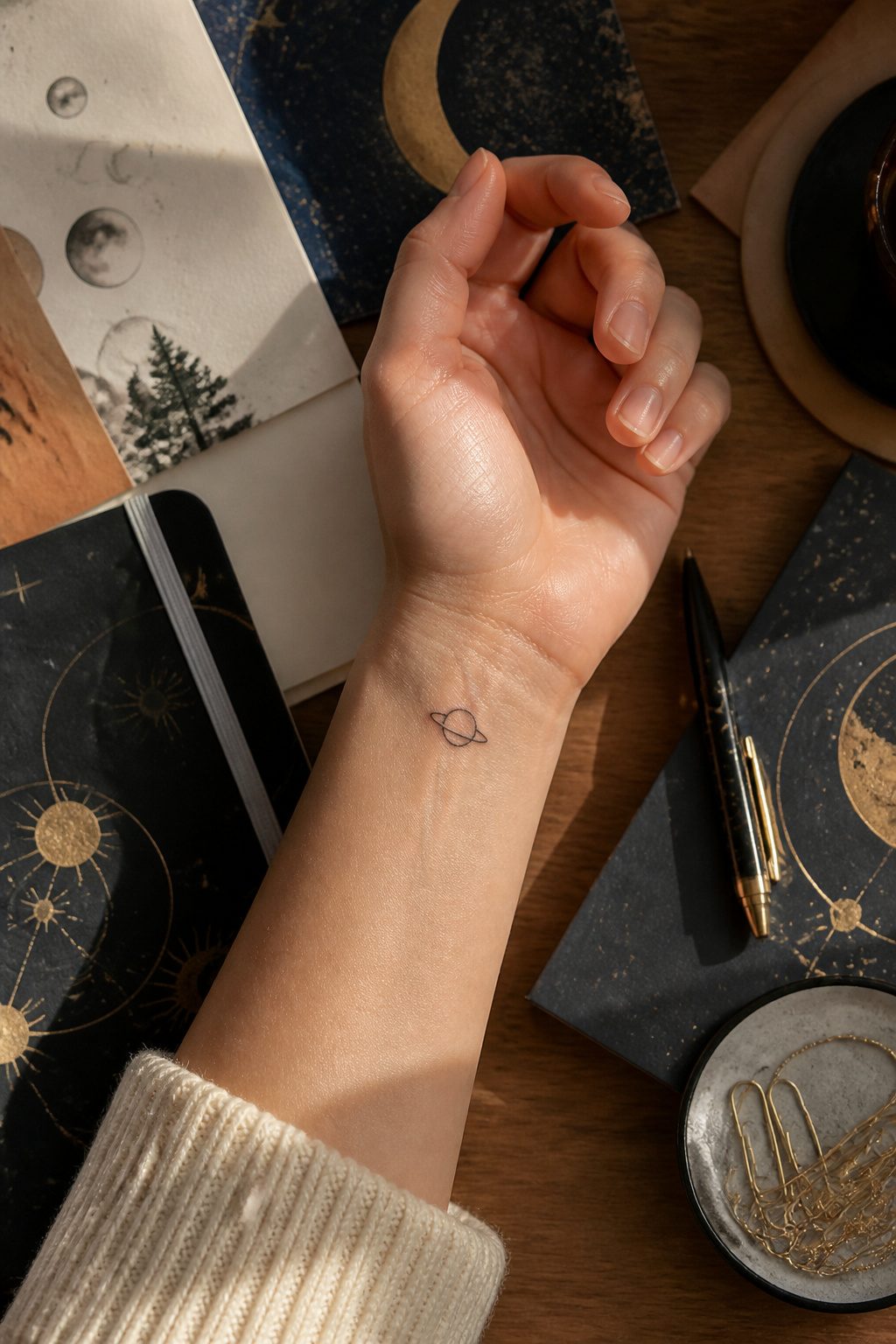
Planets and constellations stretch the celestial category well past the usual sun and moon pairings. A single planet with thin ring lines sits clean on a wrist inner edge, readable at under an inch across. Constellation patterns map naturally to linear placements; Orion’s belt or Cassiopeia’s W shape runs along a collarbone or forearm without fighting the body’s geometry. The dots and connecting strokes stay legible even as they fade, which matters more than people guess at the size. Astrology’s recent mainstream pull has pushed more women toward these designs, though I’d separate the trend from the commitment. A constellation you picked for birth chart reasons still reads as geometry to anyone else, so the meaning holds private even when the placement shows. Saturn and Jupiter both translate to small scale better than you’d expect; the ring detail or a few moons gives the eye something to trace. Linear constellation work tends to age cleaner than clustered star fields, where dots blur together over time.
10. Initials or Names
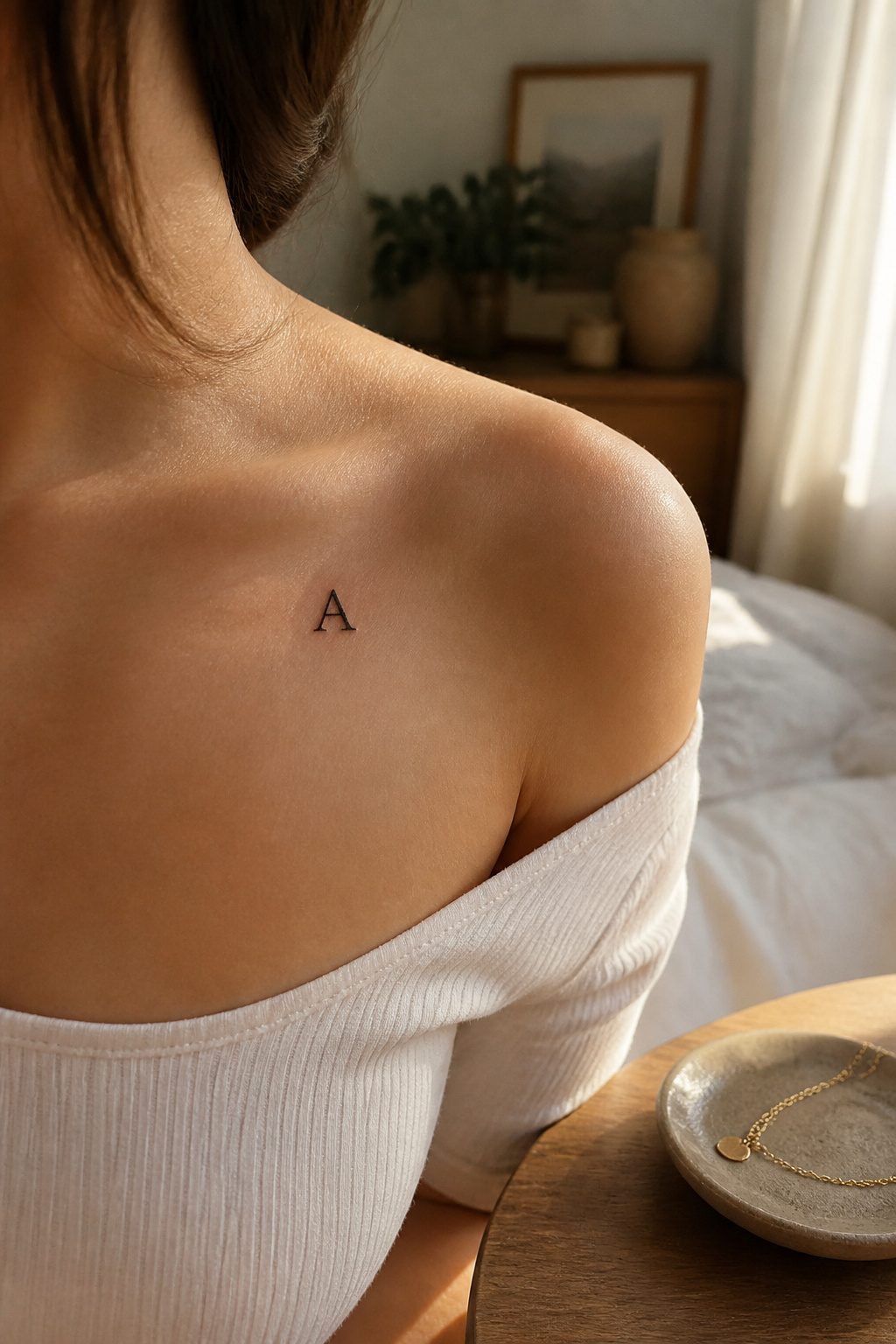
A single initial carries more weight than most small designs because the meaning is already fixed before the needle touches skin. The letter itself does the work. That directness makes initial or name tattoos one of the most common first choices for women stepping into a studio for the first time, and the sources back this: small letters sit in that space where the tattoo feels like a trial run you still keep forever.
The catch is in the script. At small scale, decorative flourishes collapse into blur within a few years. Clean, open lettering with consistent stroke width holds its shape on the wrist, the side of a finger, or over the heart where the skin moves constantly. A thick initial for a loved one reads clearly even at a distance; delicate cursive needs more frequent touch-ups to stay legible.
Placement shapes how the tattoo ages as much as the font does. The wrist and finger are visible, which suits a memorial you want to remember daily. Over the heart keeps the design private, though the chest skin stretches differently and may soften the edges sooner. Matching initials with a best friend, each carrying the other’s first letter paired with a small heart, turns the design into a shared marker without demanding identical placement on both bodies.
11. Matching Tattoos
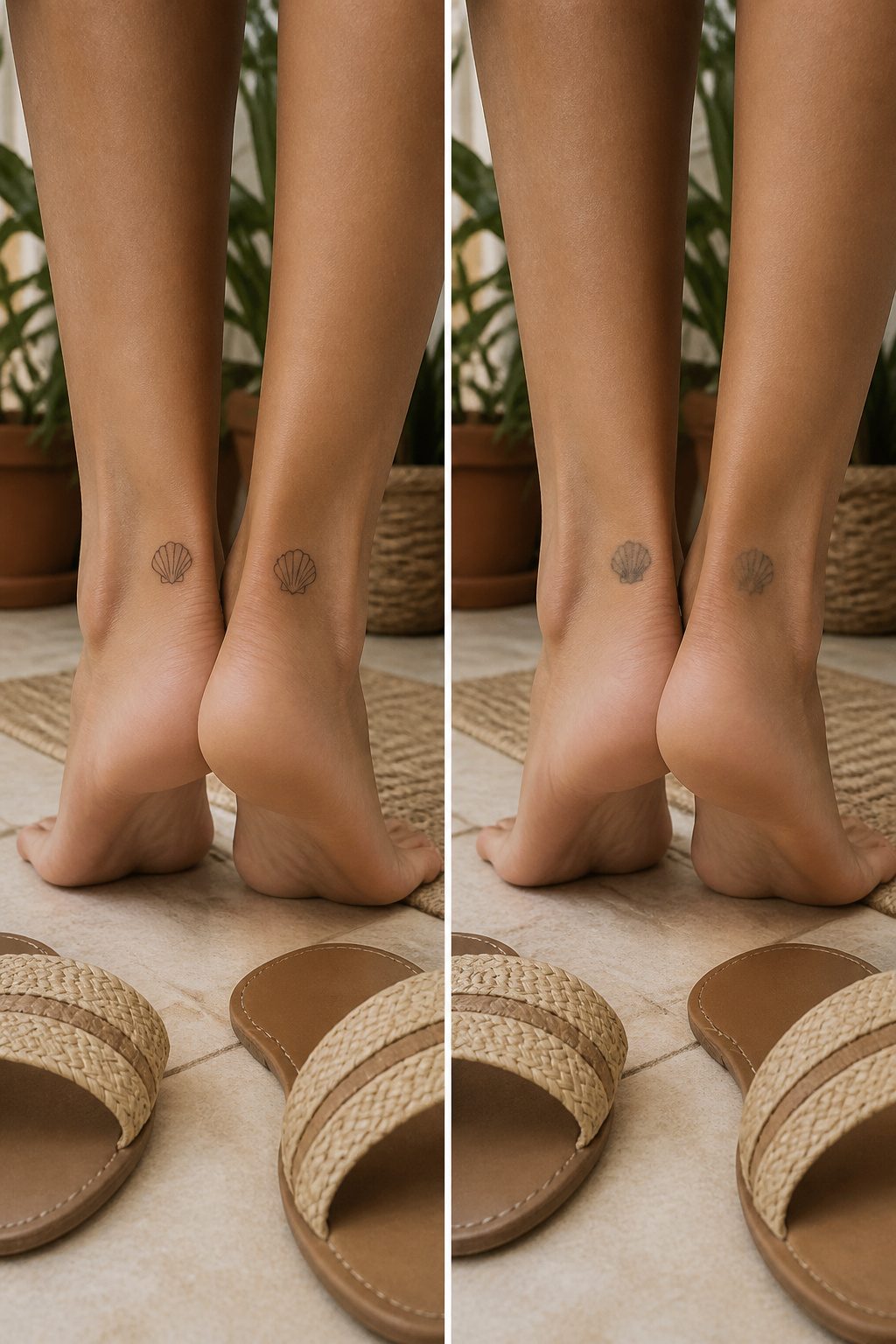
Matching tattoos live or die on the same question: both people have to want the same size and the same visibility. A tiny heart behind the ear works for one woman and vanishes on her partner’s longer hair. The design has to suit two bodies, not one.
Small scale solves this. A 1-inch line drawing, a pair of shells, a single letter, these sit almost anywhere and read the same on different skin tones, different builds. My cousin Mike, who has run shops on both coasts, told me the matching pairs that last are the ones where neither person is carrying the visual weight. One big piece and one small piece stops feeling like a match within a year.
Placement matters more than the image itself. Ribs hide under work clothes. Outer forearms do not. Couples who mismatch here, one showing and one hiding, tend to regret it. Friends usually pick easier spots, ankle or inner wrist, because the commitment is lighter and the cover-up simpler if the friendship shifts.
The image should mean something specific to the two of you, not tattoo culture broadly. Floyd, the artist Who What Wear spoke with, mentioned shells and cowboy boots as favorites. Those work because they carry private reference. A butterfly chosen because it is cute does not survive a breakup.
12. Geometric Shapes
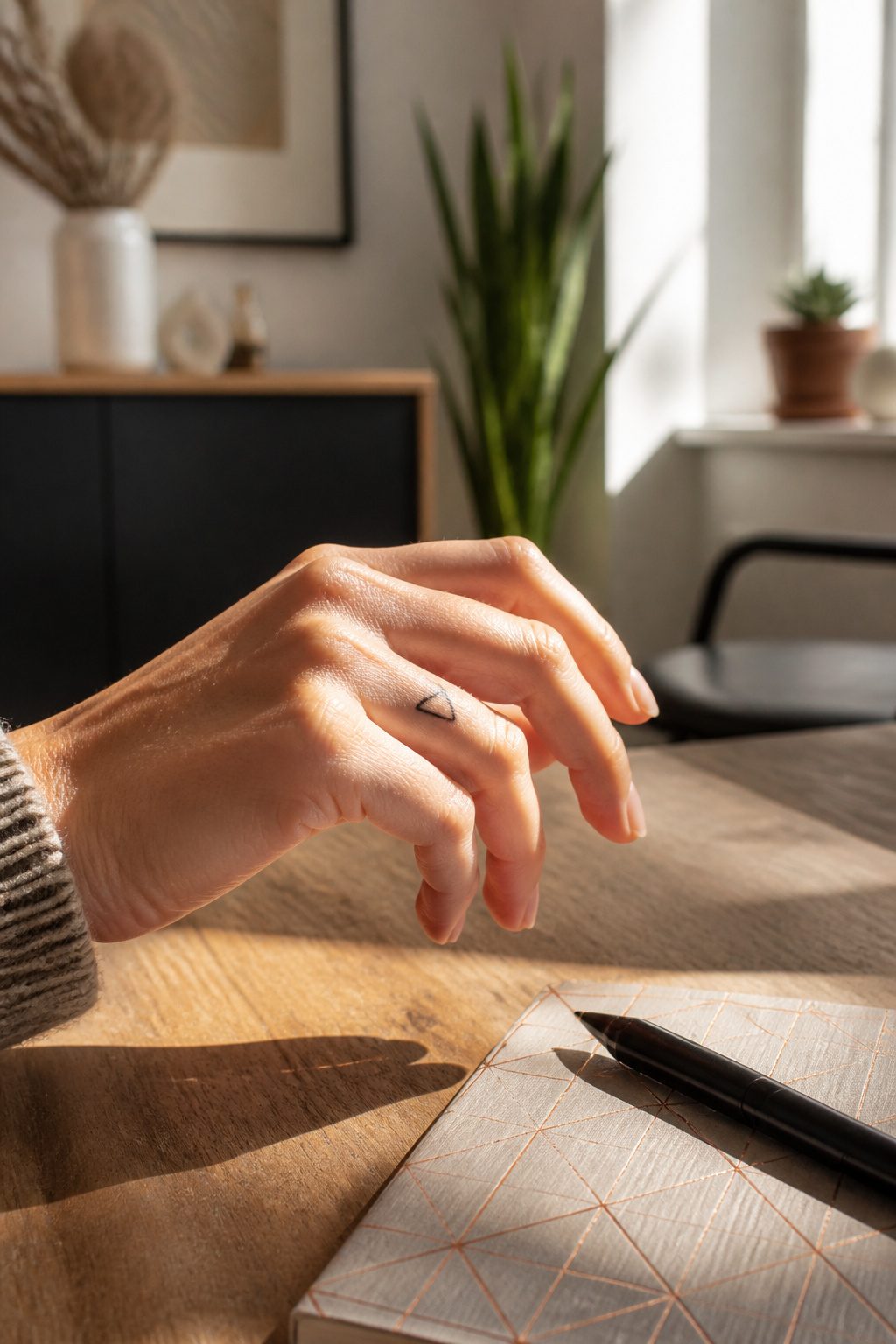
Clean lines and symmetry have a way of feeling finished even at a very small scale, which is why geometric shapes keep showing up in the little tattoo ideas for women I end up recommending. A single triangle, a hexagon nested inside another, or a thin-lined diamond carries its own logic without needing to depict anything recognizable. That abstraction appeals to women who want the design to stay modern and avoid the sentimentality of more obvious symbols.
Fingers and wrists are where these read best. The flat planes and visible bone structure give straight lines something to align against, and a well-placed shape here looks intentional rather than accidental. Circles and triangles tend to age more cleanly than intricate polygons with tight interior angles, since ink spreads slightly over time and can blur detail that looked crisp on day one.
The minimal aesthetic also means less time in the chair and, usually, a lower price point for the session. What draws me to suggesting this style is its flexibility: a geometric shape can stand alone or anchor a later collection if the person decides to build outward.
What These Symbols Mean
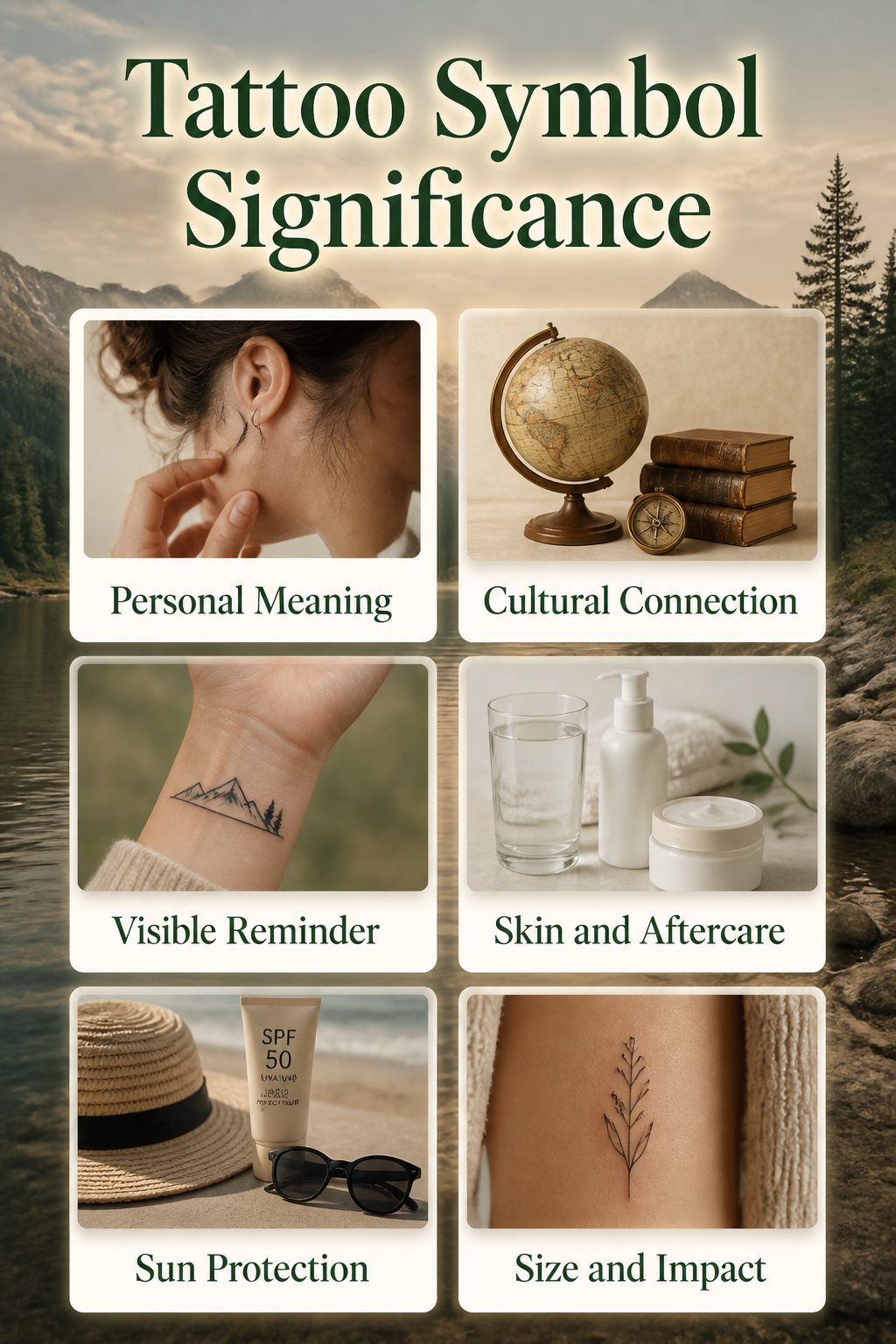
A tiny wishbone on the wrist or behind an ear carries the weight of someone wanting luck they can see. That is the shift that happens when a design moves from pretty to personal: the image becomes a reminder of a choice you made, not just a shape you liked.
I notice this most with women who come in between 35 and 54. They rarely ask what is trending. They ask what a symbol has meant over time, then they match that meaning to a named concern in their own life. Hydration shows up in how they care for skin before and after the appointment. Cleansing matters because they have learned that a fresh tattoo is an open surface. Sun protection becomes part of the conversation before the needle ever touches skin. The tattoo itself is the visible result of a decision already made.
The wishbone is one path. A mountain range drawn from fourteen hours of driving to a grandmother in Montana is another. Both work because the person wearing them can name the moment. A symbol without that named connection tends to fade faster on the skin and in memory. The small size helps here: less space means less room for borrowed meaning, so the design usually arrives already tied to something specific.
Where Small Tattoos Sit Best
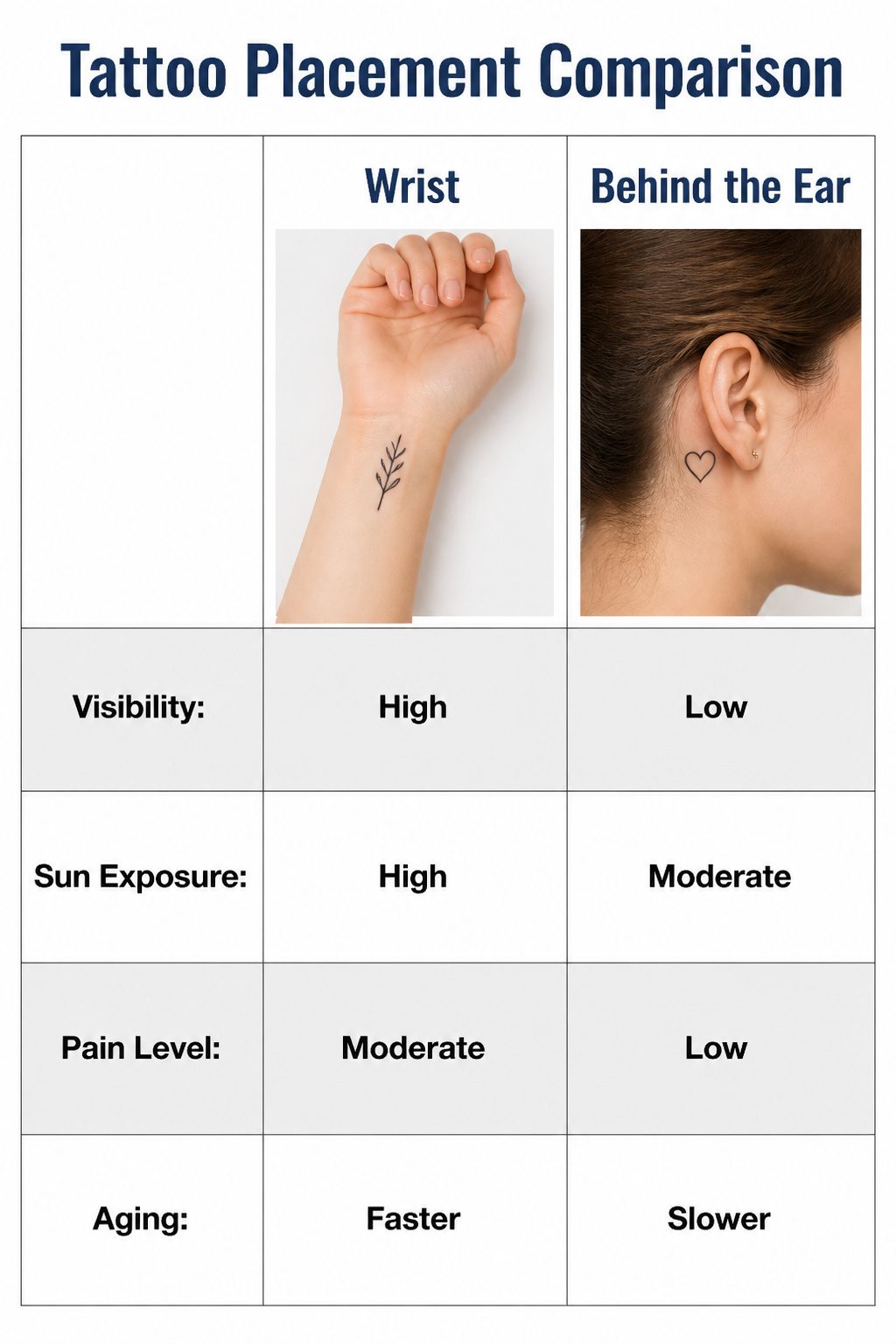
The wrist is the first place most people picture for a little tattoo, and that visibility is exactly why it works or doesn’t. A small design there sits at the end of your sleeve line, seen during handshakes and coffee orders, so the commitment is social as much as physical. What convinced me, reading through a lot of placement advice, is that wrist ink ages faster than spots that stay out of the sun; sunscreen or long sleeves become part of the maintenance.
Behind the ear reads as almost hidden until you sweep your hair up, then it becomes a framed moment. A simple heart back there turns on and off like a switch depending on your hairstyle that day. The skin is thin, so fine line work is the usual choice, but that same thinness means the ink can blur sooner than you’d expect.
Ankle placement carries the opposite logic: easy to cover with a sock or pant cuff, visible when you want it in sandals or at the beach. The bone sits close to the surface there, which some people feel more during the session, though a small tattoo finishes fast enough that this matters less.
Fingers and ring fingers are the boldest semi-hidden choice. A small symbol on a finger is technically concealable by a closed fist, yet it registers as more permanent to the people who notice it because hands are what we watch during conversation. The tradeoff is wear: daily abrasion from keys, handwashing, and typing fades finger tattoos faster than almost anywhere else.
Healing and Daily Care
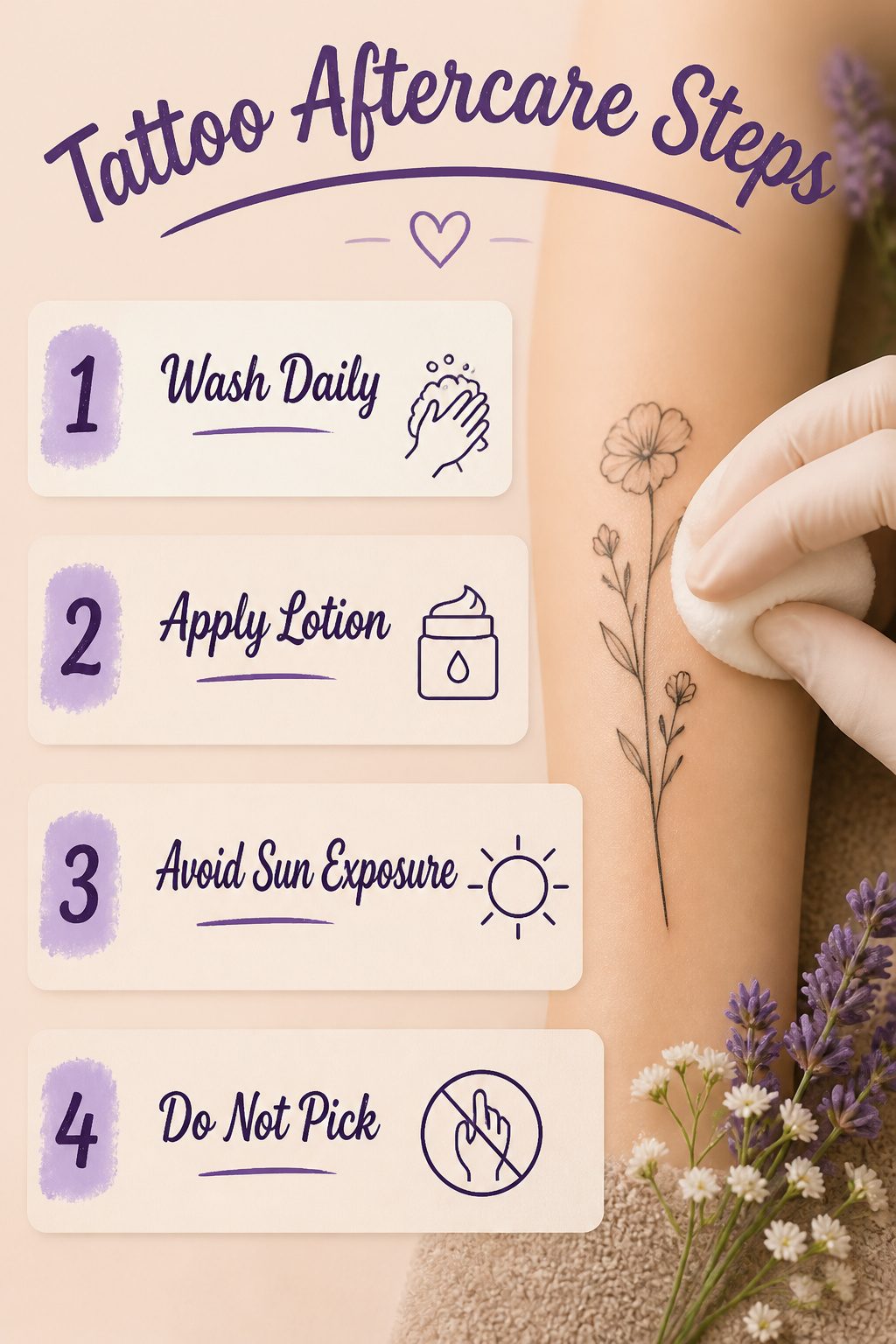
Small tattoos heal faster than larger work, often within a couple of weeks, but that speed can trick you into cutting corners. The skin still passes through the same stages: weeping, scabbing, settling. Skipping aftercare on a one-inch design costs you just as much clarity as it would on a sleeve.
I wash mine with mild soap and water daily, then apply a fragrance-free lotion or ointment. No swimming, no sun exposure for at least two weeks. The scabbing itches, and picking at it feels like it should speed things up, but it pulls pigment out of fine lines that do not have much room to spare.
Sun protection matters more once healing ends. UV breaks down the smaller ink deposits faster, and a faded 2-millimeter line goes from crisp to blob in a way a thick border does not. I keep SPF on mine the way I keep it on my face: daily, re-applied, non-negotiable. The aftercare window is short; the sun is forever.
Micro Versus Mini
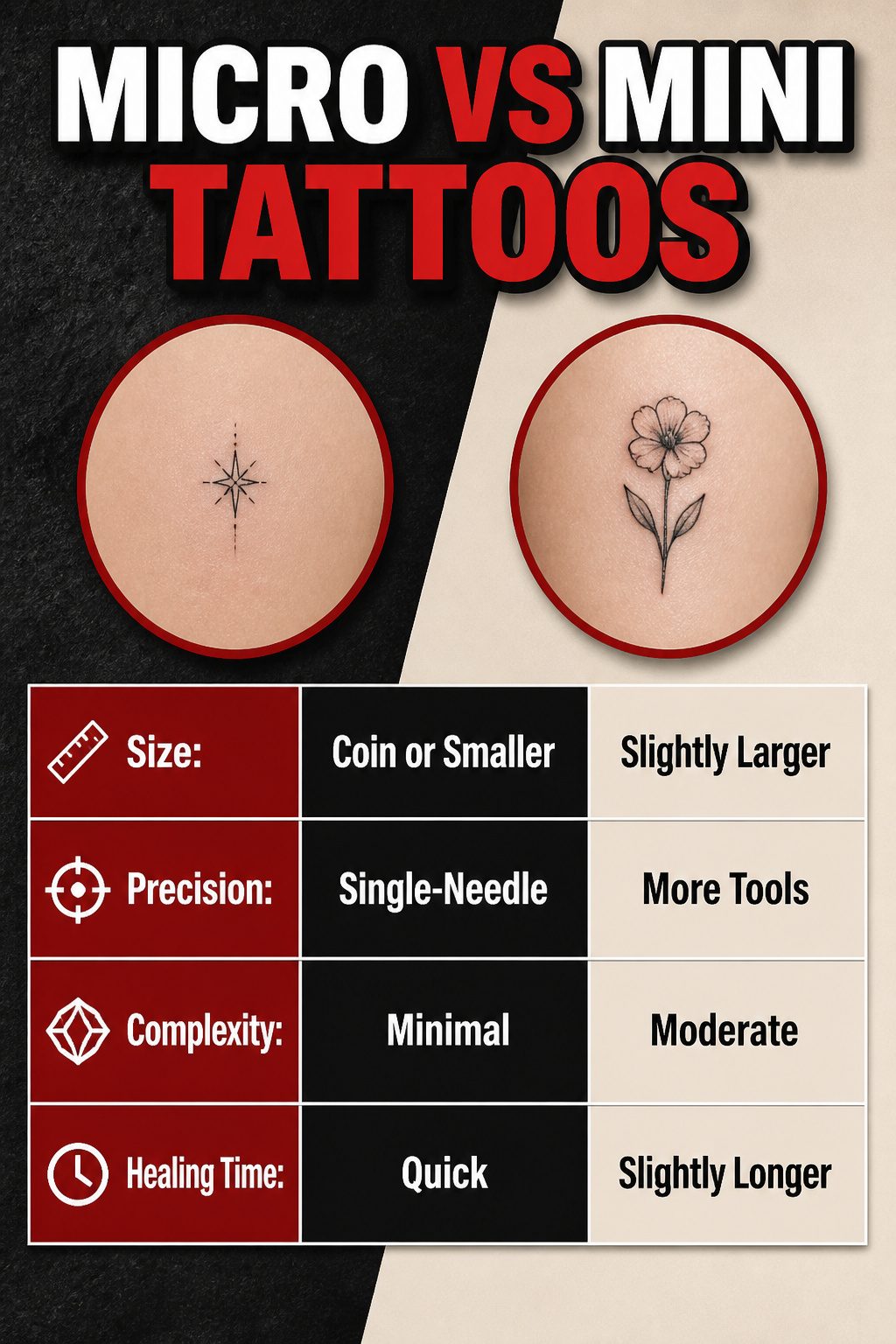
Size categories matter when you book, because the needle work changes. A micro tattoo sits at coin size or smaller and runs on single-needle precision; the artist is essentially drawing with a thread, and the margin for error is basically zero. Lines wander or blow out if the hand shifts even slightly, so the person doing it needs hours logged specifically at that scale, not just general fine-line experience.
Mini tattoos open the frame a little. Think of a small flower or a short word: still compact, but enough surface area for the artist to add a second tone, a whisper of shading, or a hairline detail that would disappear inside a true micro piece. The needle grouping can widen, which usually means steadier saturation and slightly faster healing.
The gap between them is about an eighth of an inch in practice, yet it shapes what you can ask for. Request a portrait of your dog at micro scale and any honest artist will warn you off or scale it up to mini. Bring a mini-sized reference and ask for micro pricing, and the quote will still reflect the tighter labor. Match the level to the design, not the other way around.
Frequently Asked Questions
What are some popular small tattoo ideas?
Butterflies, hearts, flowers, stars, and moons rank among the most requested little tattoo ideas for women. These shapes keep their identity even at reduced scale, and each carries meaning that works without extra explanation. Words or short phrases also hold steady, with "breathe," "hope," and "free" surviving small scale better than longer quotes.
Where is the best place for a small tattoo?
The wrist, ankle, behind the ear, and fingers are the most common placements. Wrist ink sits at your sleeve line and shows during daily interaction, while behind the ear hides under hair until you sweep it up. Ankle tattoos cover easily with socks yet show in sandals, and finger placement registers as more permanent to anyone who notices it.
How do I choose the best small tattoo?
Match the design to something specific in your own life rather than borrowing a trend. A symbol you can name, a flower tied to a person, or a word that marks a particular month will outlast one chosen only for looks. Consider placement next: whether you want daily visibility, easy concealment, or the option to switch between both.
Are there any specific care tips for small tattoos?
Wash daily with mild soap and water, then apply fragrance-free lotion or ointment. Avoid swimming and sun for at least two weeks, and do not pick at scabbing no matter how small the design. Once healed, keep SPF on the tattoo the way you would on your face; UV breaks down fine lines faster than thick borders, and a faded millimeter-wide stroke blurs into a blob.