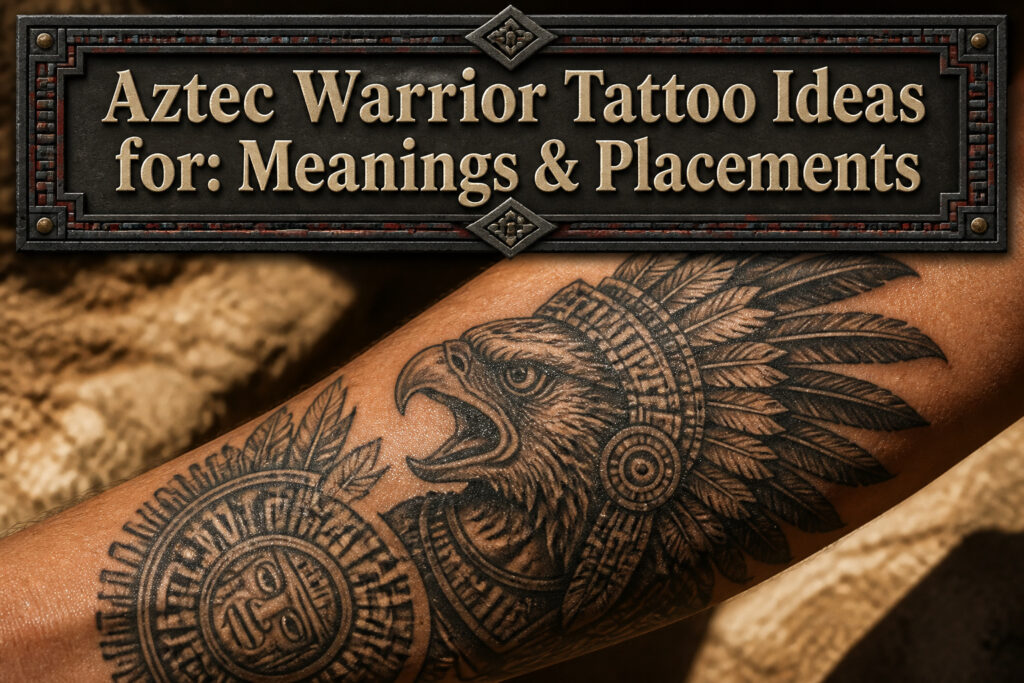
Aztec warrior tattoos range from a single two-inch shield glyph to full back pieces of the feathered serpent, and the deciding factor is usually what the wearer plans to do with the detail. The catch is that feathers are the first thing to muddy as ink ages, while solid black negative space, like the calendar stone’s center face, still reads clearly after years. What separates a meaningful piece from clip art is whether the eagle faces west with its beak open and crown feathers raised, or just looks fierce in any direction.
1. Aztec Eagle Tattoo
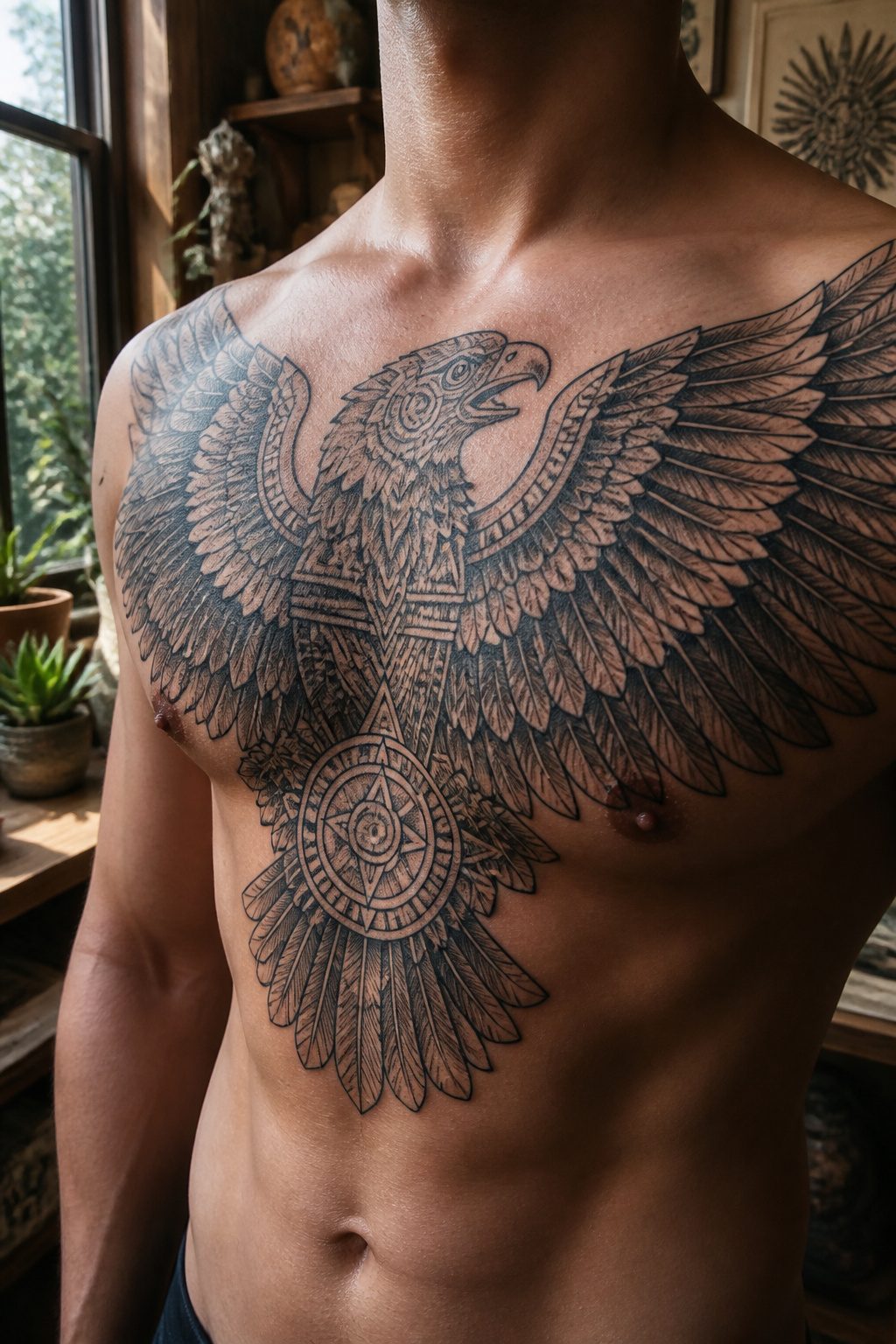
The eagle carried weight in Aztec warrior culture that still translates cleanly to skin. Eagle Warriors made up one of the two elite military orders, and the bird itself stood for power, strength, and courage rather than vague warrior spirit. An authentic rendering faces west with the beak open and feathers raised at the crown, which matters if you want the symbol to read as Aztec rather than generic tribal.
Modern designs usually stretch the wings wide and weave in geometric patterning across the body and feathers. That ethnic look is what separates a meaningful piece from clip art. The eagle pairs naturally with warrior figures in larger compositions, since the sources describe the warrior drawing strength and courage from the bird. Black and grey line work carries these best; the detail gets lost in color.
Placement follows the wingspan. Chest or back gives the outstretched design room to breathe, though arms work for smaller versions. What the 35-54 reader scanning ingredient lists would want to know: the facing direction and feather position are not decorative choices. They are the difference between a symbol with lineage and one that just looks fierce.
2. Aztec Warrior Tattoo
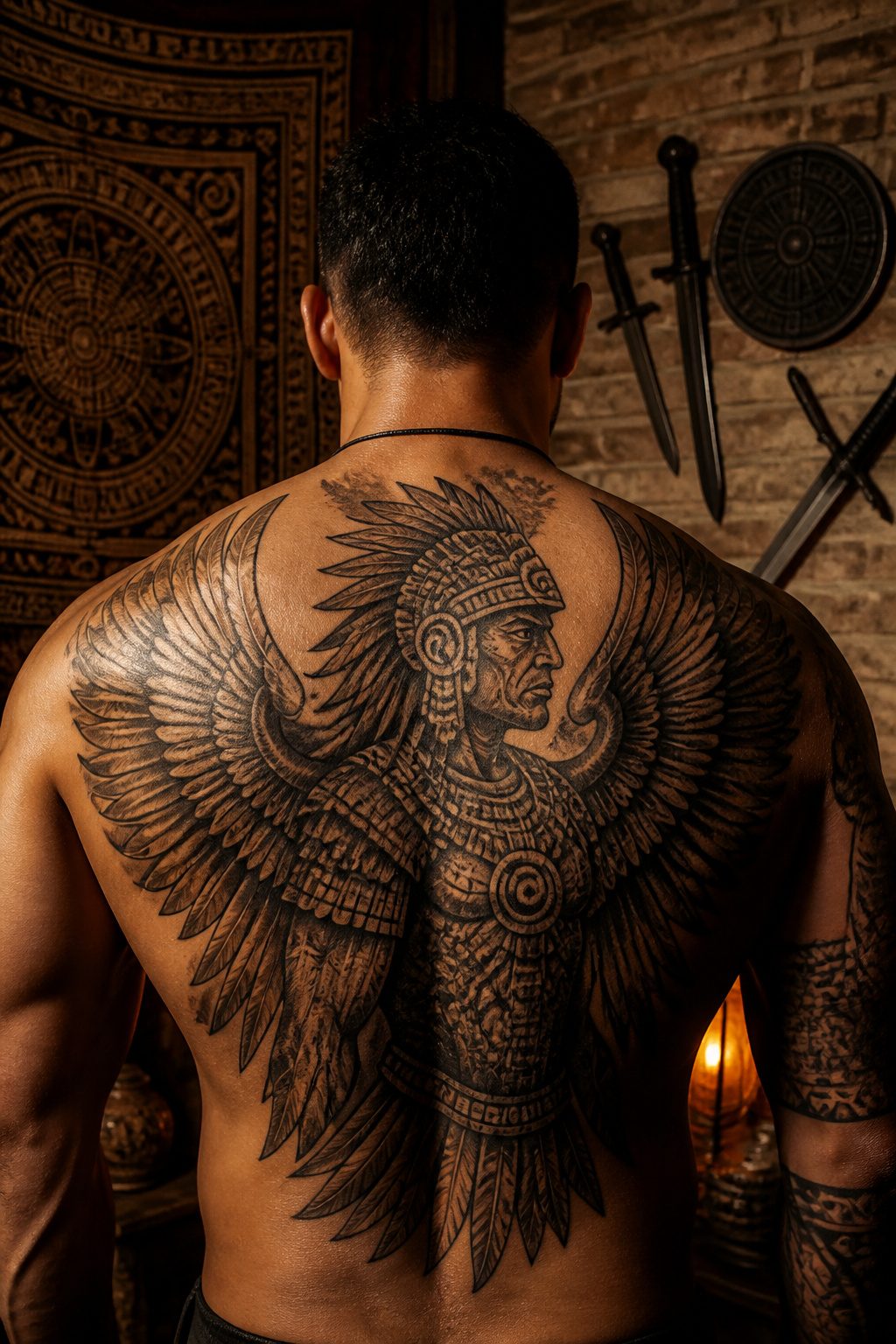
The Aztec warrior ranks among the most direct ways to carry that history on skin. In that society, military power shaped everything; the warrior stood at the center of it. A tattoo drawn from that figure signals courage and strength pressed into ink, not as abstract ideas but as the literal reputation of the society that fielded these fighters.
Eagles threaded through the design tighten the meaning. Sources link eagle imagery to the elite Eagle Warrior class, a military order whose members earned their place through battlefield performance rather than bloodline. The bird does decorative work too, wings stretched wide across a shoulder blade or chest to give the piece motion, but the pairing is never just visual. Warrior plus eagle names a specific identity within Aztec military life, one built on proven courage rather than inherited rank.
Style choices tend toward black and grey work with heavy line weight, the better to read at distance and hold up over years. Some wearers keep the warrior figure minimal, a helmeted profile or shield alone; others build a fuller scene with the eagle worked through the body or background. Either approach works if the artist understands the difference between Aztec-period geometry and the looser tribal patterns that get thrown in by habit. The distinction matters because the eagle’s connection to the Eagle Warriors is specific, not generic, and slurring that into any bird-with-lines design wastes the reference.
3. Aztec Sun Tattoo
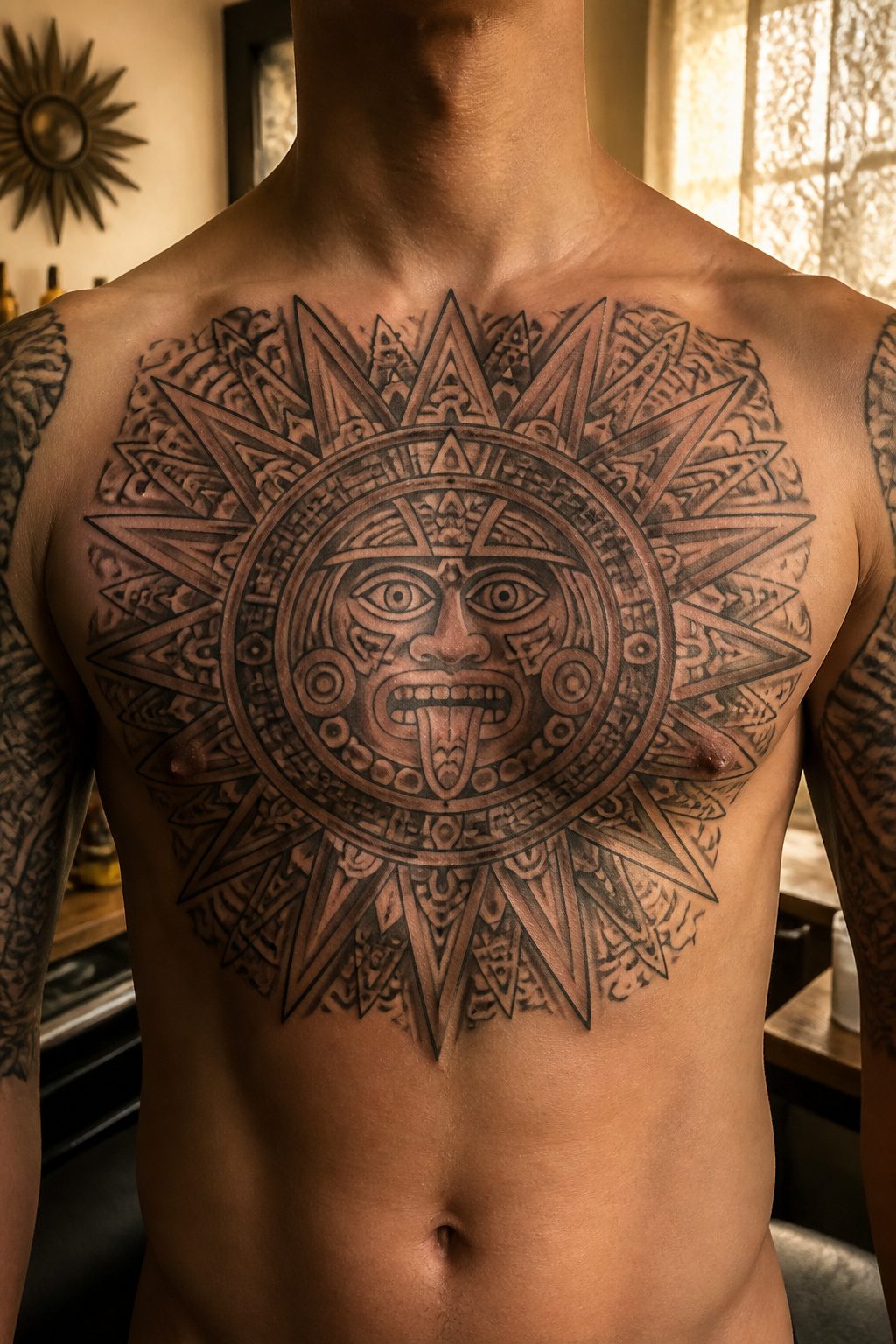
Tonatiuh, the Aztec sun god, was not a gentle source of warmth but a warrior in his own right. The Aztecs believed he made a daily battle across the sky, and that struggle mirrors exactly what people want from an aztec warrior tattoo: the idea that strength is ordinary persistence, not one dramatic moment. The design usually shows the sun’s face with its distinctive tongue or knife, sometimes ringed by the four previous suns the Aztecs said had already died.
The mourning rituals during eclipses tell you how seriously the culture took this cycle. They thought Tonatiuh could actually fail, could die, and that the world would end with him. A sun tattoo then becomes less about victory and more about returning anyway, which is a harder and more honest warrior ideal.
Black and grey line work suits this image best. The geometric rays and the stylized face need precision, and color tends to blur the fine edges that make the design readable from a distance. Chest or upper arm placements work well because the circular shape holds its proportions on broader surfaces.
4. Aztec God of Death Tattoo
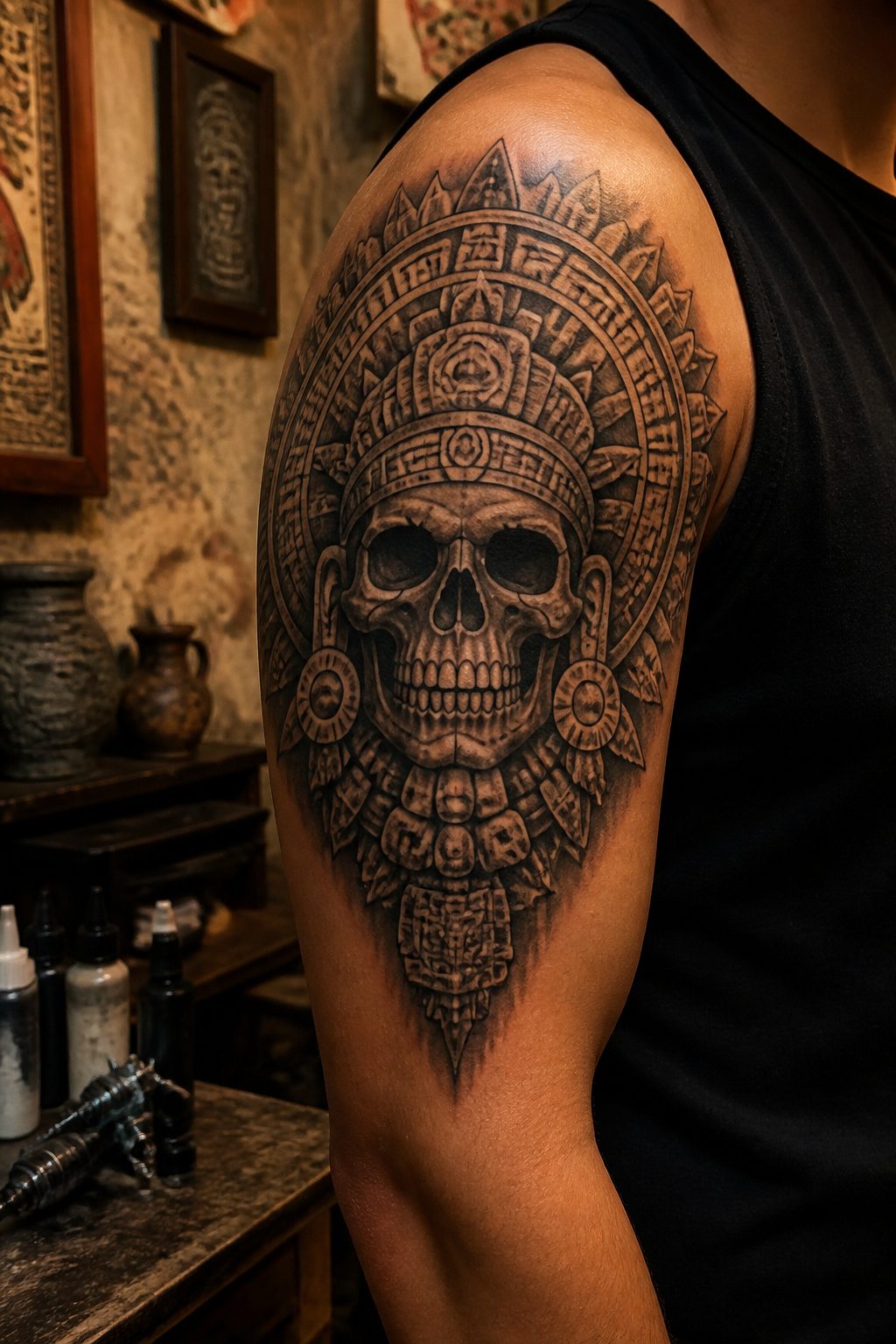
Mictlantecuhtli carries a skull face ringed by sun and calendar motifs, and that pairing is what separates an Aztec death god piece from generic skull work. The circular element above the skull represents the sun, grounding the design in the same life-death cycle that Aztec warriors trained to accept. In their philosophy, facing mortality directly was a source of strength, not despair. A warrior who could look at Mictlantecuhtli without flinching had already conquered the fear that breaks lines in battle.
The black and grey linework typical of Aztec tattooing suits this figure well. The intricate patterns let an artist build shadow into the bone structure while keeping the god recognizable across the upper arm, chest, or back placements where these designs usually sit. I have seen clients hesitate over whether a death deity sends the wrong message. The Aztec reading flips that concern: the skull here denotes regeneration and rebirth, the necessary passage that makes transformation possible. For someone marking a survived hardship or a major life pivot, that meaning lands harder than a more obvious symbol of courage ever could.
5. Aztec Feathered Serpent Tattoo
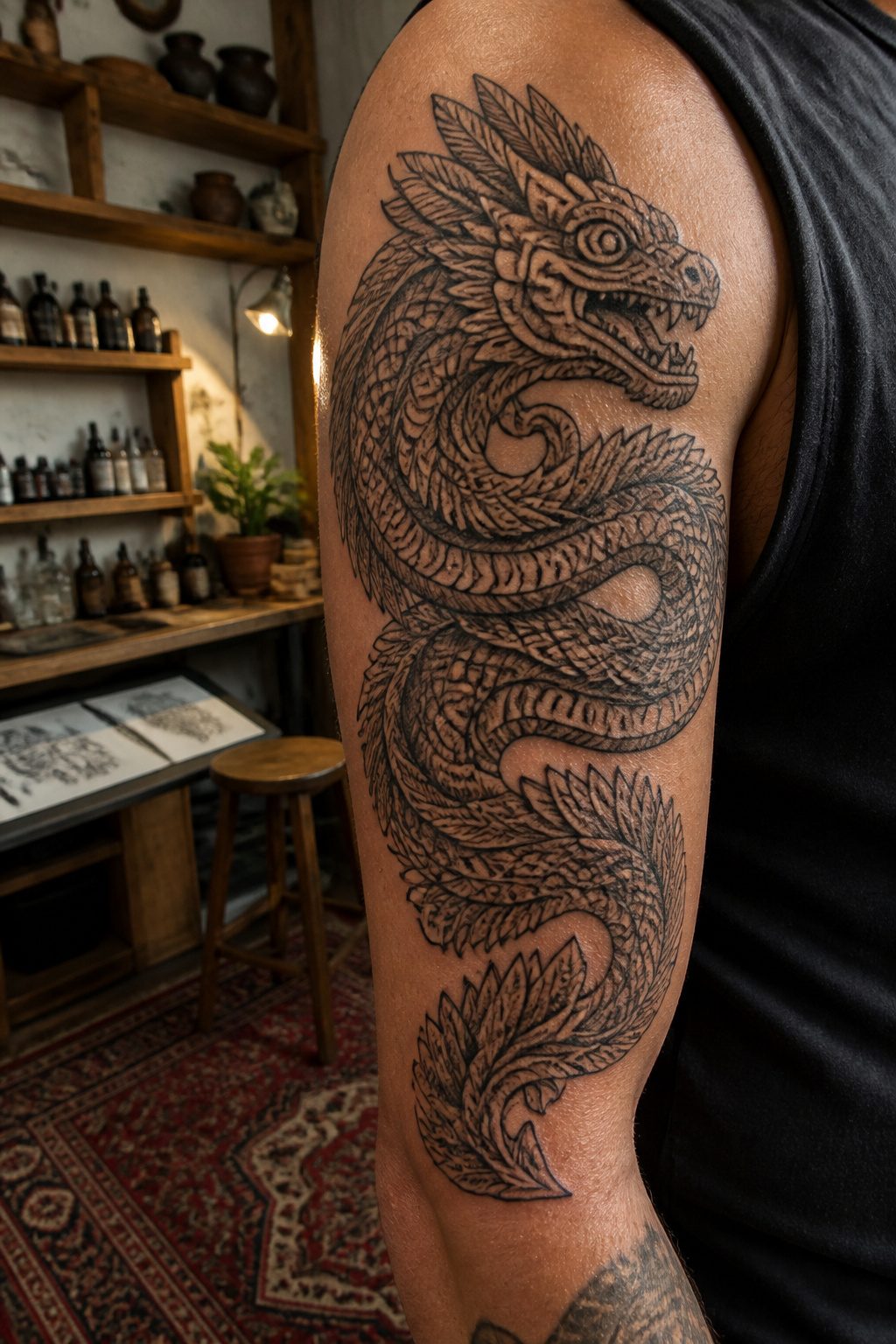
Quetzalcoatl carries a different energy than the war gods most people picture with Aztec warrior tattoos. The feathered serpent was the deity of learning, knowledge, and creativity, the patron of priesthood and fertility. What draws me to this figure for a warrior piece is the way Aztec culture itself refused to split strength from wisdom. Warriors honored Quetzalcoatl alongside Huitzilopochtli because courage without knowledge was considered empty.
The serpent form gives the design its visual power. Coiled muscle reads differently on skin than upright figures; the body suggests movement even in stillness. In the pieces I’ve studied, the feathering is where the artist earns their rate. Scale and plume need distinct weight or the whole image flattens into texture soup. Black and grey work favors the serpent because the coil creates natural shadow pockets, but the feathers demand light. That contrast is the technical puzzle that separates a Quetzalcoatl tattoo from generic snake work.
Placement follows the shape. The upper arm suits the coil well, letting the head turn toward the shoulder or hand depending on whether you want the gaze directed inward or outward. A warrior-themed Quetzalcoatl rarely stands alone; pairing it with eagle elements or calendar borders grounds the spiritual symbolism in the military tradition the wearer is actually invoking.
6. Aztec Skull Tattoo
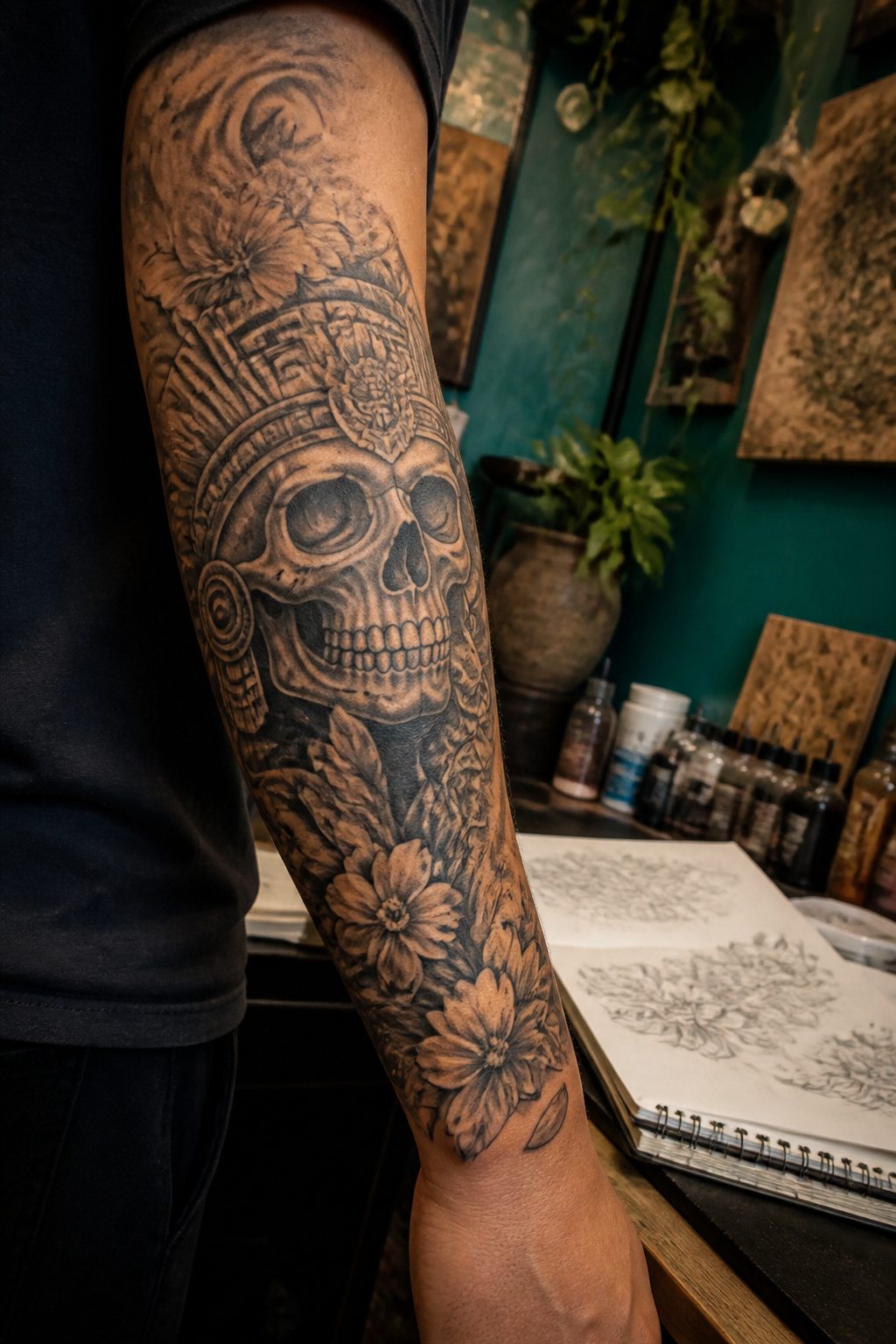
Aztec skull tattoos carry a meaning that runs opposite to what most people expect from skull imagery. Death, in this tradition, feeds life rather than ending it. The skull marks regeneration and rebirth, a belief rooted in the Aztec understanding that destruction clears ground for what comes next.
Warriors who faced death daily lived inside this cycle. The battlefield was not an endpoint but a transformation, and the skull served as a reminder that mortality and renewal are the same thread pulled through different moments. Wearing this design signals resilience, the wearer’s triumph over what broke against them rather than what broke them.
Floral additions soften the piece and add hope to the weight. A neo-traditional rendering with petals or vines keeps the skull’s gravity while opening it toward something gentler. The balance matters: too heavy and it reads as generic darkness, too decorative and the meaning thins out.
7. Aztec Crocodile Tattoo
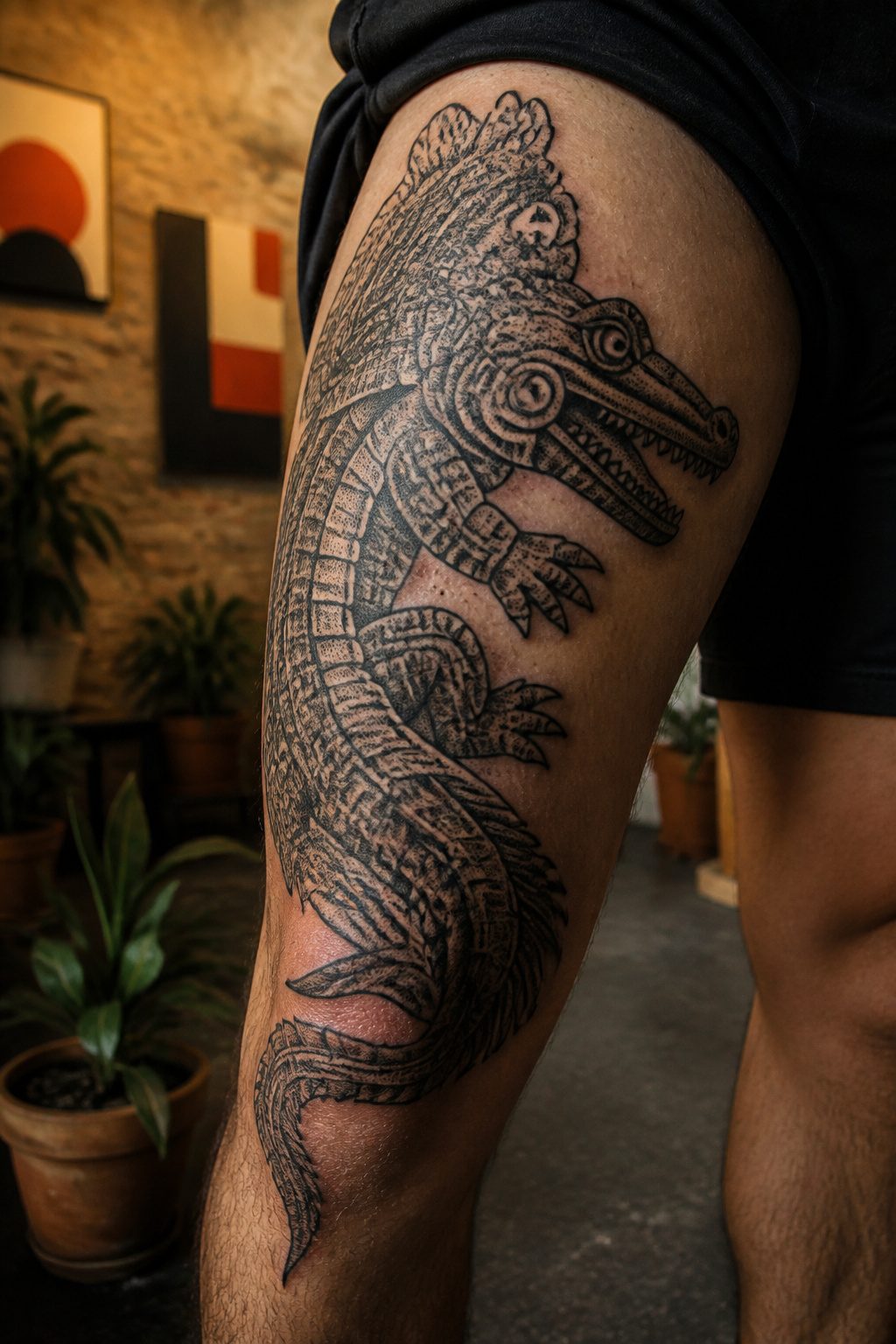
The crocodile in Aztec belief was no ordinary animal. Cipactli, as they called it, carried the weight of creation itself: a creature part toad, part fish, part crocodile, whose body became the earth. This was the foundation the world rested on, and warriors who drew cipactli onto their skin were claiming that same foundational strength.
Creation myths were not decorative stories for the Aztec military class. They were practical sources of identity, a way to root personal courage in something older and larger than the individual fighter. A warrior marked with cipactli wore the symbol of the first earth, the raw material from which everything else was made.
The design tends to work best at scale, where the hybrid features have room to breathe. Without enough space, the toad-fish-crocodile blend collapses into something generic that could pass for any reptile. The back, the thigh, or the full upper arm give the artist room to keep those three natures distinct.
Placement matters less than clarity of form. A cipactli that reads as crocodile alone misses what made it worth wearing in the first place.
8. Aztec Pyramid Tattoo
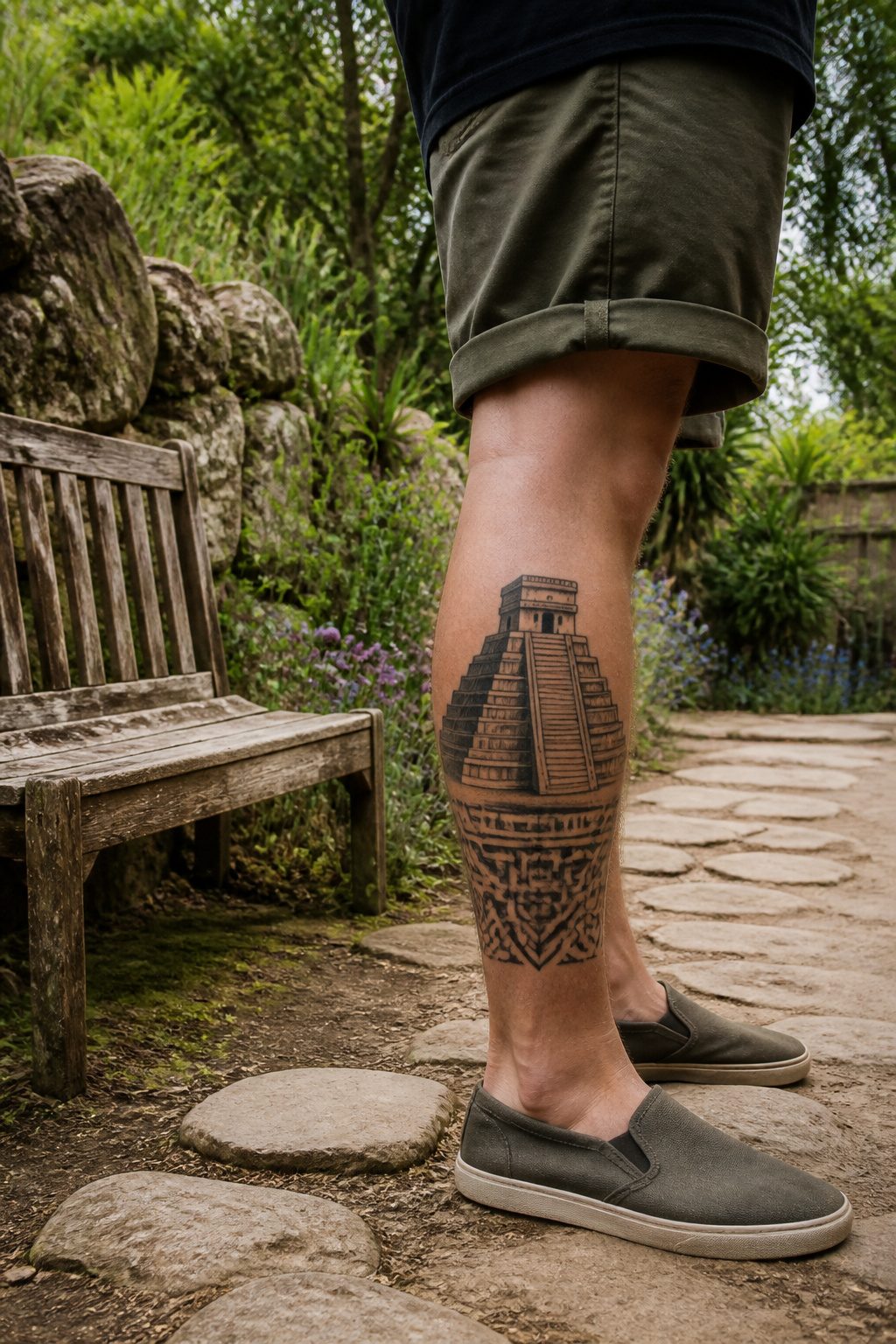
A stepped pyramid with a temple crown reads differently than a flat geometric design, and that difference matters for anyone tracing warrior lineage through ink. The stairs and summit mark the place where young Aztec men underwent initiation rites, not merely a monument to admire. Sources describe these structures as representing mountains, fertility, and the literal homes of ancestors, so the architecture already carries dual weight: agricultural blessing and genealogical claim.
The headdress-like element topping many pyramid tattoos references the sun, tying the wearer to the same celestial force that validated military campaigns. Temples hosted ceremonies before warriors marched; to wear the building itself is to wear the moment of transformation from civilian to fighter. Placement choices should respect that verticality. A forearm or calf gives the stairs room to read as ascent rather than compressed decoration. Too small, and the steps blur into stripes; too large without structural backing, and the temple floats anchorless on the skin.
9. Aztec Snake Tattoo
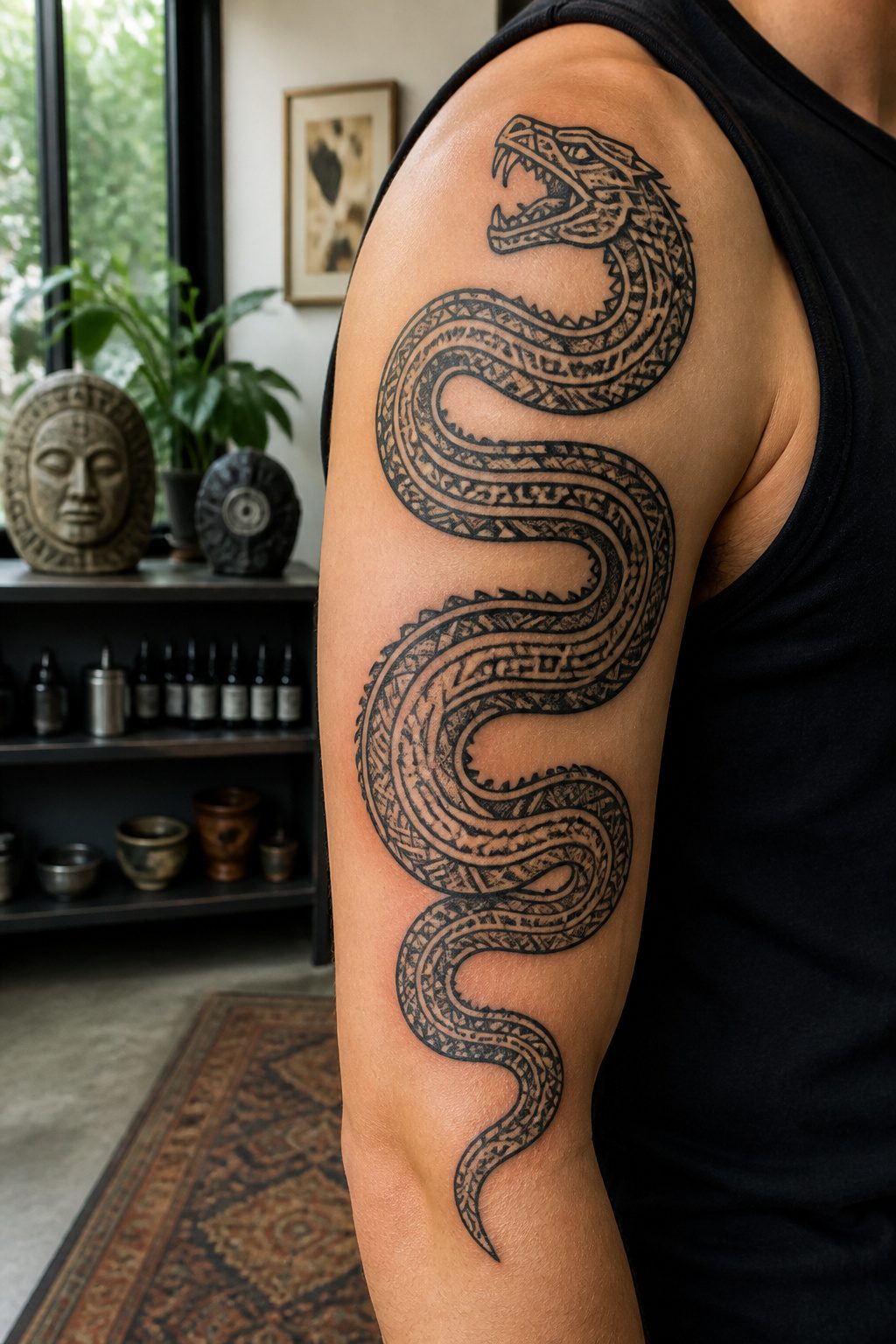
The serpent in Aztec work carries a heavier load than most animal symbols manage. It stands for creation and destruction both, and for the transformation that comes after. That three-part meaning is what makes it fit a warrior’s path so precisely: the destruction of combat, the creation of a new self through it, and finally the honored status earned by surviving.
A coiled serpent on the upper arm reads as active power rather than passive decoration. The triangular elements framing the head give it an aggressive geometry that sits well with muscle structure there. Intricate patterning around the body of the snake keeps the eye moving, which matters at the scale most people want: large enough to read across a room, detailed enough to reward closer inspection.
The warrior’s own passage through destruction into honored status mirrors the snake’s cycle directly. Where eagle imagery speaks to aspiration and solar fire, the serpent grounds the story in earned change. Placement matters for this reading. Upper arm or outer thigh carries the narrative of struggle and emergence better than a flat canvas area like the chest center, where the coil loses its tension.
Color is a choice the sources leave open. The black-and-grey approach keeps the geometry sharp; earth reds and stone ochres pull the historical register without softening the image. Either works, but the decision should follow whether the wearer wants the symbol to read as personal ordeal or as cultural continuity.
10. Aztec Princess Tattoo
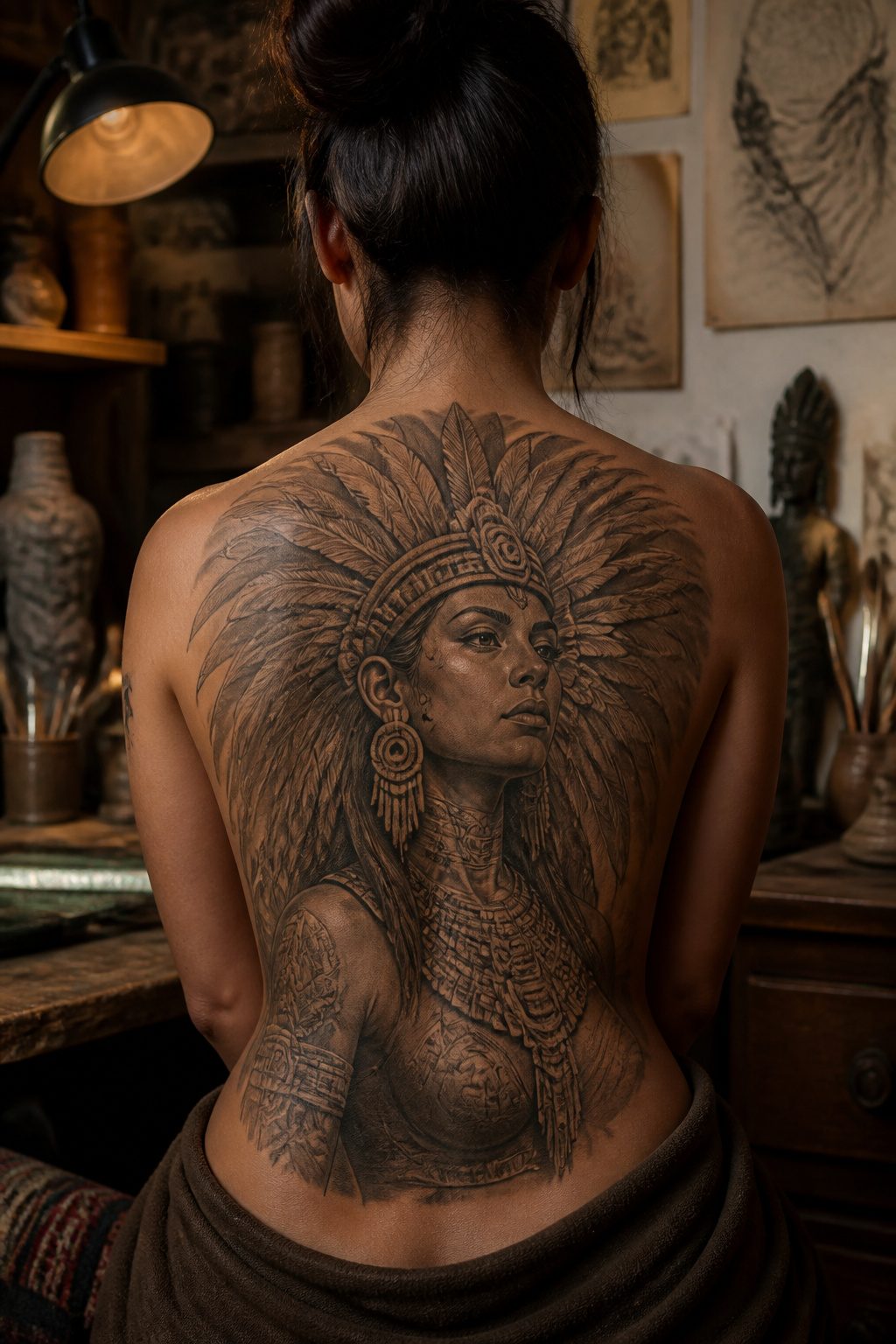
An Aztec princess tattoo carries a weight that the word "princess" alone misses. The design pairs the elaborate headdress and emblematic detail with a calm, direct gaze, and that stillness reads as strength held in reserve rather than softness. What changed my mind about this piece was learning how Aztec women actually lived: they trained as warriors, they commanded, they held property. The tattoo honors that history instead of borrowing royalty as decoration.
The headdress itself gives the artist room to build layers of fine line work, and the central emblem becomes the focal point the eye settles on first. A skilled hand can make the eyes expressive without tipping into sentimentality, and the traditional indigenous attire grounds the figure in research rather than fantasy.
Placement shapes how the duality lands. A larger back or thigh piece lets the headdress spread and the posture hold court; a smaller version on the forearm tightens the focus to the face and what it refuses to perform. Either way, the grace is visible first and the strength follows a beat later, which is exactly how the design earns its keep.
11. Aztec Dragon Tattoo
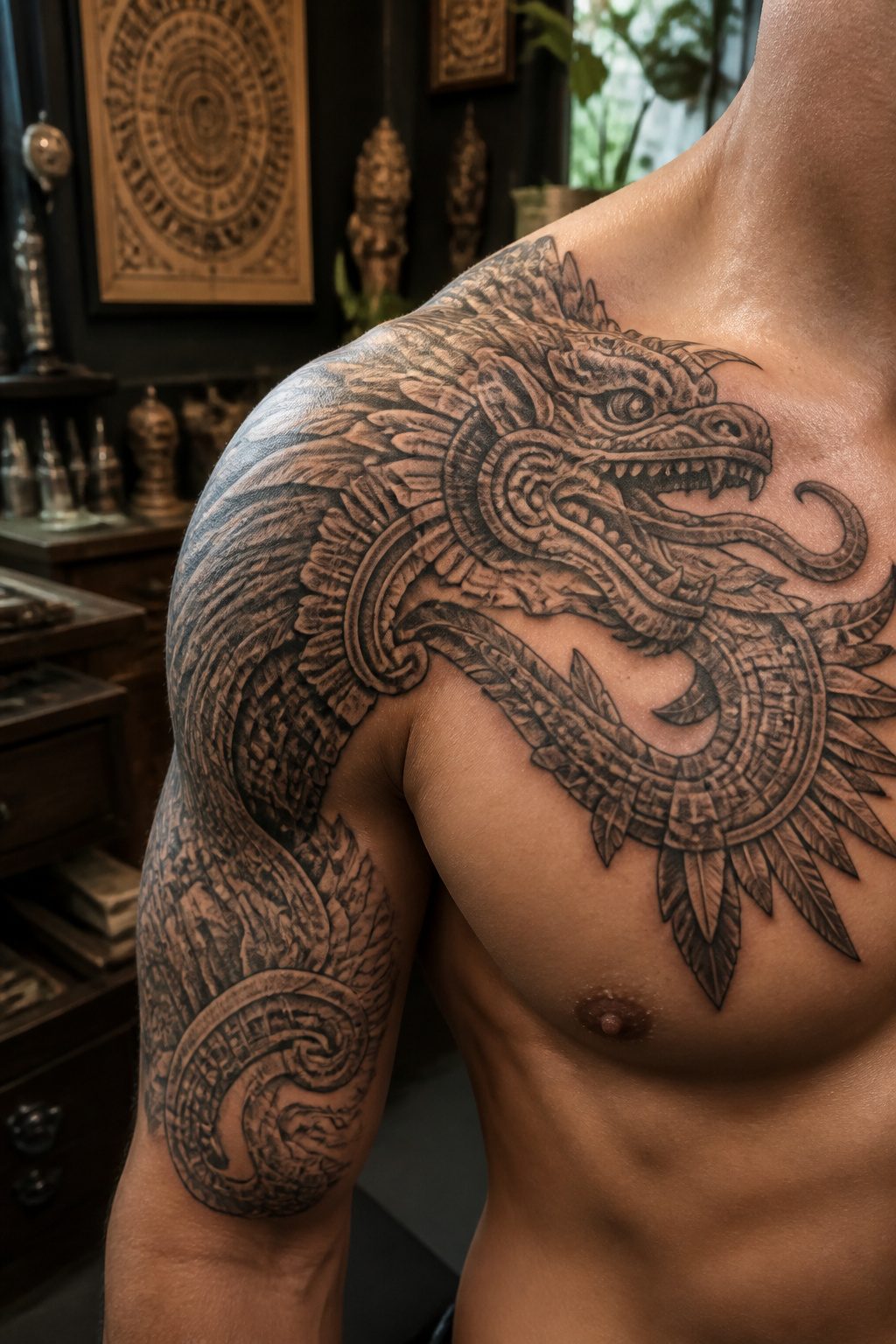
Quetzalcoatl, the feathered serpent, carries a meaning in Aztec art that European dragons never quite touch. The design blends serpent and bird features in a single form: scales along the body, plumage at the crest, sometimes a beak replacing the fanged jaw you’d expect from Western mythology. That fusion matters. Where European dragons guard hoards and breathe fire, the Aztec dragon figure governs wind, learning, and the morning star.
On skin, this shape works as a statement about strength and protection because the mythology backs it. Priests and rulers alike claimed descent from Quetzalcoatl; warriors invoked the figure before combat. The transformation angle sits in the creature itself, crossing between earth and sky, serpent and bird, mortality and something beyond it.
Placement tends toward the back or chest, enough flat surface for the geometry to read. The patterns around the head, those sharp triangular elements, carry as much weight as the central figure. Leave them out and the meaning thins. Keep them, and the tattoo holds the complexity that separates Aztec work from generic dragon flash.
12. Aztec Armband Tattoo
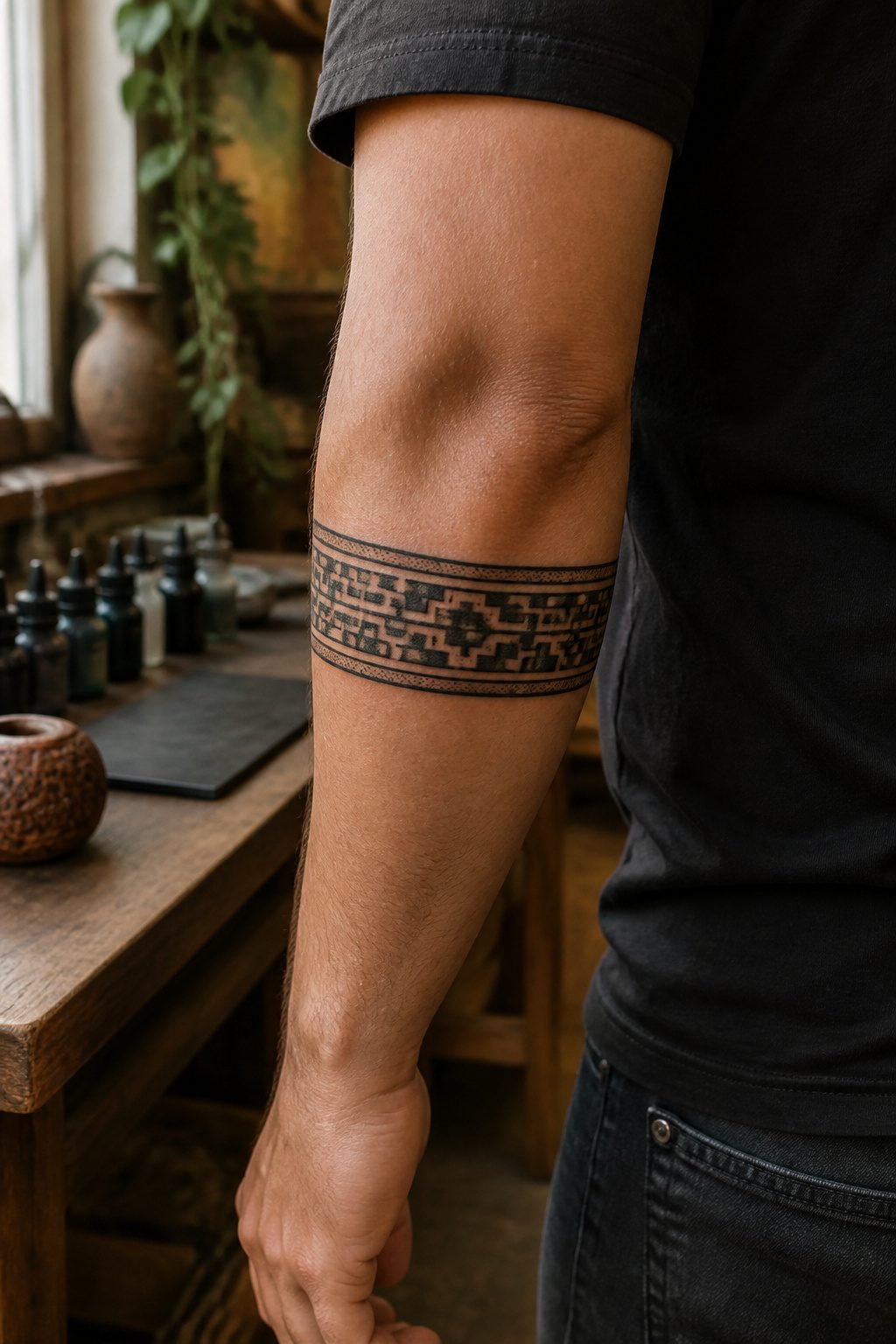
An armband that circles the full limb reads differently than a flat image on a shoulder or back. The wrap creates a loop with no fixed beginning, and in Aztec visual language that continuity carries weight: the pattern returns to itself, so the design speaks of commitment that outlasts a single moment. Thick black lines and stippling shading keep the band readable from a distance while still rewarding close inspection.
The placement also makes the armband a natural match for paired tattoos. Two people can wear bands that differ in subtle details, same motif, shifted emphasis, and the shared form still reads as a single statement. The sources note love and faith as the meaning most often assigned, not because the symbols themselves spell it out, but because the unbroken circle maps neatly onto those ideas.
Strength and power come through too, especially when the band sits on the forearm where the Aztec sun motif rises just below it. The sleeve-like fit matters here; a band that stops short of wrapping the limb looks like an accessory, one that closes the loop looks like structure.
13. Small Aztec Tattoo
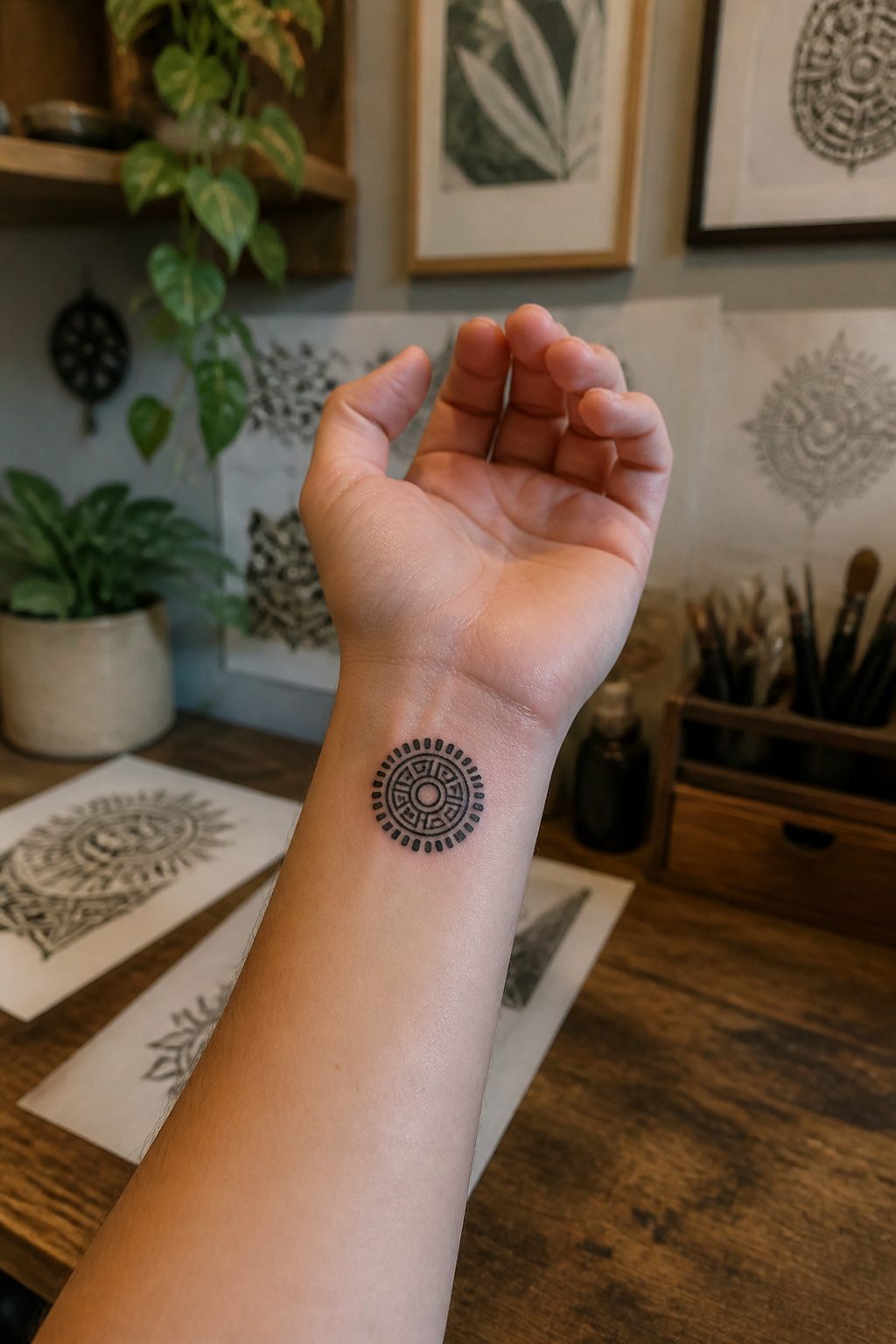
A small Aztec tattoo works best when a single glyph carries the full weight of meaning. The warrior’s shield, the chimalli, simplifies cleanly to a circle with its distinctive fringe pattern still readable at two inches. The eagle’s profile, another warrior emblem, loses its power if the beak gets too soft; the eye and the hook of the beak are the details worth fighting for, and everything else can go.
What convinced me, looking through portfolios of pieces that aged five years versus five months, is that solid black negative space outlasts fine line every time. The calendar stone’s center face, the Sun Stone’s tongue, the flint knife symbol: these all survive shrinking because their shapes are bold enough to read as silhouettes. Feathers are the first thing to muddy. A single quetzal plume drawn at three inches holds its barbs; at one inch it becomes a vague leaf, and the warrior rank it signaled disappears with the detail.
Placement on the wrist or behind the ear demands this kind of restraint. The inner forearm gives slightly more room, but the principle holds: pick one element with a shape so strong it still speaks when the lines thicken and the skin shifts.
14. Aztec Tattoo for Women
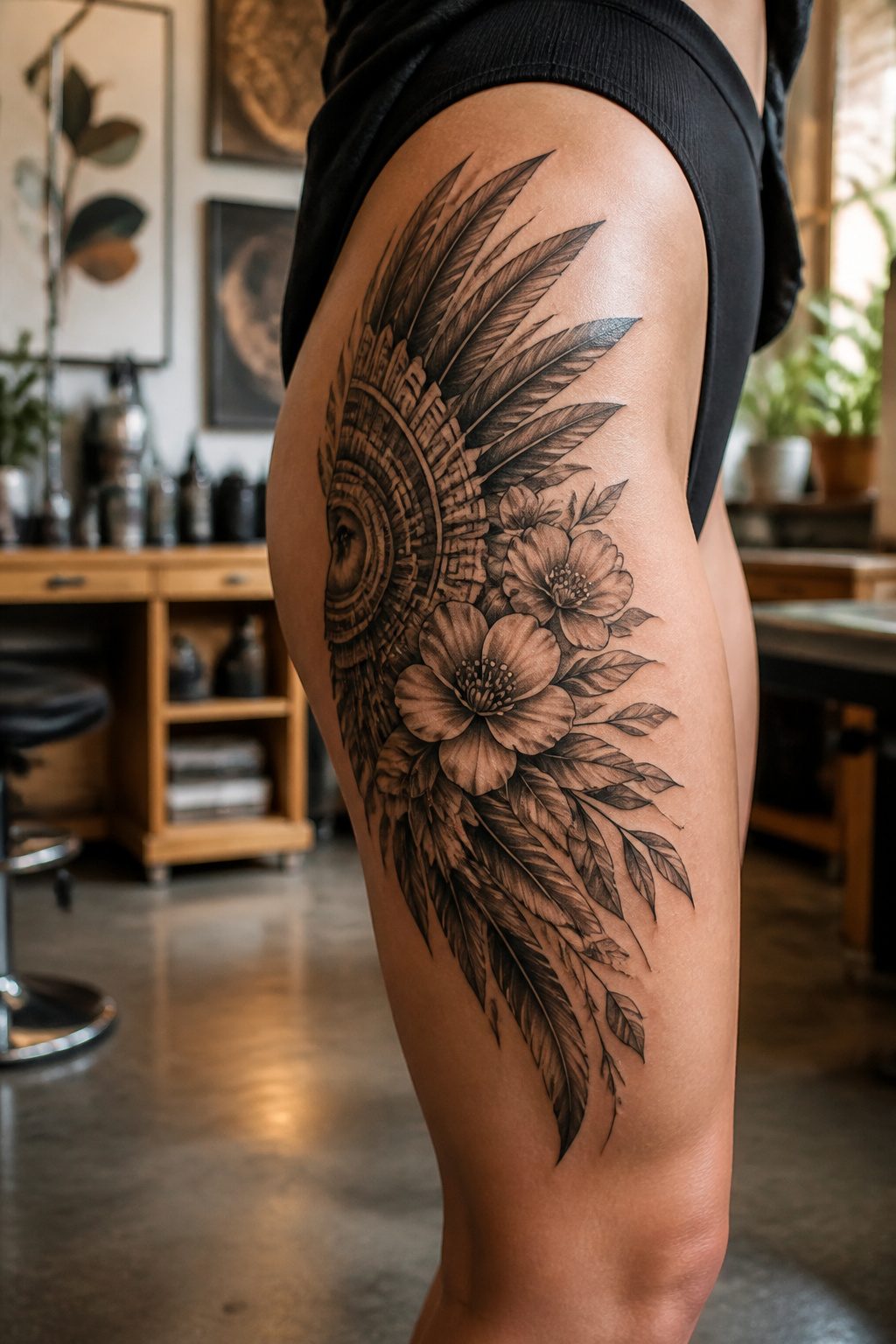
Feather and flower pairings in Aztec-inspired tattoo work land differently on women because the combination itself is a modern framing, not a documented historical motif. The feathers reference the warrior headdress, carrying strength, freedom, and wisdom, while the flower brings in beauty and elegance. What makes the design work is the visual tension between the two: the rigid geometry of feather vanes against soft, overlapping petals. A simpler route keeps just the feathers, etched clean without the floral element, and reads more graphic on smaller placements like the wrist or behind the ear. The full combination needs more real estate to breathe, typically the shoulder blade or outer thigh where the feather can scale large enough to detail and the flower anchors the composition without crowding it. The strength of this pairing is that it is chosen, not traditional — the meaning sits in the deliberate contrast rather than inherited symbolism. That is also the risk: without clean linework, the two elements compete instead of balance.
15. Aztec Tattoo for Men
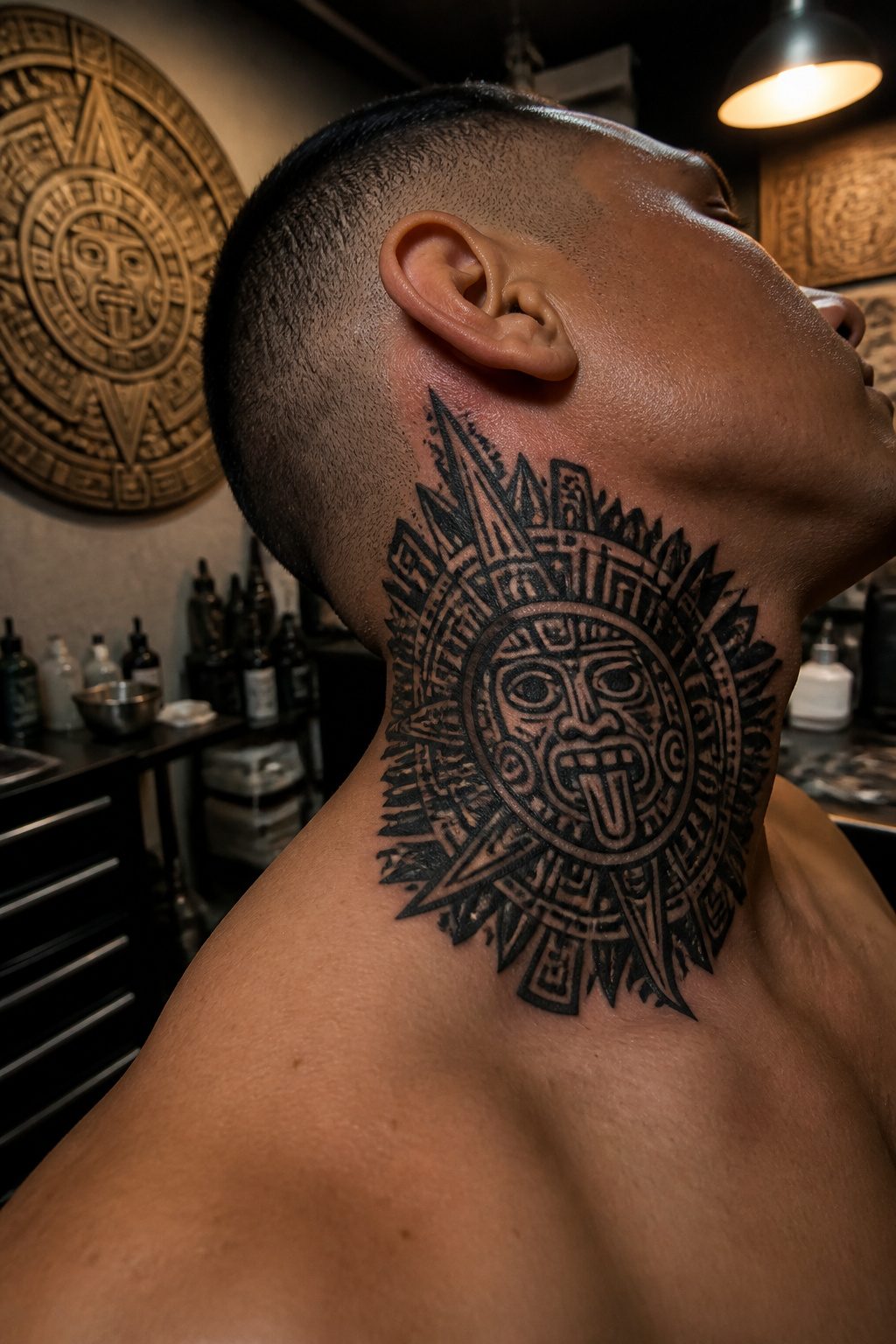
The rebellious framing of an Aztec warrior tattoo for men usually starts with placement that courts risk. A sun symbol riding the side of the neck, blackwork dense enough to erase negative space, reads as aggression before it reads as heritage. That is the point. The wearer is not asking permission.
Black and grey ink dominates these pieces, with line work so intricate it demands the larger canvas of an arm, chest, or back. The motifs carry weight: eagles for the elite Eagle Warriors, skull-faced Mictlantecuhtli for a fearless stance, Tonatiuh’s sun disk for raw power. Each symbol ties back to the Aztec military classes and their death-cult aesthetics, which modern tattooing has translated into something deliberately confrontational.
What separates a masculine presentation from a neutral one is often the density of the black and the refusal of empty skin. Negative space exists, but it is carved out, not left open. The tattoo becomes armor rather than ornament, and that shift in function changes how it is read across a room.
16. Aztec Bicep Tattoo
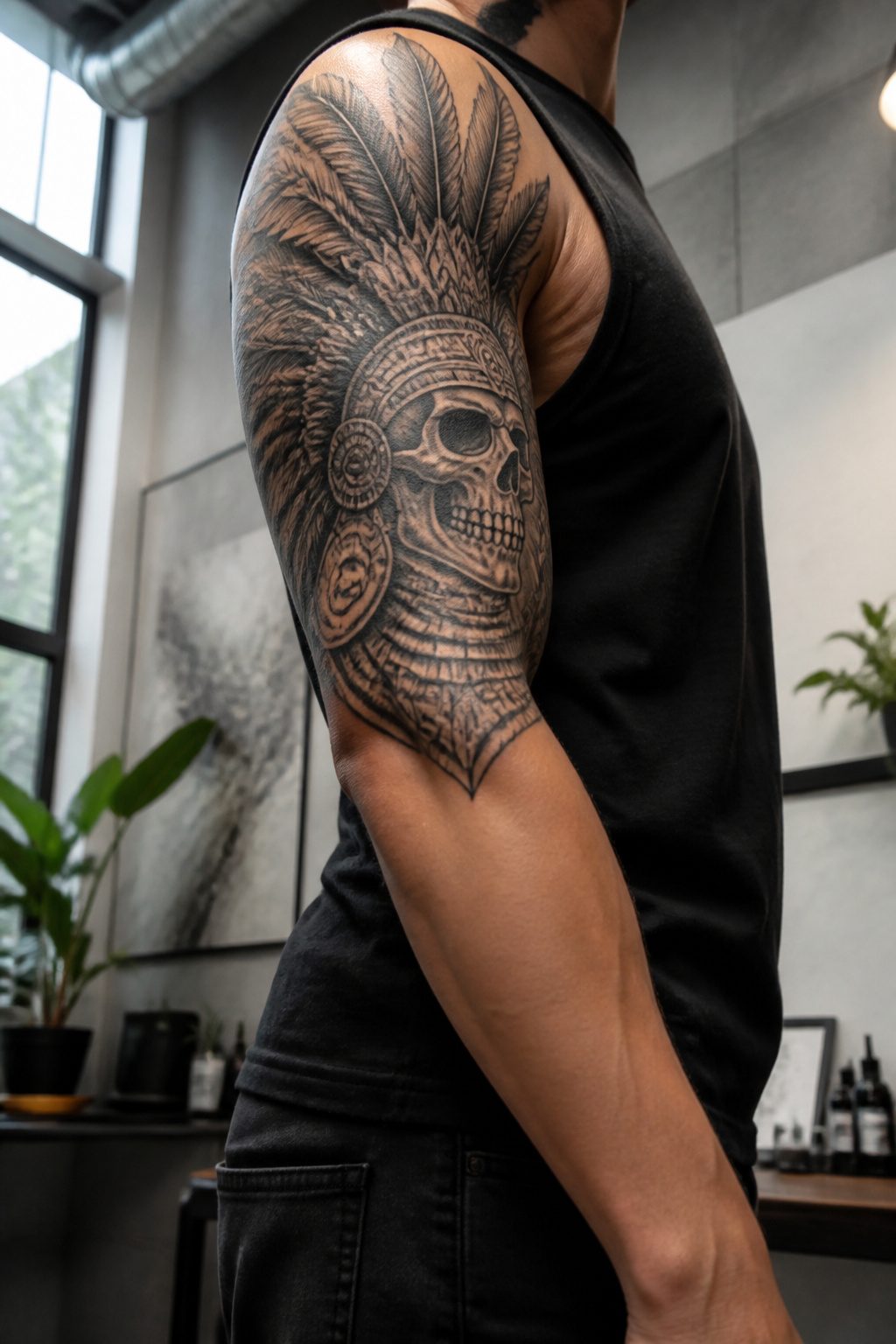
The bicep carries Aztec warrior imagery with a mechanical advantage other placements do not. Muscle contraction changes the whole composition: a design centered on the upper arm reads as static until the wearer flexes, at which point a skull in warrior regalia seems to animate, the feather headdress stretching with the skin. This is where blackwork sizing matters most. Too small, and the line work blurs into gray wash within a few years. A piece that wraps fully around the upper arm, four to six inches in height, keeps its detail without dominating the shoulder or forearm.
Power and rebirth sit naturally here. The Aztec skull in warrior gear does not mark death the way a generic skull might; it signals regeneration, the cycle the culture treated as continuous rather than final. On the bicep, that meaning pairs with visible strength in a way that feels earned rather than declared. The wearer sees it privately in mirrors, others see it in motion, and both views land differently.
What Aztec Tattoos Mean
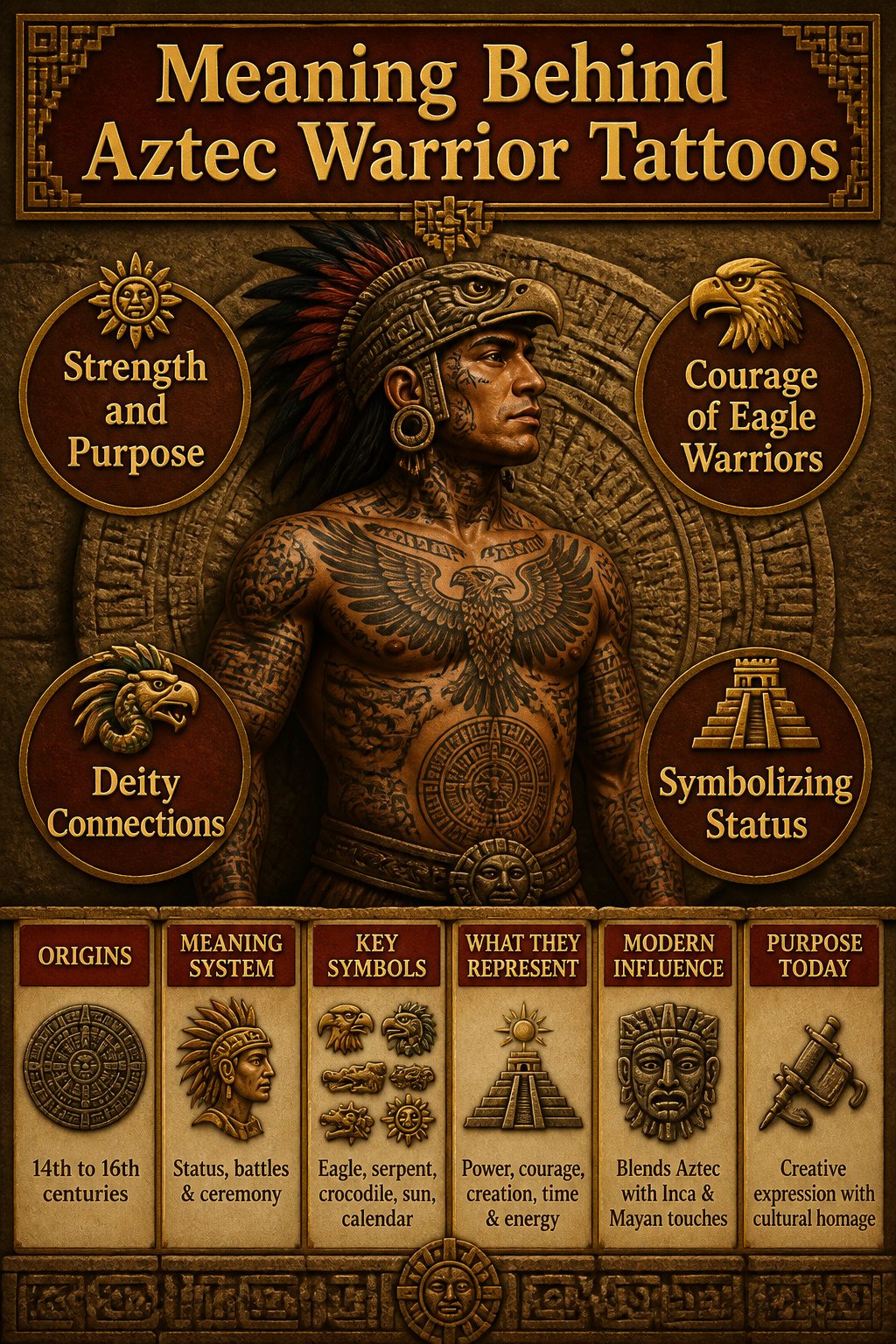
The shared thread running through Aztec warrior tattoos is strength tied to purpose, not strength for its own sake. An eagle on a warrior’s chest marked him as part of the elite Eagle Warriors, a military class whose courage was understood as borrowed from the bird itself. The same eagle inked today still carries that meaning of power and bravery, whether or not the wearer knows the specific regiment.
Deity connections run just as deep. The feathered serpent Quetzalcoatl stood for wisdom and creativity, while the sun god Tonatiuh anchored designs to life and energy. These weren’t decorative choices in the 14th to 16th centuries. Tattoos identified status, marked achievements in battle, and served religious ceremony. A warrior’s ink signaled where he sat in the social order and what the gods had seen him do.
That system of meaning holds across designs. The crocodile, a mythical earth-forming creature, speaks to creation. The calendar, with its animal faces for each month, ties to time and the enduring soul. What shifts is the emphasis, not the grammar. A sun piece foregrounds energy; an eagle foregrounds courage. Both still point back to the same cultural logic of sacred symbols marking sacred roles.
Modern work blends these traditional elements with contemporary styling, sometimes pulling in Inca or Mayan touches where histories overlap. The result is creative expression that still reads as homage, provided the core symbols stay recognizable.
Where to Place an Aztec Tattoo
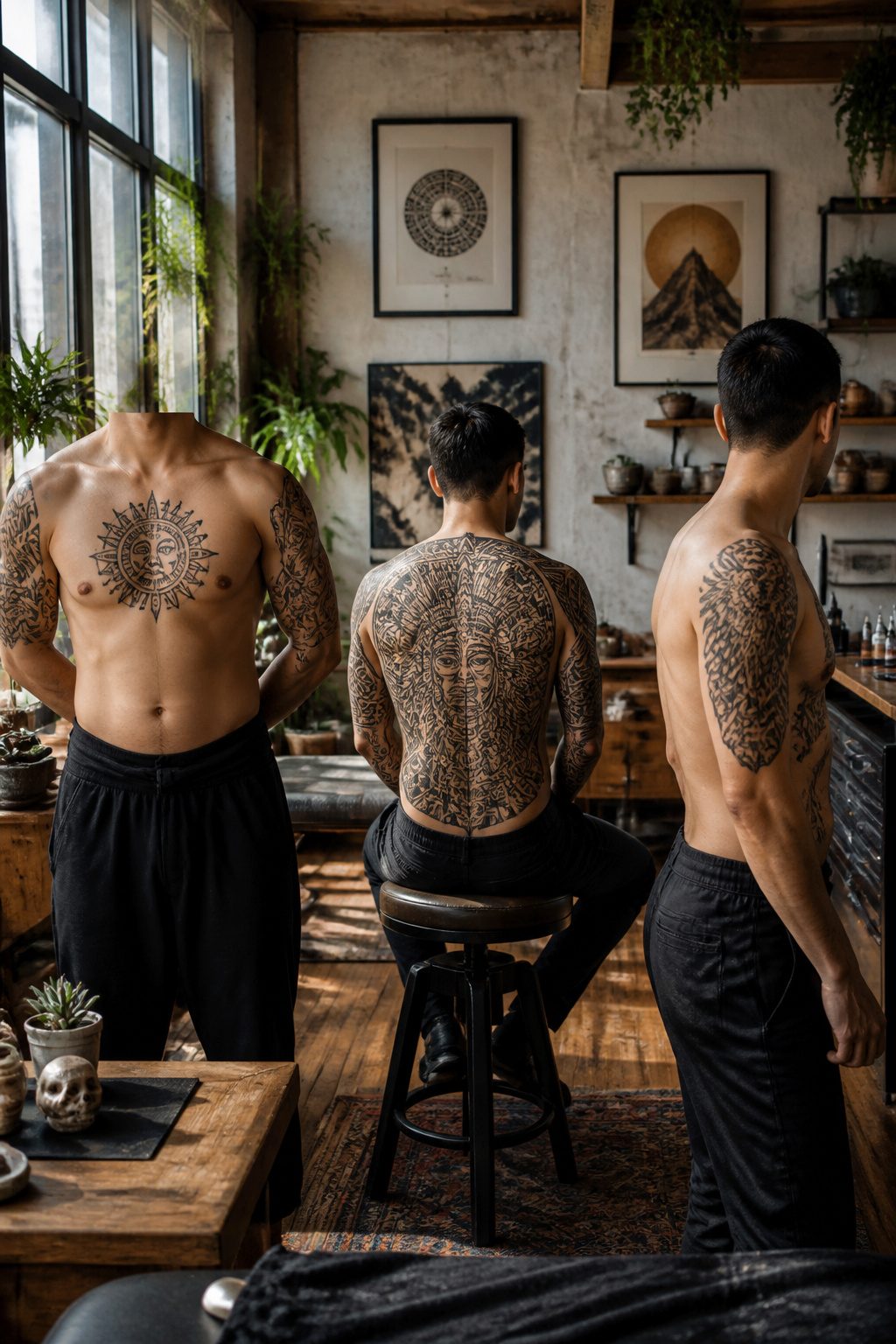
The upper arm and leg are the most common placements for Aztec warrior tattoos today, though the chest, wrist, and stomach carry the historical weight. In ancient Aztec culture, those three spots were considered the body’s power centers, chosen deliberately to draw on that energy. A chest piece sits close to the heart, visible when you want it to be and hidden under a shirt when you do not. The back offers the largest canvas for the intricate line work these designs demand, especially if you are building around a sun god or a full warrior figure.
Size decides placement as much as symbolism does. A detailed eagle warrior needs room for the feathers to read clearly; squeeze that onto a wrist and the artist loses the fine black-and-grey patterns that make the style work. A private expression belongs on a spot you cover; a piece meant to show off to the world wants the forearm or calf, where a short sleeve or shorts do the job without thought. The decision is yours, but make it before the stencil goes on.
Aztec Tattoo Origins
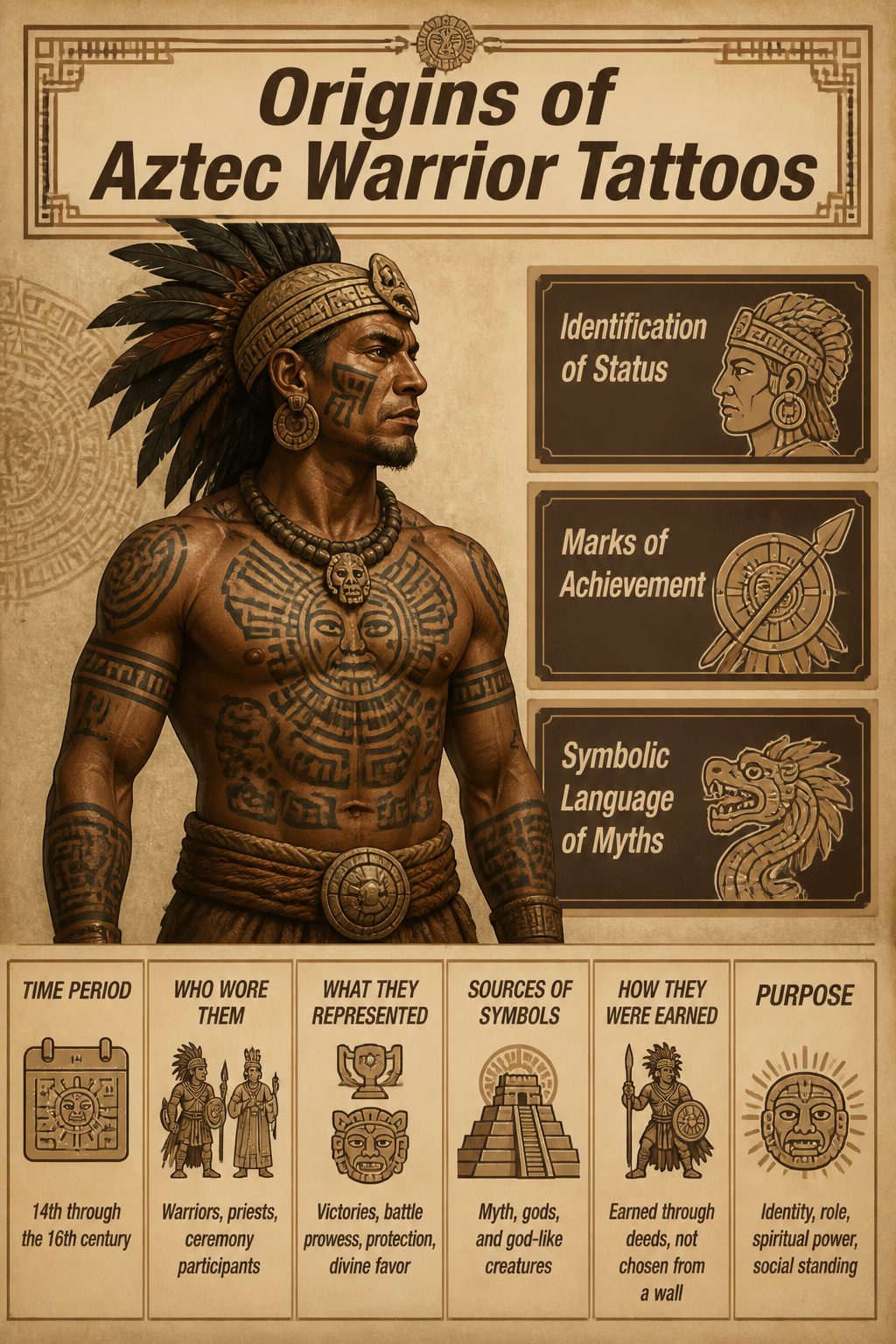
Tattooing in Aztec society ran deeper than decoration. From the 14th through the 16th century, the civilization used permanent marks as identification of status, achievement, and social role. Warriors carried symbols of victories and battle prowess on their skin. Priests and participants in religious ceremonies wore tattoos believed to summon protection or divine favor from specific gods. The symbols themselves drew from a culture saturated with myth, where gods and god-like creatures explained everything from life and death to natural events. That layered meaning is what separates an Aztec warrior tattoo from generic tribal design: the original marks were earned, not chosen from a wall.
Frequently Asked Questions
What do Aztec tattoos symbolize?
Aztec tattoos symbolize strength tied to purpose, not strength for its own sake. The eagle marked elite Eagle Warriors and still carries power and bravery today. Deity symbols run deep too: Quetzalcoatl for wisdom and creativity, Tonatiuh for life and energy, and the skull for regeneration rather than final death.
What are popular Aztec tattoo designs?
Popular designs include the eagle, warrior, sun, skull, feathered serpent, crocodile, pyramid, and armband. Each carries specific meaning: the eagle for elite military status, the sun for daily struggle and persistence, the skull for rebirth, and the serpent for transformation through destruction.
Where should I place my Aztec tattoo?
Common placements are arms, chest, and back, with specific designs favoring specific spots. Eagles and sun disks need room for wingspan or circular proportions, so chest or back works best. Coiled serpents and bicep pieces animate with muscle movement. Small glyphs survive on wrist or behind the ear only if bold enough to read as silhouettes.