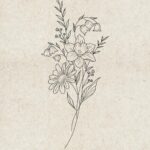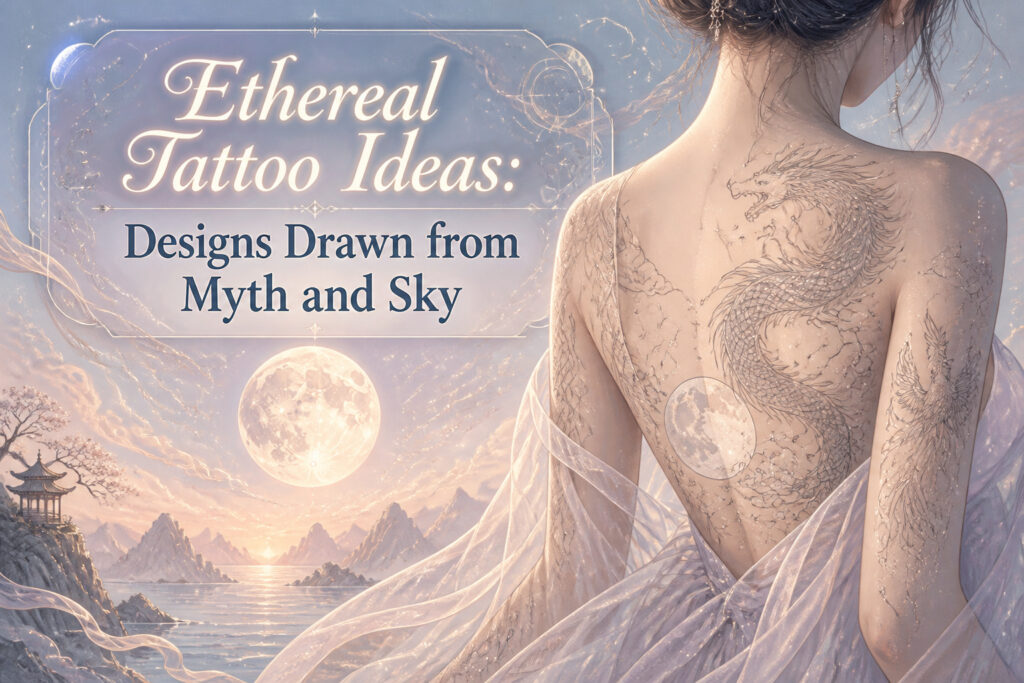
Ethereal tattoos are fine-line body art built from mythological figures, celestial bodies, and translucent textures that suggest light passing through pigment rather than sitting on top of skin. The style demands single-needle work and disciplined restraint, since a second pass over healed lines muddies the effect most artists spend hours trying to achieve. Jing, whose 119K Instagram following grew from training at Beijing’s Central Academy of Fine Arts, lets empty skin stand in for light itself; her clients describe the result as carrying magic, though the technique is entirely technical.
Ethereal Butterfly with Flowing Silk Ribbons in Moonlight
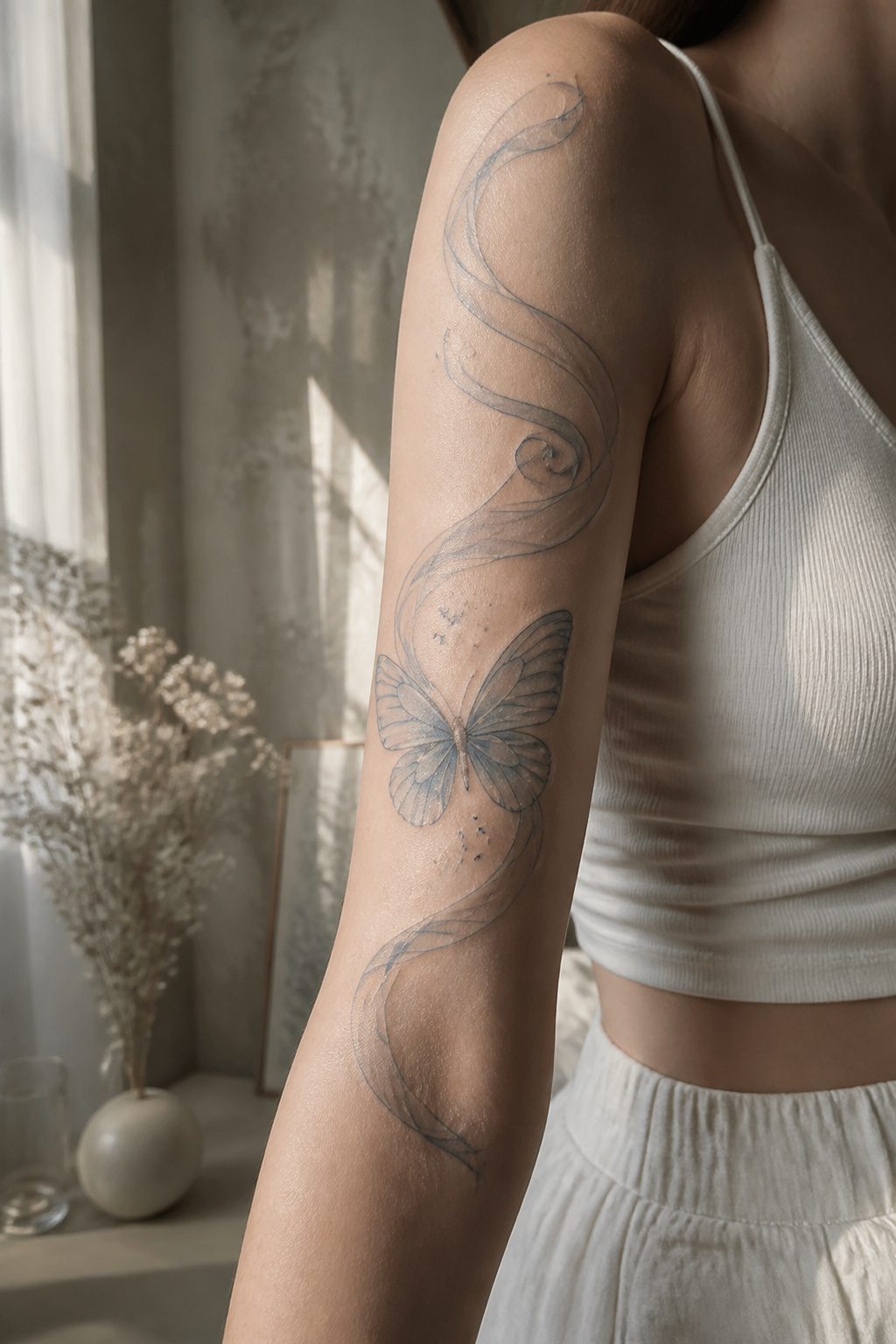
The butterfly’s transformation symbolism pairs naturally with silk ribbons caught in soft moonlight, and the combination reads as freedom rather than decoration once the ink settles. Fine line work builds the wing texture so translucent that light seems to pass through the pigment, a trick that demands a steady hand and a single-session commitment because going back over healed fine lines tends to muddy the effect.
Ribbons need movement to earn their place. Static bands look like clip art; ribbons that wrap around the form and catch imaginary wind suggest escape from the daily routine. The curve of the upper arm carries this motion well, especially when the ribbon trails toward the shoulder and the butterfly hovers near the elbow so the whole piece moves when you do. The back offers more room for the moonlight wash, usually placed low along the spine where the body’s natural hollow pools shadow and makes the glow read brighter by contrast.
Placement on flat bone like the shoulder blade risks the ribbons looking pressed into a page instead of flowing. The ribs or outer thigh handle the curves better if you want the piece larger. Moonlight in tattoo pigment reads as pale blue or cool gray, never white, since white ink heals to a yellowish cast on most skin tones.
Ethereal Mermaid with Flowing Hair Among Coral and Sea Flowers
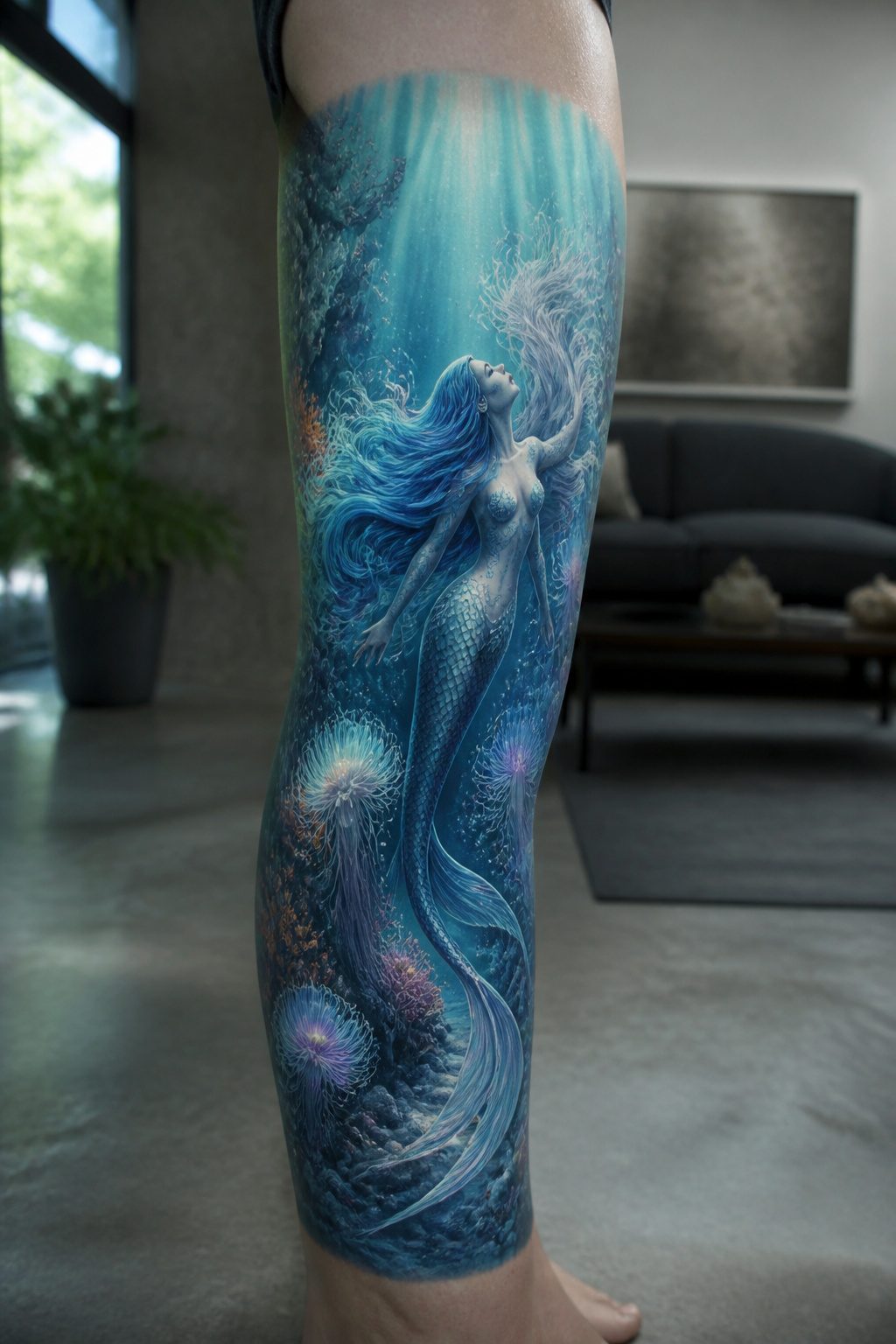
Soft color gradients do the heavy lifting in an underwater mermaid piece. The hair has to read as weightless, drifting between coral formations rather than resting on them, and that only happens when the blue-green shift is gradual enough to suggest filtered light rather than painted stripes. Aim the darkest tones at the scalp and let them dissolve to near-white at the tips, the same way sun shafts lose strength as they push deeper.
Sea flowers are where most designs go too literal. Anemone shapes read as botanical illustration; the better move is borrowing their translucency and abandoning the taxonomy. The tension between human and mythical forms lives in the face. Keep it recognizably person, but the neck should start dissolving into something that could go either way. Coral frames the figure without touching it; the negative space is what sells the depth.
I have watched clients sit through eight-hour sessions for these, and the ones that hold up are the ones where the artist stopped two passes earlier than they wanted to. The deep water light is easy to overstate. Subtlety is what keeps it otherworldly five years in.
Ethereal Medusa with Phoenix Wings
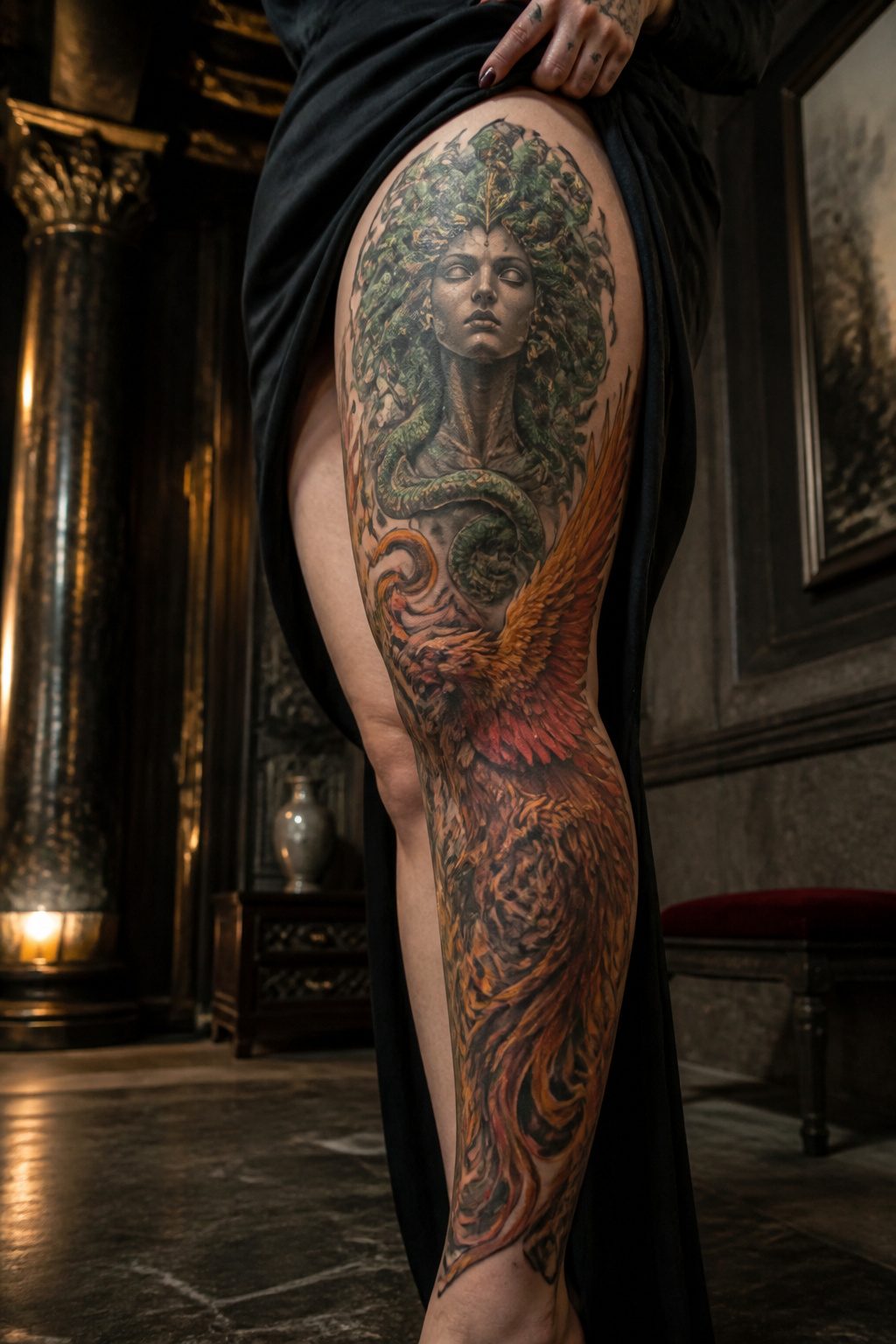
The Medusa-and-phoenix fusion lands hardest when the two halves fight each other. Her serpents coil downward, weighting the face in stillness, while the wings sweep up from the shoulders with enough curve to suggest motion the figure hasn’t finished yet. That tension between the frozen gaze and rising wings is what makes the design read as rebirth rather than simple monster.
The artist needs to have done complex figure work before, not just mythology pieces. The scale shifts are tricky: the wings have feather detail that can go murky if shaded too dark, and the snakes need line weight that stands up to the softer wing edges without looking pasted on. I’ve watched this composition go wrong when the wings get treated as background instead of anatomy; they attach at the shoulder blades, not behind the head like a halo.
Color tends toward ember tones in the wings against cool stone grays for the figure, though a full monochrome version with white ink for the feather highlights can carry the ethereal quality without the carnival effect. Placement on a thigh or ribs gives the wings room to open; wrapping around an arm collapses the upward lift into a band.
Mystical Tree of Life with Cosmic Roots and Celestial Branches
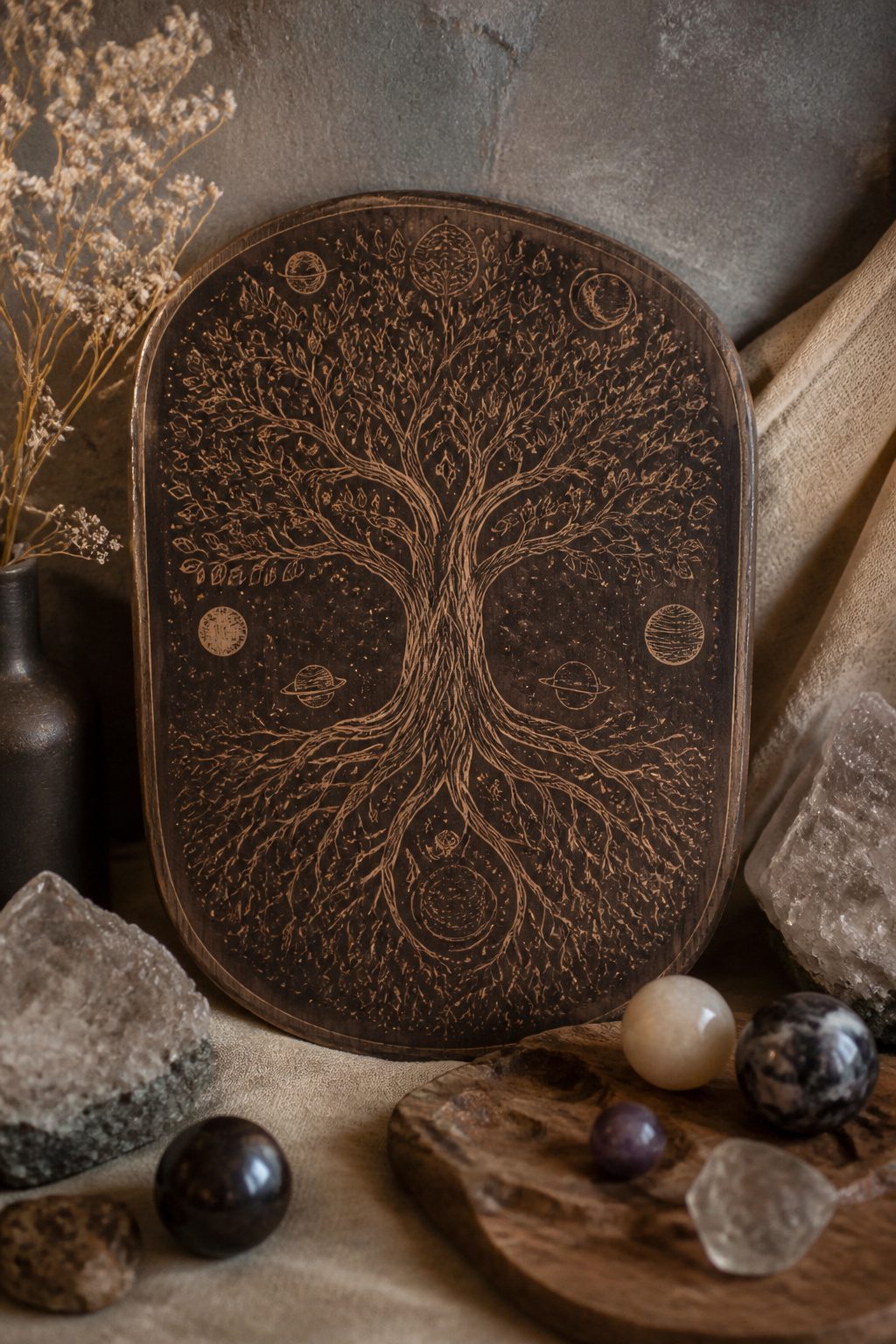
Vertical compositions live or die on whether the body makes sense as the trunk. The spine placement does this almost too well: the tree’s roots pool at the lower back in cobalt and violet dotwork, then the bark runs the vertebrae like a natural ridge, and branches fan across the shoulder blades into Orion’s belt or a crescent moon. Dotwork builds the nebula textures, not color washes, because stippled pigment heals softer and reads as actual distance rather than painted sky. The roots need more hours than the branches; most artists reverse the usual schedule and knock out the celestial top first so the client sits fresh for the dense bottom work. Back pieces this tall usually split across three sessions minimum, and the spine itself is the one spot where the sensation never quite numbs, so plan around that. What separates a cosmic Tree of Life from a generic one is the roots dissolving into actual star fields rather than just dark earth: the transition point should sit at the waist, not the hip, so the body still reads as ground before it gives way to space.
Ethereal Goddess with Flowing Hair and Celestial Stars
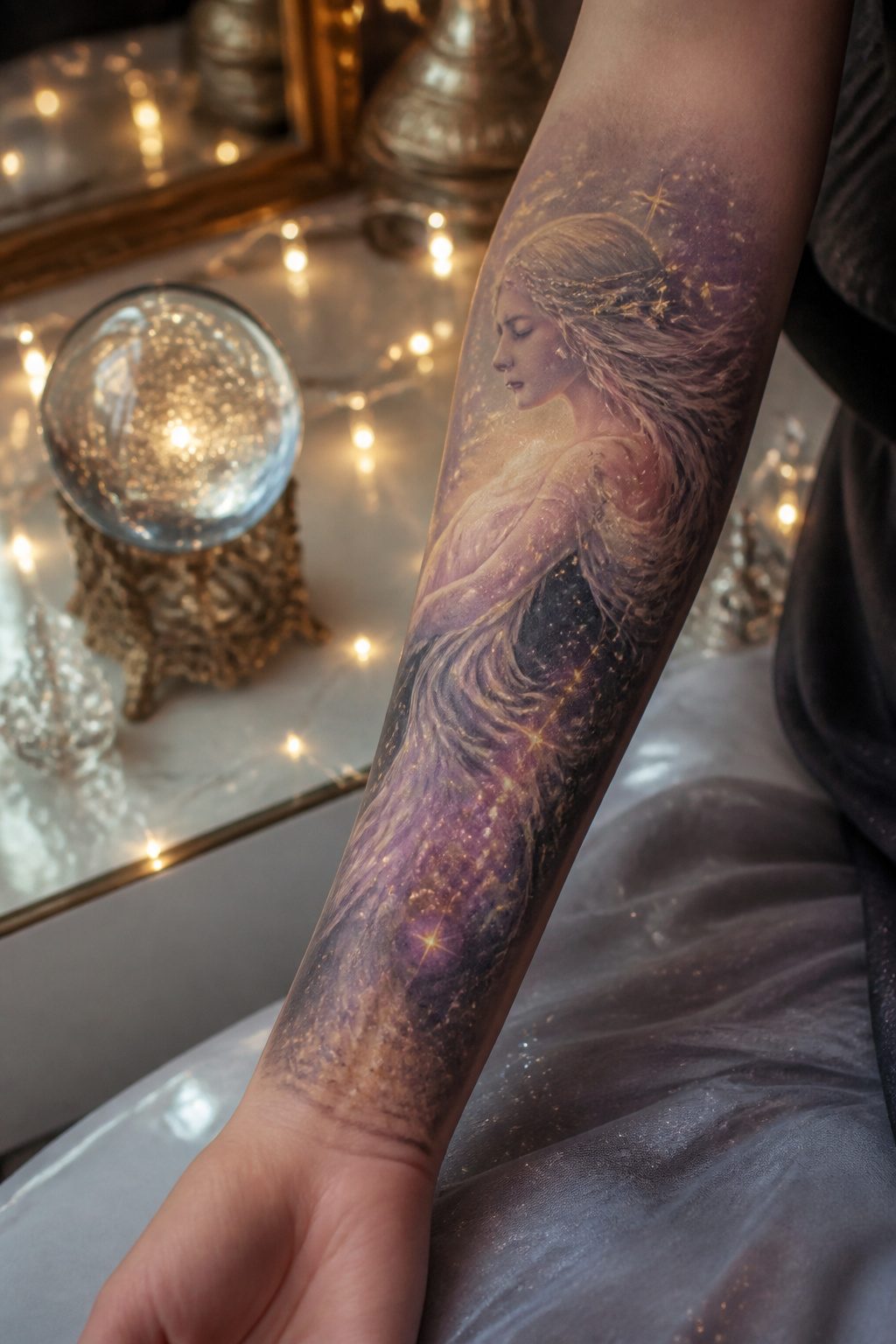
Soft focus does the heavy lifting in a goddess piece. The figure’s edges blur just enough that her hair seems to dissolve upward, individual strands becoming indistinguishable from the star field behind her. That transition point, where skin tone fades into lavender or pale gold and then into actual stippled stars, is what keeps the image from reading as two separate tattoos forced together.
The grace comes from posture, not detail. A turned shoulder or lifted chin carries more weight than facial features ever could, which is why so many of these pieces work best when the face is barely there at all. Constellations should be suggested, not catalogued: too many named stars and the eye starts checking accuracy instead of feeling the drift.
Color stays in the whisper range. A little rose in the cheek, maybe a cool blue thread through the darkest hair. What you are after is the memory of pigment, not the fact of it. The whole piece should look like it might fade further if you stared long enough, which is exactly the transcendence the form promises.
Ethereal Dragon Born from a Magic Book
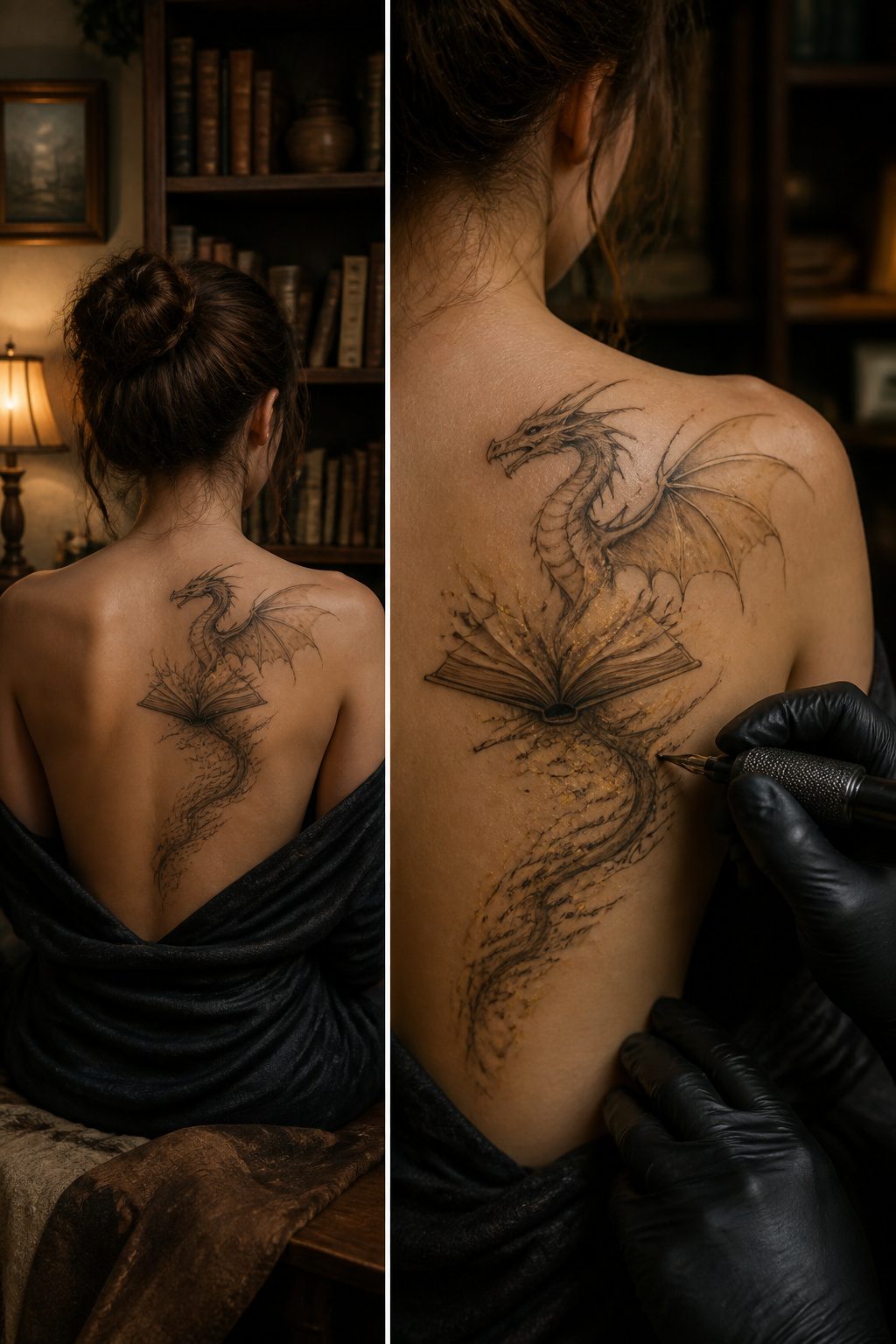
A client brought me a sketch once, a dragon climbing out of an open book with pages still stuck to its wings like wet tissue. The idea was that stories take shape, that ink becomes muscle. The best version keeps the dragon half-formed, scales dissolving back into text at the tail, a paragraph of Latin or a line from a poem visible through the translucent membrane where wing meets word.
The paper texture matters more than the dragon itself. Fine line work can suggest the grain of old pages, the deckled edge of a folio, the slight ripple where water or age has warped the sheet. Color should stay muted: ivory, aged gold, a dusting of iron-gall black. Anything bright kills the illusion that this creature is still becoming.
Placement changes how the story reads. Across a shoulder blade, the book sits open like a desk prop, the dragon curling toward the collarbone. Down a forearm, the viewer sees the emergence from the side, pages lifting in a spiral that draws the eye toward the hand, the writing hand. A woman who works in publishing chose her ribs, the book nestled close to her heart, the dragon’s head turned back as if listening for what comes next after the final page.
The concept fails when the dragon finishes too completely. Leave the hindquarters sketched, ink-wash, a sentence trailing off into scale and claw. The moment of becoming is the whole point.
Ethereal Woman with Flowing Hair and Celestial Stars
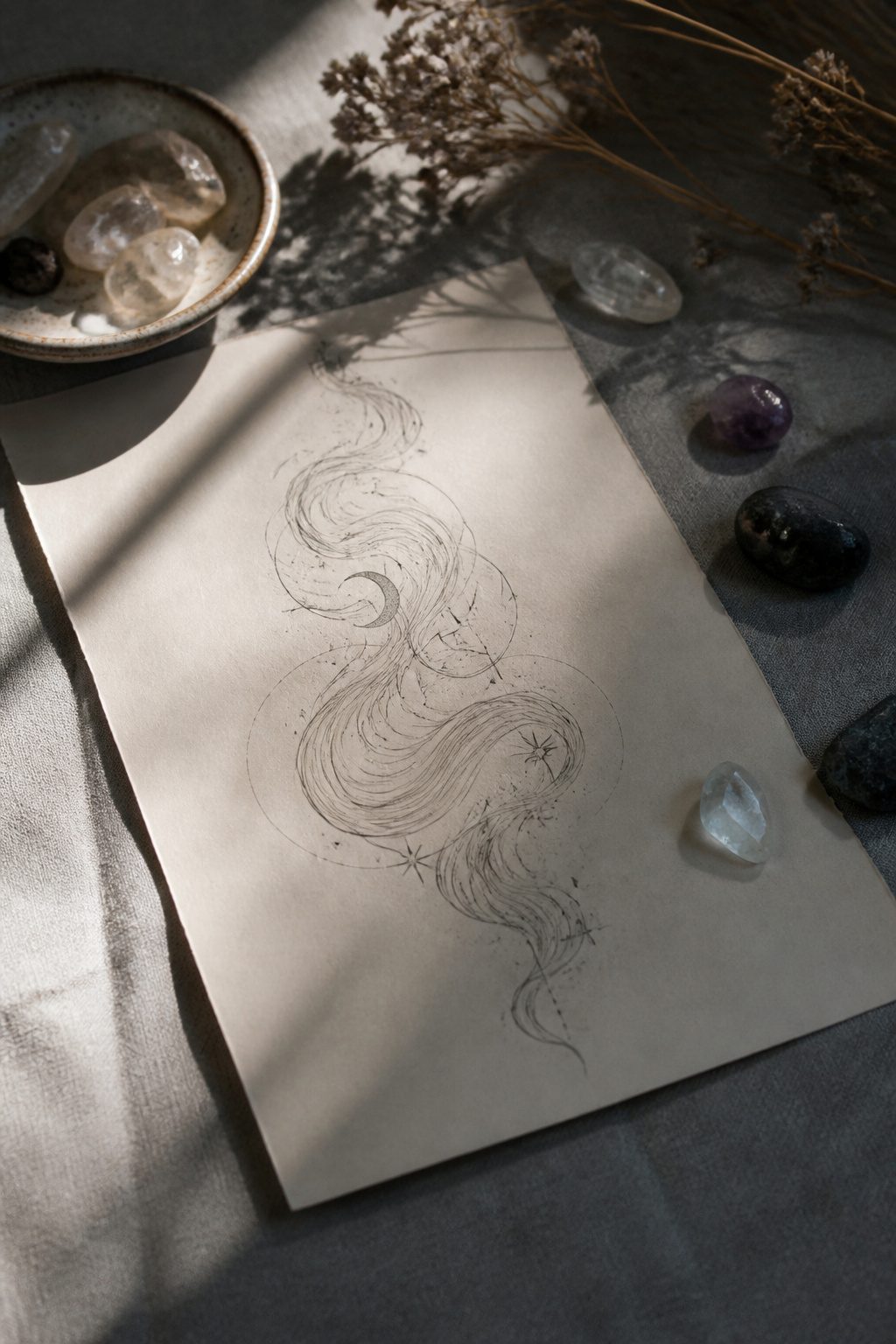
The woman with flowing hair and celestial stars sits in a different territory from the goddess version, and the gap matters the moment you sit in the consultation chair. The face stays specific, recognizable, yours while the hair loosens into star fields and cosmic color. That distinction decides whether the piece reads as archetype or as portrait.
I have watched clients wrestle with this choice without naming it. They bring reference photos of their own face, or they bring images of women who could be anyone. The first path asks the artist to render a likeness and then let the hair dissolve into abstraction. The second surrenders identity from the start and lets the figure stand for something larger. Neither is wrong, but mixing them by accident produces a piece that feels uncertain of its own purpose.
Hair makes the natural vehicle for this because it already carries movement. Strands become comet trails, a part at the crown opens into a nebula, the ends cool from warm scalp tones into the blue-shift of distance. The face anchors the design in human scale while the hair does the cosmic lifting. Without that anchor, the image drifts toward the goddess territory this section deliberately steps away from.
The consultation is where you choose. Say which starting point you want, because the artist’s approach shifts significantly with the answer.
Ethereal Faceless Woman with Flowing Hair and Celestial Stars
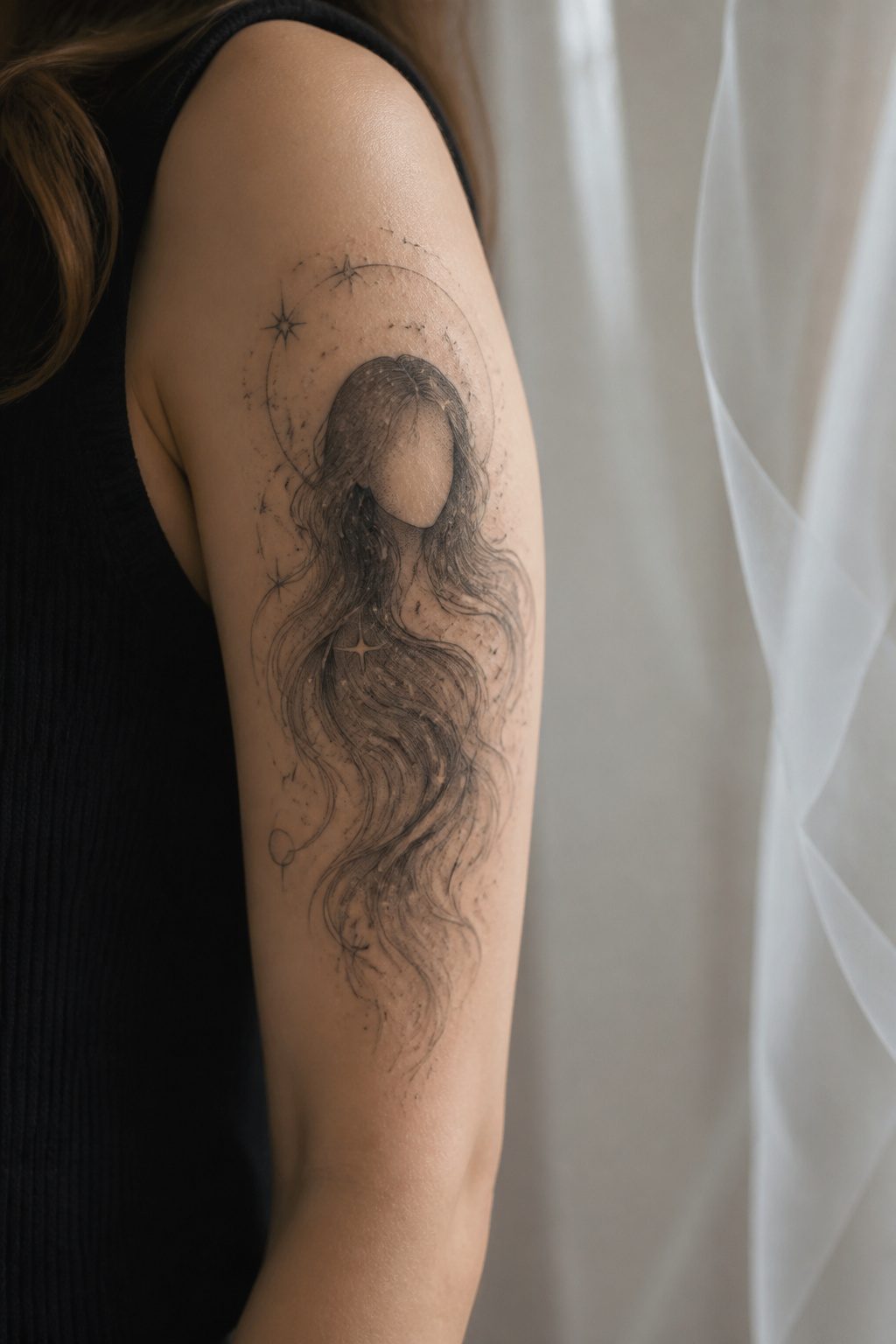
The faceless woman design strips away anything that would anchor her to one person. No eyes, no mouth, no particular era or expression. What stays is the hair, usually drawn in long waves or strands that seem to move on their own, and the stars scattered through or around it. That blank space where the face should be is what makes the piece work. A viewer can read their own mood into it, their own half-remembered dream, without the image pushing back with a specific emotion.
Hair and stars still carry the same celestial feeling they do in the faced version of this motif. The difference is in the emotional temperature. Where a goddess with features might feel aspirational or protective, the blank face tilts the piece toward something closer to a question. It reads as memory rather than portrait, the kind of figure you see from behind in a dream and wake up still trying to identify.
Placement matters for this one. The negative space of the missing features needs room to breathe, so the design tends to work better at medium scale or above. Too small and the face area risks looking unfinished rather than intentional. Most artists handle the hair in fine line or whip shading to keep the movement light, and the stars as small stippled dots or single-needle highlights that catch light without shouting.
The ambiguity is the point, but it is not a free pass on composition. Without eyes to draw the viewer in, the hair flow and star placement have to do all the structural work. Get that balance wrong and the piece just looks like a head with a missing piece rather than a deliberate choice.
Fine Line Work and Delicate Color
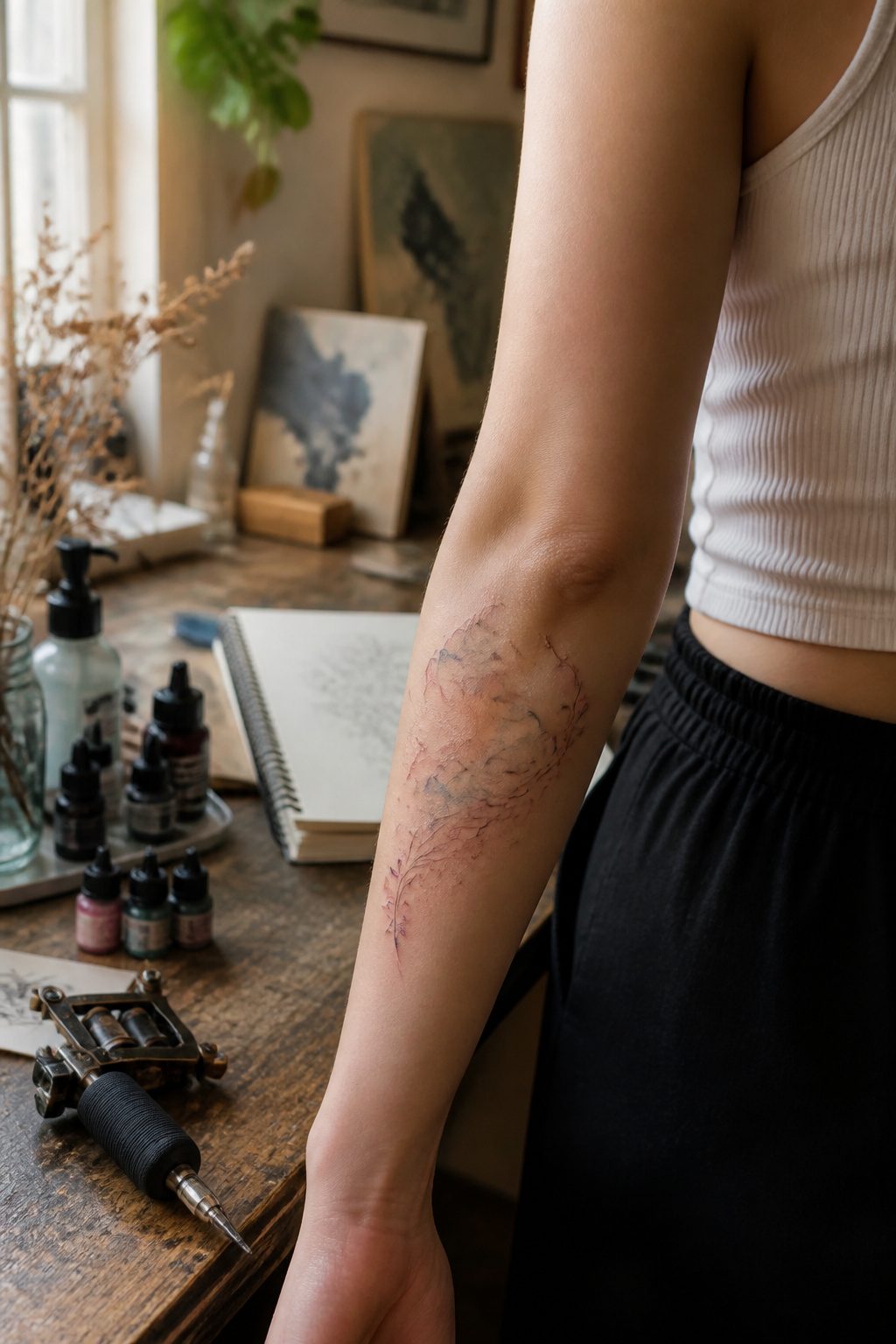
Single-needle work changes what ink can suggest. The line stays so thin that a cloud reads as vapor rather than outline, and the skin between strokes starts doing half the work. Jing, the Los Angeles artist whose fine-line pieces drew 119K followers, trained first at the Central Academy of Fine Arts in China and later at Zurich University of the Arts; that background in traditional illustration shows in how she lets empty skin stand in for light itself. White ink and soft gradients do the rest, lifting pigment off the surface so a moon or a ghost of a figure seems lit from behind rather than painted on top.
The restraint matters more than the subject. Saturated color would kill the effect. Instead the palette stays narrow, sometimes barely there, with white dropped in to catch light the way watercolor paper does. The result is what the style promises: something that looks like it might drift if you breathed on it.
"With Jing, clients seek more than just a tattoo—they want a touch of magic they can carry with them for the rest of their lives."
That "touch of magic" is technical, not mystical. It comes from an artist who knows where not to lay ink, and who trusts the skin to finish the image.
What Ethereal Tattoos Mean
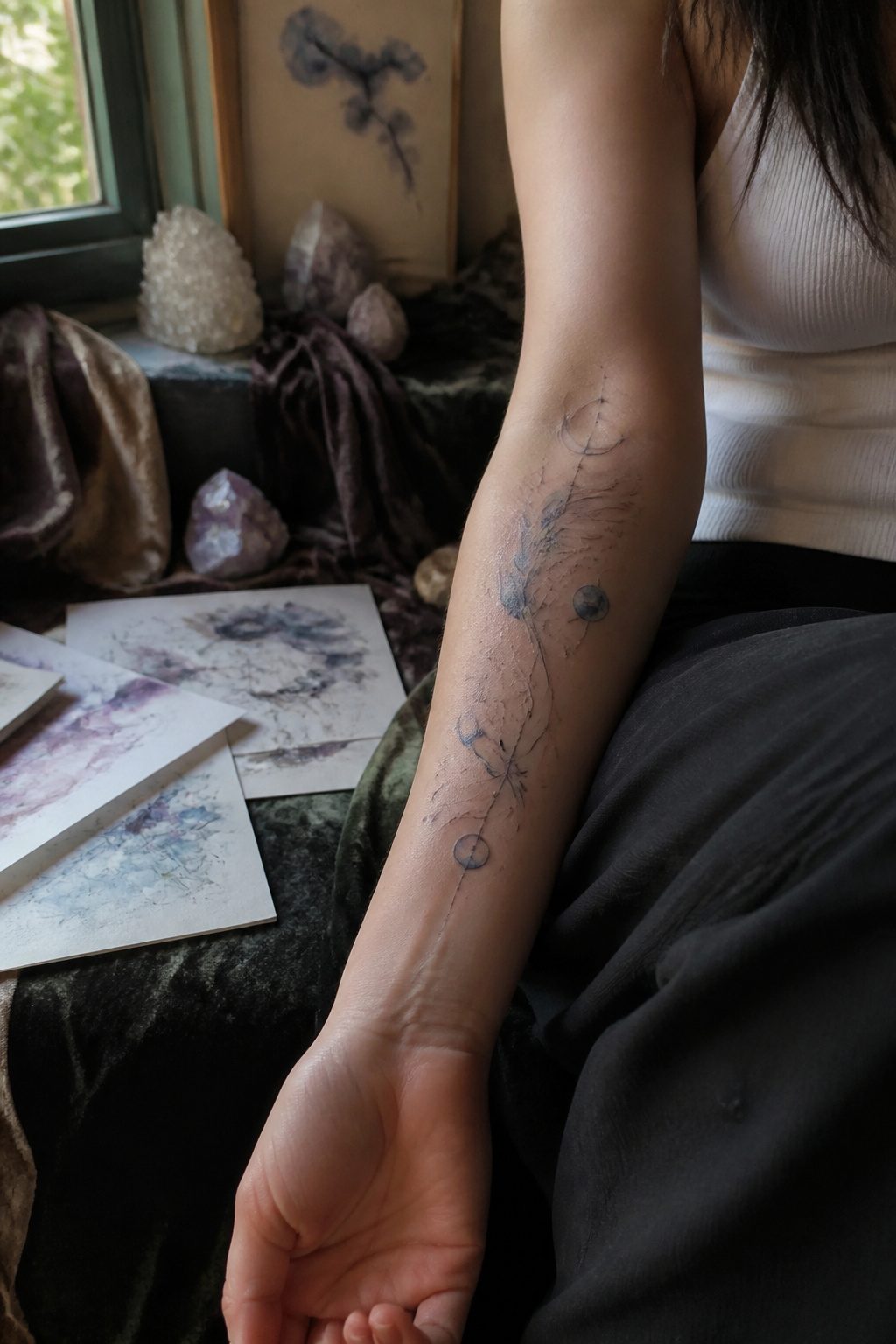
The meaning of an ethereal tattoo stays deliberately open, which is exactly why the style works for so many different people. Delicacy and otherworldliness form the core visual language, a way to mark spiritual or mystical experience without locking into any single religion’s symbols. A butterfly rendered in this style might hold grief for one wearer and transformation for another; the same soft lines, the same moonlit palette, carry either weight depending on what the person brings to it.
Clients often describe the impulse as wanting freedom from mundane reality, a permanent reminder that beauty and transcendence exist as possibilities rather than finished states. The tattoo does not preach. It leaves room for the meaning to shift over years, which matters for something meant to last a lifetime.
Booking and What It Costs

Most studios now run their booking through online forms where you lay out the idea, size, placement, and which artist you have in mind. The shop minimum sits around $150, and a non-refundable deposit is required to hold the date. That deposit gets applied to the final cost, though you will need at least 72 hours’ notice to reschedule and you can only move the appointment twice before putting down fresh money.
Ethereal tattoos with their fine linework and delicate detail almost always run well above that minimum. Few shops publish clear size-based ranges for this kind of piece, so the consultation is where you will get your real number. You must be 18 or older to book, no exceptions, even with a parent willing to sign.
Frequently Asked Questions
What are ethereal tattoos?
Ethereal tattoos center on delicacy and otherworldliness, a visual language built from fine lines, soft color, and negative space that suggests spiritual or mystical experience without locking into any single symbol. The style leaves meaning open, so a butterfly might carry grief for one wearer and transformation for another, depending on what the person brings to it.
How do I book a tattoo appointment?
Most studios run booking through online forms where you submit your idea, size, placement, and preferred artist. The shop then reviews the request and follows up to schedule a consultation or confirm the date. A non-refundable deposit is required to hold the appointment, and you will need at least 72 hours’ notice to reschedule.
What is the age requirement for getting a tattoo?
You must be 18 or older to book, with no exceptions, even if a parent is willing to consent. This is standard across studios handling ethereal and fine-line work.