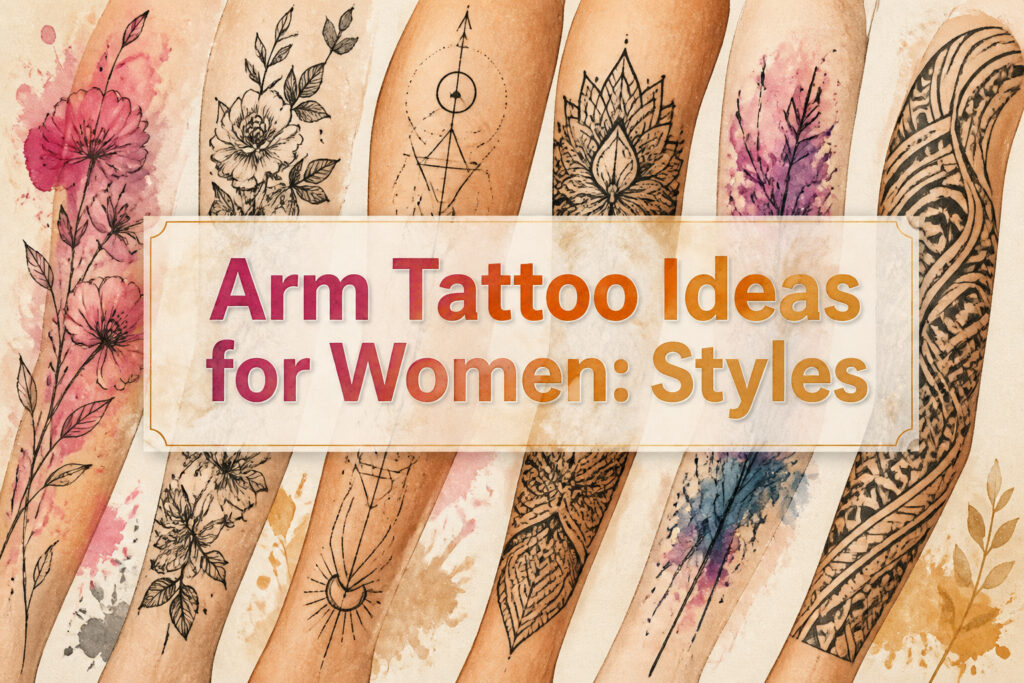
Arm tattoos for women range from a $150 single-needle botanical to a $2,500 full sleeve, and the deciding factor is not design alone but how much maintenance you will actually schedule. Watercolor work fades to pale blur within five years without touch-ups, while bold traditional blackwork holds two decades, so the style you choose is really a question of long-term budget and tolerance for return visits.
1. Floral Tattoos
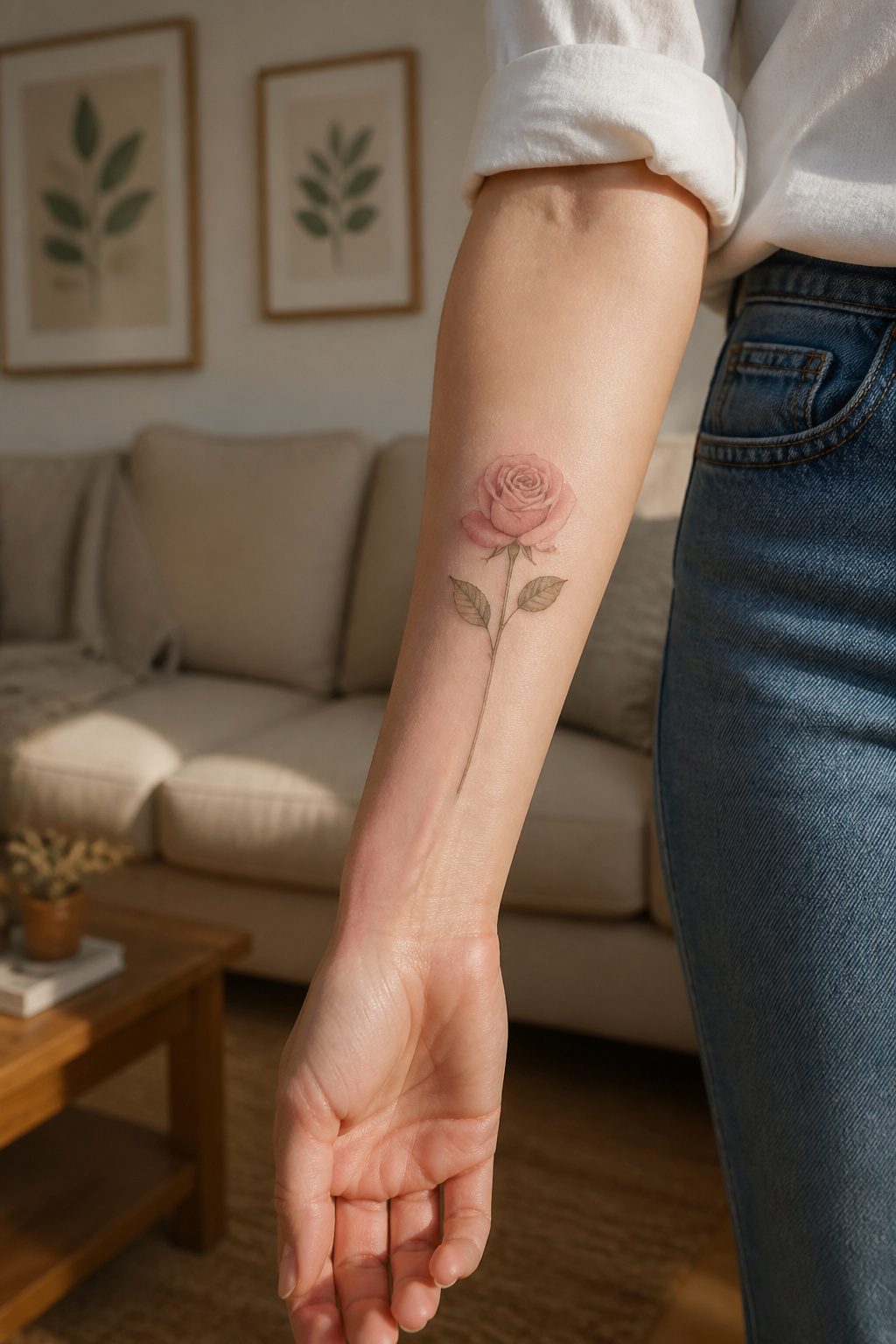
Roses still dominate floral arm tattoos for women, and after reading through the designs that keep surfacing across shops and portfolios, the staying power makes sense. A single rose on the forearm carries its weight in meaning without demanding a sleeve commitment, which is why first-timers gravitate toward it. The upper arm and forearm both suit fine line work, where the needle weight keeps petals readable at smaller sizes without the blur risk that heavier blackwork faces on those spots.
Placement splits cleanly by lifestyle need. The upper arm hides under a short sleeve for offices that care, while the inner forearm sits visible for anyone whose work allows it. Size follows the same logic: a small cluster tucks against the wrist bone, but a rose that needs to wrap the shoulder demands the real estate of a half sleeve at minimum.
Flowers stay the default starting point because the symbolism is already understood. A rose signals love and beauty without the explanation a geometric piece might need. That built-in meaning lowers the stakes for someone still learning what they want ink to say about them.
2. Butterfly Tattoos
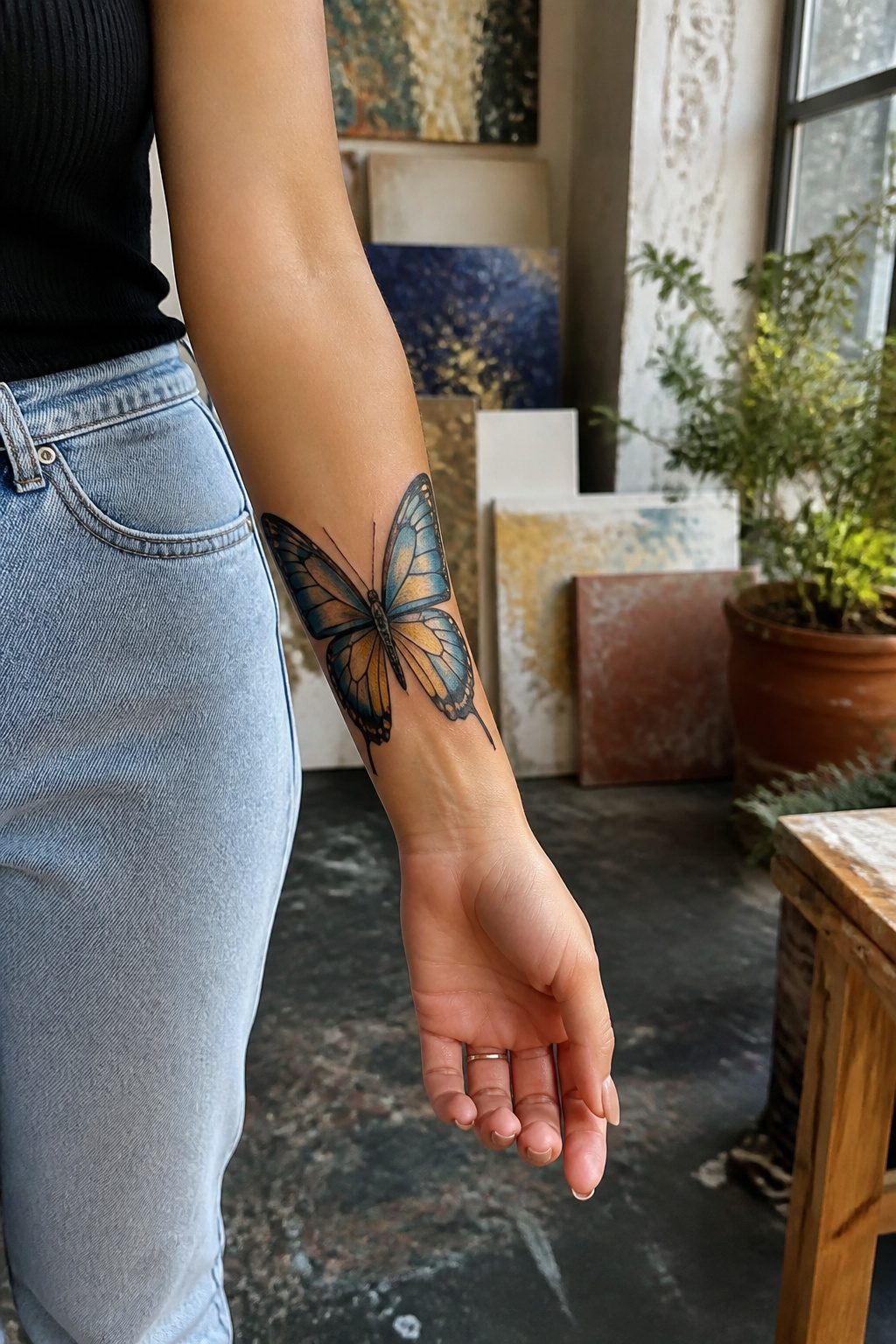
Butterflies land on arms for a reason: the wing span follows the natural curve of a forearm like it was drawn for it. A design that opens upward from wrist to elbow catches the eye every time you reach for a coffee or shake hands, which makes the forearm the go-to spot if you want the meaning visible without working for it.
The wrist sits at the other end of the pain scale. Sources describe the sensation across the arm as a persistent, sharp scratching, but the wrist with its thin skin and proximity to bone turns that up noticeably. Fleshier areas like the outer bicep or standard forearm are easier sessions. If you are set on the wrist, keep the detail simple; fine lines there blur faster and the discomfort compounds with time in the chair.
Symbolism is where butterfly tattoos earn their staying power. The metamorphosis from caterpillar to winged form maps cleanly onto lived change: leaving something behind, surviving something, starting clean. A black outline reads as quiet reminder; color work pushes toward joy and comfort. Either way, the shape itself does the symbolic lifting, so the design need not be busy to carry weight.
Wrist placement frames the tattoo like jewelry, visible to you first of all. Forearm placement turns it outward, a conversation starter rather than a private token. The curvature of the arm flatters both, but the wing span along the forearm’s longer canvas gives more room for the geometry to breathe.
3. Snake Tattoos
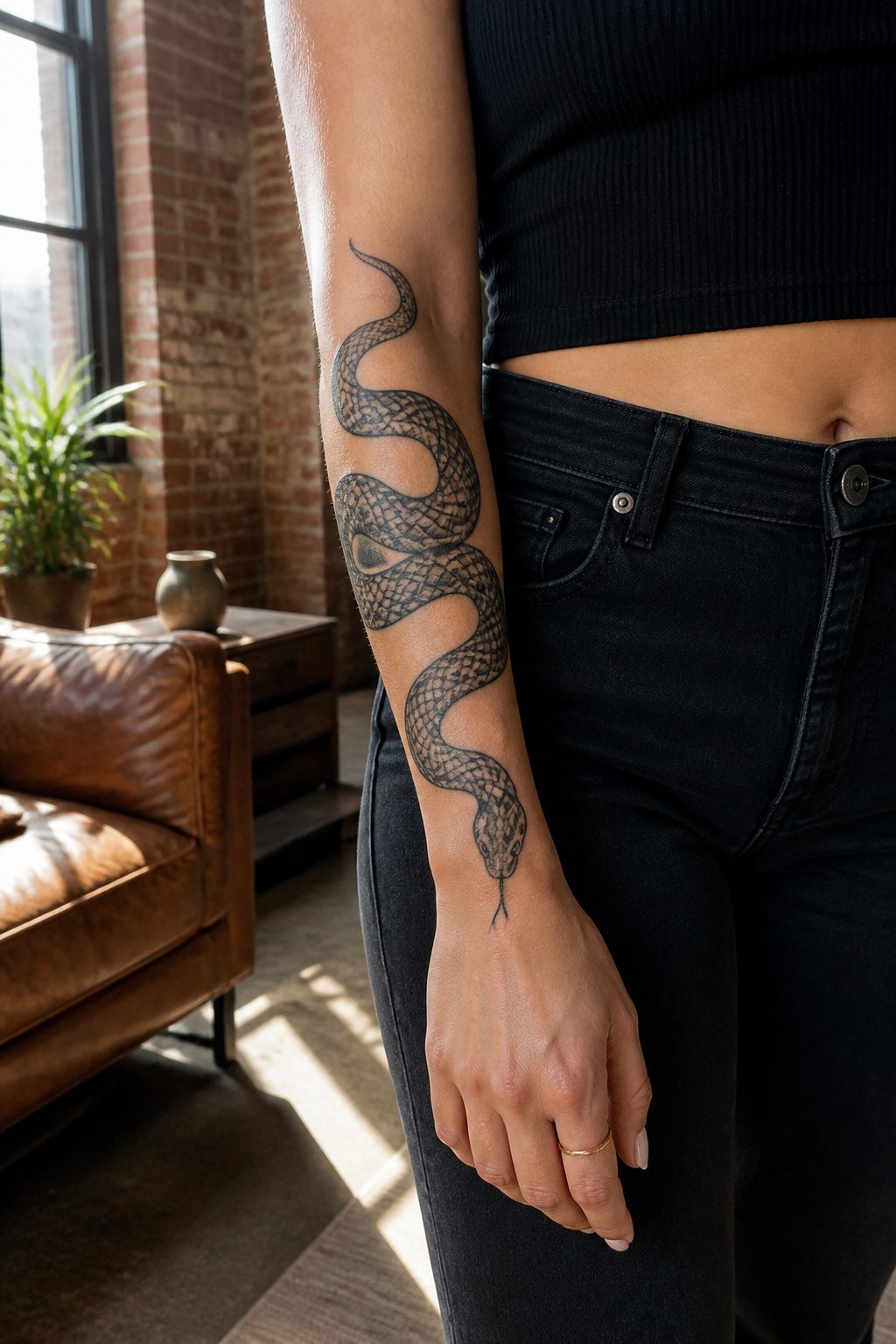
Snake designs rank among the most requested arm tattoos for women, and the reason is largely practical. The long, narrow body of a snake follows the arm’s natural muscle line in a way few other subjects do, wrapping from shoulder to wrist or coiled around the forearm as a living bracelet. That flexibility matters when you’re deciding between a single visible piece and the anchor for a full sleeve.
The symbolism runs deep enough to split opinion, which is part of the appeal. Shedding skin maps cleanly onto rebirth and transformation, something several ancient cultures tied to fertility and new life. The same creature carries venom associated with healing in some traditions and deception in others, so the tattoo can mark growth or act as a reminder of past mistakes. Either reading is valid; the meaning sits with the wearer.
The wrap placement works best when the snake’s head lands at a natural stopping point, the wrist or the inner arm, where the eye meets yours every morning. Upper arm placement draws from the same protective associations that made this area a shield symbol historically, and the muscle there handles detailed scale work without distorting the image as the skin moves. Pain levels stay relatively manageable on the upper arm, which helps if this is a first tattoo or if you’re committing to the long sessions a full wrap requires.
Black ink dotwork catches the texture of individual scales without the heavy fill that can blur over time. The result reads as intricate from arm’s length and still holds up when someone asks to look closer.
4. Watercolor Tattoos
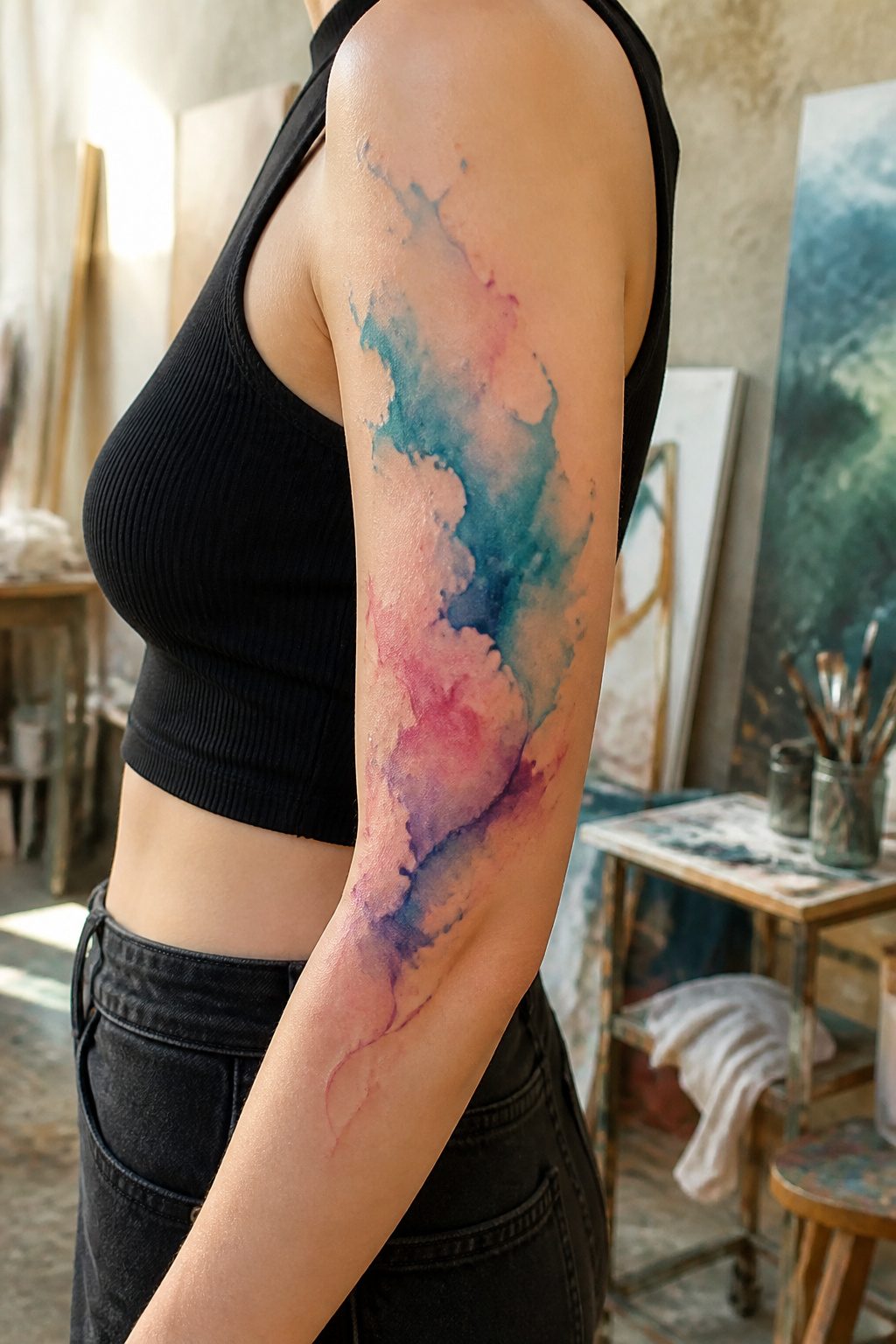
Watercolor tattoos borrow directly from paint on canvas: color bleeds and fades at the edges rather than holding a hard black outline. The technique needs room to breathe, which is why the upper arm or a full sleeve from shoulder to wrist carries it better than a small wrist piece where the soft edges look muddy instead of intentional.
The trade is real maintenance. Without dense black ink anchoring the design, watercolor work fades faster and demands touch-ups more often to keep those soft color fields from washing out to a pale blur. The same flowing quality that makes the style beautiful on day one works against it by year five. If you are drawn to this look, budget for that upkeep from the start and place it where you will actually schedule the return visits.
5. Geometric Tattoos
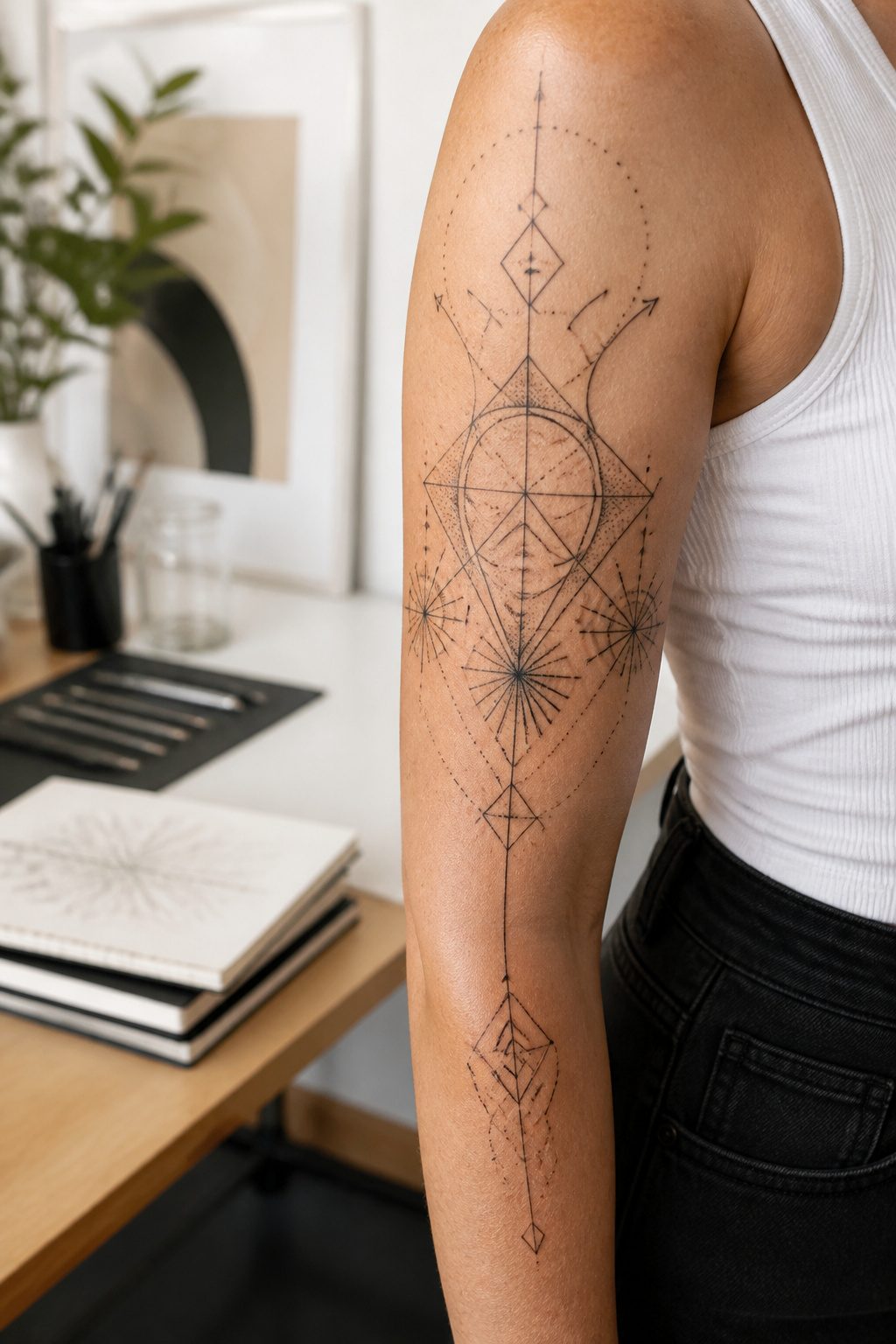
Sharp, clean lines behave differently on the flat plane of a forearm than they do over curved muscle. Geometric work, including mandala-adjacent patterns and sacred geometry, relies on that flat surface for symmetry; the design reads as intended only when the eye can travel uninterrupted.
I have watched artists map these pieces with a ruler and stencil, then freehand the final pass. The precision matters because geometric tattoos extend cleanly into full sleeve work, each band or shape locking into the next with mathematical regularity. The elbow sits at the center of this, often carrying a mandala or web that connects upper and lower arm into one continuous sleeve.
The skin here is thin over bone, and the needle must hold steady through the vibration. Crisp edges demand a practiced hand and fine needles; without both, the line wavers and the whole piece softens into something the eye distrusts. An armband, wrapping like jewelry, can stay simple or grow dense with pattern, but either way the circumference must close exactly or the gap shows every time the arm turns.
6. Quote Tattoos
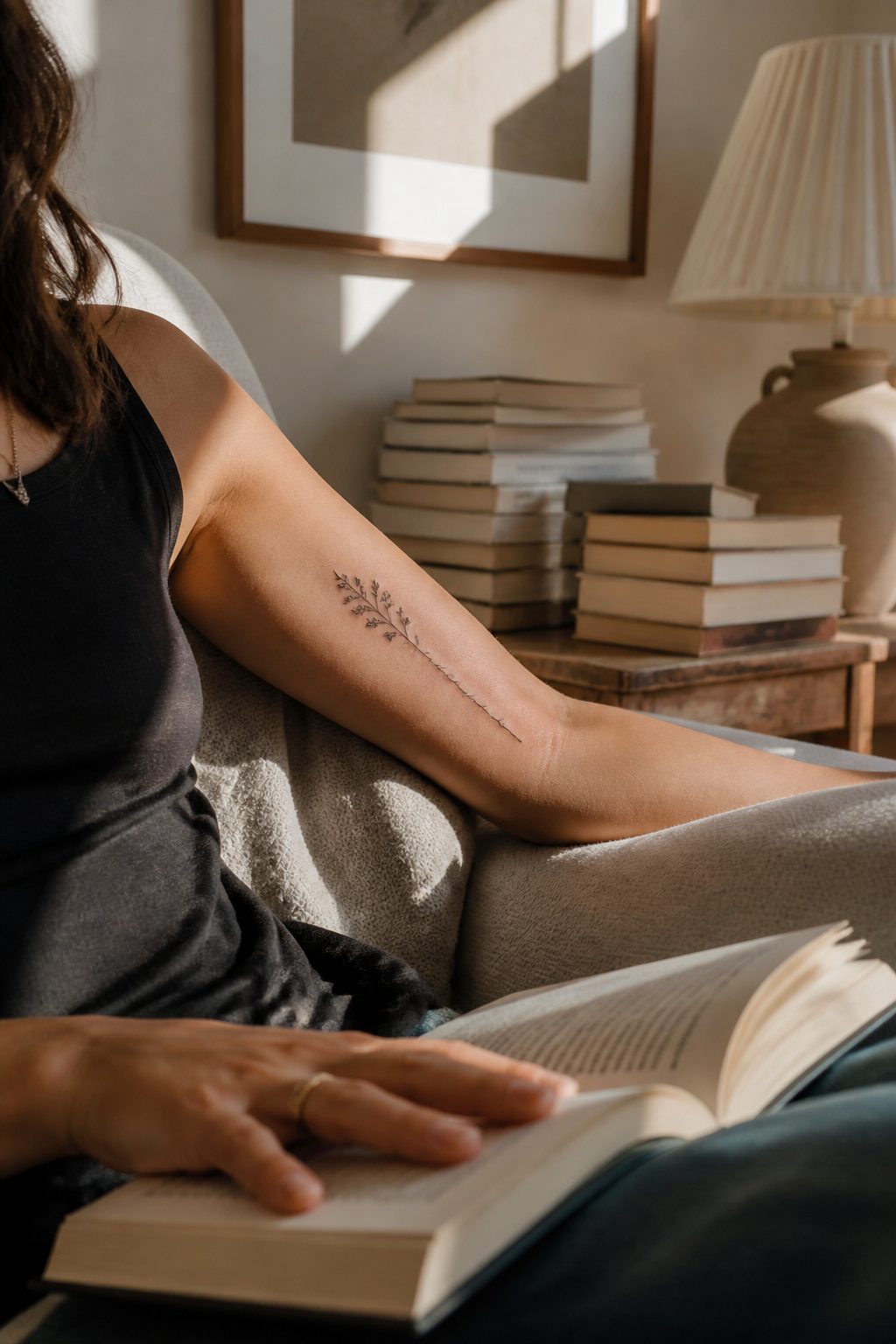
Text on skin ages differently than image work, and quote tattoos test that rule the hardest. "Self-love" has become the phrase I see requested most often on forearms and inner biceps, a placement choice that splits cleanly between private reminder and public statement. The inner bicep keeps the words for mirrors and chosen company; the outer forearm broadcasts them to coffee shops and coworkers.
Font selection matters more than the words themselves. Script and thin serif styles blur faster on skin that moves and stretches, which is why fine line lettering runs $150 to $350 per hour and still needs refreshing every three to five years as ink settles. Bold traditional lettering holds twenty-plus years but reads louder than many women want for a mantra meant as daily armor.
I have watched clients debate this tradeoff for hours: readability at age fifty versus the delicacy that drew them to the idea. The inner forearm offers the compromise, visible to the wearer without announcing itself across a room, and the skin there resists stretch better than the inner upper arm if pregnancy or weight fluctuation is part of your future.
7. Animal Tattoos
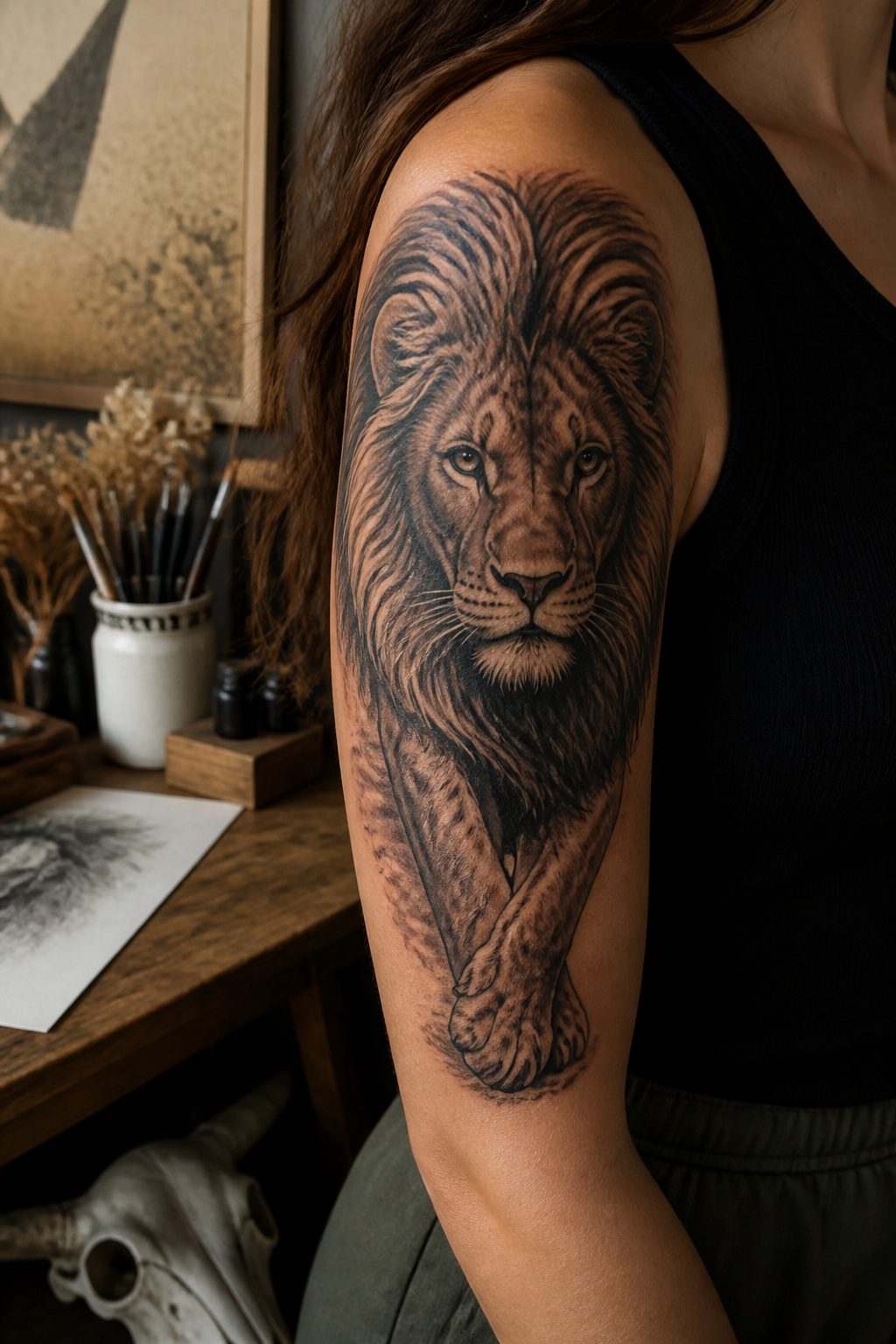
Animal tattoos on the arm live or die on whether the artist can read muscle underneath skin. A lion rendered flat against the deltoid looks pasted on; the same design, curved around the curve of the shoulder and dropping slightly with the tricep, starts to breathe. The upper arm’s rounded plane is what makes muscular animals work there, and four separate rankings back the lion as the most requested choice in this category, ahead of tigers and other wildlife.
Realism matters more with animals than with any other subject. A geometric butterfly forgives a shaky line; a lion’s eye placed a millimeter off destroys the whole face. The upper arm’s visibility, noted across sources, becomes a liability here: you cover it easily with sleeves, but you also live with the portrait daily, and any flaw in proportion stares back. Snakes coil well up the arm because the body’s length follows the limb’s length, a natural read that a lion’s compact head does not automatically share.
My own preference, having watched clients heal these over years, is for the lion slightly above center on the outer arm, where the shoulder’s mass helps the mane and the eye line meets a viewer at full height. Tigers read better in motion, stretching across the bicep, stripes carrying the eye along the muscle’s length. Either way, the arm’s anatomy is doing half the artistic work; the tattooist’s job is not to fight it.
8. Mandala Tattoos
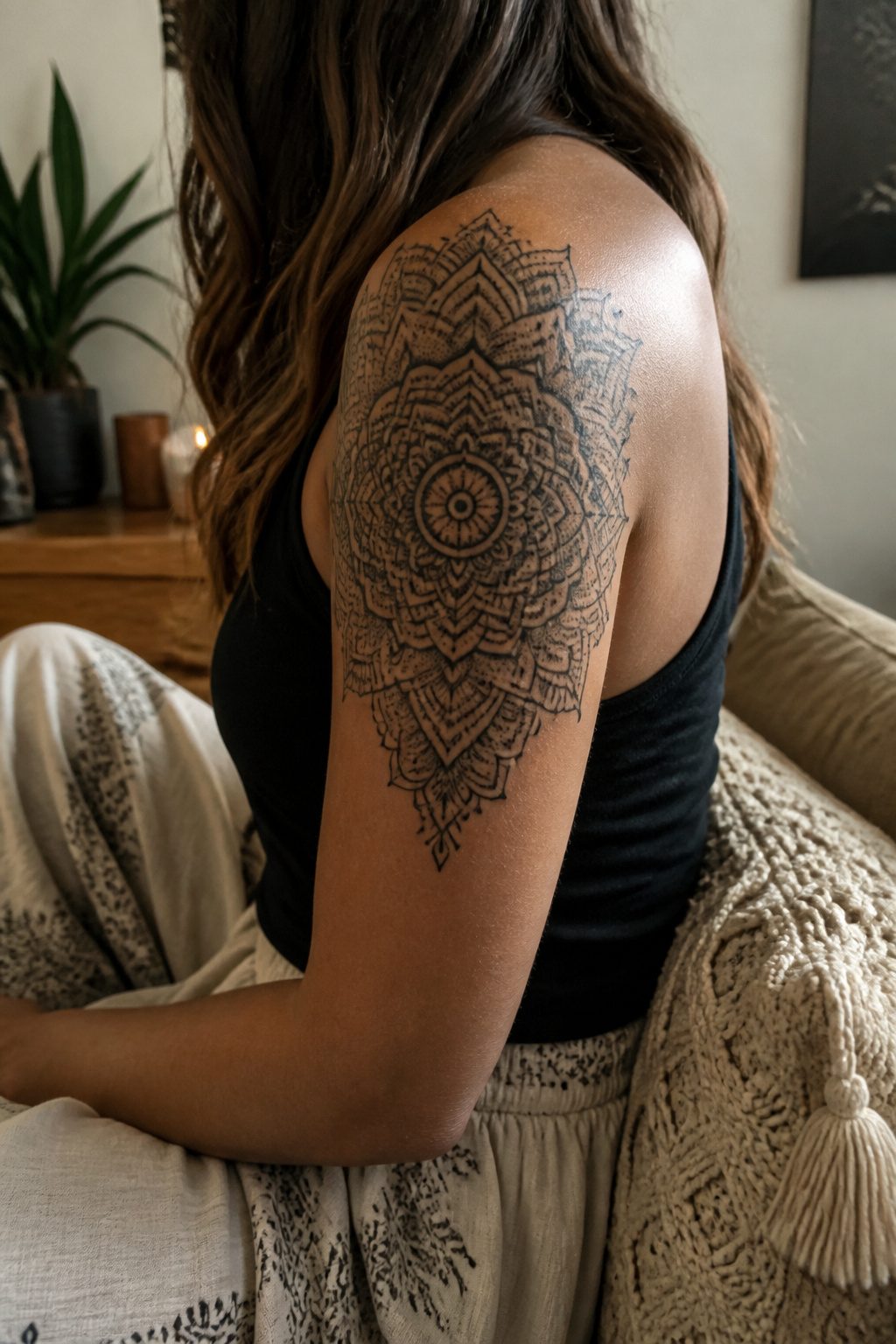
Mandala patterns trace back to Hindu and Buddhist practice, where the circular form stood for the sun, the universe, and the stars. The center point anchors to a specific location like the elbow or shoulder, and the design radiates from there in symmetrical layers of triangles, circles, and interlocking shapes. The elbow placement makes the mandala read as a bold focal point, though it sits on bone and tends to hurt more than fleshier spots. A shoulder center works softer and connects more naturally to sleeve work that moves down the arm. The modern adaptation keeps the sacred geometry but strips away the ritual context, so what you get is visual balance rather than religious statement. If you are deciding between placement, the elbow wins for impact and the shoulder wins if you plan to expand into a larger piece later.
9. Tribal Tattoos
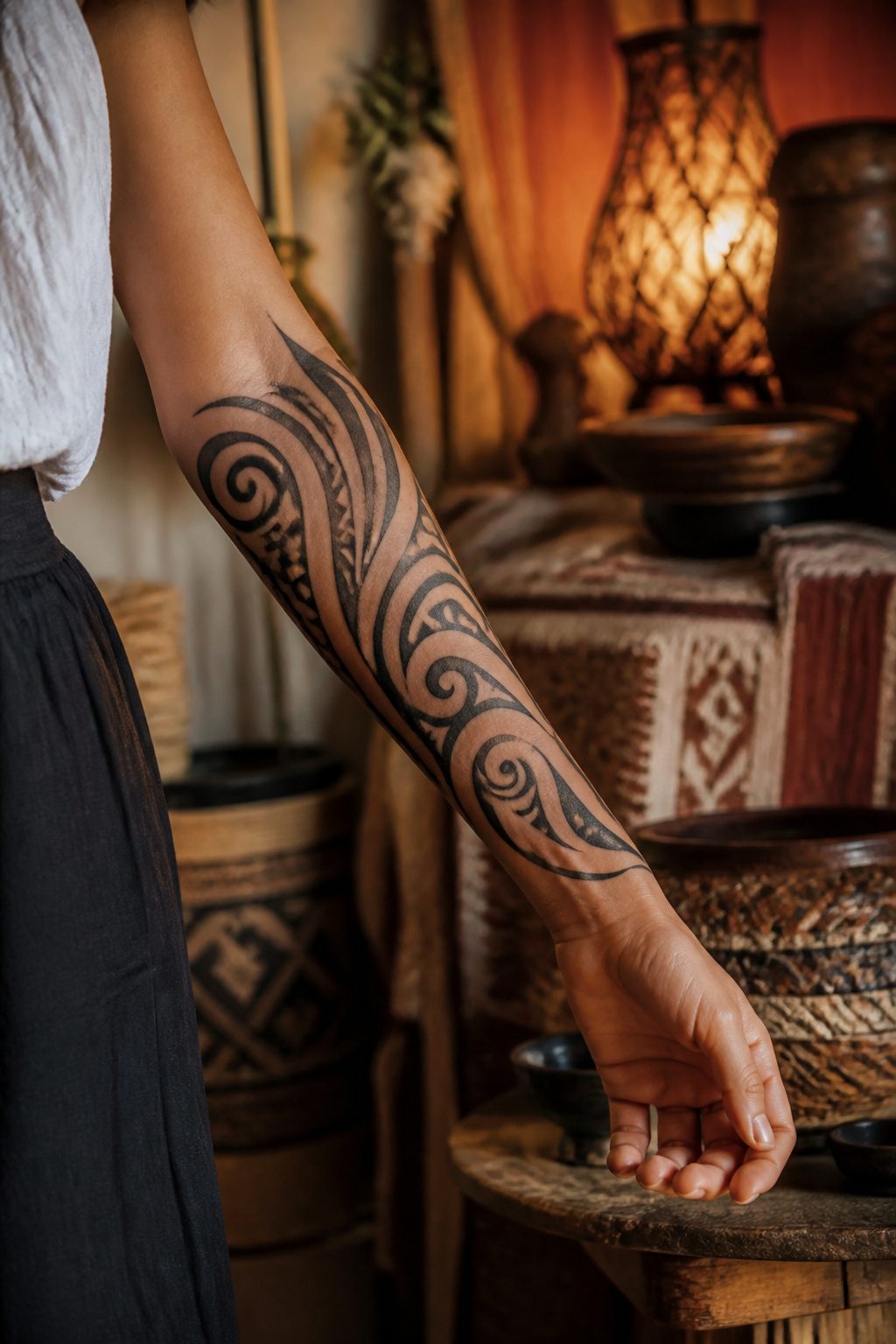
Tribal patterns on the arm carry a weight that floral or geometric work usually doesn’t. The bold black ink and repeating motifs descend from Polynesian and Maori traditions where tattooing marked status, identity, and rite of passage. Those origins matter, because wearing them now without that lineage raises a real appropriation concern. Modern adaptations often strip away the specific cultural grammar, turning sacred patterns into decorative texture.
The visual appeal is undeniable, though. Solid black work holds up. For arm placement, bold traditional styles carry 20-plus years before significant fade, while fine-line alternatives need touch-ups every 3–5 years as the ink spreads. The outer shoulder or outer forearm handles this best, sitting at roughly a 3/10 pain level and staying clear of the inner bicep’s thinner, more nerve-dense skin. Weight fluctuation and pregnancy distortion hit the inner upper arm hardest, so the outer deltoid or forearm resists stretching better.
My read on this: if the pattern draws from a tradition you don’t belong to, the respectful move is commissioning an artist who reinterprets rather than copies, or choosing abstract blackwork that nods to the form without claiming the meaning.
10. Abstract Tattoos
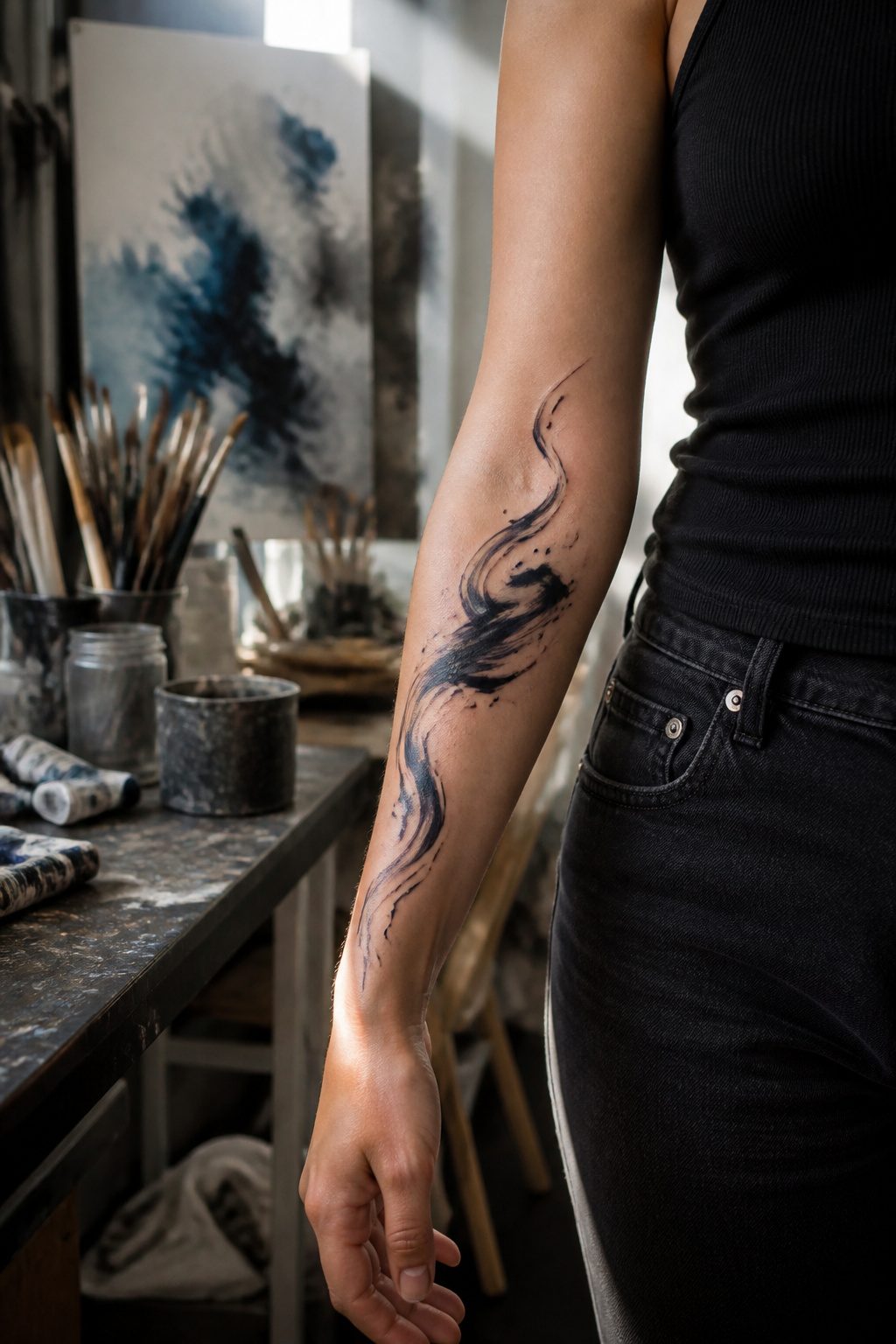
Abstract work lives in the space between recognition and feeling. A sweep of cobalt thinning to nothing, a hard edge of black against skin tone, a cluster of marks that read as motion rather than object: these are the marks abstract tattooing trades in. The style hands the viewer a problem to solve, which is why it ages better on an arm than literal imagery. A rose dates itself; a shape that might be water or might be memory does not.
What drew me to this style, reading through portfolios and artist statements over the years, is how abstract cover-up work hides old ink without pretending to be something else. A geometric sleeve needs a blank canvas. A field of color and texture can swallow a name or a blown-out tribal piece and never announce itself as correction. The new piece reads as intention, not repair.
Artists who build careers here tend to come from fine-arts backgrounds rather than street-shop apprenticeships. They think in terms of composition first, symbol second. The best of them, the ones whose books stay closed for months, treat the arm as a cylinder to be circled rather than a flat page to be filled. Color saturation shifts as the body turns, so the design completes itself only in motion.
The risk is interpretation without anchor. Pure abstraction can feel like decoration rather than tattooing. The artists who solve this ground their work in something physical: the weight of pigment, the direction of a line, the way scar tissue from old work becomes texture in the new. The result is personal without being private, which is the balance arm tattoos for women in this style need to strike.
11. Religious Symbols
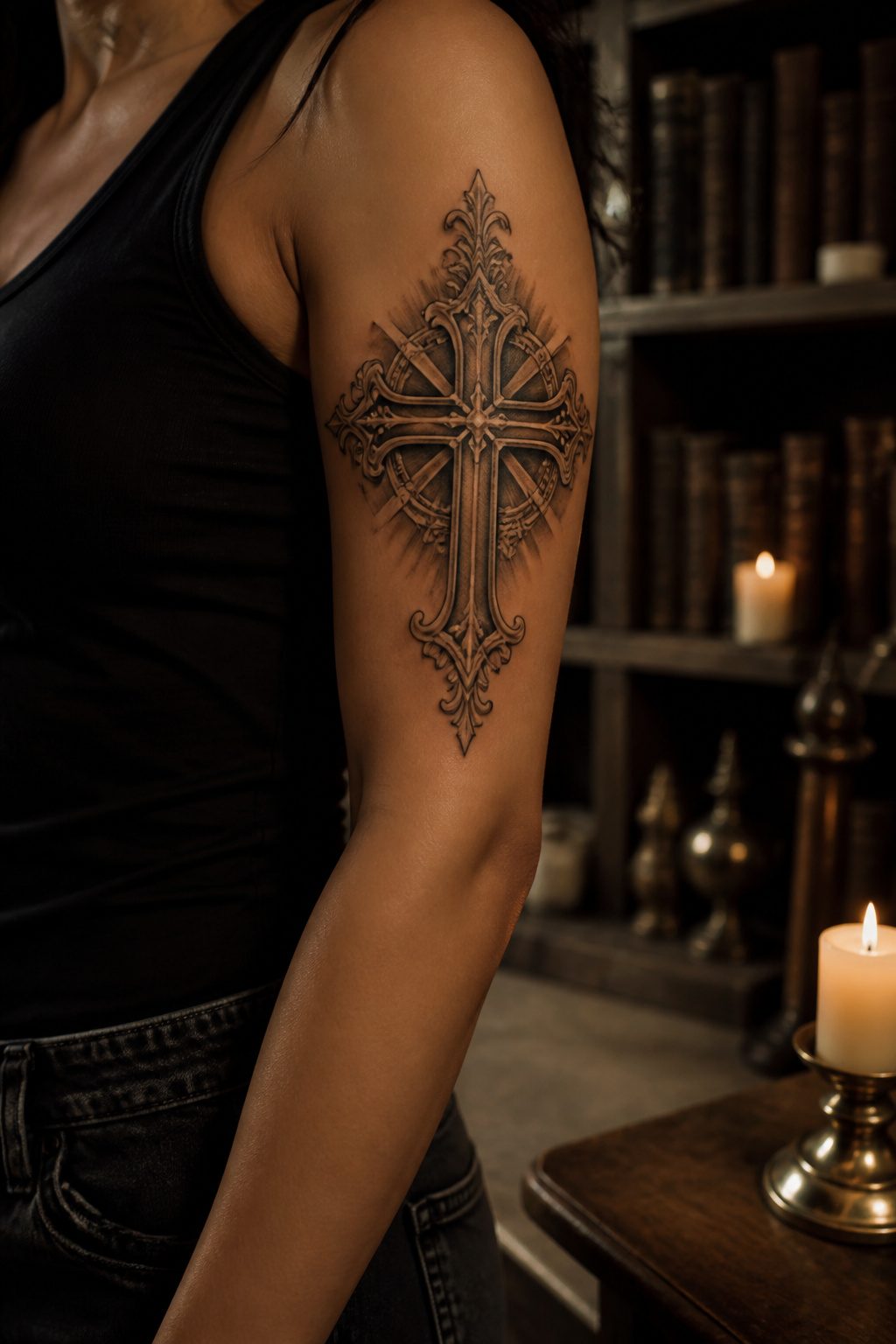
A crucifix on the forearm makes devotion public by default; the upper arm lets you choose when it shows. That visibility split matters more than most people think through before booking. Fine filigree around a cross, seraphim wings, or script in Latin all read beautifully at first, but religious iconography with hairline detail is where aging hits hardest. Skin shifts, ink settles, and a thorn crown rendered at two inches across can blur into an unidentifiable smudge inside ten years. The passages note upper-arm placement as historically protective and relatively less painful, which tempts some toward smaller work there, but the same spot’s movement and sun exposure accelerate that blur.
Size is the guard against it. A crucifix with readable detail needs room; the passages don’t name a measurement, but the accepted minimum among artists for recognizable script or facial features in a cross scene is roughly palm-sized or larger. Go smaller and you are betting the piece ages into amorphous dark pigment rather than readable symbol. The inner bicep offers shelter from sun and stretching both, though the tradeoff is a narrower canvas that forces simpler composition. Two ways to play this: place a complex scene high enough for short sleeves to cover, accepting limited width, or simplify the imagery to bold black-line geometry that holds at smaller scale. The second option wins if your concern is how the tattoo reads at fifty, not just how it photographs next week.
12. Minimalist Tattoos
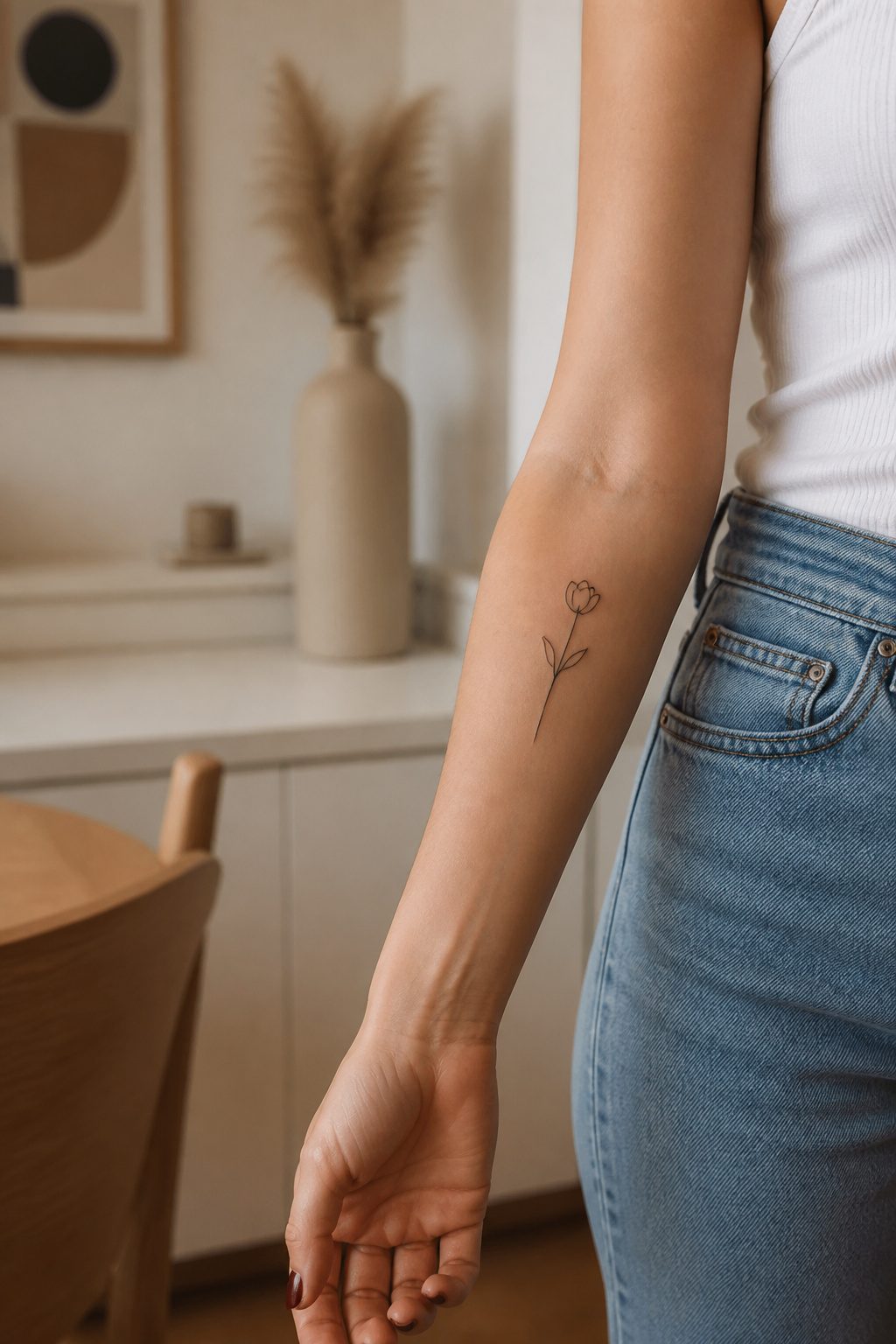
Single-needle and fine-line work draw the biggest share of first-timers through the door, and for arm tattoos for women the appeal is obvious. The needle cluster is tiny, one round point or three at most, so the artist builds tone with hair-width passes instead of packing solid fields of ink. A small botanical or geometric piece on the inner forearm sits naturally hidden, easy to show or cover, and the deltoid cap works the same way for something you want more discreet.
The hourly rate for this level of detail runs $150 to $350, which sounds steep until you realize a palm-sized piece might take forty-five minutes. The tradeoff comes later. Less ink saturation means faster fading, especially where skin sees friction or sun. Ultra-fine lines on the outer wrist or elbow can blur or disappear within one to two years from joint movement alone. The inner forearm holds up better, less UV exposure and less flex, but even there a touch-up every few years is part of the real cost.
13. Full Sleeve Tattoos
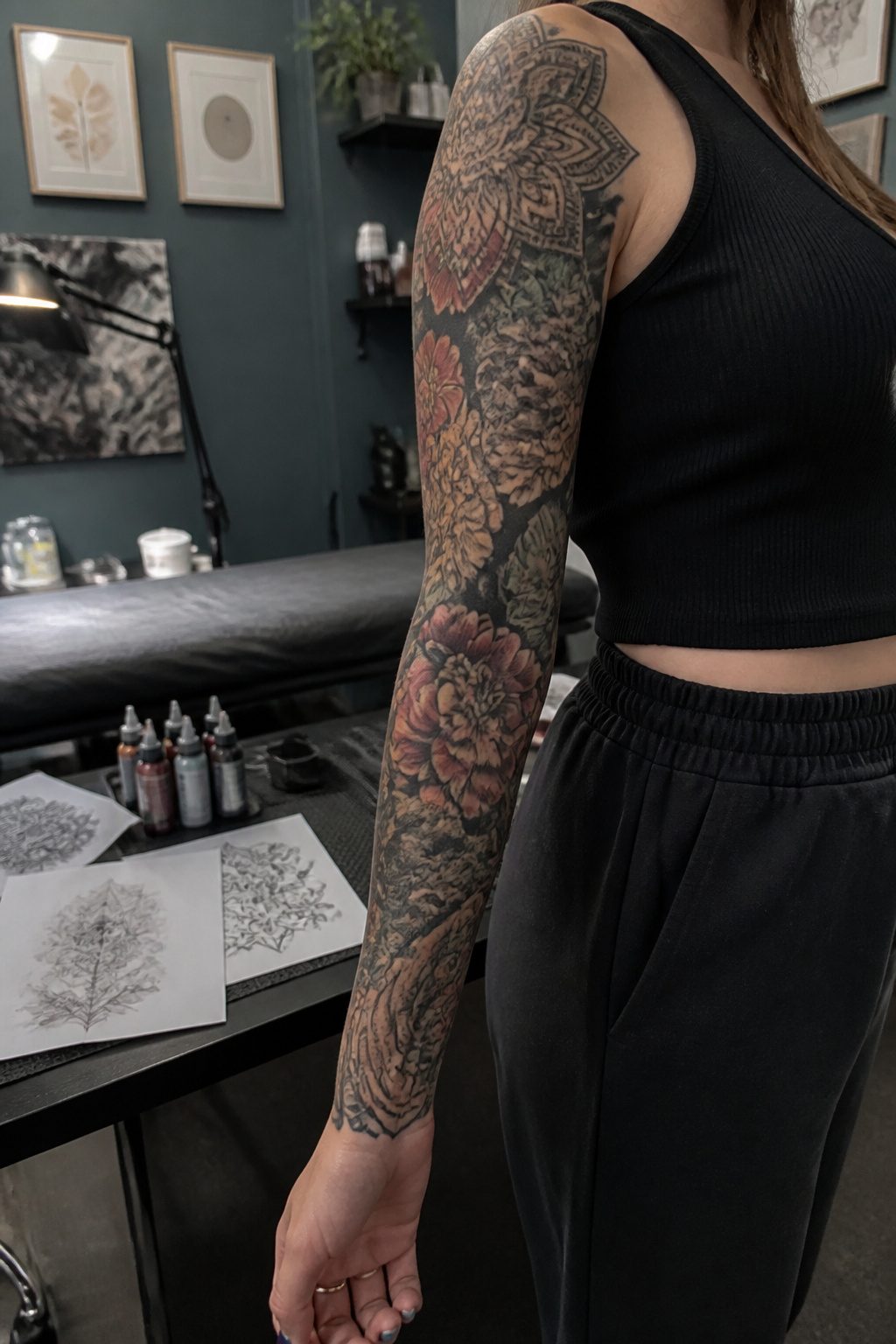
A full sleeve tattoo runs $2,500 or more, and that figure only buys the hours, not the months. Planning the design as one coherent piece matters more here than with any other arm option, because a sleeve built from disconnected sessions tends to read like a collage someone outgrew. The outer arm sits at about a 3 out of 10 for pain, but the inner bicep hits 7, which means some of those long sessions will test tolerance more than others.
Surface healing takes two to three weeks, yet the deep dermis needs three to four months, so the multi-session reality stretches across half a year or longer even when the calendar and budget allow back-to-back bookings. Starting with a single forearm piece and adding outward over time can work, though the artists who do sleeves best usually prefer mapping the whole arm before the first needle touches skin. Half the commitment gets a similar effect; the full thing only wins if the canvas itself, not just the images on it, is the point.
14. Half Sleeve Tattoos
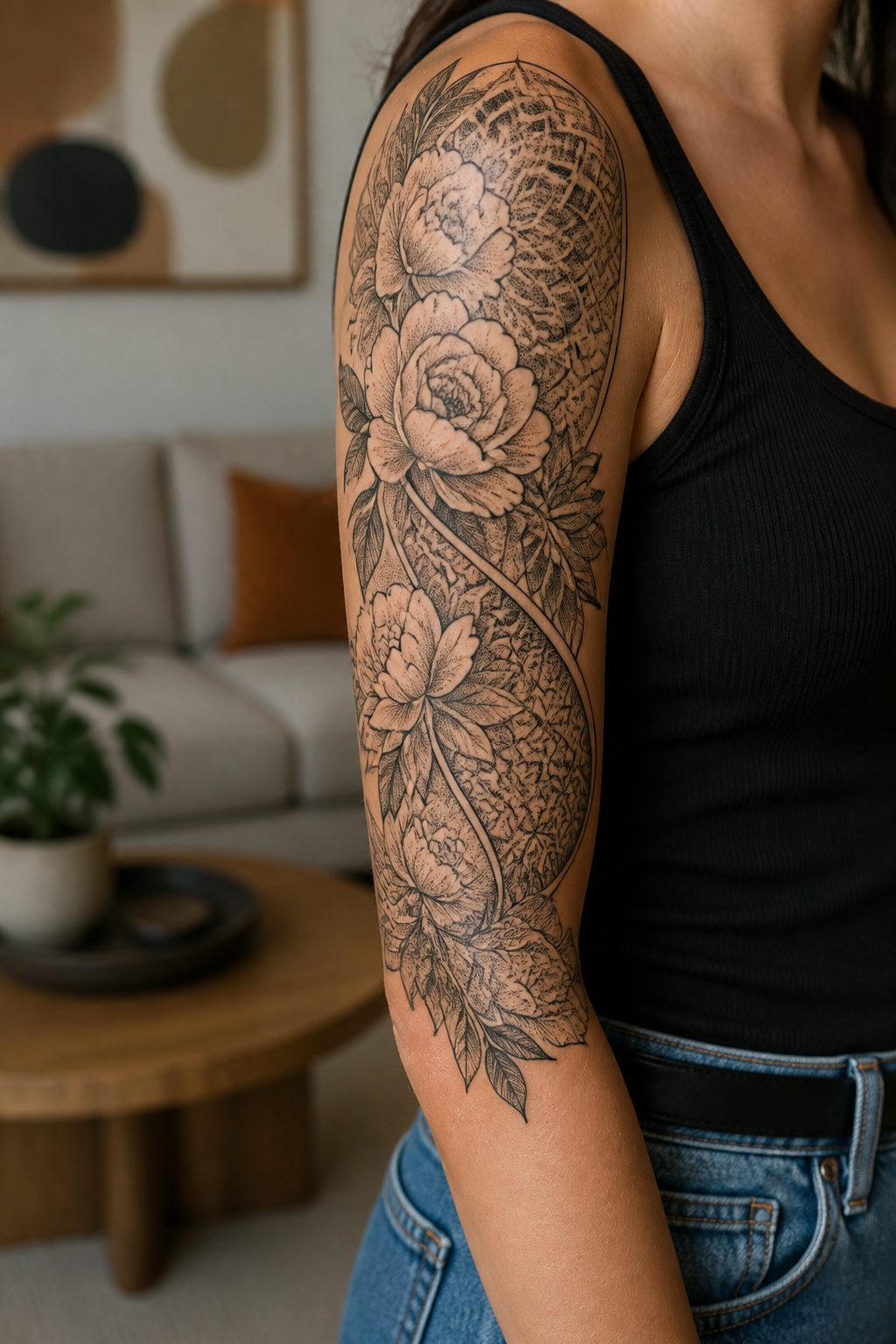
A half sleeve keeps the commitment manageable while still giving a tattoo room to breathe. The elbow and shoulder create natural stopping points, so the design reads as finished rather than abandoned. Upper placement makes covering it simple: a short sleeve hides the work completely, and that privacy appeals to women who want the option. Lower half sleeves on the forearm flip the tradeoff. The ink stays visible day-to-day, which works if you are building toward a full sleeve later or simply prefer to see the piece yourself.
Cost scales down from the full sleeve baseline of $2,500, though hourly rates for fine line work still run $150 to $350. Pain sits at opposite ends of the scale depending on which half you choose. The outer arm rates about a 3 out of 10, while the inner bicep jumps to a 7. That gap matters when you are deciding between one long session or several shorter ones. Healing stays consistent either way: surface recovery in two to three weeks, deeper dermis in three to four months.
15. Armband Tattoos
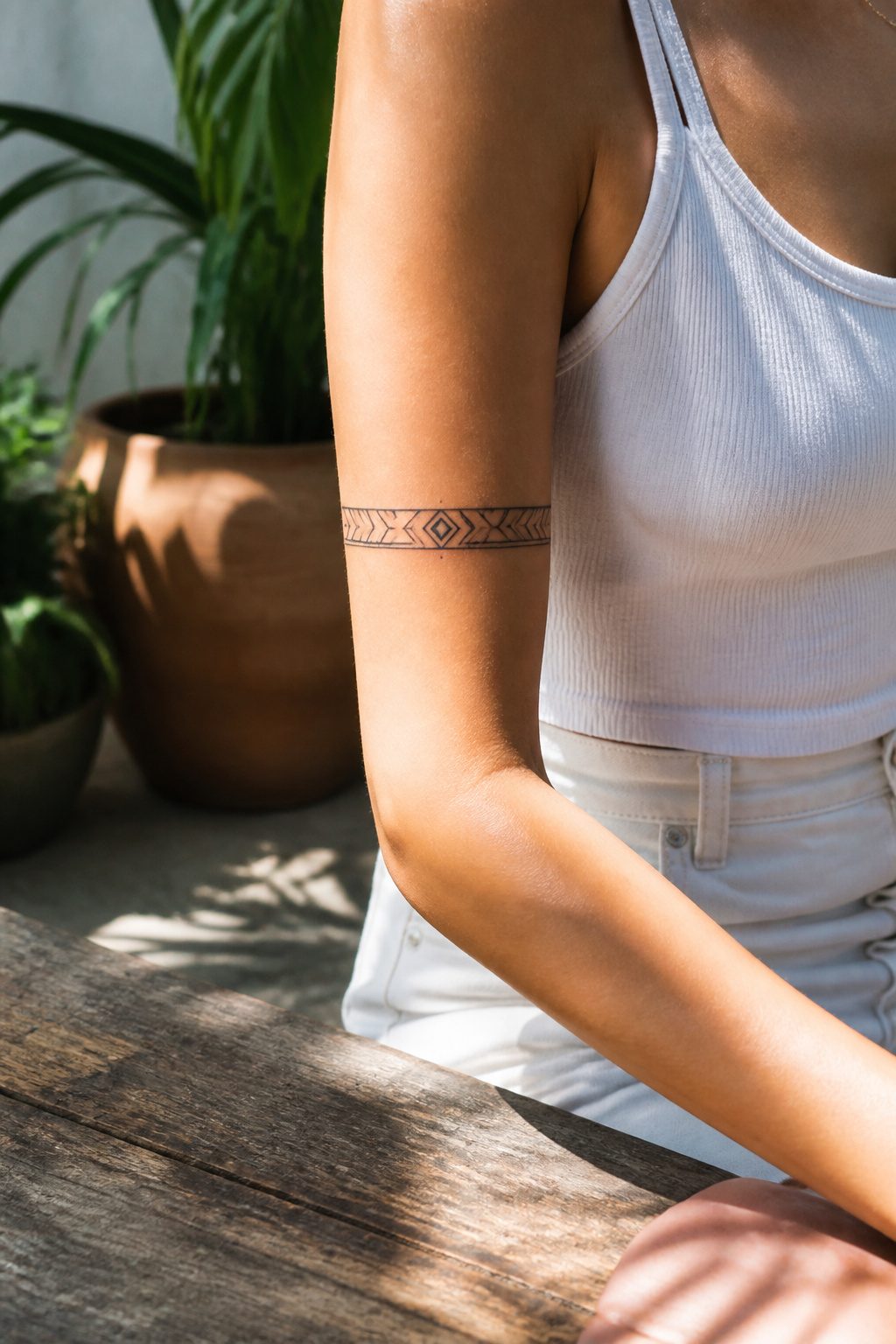
The armband circles the upper arm or forearm like a ring on a finger, a placement that has resurfaced across cultures for thousands of years. Ancient Polynesian designs used the form to mark status and identity, and the shape still carries that sense of deliberate statement. Modern versions split cleanly into two camps: geometric bands built from repeating lines, dots, or minimal shapes, and floral or vine bands that soften the edge with organic curves.
The band’s interaction with the body is where most designs succeed or fail. A horizontal band on the forearm will warp noticeably when the radius and ulna twist during daily movement, so straight geometric lines there read as crooked more often than not. The upper arm gives more forgiving canvas. The deltoid’s rounded surface holds shape through weight change, and a band placed here shifts gracefully with muscle flex rather than fighting it. For athletic builds, the design should follow the muscle’s curve rather than cutting across it. Petite frames face the opposite risk: a thick band visually truncates the arm, where a narrower composition or vertical extension preserves length.
Where It Hurts Most
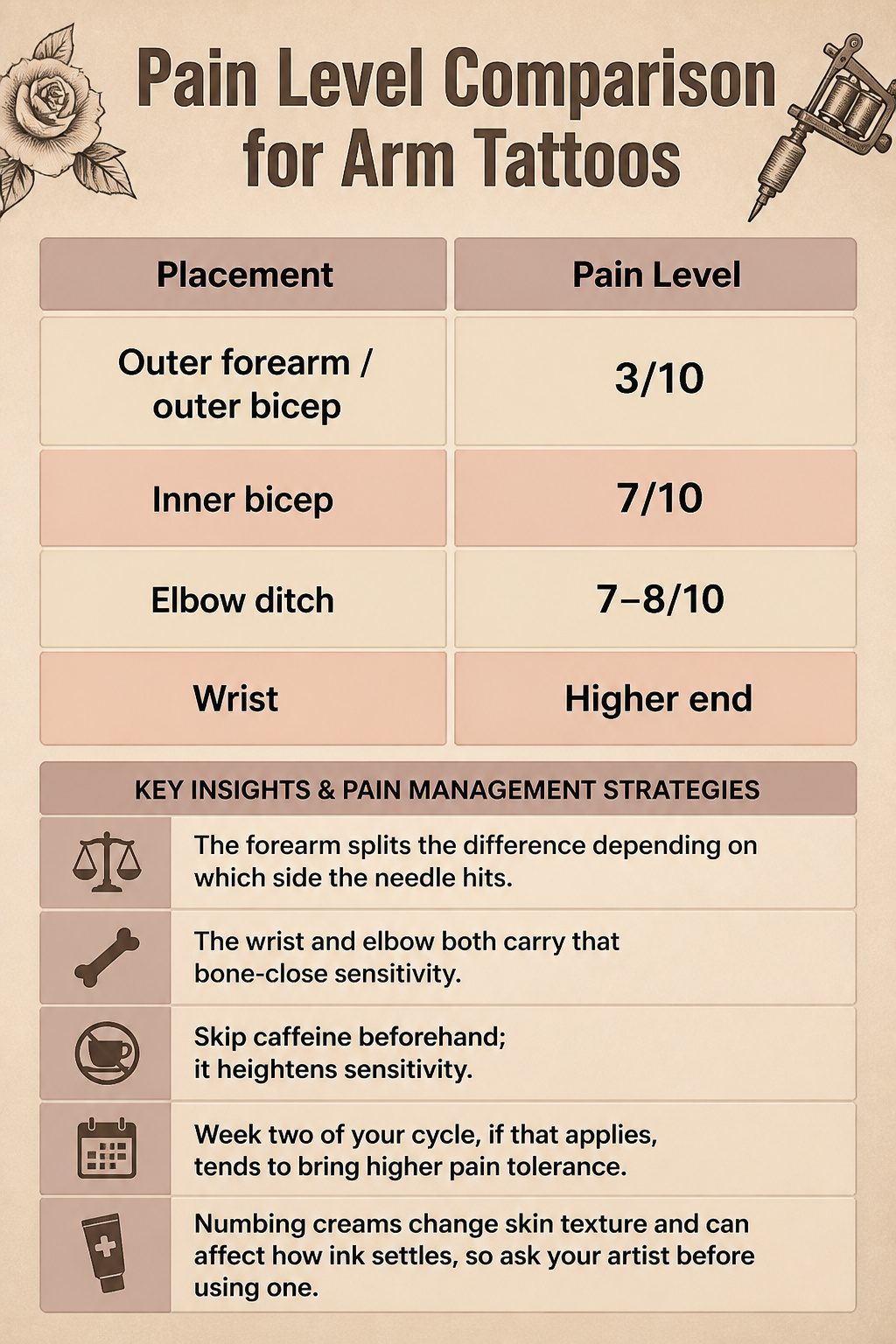
Nerve density across the arm is not uniform, and that matters when you’re booking a session length. The outer arm sits at about a 3 out of 10 for most people, thick skin and fewer nerve endings making it the easiest territory for a first piece or a long sitting. The inner bicep jumps to a 7 out of 10, thin skin pressed close to major nerves, sharp and stinging rather than dull.
| Placement | Pain Level | What to Know |
|---|---|---|
| Outer forearm / outer bicep | 3/10 | Good zone for conversation or music as distraction |
| Inner bicep | 7/10 | Thin skin, major nerves nearby |
| Elbow ditch | 7–8/10 | Similar to inner bicep, sharp sensation |
| Wrist | Higher end | Bone proximity, thin skin |
The forearm splits the difference depending on which side the needle hits. The wrist and elbow both carry that bone-close sensitivity. For session planning, the practical move is clustering easier work together rather than sandwiching a tender spot between two manageable ones. Skip caffeine beforehand; it heightens sensitivity. Week two of your cycle, if that applies, tends to bring higher pain tolerance. Numbing creams change skin texture and can affect how ink settles, so ask your artist before using one.
Healing Timeline
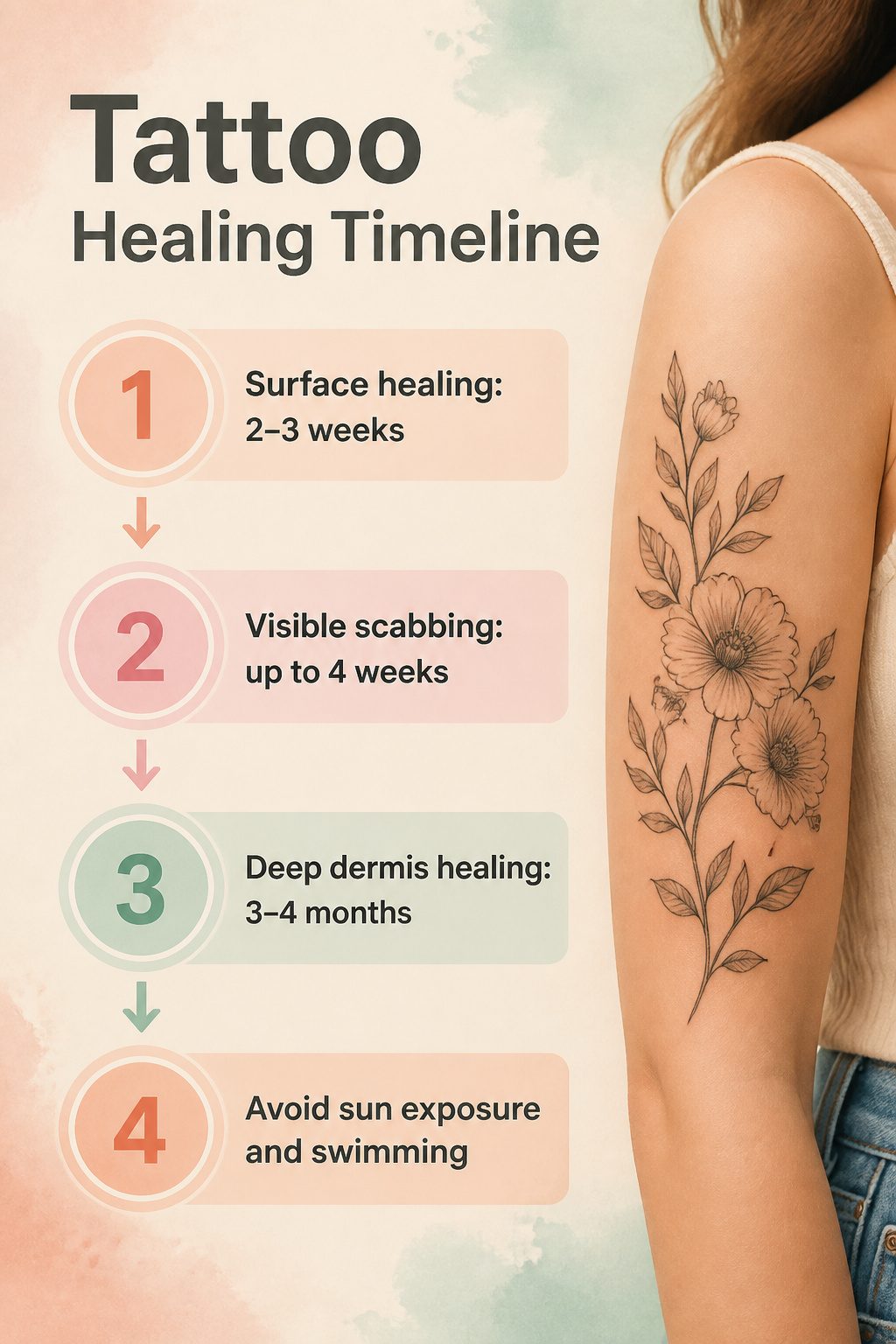
Surface healing on arm tattoos for women runs 2–3 weeks, though some scabbing and peeling can stretch closer to four. That first phase is when the skin closes over and the ink settles enough to look presentable in short sleeves. Deep dermis healing takes longer: 3–4 months before the tattoo actually looks settled, not merely closed. Sun exposure and swimming stay off-limits until that deeper layer finishes, not when the surface looks fine. The outer arm heals faster than inner bicep work, since friction from clothing and movement slows the latter down. If you plan a summer reveal, March or April timing puts the finished result where you want it.
Aftercare That Actually Works
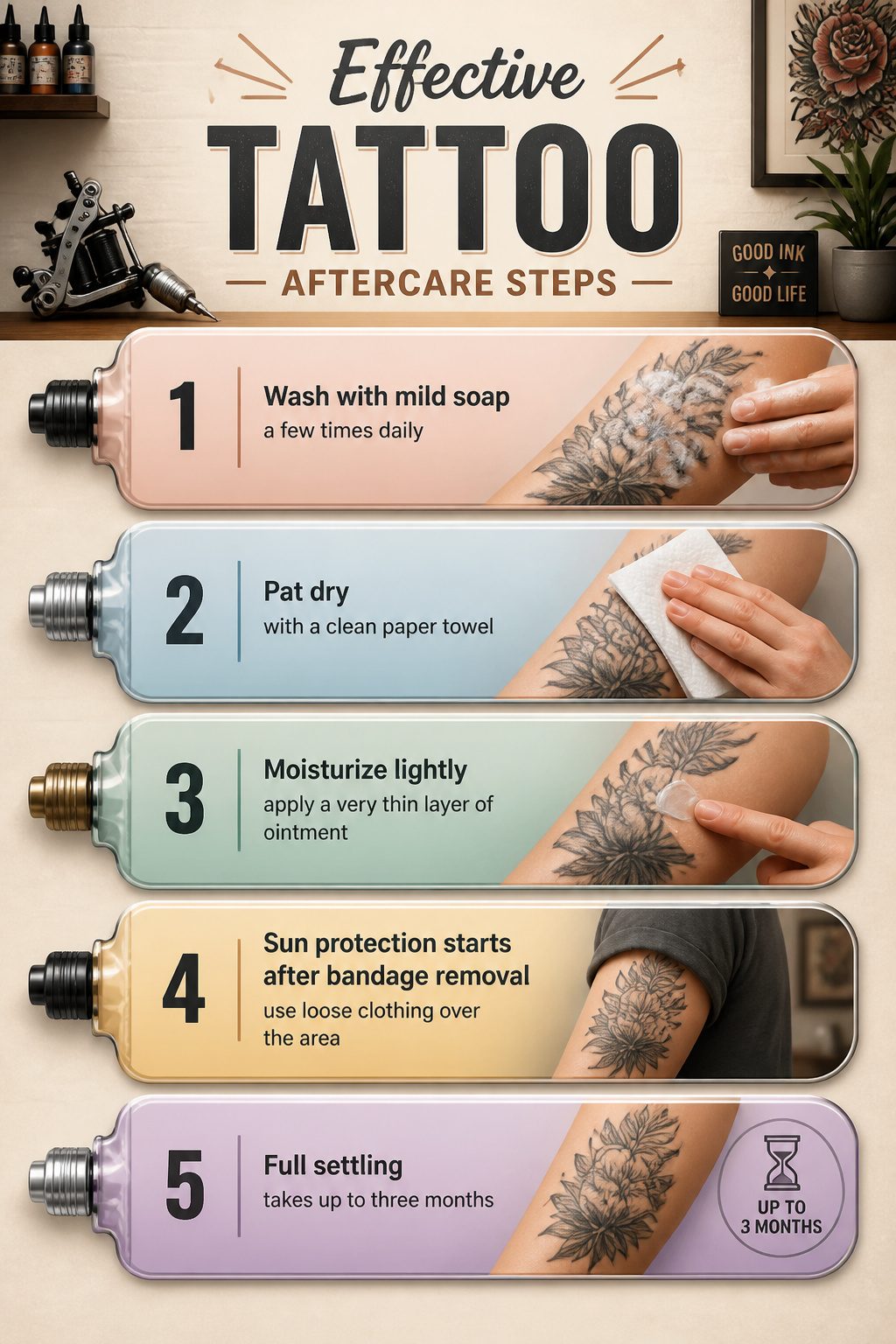
- Wash with mild, fragrance-free soap a few times daily for the first two to four weeks, pat dry with a clean paper towel, and apply a very thin layer of the ointment your artist recommends. Scented lotions during healing irritate the skin and affect ink retention, so skip them entirely.
- Moisturize lightly, but let the skin breathe. A thick coating traps moisture and slows the scabbing and peeling phase that runs those same two to four weeks. The tattoo will itch like a sunburn; scratching pulls ink and leaves patchy spots.
- Sun protection starts the day the bandage comes off. UV rays fade arm tattoos fast, and loose clothing over the area beats a fresh application of anything on healing skin. Full settling takes up to three months, so the deeper layers need that shield even after the surface looks done.
Cover-Up Realities
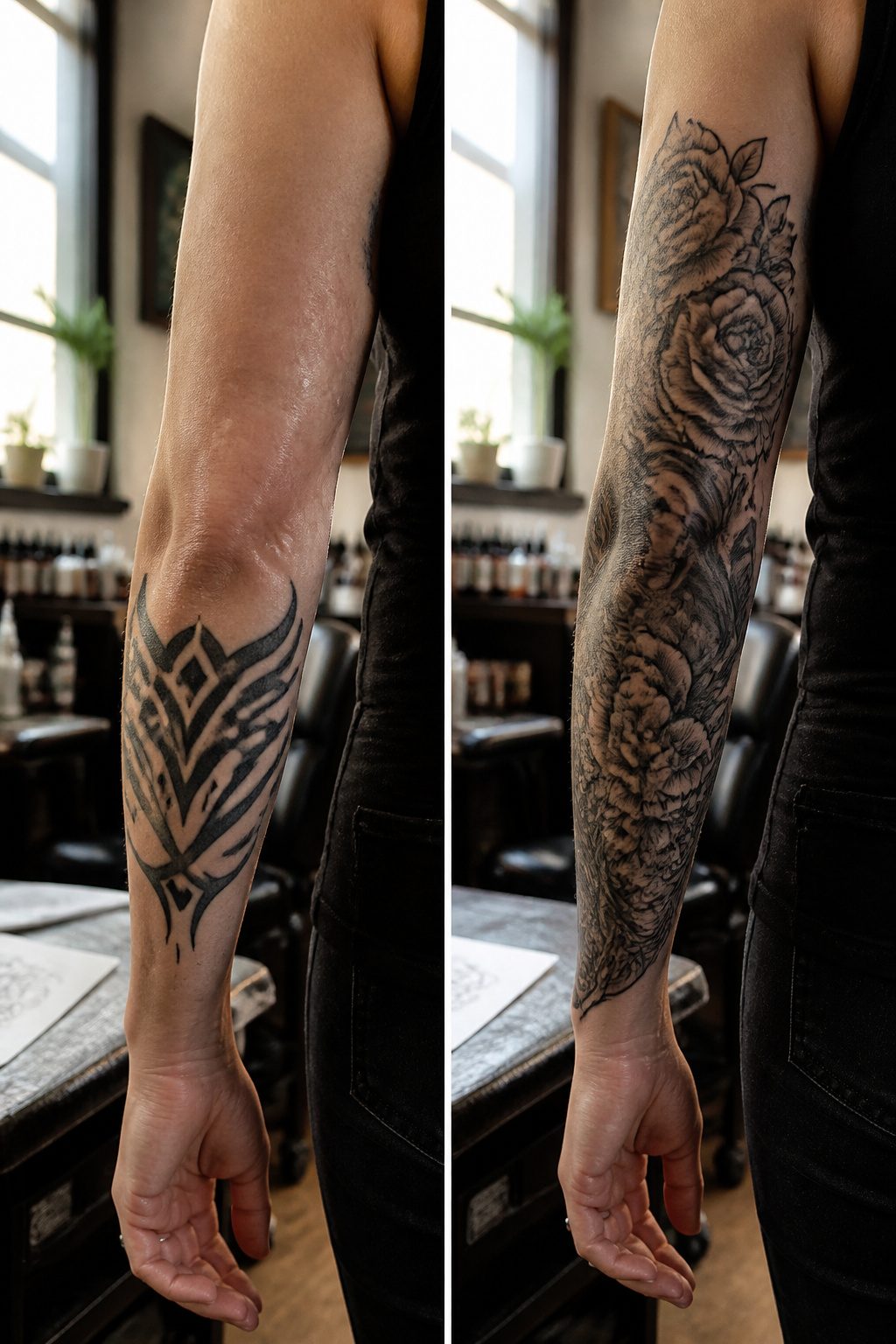
Old ink sets the rules for anything new that goes over it. The darker the existing tattoo and the larger its footprint, the more limited your options become. A solid black tribal band or a deeply saturated old piece will need bigger coverage and darker pigments to disappear underneath fresh work, which is why a skilled cover-up artist matters more than the design concept you walked in with.
Scar tissue from the original tattooing or from a poorly healed piece complicates things further. Raised or shiny skin doesn’t hold new pigment evenly, so the artist has to work around those patches rather than through them. Sometimes the old tattoo is simply too dense to bury. When the ink sits too deep and too dark, laser fading becomes the necessary first step, not an optional extra. A few sessions of laser will break the pigment into particles the body can flush out, dropping the saturation enough that new art can actually take. Without that prep, you’re forcing a design to fight its way through a wall of existing color, and the result usually looks muddy within a year.
Placement and Your Daily Life

The upper arm slides under a blazer sleeve without a wrinkle, which makes it the default for anyone whose workplace still expects shoulders covered. I have watched clients choose the deltoid cap specifically because the muscle rounds the design naturally; weight shifts, and the art keeps its shape. The tradeoff is harder to admire yourself without a mirror.
Forearm skin sits flat over the radius and ulna bones, so fine detail holds beautifully. That same flat plane warps when the wrist twists, which is why straight horizontal lines around the forearm read crooked ninety percent of the time. Organic, flowing shapes behave better here. Your handshake, your coffee cup, your keyboard: the forearm is always performing.
Inner bicep offers a middle path. The skin stays softer, thinner, more sensitive to the needle, but UV damage rarely reaches it and the reveal stays deliberate. A mantra there belongs to you first; a date sees it only when you choose.
Design follows this logic. Upper arm pieces can wrap and expand because the real estate is generous and private. Forearm work competes with every gesture, so the composition needs to read complete at a glance. Neither placement is braver than the other; they simply answer different schedules.
Frequently Asked Questions
How painful are arm tattoos?
Pain varies sharply by placement. The outer arm rates about a 3 out of 10, with thick skin and fewer nerve endings making it manageable for long sessions or first pieces. The inner bicep jumps to a 7 out of 10, where thin skin sits close to major nerves and the sensation turns sharp and stinging. The wrist and elbow both hurt more than surrounding areas because bone sits just below the surface.
How long does it take for an arm tattoo to heal?
Surface healing takes 2 to 3 weeks, though scabbing and peeling can stretch closer to four. Deep dermis healing needs 3 to 4 months before the tattoo actually looks settled rather than merely closed. Sun exposure and swimming stay off-limits until that deeper layer finishes, not when the surface looks presentable in short sleeves.
Can I cover an old arm tattoo with a new one?
Yes, though success depends on how dark and large the old tattoo is. The new design usually needs to be bigger and use darker inks to make the old work disappear. Abstract styles that trade in fields of color and texture hide old ink particularly well, since they swallow names or blown-out pieces without announcing themselves as corrections.
What are the best placements for arm tattoos?
The upper arm hides easily under short sleeves for offices that care, while the inner forearm stays visible for anyone whose work allows it. The outer bicep handles detailed work without distorting as skin moves, and the forearm’s longer canvas gives winged or coiled designs room to breathe. The wrist frames tattoos like jewelry but hurts more and blurs faster, so simple detail works better there.