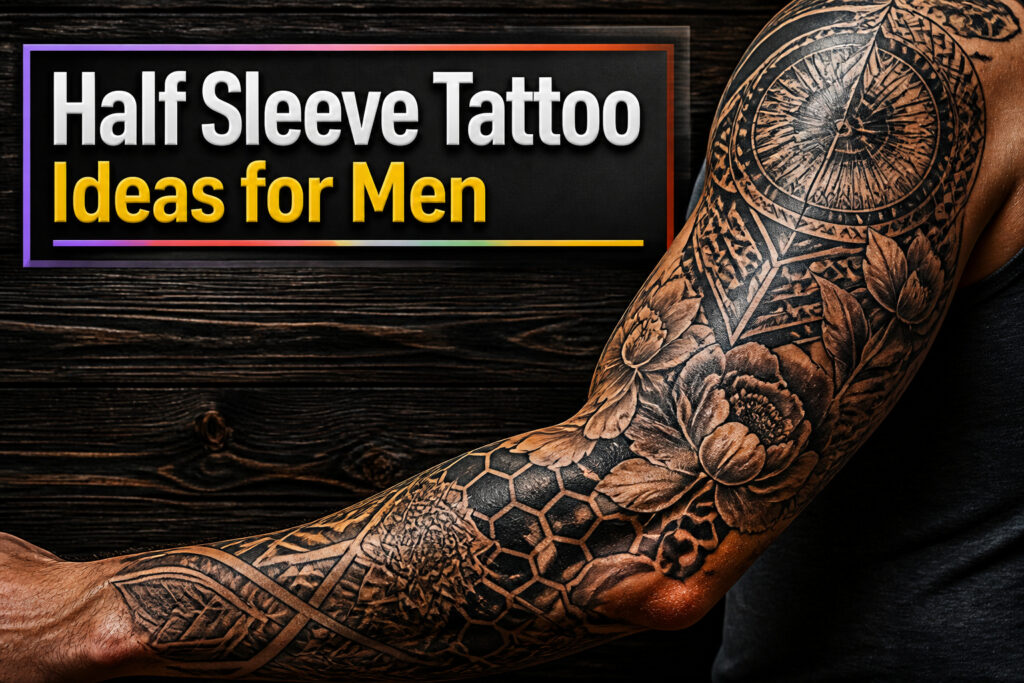
A half sleeve runs shoulder to elbow, or elbow to wrist, and the difference between a piece that looks grown there versus pasted on comes down to whether the design follows the muscle underneath.
The outer bicep rates about a 4 out of 10 for pain, but that jumps to a 7 on the inner arm where skin is thinner and nerves cluster closer to the surface.
Most men need 2-4 sessions totaling 10-15 hours, with costs landing between $1,200 and $3,000 depending on complexity and the artist’s hourly rate.
1. Tribal Patterns
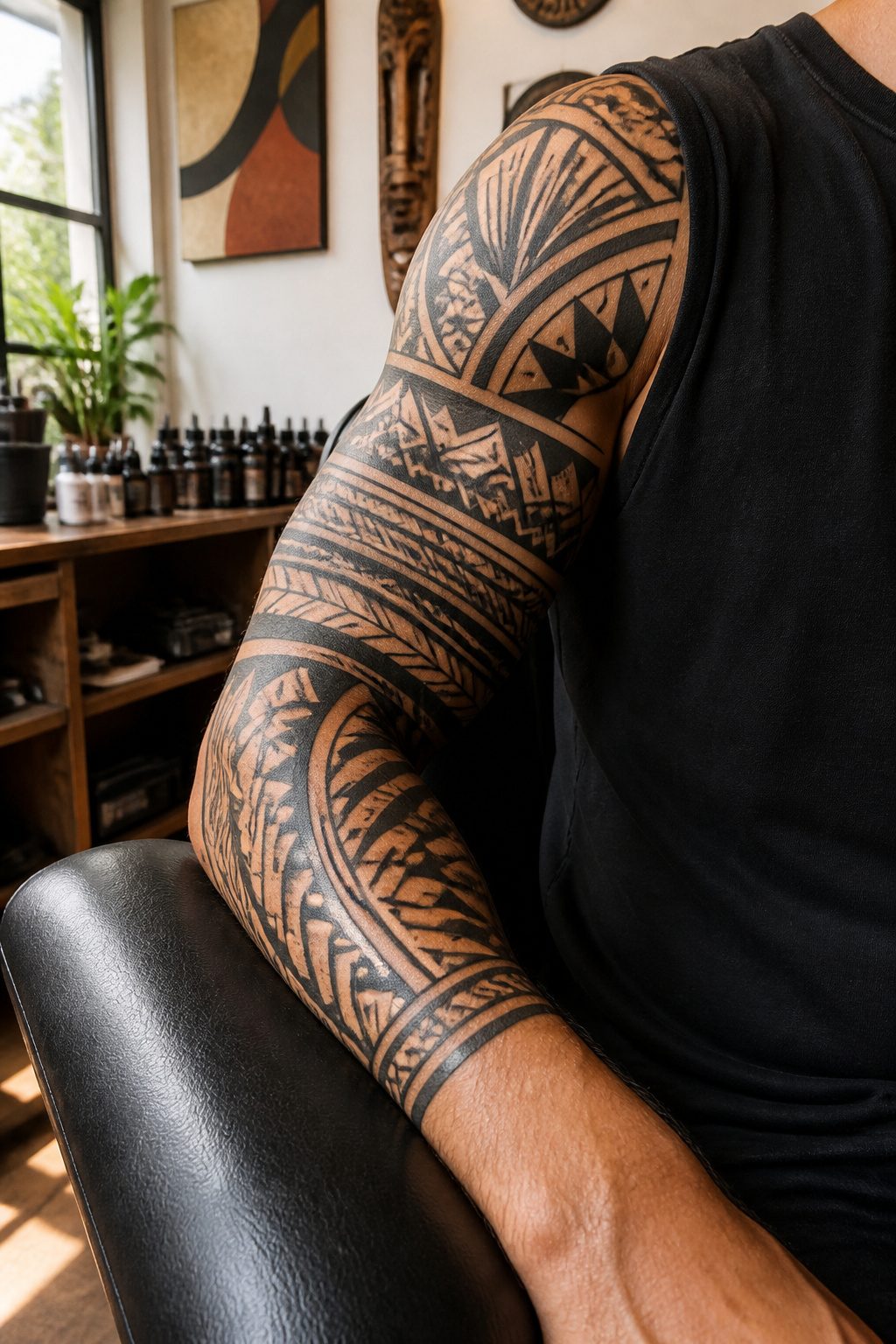
Bold black lines and repeating geometric shapes that follow muscle contours are what make tribal half sleeves read as part of the arm rather than a sleeve pulled over it.
The designs draw from Polynesian, Maori, and Samoan traditions, though modern versions often mix sources freely. Plan the flow around the deltoid and bicep so the pattern moves with the arm rather than fighting it.
Bands should follow the natural taper from shoulder to elbow, emphasizing arm definition during flexing. Athletic builds gain the most traction from designs that track specific muscle groups to create visual power.
A good artist will drape the composition around the deltoid and let it taper toward the elbow, because the arm narrows there.
Position primary elements on the outer bicep for visibility during handshakes. Extend secondary elements vertically down the forearm to avoid shortening the visual length of the arm.
Solid blacks and clean whites hold their edges as ink settles, while mid-tone grey tends to blur into one soft mass over time.
2. Japanese Motifs
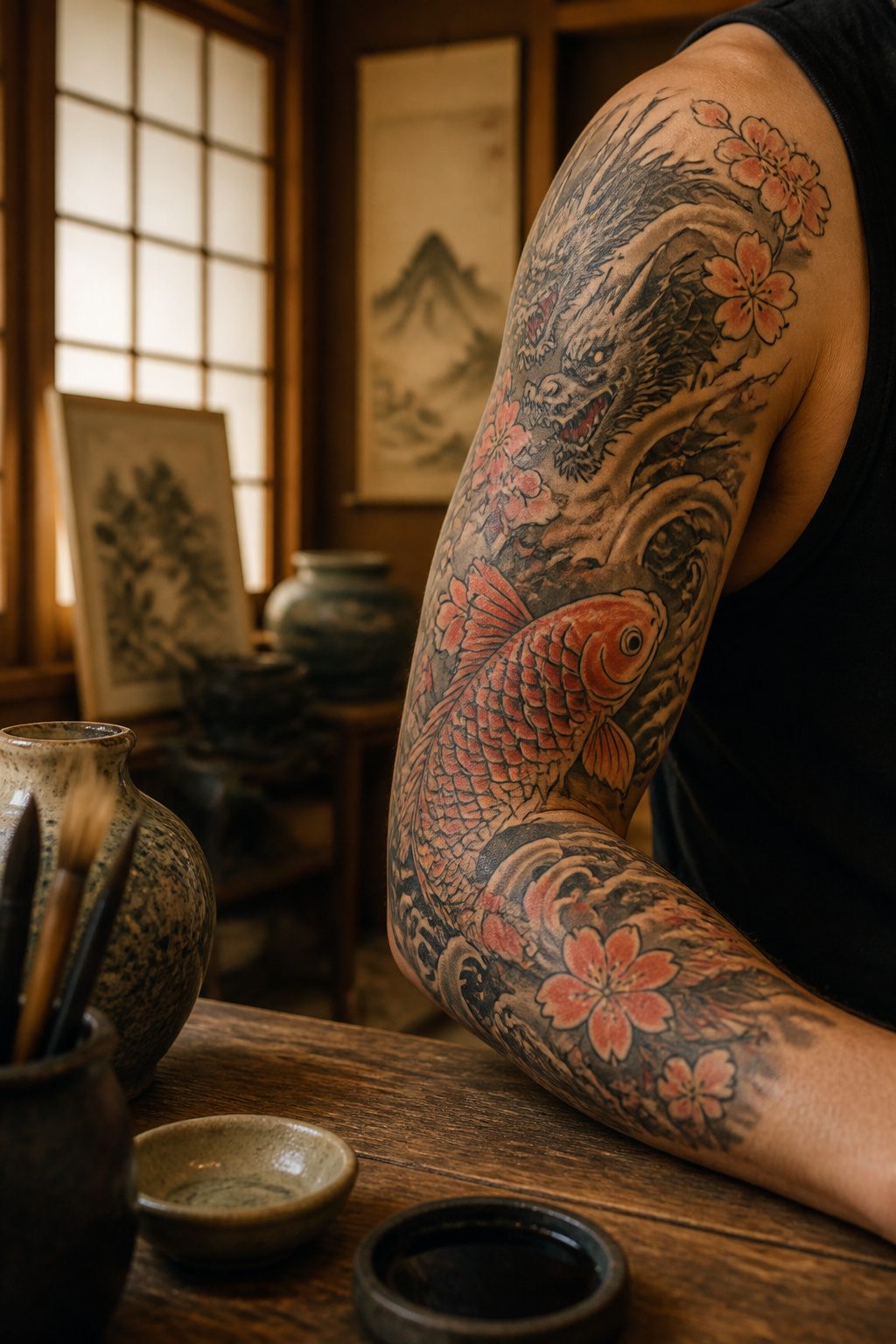
Japanese-style work was built for arms. The tradition spent centuries solving exactly this problem: how to fill a curved limb with a design that still reads at a distance.
The background elements are not filler; they are the connective tissue that makes the whole arm look like one piece.
Koi swimming upstream, dragons coiled through clouds, cherry blossoms, and waves read from shoulder to elbow like a scroll.
The vocabulary runs deep, and the gaps between main subjects fill with wind bars, maple leaves, or peonies so nothing sits isolated.
A dragon wrapping the deltoid is the classic anchor. It gives the artist a natural direction of flow and lets the rest of the piece spiral downward from there.
The style demands an artist who understands Japanese tattoo conventions, not just someone who can copy reference photos.
Two ways to play this: book an artist trained in the tradition, or accept that the background will look like wallpaper pasted around disconnected images. The trained artist wins if you want the arm to move as a single piece.
Be honest with yourself about time. These are usually a multi-session build, and rushing the background is where they most often go wrong.
3. Animal Portraits
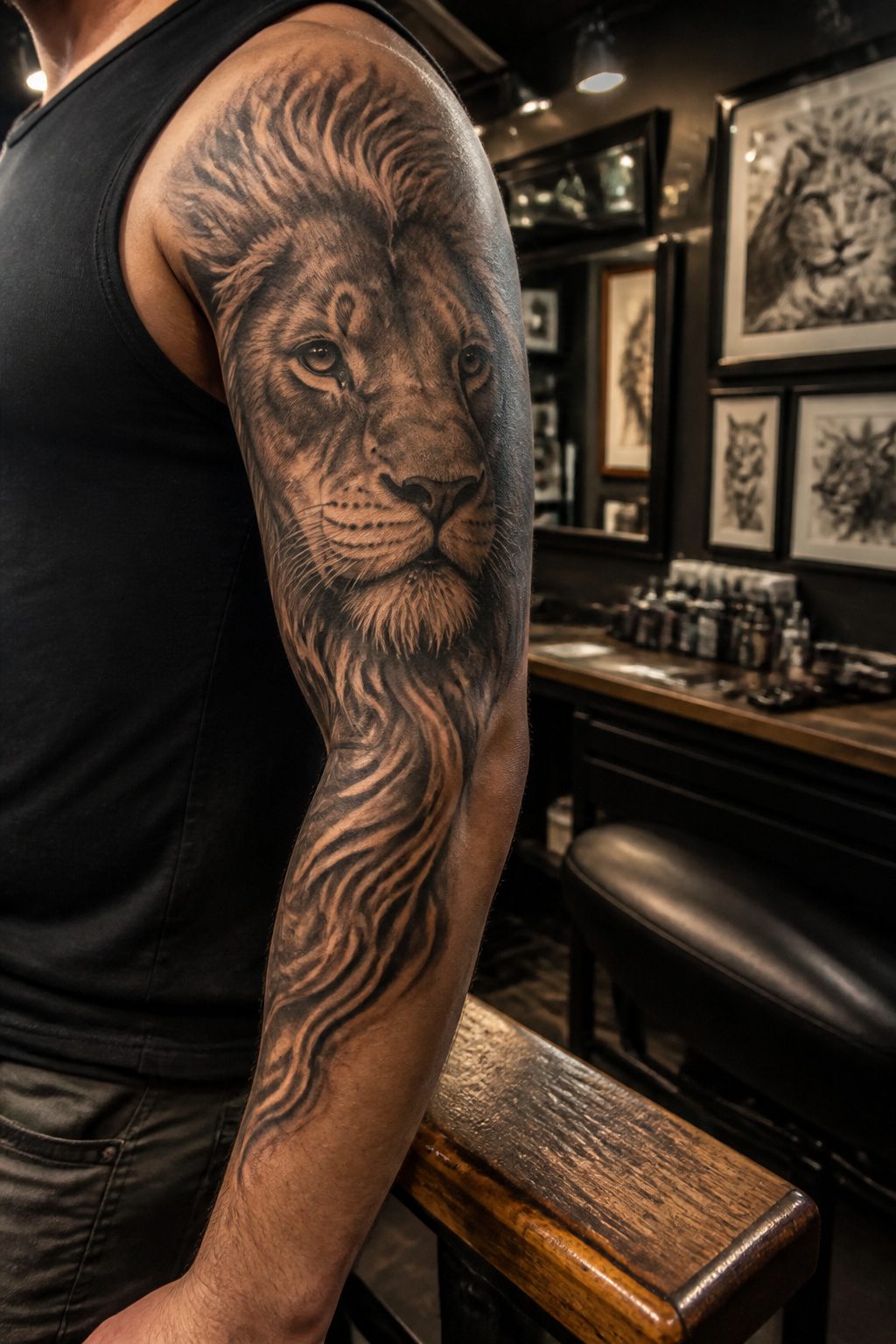
A face gives the piece a focal point, which is why wolves, lions, bears and eagles dominate the animal portrait category.
The shoulder cap holds the head while the body dissolves into background toward the elbow, so size the head to the muscle, not to the reference photo.
A small portrait floating in the middle of a large arm looks lost, and I see that mistake more than any other.
The eyes carry the piece. Get them wrong and the whole tattoo loses life, no matter how sharp the fur texture reads.
A lion facing forward on the outer bicep lands as guardianship, solid and watchful. A wolf howling toward the shoulder suggests something more solitary, the motion pulling the eye up rather than holding it in place.
The style range runs from photorealistic to heavily stylized, but the eye placement rule holds across both: slightly too large reads as expressive, slightly too small reads as dead.
4. Nature Scenes
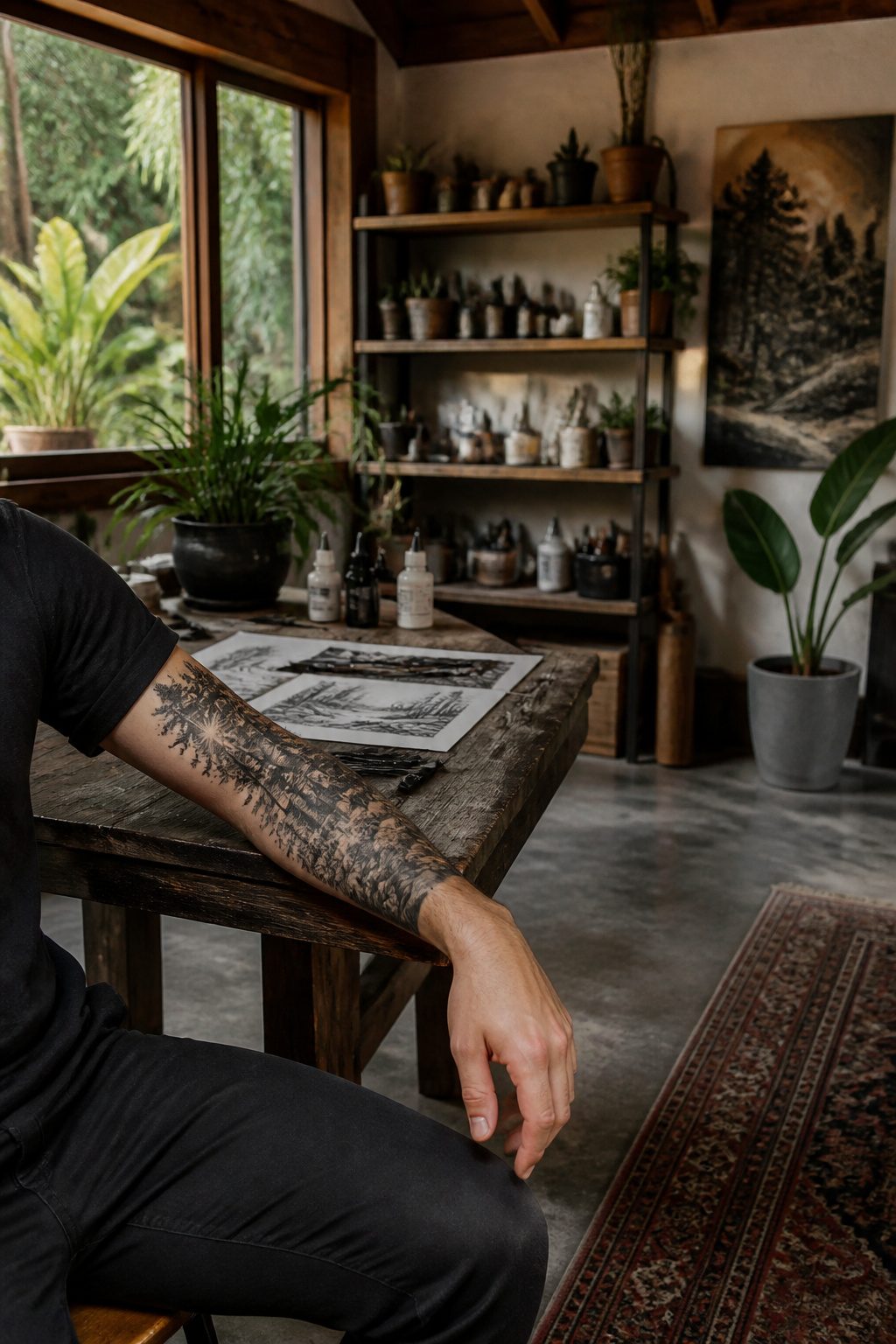
A forest wrapping around your forearm needs a moon or a sun tucked into it somewhere, or the whole thing collapses into green wallpaper.
I learned that watching a client sit through fourteen hours on a piece that had no light source, no entry point for the eye, just trees stacked on trees.
The fix was a single shaft of painted dawn breaking through the canopy, which the artist burned in afterward at the wrist. Without that built-in light, nature scenes flatten faster than any other subject.
Mountains work the same way. A peak catches snow differently depending on where the sun sits, and that contrast is what lets the arm’s cylinder read as a three-dimensional space.
Seascapes need it most: a moon low on the horizon throws the real shadow across the water, gives the waves their shape, lets the dark sleeve end at the shoulder like actual night falling.
Night skies are the cheat code here, since the light source is already the subject, but even then the stars need clustering, not sprinkling, or they read as freckles.
The arm moves, so the scene has to hold together at every angle a joint can reach.
5. Blackwork Designs
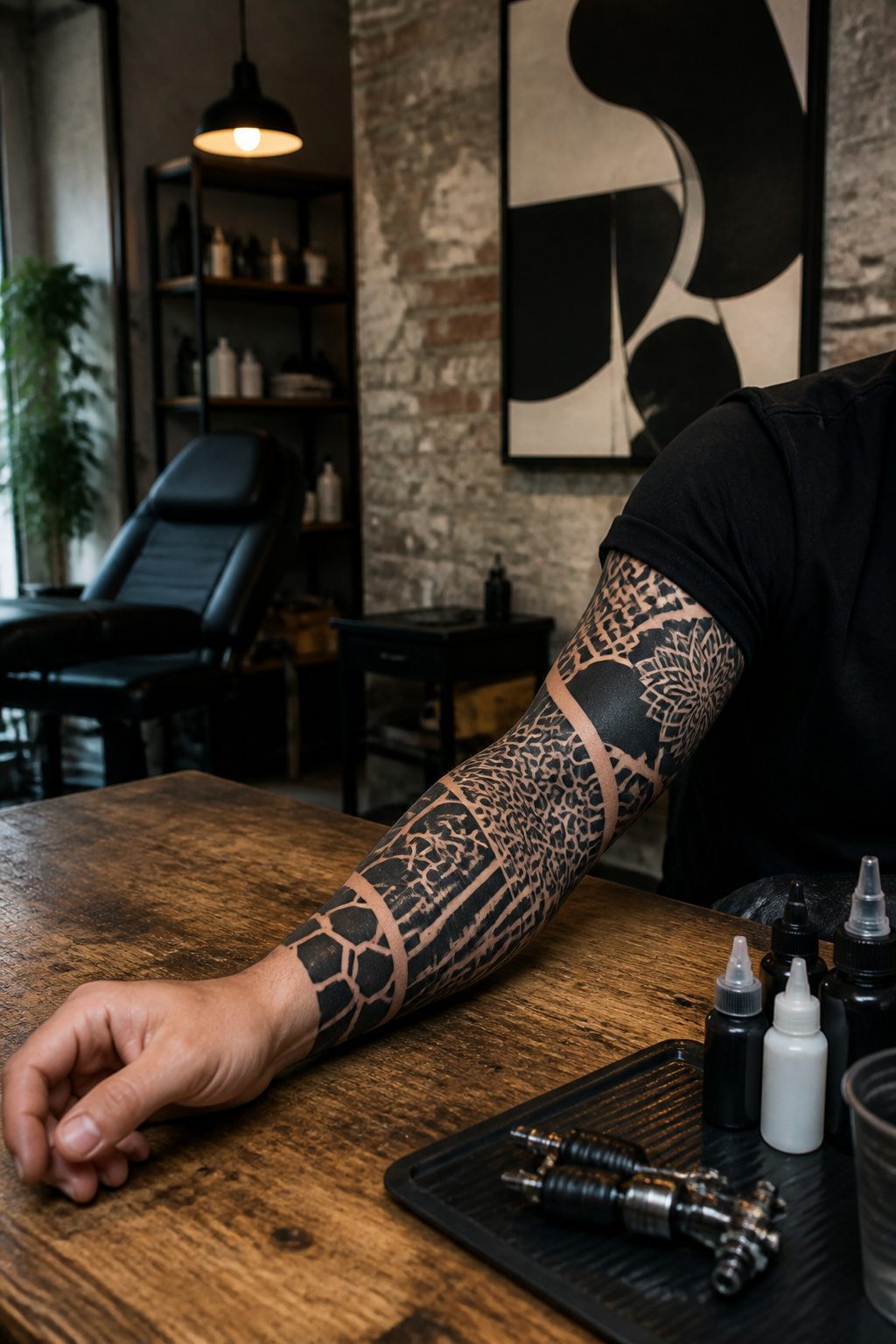
Solid blackwork reads from across a room, which is half the reason men keep choosing it for half sleeves.
The other half is speed: a piece this size in pure black sits in fewer sessions than color, though each session hurts more because the artist passes the needle over the same patch of skin repeatedly to drive the ink deep enough for true saturation.
That repetition leaves the area swollen and hot, so healing demands more discipline than with lighter styles.
Gaps of untouched skin, what artists call negative space, can save the design from turning into a shapeless blob, but they have to be planned from the first stencil.
A line that wanders or a spot that scabs too thick will not fade into softness the way a color piece might. The mistake stays sharp, which is the point of the style and also its risk.
The best blackwork sleeves mix solid fields with patterned texture, giving the eye somewhere to rest so the arm does not read as a single block.
6. Geometric Patterns
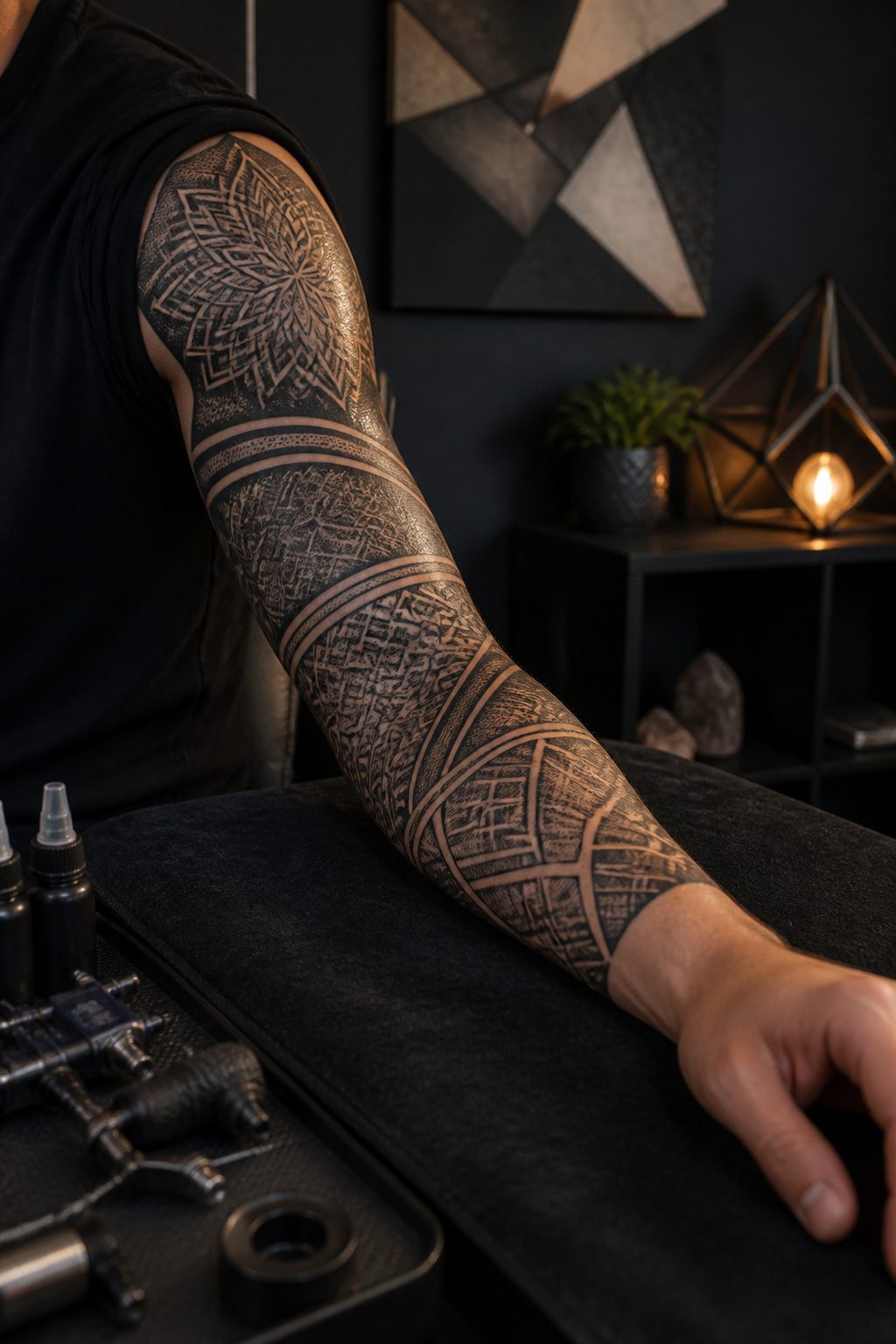
Geometric half sleeves live and die on line quality. A line off by an eighth of an inch at the shoulder becomes a quarter inch at the elbow, and on a curved surface that error compounds fast.
Healed photos of straight lines on a curved arm are what separates the portfolio you want from the one you settle for.
Dotwork mandalas on the shoulder cap work with the body rather than against it. The deltoid’s dome gives the pattern a natural center to radiate from, and the geometry can track the muscle taper down toward the elbow.
Athletic builds gain the most when bands follow that taper and emphasize definition during a flex. The best pieces do not ignore structure; they use it.
This is the style where paying more for the right artist beats compromising. When the lines wobble, everyone can see it.
7. Realism
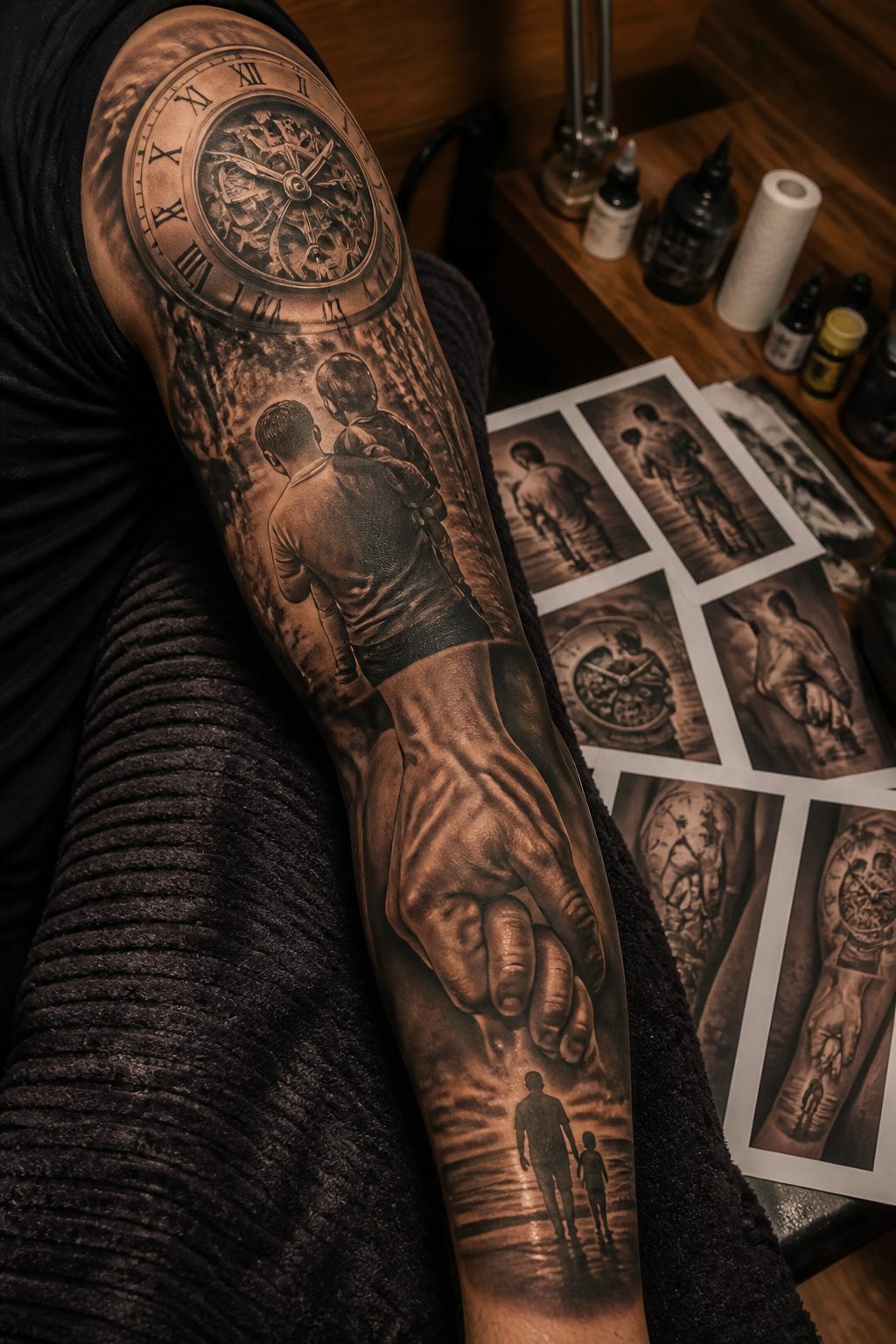
Realism on a half sleeve is the style that stops people mid-scroll, then makes them sit longer in the chair than they planned.
Portraits of family members, celebrity faces, or hyper-detailed objects like clocks and cameras all fall here, and this is the most technically demanding style on the list.
The work relies on value contrast rather than pigment saturation, which is why black and grey realism generally ages better than color.
A realism half sleeve can take 15 hours or more, and artists typically need to finish whole tonal areas in long blocks before skin swelling sets in. Most are completed across several sessions rather than in one sitting.
The portfolio check matters more here than anywhere else. Ask to see healed work, not just fresh photos where redness hides imperfections.
Fresh realism looks almost unfairly good; healed realism is where you find out if the artist actually built tones that hold.
One hard judgment worth making: portraits of living people are the tattoos men most often ask to have covered later. If you are set on a face, sit on the idea longer than you think you need to.
8. Biomechanical Designs
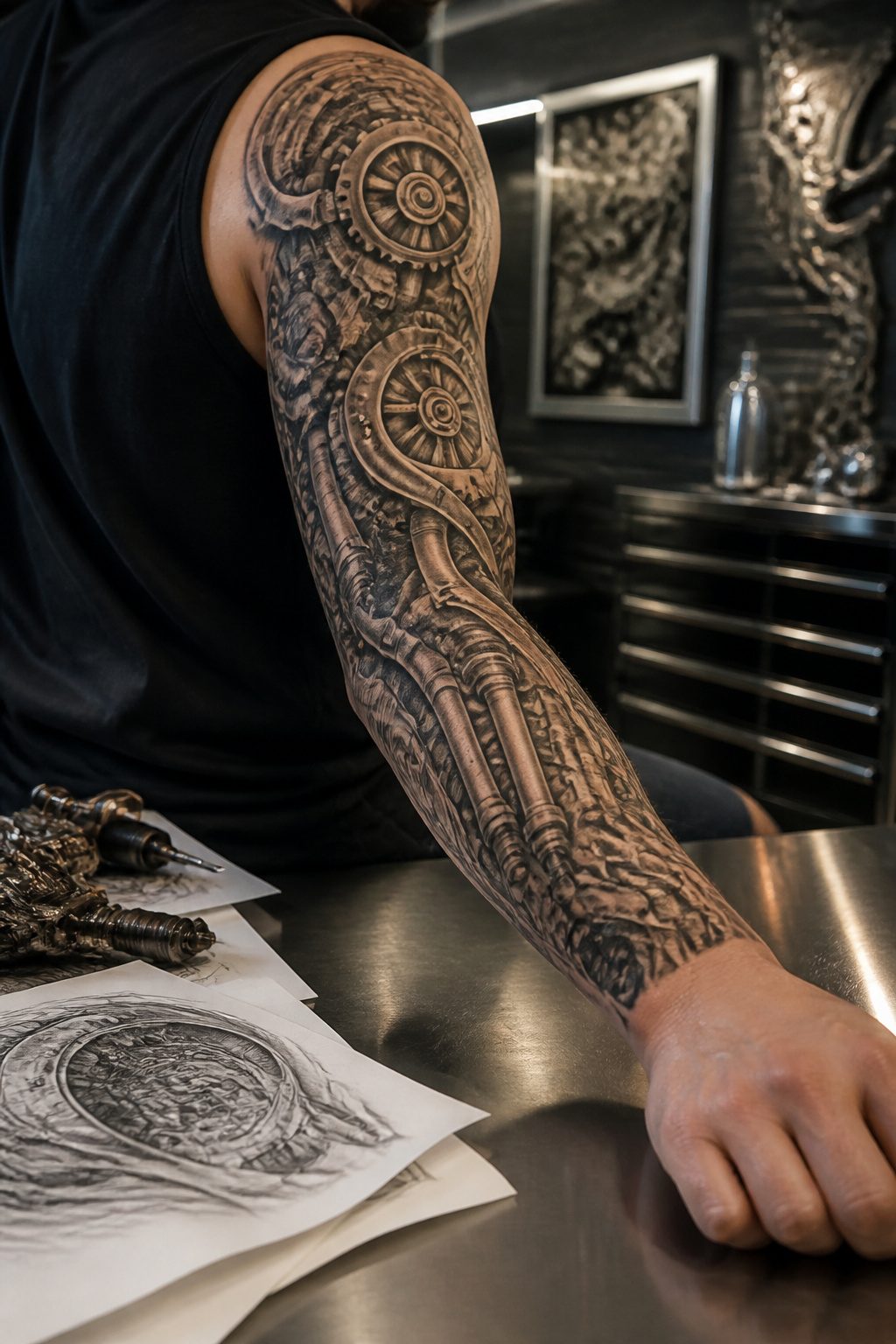
Biomechanical half sleeve tattoo ideas for men live or die by the depth illusion.
The style peaked in the 1990s and has contracted since, which means finding an artist who still builds gears and pistons that appear to emerge from under the skin takes more legwork now than it did twenty years ago.
A good biomechanical piece needs to hold that illusion from multiple angles, not just the one angle in the reference photo. The arm itself becomes the concept: skin that has opened to reveal machinery underneath.
Because the effect depends so heavily on anatomy, these pieces are usually drawn freehand directly onto the arm rather than applied from a flat stencil. That freehand step works as a filter.
An artist confident drawing biomech on skin is almost always the right one for the job.
The best placement for a half sleeve runs from the shoulder down toward the elbow, with designs wrapping around the bicep to create dimension.
Gears and pistons should appear to move beneath the skin when you lift or rotate your arm. That requires tracking specific muscle groups rather than fighting against them.
9. Script and Lettering
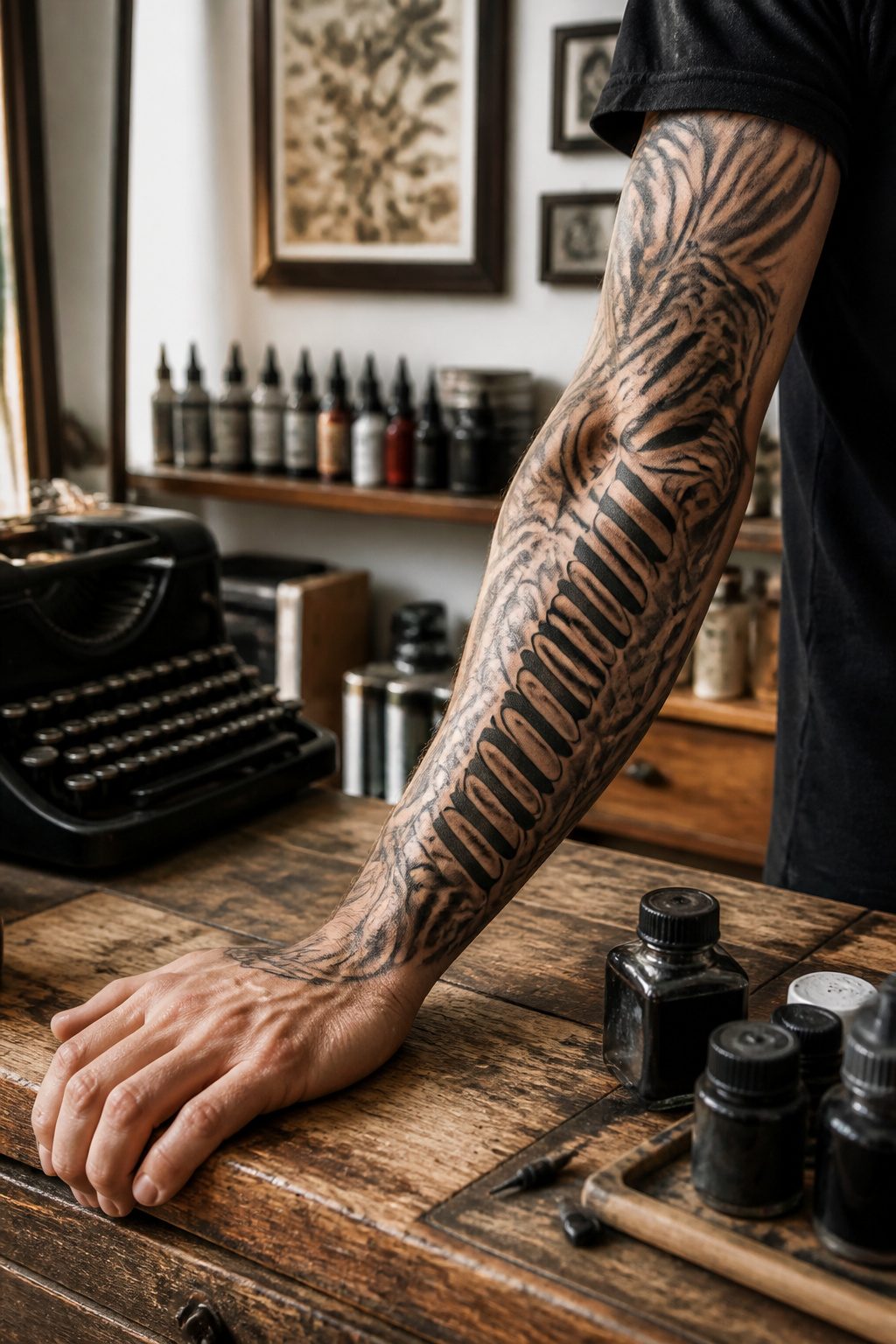
Script rarely carries a half sleeve alone, but it works well as a spine running down the outer arm between larger elements. The real risk is choosing a font that looks clean on paper but falls apart at tattoo scale.
Thin serifs bleed together within five years as ink spreads under the skin, so the safe move is keeping letters larger than feels necessary.
Fine script tightens and thickens as it heals, and closely spaced letters can turn into a smudge someone has to lean in to read.
Placement on the inner bicep adds another problem: the muscle flexes and stretches the skin, so shorter phrases hold their shape better there. Long quotes distort every time the arm moves.
If the words matter, have the artist print the exact text and check it twice while the stencil is on. A misspelling can survive a whole session because nobody read it out loud.
Line weight and contrast matter more than the font itself. A design that only works because of tiny texture or faint tonal shifts will not hold the way you expect.
Keep the text bold enough to read from three feet away, or plan on it blurring into decoration by the time the piece is finished.
10. Abstract Designs
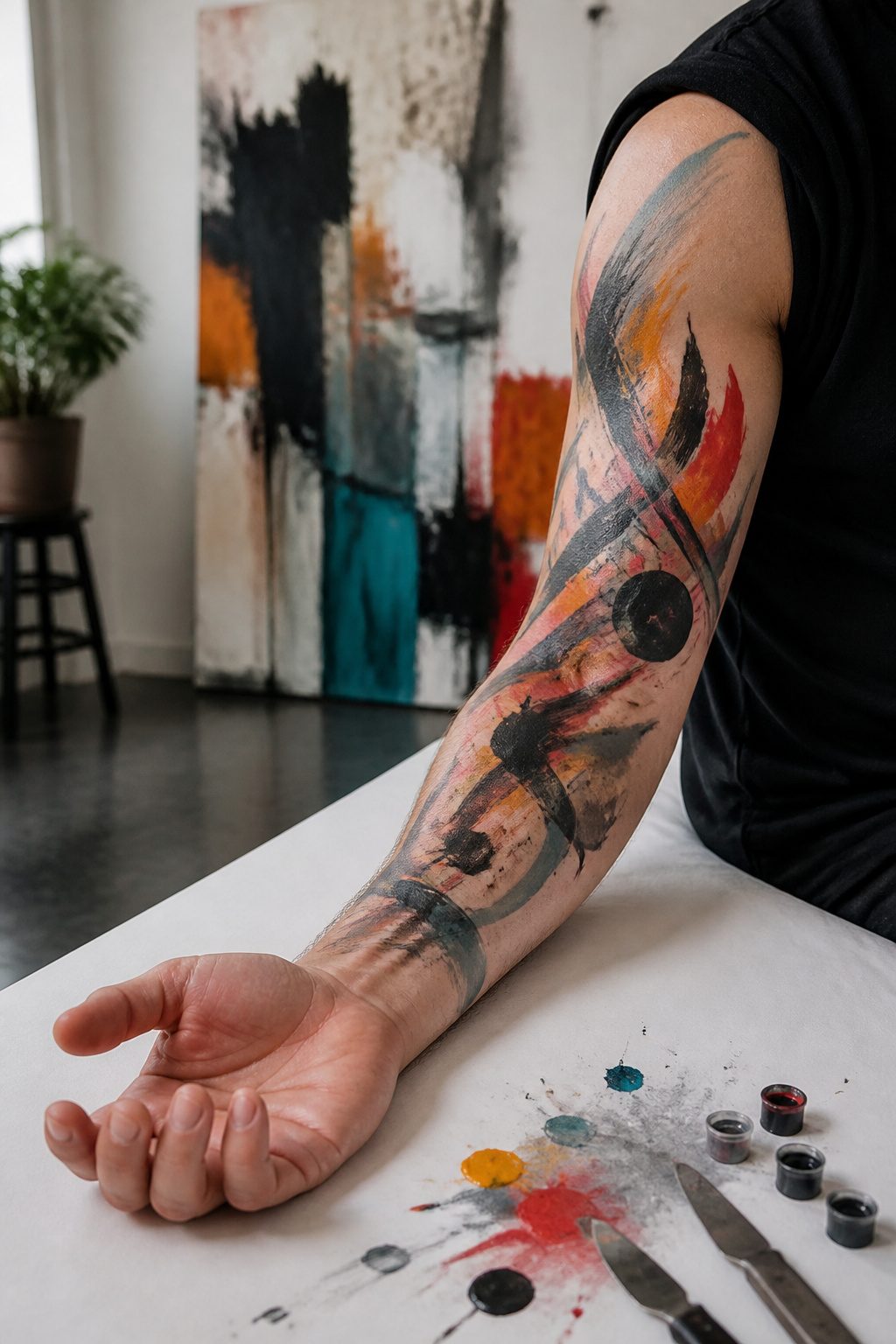
Abstract work on a half sleeve lives or dies by the flow between the marks and the muscle underneath.
Color fields that follow the curve of the deltoid read as intentional; the same shapes placed without that relationship look like spill.
I have watched clients bring in mood boards full of Rothko and Franz Kline references and assume freedom means no rules. The opposite is closer to true.
Without a recognizable image to anchor the eye, the composition has to carry everything.
The best pieces I have seen use the body’s landmarks as their organizing principle.
A heavy brush stroke might start at the shoulder peak and weight down toward the elbow ditch, or a set of non-representational shapes might tighten as they approach the wrist bone.
The artist is not copying a reference; they are building a new form that only works on you. That collaboration takes trust and time, usually more sessions than a straightforward portrait would need.
The risk is real. A half sleeve without that internal logic becomes wallpaper at best, accidental camouflage at worst.
The test is whether the design still holds when the arm hangs straight, bends ninety degrees, and lifts overhead. If the shapes read clearly in all three positions, the abstraction has earned its place.
Pain by the Numbers
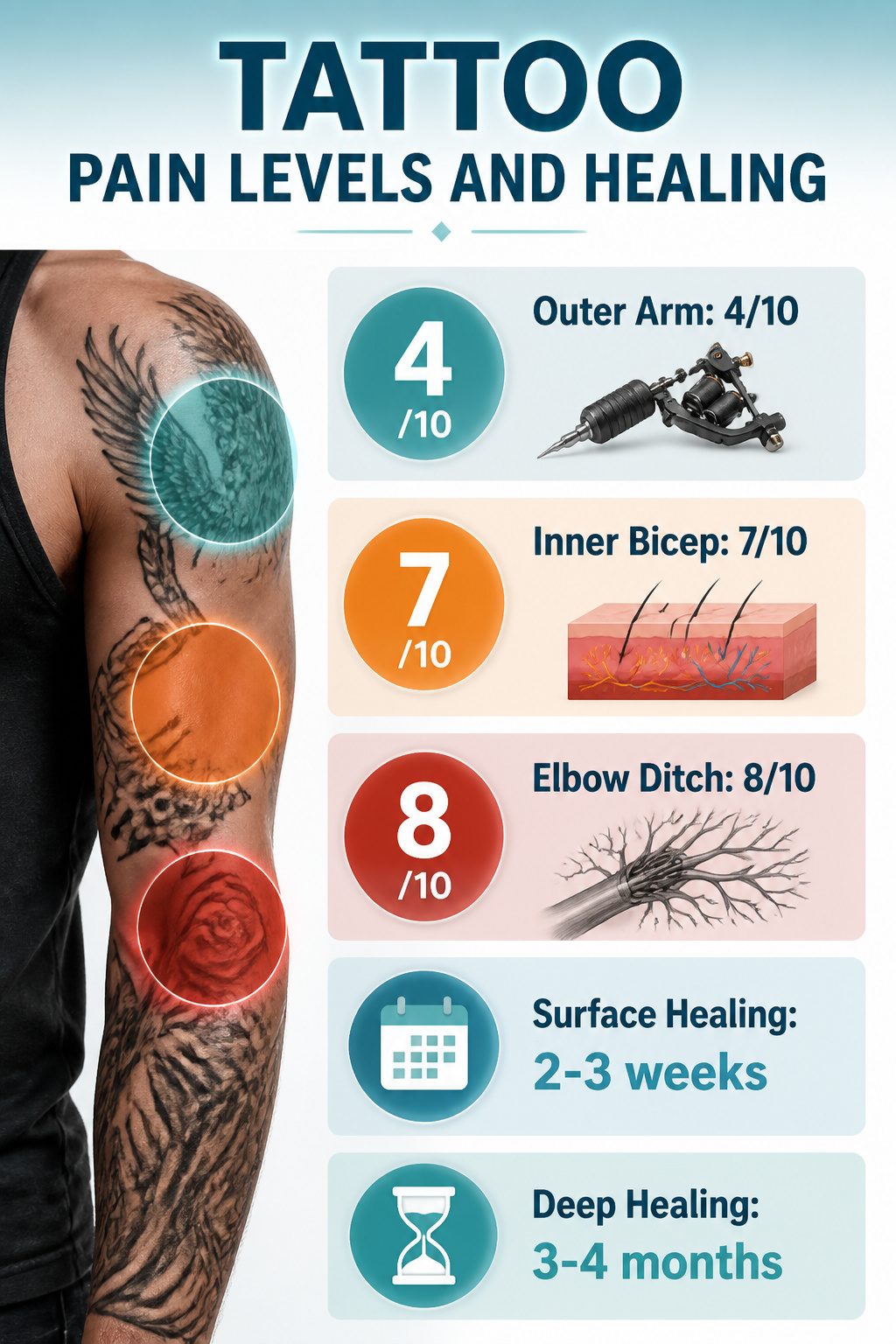
The outer arm sits at about a 4 out of 10 for most people, which sounds manageable until you reach the inner bicep.
That area jumps to a 7 out of 10, and for good reason: the skin is thinner there, and nerves cluster closer to the surface.
The elbow ditch and the armpit edge can spike even higher, so budget your composure, not just your wallet.
Surface healing runs 2-3 weeks. The deeper layers need 3-4 months to fully settle, and that is when the final color saturation and line sharpness actually show.
What looks patchy at week six may resolve into exactly what the artist intended by month four. Plan any touch-ups around that timeline, not earlier.
Session Planning
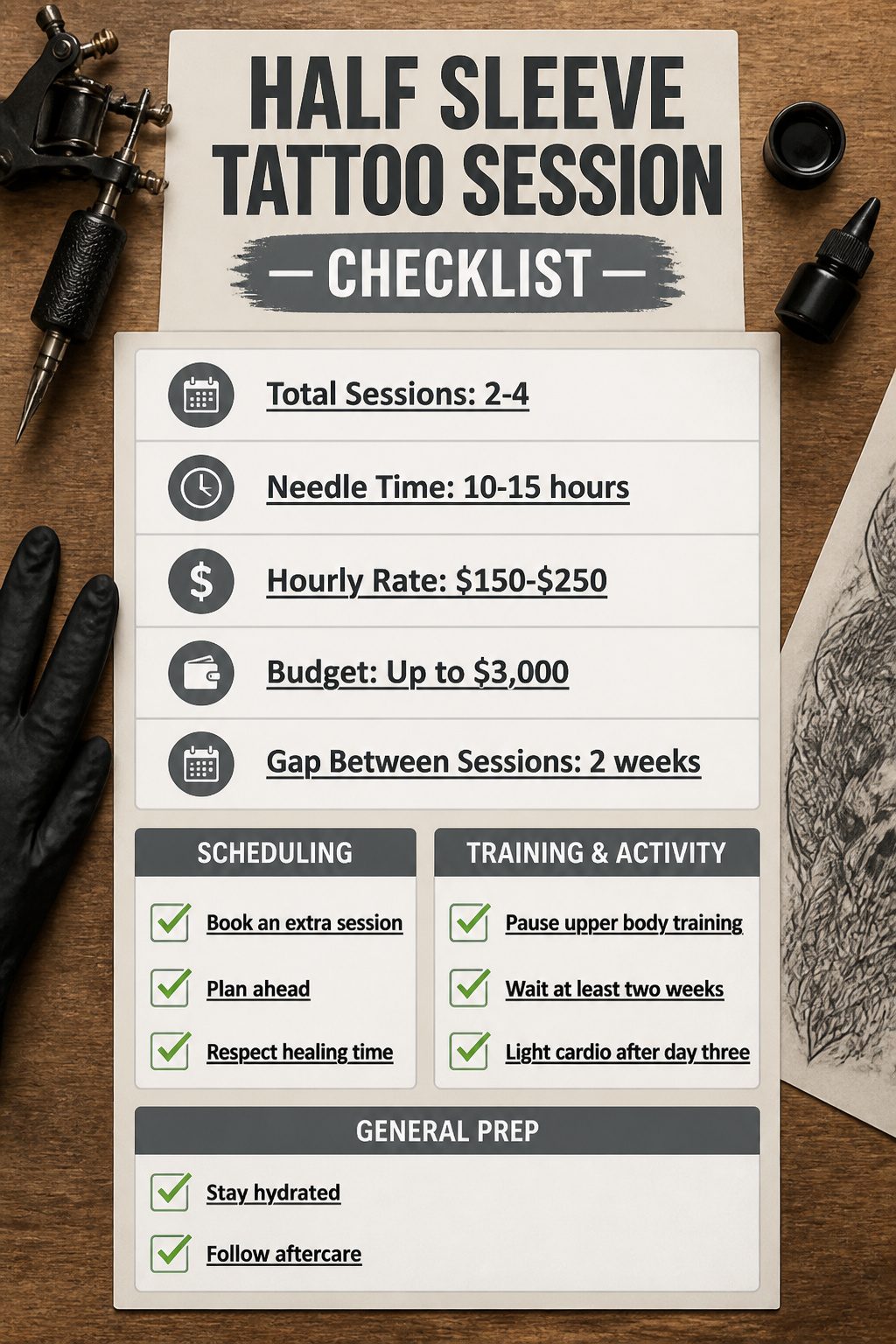
Most half sleeve tattoo ideas for men need 2-4 sessions totaling 10-15 hours of needle time. The hourly rate runs $150-$250, which puts the full piece anywhere from $1,200 to $3,000 or higher once complexity and the artist’s reputation enter the equation.
The scheduling matters more than first-timers expect. Two weeks is the minimum gap between sessions; the surface needs that long to heal, and pushing it risks patchy ink.
I would book a fourth session even if the artist thinks three will finish it. Cancelling one you do not need beats discovering at session three that a fourth exists and the calendar is full for two months.
Upper body training has to pause for at least two weeks after each session. Blood flow from worked muscle pushes fresh ink out of the wound, and the healed result comes back uneven.
Light cardio is acceptable after day three if equipment gets wiped down and the tattoo is rewrapped before leaving the gym.
Why the Artist Choice Changes Everything
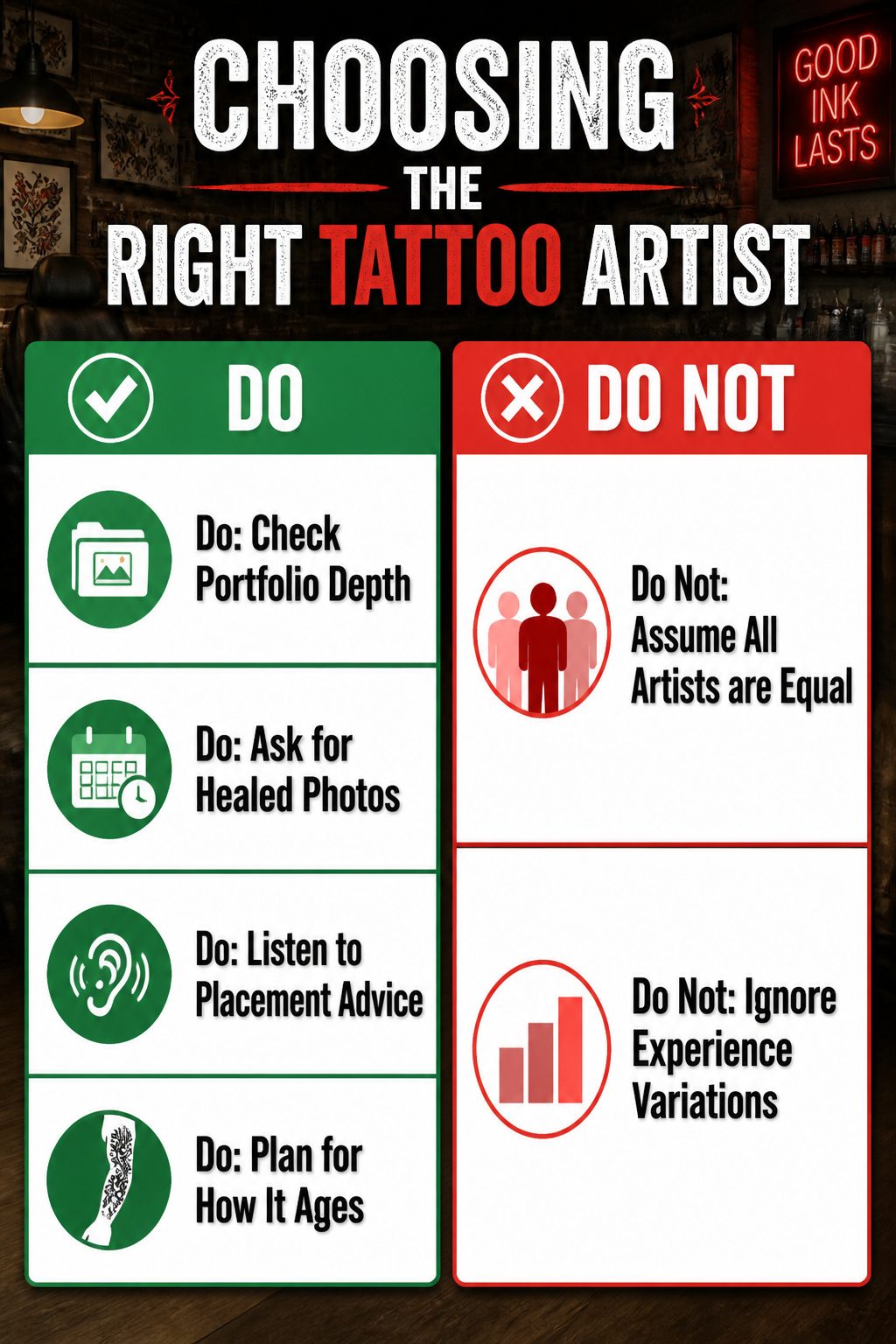
A Japanese specialist and a realism specialist are rarely the same person. Portfolio depth in your chosen style matters more than overall years in the industry.
Ask to see healed photos from at least six months prior, not just fresh work under studio lighting. Fresh ink looks sharp under controlled conditions; healed skin shows whether the linework held and the saturation stayed where it belonged.
The right artist will also talk you out of bad placement ideas. That pushback is a signal worth listening for.
Someone who nods along to whatever spot you point at is someone who cares more about the booking than the result.
A half sleeve runs shoulder to elbow, or elbow to wrist, and reads as a finished piece on its own.
The artist needs to plan for how that piece ages across curved muscle and moving skin, and sometimes that means the placement you wanted costs you the flow that makes it work.
Building Around What the Arm Already Does
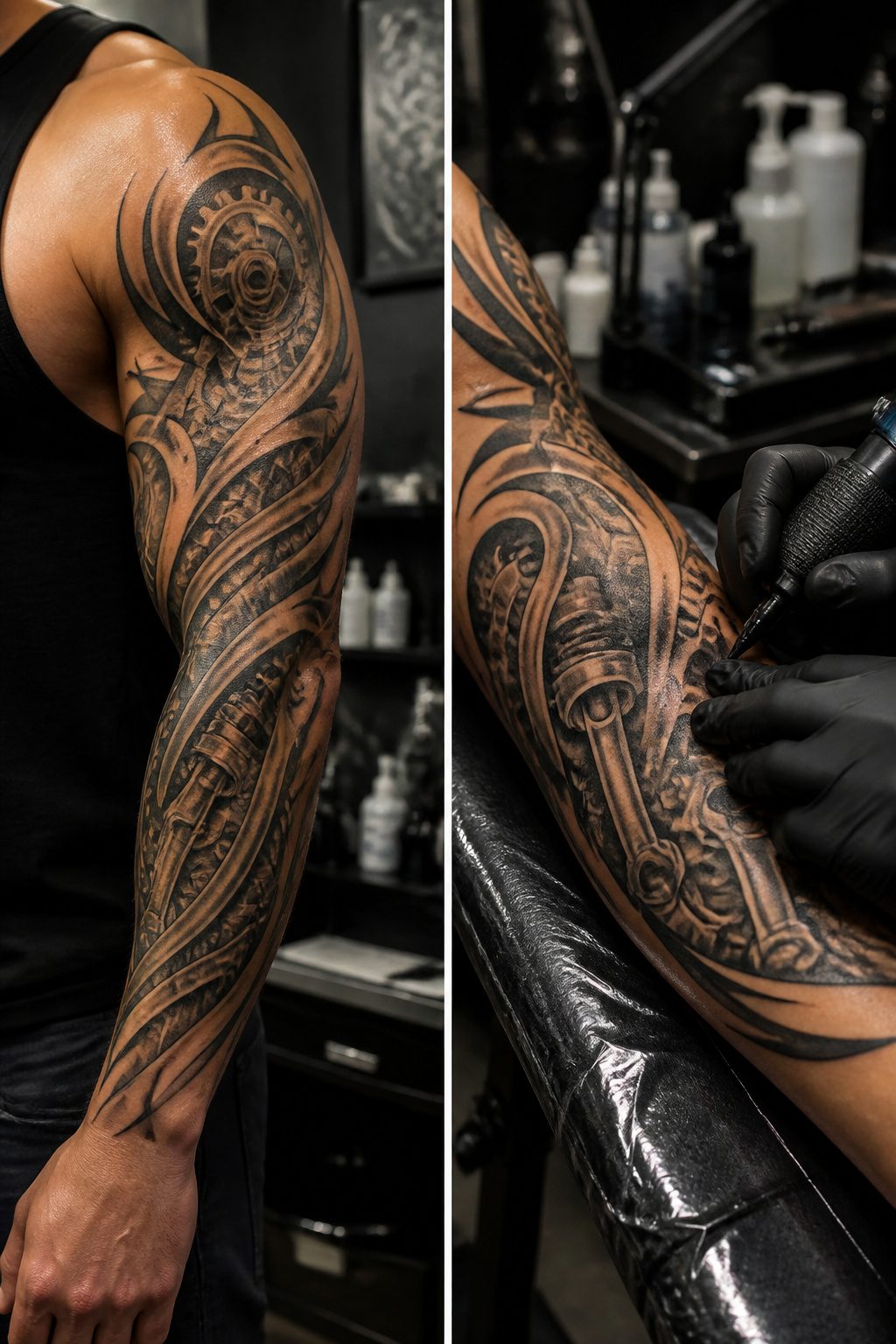
The arm is not a flat billboard. It flexes, rotates, and changes circumference from shoulder to elbow, so a half sleeve that treats the surface like a cylinder looks pasted on rather than grown there.
The designs that age best track the muscle groups they cover, not fight them. Bands of tribal or geometric work should follow the natural taper of the bicep, tightening visually as the arm narrows.
Biomechanical pieces wrapping the bicep gain dimension when gears and pistons appear to shift under the skin during movement.
Placement matters for visibility too. A primary element like a skull or predator face sits best on the outer bicep, where a handshake puts it at eye level.
Secondary elements such as smoke or waves run vertically down the arm to avoid shortening its apparent length.
If you suspect you might want the full arm eventually, say so in the consultation. A half sleeve drawn as a two-phase build costs less than retrofitting later, and the elbow transition gets designed rather than improvised.
The worst outcome is a standalone panel closed off at both ends, because extending that gracefully means rebuilding rather than continuing.
Frequently Asked Questions
How many sessions does a half sleeve usually take?
Most half sleeve tattoo ideas for men need 2 to 4 sessions totaling 10 to 15 hours of needle time. The exact count depends on style complexity, color versus black and grey, and how your skin takes saturation.
Budget for a possible fourth session even if the artist estimates three; canceling an unneeded appointment beats waiting two months for an open slot.
Can a half sleeve be turned into a full sleeve later?
Yes, but only if it was planned with expansion in mind from the start.
Tell the artist during consultation if you suspect you might want the full arm eventually; a half sleeve drawn as a two-phase build costs less than retrofitting later.
The worst outcome is a standalone panel closed off at both ends, because extending that gracefully means rebuilding rather than continuing.
Does a half sleeve hurt more than a smaller tattoo?
The per-minute pain is not usually worse; the duration is what makes it feel harder.
The outer arm sits at about a 4 out of 10 for most people, while the inner bicep jumps to a 7 and the elbow ditch can spike higher.
Most men find the last hour of a long session the toughest part, not the first.