
A foot tattoo ranges from a single fine line to a full mandala wrapping the ankle, and the deciding factor is not style but how much maintenance you will accept. Fine lines blur fastest here, where friction and fast skin turnover make touch-ups a scheduled cost, not a failure of care. The top of the foot rates 7 to 9 out of 10 for pain, with bone sitting directly beneath thin skin and nowhere for the needle shock to go.
1. Floral Tattoos
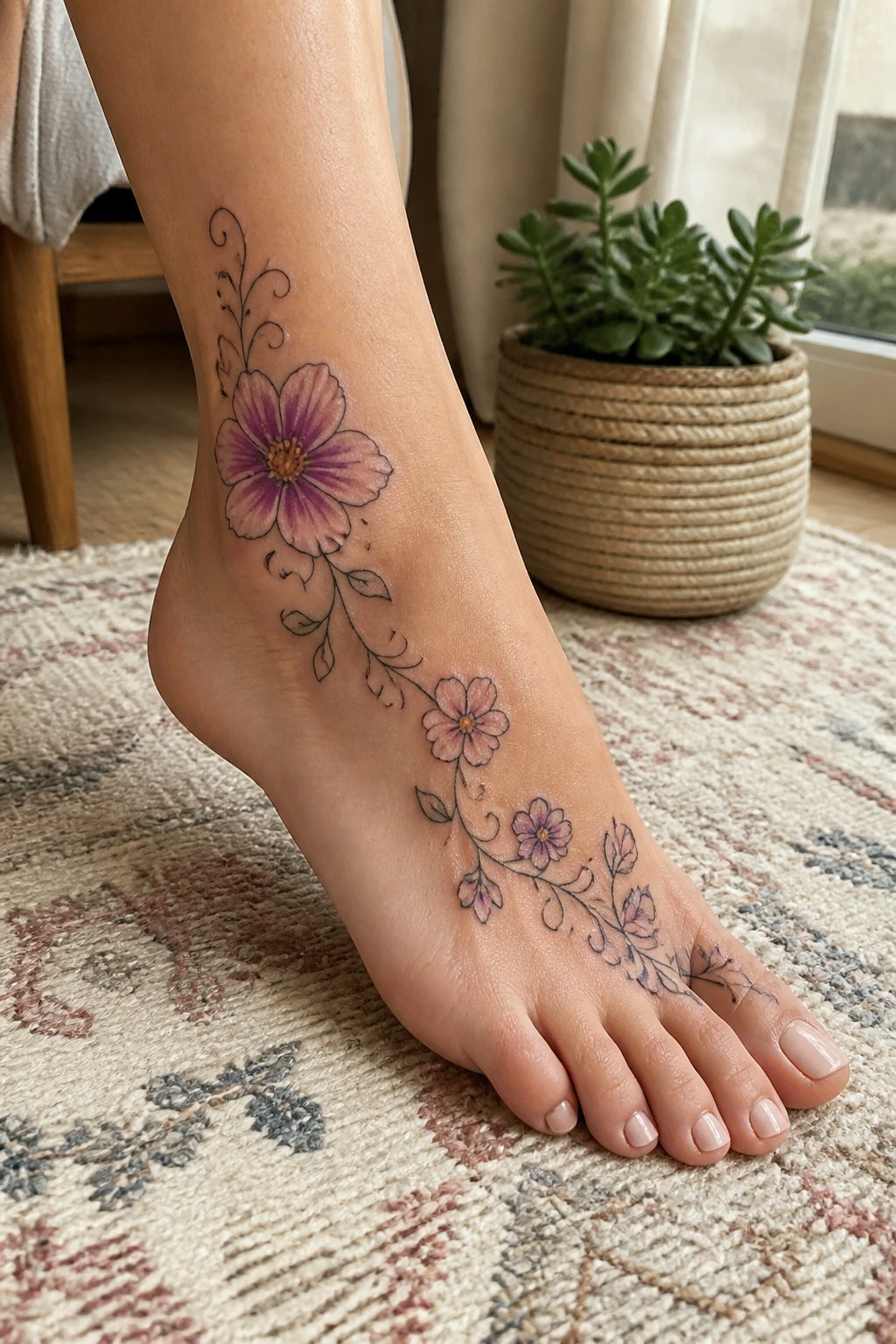
Floral designs still dominate foot tattoo ideas for women for good reason. The shape of the foot almost asks for it: a vine tracing the arch, a single bloom settling on the ankle bone, small clusters tucked along the toes. Each placement reads differently. The vine follows the foot’s natural curve and draws the eye upward; the ankle bone gives a single flower the spotlight; toe clusters stay hidden in shoes and reveal themselves only when you want them to.
The symbolism is straightforward and earned. Growth, beauty, femininity, the lotus rising from difficulty. These meanings attach to the design without requiring explanation, which matters on a body part you cannot see yourself without bending down.
Fine lines blur faster on the foot than on the shoulder or forearm. The skin there sheds quickly, shoes rub, sun hits without warning. Touch-ups are not a failure of aftercare; they are part of the maintenance. A tattoo artist who works feet regularly will build that into the original line weight rather than pretending the problem does not exist.
2. Butterfly Tattoos
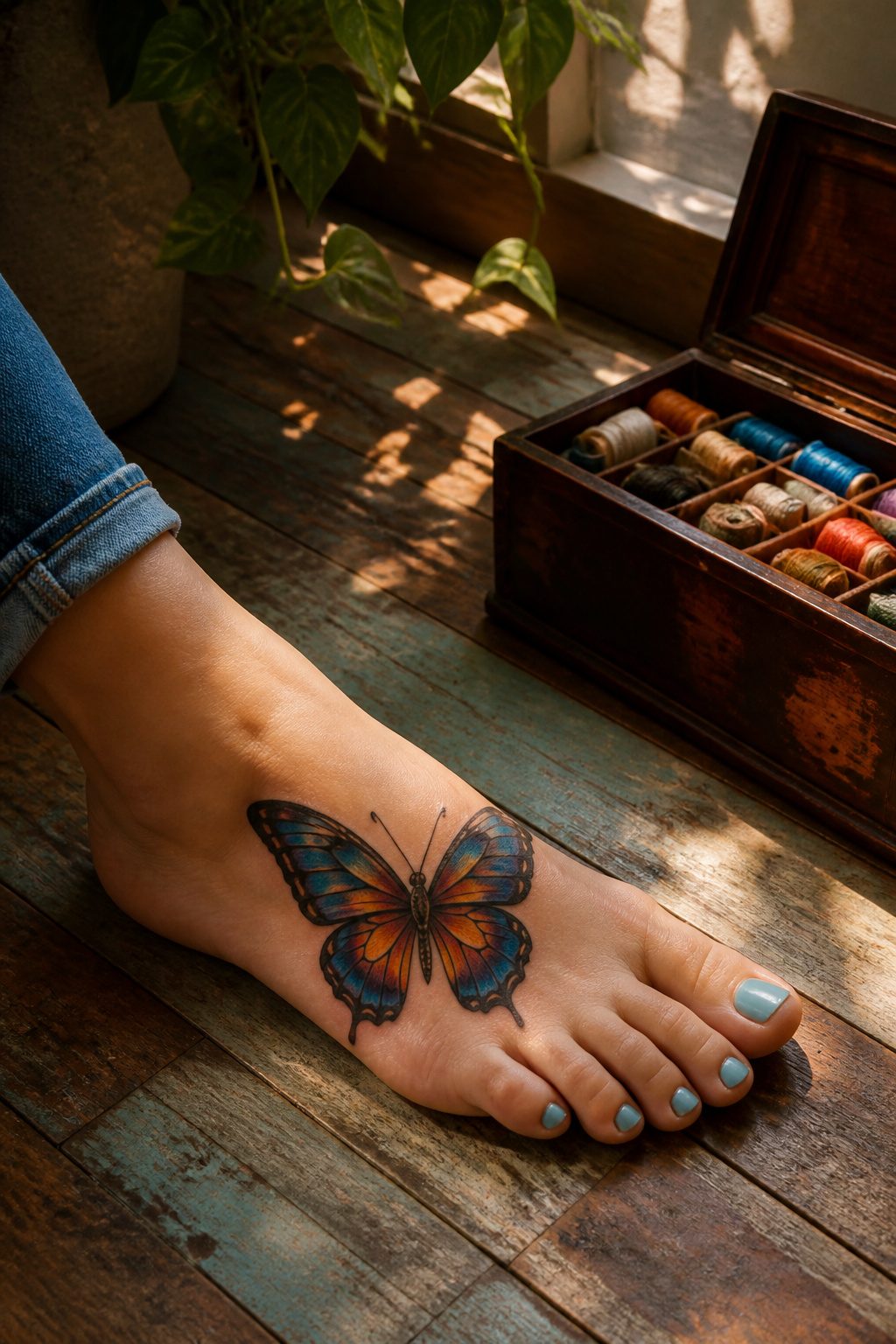
Butterflies rank among the most requested foot tattoo ideas for women, and the symbolism carries real weight. Transformation marks the meaning most people come for, a reminder of growth that still reads as decorative rather than heavy. A design can split across both feet, one wing on each, so the image completes when you stand with feet together. That placement works best for people who want the tattoo to stay personal, visible mainly to themselves or a partner.
A single butterfly across the top of the foot gets the space and light it needs. High arches in particular suit this placement, since the raised surface gives a more stable canvas for detail. For flatter feet, the side of the foot often holds ink better. The skin there shifts less under pressure, and a smaller butterfly running along the outer edge ages more cleanly.
Wing detail is where foot tattoos earn their reputation for fading. Fine lines and dense patterns blur faster here than on the upper arm or back. The foot takes friction from shoes, absorbs sun when sandals come out, and sheds skin faster than most spots. Artists who know the territory tend to simplify the wing veins, trading microscopic accuracy for a shape that still reads as butterfly five years in.
3. Script or Quote Tattoos
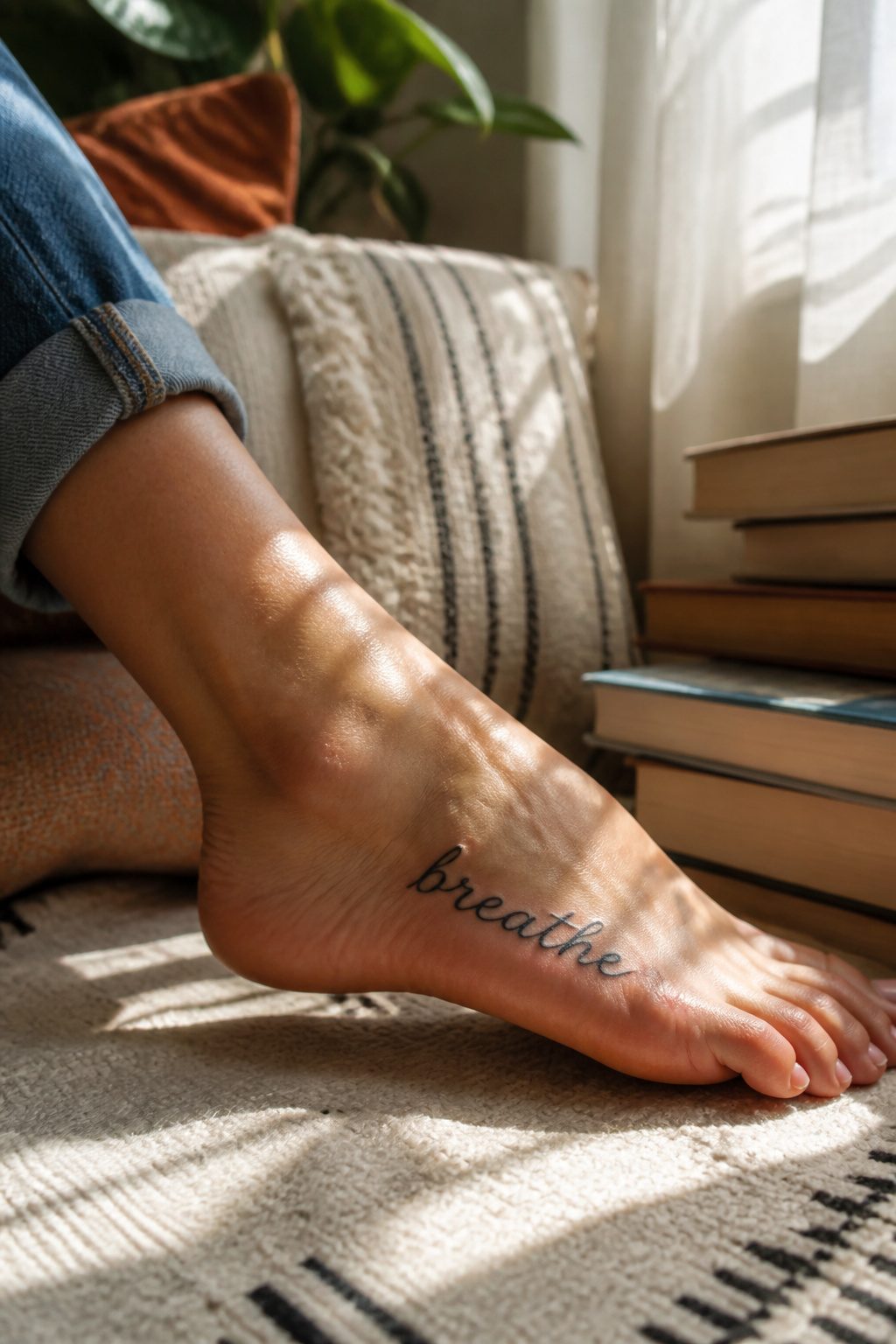
Script tattoos on the foot carry words you want to walk with, but the skin there works against fine detail. Lettering expert Mia Harper notes that choosing a font with lasting clarity matters for long-term visibility, and simpler scripts hold up better than ornate cursive on thin foot skin. The arch and outer edge are the practical placements, with side placements giving more stable skin surface for flatter feet, while the top of the foot works for high arches. Short words or single names beat long phrases because lettering spreads over time on the foot’s thin skin, a line that blurs faster than you expect. A partner’s name, a child’s name, or a single motivating word sits cleanly along the outer edge where the skin sees less direct abrasion. Block letters or clean sans-serifs age more gracefully than flowing script, and spacing the letters slightly wider than looks right at first accounts for that inevitable spread. The constant motion of walking means foot text tattoos demand restraint in both length and ornament.
4. Animal Tattoos
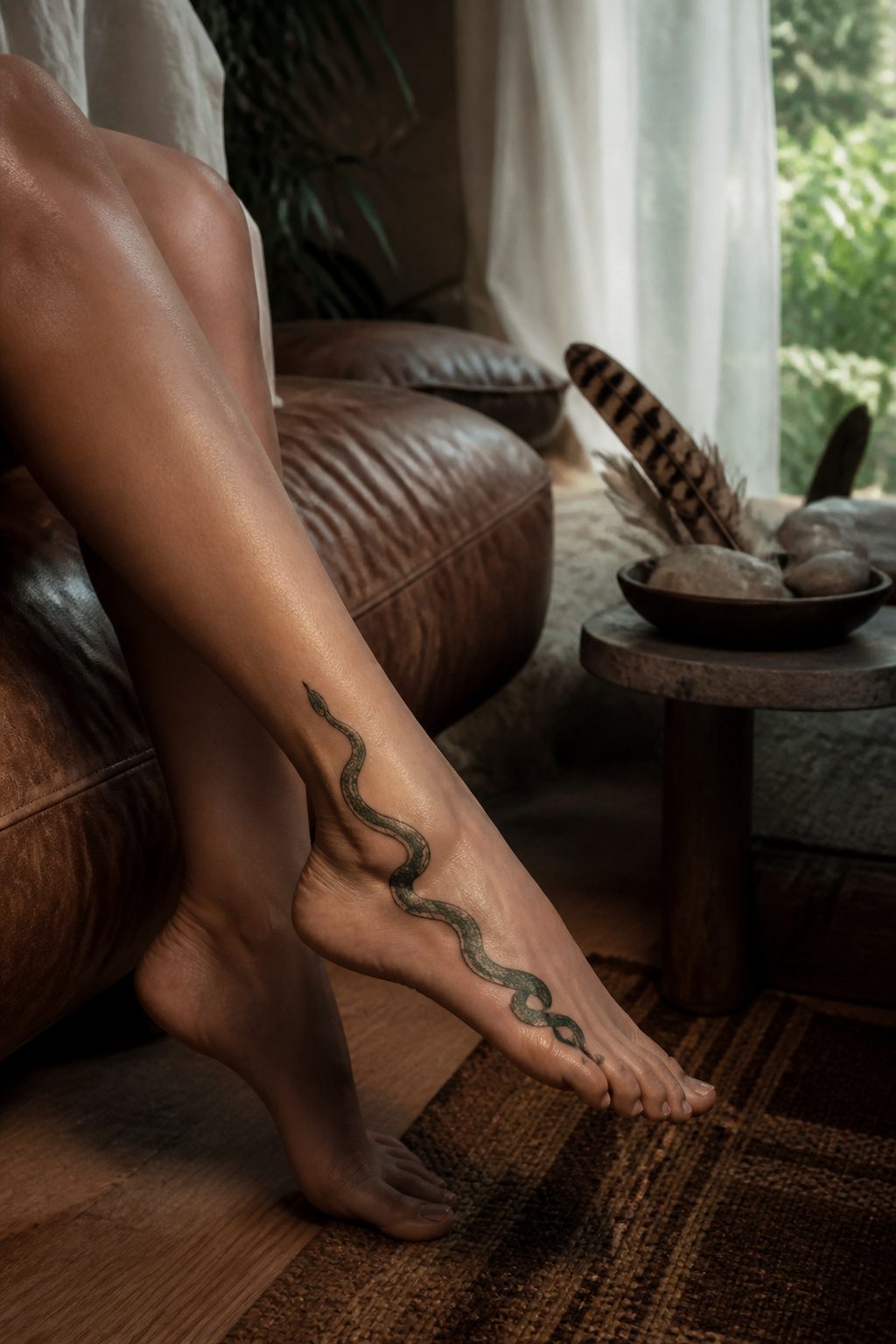
Rabbits and snakes are the two animal designs that come up most often for feet, and for opposite reasons. The rabbit reads as small, fast, lucky; the snake reads as deliberate, continuous, a little dangerous. On a foot, those meanings get shaped by where the body goes.
A snake’s long, narrow form follows the arch almost too well. The curve from heel to ball becomes the snake’s own spine, and a good artist will use that rather than fight it. About 75% of clients who come in with high arches put the larger, more detailed work right on that raised top surface, where the skin is most stable and the line stays clean longest. Flat-footed clients usually do better pushing the design toward the outer edge, where the skin doesn’t flex and stretch as much with every step.
Rabbits land differently. Their compact shape suits the ankle bone or the flat plane across the top of the foot, places where a small mammal can sit still without wrapping around a curve. The temptation is to ask for fur texture, whisker-fine linework, the soft look of an actual pelt. Fur detail on a foot is the first thing to blur. Feet shed and regenerate skin faster than almost anywhere else, and the fading runs roughly 15–30% ahead of a comparable tattoo on the upper arm or back. What starts as a fluffy realistic rabbit becomes a smudged silhouette in two or three years unless you commit to touch-ups.
The snake faces the same problem in reverse. Its scales are easier to simplify into bold black or strong geometric pattern, which holds. A snake done as a single flowing line, no fill, will age cleaner than one loaded with scale-by-scale shading. The symbolic reading is protection or facing fear, depending on who you ask; either way, the image works because the foot itself moves like a snake when you walk, flexing and releasing along that same S-curve.
Other creatures get requested, but the same rules apply. Anything with a long body wants the arch or the outer edge. Anything small and round wants a flat, stable panel. And anything whose appeal depends on fine texture should be planned from the start as a design that still reads when the texture is gone.
5. Geometric Designs
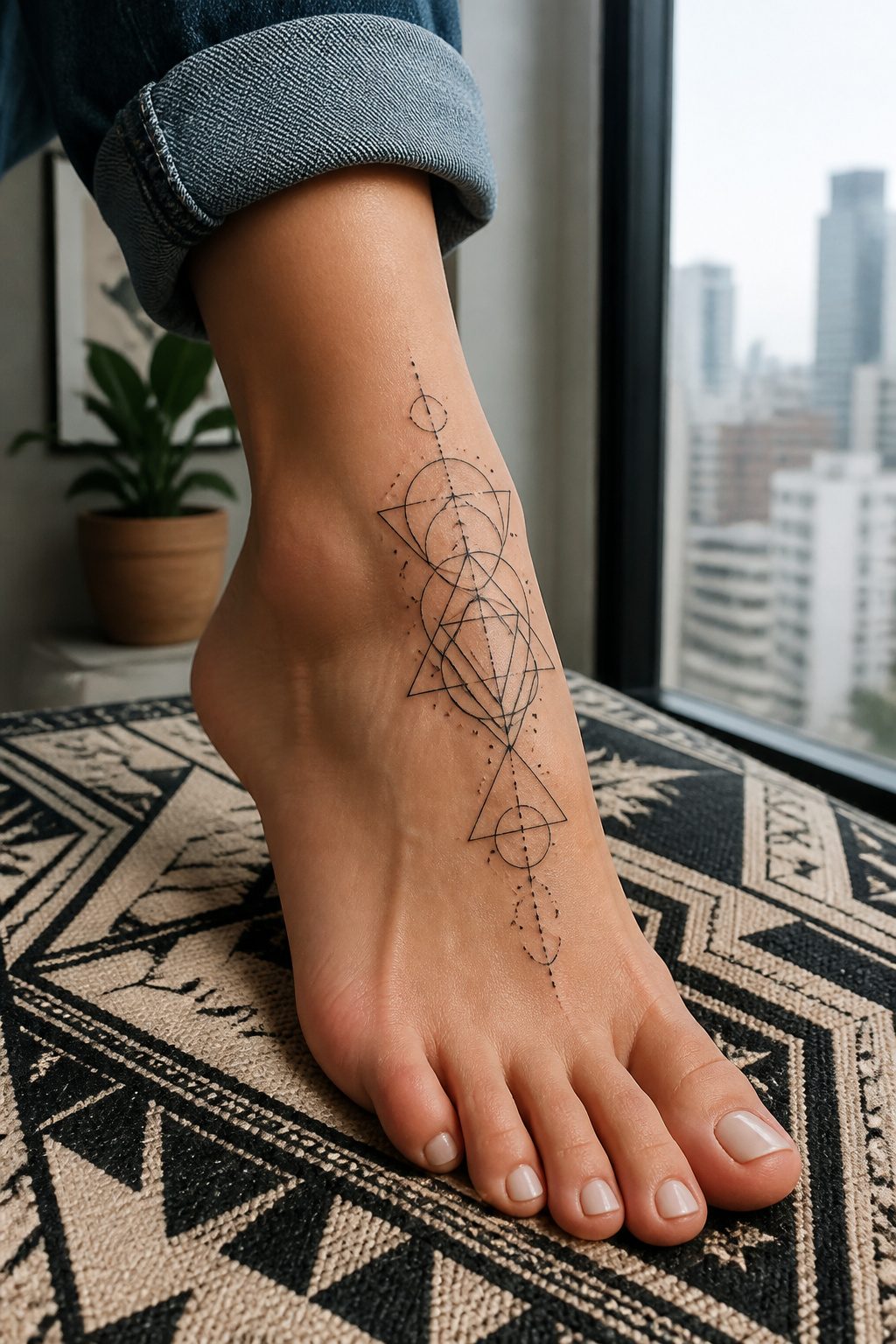
Straight lines on a foot are harder than they look. The skin stretches differently across the arch, pulls at the heel, and swells enough after a session that a perfect circle can heal into something closer to an egg. Geometric work, bands around the ankle, shapes laid across the top of the foot, dotwork radiating from a center point, all of it demands a hand that does not shake and a design that accounts for the bone underneath.
The top of the foot, where the arch is highest, carries larger, more detailed pieces well. About 75% of clients with high arches choose this placement. Flatter feet shift the math toward the side, where the skin stays more stable against the edge. Bands that wrap slightly around read as dimension on wider feet; narrower feet carry vertical designs that follow the length more gracefully.
Jenna Rose, who works at Good Grief Tattoo in Stanstead, notes that feet swell and stay sore after tattooing. She recommends soft, cushiony old trainers rather than anything with straps that cut in. Geometric tattoos on feet need that steady swelling to go down before the final line is really final, and even then, touch-ups are common. The symmetry that makes these designs striking is exactly what blur or uneven healing betrays first.
6. Mandala Tattoos
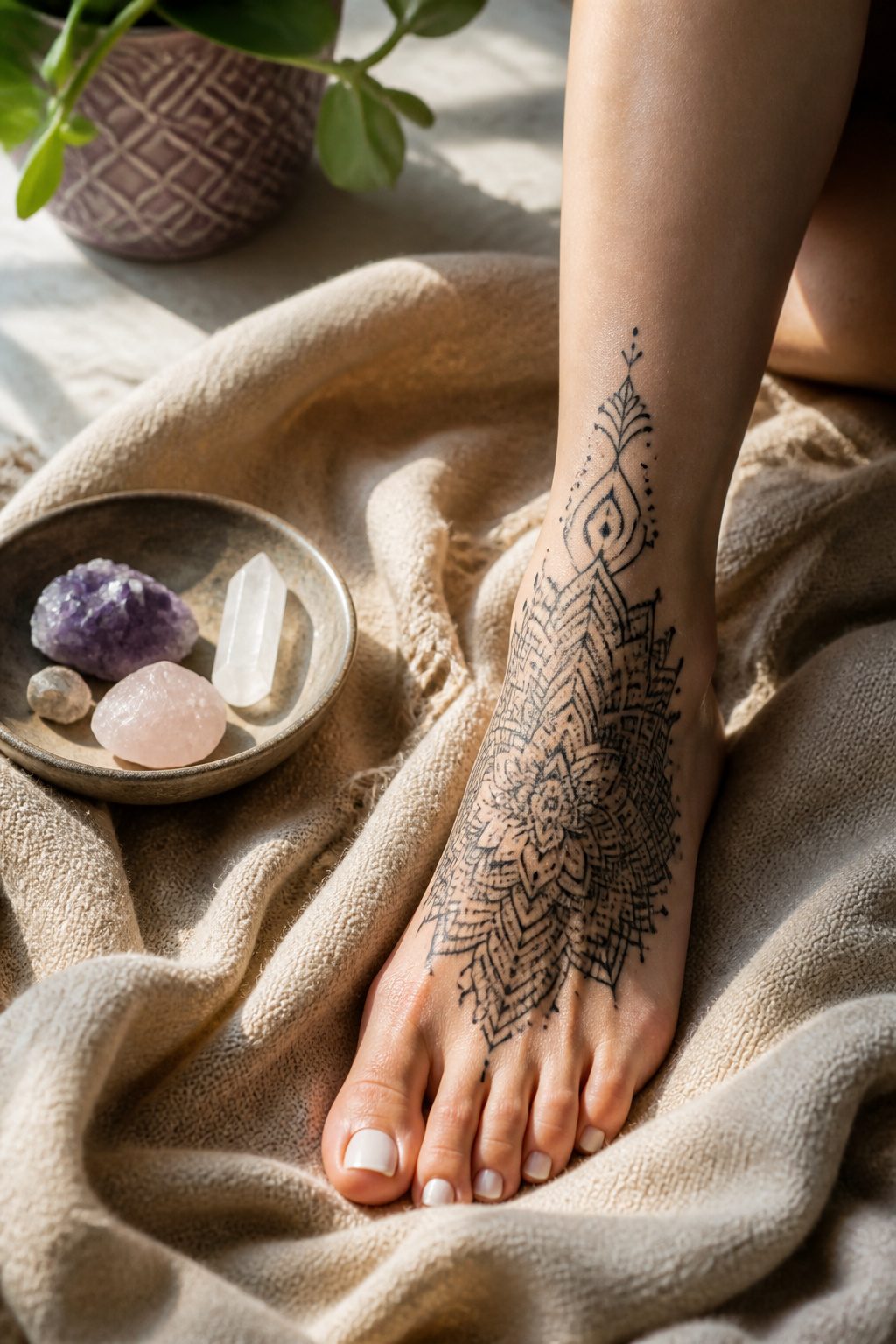
A mandala lives or dies by its center, and the foot gives you two natural focal points: the high arch where the foot meets the ankle, or the flat plane just above the toes. The curve between those two spots is what makes this tricky. A perfectly symmetrical mandala drawn on paper will distort when wrapped across the instep, so most artists I watched during my years in shops started the stencil with the client standing, weight on the foot, not lying flat.
The top of the foot offers maybe four inches of usable width before the design starts wrapping over the sides. That is tight for the detail work mandalas invite. What convinced me, looking through portfolios and watching consultations, is that the mandalas that age best extend deliberately onto the lower leg, using the ankle bone as a natural border rather than fighting to squeeze everything above it. A six-inch circle that starts two inches up from the toes and rides over the ankle preserves the geometry; a four-inch circle crushed entirely onto the foot tends to blur at the edges within a few years.
Color in foot mandalas is its own gamble. The foot sheds skin faster than almost anywhere else, and the fine lines that define petal layers or dotwork fade first. Black and grey hold the structure; color fills, if you want them, sit safer on the lower leg extension where the skin takes ink more predictably.
7. Rosary Tattoos
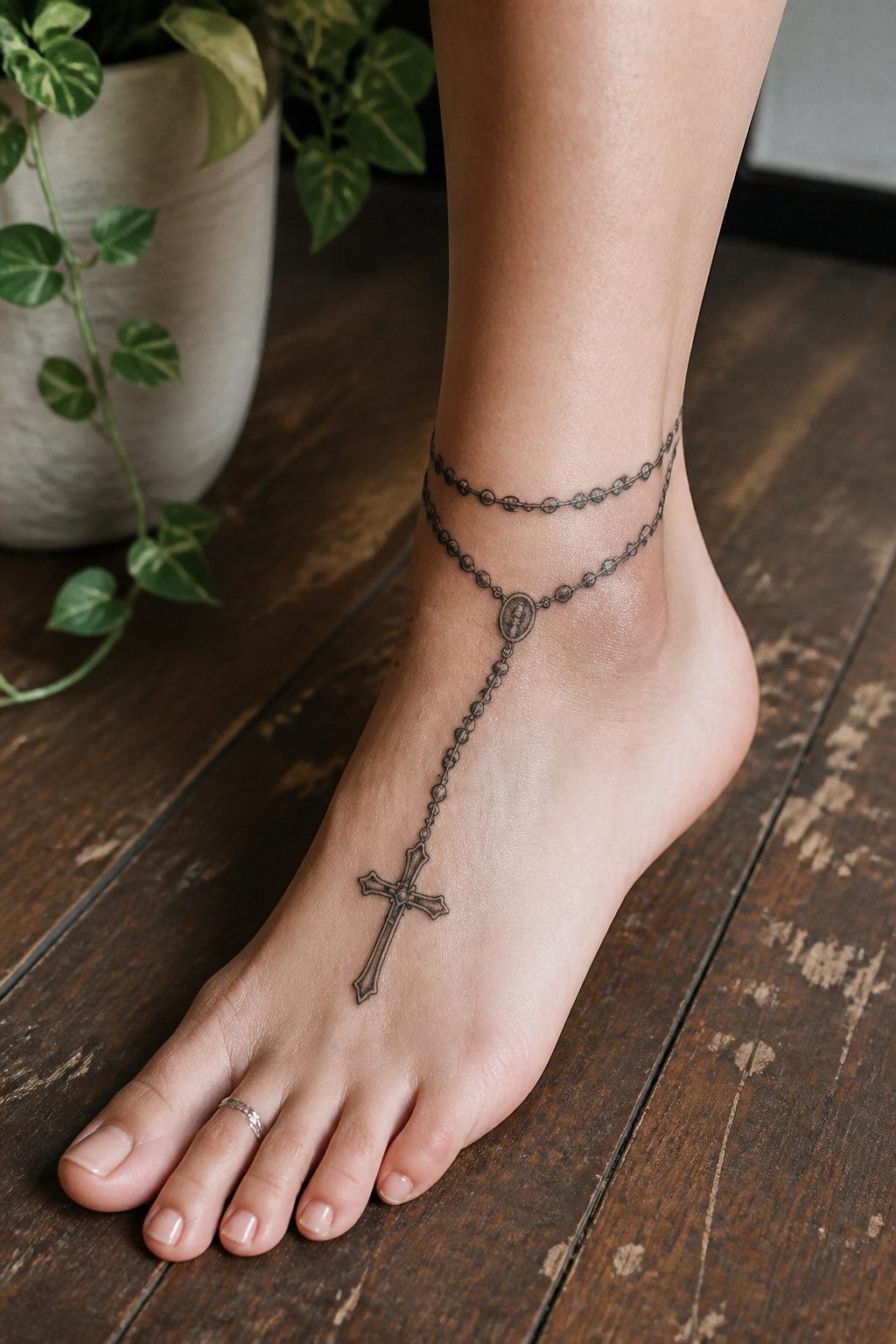
A rosary tattoo wraps beads around the ankle with the cross dropping toward the top of the foot or tracing the arch, and this is one foot design where asymmetry is expected rather than a flaw. The loop follows the bone, the cross settles where the foot flattens, and both shift with every step.
Straight lines fight the foot’s anatomy. The arch rises and falls, the ankle rolls, and a beaded chain that looked even on the stencil can kink or bunch once the skin moves. Experienced artists map the placement while the foot flexes, not just flat on the bench, because a rosary that drapes gracefully when you stand can torque into something else entirely when you walk. The weight of a detailed cross at the arch adds another variable: it sits where the skin stretches most and where shoes rub hardest.
The spiritual reading is personal. Some wear it as a private emblem, the cross hidden under a sock line, the beads peeking at the heel. Others let the cross face forward across the toes. Either way, the foot’s mechanics make this one of the harder placements to keep crisp, and the asymmetry of the wrap is part of what makes it look alive rather than broken.
8. Watercolor Tattoos
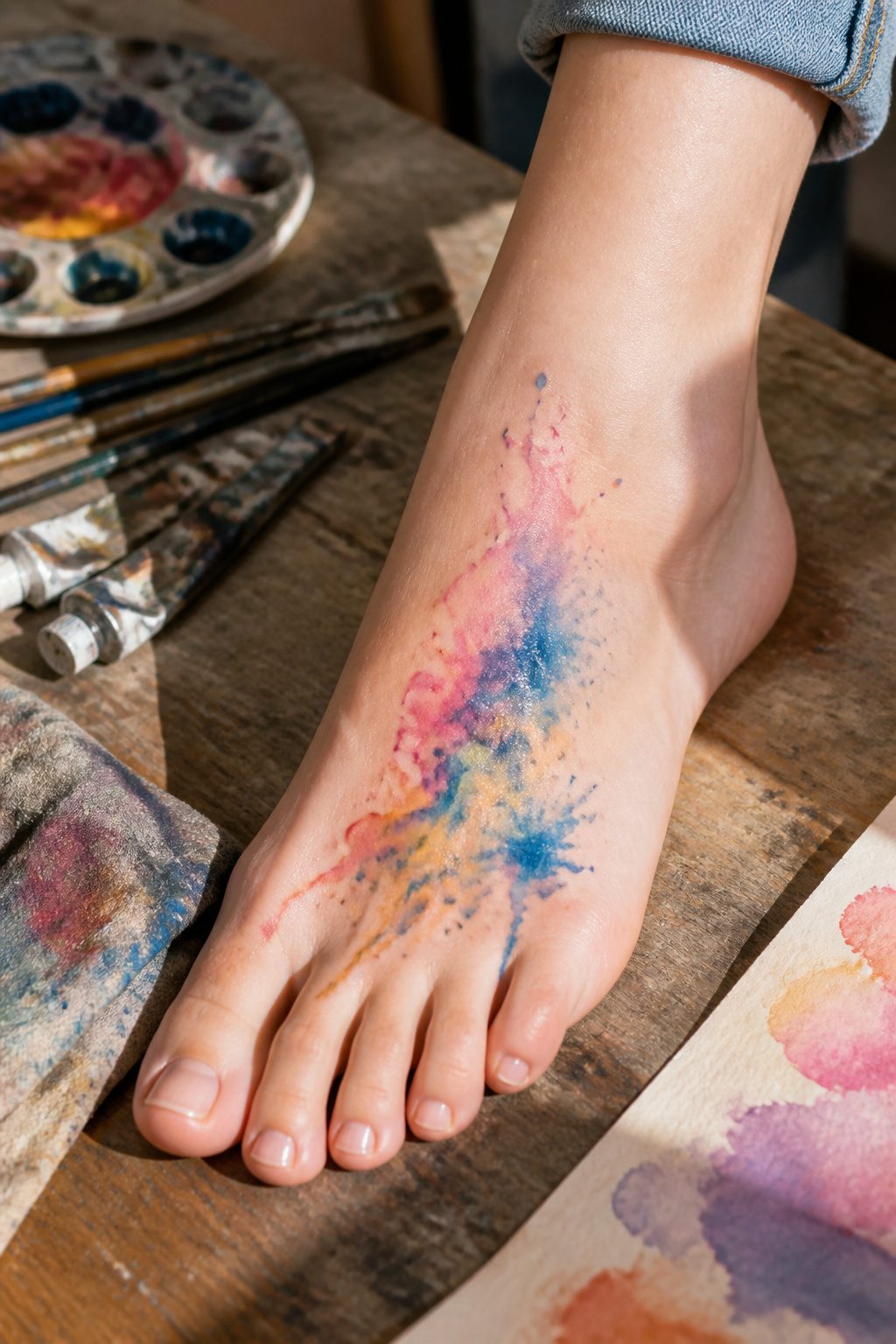
Watercolor tattoos look delicate on a foot, and that delicacy is exactly the problem. The technique trades black outlines for bleeding edges and transparent pigment layers, which means nothing holds the shape once the ink starts to move. On feet, that movement happens fast. Friction from socks and shoes works the skin harder than almost anywhere else, and without a dark boundary to keep the form intact, watercolor pieces blur fastest of all styles.
Flowers and abstract splashes fare better than portraits or anything with fine detail. A rose can lose a petal edge and still read as a rose; a face loses an eyebrow and becomes a smudge. Subjects with soft, irregular edges in nature match what the style already does, so the fading looks intentional longer.
The color question is starker here than with other styles. Black and grey work lasts 30–40% longer on feet than full-color pieces, and watercolor lives in its lightest hues. Yellow and light blue, the shades that give the style its airiness, fade quickest of all. What starts as a bright splash can settle into a pale bruise within a few years.
That does not make watercolor impossible on a foot, only higher-maintenance. Expect more frequent touch-ups, budget for them, and choose a subject that forgives the blur.
9. Minimalist Designs
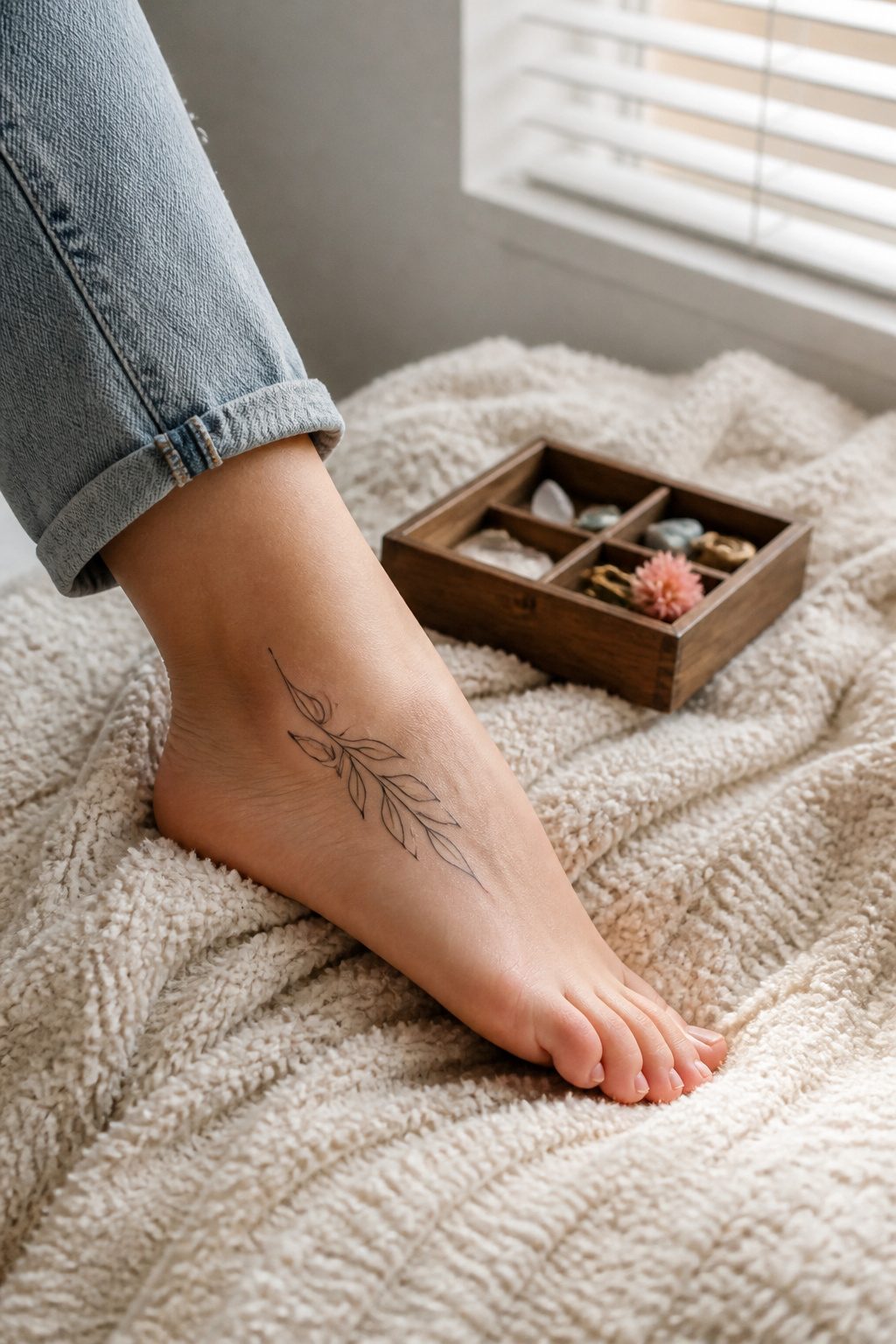
Single-line drawings stay popular because they read as jewelry rather than ink, a thin constellation tracing the arch or a leaf strand running from ankle to toe. The sources note women choosing these for exactly that reason: something that follows the foot’s natural curve and never comes off. Tiny symbols work the same way, a maple leaf or Eye of Horus small enough to hide in a sandal strap but deliberate when shown.
Micro tattoos and fine-line botanicals extend the same logic to even less surface area. The problem is the technique itself. Minimalism relies on lines thin enough to blur, and the foot’s daily friction from socks, shoes, and sheer mileage accelerates that blur past what happens on a shoulder or forearm. Touch-ups within two years are the practical norm, not the exception, so budget the time and cost of a second session when you choose this route.
Placement shapes how fast the fade arrives. Toes lose ink fastest, the side of the foot holds somewhat better, and the ankle bone offers the most stable canvas while still reading as foot rather than ankle. I would skip the toe suggestion entirely unless you genuinely enjoy maintenance; the side or ankle bone gets the same visible effect with less commitment to upkeep.
10. Nature-Inspired Motifs
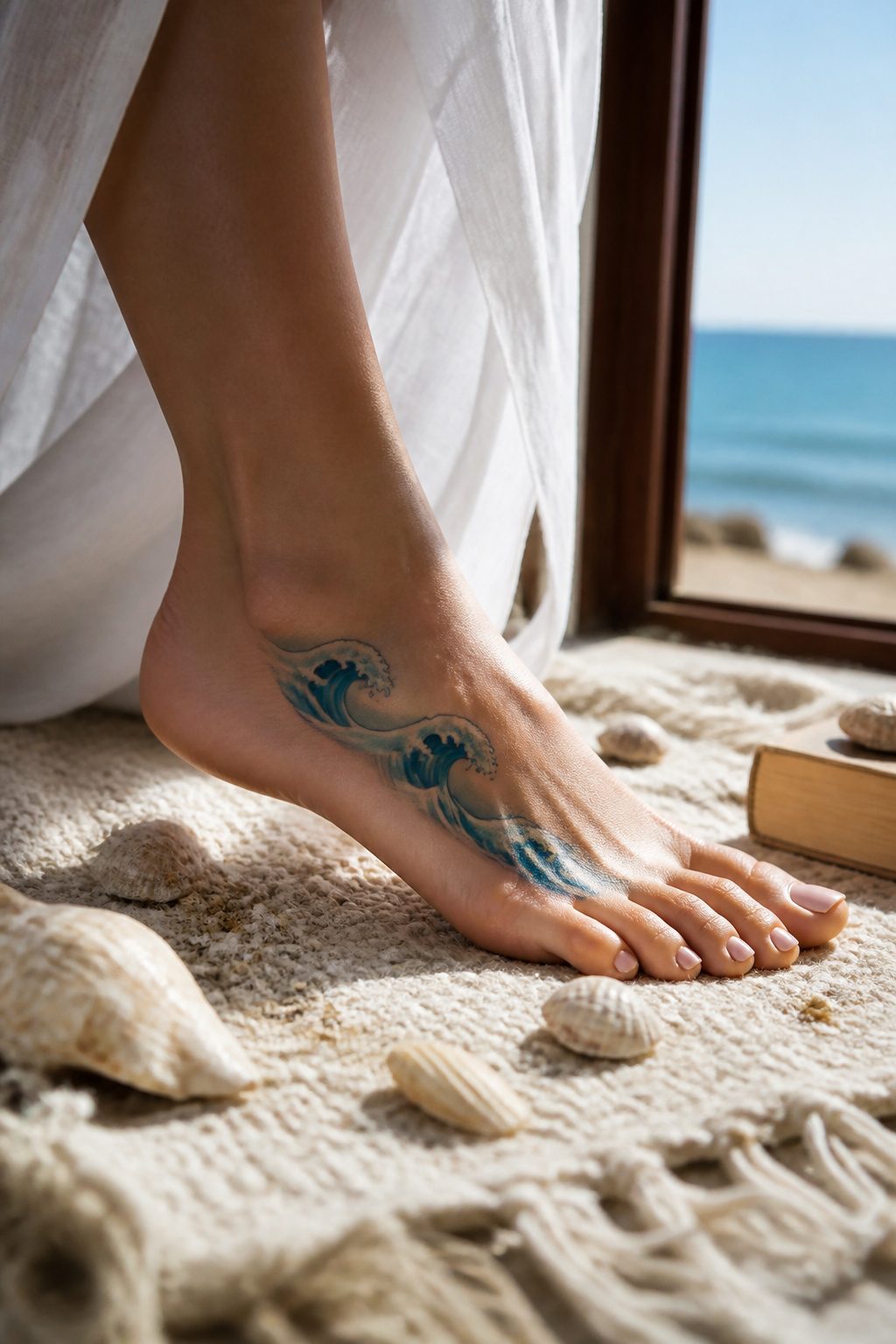
Waves, trees, mountains, and celestial bodies all translate well to the foot because the shape itself suggests a landscape. A wave can follow the arch like a shoreline, with the crest breaking toward the toes. Trees root at the heel and branch upward, using the ankle as a trunk and letting the canopy spread across the top of the foot. Mountain ranges sit naturally across that same top surface, peaks rising where the bone shows most.
Sun exposure on feet fades outdoor-themed ink faster than work on covered skin. The top of the foot sees more daylight than almost any other tattoo location except the hands, so a wave or sun motif that starts crisp will soften sooner than one on a shoulder or thigh. A skilled artist can anticipate this by packing pigment slightly heavier in the linework, though the color will still shift over time.
Coastal tattoo artist Brian Shaw notes that wave tattoos on the foot suit people who find meaning in the ocean’s rhythm. The connection between the design and the wearer’s own movement, step after step, gives the motif weight beyond the image itself. A mountain range, meanwhile, can read as personal conquest in such a small, weight-bearing space. The celestial options, moon phases or scattered stars, work almost anywhere on the foot but hold up longest on the outer edge where socks and shoes rub less.
What the Pain Actually Feels Like
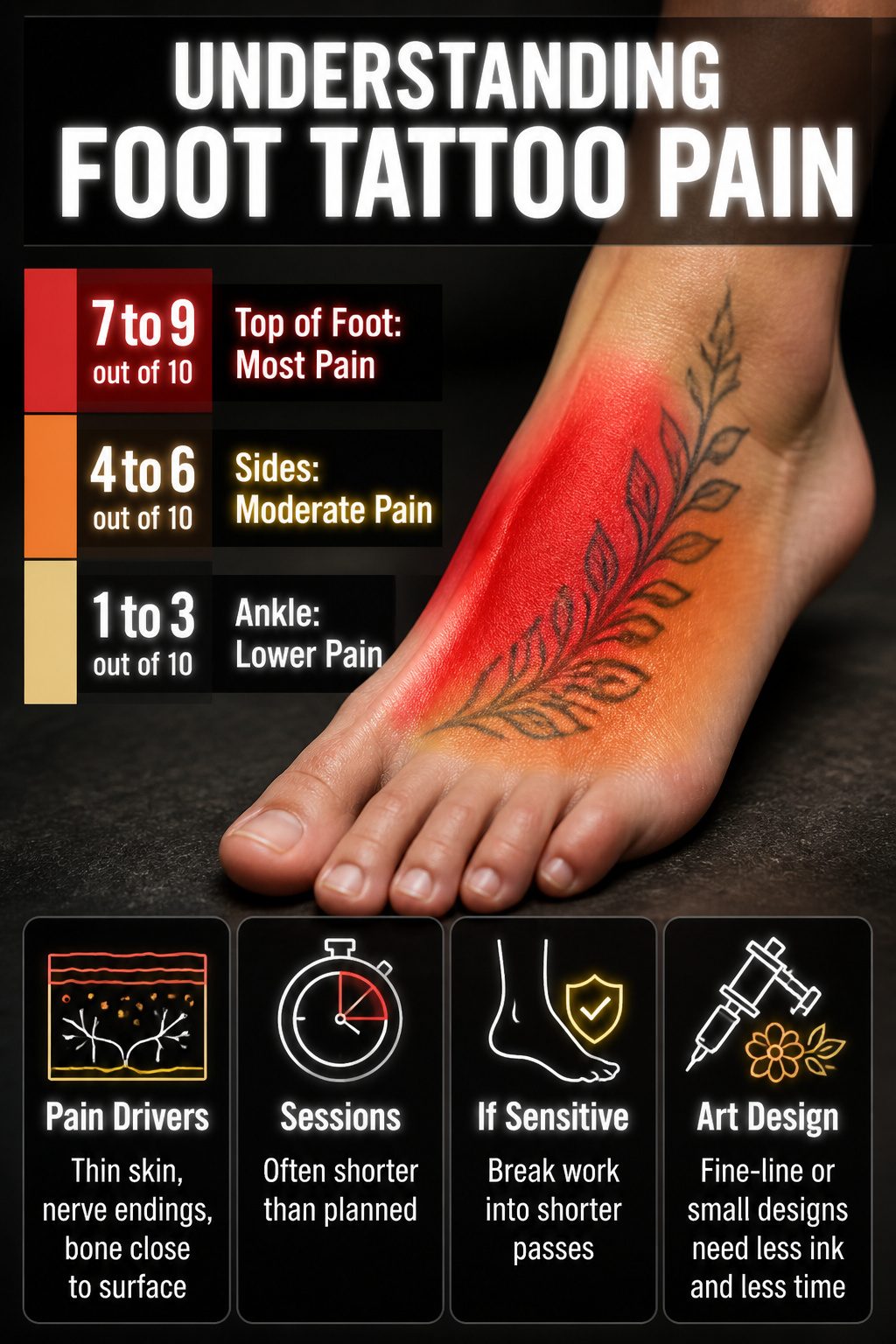
A foot tattoo sits at 7 to 9 out of 10 on the pain scale, against 4 to 6 for an outer arm piece. The foot has thin skin, almost no fat padding, and nerve endings packed close to the surface with bone lying directly underneath. That combination leaves nowhere for the needle impact to go.
The top of the foot hurts most. Sides rate somewhat lower, and the ankle edges below that. I have watched sessions run shorter than planned because the intensity does not let up; artists and clients both tend to cap the time and return later rather than push through. A stomach or knee carries its own reputation, but foot pain stays consistently high across the area rather than spiking only at certain points.
If you are sensitive, ask your artist to break the work into shorter passes. Fine-line or small designs need less ink and less time under the needle, which limits total exposure without changing what each moment feels like.
Healing Timeline and Aftercare
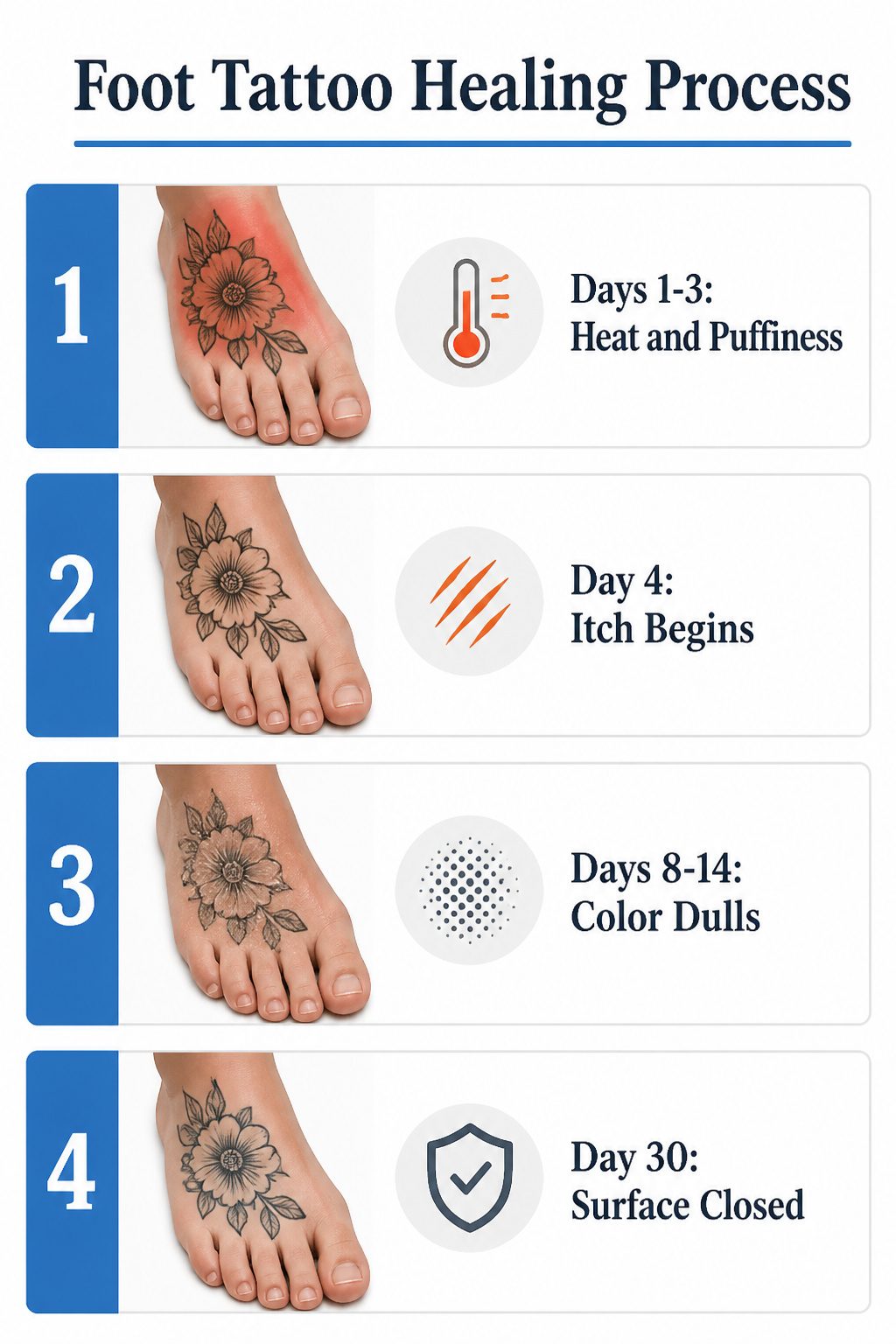
A foot tattoo heals slower than work on your arm or back, usually running 20 to 30 percent longer because circulation below the knee is weaker and the skin takes more punishment. The full timeline runs one to three months, and the first two weeks look like a separate project entirely.
Days one through three brought the familiar heat and puffiness for me, except standing made it worse, since gravity pools blood in the lowest point. By day four the itch started, and a tight layer formed over the lines. That scab-like surface flaked off between days eight and fourteen, leaving the color looking dull and almost dusty, which is normal but still alarming if no one warns you. The surface looked closed by day thirty, though the deeper layers kept rebuilding for weeks after.
Water is the enemy in ways that surprised me. Showers are fine, but baths, swimming, and any full submersion are out. I kept a bottle of plain, fragrance-free moisturizer by the bed and applied thin layers whenever the skin felt tight. Socks with tight elastic bands cut into the swelling and left marks against fresh ink, so old, soft-cushioned trainers with loose tops became my uniform for the first month. Running and gym time stopped completely; foot sweat raises infection risk, and the friction from a treadmill belt or even gym-floor rubber is brutal on new work.
The real challenge is that you cannot simply not use your feet. Every step is a micro-trauma to the healing surface. Planning this for a week with minimal walking, or scheduling around a desk-heavy stretch, makes the difference between clean lines and a patchy result.
Why Foot Tattoos Fade Faster
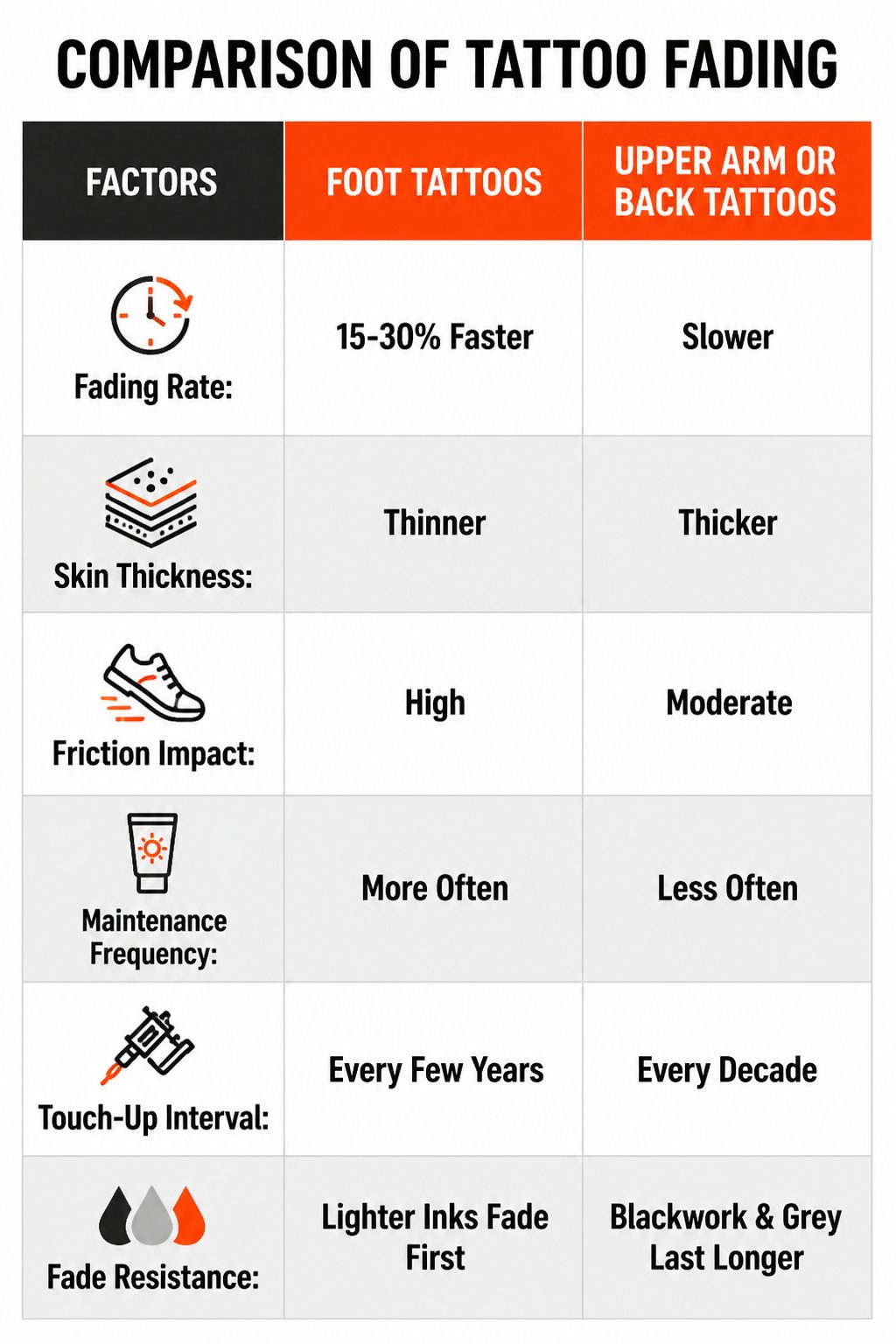
Foot tattoos fade roughly 15–30% faster than work on the upper arm or back, and the reasons stack up quickly. The skin on the sole and sides of the foot turns over faster than most body areas, shedding ink-bearing cells before the pigment settles deep. That skin is also thinner, so the needle deposits less ink to begin with.
Friction does the rest. Socks and shoes rub the area hundreds of times per day, steadily wearing down lines and color. Sun exposure adds to it whenever the feet are bare, and lighter inks—yellow and light blue in particular—show fading before bold blackwork or dense grey shading.
Black and grey designs maintain their integrity 30–40% longer on feet than full-color pieces. The bolder the line, the more forgiving the tattoo.
Slowing the fade means daily sunscreen when the feet are exposed, regular moisturizer to keep skin from drying and flaking, and choosing shoes that do not rub directly over the design. Even with good care, expect touch-ups more often than for a shoulder or thigh piece. For most people, that means a refresh every few years rather than every decade.
Seasonal Timing That Actually Matters
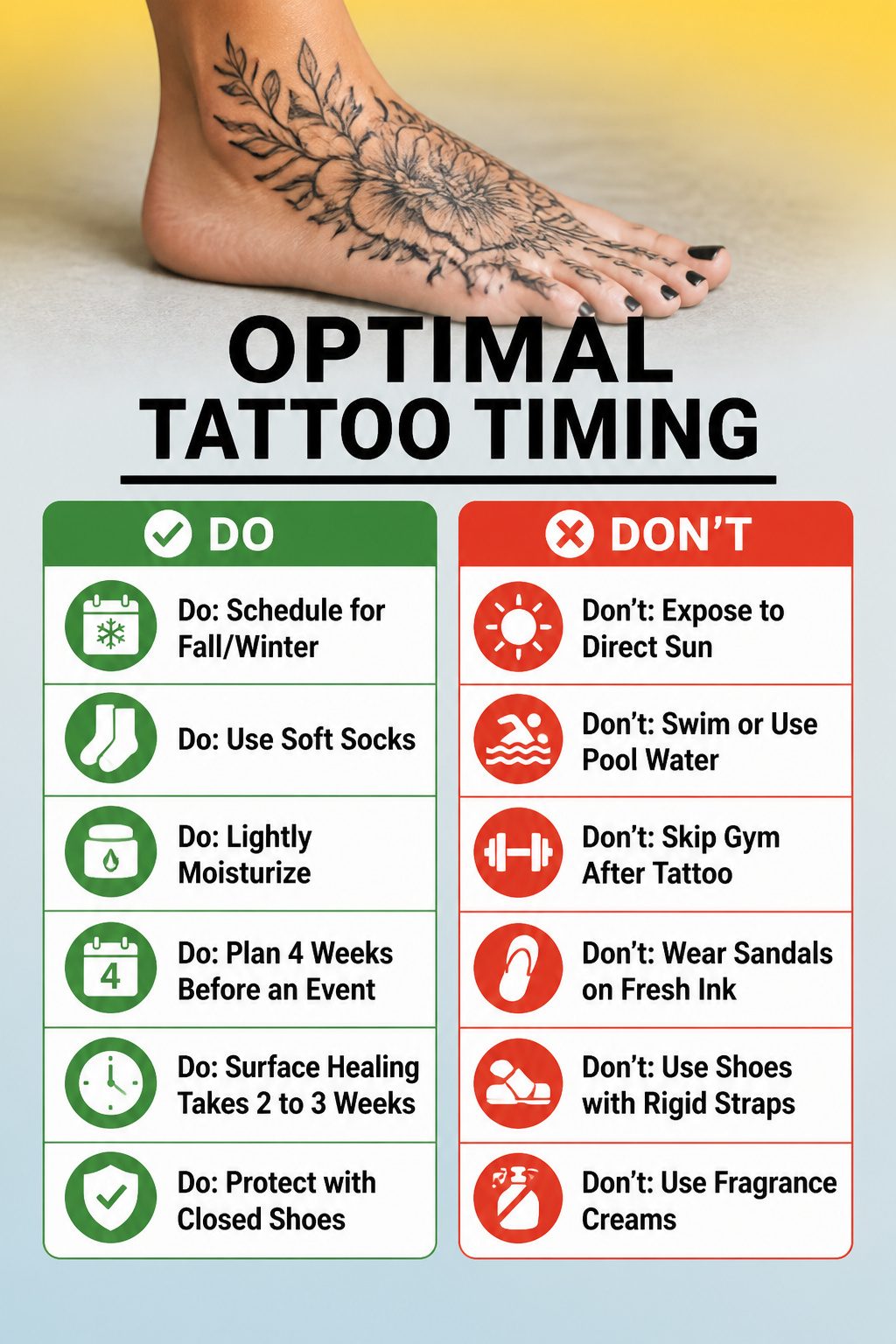
Summer heat turned out to be the wrong season for my first foot piece. The studio data backs up what I learned the hard way: healing complications jump roughly 35% for foot tattoos done in peak summer months. Sweat keeps the wound damp, UV exposure hits fresh ink when sandals expose it, and pool water is off-limits for weeks anyway.
Fall and winter look better on paper. Closed shoes shield the tattoo from sun and grit. But that same footwear creates friction where the ink sits, and socks with tight elastic can cut into swollen skin. The artist Jenna Rose recommends soft, cushiony old trainers instead of anything with rigid straps.
Sandals solve the rubbing problem and then hand you a new one: direct sunlight on unhealed pigment. Either route demands management. Moisturize lightly with a fragrance-free cream, skip the gym to avoid sweat, and plan the appointment at least four weeks before any event where you want the tattoo visible. Surface healing needs two to three weeks; redness fades closer to four.
Frequently Asked Questions
Do foot tattoos hurt?
Foot tattoos rank between 7 and 9 on a 10-point pain scale, compared to 4 to 6 for an outer arm piece. The foot has thin skin with almost no fat padding, nerve endings close to the surface, and bone lying directly underneath, so the needle impact has nowhere to go. The top of the foot hurts most, while sides rate somewhat lower.
How long do foot tattoos take to heal?
Foot tattoos take one to three months to heal fully, running about 20 to 30 percent longer than work on the arm or back. The surface typically looks closed by day thirty, but deeper layers keep rebuilding for weeks after. Weak circulation below the knee and the fact that every step is a micro-trauma to the healing surface both slow the process.
Do foot tattoos fade faster than other tattoos?
Foot tattoos fade roughly 15 to 30 percent faster than tattoos on the upper arm or back. The skin turns over faster, friction from socks and shoes wears down lines daily, and sun exposure hits whenever feet are bare. Black and grey designs last 30 to 40 percent longer than full-color pieces on feet.
What are some popular foot tattoo designs for women?
Floral designs, butterflies, script or quotes, and geometric patterns all rank among the most requested foot tattoo ideas for women. Snakes and rabbits are common animal choices, while mandalas, rosaries, watercolor pieces, minimalist line work, and nature motifs like waves or trees also draw steady interest. Each style ages differently on foot skin, so the choice of design should account for how much detail the placement can hold over time.