
A back tattoo for a guy can run from a single shoulder piece to a $10,000 full narrative spanning years of sessions, and the deciding factor is not the design you like but whether you can sit through the needle hitting bone. Spine and kidney work pushes 9 out of 10 on the pain scale and cuts sessions to three or four hours, which is why the artists who build these pieces break the work into stages before the first line goes down.
1. Tribal Tattoos
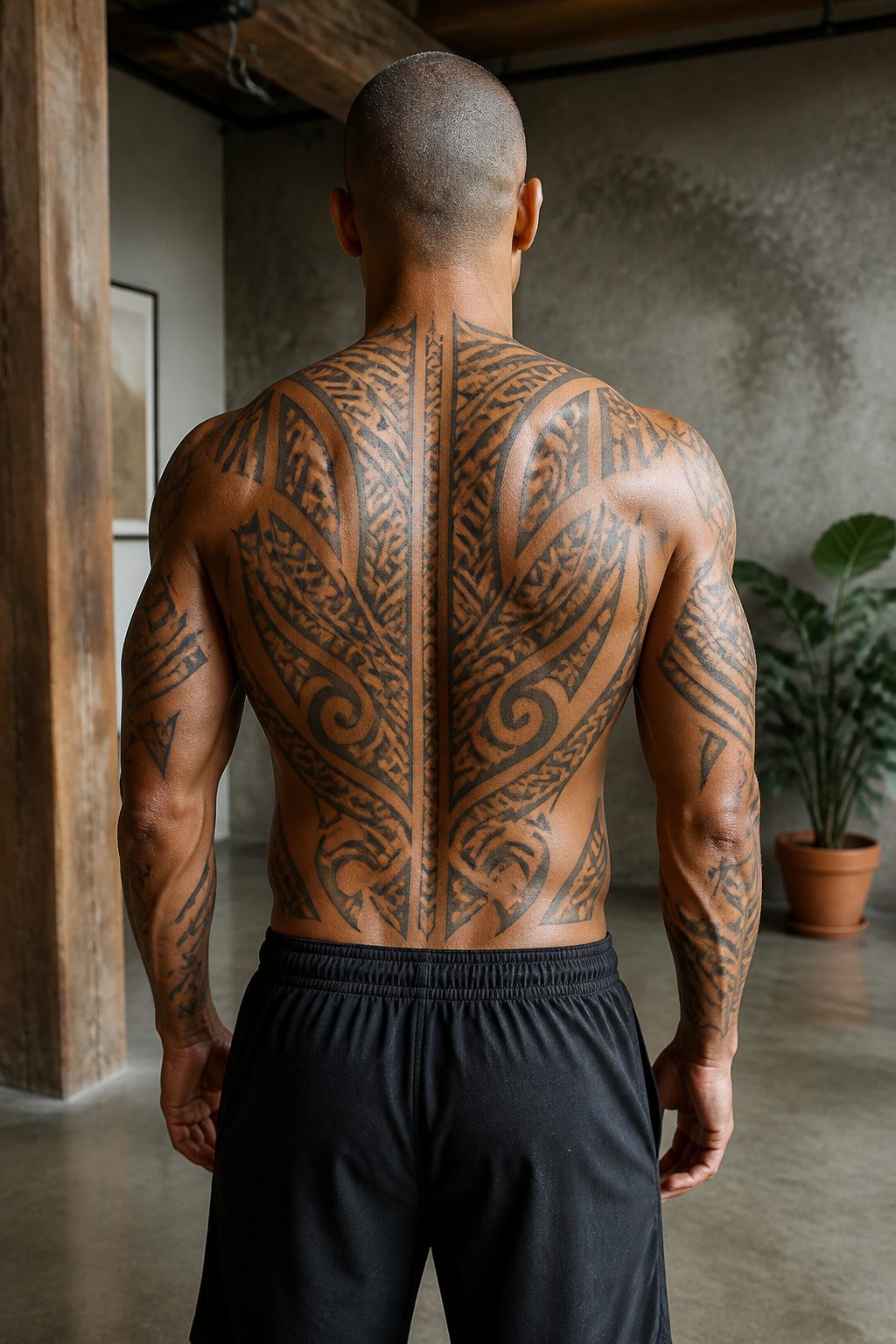
Tribal patterns sit at the top of nearly every ranking of back tattoos for guys, and the reason is structural as much as stylistic. The bold, interlocking blackwork is built to follow the lines of the latissimus dorsi and trapezius muscles, turning the back’s natural geometry into part of the design rather than fighting it. I have watched clients stand in front of the mirror after a session and the tattoo already looks like it belongs there, not like something applied on top.
The cultural weight is harder to navigate. Polynesian societies used these markings as a rite of passage and a record of social status; warriors carried their bravery and achievements in ink across their backs. Japanese Irezumi served a different function entirely among organized crime syndicates, where full-back pieces tested endurance and demonstrated loyalty. Those histories do not disappear just because the design appeals to you aesthetically.
If you are drawn to tribal work, the choice is which lineage you are actually connecting to. A tribal sun draws on life and vitality symbolism tied to specific communities. Interconnected motifs can mark personal milestones, but the visual language comes from somewhere. The best artists I have seen working in this style either have direct cultural ties or have done the work to understand the difference between borrowing and honoring. The muscle flow will look impressive either way; the question is whether you can explain what the pattern means when someone asks.
2. Japanese Irezumi
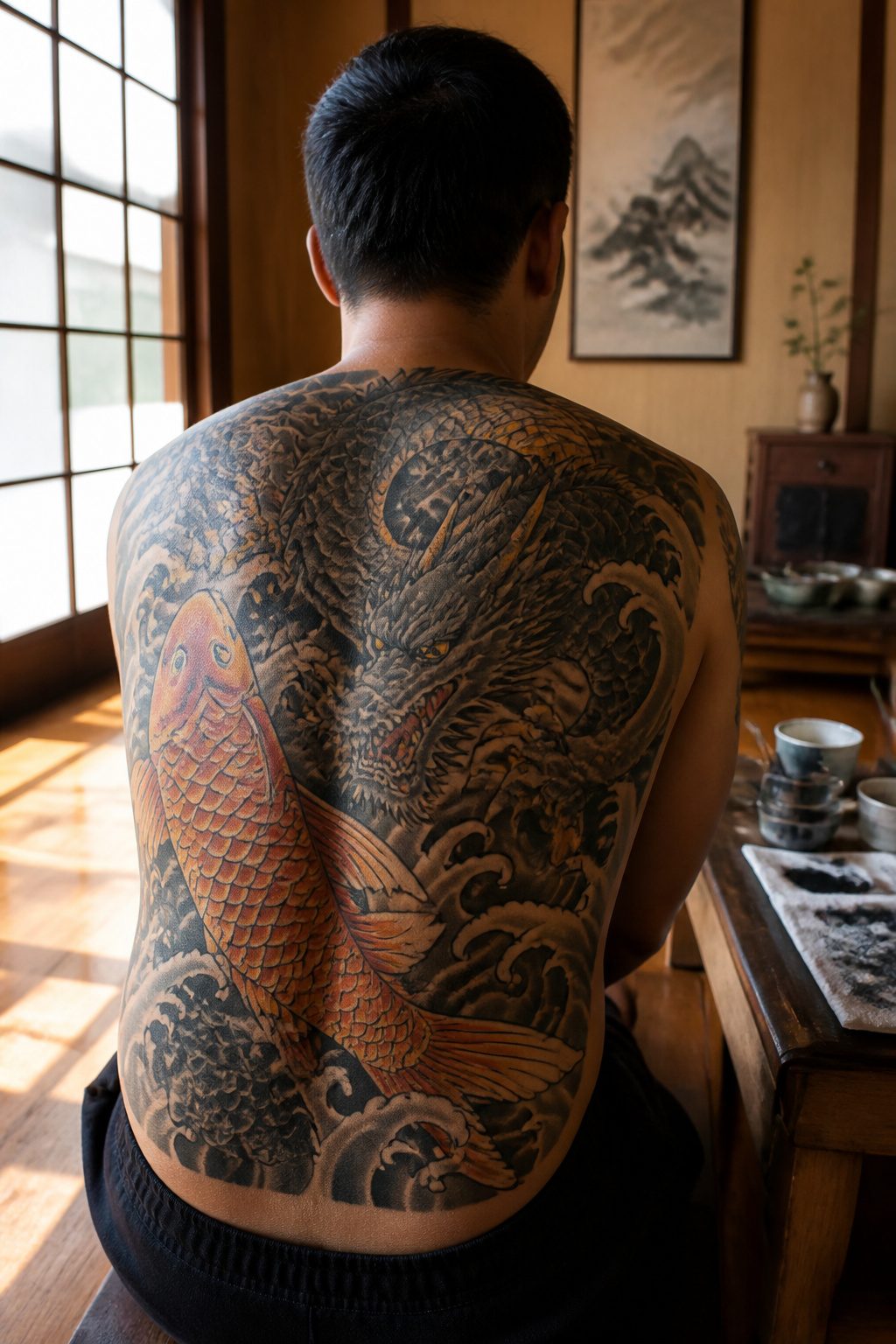
Japanese Irezumi turns the entire back into a single narrative scene, and a full-back piece can take several years to complete in the traditional hand-tapped tebori style. Most artists now use modern machines, but the imagery stays loaded: koi swimming upstream signal perseverance through hardship, dragons carry protection and wisdom, and cherry blossoms mark the briefness of living things. Hanya masks and other mythological figures fill out the roster, each chosen for personal connection rather than decoration alone.
The commitment runs deeper than the chair time. Historically, the pain itself was part of the earning, and a finished bodysuit that extends onto the upper arms and down the thighs still reads as a mark of serious resolve. Cost scales with coverage, though exact pricing varies too much by city and artist to pin down. What does hold is that this is not a style for the guy who wants something quick or easily hidden; the back becomes a private canvas you reveal selectively, and the design demands an artist who actually understands the cultural weight of what they are drawing.
3. Animal Tattoos
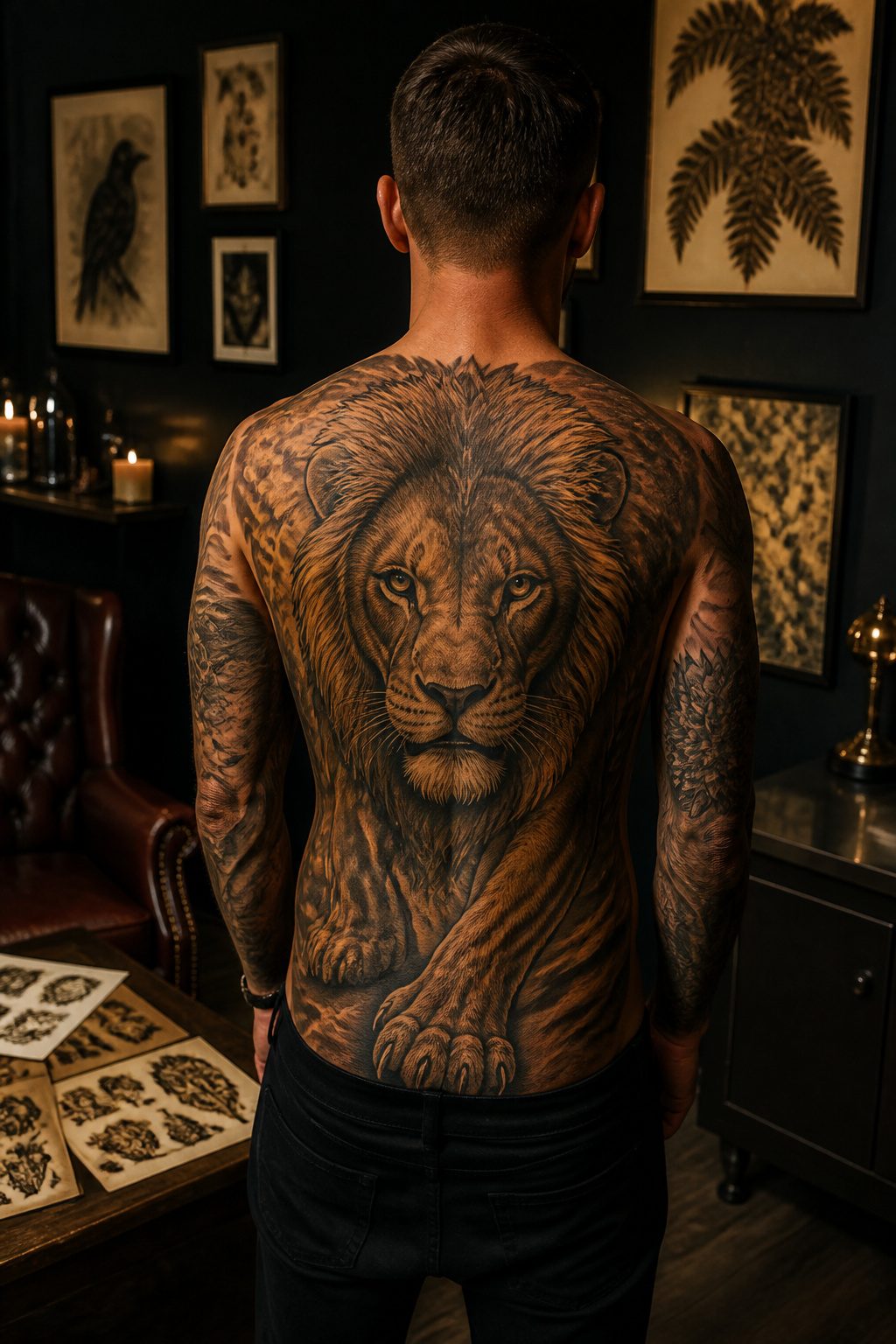
Wolves, eagles, and lions dominate the animal tattoo category for a reason that has nothing to do with trend cycles. A lone wolf across the shoulder blades reads as personal struggle made visible, while a lion between the scapulas uses the back’s natural width to stretch the mane into something that actually looks protective. The back is the largest uninterrupted canvas on the body, and animal designs exploit that scale differently than a chest or arm piece could.
Placement matters more than most first-timers assume. An eagle with wings fully spread needs the latissimus dorsi area to achieve the span that reads as freedom rather than confinement; the same design compressed between the shoulders looks caged. Japanese tradition recognized this with full back pieces called irezumi, where mythological creatures followed the spine’s vertical axis to command presence.
The commitment level tracks with size. A single animal rendered large enough to carry meaning across the entire back requires the same endurance as historical status tattoos, and the pain profile sits near the top for any placement. What separates animal back pieces from tribal or geometric alternatives is the narrative burden: the creature has to look like it belongs to the wearer, not like clip art applied to skin. That is where most back tattoos of this type fail. The lion that reads as strength on paper becomes decoration without posture and eye placement that suit the specific back it inhabits.
4. Floral Tattoos
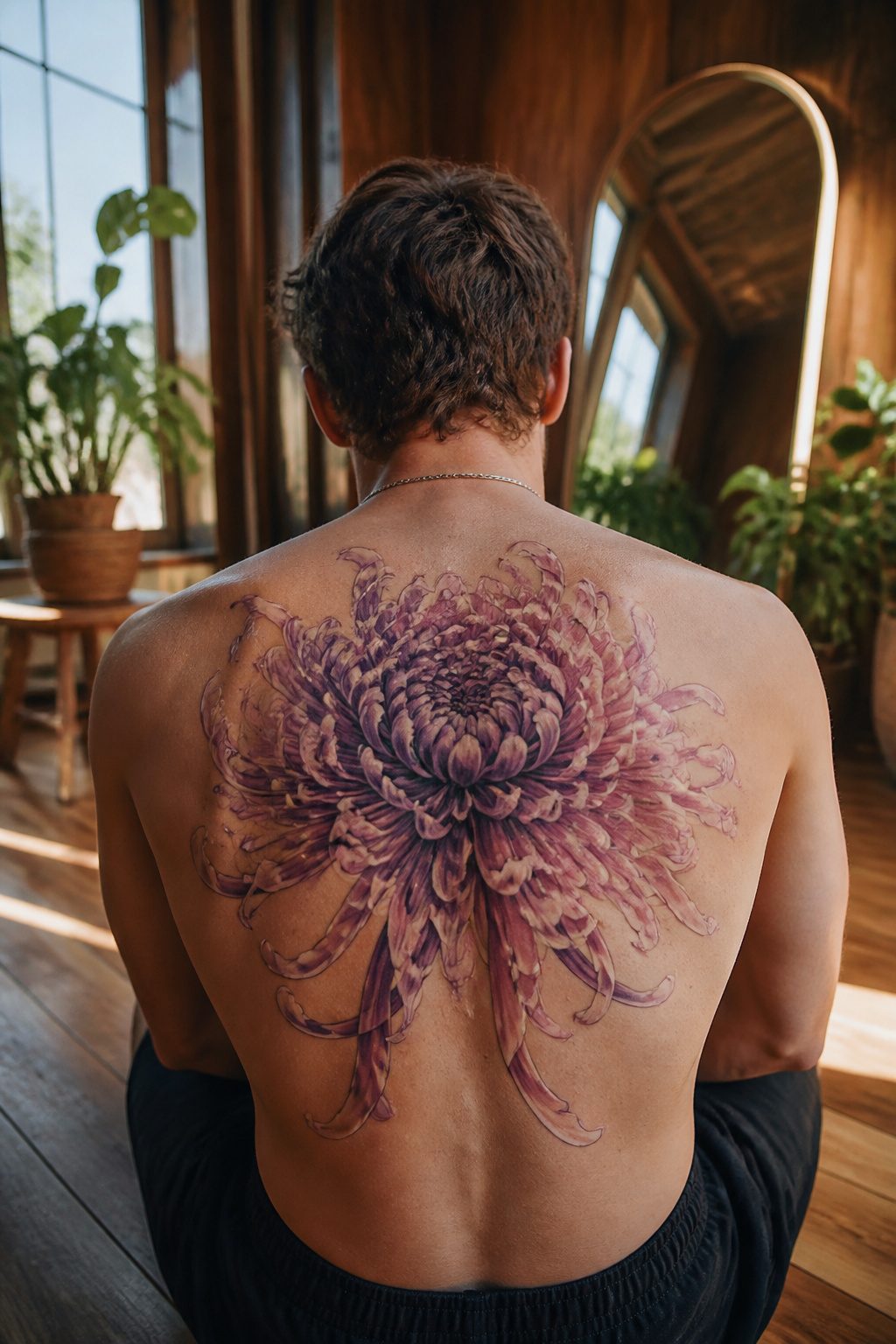
A lotus, rose, or chrysanthemum on a shoulder blade reads like a postcard; the same flower opened across a full back becomes architecture. The scale changes the meaning. On a man’s back, a single bloom at full span can carry both life and death without needing a skull beside it; the flower’s own cycle, bud to wilt, does that work.
The skull-and-floral pairing still holds ground for guys who want the contrast made explicit. A skull grounded in the center of the back, with vines or petals climbing the latissimus, keeps the mortality symbol central and lets the living growth frame it. Some artists reverse this, putting the bloom at the spine and letting bone fragments scatter toward the flanks. Either way, the back’s broad planes let each element breathe at a distance that would crowd a forearm or calf.
Butterflies and smoke get used too, though they read softer. A guy choosing floral work for the first time often worries about that softness. The back solves it: the muscle structure underneath gives even a chrysanthemum, traditionally a memorial flower, a weight that smaller placements lack. The petal edges catch light differently over trapezius definition than over flat stomach skin.
Personal growth gets cited often as the reason, and the back’s hidden-then-revealed quality suits that. A man sees it in the mirror after a shower, or a partner does. The timing of the reveal becomes part of the tattoo’s function. That is harder to engineer on a hand or neck, where the work is always performing.
5. Biomechanical Tattoos
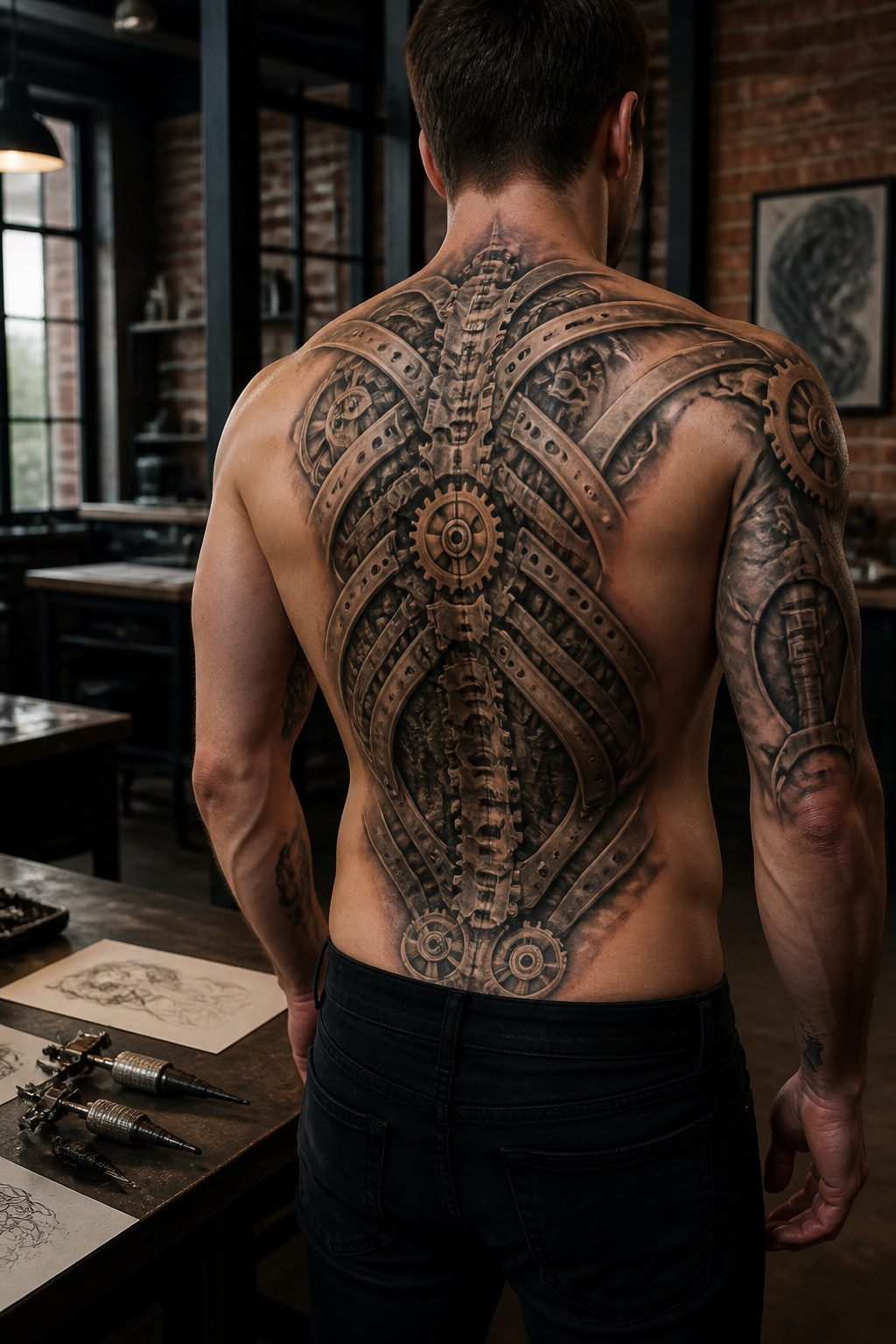
Biomechanical tattoos merge what looks like living tissue with pistons, gears, and industrial hardware, often arranged so the spine becomes a central conduit and the shoulder blades read as access panels. The flat planes of a man’s back carry the illusion better than curved limbs because the eye finds consistent perspective across the lats and traps, and an artist can anchor a "mechanical" structure to actual bone landmarks so the effect holds from multiple angles. This is not a style a generalist handles well. The shading has to sell both metal and membrane in the same inch of skin, and the transition points, where cable meets vein or housing meets fascia, are where the piece lives or dies. A portfolio heavy in black-and-gray realism does not automatically qualify someone for this; you want to see healed work from a year out, because the fine linework that defines a gear tooth or piston head tends to spread or drop out if the saturation was tentative. Small designs get swallowed by the scale of the back anyway, so the commitment is inherently large, and the hours stack accordingly.
6. Geometric Patterns
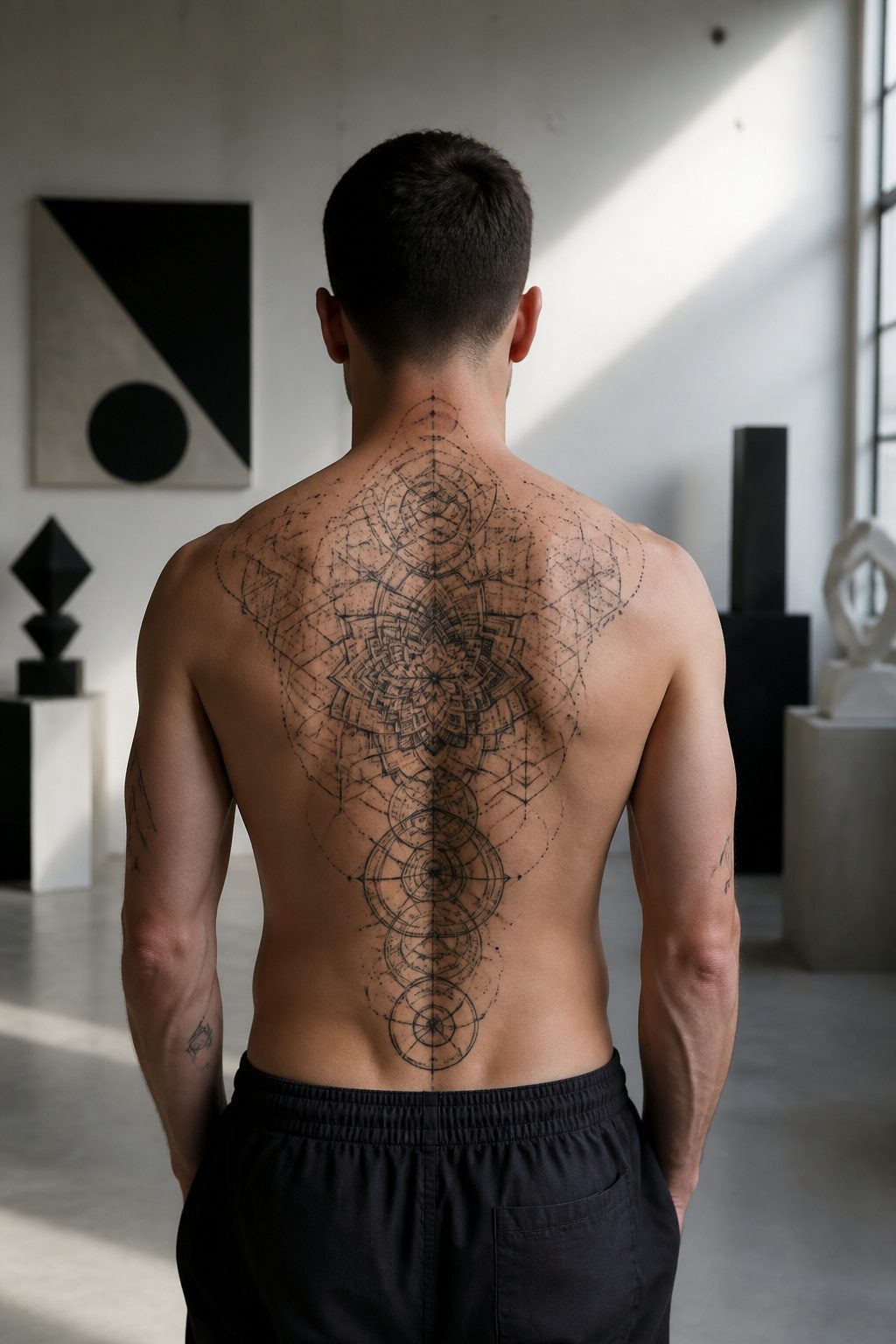
The back’s flat planes and natural symmetry make it the ideal canvas for geometric work. Clean lines and shapes built from circles, triangles, and repeating polygons carry meaning without needing literal imagery. Sacred geometry, the mathematical structure found throughout nature, translates directly into tattoo form: the Flower of Life, Metatron’s Cube, and the golden ratio spiral all map cleanly across shoulder blades or down the spine.
Mandala influences pull the eye inward to a central point, creating a whirlpool of complex patterns that suggest balance and the soul’s layered journey. A detailed mandala on the upper back becomes a statement of eternity and the pursuit of symmetry amid daily chaos.
Sharp lines and angles lend a masculine feel that softer styles often miss. Simple shapes can make a bold statement when scaled to full-back size, and the contemporary take on body art means these designs range from minimal single-pattern pieces to elaborate optical illusions that accentuate the back’s contours. The choice between a single focal point and an all-over composition depends on whether you want the eye to rest or to travel.
7. Full Back Tattoos
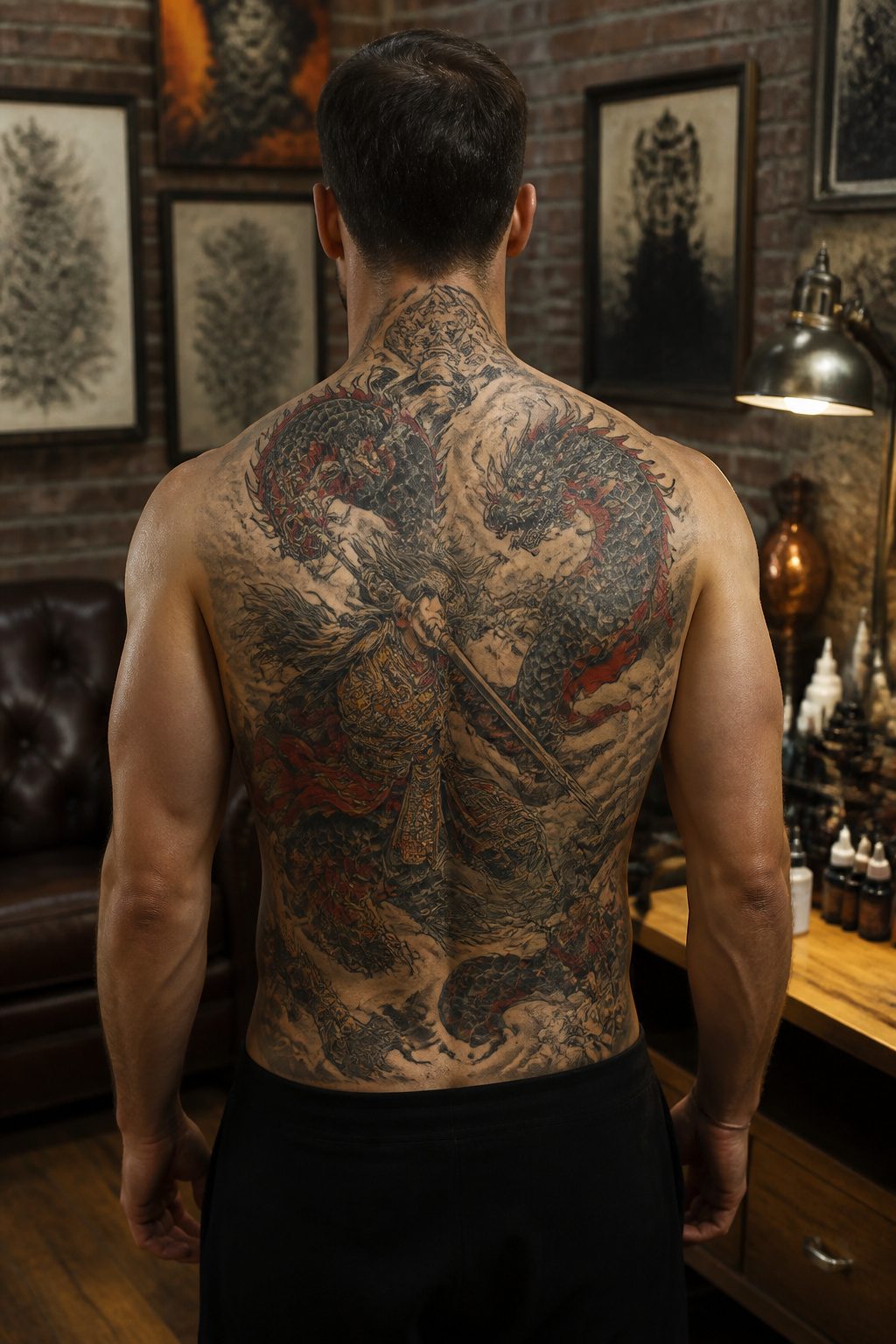
A full back piece runs from the neck to the waist, edge to edge, and the artists who build them treat the whole canvas as one image rather than a collage of smaller ones. The commitment is substantial: 5–10 sessions is the typical count, and the cost lands between $1,500 and $8,000+ depending on who holds the machine and how dense the detail gets. At $150–$300 per hour, the hours add up faster than the ink.
The pain shifts as the work moves. The upper back over solid muscle rates around a 4/10 for most people, but the spine, kidneys, and shoulder blades push toward a 9/10. Endurance matters as much as the design choice because you are signing up for months of this, not an afternoon.
What the full back offers is narrative space. Mythological scenes, personal stories, or pure black-and-grey realism all find room to breathe. The back stays hidden under a shirt, which makes this the safest luxury investment for anyone who needs to look conventional at work but wants something private and large-scale in their off hours. Smaller pieces cost less and finish faster, but none of them let a story unfold at this scale.
8. Skull Tattoos
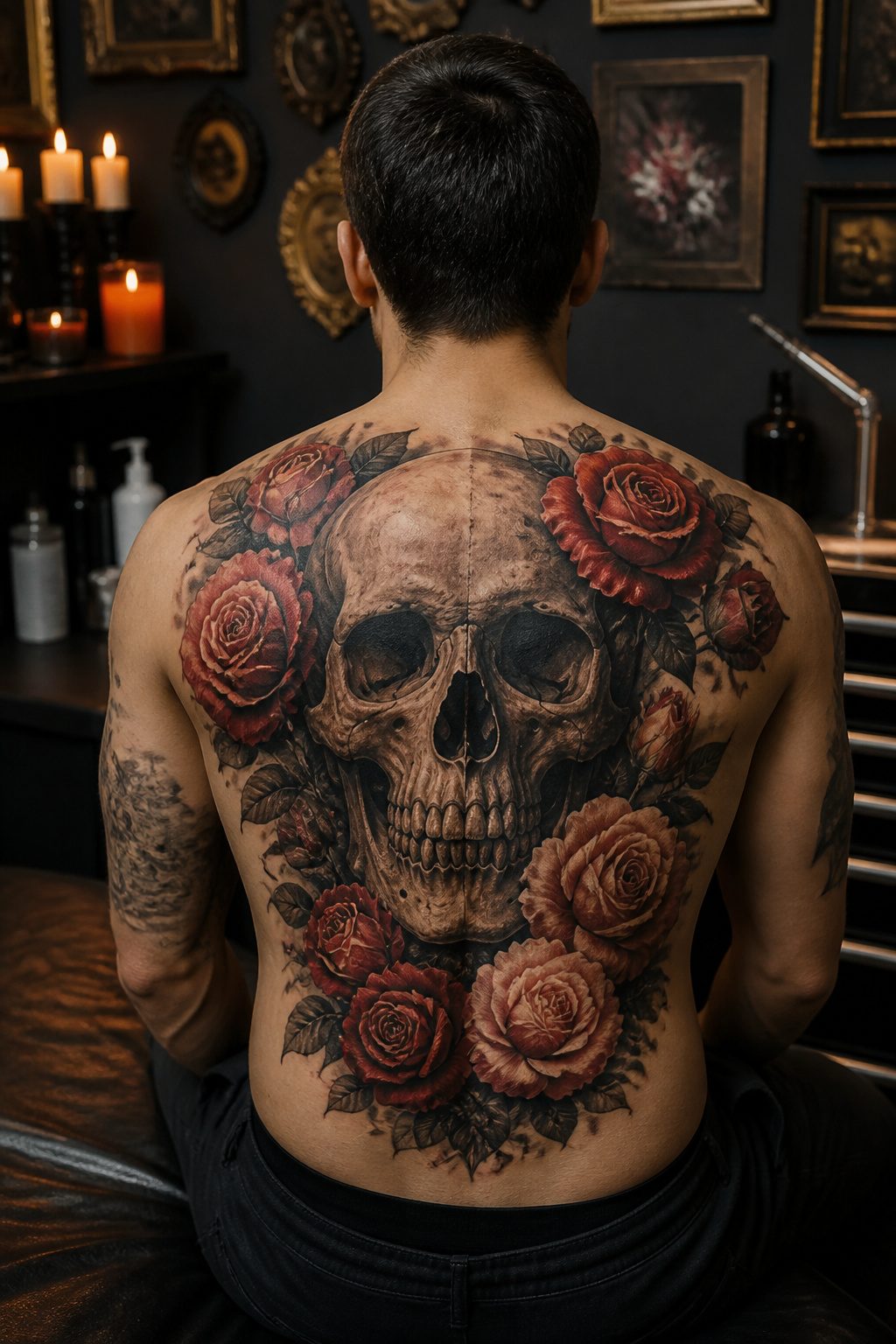
Skull tattoos on a man’s back carry weight because the bone itself is honest: mortality is the one promise life keeps. The design works hardest when it is paired with something alive. Blooming flowers set against the stark skull ground the piece in the duality the sources keep returning to, vitality pressed right up against the finite. That tension is what earns the space across a shoulder blade or down a spine.
The sugar skull style, drawn from Day of the Dead tradition, turns the mortality symbol into color and pattern. It is a different mood than the military memorial skull, which tends toward restraint, names, dates, unit insignia. Both use the same anchor but pull in opposite directions: one celebrates, one remembers. A back piece large enough lets you split the difference, a memorial skull on one side, a living element on the other.
The smiling skull with crossbones reads differently now than it did on a pirate flag. Where sailors once saw a warning, the modern wearer often means resilience, a grin that says the danger was met and survived. That grin is the detail that separates a skull that scares from a skull that stays. On a back, where the canvas is broad, the skull is rarely alone. It anchors the composition, gives the eye a center, and lets the surrounding elements, roses, banners, smoke, orbit something fixed. The skull is the gravity; everything else is the story you wrap around it.
9. Guardian Angel Tattoos
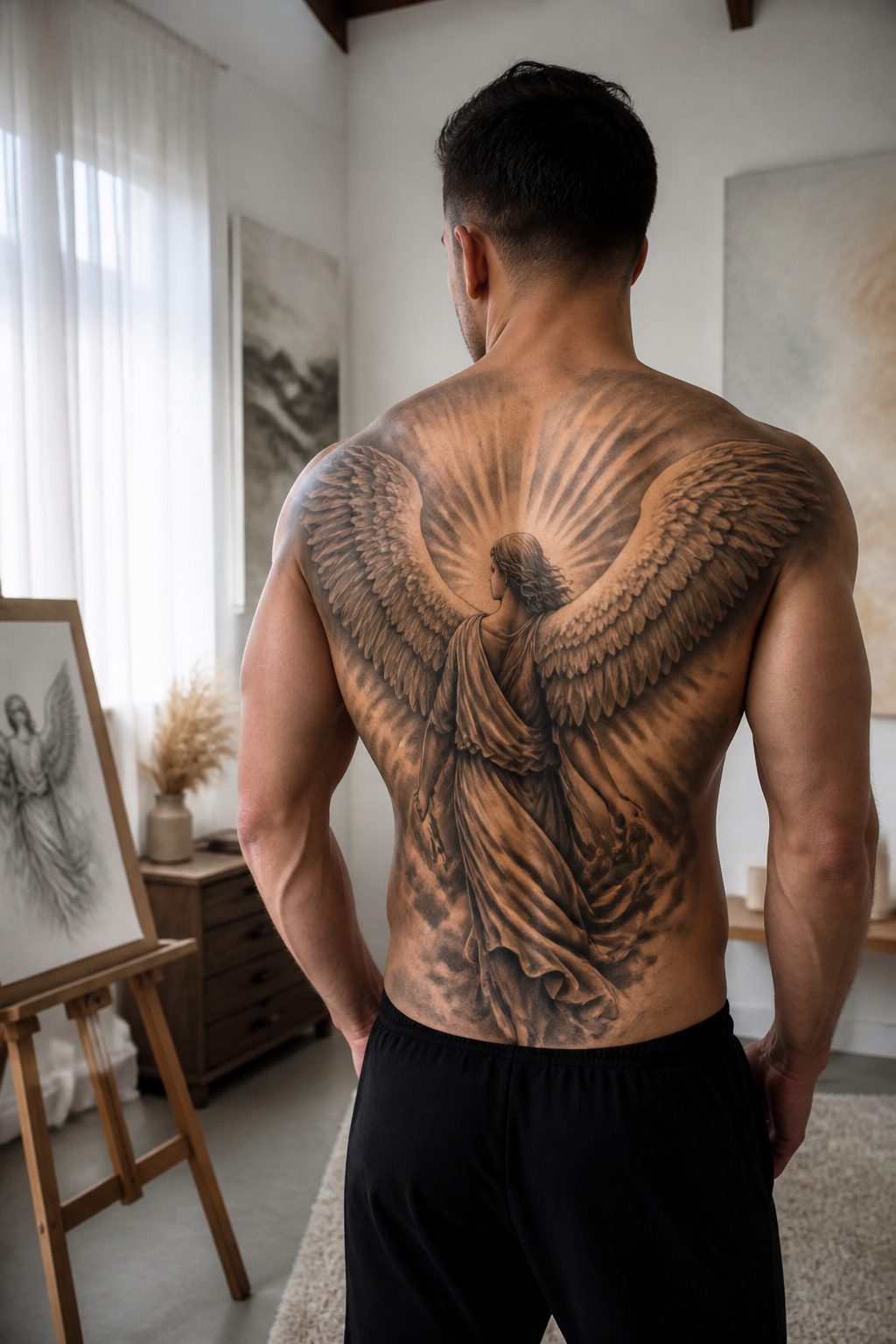
A guardian angel spans the full back with wings unfurled in a protective stance, the shoulder blades acting as the natural hinge point so the feathers move subtly when the wearer reaches or turns. The placement follows bone structure rather than fighting it; the artist maps the wing roots to the medial edges of the scapulae and lets the primary feathers extend toward the lats, which means the tattoo stays coherent whether the shoulders are relaxed or rolled back.
Religious wearers often intend divine protection, but the same design serves as memorial ink, a permanent reference to someone who filled that guardian role in life. The bowed head and muscular form common in these pieces add humility to the strength, a combination that reads differently than pure power imagery.
Wing tattoos in Western tradition carry the angel association directly: freedom, guidance, and protection in one image. Eastern traditions treat wings more as spiritual connectors and prosperity symbols, so the same spread of feathers can shift meaning based on what the wearer anchors it to. Either way, the full back is the only canvas that does the span justice; a guardian angel cramped into too small a space loses the enveloping quality that makes the design work.
10. Nature Scenes
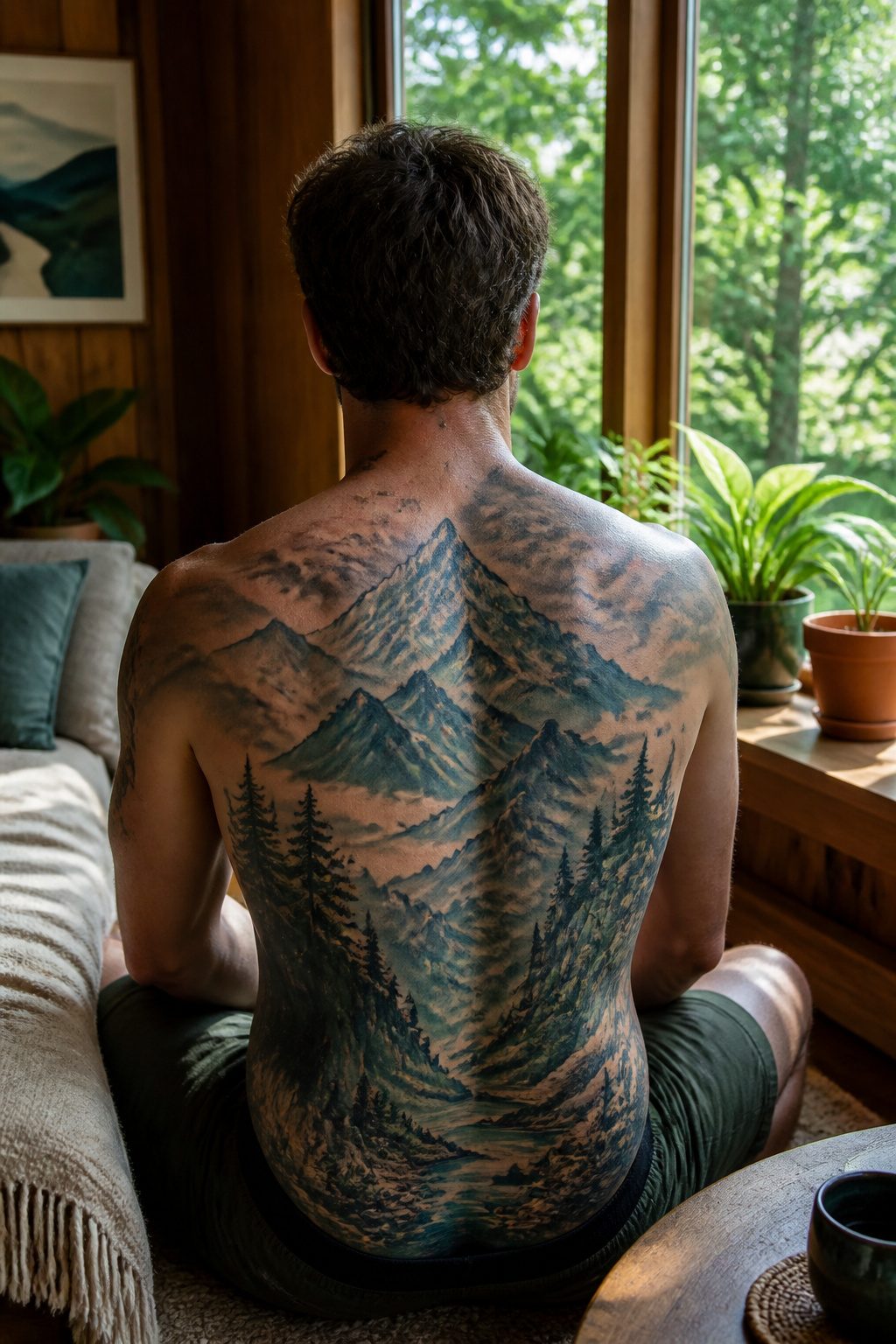
Mountains read differently on a back than they do on an arm or a chest. The spine becomes the ridgeline, the shoulder blades turn into foothills, and a skilled artist can push ink lighter toward the neck so the peaks seem to fade into fog. I’ve watched this illusion fail when the contrast stays flat top to bottom; the piece looks like a sticker instead of a vista.
Forests gain their depth from the same trick. Trunks narrow as they climb, and the darkest saturation sits low, near the lumbar, where undergrowth would thicken. Ocean pieces reverse the logic: open water belongs across the upper back, with the break and foam saved for the lower edge where a waistband or shirt hem might cut the scene short. The back’s width lets a horizon line stretch naturally, something a thigh or foreshortened sleeve cannot manage.
What convinced me, looking through portfolios for this piece, was how often guys choose nature they have actually stood in. A mountain from a childhood camping trip, a coastline from a first solo drive. The back holds enough acreage for a full narrative, but the artists who do this best resist filling every inch. Negative space does the work of atmosphere; it lets the skin breathe and the eye rest. The mistake is treating the back like a wall to cover rather than a field to compose within.
Pain by Placement
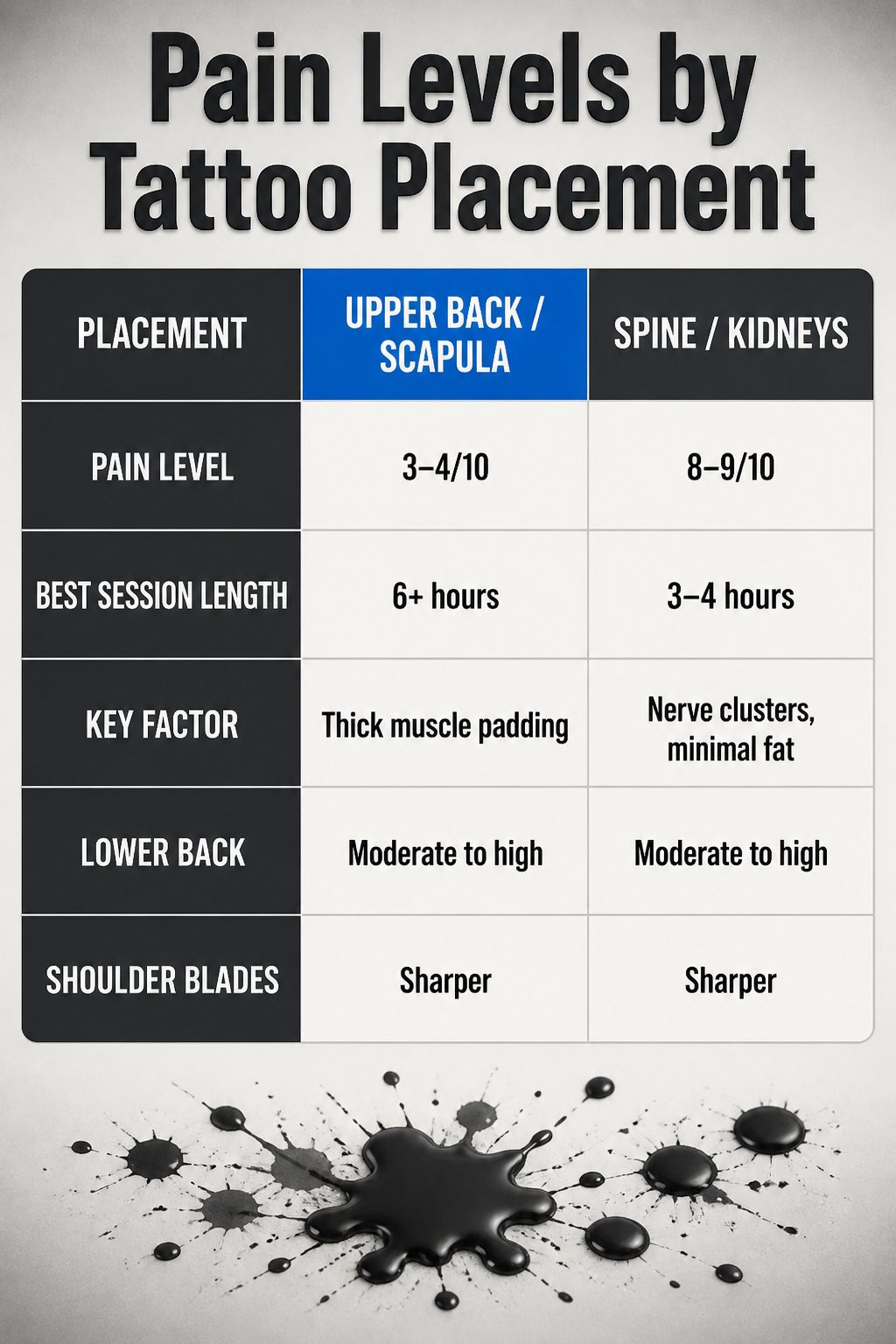
The upper back over solid muscle lands around a 3 to 4 out of 10 for most people, enough to notice but easy to ride out for hours. Move that same needle toward the spine or the kidneys and the story changes fast. Those zones carry dense nerve clusters with almost no fat padding between bone and skin, which pushes the sensation to an 8 or 9 out of 10 and shortens how long you can sit still.
That gap matters when you are scheduling work. Fleshy areas like the lats let artists run 6-plus hours, while spine sessions often get broken into 3-to-4-hour chunks so the body does not tap out before the ink goes in. Numbing cream exists, but it fades around the 90-minute mark, and the returning sting can feel sharper than if you had never used it at all.
| Placement | Pain Level | Best Session Length | Key Factor |
|---|---|---|---|
| Upper back / scapula | 3–4/10 | 6+ hours | Thick muscle padding |
| Spine / kidneys | 8–9/10 | 3–4 hours | Nerve clusters, minimal fat |
| Lower back | Moderate to high | Varies | Near spine and bone |
| Shoulder blades | Sharper | Varies | Bone proximity |
Pain tolerance is only part of it. The real limit is how long you can hold position while the work moves across bone. Plan the big pieces for the meaty sections first, and know exactly where your break points are before the needle reaches the spine.
Healing Timeline
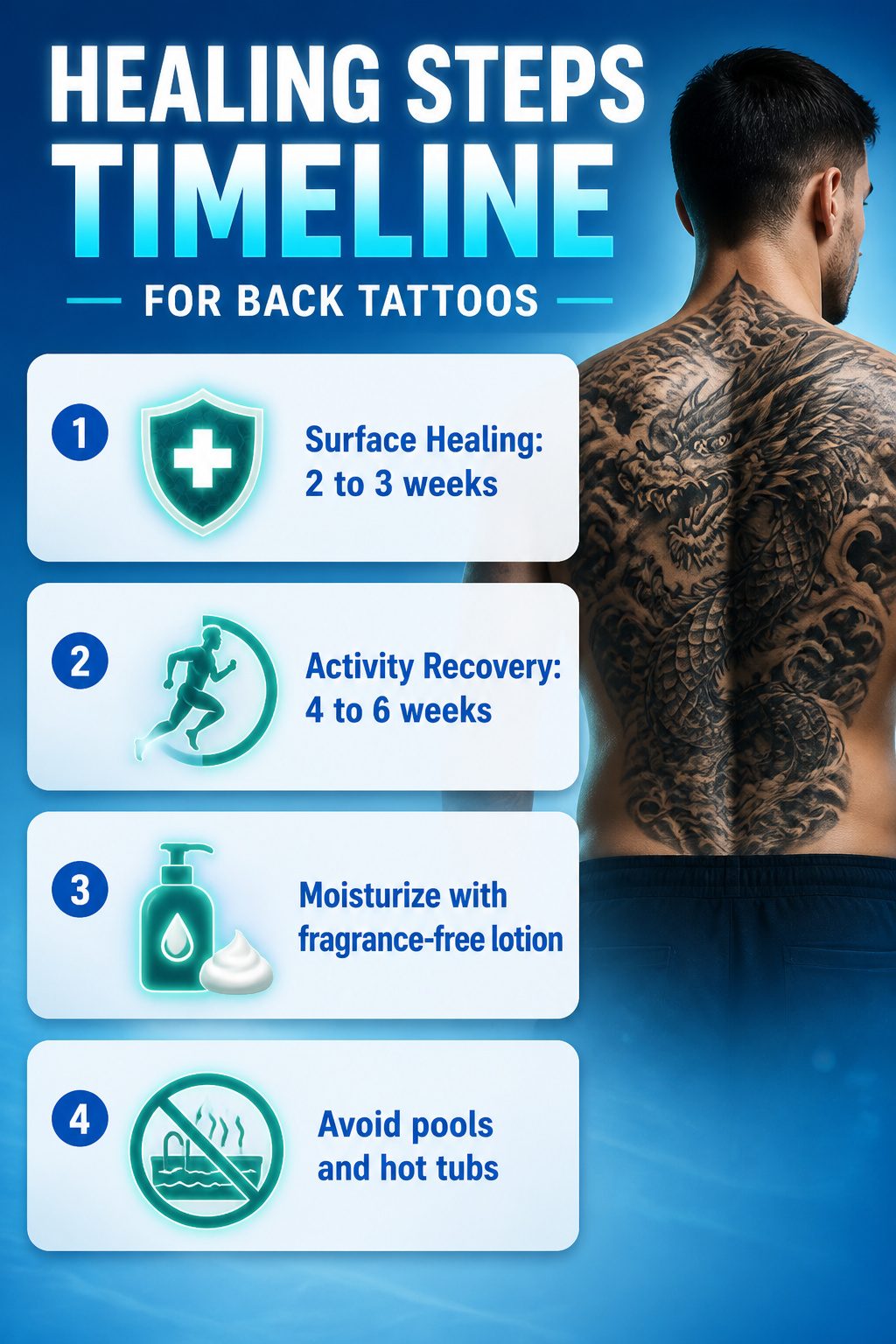
Surface healing for a back tattoo runs 2 to 3 weeks, with full activity recovery stretching to 4 to 6 weeks. That first fortnight is when the outer layer seals itself back together, but the skin underneath is still rebuilding, and the back’s constant flexing with every reach and twist slows that down compared to an arm or leg that moves on simpler hinges.
The real complication is reach. Most of the back is territory you cannot see or treat without help, and the scapula and spine areas see pressure the moment you lie down. Sleep becomes a logistics problem. Gym routines take the bigger hit because back tattoos intersect with almost every major compound movement. Deadlifts, pull-ups, and barbell squats need a 3- to 4-week pause; stretching healing skin risks ink fallout and scarring.
Moisturizing means either a willing partner or a long-handled tool, and fragrance-free lotion is the standard to prevent irritation. Sun, swimming pools, and hot tubs stay off-limits until the surface is fully closed, which on the back is harder to judge by eye. Muscle growth generally enhances a back tattoo long-term, the skin stretching uniformly as lats develop, but rapid bulk or cut cycles inside the first 6 months can distort lines before the ink settles.
Cost and Sessions
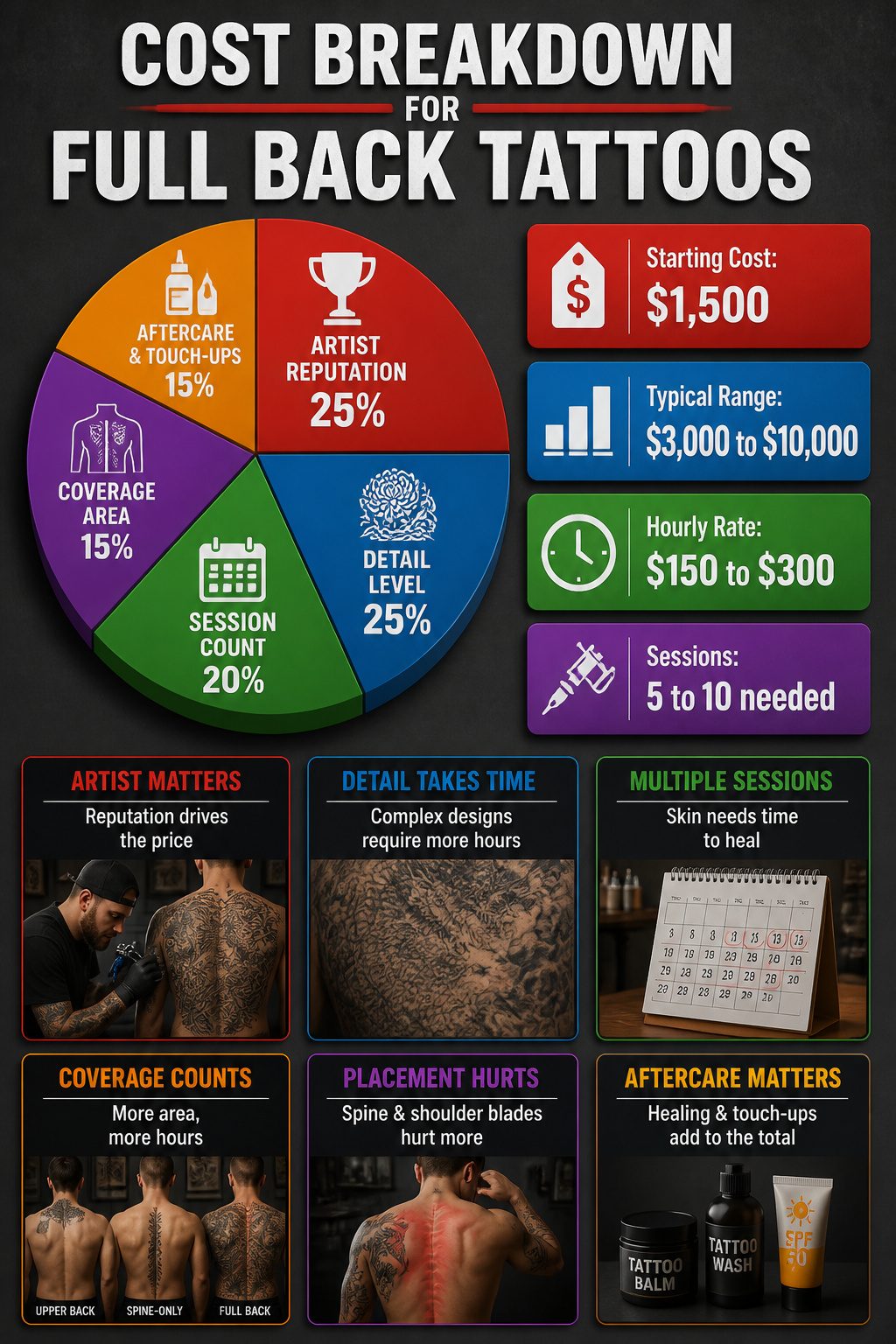
Full back tattoos start around $1,500 and climb past $8,000, with most serious pieces landing in the $3,000 to $10,000 range once you factor in artist reputation and detail level. Hourly rates run $150 to $300 or more, and a complete back piece typically needs five to ten sessions spaced weeks apart.
The price gap comes down to a few things. A known artist with a waitlist charges more per hour and usually books in longer blocks. Complex work, Japanese irezumi or photorealistic black-and-grey, demands more time than a simpler illustrative concept. Coverage matters too: a full back versus upper back or spine-only changes the total hours fast.
Multiple sessions are not optional for large work. Skin can only take so much in one sitting, and healing between rounds affects how the final piece settles. The shoulder blades and spine area hurt more than muscle-covered upper back, which affects how long you last per session and how many breaks you need.
Choosing someone experienced with large-scale back work matters for the result. This is one placement where symmetry and flow across your body’s movement really show. A portfolio of finished back pieces, not just small flash, tells you whether they understand how the design rides your frame.
Cultural Roots
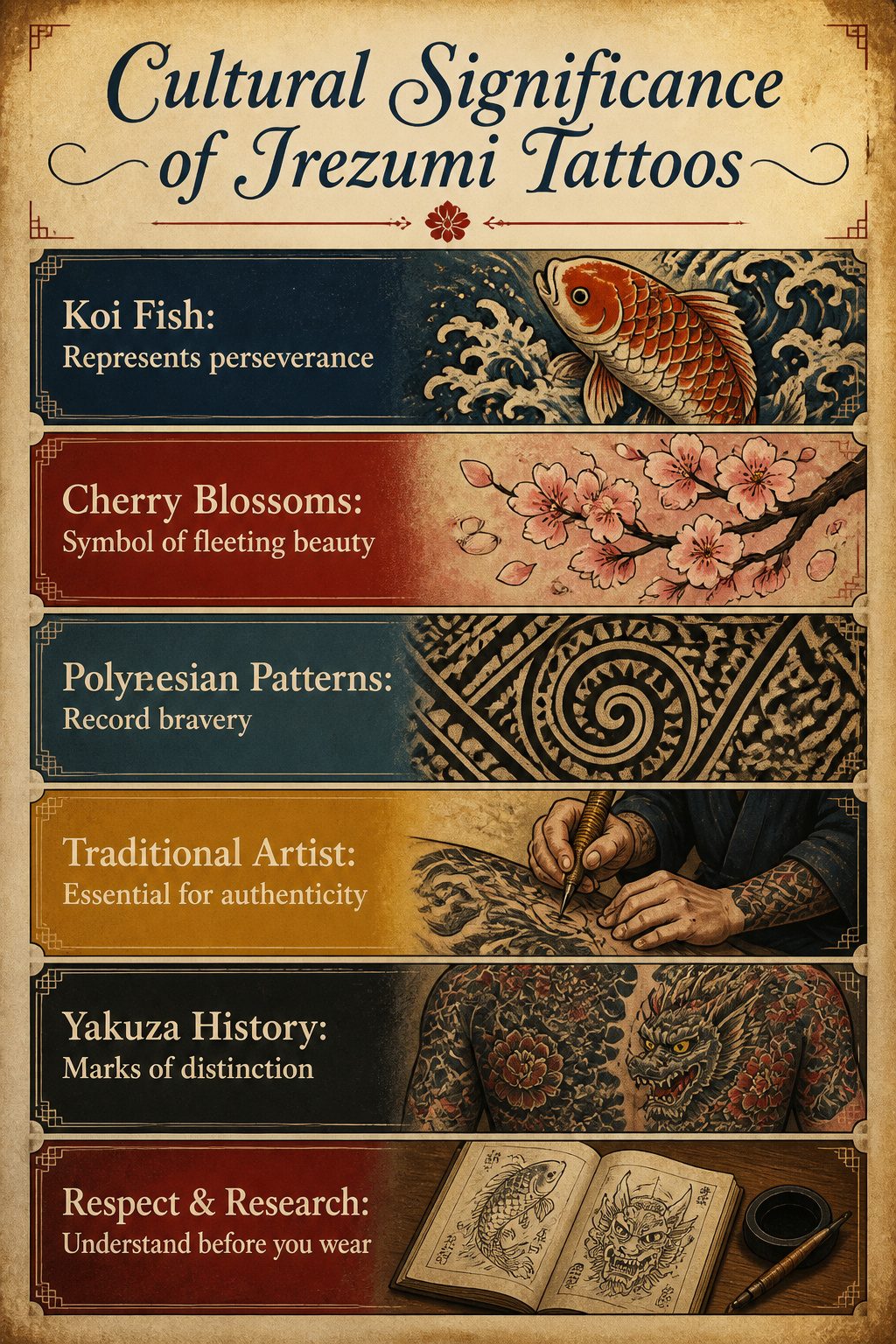
A full Japanese irezumi back piece carries weight far beyond the image itself. Koi fish mark perseverance, cherry blossoms mark how brief beauty is, and the whole composition demands an artist trained in that specific lineage. The same holds for Polynesian work: historically, warriors wore back tattoos to record bravery and social standing, so the patterns function as identity, not decoration.
The question of who should wear them sits at the center of choosing. I have watched artists spend years apprenticing in traditions outside their own heritage to get the geometry of Maori spirals or the color theory of tebori right, and I have watched others treat tribal bands as texture without meaning. The difference shows in the line weight, in whether the placement follows protocol or just fills space. Japanese full-back pieces were once marks of distinction within the Yakuza, tests of pain tolerance and loyalty; that history does not disappear because the design appeals to you. An artist who specializes in a tradition they were not born into is not automatically wrong, but the good ones study long enough to know why the koi swims upstream and why the direction matters. Ask them. The answer separates research from borrowing.
Artist Choice

A back piece is where an artist’s skill becomes visible from across the room. For large-scale work, portfolio review means checking for healed back pieces specifically, not just fresh photos. The skin of the back moves differently than the arm or chest, and an artist who builds large compositions regularly understands how the design will settle as the body shifts.
Specialization matters more than shop reputation. An artist who routinely books multi-session projects will have different habits around stencil placement and session pacing than one who works mostly in single sittings. During consultation, ask how they plan to break the work into stages and how they handle swelling across the broader surface area.
The studio itself is part of the decision. Multi-session back work means repeated visits to the same space, so assess whether the setup supports long appointments comfortably. Cleanliness and sterile equipment are baseline requirements for any work that breaks the skin repeatedly over weeks or months.
Frequently Asked Questions
How much do back tattoos cost?
Expect to pay between $1,500 and $8,000 or more for a full back piece, with most serious work landing in the $3,000 to $10,000 range. Hourly rates run $150 to $300, and a complete back tattoo typically takes five to ten sessions. A known artist with a waitlist and dense detail work both push the price toward the higher end.
How painful are back tattoos?
The upper back over thick muscle rates around a 3 to 4 out of 10, but the spine, kidneys, and shoulder blades jump to an 8 or 9 out of 10. Nerve clusters near bone with little fat padding make those zones sharp. Plan shorter sessions for the painful areas; fleshy sections let you sit six hours or more.
What is the healing time for back tattoos?
Surface healing takes 2 to 3 weeks, with full activity recovery stretching to 4 to 6 weeks. The back’s constant flexing slows this down compared to simpler-moving limbs. Sleep becomes a logistics problem since you cannot see or treat most of the area without help, and gym routines need a 3- to 4-week pause for compound movements.
What are the best placements for back tattoos?
Common placements include the upper back and scapula for detailed work, the full spine for vertical designs, the lower back for discreet pieces, and the full back for immersive compositions that command attention. Muscle structure guides the choice: wings need the lat span, mandalas center on the spine, and animals exploit the back’s width differently than curved limbs allow.
Can muscle growth affect my back tattoo?
Muscle growth generally enhances a back tattoo long-term because the skin stretches uniformly as lats develop. Rapid bulk or cut cycles inside the first 6 months can distort lines before the ink settles, so keep your weight stable during that window. The back’s large canvas actually handles growth better than smaller, tighter placements.