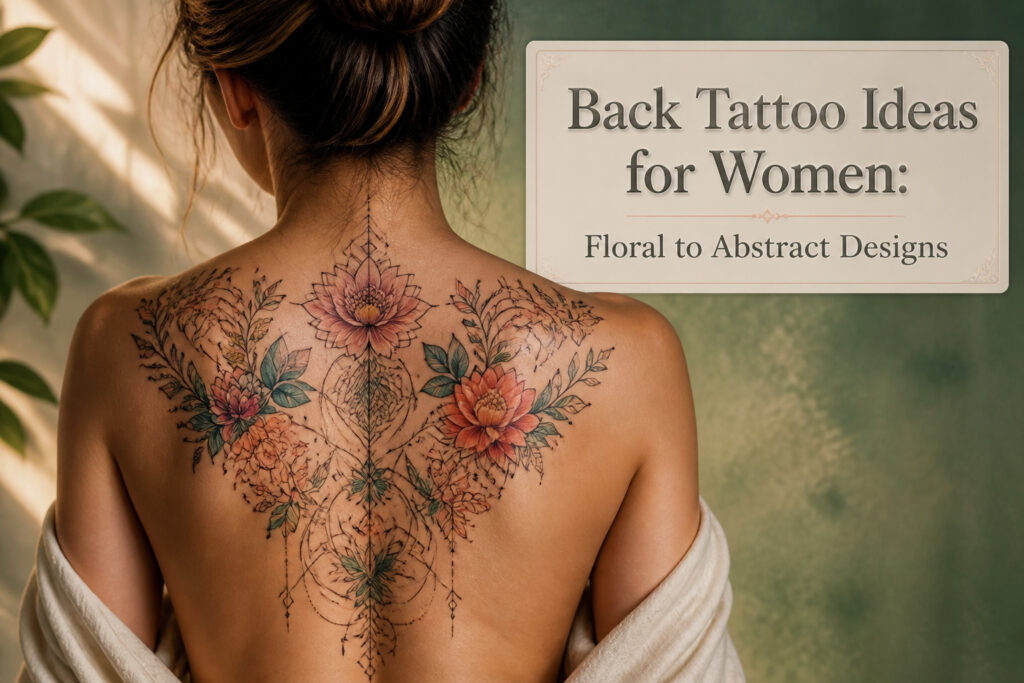
A back tattoo runs from a $300 shoulder mandala to a multi-session full piece, and the deciding factor is whether your daily life needs concealment or occasional display. The spine hurts most but frames vertical designs like florals and lettering with architectural precision; the shoulder blades balance pain and visibility, hiding under a standard tee or showing in a tank top with no planning.
1. Floral Tattoos
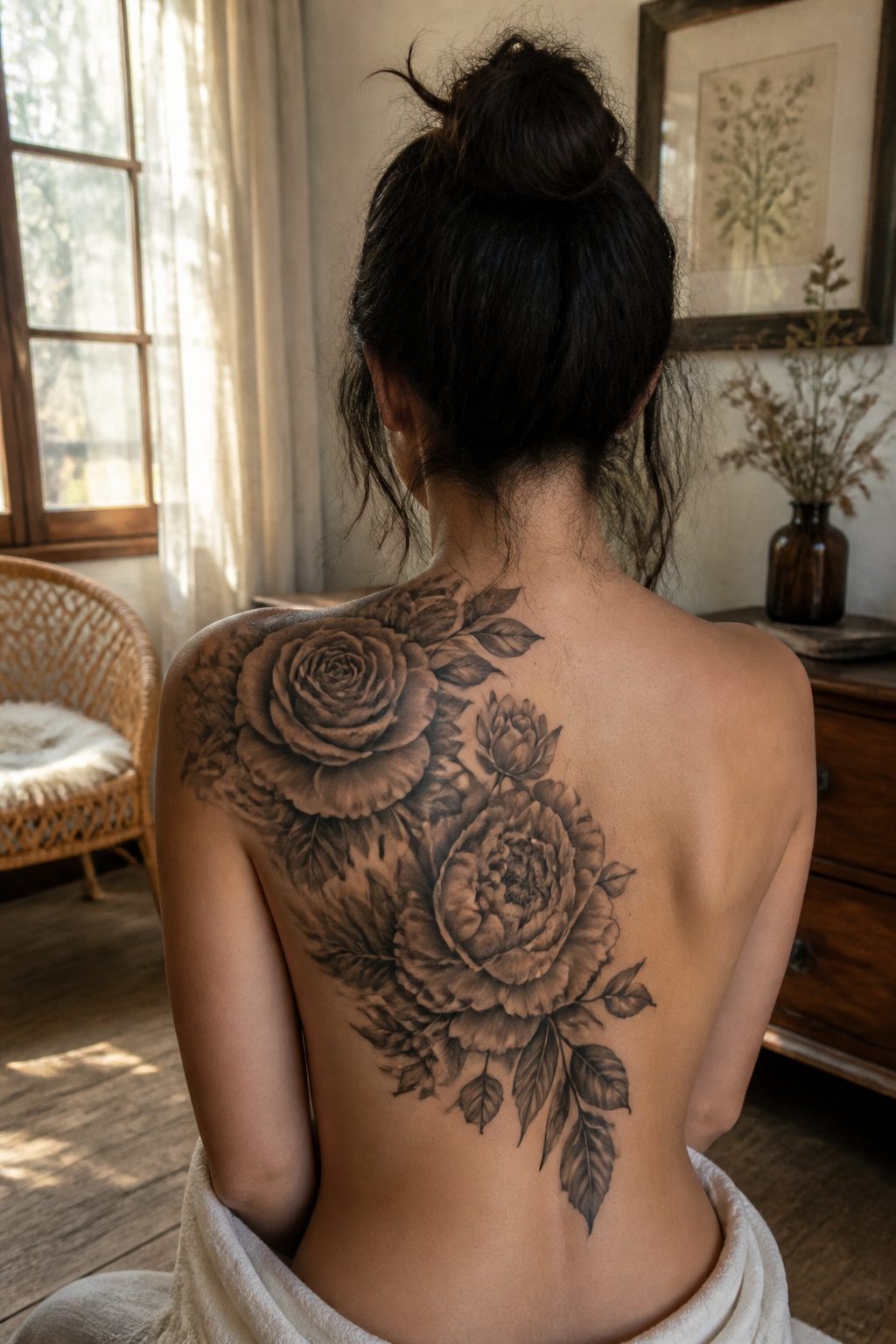
Roses, lotus, and peonies dominate the requests I see for back tattoos on women, and the reason holds up once you watch them laid down. Each carries its own read on beauty and femininity, but the real payoff is how the back accepts them. A peony or rose can start at the shoulder blade and spread without looking forced, the petals opening wider as the artist works toward the spine or across to the opposite blade. The lotus reads differently, more vertical, which is why it ends up tracing the spine in so many of the designs that come through the shop.
Black and grey realism does the heavy lifting for these. Deep shading gives the petals weight, and the botanical detail turns a shoulder blade into something you stop on. Color works too, but the monochrome approach forgives placement shifts better, especially when the design has to travel down the back or wrap slightly around the side.
The spine itself is the other natural home. A stem of roses or a lotus repeated at intervals follows the line of the body in a way that looks intentional rather than just long. The back offers enough flat plane that the flowers read as a centerpiece, not a stamp.
The shoulder blade wins for a first piece, since you can hide it or show it without planning your whole wardrobe around it. The spine demands more commitment, both in the chair and after.
2. Geometric Tattoos
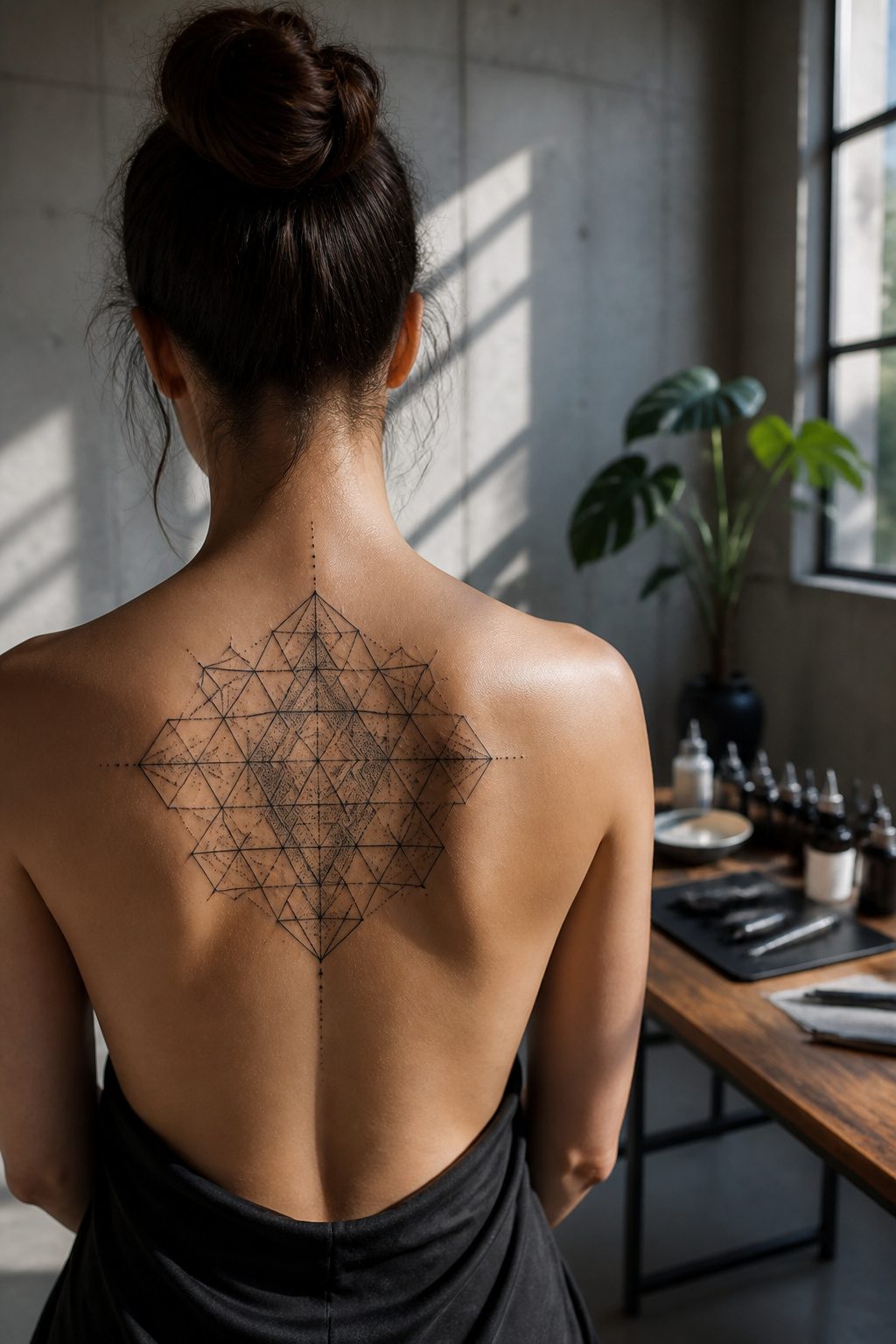
Clean lines and repeating shapes turn the back into a frame for the design itself. A geometric pattern running down the spine draws the eye along the body’s natural axis, while identical forms placed across both shoulder blades create symmetry that reads as deliberate, not accidental.
The shoulder blade placement works because the flat bone surface holds fine detail without the distortion you get over muscle. Triangles, hexagons, or interlocking lines stay crisp there. Down the spine, the narrow corridor favors length over width; a single vertical sequence of shapes reads better than something that tries to spread.
I have seen geometric pieces fail when the artist freehanded what should have been measured. The difference between a line that looks straight and one that is straight becomes visible at about three feet. For a spine piece, that means stenciling from a level reference point, not eyeballing it. The linework in successful geometric back tattoos, the kind Dima and others in that fineline tradition produce, relies on transfer paper and a steady ruling hand before the needle ever touches skin.
Shoulder blade designs offer more forgiveness. Small shifts in placement matter less when each blade carries its own self-contained pattern. The two sides do not need to mirror exactly; they need to balance. One blade might carry a dense cluster, the other the same cluster reversed or spaced differently. What reads is the equivalence of visual weight, not pixel-perfect duplication.
The modern aesthetic comes from restraint. A geometric back tattoo gains impact from what it leaves out. Negative space becomes as active as the ink, especially when the design wraps slightly around the ribs or trails toward the neck. The back’s large canvas tempts some toward complexity, but geometry works best when the viewer can hold the whole pattern in memory after one look.
3. Animal Tattoos
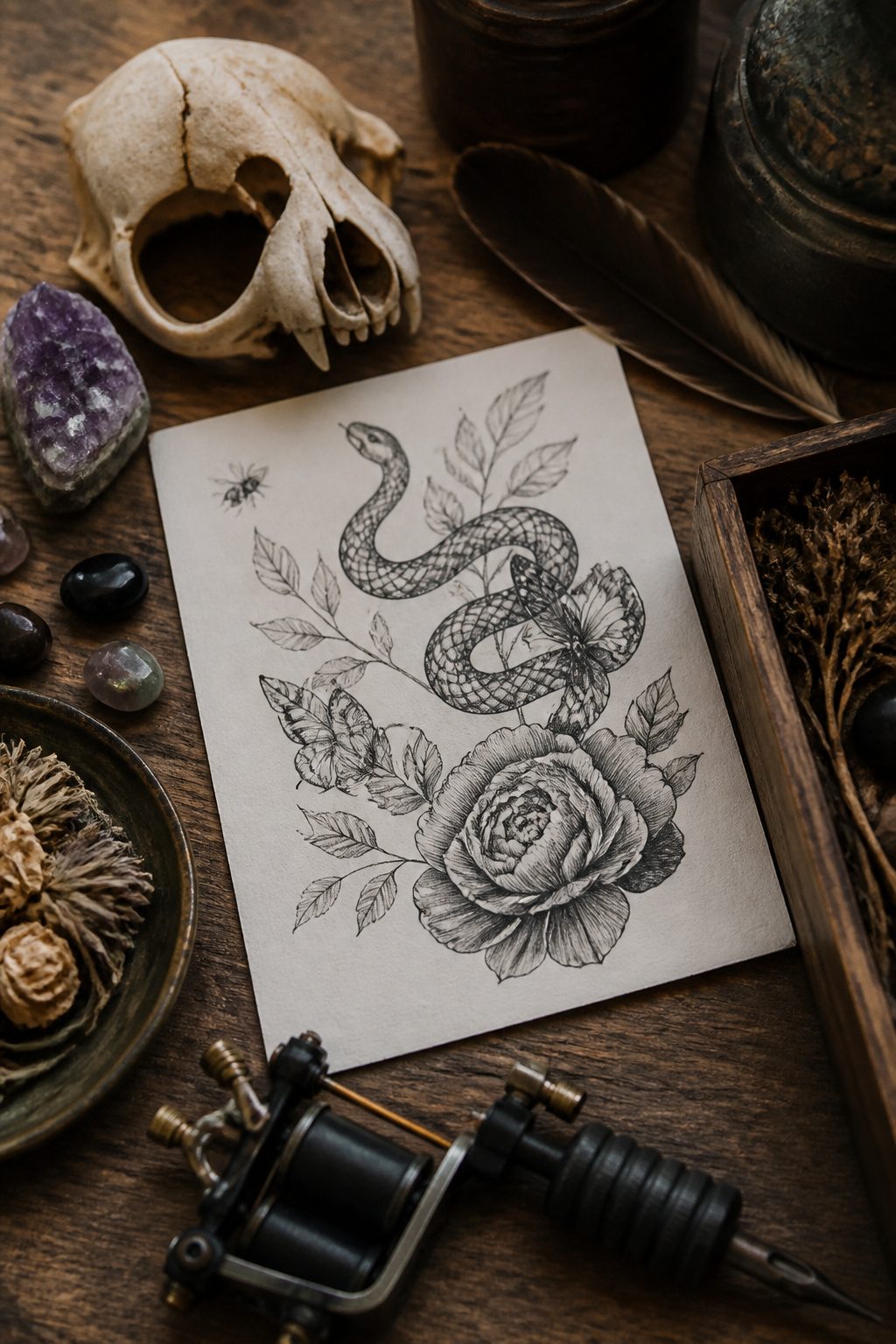
Butterflies, koi fish, and dragons each carry weight that outlasts the trend cycle. A butterfly reads as transformation and the pursuit of freedom, which is why it lands on so many first tattoo lists and still holds up twenty years later. Koi fish carry the same symbolism of perseverance and strength they held in Asian tradition, though the women’s versions tend toward finer linework and smaller scale than the full-back pieces you see in older Japanese work. Dragons split the difference, pulling on strength without the same cultural borrowing concerns if you work with an artist who knows the iconography.
The back’s length matters here more than for floral or geometric work. These three designs all follow the spine or the shoulder blade’s curve rather than fighting it. A koi swimming upward can track the natural line from lumbar to neck. Butterfly wings flatten across the scapula with less distortion than a rigid shape would. The movement is in the subject, and the back’s canvas lets it breathe.
I have watched clients come back for second sessions on animal pieces less often than on quote or geometric work. The symbolism is front-loaded; you know why you chose it, and the meaning does not wear thin the way a phrase can when you have read it six hundred times in the mirror. The tradeoff is that animals date more obviously if the style is too of-the-moment. A 2014 watercolor butterfly looks like a 2014 watercolor butterfly. Line-and-dot koi age cleaner.
4. Quote Tattoos
Words running straight down the spine follow the body’s natural architecture better than any other placement. The vertical line draws the eye upward, and the narrow column of text mirrors the bone beneath it. A single phrase fits here; a longer quote needs the broader canvas of the upper back, where the shoulder blades create a flatter plane for multiple lines.
The shoulder blade also hides or reveals the work depending on what you wear, which matters if the words are personal. Along the spine, the tattoo stays more private, visible only in backless cuts or at the beach.
Script choice makes or breaks readability. Thin lines blur over time on skin that stretches and ages, so a slightly heavier weight in the font holds up for the years a back tattoo is meant to last. Black ink ages most predictably; color in lettering tends to soften faster, especially on an area that sees sun whenever you swim.
5. Dreamcatcher Tattoos
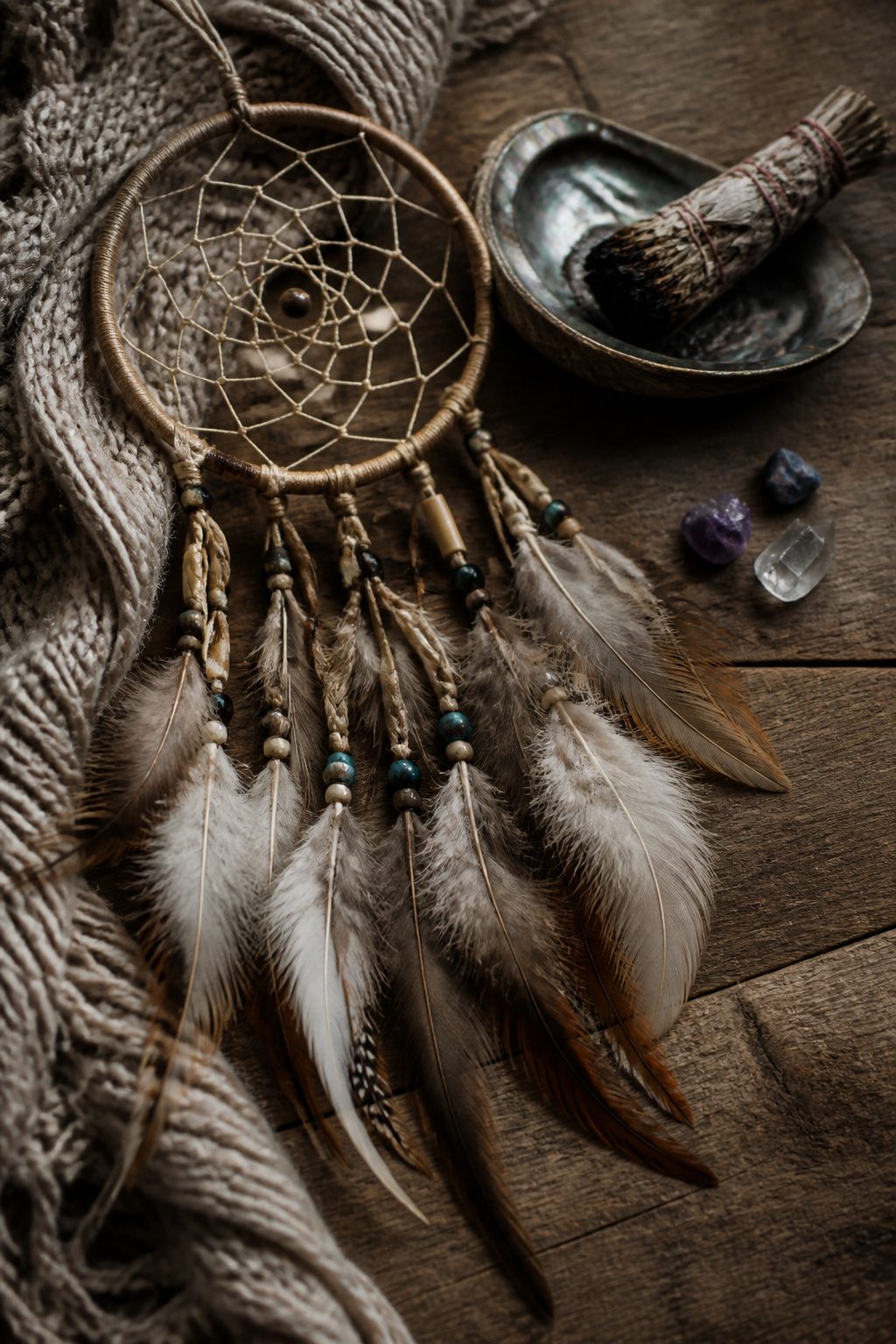
Dreamcatcher tattoos carry the protective symbolism of the original Native American amulet: a round frame, an inner web, and hanging beads that together filter harm. The web catches what troubles you; the feathers below let good pass through. That structure makes the design especially suited to the space between shoulder blades, where the circular frame centers cleanly and the web’s radiating lines follow the natural width of your back.
Intricate detailing is where this tattoo earns its keep. A skilled artist can weave the web tight enough to read as lace from a few feet away, then let feathers trail downward toward the spine or fan slightly across the upper back. The beadwork, usually three or seven in traditional count, gives points of color or white highlight that break up heavy linework.
Placement splits two ways. Between the blades keeps it compact, visible in a tank top or backless dress, hidden under a standard tee. Extending the feathers downward turns the same elements into a vertical piece that moves with you, though the lower web sits over more shifting skin and may need touch-up sooner. The full design reads as armor in either case; the partial reads as ornament. Most women who sit for this one come wanting the first and leave with the second, once they see how much back real estate even a "small" dreamcatcher actually covers.
6. Mandala Tattoos
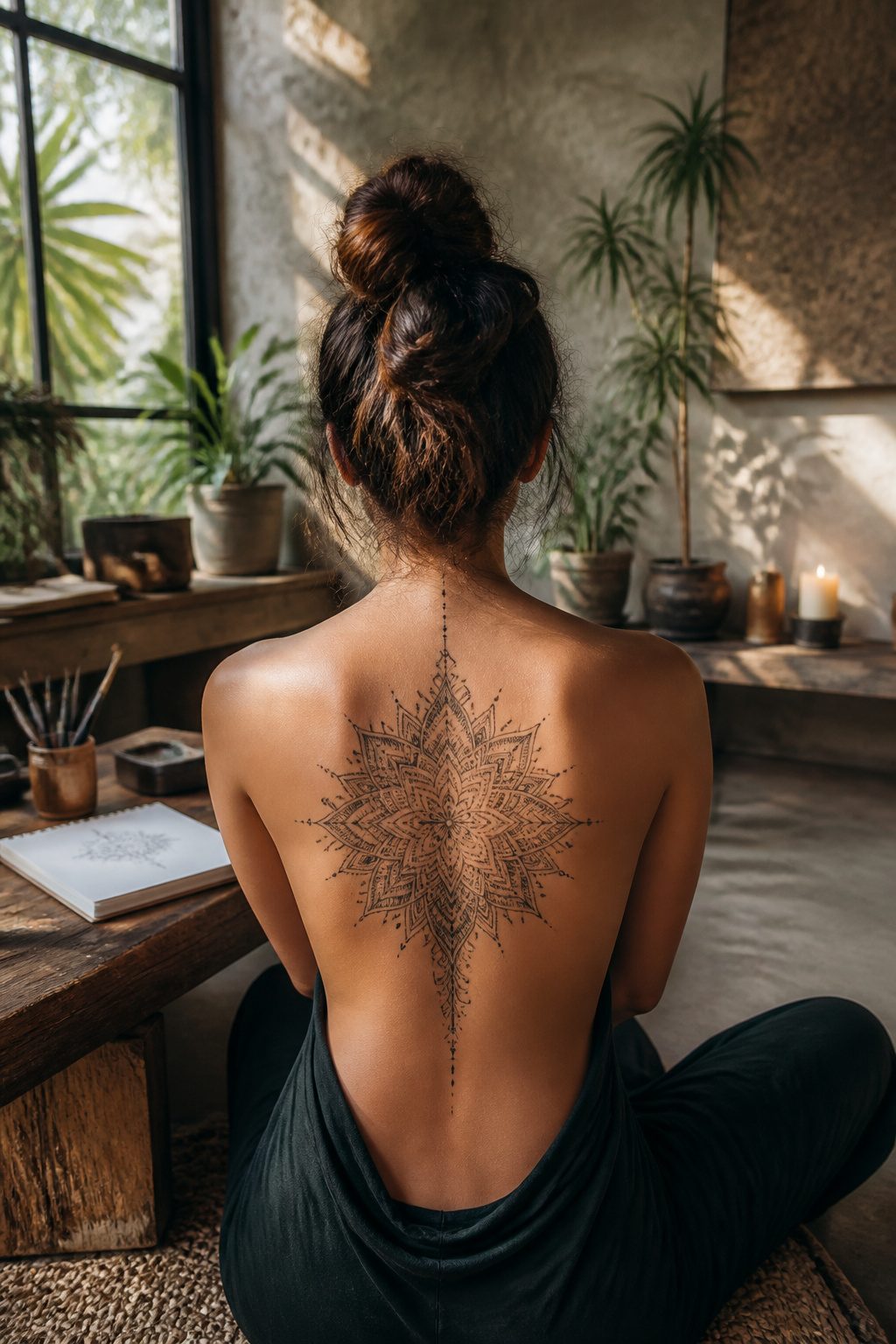
Mandala tattoos live or die on symmetry, and the back is one of the few places on the body flat enough to give an artist that control. Centered on the spine, the design holds itself like a compass rose; placed on a shoulder blade, it becomes a contained medallion that moves with you but never breaks its own geometry. The flat planes matter here. Curved surfaces distort radial lines; the back’s broad, even skin lets the detail hold at size.
A shoulder blade mandala runs about $300–700, which puts it in the mid-range of back work. That price reflects the time, not the complexity alone. Every dot on one side needs its mirror, and the eye catches a mismatch faster than in a looser floral or abstract piece.
The spine placement reads more vertical, almost architectural. It frames the body’s natural center line, and the mandala’s balance becomes the body’s own. Some women split the difference: a shoulder piece for visibility, a spinal piece for private reference. Either way, the style rewards the back’s particular gift, which is space without the distortion of limbs or joints.
7. Abstract Tattoos
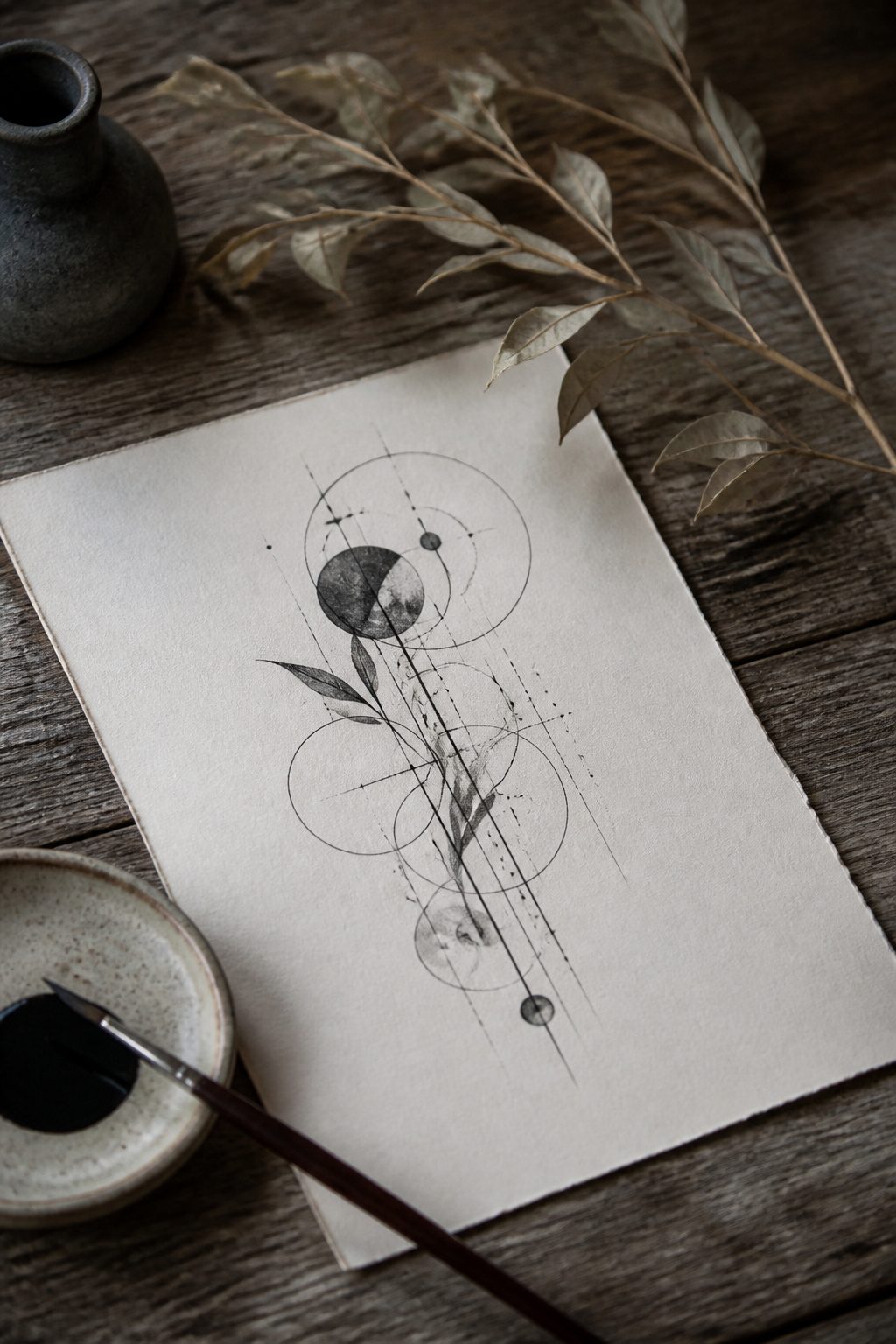
Abstract back tattoos trade literal imagery for color fields and line work that move with the spine and shoulder blades. A piece I watched develop over three sessions on a swimmer’s back started as a cobalt wash at the neck, then let the pigment fracture into warmer oranges as it crossed the scapulae. The artist mapped it to her muscle movement so the shapes appeared to shift when she reached overhead.
The full back is the only canvas large enough for this to work at scale. A sleeve or rib piece forces abstraction into too small a box; the shapes get cramped and the color transitions feel rushed. On a back, an artist can let a single hue bleed across twelve inches of skin before it meets a complementary tone, and the eye reads it as atmosphere rather than object.
Freeform lines that follow the vertebrae down the center read as one statement. Splashes that break across the whole width read as another. The choice depends on whether you want the tattoo discovered all at once or in pieces as you move. Both break from the literal, but the spine-down version tends to age cleaner because the central line stays readable even as surrounding color softens.
Where It Hurts Most and Least
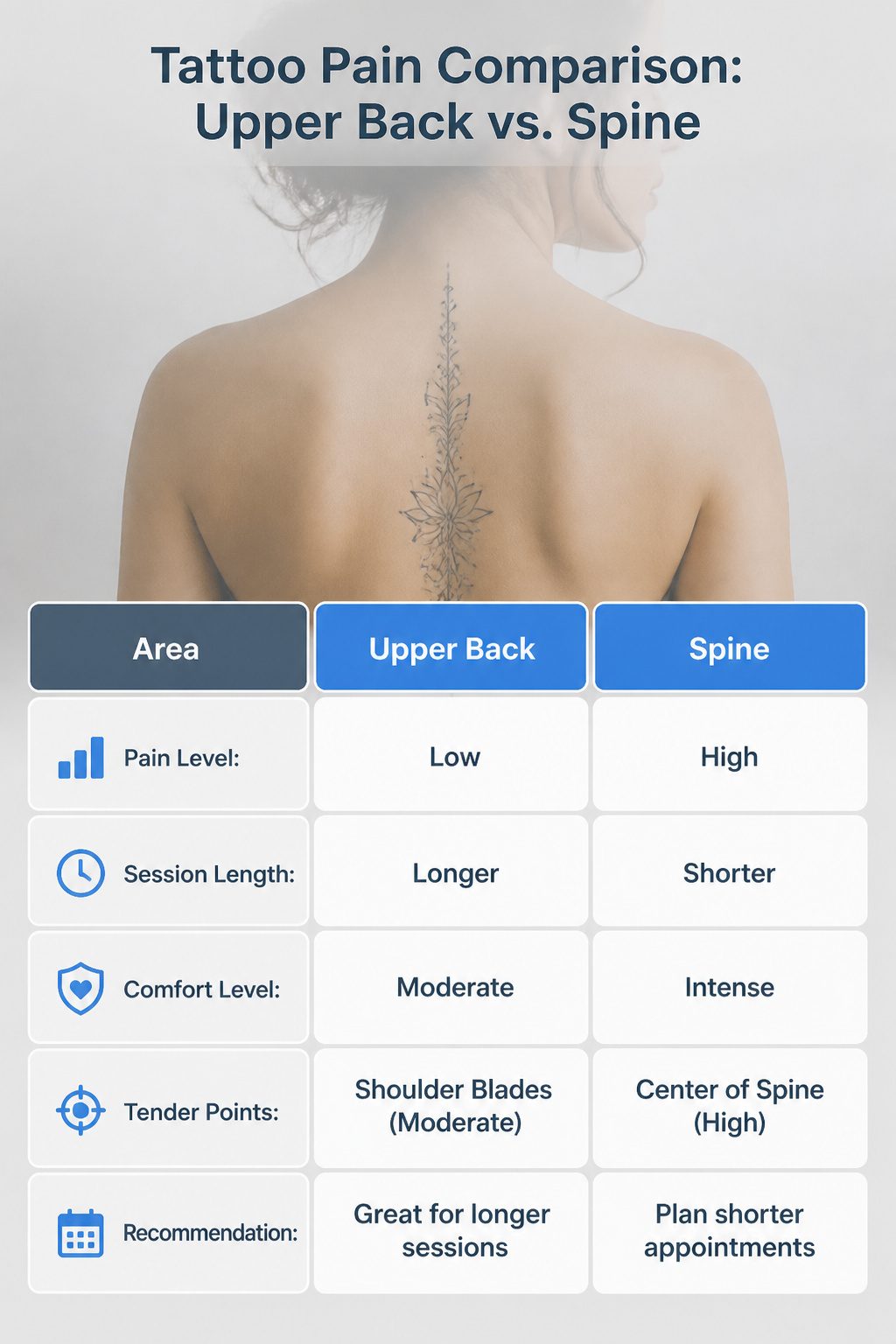
The upper back is the easiest place to sit through, because the skin there is thicker and carries fewer nerves. Most people compare it to a deep scratching sensation that dulls after the first few minutes.
Spine work is a different story. The skin over the vertebrae is thin, and the needle sits close to bone with almost no cushioning fat. That vibration travels, and the area stays sensitive for the full session. Plan shorter appointments for anything running down the center of your back, or ask your artist to break a long piece into multiple sittings.
The shoulder blades fall somewhere between. The bone sits near the surface, which creates that sharp, direct feeling when the needle crosses it, but the surrounding muscle gives you stretches of relative comfort. Backless tops show this placement off easily, which is part of why it stays popular despite the middle-range pain level.
Spine, Shoulder Blades, or Full Back
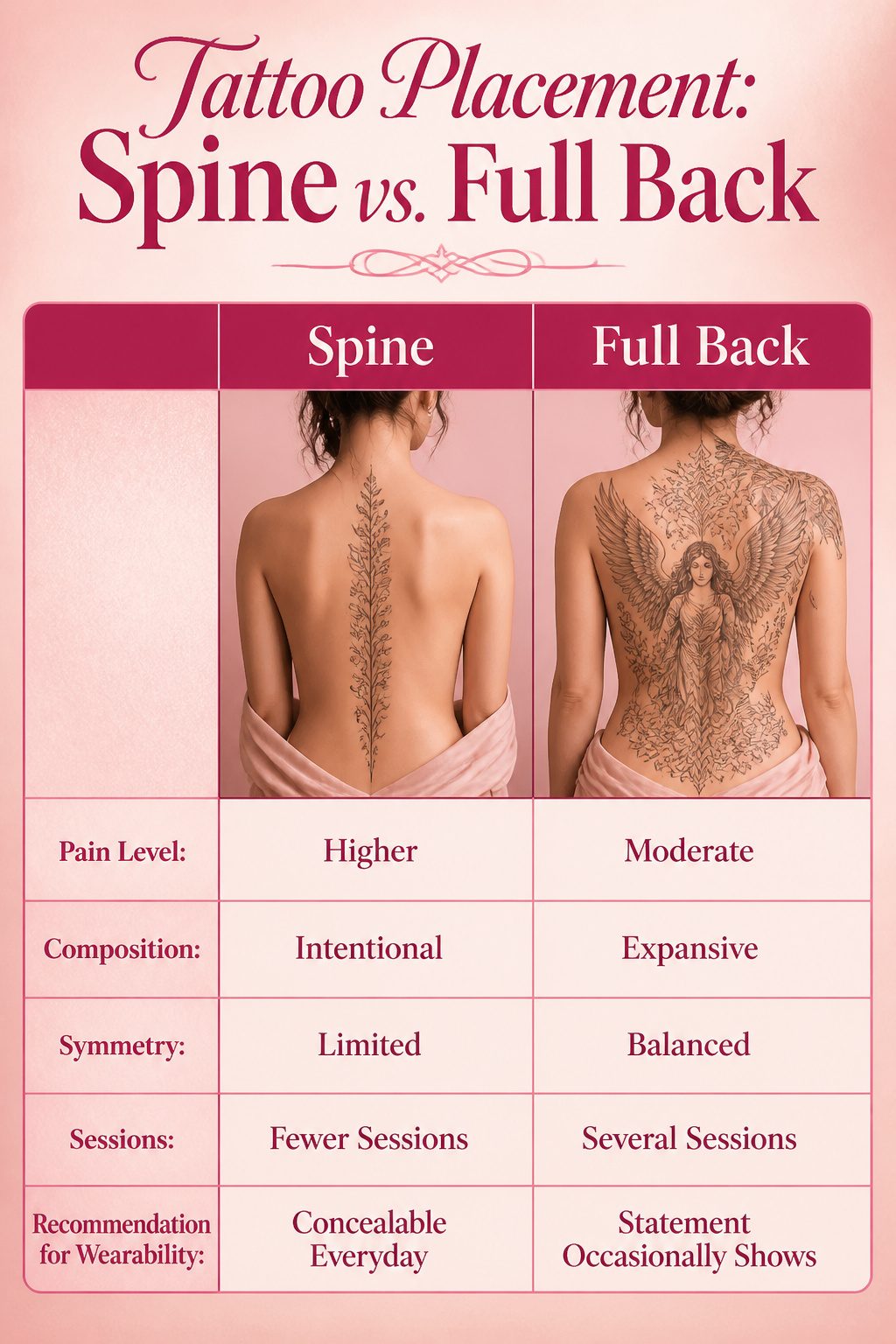
The spine naturally pulls the eye upward, so vertical compositions like flowering branches, handwritten lettering, or stacked symbols read as intentional rather than squeezed in. Pain levels run higher there and near the shoulder blades, where bone sits close to skin, while the fleshier zones around them are easier to sit through.
Shoulder blades carry symmetry better than almost anywhere else on the body. Wings, mandalas, or mirrored bouquets hold their balance here, and a tank top or blouse hides or reveals the work in seconds. A single shoulder blade also works for a self-contained piece, a realistic floral composition that does not need the other side to feel complete.
A full back piece demands several sessions and an artist who is comfortable with large formats, but the scale lets mythical scenes or angel wings operate as actual composition rather than shrunk-down versions of themselves. The 2026 trend among women points toward fine line florals tracking the spine, ornamental lace pieces, and those single-shoulder florals. What you choose should depend on whether your daily routine calls for concealment or for a statement that occasionally shows.
What the Style Says
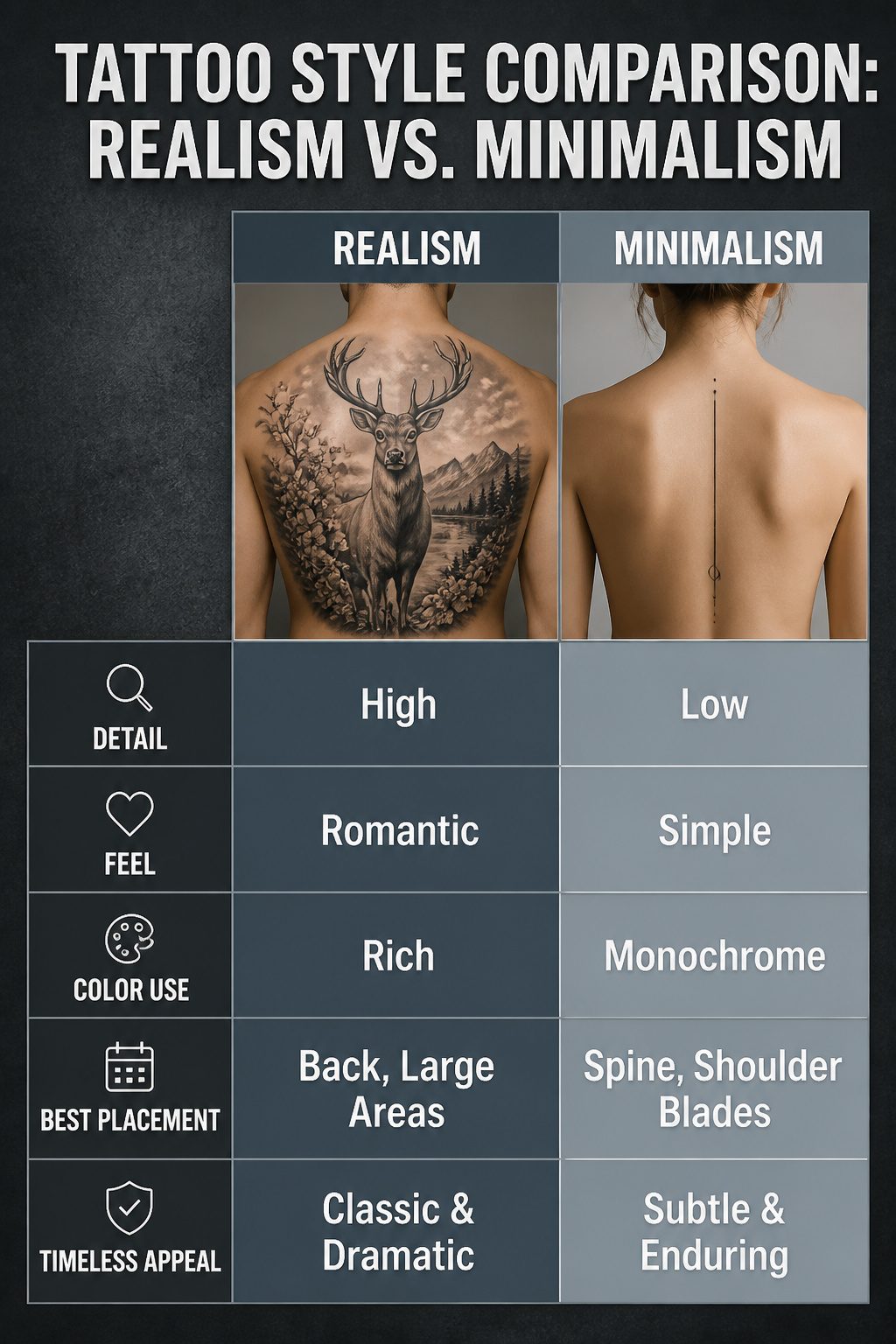
Realism brings out the finest details, whether in a portrait or a complex landscape, and on a back that scale lets the shading breathe. Watercolor creates a light and romantic feel with soft color transitions, the kind I have seen paired with deer antlers and blossoms so the tattoo looks less drawn than spilled. Minimalism values simplicity, which works when the shape itself carries the weight, a single line down the spine or a small mark between the shoulder blades. Tribal or ethnic patterns add antiquity and mysticism, though that mood has to match the wearer; the bold geometry reads differently on a 2026 client than it did in the nineties. Black-and-white classic remains the universal choice, emphasizing clarity of lines when color feels like a risk you are not ready to take.
What Each Design Means
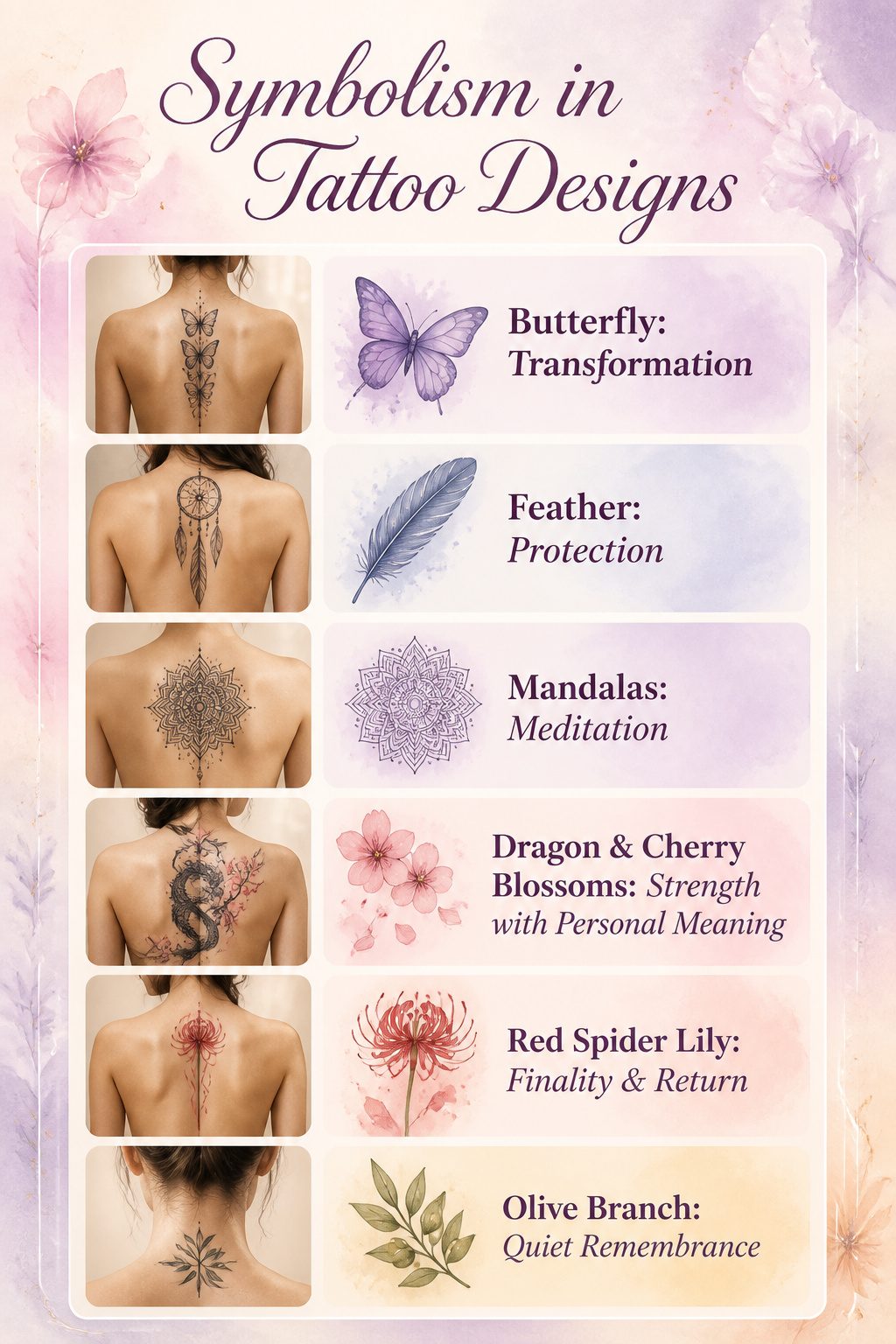
A butterfly drifting down the spine carries transformation in a way that feels earned, not borrowed. The meaning lands because you chose it, not because the design came pre-loaded. I see this most clearly when someone sits in the chair with a photo of their grandmother’s gardenias and asks the artist to make the petals heavy enough to show weight.
Symbols gain their weight from the story you attach, not the other way around. A dragon on a woman’s back can read as strength or as the loyalty Haku carried in Spirited Away; the cherry blossoms woven through change the tone from fierce to something more guarded, more personal. The red spider lily breaks the flower pattern entirely: beauty still, but tied to finality and return rather than romance.
The back hides the work from casual view, which turns the meaning inward. A mandala centered between the shoulder blades becomes meditation you carry, not display. An olive branch below the nape stays quiet enough that the wearer forgets it some mornings and remembers again in the mirror.
Placement shapes the symbolism too. Feathers falling from a dreamcatcher down the full length of the spine turn protection into movement; the same motif locked at the upper back reads more like armor. Most women I sketch for come knowing the concern, hydration first, then how the ink settles over bone versus softer tissue. The meaning they want drives where it sits, and that choice matters more than any dictionary of symbols could.
After the Needle
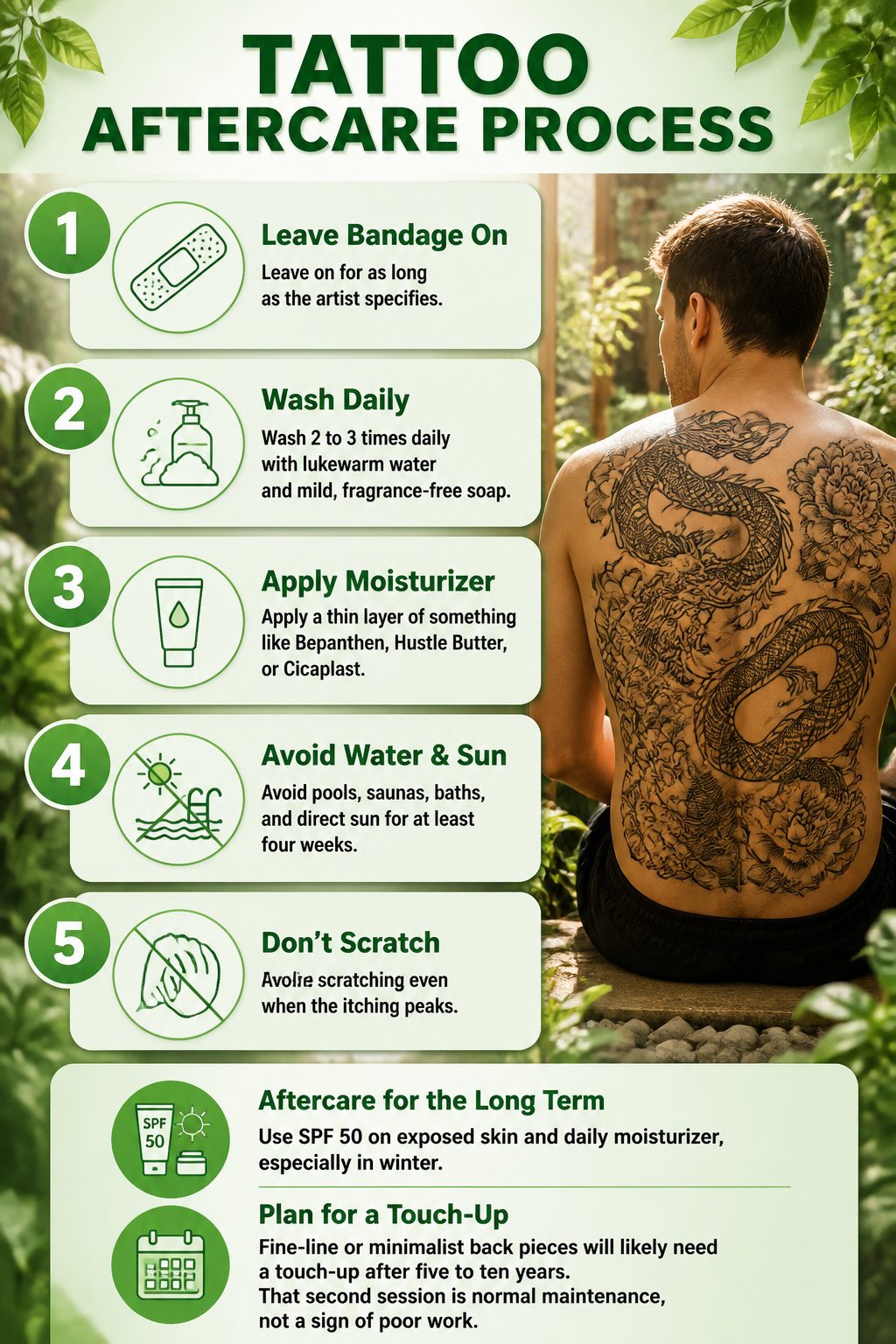
The first two weeks settle how a back tattoo ages, and the location makes the work harder than it is for a wrist or ankle. The skin stays under clothing that rubs, shifts, and traps sweat, so leave the bandage or healing film on for as long as the artist specifies, not what seems convenient. After that comes washing two to three times daily with lukewarm water and mild, fragrance-free soap, then a thin layer of something like Bepanthen, Hustle Butter, or Cicaplast. Pools, saunas, baths, and direct sun stay off-limits for at least four weeks, and scratching is non-negotiable even when the itching peaks.
Once healed, the sun becomes the long-term threat. SPF 50 on exposed skin is the only reliable way to keep ink from blurring or shifting color, and daily moisturizer, especially in winter, keeps the skin surface even. Fine-line or minimalist back pieces will likely need a touch-up after five to ten years. That second session is normal maintenance, not a sign of poor work.
Frequently Asked Questions
Do back tattoos hurt for women?
The fleshy upper back is the easiest area to sit through, with most people comparing it to deep scratching that dulls after a few minutes. Spine work hurts more because the skin there is thin and sits close to bone with almost no cushioning fat, so plan shorter appointments or multiple sittings for anything down the center. The shoulder blades fall in between; bone near the surface creates sharp moments, but surrounding muscle offers stretches of relative comfort.
How much does a back tattoo cost?
A shoulder blade mandala runs about $300–700, while a small fine line piece along the spine falls in the $100–250 range. Large compositions covering the whole back typically reach $1,000–3,000 and need several sessions. The price reflects time more than complexity alone; symmetry work like mandalas costs more because every dot needs its mirror.
Which back tattoo design should I choose?
Pick based on your personal style, the meaning you want to carry, and how visible you need the piece to be day to day. Floral and animal designs age well if you avoid overly trendy styles; geometric and mandala pieces rely on precise placement and flat back skin to hold their symmetry. The shoulder blade wins for first tattoos because you can hide or show it without planning your wardrobe around it, while spine placement stays more private.