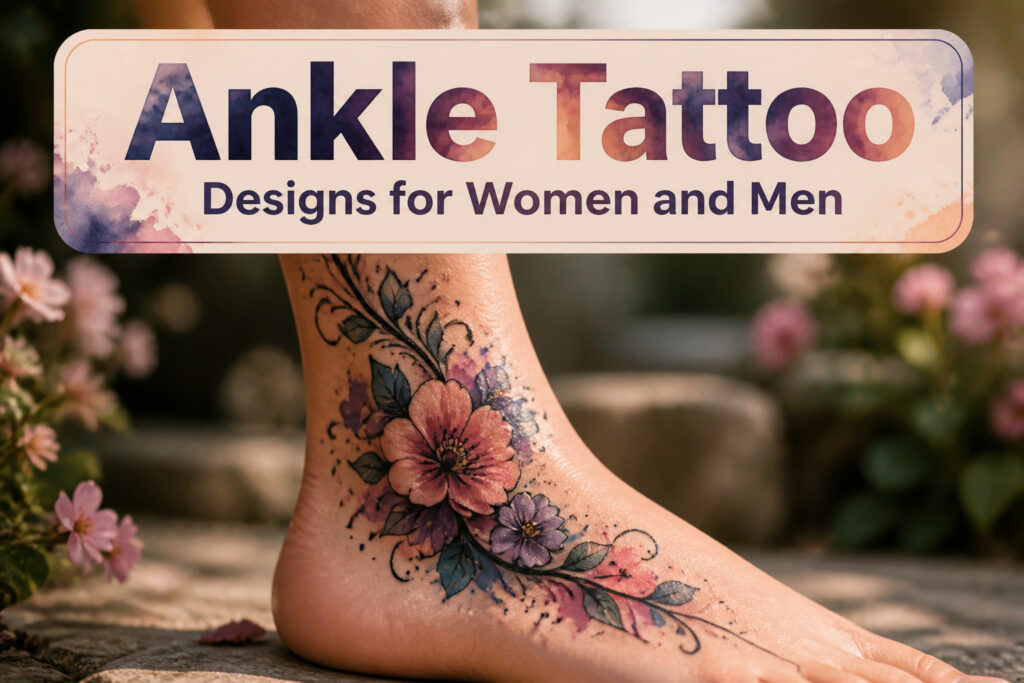
Ankle tattoo designs range from single-needle micro-work to full wrap-around mandalas, and the deciding factor is usually how much motion the skin sees daily. The catch is that placements promising the most visibility, like the front shin or back Achilles, also take the hardest friction from socks, shoes, and sun. A $60 flash piece can outlast a custom $400 mandala if the simpler design sits where bending and rubbing are minimal.
1. Wrap Around Ankle Tattoos
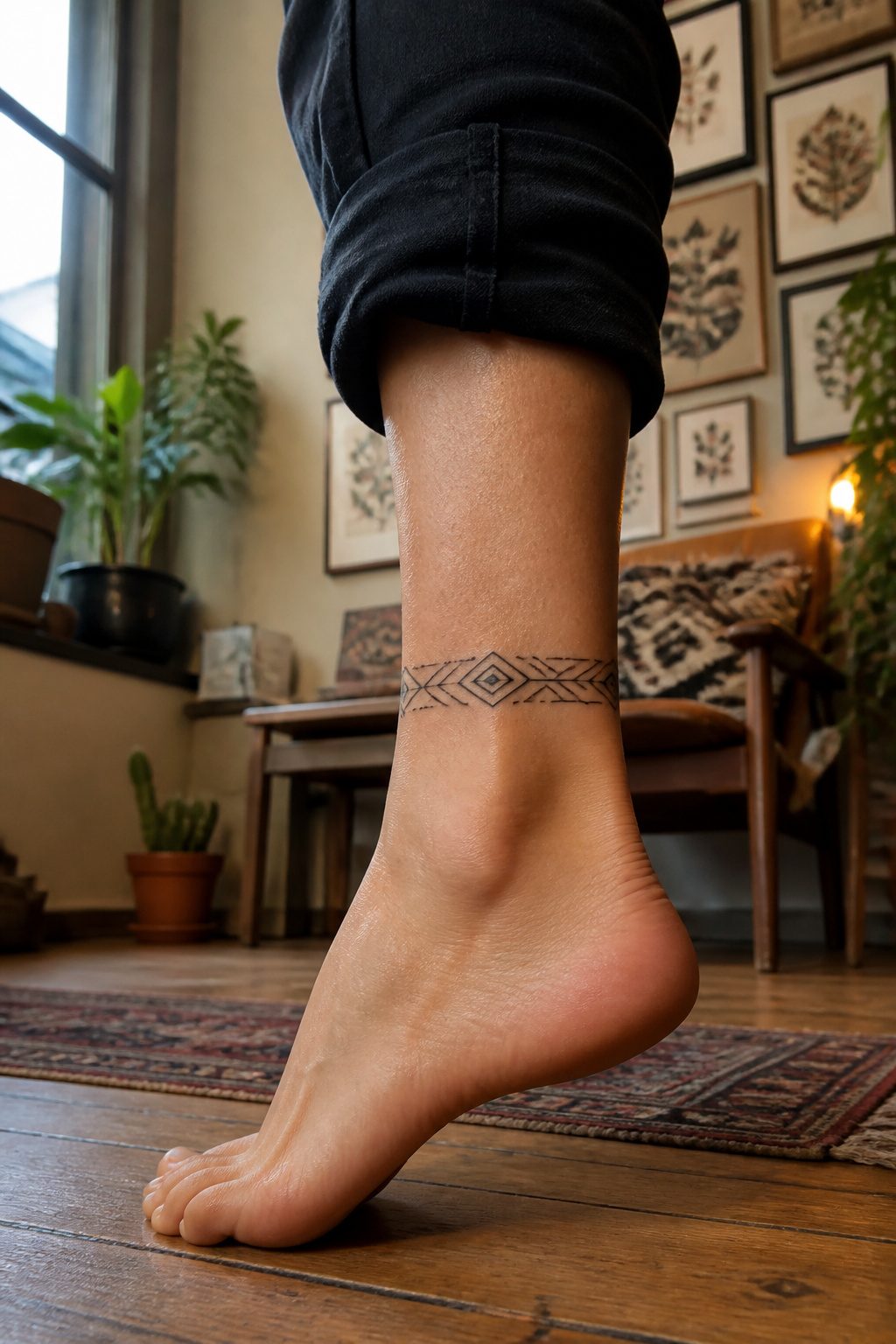
The ankle’s cylinder shape does something flat skin cannot: it lets a band of ink flow without interruption, turning geometric patterns, florals, or ornamental work into a continuous circuit. That unbroken flow is what separates a wrap-around that ages well from one that falls apart.
I have watched thin dotwork chains and compact lace cuffs settle over the years, and the difference starts in placement. Skin on the shin or top of the foot stretches and shifts, distorting straight lines into wavering ones. The ankle band, riding the narrowest part of the limb, moves as a single unit. The design stays legible because the whole band distorts together rather than shearing across a joint.
Two ways to play this. A minimalist band, geometric or dotwork, keeps the line weight light and the spacing generous. That leaves room for the ink to spread slightly without closing up. Ornamental designs, filigree or mini-mandalas, demand tighter detail but reward the eye with jewelry-like precision. The denser work costs more sessions and more aftercare discipline, and it shows wear faster if the line work is too fine.
Traditional Polynesian or tribal bands carry the same advantage: bold, repeating motifs read clearly even when the edges soften. What fails is detail crammed into too narrow a ring. The ankle’s circumference looks small until you try to fit a mandala or a long phrase around it; scale the elements to the real estate or the design blurs within five years.
2. Feminine Ankle Bracelet Tattoo
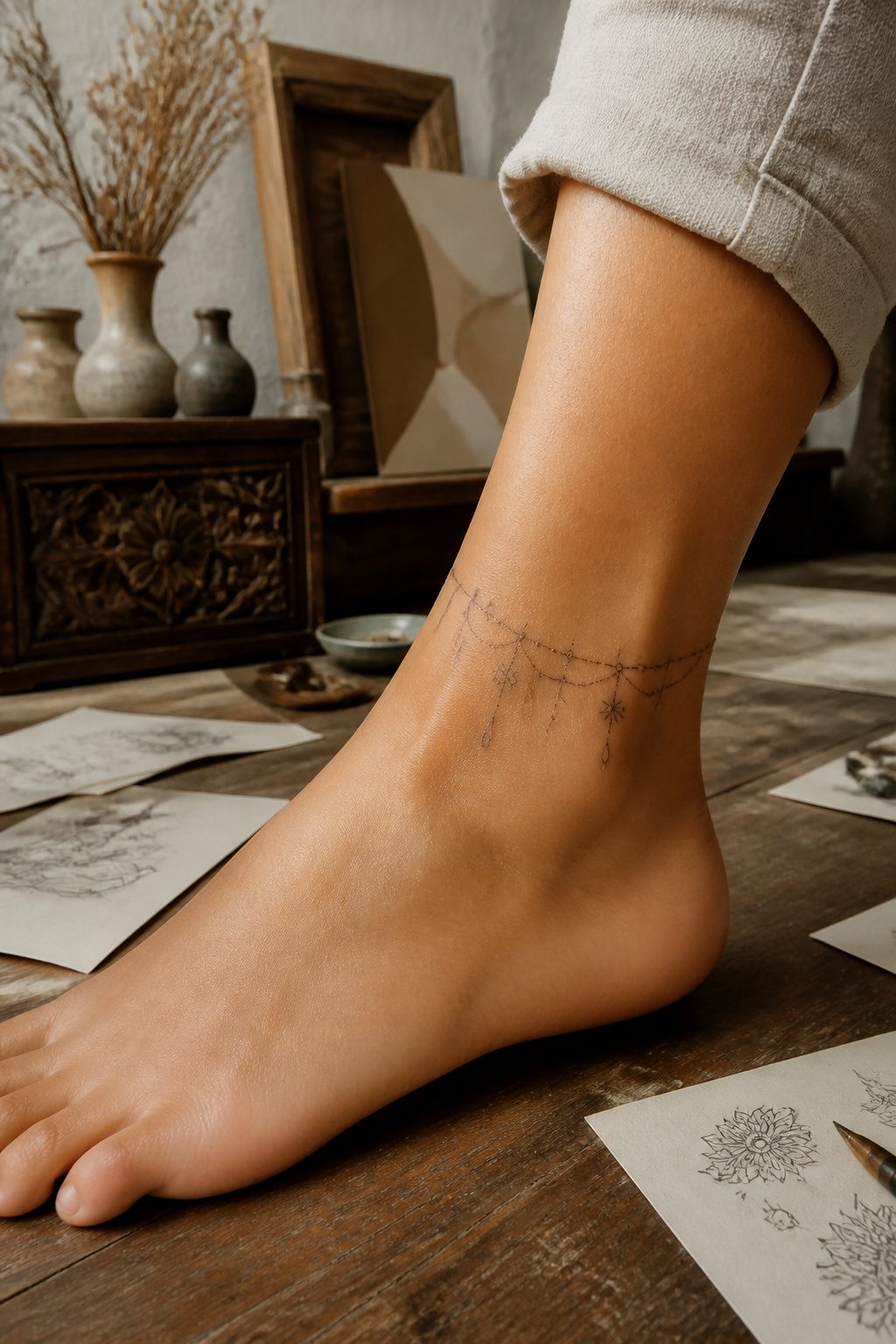
A feminine ankle bracelet tattoo works best when the line weight stays under two millimeters. The skin here shifts with every step, and heavier ink pools into a blurred band within a few years. Single-needle work, the kind trytattoo.ai calls out for precision, is what keeps those gem dots and tiny beads reading as separate objects instead of one muddy stripe.
The charm of these pieces is literal: small pendants, birthstones, or a single flower woven into the chain. Stylecraze’s example of a client choosing their own gem makes sense because the placement is personal enough already. What I notice comparing healed photos to fresh ones is that the ornamental filigree and lace details, the curves that follow the ankle bone, hold up better than straight horizontal bands. The natural arc moves with the body instead of fighting it.
Fine line on ankle skin demands an artist who works slowly. The area bruises, swells, and shifts under the needle in ways that thicker body parts do not. A bracelet design that wraps the full circumference especially needs someone accustomed to ornamental composition, because stopping and restarting around the tendon changes how the ink sits. The result can look like jewelry or like a regrettable tan line; the difference is almost entirely in the artist’s control of needle depth across that moving surface.
3. Small Ankle Tattoos
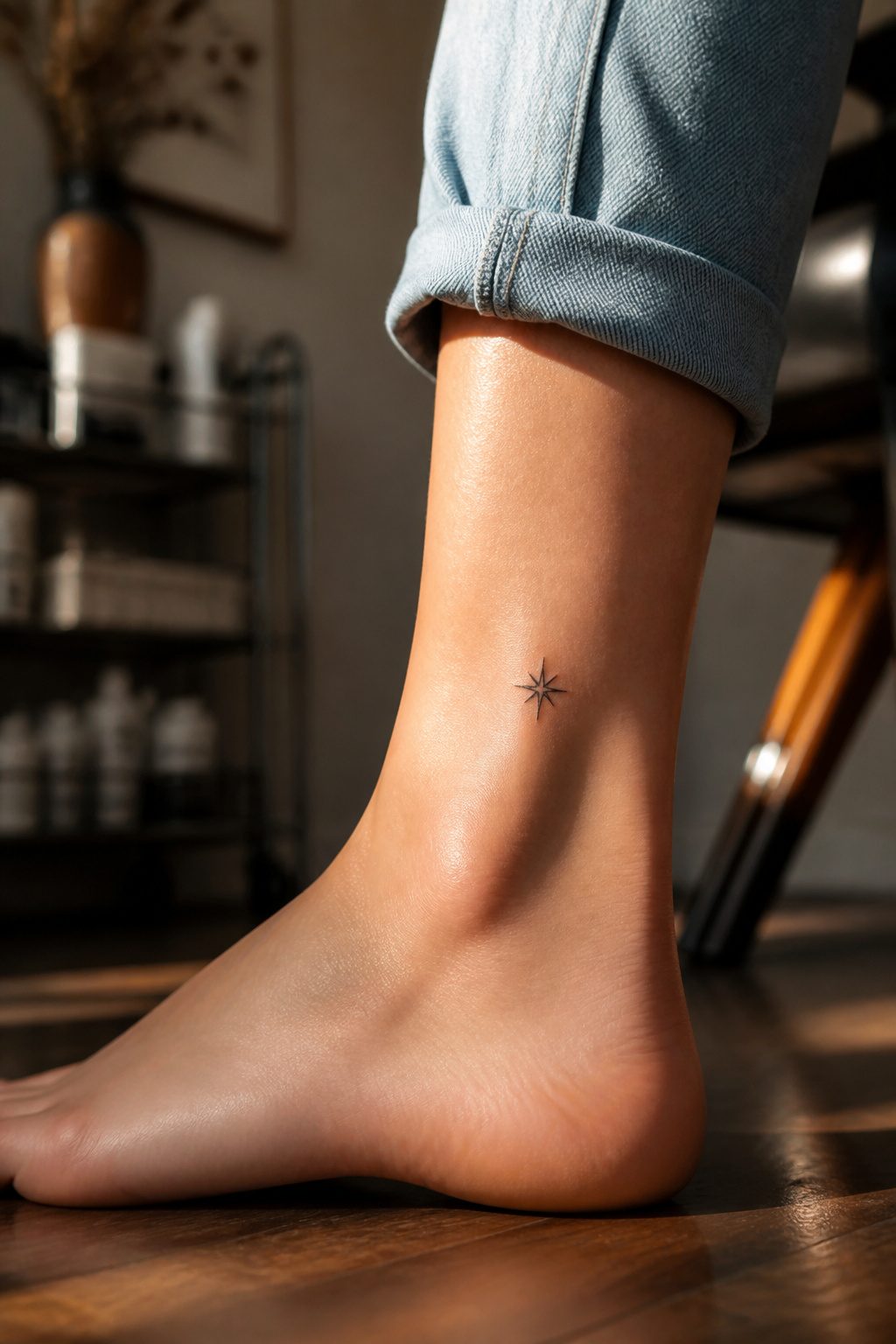
A single needle line, a miniature star, a dot placed just above the ankle bone, these pieces read as quiet from across the room but hold up only when the artist slows down. The skin at the ankle shifts with every step, and a design under two inches still demands the same sterile setup, the same stencil precision, the same healing guidance as a palm-sized piece. $60 to $150 covers most micro-work, though the lower end usually means a flash piece the artist has already drawn, not a custom sketch.
Smaller tattoos suit first-timers for the obvious reason: coverage takes a sock, a boot, a pant cuff with no negotiation. The same scale also ages faster than expected. Friction from shoe backs and sock seams hits the Achilles and the outer ankle bone hardest, so a simple design, a clean line with no packed black, holds its readability longer than a miniature portrait or a letterform with hairline details. Delicate florals and single symbols work here because they leave space around each element; the eye fills in what time slowly softens.
4. Ankle Tattoos For Men
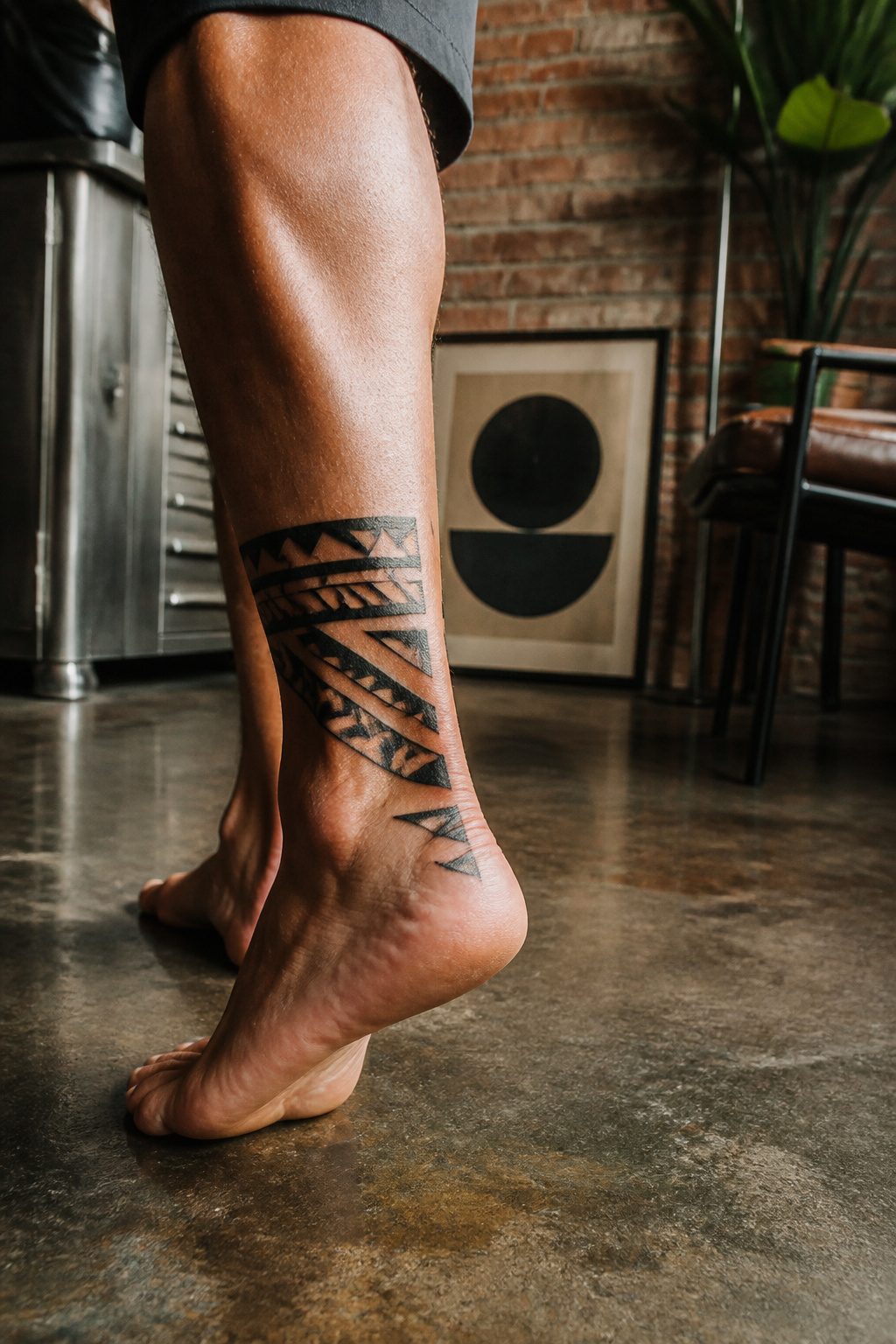
Men’s ankle work tends toward heavier linework and darker saturation than what usually gets photographed for women’s collections. Tribal patterns and biomechanical designs both sit well on the outer ankle or the back of the calf above the heel, spots that stay visible in shorts without trying too hard. Plenty of guys rule the placement out because they assume the ankle reads as strictly feminine, yet bold imagery like anchors, animals, or geometric blackwork changes that frame completely. The bone sits close to the skin there, so solid fills and thick lines age cleaner than fine detail that might blur over time. Your most natural choices for visibility without a full leg sleeve are the outer ankle and the back heel.
5. Flower Ankle Tattoo
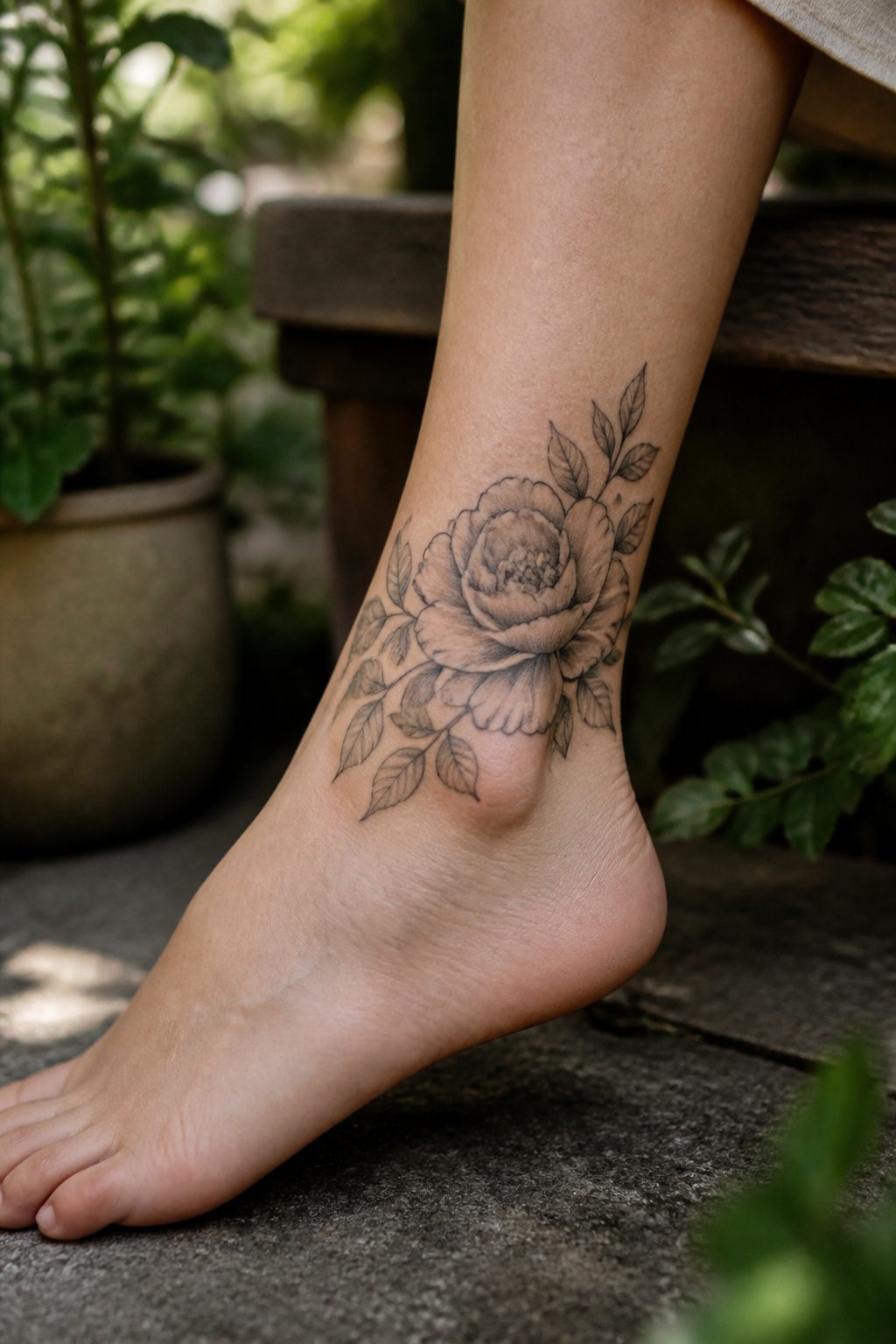
Flowers on the ankle carry the usual meaning of growth and femininity, though the bone underneath changes how they read. A flat rose or peony sitting on the outer ankle stays visible and ages evenly, while stems that wrap the joint move with every step and soften faster than the wearer expects.
Black and gray holds its edges longer here because the ankle sees sun, friction from socks and shoes, and skin that turns over quickly. Color, especially the lighter yellows and pinks common in peonies, drops out or shifts toward brown within a few years unless the wearer commits to sunscreen and touch-ups. The sources agree on this split: wildflowers in fine line black work stay readable as a cluster, but the same design in watercolor needs more maintenance to keep the distinction between one bloom and the next.
A single botanical stem climbing from the heel toward the bone gives the ankle length without circling it. Multiple small flowers scattered around the joint read as a bracelet whether the wearer intended that or not, and that territory belongs to a different section entirely. For growth symbolism without the bracelet effect, the inside or back of the ankle keeps the stem vertical and the meaning intact.
6. Back Of Ankle Tattoo
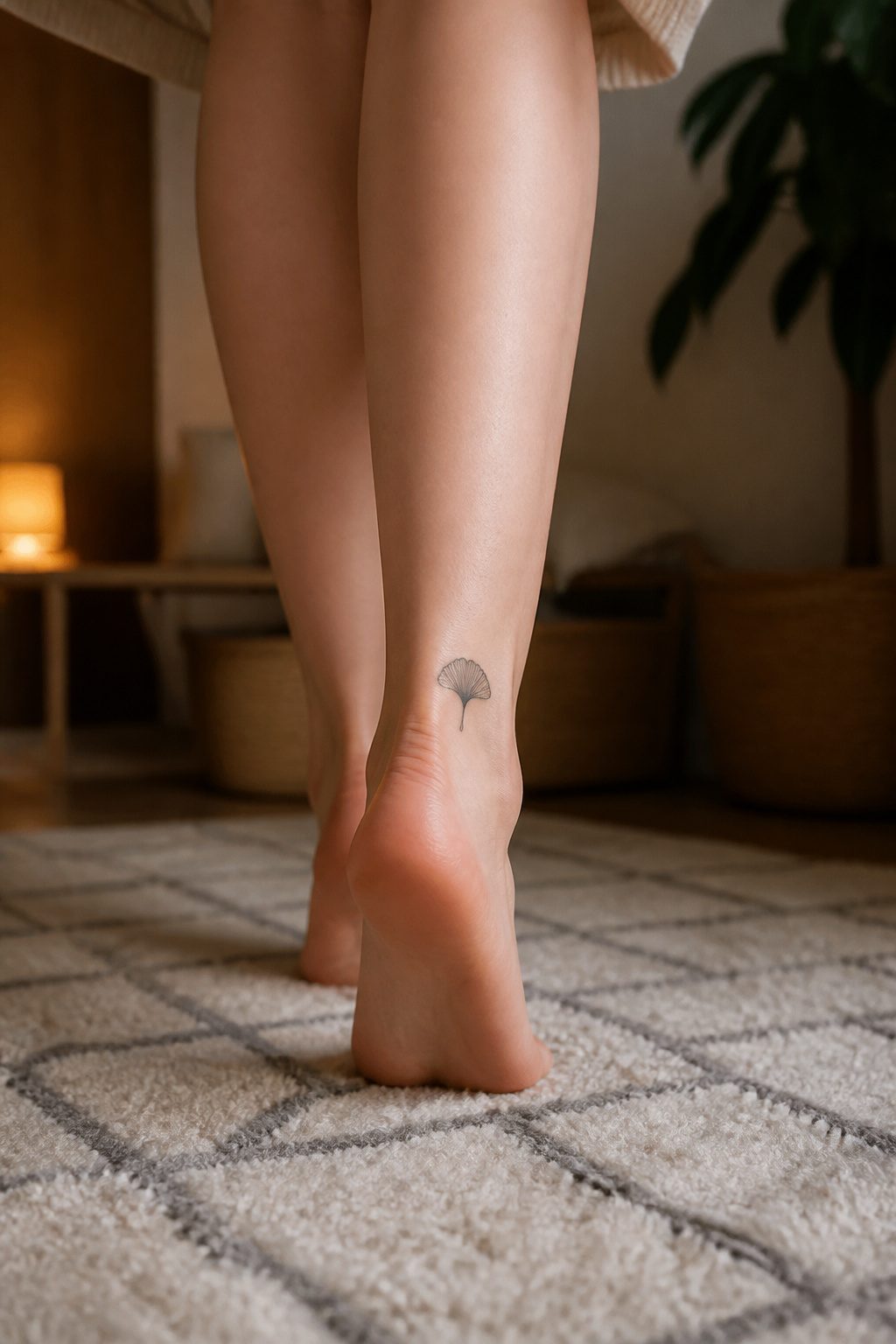
The back of the ankle sits right on the Achilles tendon, and that placement changes everything about how a tattoo there looks and feels. Skin is thin over that tendon, and the bone sits close underneath, so the needle registers as sharper pain than on the inner or outer ankle. Most sessions run 10 to 30 minutes for a standard design, which keeps the total time short even if the minutes themselves are noticeable.
What a back-of-ankle tattoo does that other placements do not is move. Every step flexes the tendon, so the design shifts visibly with your gait. That motion is part of the appeal: someone walking behind you catches it at a different angle each time. Artists often orient these designs to face downward, not toward a viewer, so the wearer sees them right-side-up when looking at their own feet.
Friction from shoes and socks hits the Achilles zone directly, which can speed fading at the contact points. A simple design holds up better over 15 years than intricate linework here, and daily SPF 50 on the spot is the difference between a tattoo that stays legible and one that blurs early. The ginkgo leaf is a common choice for this placement, small enough to sit cleanly on the narrow tendon strip and weighted with a meaning that suits the visibility: resilience, because the spot itself is a harder wear.
7. Inner Ankle Tattoo
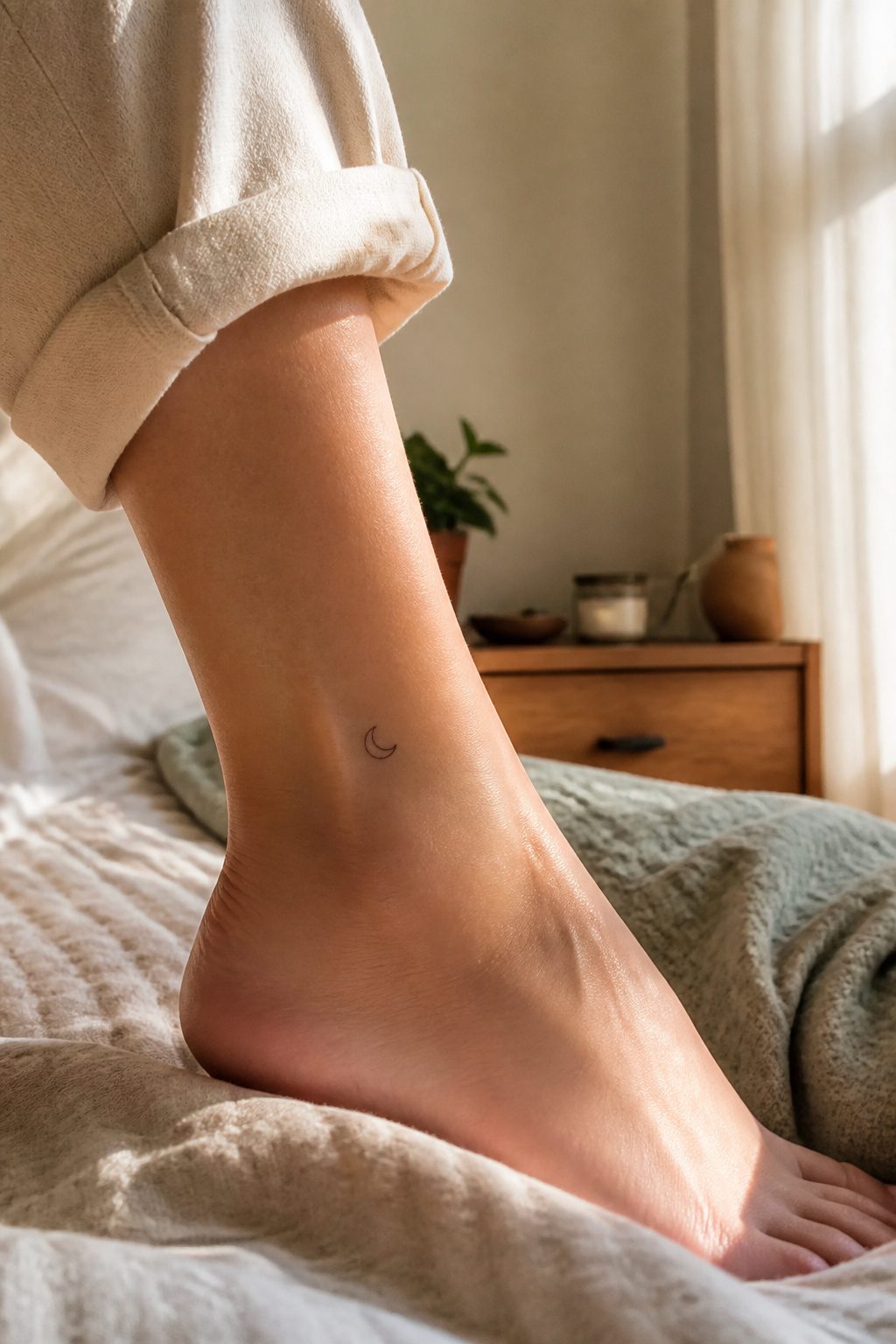
The medial ankle, just above the arch, hides itself well. Shoes cover it, pants fall over it, and even someone sitting across from you at dinner will not see it unless you kick off your flats. That privacy is why I chose the spot for my first tattoo, a small star I thought I could keep perfect.
Soft skin there blurs faster than you expect. The inner ankle presses against its partner when you cross your legs, rubs against socks, and sits in the damp pocket of a boot heel. My star began to feather at the edges within three years, the lines softening from friction and trapped moisture until it looked more like a smudged stamp than ink.
If you still want the placement, keep the design simple: a single initial, a short date, a micro-symbol with no fine detail to lose. The sources agree that tight, complex work does not survive here. For the first two days after getting it, loose sandals beat any enclosed shoe. Long-term, SPF 50 on the spot every morning slows the fade, though nothing stops the mechanical wear.
8. Ankle Tattoo Cover Up
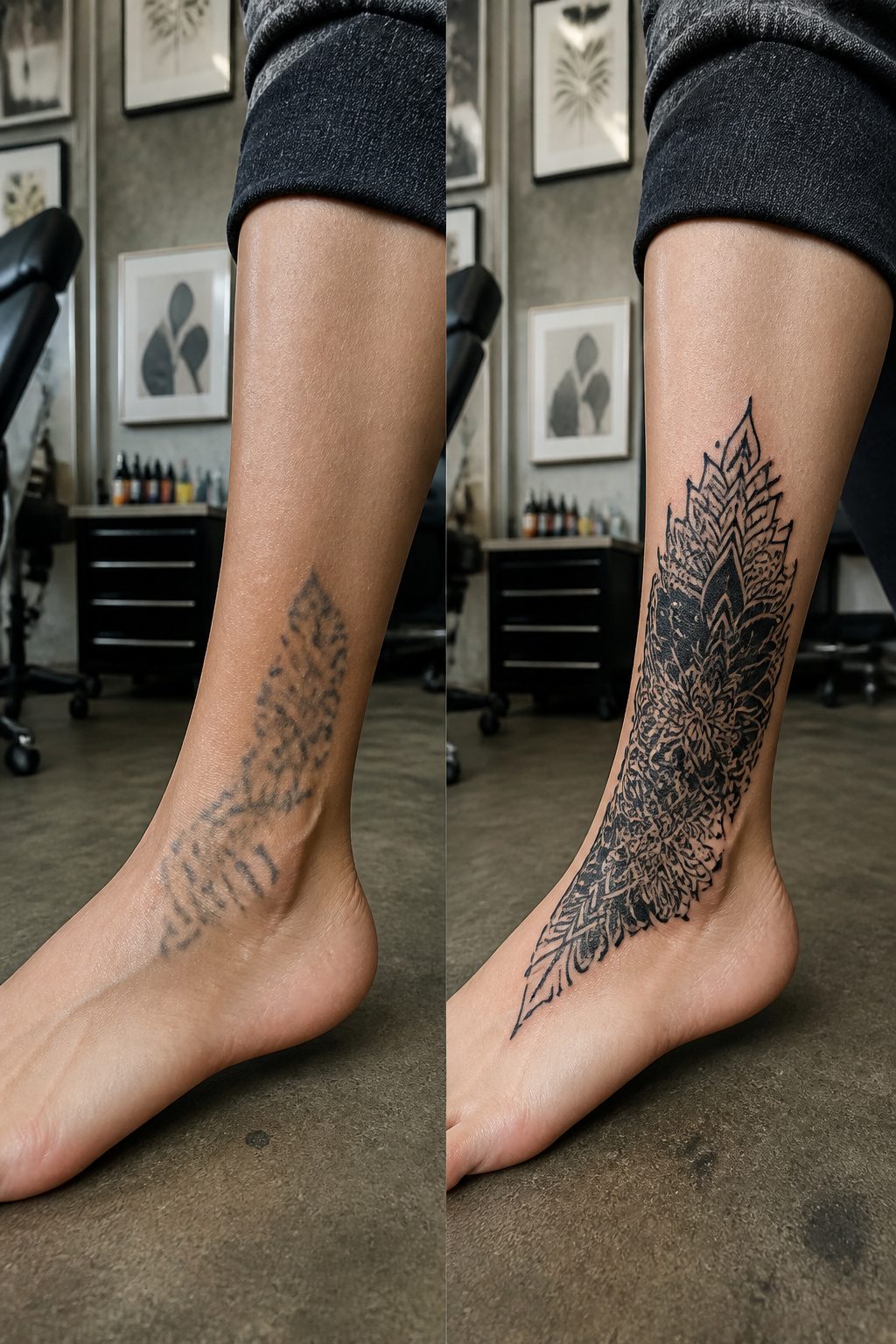
The ankle’s tight curve and thin skin make cover-up work here harder than almost anywhere else on the body. Old ink sits close to the bone with little padding, so a dark box or blown-out line from 2008 does not hide easily under new pigment the way it might on a thigh or shoulder.
Dense blackwork can swallow a faded name or a small blown-out star, but the tradeoff is real estate. A solid black band or heavy ornamental pattern needs enough surface to read as intentional rather than desperate, and most ankles simply do not offer that canvas. What convinces me, looking at portfolios over the years, is that the best ankle cover-ups redirect the eye rather than fighting the old tattoo head-on. Ornamental patterns with built-in dark zones, mandala centers, or floral clusters that naturally pool black ink tend to succeed where a single image trying to "go over" fails.
Laser lightening changes the math entirely. Two or three sessions to break up the old pigment can drop a dark piece to something a new design can actually incorporate rather than mask. The cost adds up, but so does the alternative: a cover-up that turns into a muddy dark blob because the artist had no workable middle values to build from. If the old tattoo is black and saturated, lightening first is usually the smarter money.
9. Sunflower Ankle Tattoo
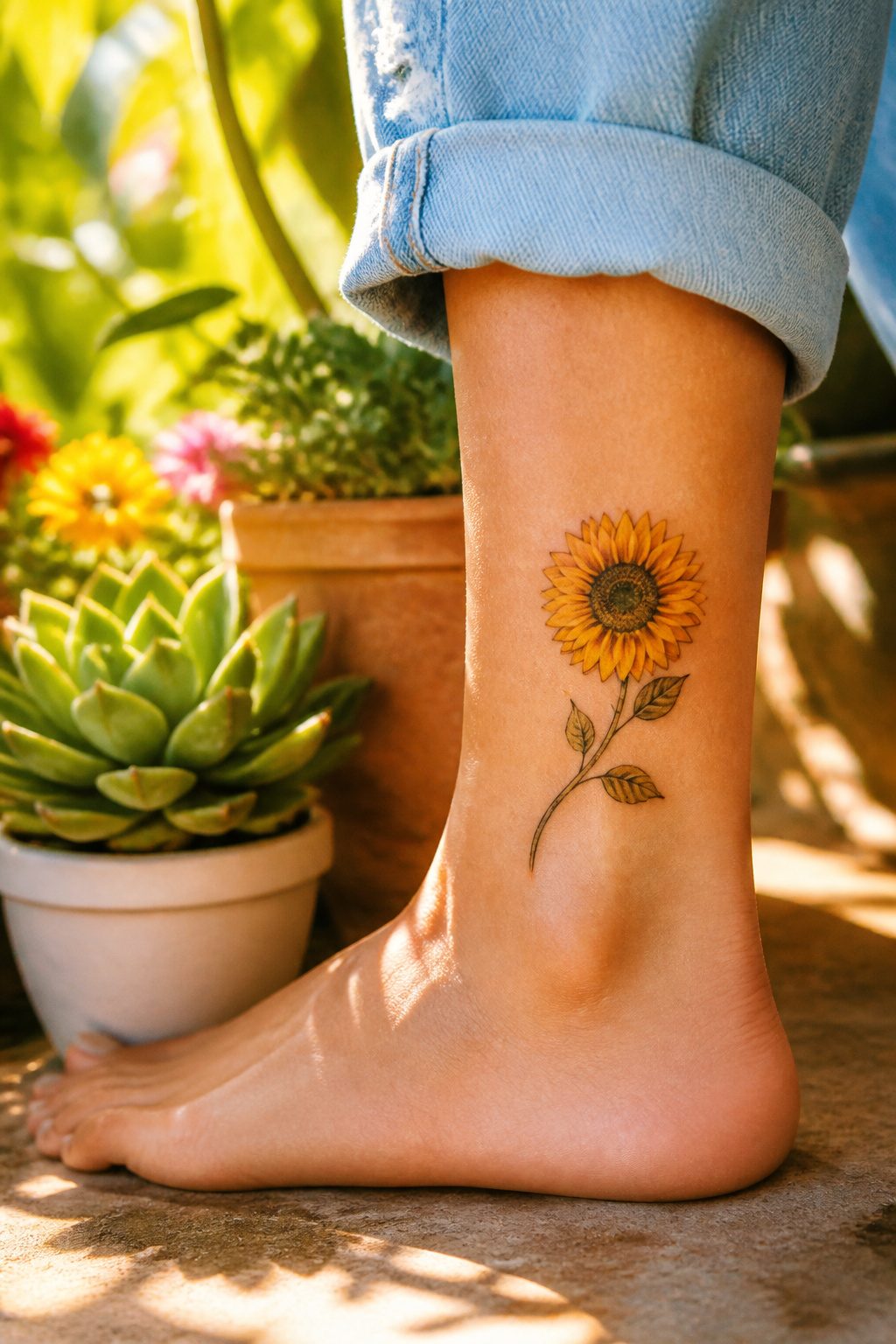
Sunflowers carry meaning that outlasts the trend cycle. Loyalty, happiness, and that instinct to turn toward light; these are the reasons the design keeps resurfacing in shops year after year. The radiating petals map naturally onto the ankle’s curve, either wrapping the stem in a spiral up toward the calf or sitting as a single bold bloom on the outer bone where it catches when you cross your legs.
Yellow ink fades faster than darker pigments, and a sunflower without its brightness is just another flower. What convinced me, reading through a dozen portfolios and aftercare threads, is that the artists who make these last either pack the yellow in solid rather than washed, or they steer clients toward a gold-ochre base with orange depth that holds longer than pure lemon. A wrap-around placement helps here; the back of the ankle sees less sun than the outer face, so the color stays truer where the leg meets the shoe line.
A small sunflower above the ankle bone reads as cheerful without shouting. A larger piece with the stem wrapping to the heel takes more sessions and more commitment to touch-ups, but the movement of it, the way the petals seem to follow your step, rewards the extra care.
10. Front Ankle Tattoo
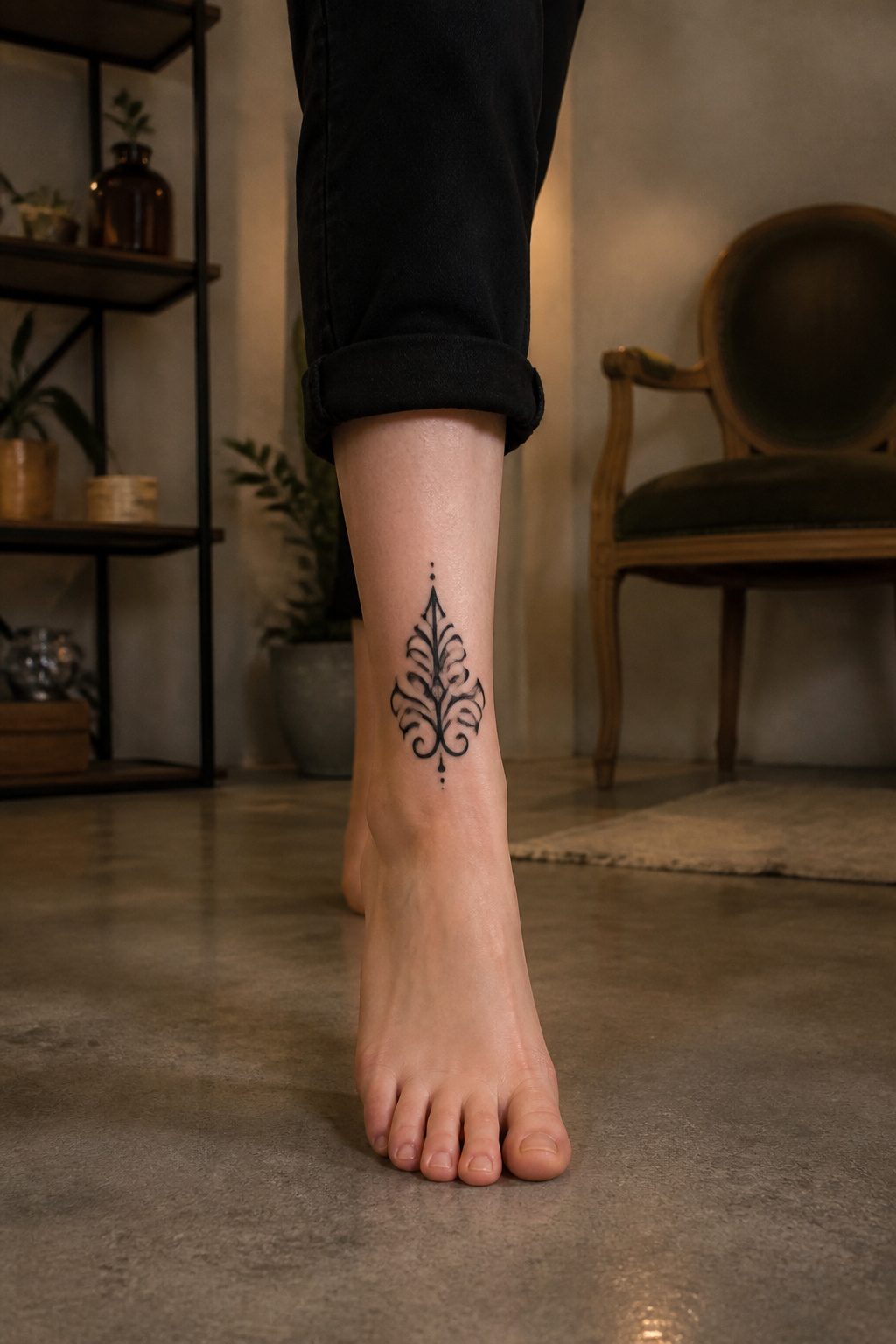
The front ankle sits right on the shin, just above the ankle bone, and it is one of the most visible tattoo placements you can choose. Skin here is tighter and bonier than most spots, which makes the needle feel sharper against the bone underneath. Sessions run short, usually 10 to 30 minutes for a standard design, but the pain is noticeable and direct.
Most artists orient the design to face outward, toward whoever is looking at you, rather than turning it in for your own view. That changes how you pick the image: a word or symbol meant for you to read will sit backward in the mirror every day.
The real wear comes after healing. Sock friction rubs at the ink steadily, and sun exposure hits this spot hard since shorts and skirts leave it bare. Fading speeds up at contact zones, so simple designs with clean lines hold up better than dense shading over the long term. Daily SPF 50 matters here more than almost anywhere else on the leg.
11. Ankle Small Beach Tattoo
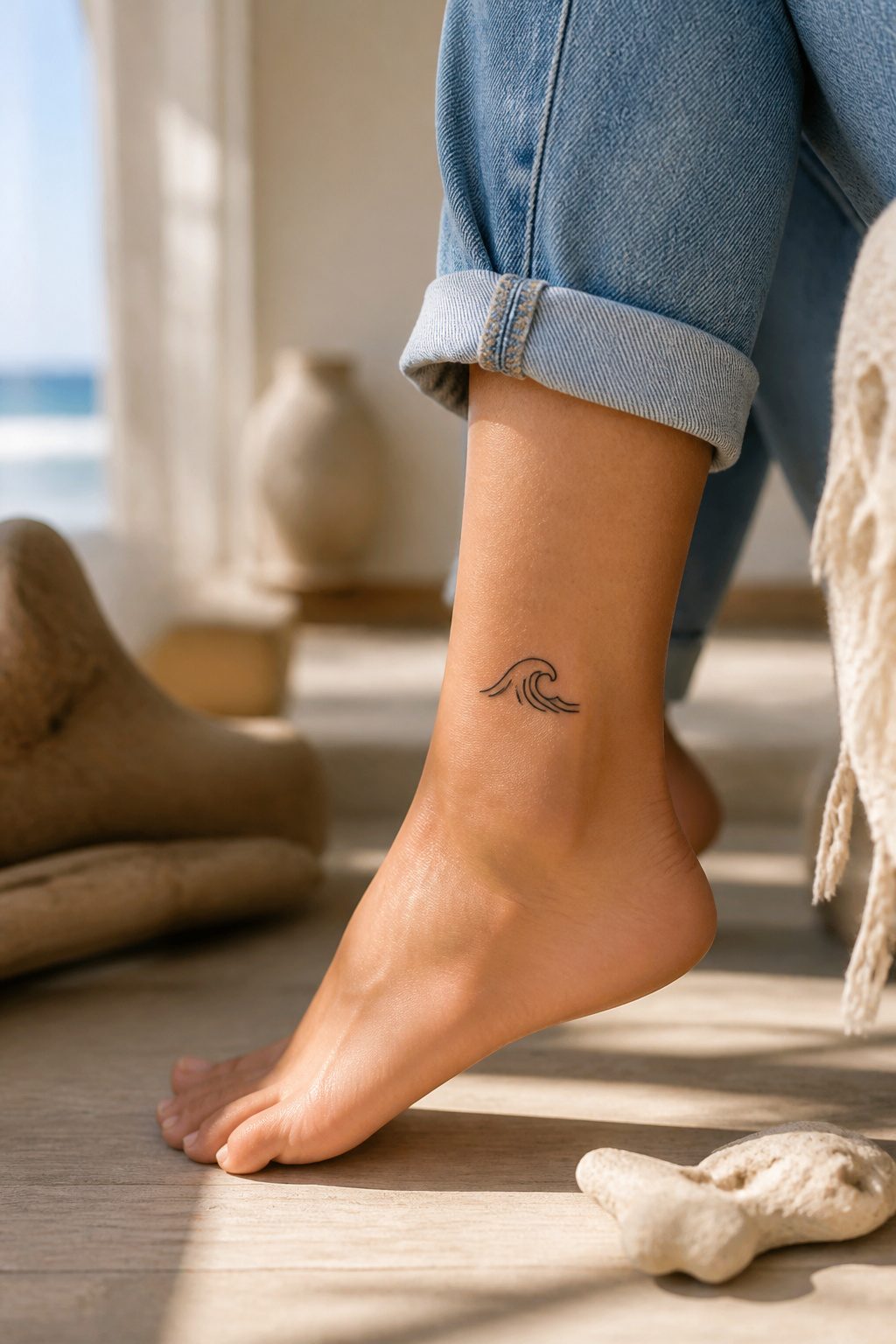
Waves, shells, and sand dollars hold up at ankle scale because the shapes are already simple. A two- or three-curve wave, something in the spirit of Hokusai but stripped down, reads clearly from a few feet away without the detail that blurs after a few years. The ankle gets friction from socks and shoes, especially at the Achilles tendon and ankle bone, so minimal coastal imagery wins here over fine detail that will soften faster than you want.
A tiny sunset in three or four bands of color, or a sand dollar in clean blackwork, carries the same personal weight as a full sleeve scene for someone who grew up near the water or marks a specific trip. The vacation connection matters more than the size: a shell the diameter of a dime can stand in for a whole coast. Placement follows the same logic. The outer ankle offers flat skin and easy aftercare access; the inner ankle hurts more and sees more rubbing from the opposite shoe, so a simpler shape there is the smarter move.
Stick to black ink or a very limited palette. Traditional anchors work at this scale because the red and blue are flat fills with clean outlines, not gradients that age into mud. The same rule applies to any beach imagery you choose: if the design needs shading to read, it is too complex for the space.
12. Cute Ankle Palm Tree Tattoo
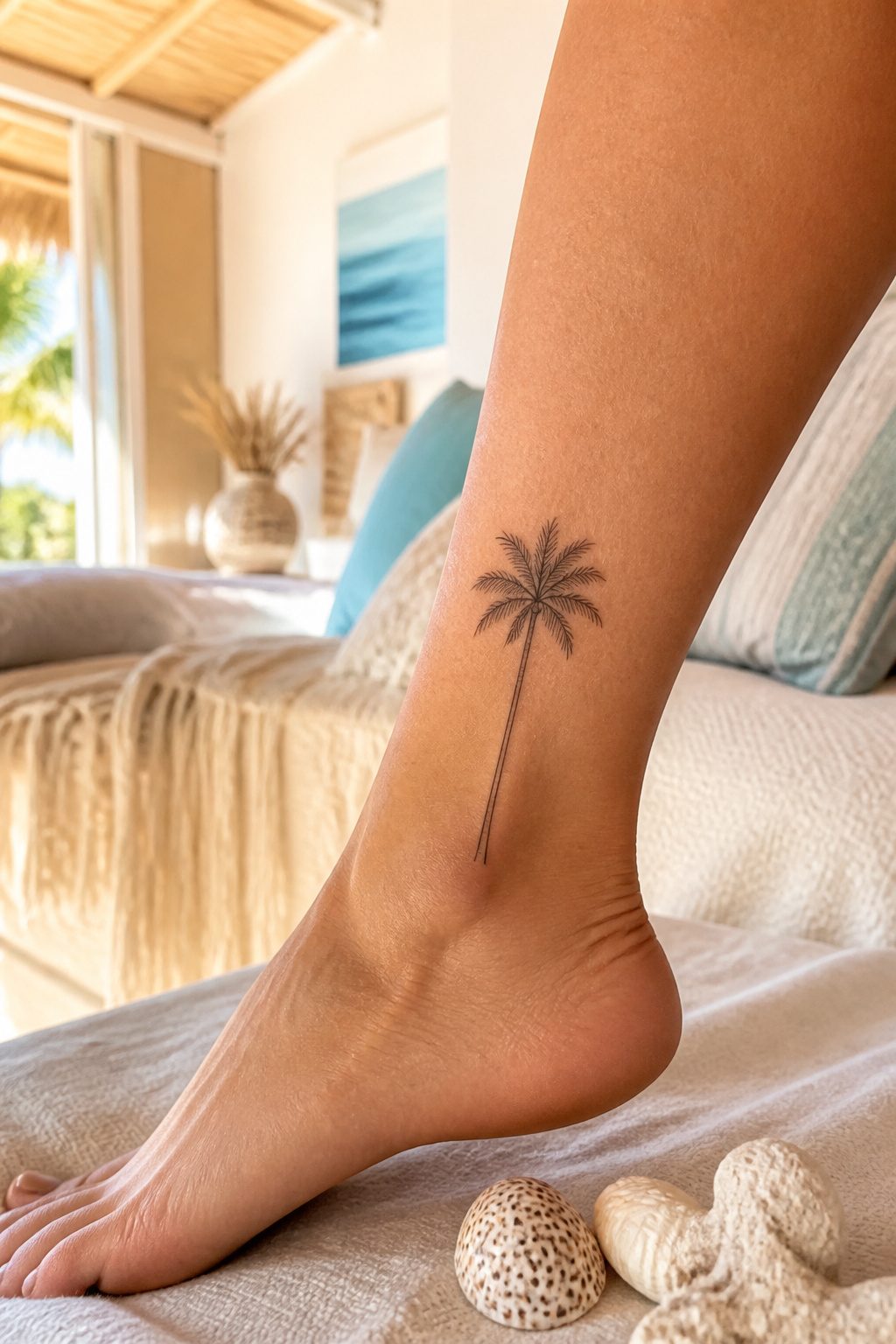
A single slender palm tree running up the outer ankle carries its weight in a way few other designs manage. The vertical trunk mirrors the bone’s natural line, so the tattoo reads as an extension of the body rather than a sticker placed on top. I’ve seen these work best in fine line, sometimes with a pair of palms framing the ankle like a doorway, more often as one quiet silhouette.
The appeal is specific: tropical travel without the souvenir-shop bluntness. What keeps it from looking like a spring-break cliché is the restraint in shading. Heavy black fill kills the airy feeling that makes a palm tree read as breeze and distance. Minimal linework keeps the mood intact, letting the negative space do the cooling-off work.
Placement matters more than size here. Too low toward the foot and the trunk bends awkwardly at the ankle bone; too high and it competes with the calf muscle’s curve. The sweet spot sits where the ankle’s narrowest point meets the beginning of the leg’s vertical rise, about two fingers above the malleolus. From there the eye travels up naturally, which is the whole point of choosing this design over a busier tropical scene.
13. Rosary Ankle Tattoo
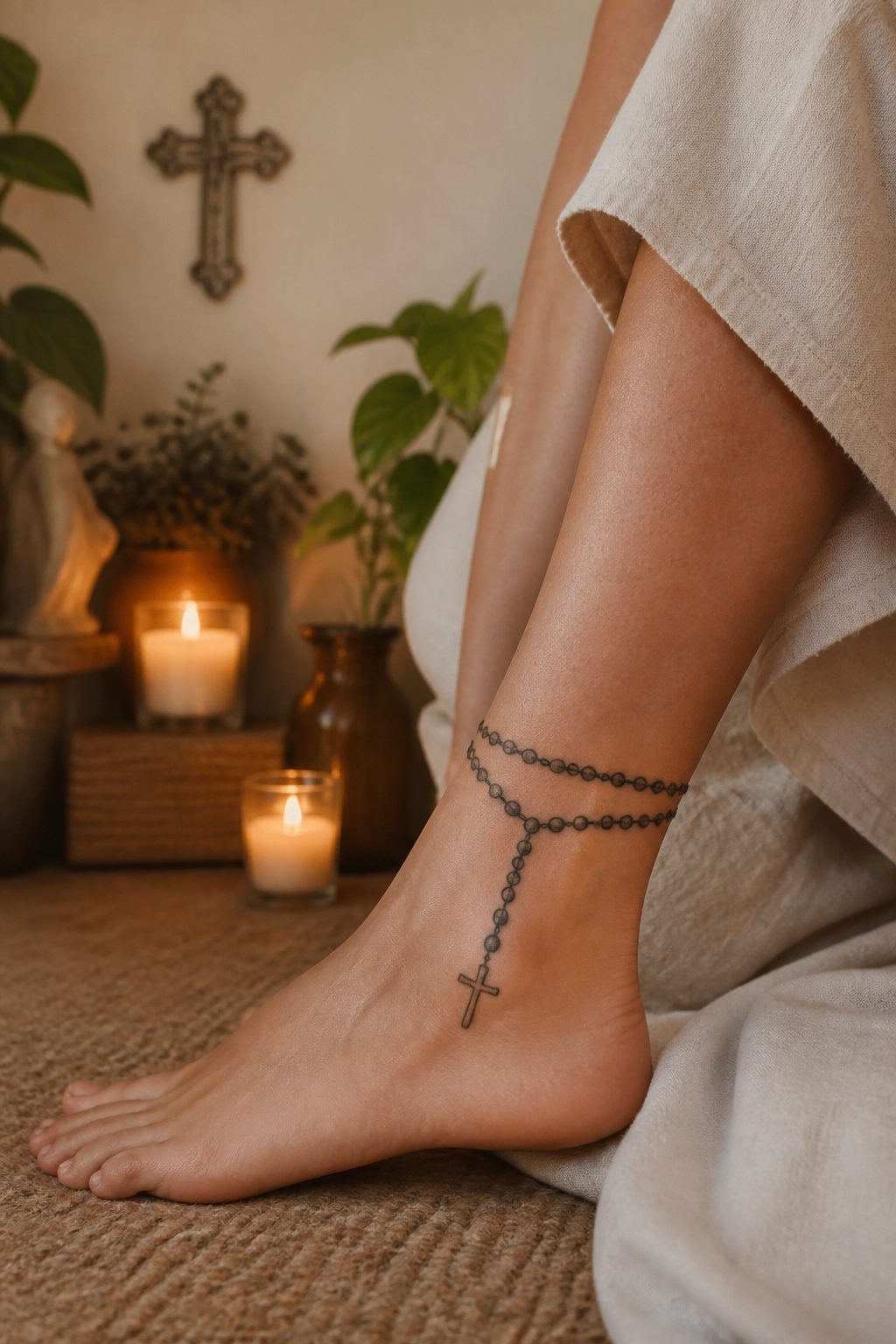
A rosary wrapped around the ankle lives or dies on bead size. Each bead has to carry enough weight to read as a separate sphere at small scale, or the whole chain collapses into a muddy line. I have seen artists solve this by leaving slightly more skin between dots than the dot itself occupies, letting negative space do the defining.
The cross at the end changes the math. Hanging straight down toward the foot, it becomes a focal point that moves with every step. That motion is half the appeal, and half the risk: a cross too heavy on detail will blur inside a year of socks and shoes rubbing the area. The smarter versions keep the cross simple, even abstract, and let the beads carry the ornament.
Faith is the usual reason for booking this design, but the jewelry mimicry works on its own. A rosary reads as an anklet whether the wearer means it devotionally or not. The distinction shows up in how the chain terminates: a plain clasp suggests accessory; a cross, even a small one, signals prayer.
Dotwork handles the beads cleanly, but only if the artist has steady enough spacing to keep the circle round. The ankle bone complicates this. The chain has to flex over a joint that shifts with every step, so wrapping directly around the narrowest part of the ankle usually ages better than draping across the bone itself.
14. Cool Ankle Tattoos
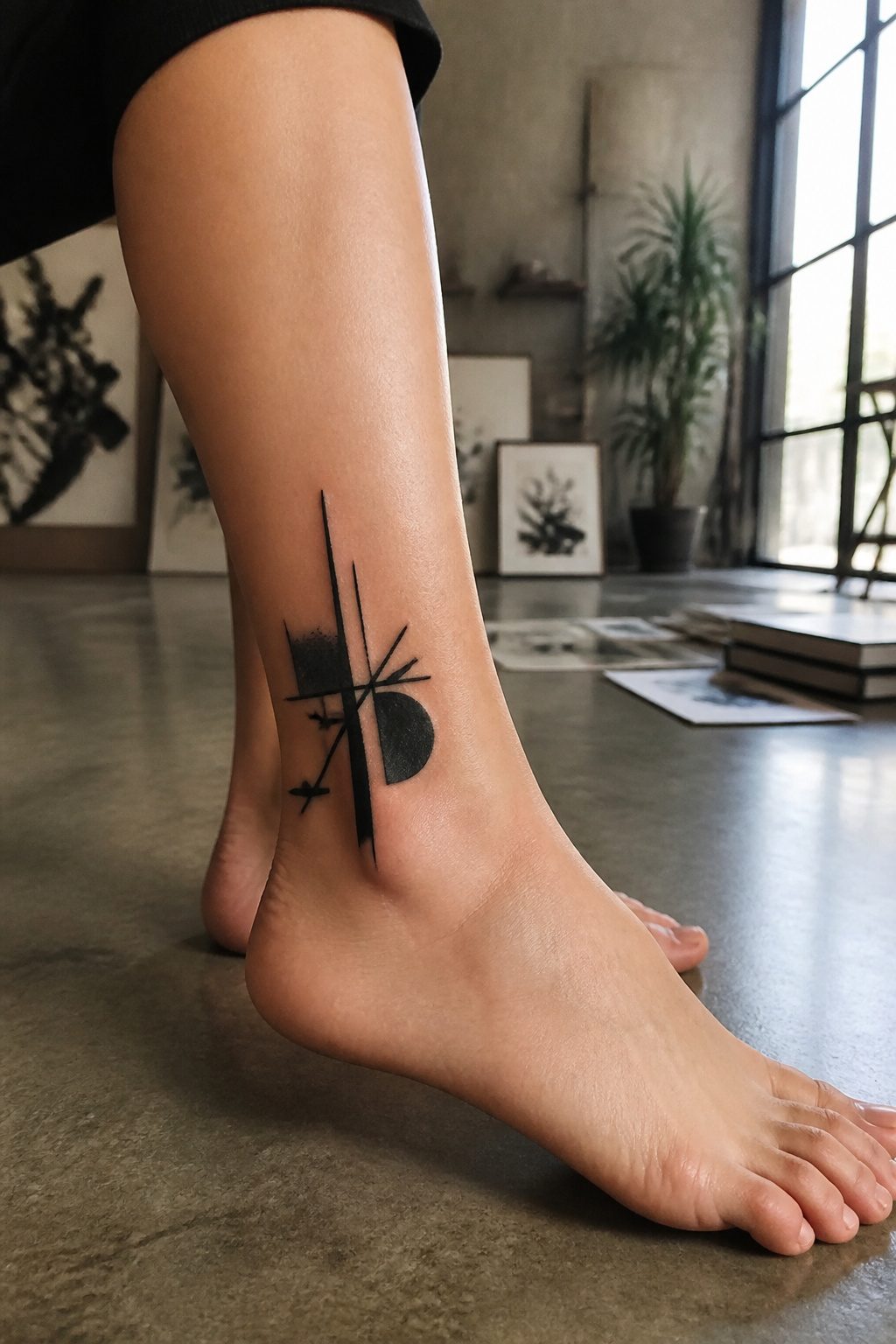
The outer ankle’s flat bone structure carries heavier ink better than the inner curve, which is why bold blackwork and graphic pieces settle there. A dagger or skull rendered in solid fill and thick lines keeps its edges for years where fine linework would feather into the skin’s natural grain. Geometric patterns and tribal motifs work especially well in this zone; the eye reads them clearly from across a room, and they do not depend on the viewer noticing a tiny detail to land.
Abstract designs gain something from the ankle’s shape rather than fighting it. A blackwork piece that wraps slightly onto the top of the foot follows the body’s line instead of sitting like a sticker. The tradeoff is commitment: these styles read as deliberate and loud in a way a small symbol does not. For anyone whose daily routine already includes visible footwear, that visibility is the point. Heavier line weights are not optional here; they are what keeps the design from blurring into a gray smudge by year five.
15. Ankle Scar Tattoo
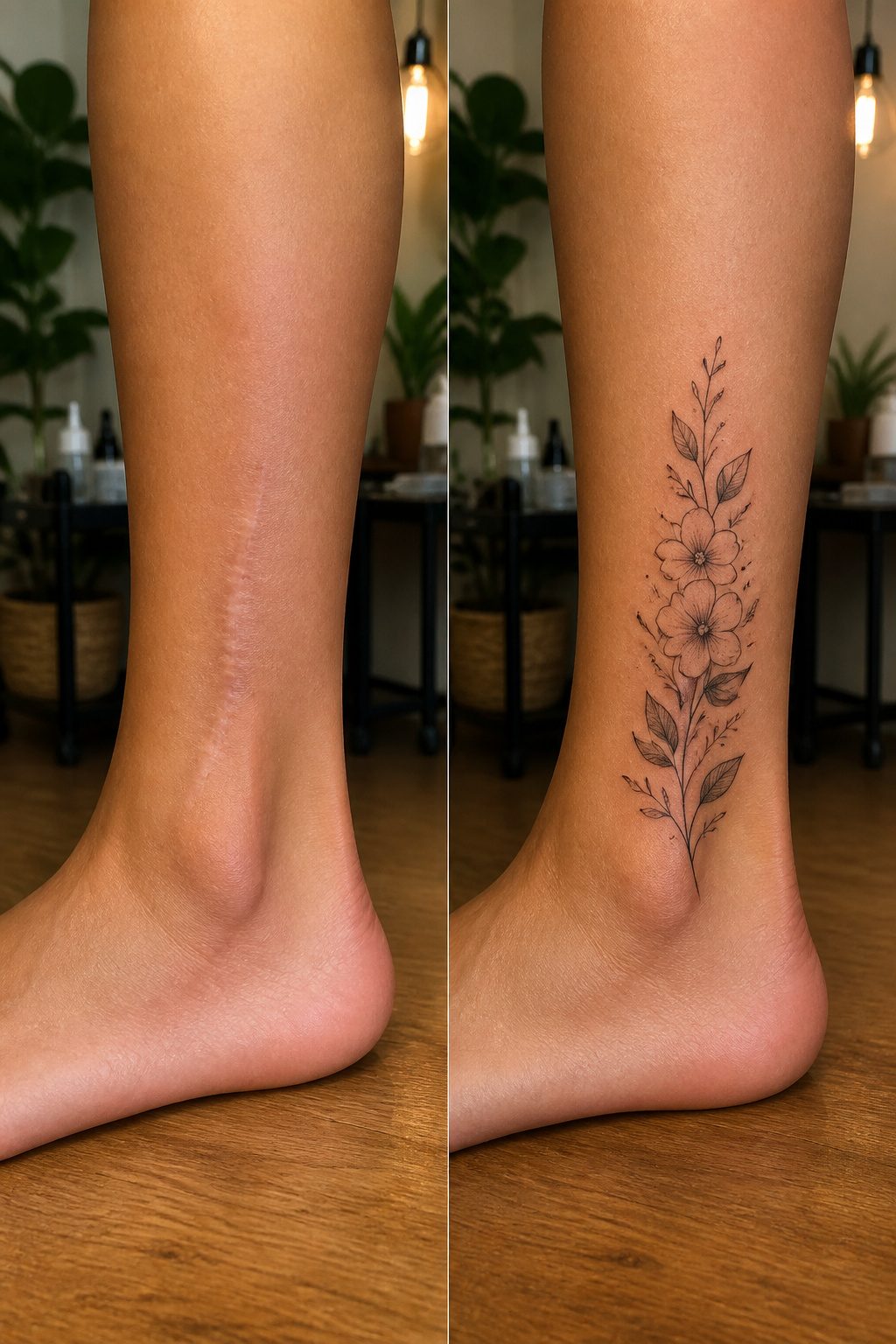
Scarred ankle skin holds ink differently, and most artists figure that out the hard way. A small test patch a few inches above the worst tissue lets you see how the pigment settles before committing to a full design. The texture matters more than the image itself: raised surgical lines, the smoother surface of an old burn, or the irregular map of self-harm scars each pull color their own way. Some saturation stays patchy no matter how skilled the hand.
I have watched this work two ways in consultation notes. One path surrounds the mark, letting the scar read as negative space inside a flower or glyph, a deliberate part of the composition rather than something masked. The other buries it under dense, colorful fill, though that demands more passes and the skin may not take every layer evenly. The transformation is what people return for, not the particular vine or geometric band they chose. A woman I spoke with said her surgical scar stopped being the first thing she noticed about her own ankle roughly three healing weeks in, when the swelling dropped and the new line work drew her eye elsewhere.
16. Ankle Cross Tattoo
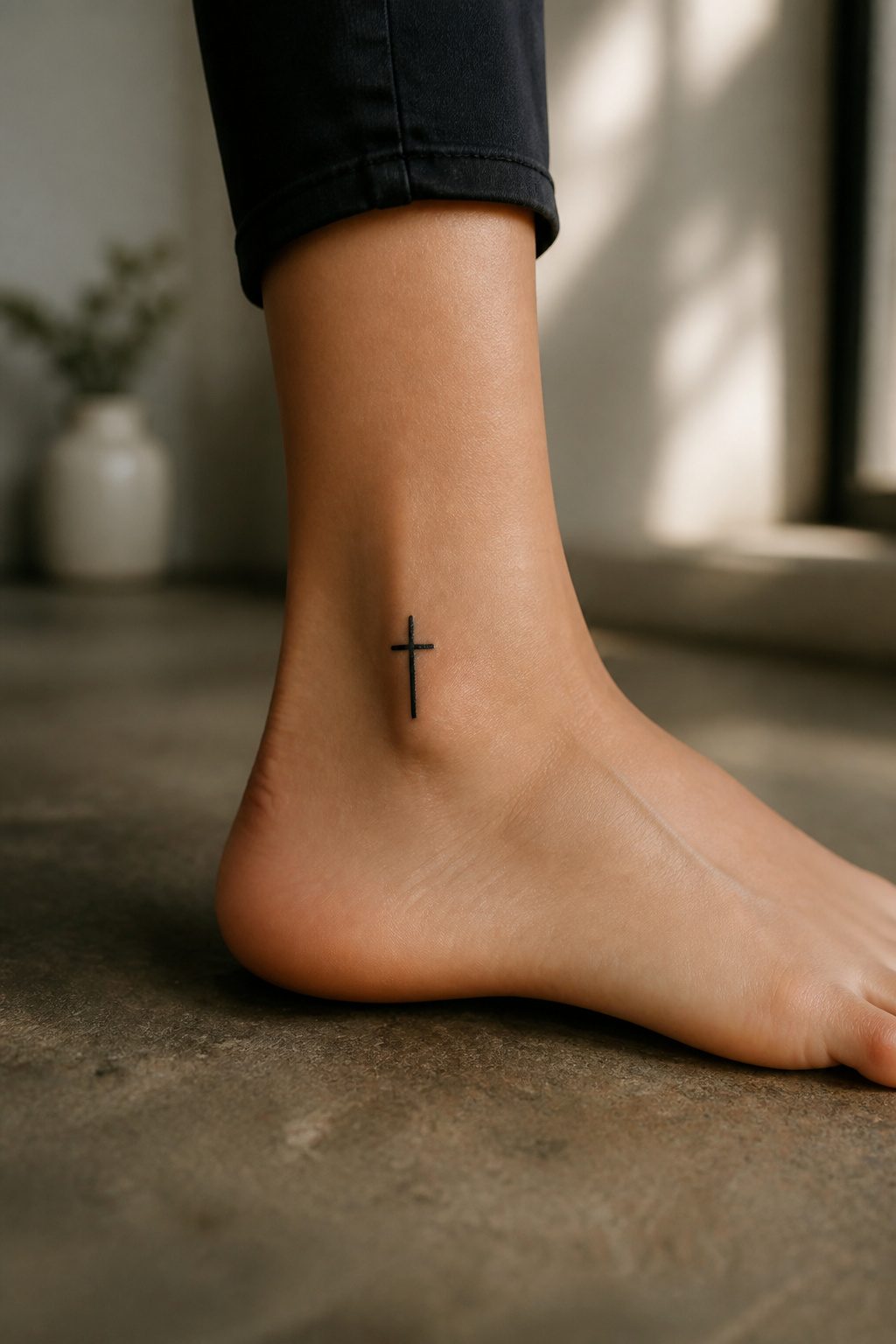
Crosses on the ankle work because the shape already wants to run vertical. The inner ankle keeps the piece hidden under socks and most shoes, visible only barefoot or in flat sandals. That placement reads private, almost intimate. The outer ankle does the opposite: it frames the bone and draws the eye along the leg’s line.
Most requests run small. A simple Latin cross without filigree sits clean at an inch or two, though some add a name and date underneath to mark loss. The cross itself signals faith, but the addition turns it into memorial work. Filigree or knotwork can push the piece toward ornate, though the ankle’s real estate limits how far that goes.
The back of the ankle offers a third option, one I see chosen more often by women who want the tattoo to appear when they walk away, like a hidden signature. Each placement carries its own logic. The inner ankle wins for discretion, the outer for display, and the back for that half-reveal that only certain moments trigger.
17. Wrap Around Mandala Ankle Tattoo
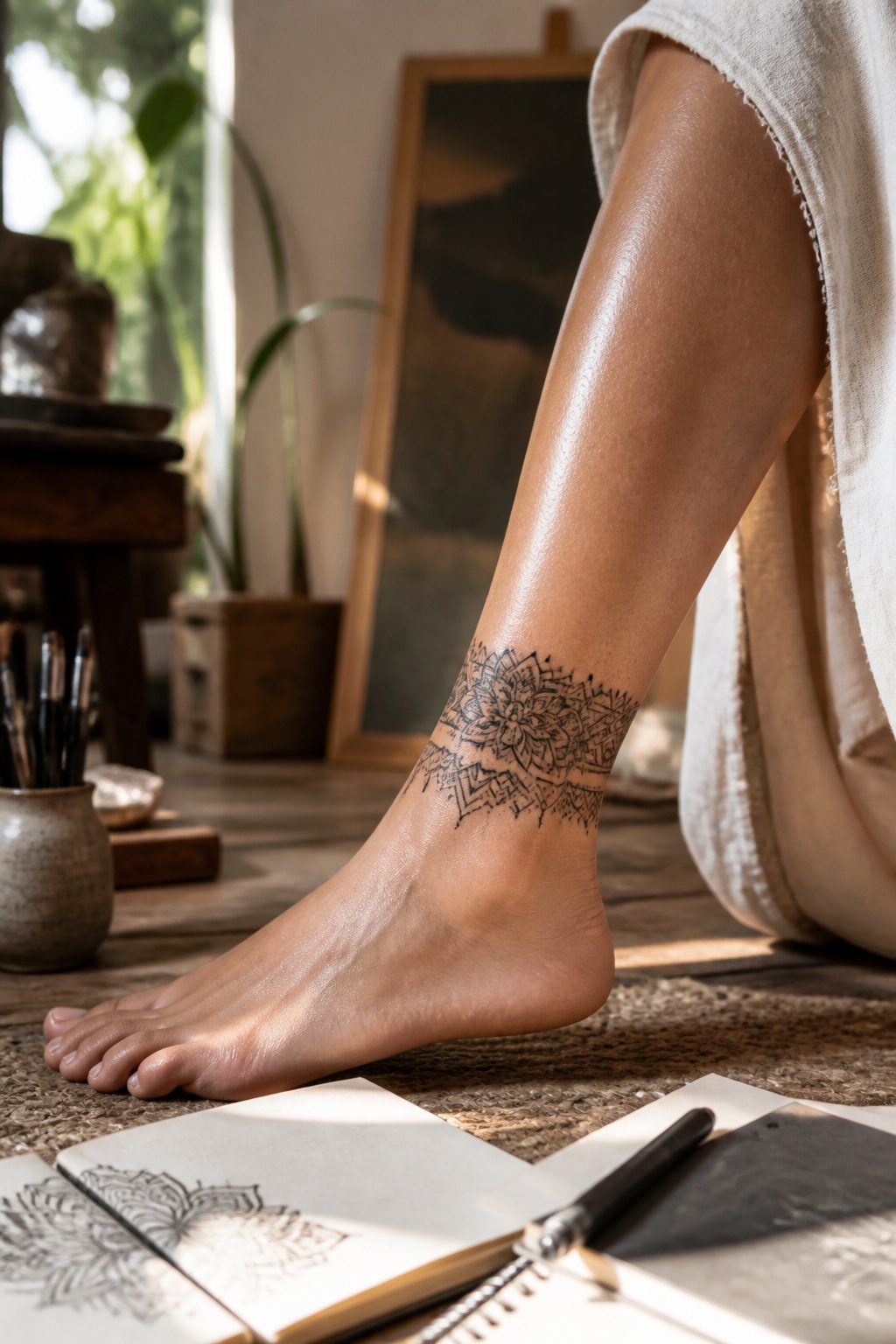
Circular geometry sits naturally on the ankle’s ring-shaped form. A mandala design wraps the bone as a $200 to $400 piece minimum, and that price point reflects what the work actually demands. The precision of line weight and spacing around the curve means either the artist has the control or the tattoo ages badly; there is no middle ground where a bargain version holds up.
The symbolism of wholeness and balance maps cleanly onto the ankle’s structure. What convinced me, reading through the available guidance, is that the mandala’s center can sit at the front of the ankle with the pattern radiating backward, or the whole composition can circle the bone like an ornamental band. Either way, the ankle’s shape becomes part of the design logic rather than a surface the image is simply applied to.
This is not a quick session. The detail level that makes a mandala readable at wrist size becomes harder to execute around the ankle’s tighter radius and thinner skin. Dotwork chains and minimalist bands may follow the same curve, but the mandala’s filled geometry requires steady passes and a steady hand.
18. Dragon Ankle Tattoo
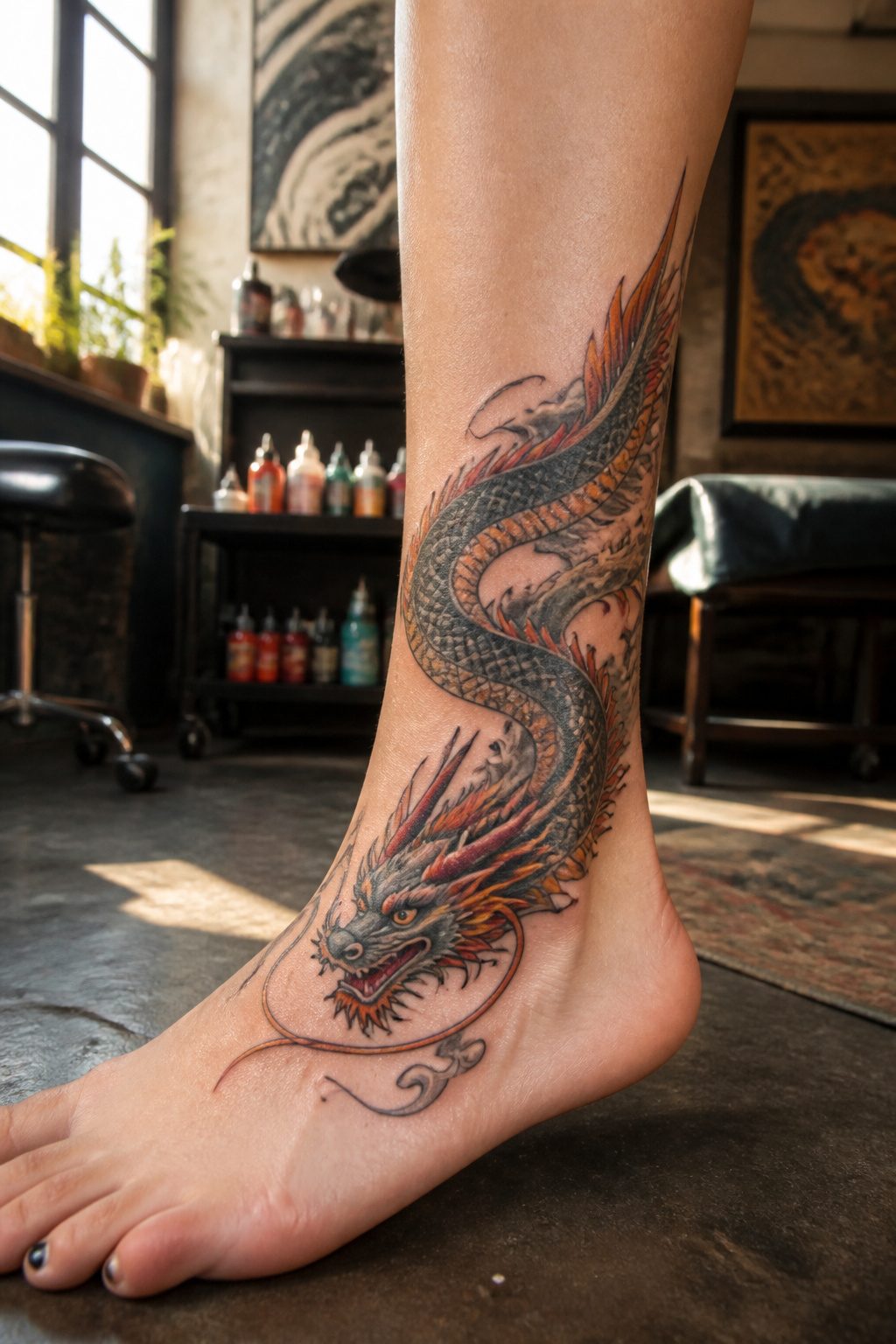
The serpentine curve of a dragon’s body is one of the few large motifs that actually cooperates with the ankle’s length. Asian dragons wind upward from the foot in a single coil or climb toward the calf in multiple loops, their scales and whiskers filling the narrow vertical space without looking squeezed. Western dragons read differently: the same body shape carries more aggressive weight, wings and claws spread wider, so the design usually stays smaller or wraps tighter to keep the proportions sane.
Color changes the cultural signal completely. A red dragon with flowing lines keeps the Eastern association with good fortune and protection; black and gray ink shifts the same shape toward a Western reading, more fire-and-scale menace than guardian spirit. I’ve watched clients wrestle with this choice for years. The ones who want the piece to feel like heritage lean toward color; the ones who want graphic impact go monochrome.
The wrap-around placement matters for longevity. The ankle bone and Achilles tendon shift constantly, so a dragon climbing the inside of the leg will age softer than one coiled across the back where the skin stretches less. A single coil around the narrowest point, just above the bone, holds detail better than a design that tries to cross both the joint and the foot; the foot creases too much and the line work blurs within a few years.
Small coiled dragons work as standalone ankle pieces. Larger designs that extend toward the calf need more planning; the body has to scale correctly as it leaves the narrow ankle, or the dragon looks like it swallowed something halfway up the leg.
19. Charm Anklet Tattoo
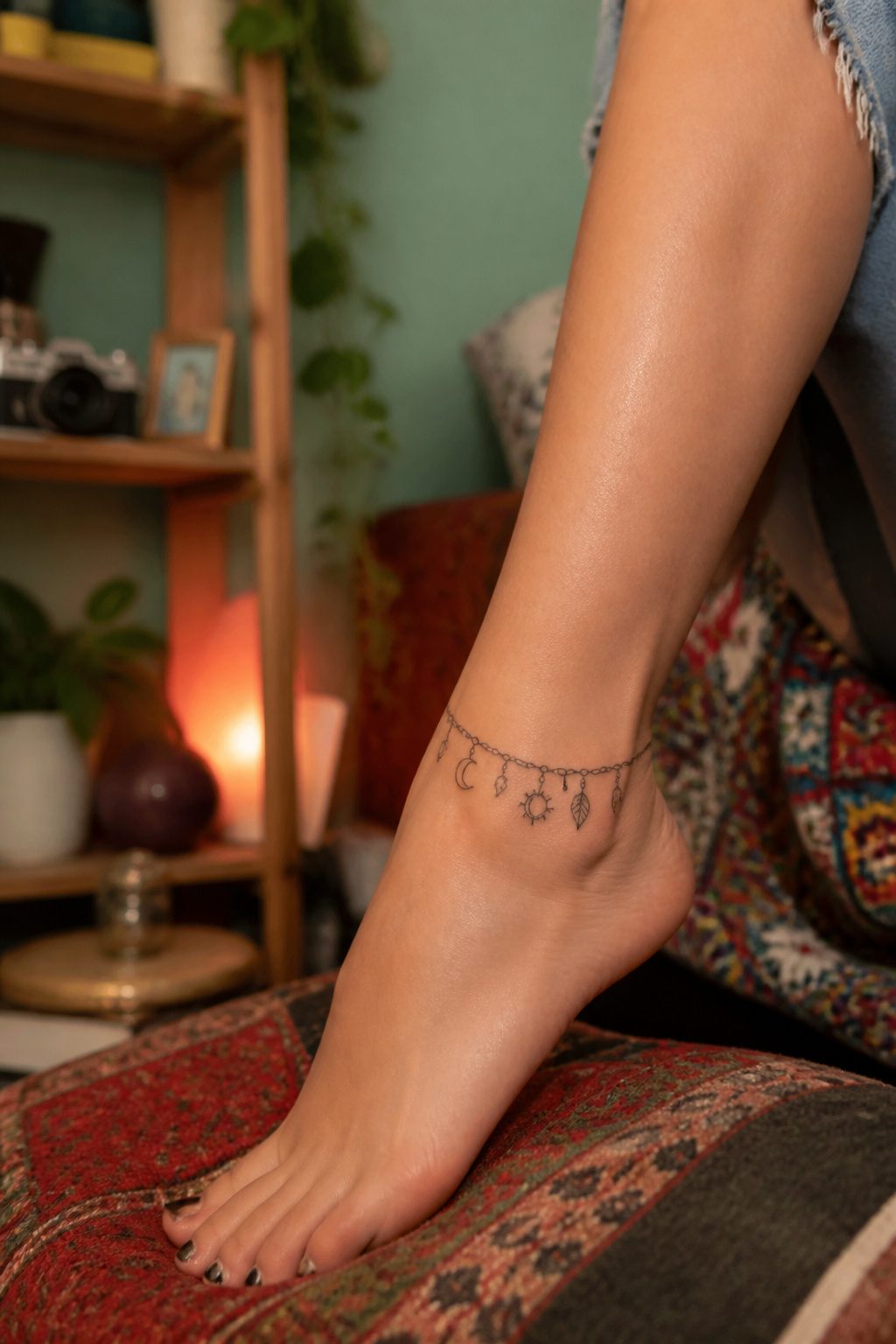
A charm anklet tattoo lives or dies on how the pieces read at every angle. The chain itself wraps the ankle, but the dangling elements, hearts, stars, letters, tiny objects, those shift when you walk and settle when you stop. Plan the resting position first: a charm that hangs straight down when your foot is flat might swing to the side when you step, distorting the shape or tangling visually with the next charm.
Spacing matters more than in a real bracelet. Skin stretches and the ankle narrows toward the Achilles, so a cluster that looks balanced on paper can bunch up or leave awkward gaps once applied. The sources mention clovers, stars, and hearts as common choices, and each carries its own weight. A solid heart drops differently than an open star.
The personal meaning is the selling point, but the tattoo artist has to engineer it. Initials or coordinates work best as flat pendants rather than fully rounded charms, since 3D effects flatten on curved skin and age poorly. Single-strand designs hold up cleaner than layered chains, which blur together as the ink settles. If you want motion in the design, build it into the chain links themselves rather than counting on the charms to provide all the movement.
20. Matching Ankle Tattoos
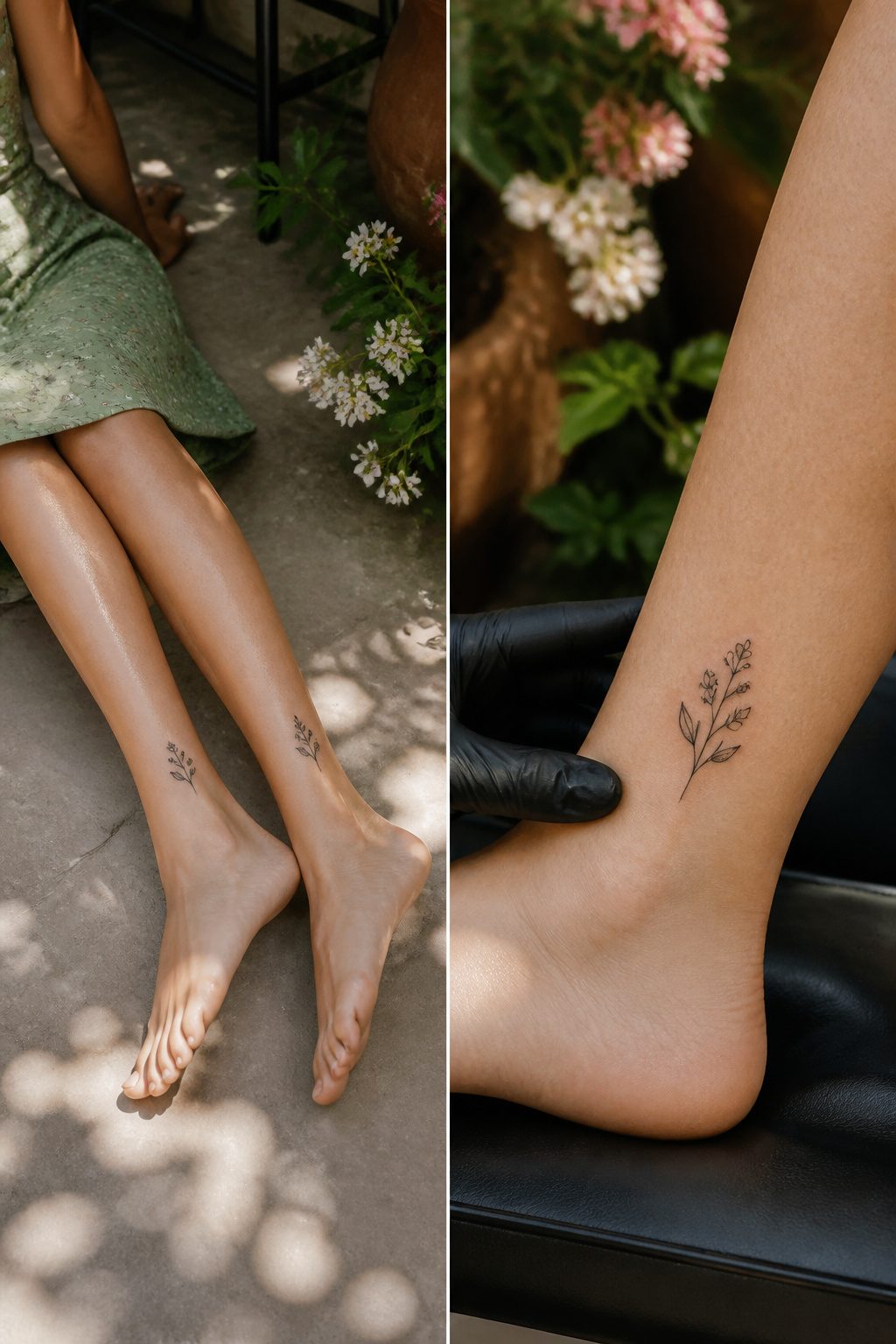
Matching ankle tattoos work best when the design stays simple enough to read from two different angles. A ginkgo leaf, for instance, carries meaning on both sides of a pair without needing to wrap the ankle or compete with bone. The passages point to small, delicate choices as the ones that hold up here, and that rule tightens further when two people are matching: what looks balanced on your ankle may sit differently on theirs.
The symmetry itself becomes part of the design. Two people walking beside each other catch glimpses of the tattoo at shifting perspectives, so minimalist line work or a single small symbol lands clearer than something busy. Geometric shapes, a short word, or a dainty floral like a daisy or lotus keep the match clean without demanding identical ankle shapes or skin tones.
21. Ankle Wing Tattoo
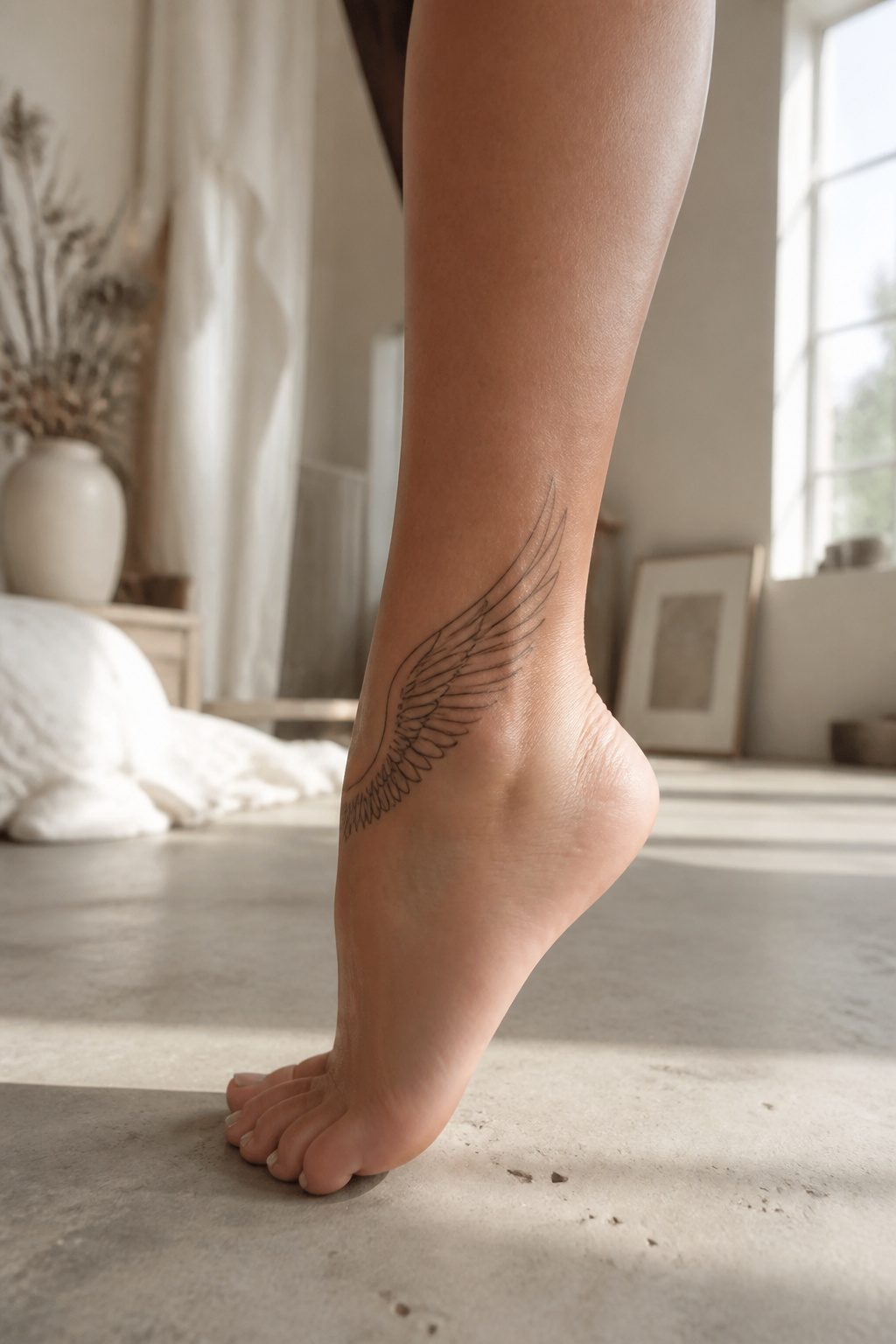
A single wing wrapping one ankle, or a pair spread so the left and right mirror each other, carries the old meaning of Mercury’s Talaria: the winged sandals that let the messenger god move between Earth and the underworld. That history lives on in travel tattoos and memorial pieces for someone who crossed realms before you did.
The feather detail is where ankle wing tattoos fight back. At this scale, individual barbs blur into a muddy stripe within two years. Most experienced artists skip the realism and cut straight to a clean silhouette or a stylized shape that still reads as "wing" from across a room. I have watched portfolios where the bold outline held up at five years and the photorealistic feather work aged into something the client had to explain.
Two ways to play the placement. Center the wing on the outer ankle bone so it shows when you walk, or angle it to trace the Achilles tendon and keep the surprise for when you turn around. The outer placement wins if you want the symbol seen; the tendon angle wins for office environments where the ink stays under a sock until evening.
22. Ankle Cuff Tattoo
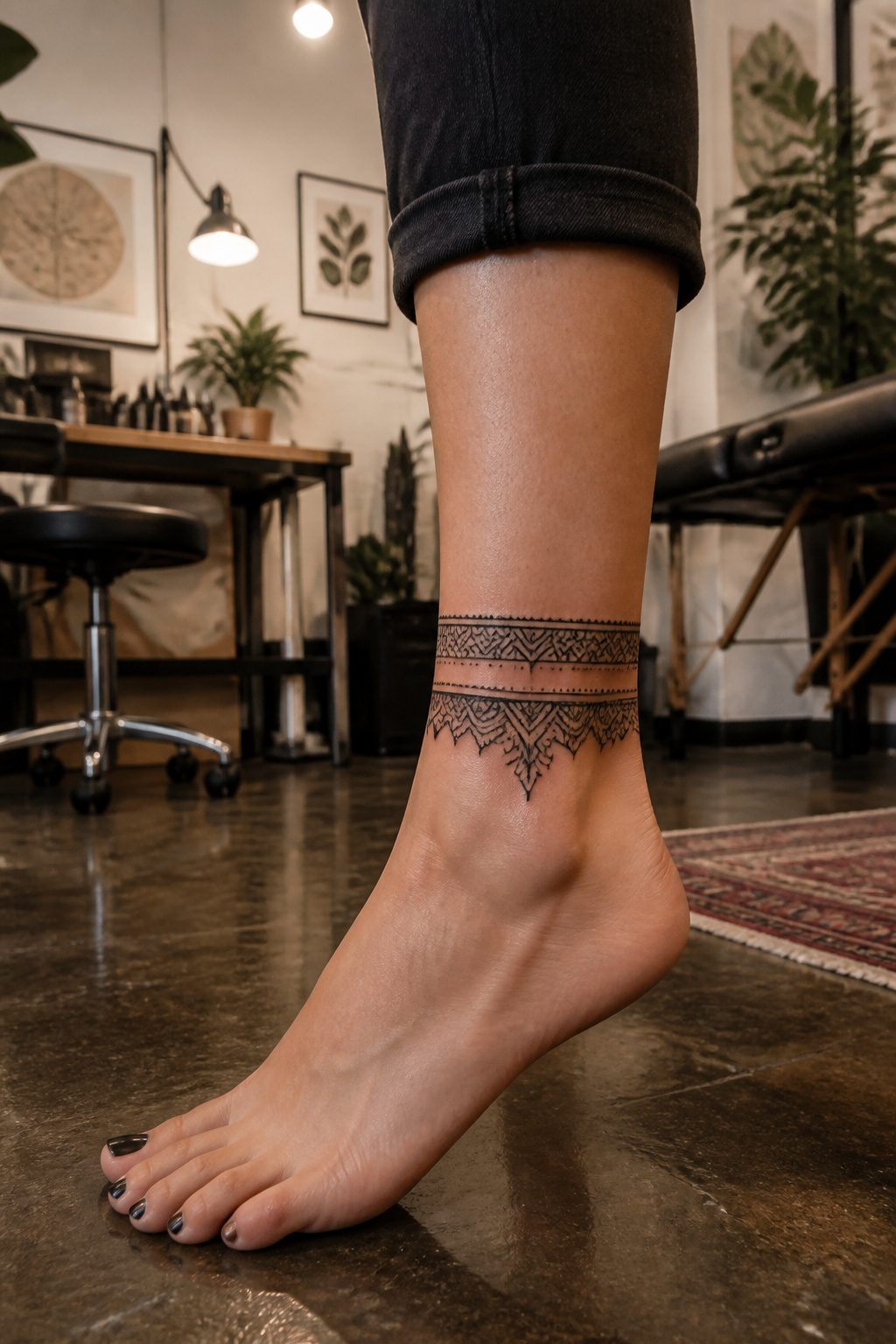
An ankle cuff reads like jewelry from a distance, but the geometry underneath makes it one of the trickier placements to execute. The ankle is not a cylinder; it tapers toward the foot, widens at the calf, and shifts shape when you walk. A band that looks even while sitting distorts into a wobble the moment you stand. The tattoo has to be designed while you are standing, with the artist measuring how the skin stretches across the tendon and the bone.
The style range runs from solid blackwork geometry to lace-thin florals that repeat like a pattern. An ornamental band with detailed flowers and leaves sits in the $200 to $400 range, while something heavier, a mandala or dense geometric fill, pushes toward $400 to $700. Blackwork cuffs carry the visual punch of bold line and solid fill, but the same density also hides unevenness better than a fine-line version, where a millimeter of drift becomes obvious.
What convinced me, reading through the portfolios, is that the best cuffs do not try to be perfectly level all around. They let the design break or thicken at the Achilles, where the ankle narrows most, so the eye reads continuity instead of measuring a ring. Color is an option, though a broad band of uncolored skin left inside the pattern, as some artists do, keeps the weight from looking like a sock.
23. Lotus Ankle Tattoo
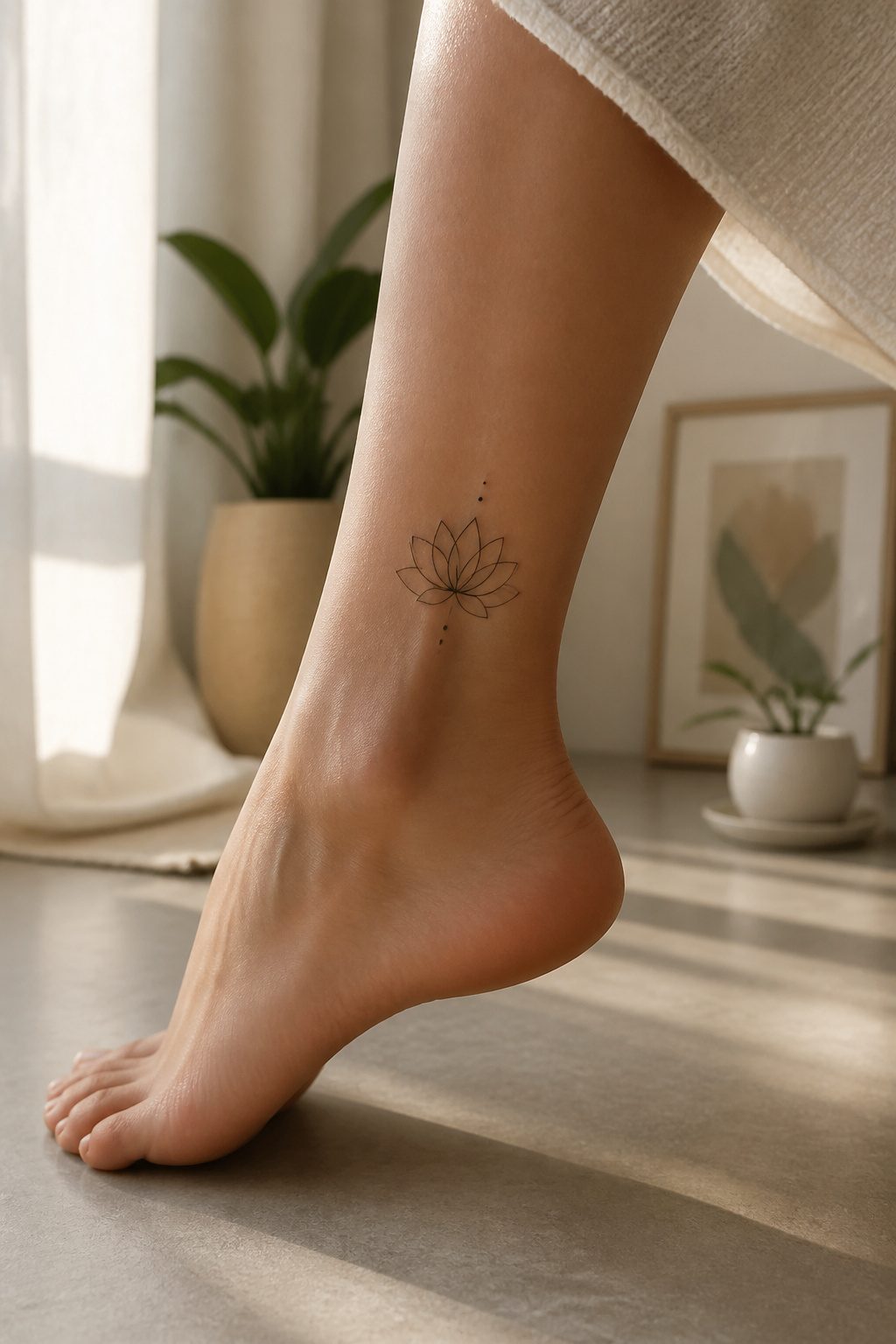
The lotus flower spends its roots in mud and still pushes a clean bloom above the waterline, a sequence that carries weight across Hindu, Buddhist, and Egyptian iconography. That layered meaning packs into an ankle’s limited real estate only when the petals are simplified, stripped to their readable silhouette rather than botanically charted. A three-petal read from the side, or a top-down rosette of five, keeps the symbol legible at the scale the ankle allows.
Color or black and gray both hold. A soft pink or muted blue can read feminine without drifting decorative, while single-needle black work lets the geometry of the overlapping layers do the lifting. The ankle’s curve matters: a lotus facing upward toward the knee reads as ascent, downward toward the foot as rootedness, and sideways along the bone as travel or transition. The placement changes the meaning without changing the design, which is part of what makes the motif durable. In my own drafting, the lotus is one of the few symbols where I will place the face of the flower in any direction the skin and the story ask for; most imagery fights the anatomy harder.
24. Turtle Ankle Tattoo
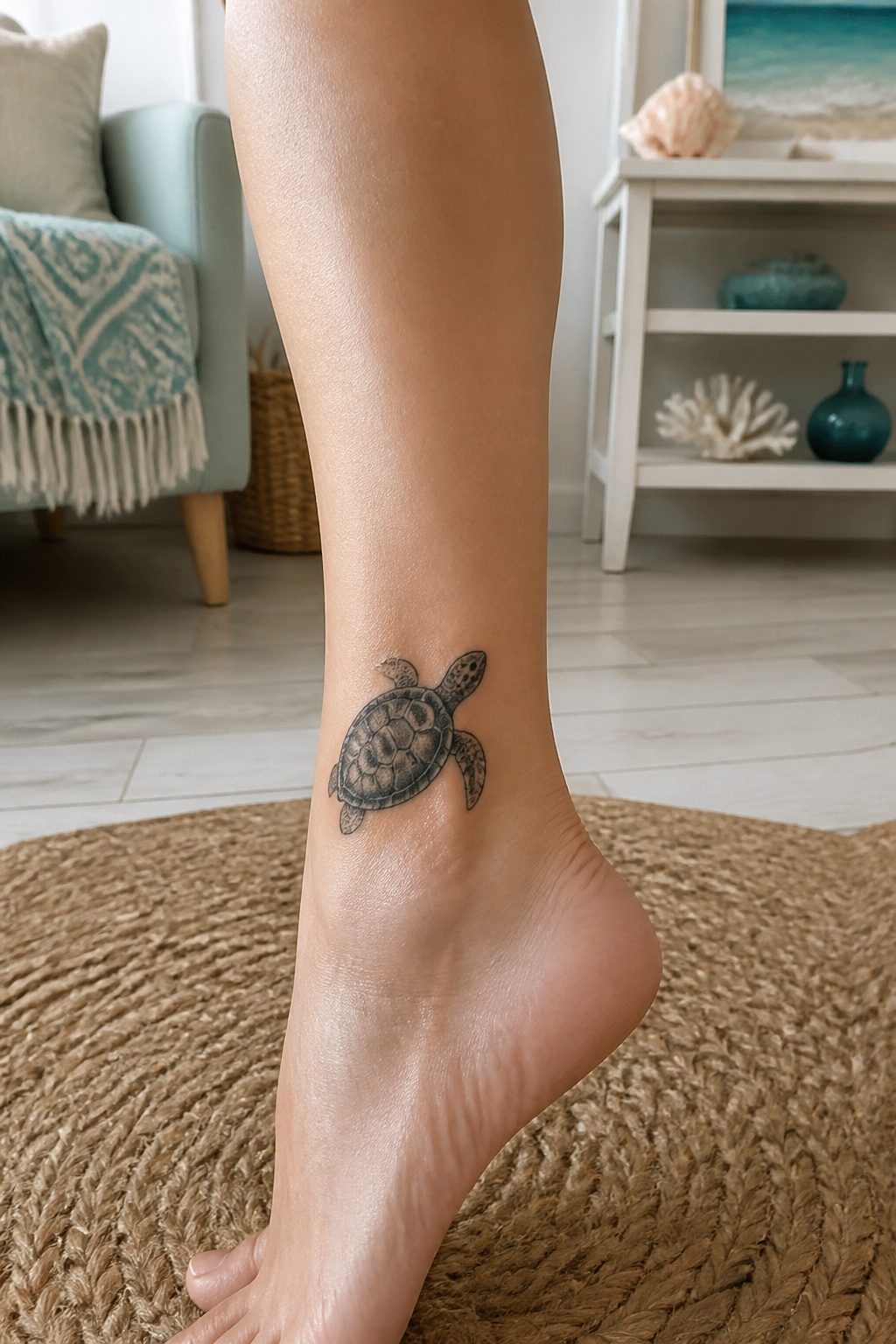
Sea turtles carry a meaning that lands differently from flashier ankle tattoos. The shell’s hexagonal pattern builds itself into natural geometry without the artist having to force symmetry, and the animal itself reads as patience made visible. A small turtle tucked on the inner ankle stays hidden until sandals come off, which suits anyone who wants the tattoo personal rather than public. That placement also plays to the shape: the curve of a turtle’s shell follows the slight convex of the inner ankle bone in a way that feels settled rather than squeezed.
Larger designs need more room to breathe. Water bubbles, seaweed, or coral framing the turtle can extend the piece toward the foot or up the calf, turning a single figure into a scene. The tradeoff is commitment. A lone turtle two inches across takes under an hour and heals cleanly with minimal aftercare fuss. Add a full underwater backdrop and you are looking at multiple sessions, more expense, and the reality that ankle skin moves constantly with every step. Color saturation on the lower leg also fades faster than work higher up the body, something to weigh before choosing the elaborate route.
Tortoises work too, though they read more landlocked and steadied. The shell pattern stays the same visual hook. Either way, the turtle’s meaning, longevity, endurance, a quiet kind of strength, holds up without requiring explanation. That matters for a tattoo you will explain to strangers less often than you think, but live with every morning.
25. Cherry Blossom Ankle Tattoo
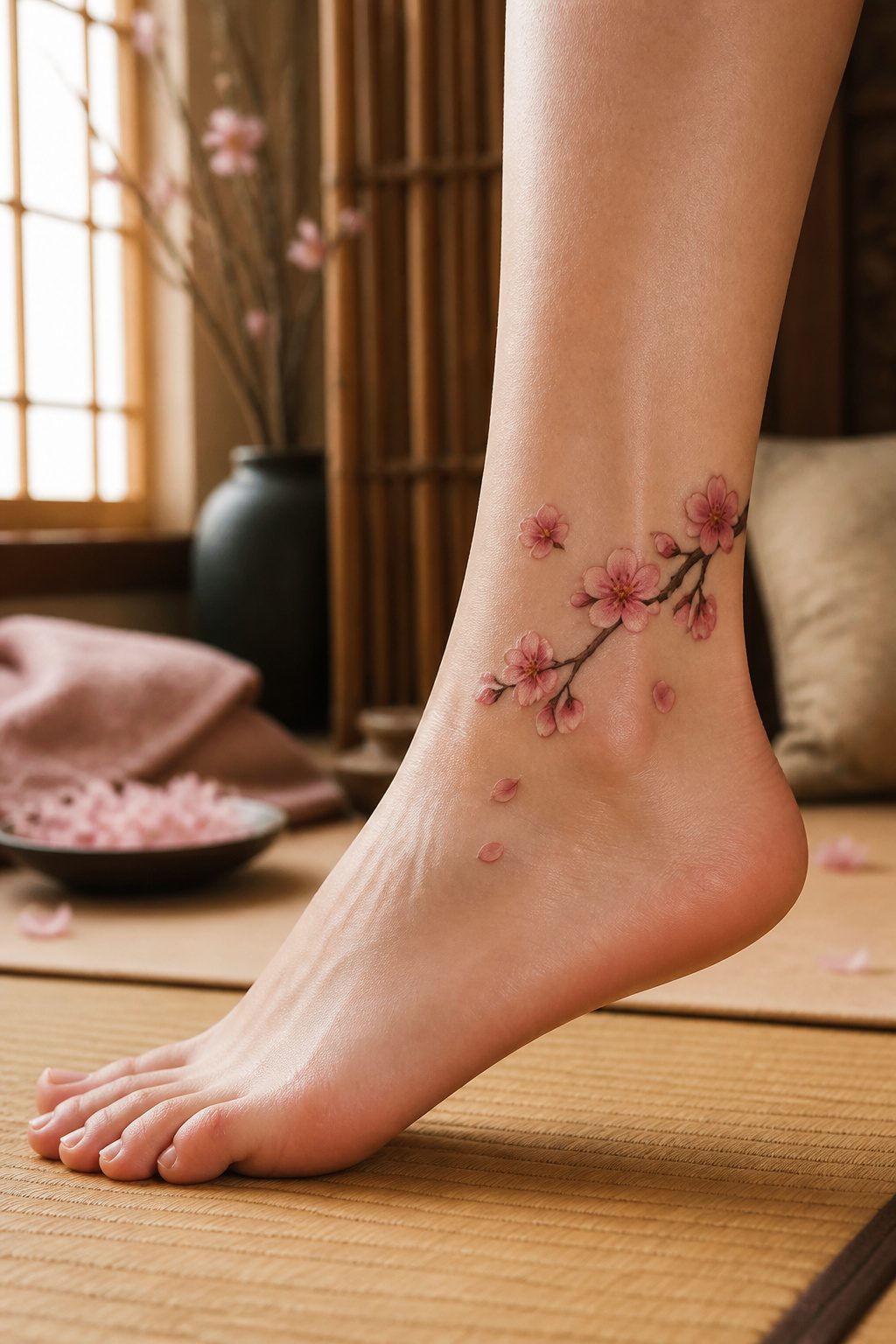
Cherry blossom branches work especially well around the ankle because the curve of the bone gives the trailing stem a natural place to land. The pink ink carries a specific cost: fades faster than black, with touch-ups commonly needed within two to three years. Friction from shoes and socks speeds that fading at the Achilles tendon and ankle bone, the same contact zones that wear on any design in that spot.
The Japanese association with impermanence suits the medium more than most floral choices. Brief-blooming sakura already means something about not lasting, so a tattoo that softens and settles with age reads as intentional rather than neglected. That said, going minimal on the pink saturation buys you time. A branch concentrated near the bone with lighter petal density keeps the shape readable longer than a dense wrap-around with full color saturation.
Ankle placement keeps the symbolism visible when you want it and hidden when socks cover it, which matters for a design some employers still read as ornamental rather than serious. The tradeoff is the maintenance schedule. SPF 50 on the area daily slows fading, but the two-to-three-year touch-up window is typical even with care. Simple line work on the branch structure helps; heavy realism in the petals is where the pink ink disappears fastest.
26. Cat Ankle Tattoo
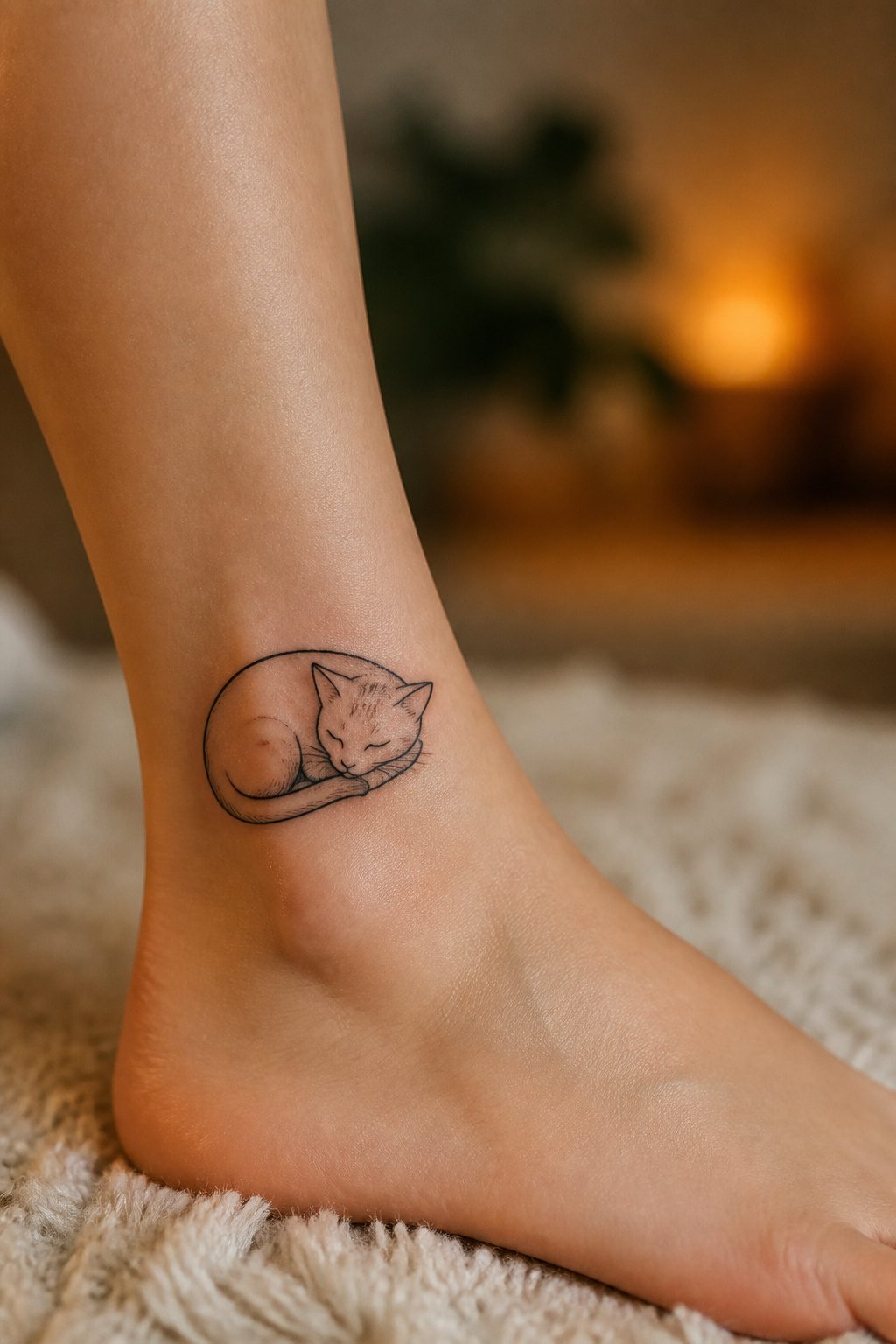
A curled sleeping cat follows the ankle’s curve better than most subjects, and that natural fit is why cat ankle tattoos keep coming up in consultations. The shape lets the artist tuck the head toward the heel and the tail around the outer bone without fighting the body’s geometry.
Realistic portraits work at small scale if the artist builds the fur in layers of single needle work, but the detail takes longer and the skin on the ankle sheds ink faster than the shoulder or back. A stylized silhouette skips those problems, reads clearly from a distance, and ages better on an area that sees sun and friction. Cartoon forms suit clients who want the personality without the weight of a memorial piece.
Cats carry the meaning people project onto them, independence most often, though plenty of owners want a portrait of a specific animal. The ankle keeps it private enough that the symbolism matters more to the wearer than to anyone asking about it.
27. Barbed Wire Ankle Tattoo
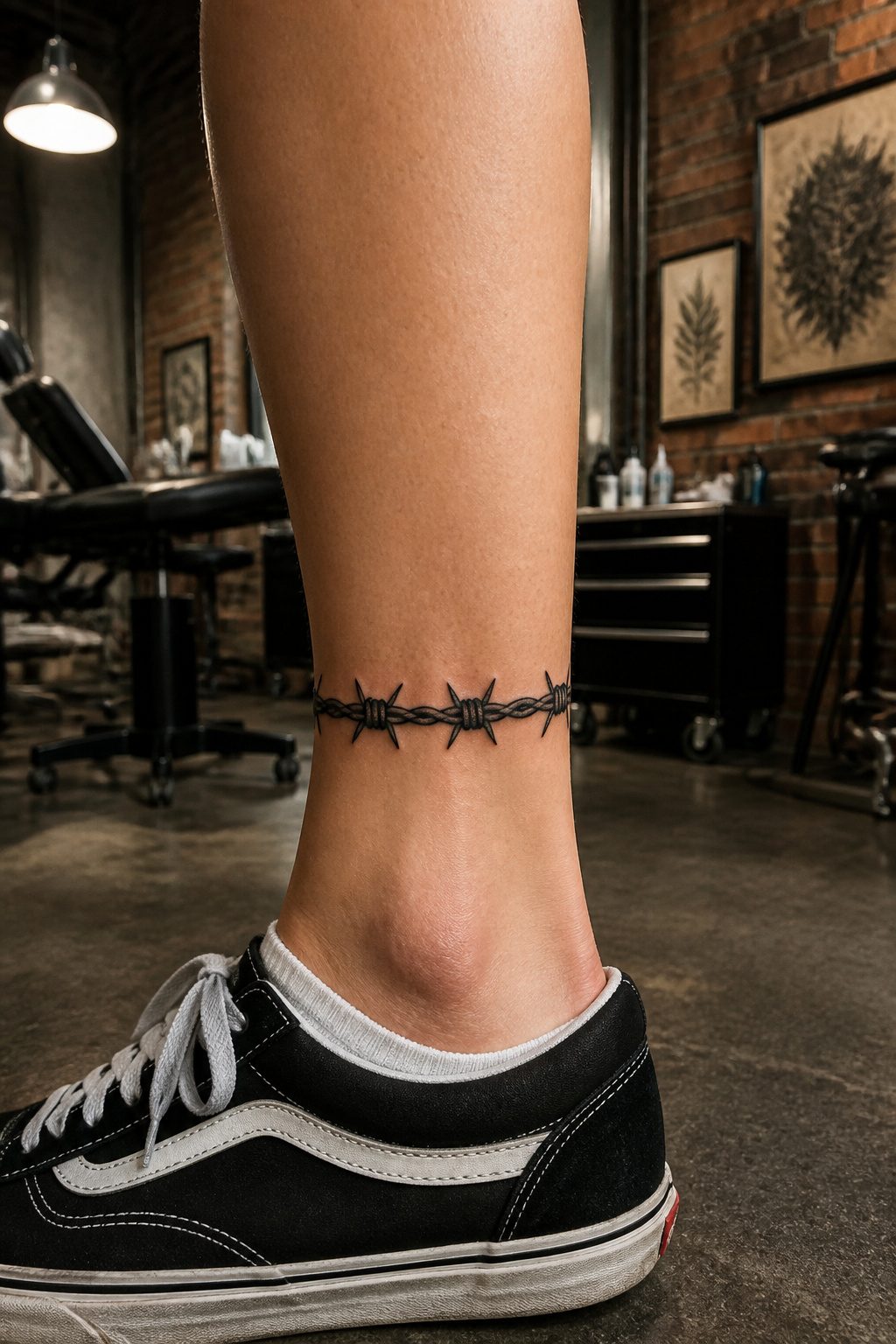
A barbed wire band around the ankle reads differently in 2026 than it did in 1996. Back then it signaled rebellion, prison culture, or Pamela Anderson’s iconic arm band. Now the same imagery gets picked for toughness, protection, or pure 1990s nostalgia. The shift matters because your artist needs to know which story you are telling before the needle touches skin.
The gap between barbs must stay wide enough to read at ankle scale, where skin shifts and blurs fine detail. Too tight, and the wire tangles into a gray smudge within a few years. The best versions space barbs roughly a finger-width apart, letting negative skin do the work of defining each point. Black ink holds up here; gray wash fades faster on the ankle than almost anywhere else.
Placement splits the choice. A full circle reads as a cuff, deliberate and finished. A broken band, stopping at the Achilles, looks more like a scar or a story interrupted. Either works, but the full circle demands more commitment and more pain around the bone.
I have watched this design come back twice now, and the second wave is choosier. The people who want it now know exactly what 1996 looked like, and they want the reference sharp, not sloppy.
28. Mushroom Ankle Tattoo
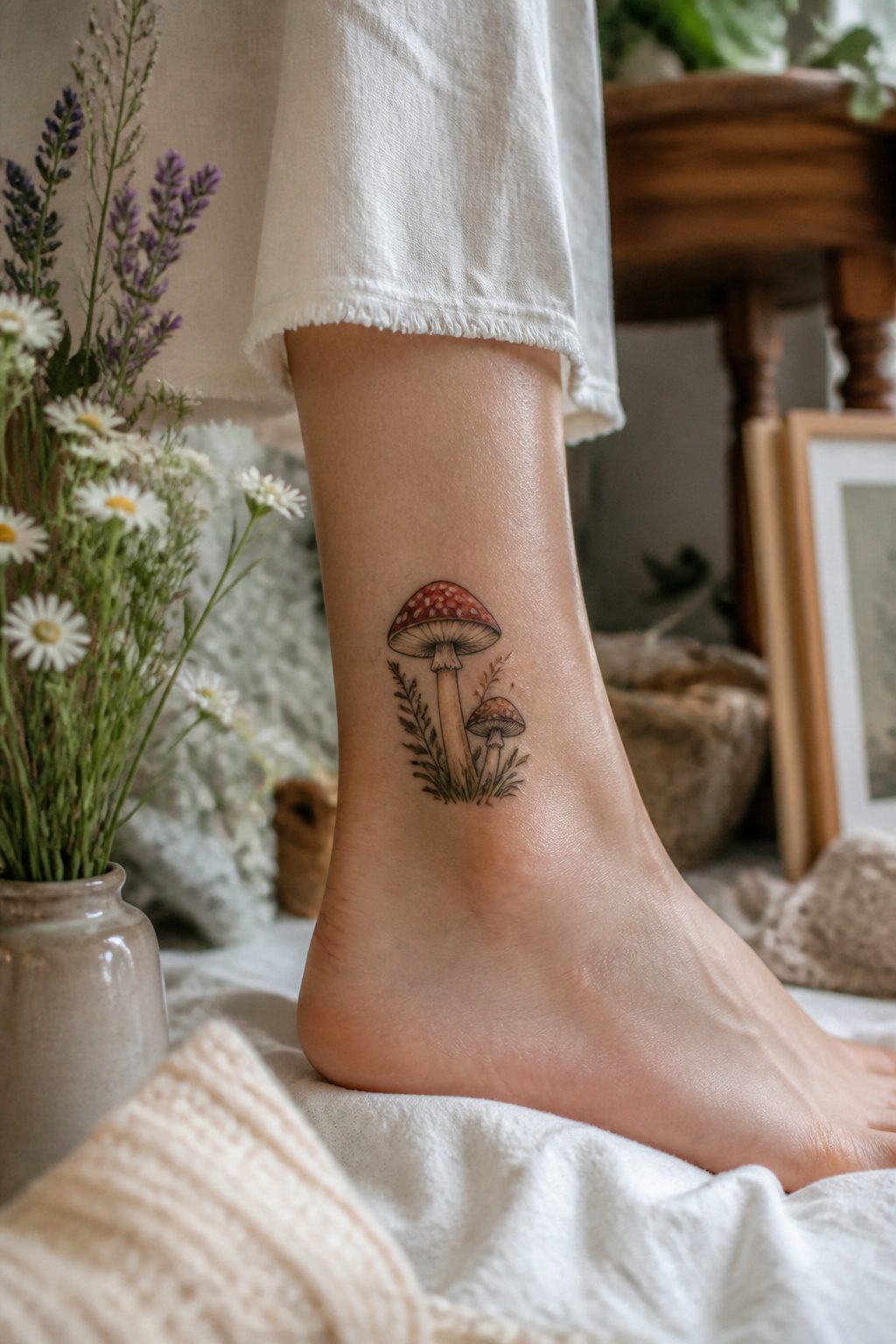
The mushroom shape, stem and cap, suits vertical placement on the inner or outer ankle better than most designs. The stem draws the eye upward along the bone, and the cap can sit just above the ankle’s narrowest point or fan slightly onto the foot. Amanita muscaria, the red-and-white spotted toadstool, shows up most often in this spot, though morels and chanterelles work for anyone wanting something less immediately recognizable.
Pairings matter more here than with other nature motifs. Moss and ferns fill the gaps between multiple mushrooms and soften the edges against bare skin. Fairy lights or a small door cut into the stem push the design toward cottagecore, which is where most of this style’s recent demand has come from. The line weight needs to stay fairly consistent; too fine and the gills under the cap muddy together within a year.
Color heals tricky on the ankle. Red caps fade fastest where socks rub, and the white dots often need touch-ups at twelve to eighteen months. A gray-scale morel with fine root threads ages more gracefully and still reads as botanical rather than generic. Watercolor backgrounds, the mossy greens bleeding out, look fresh for about two years before the blur becomes noticeable. Solid black or limited green and brown holds the shape.
29. Fine Line Ankle Tattoo
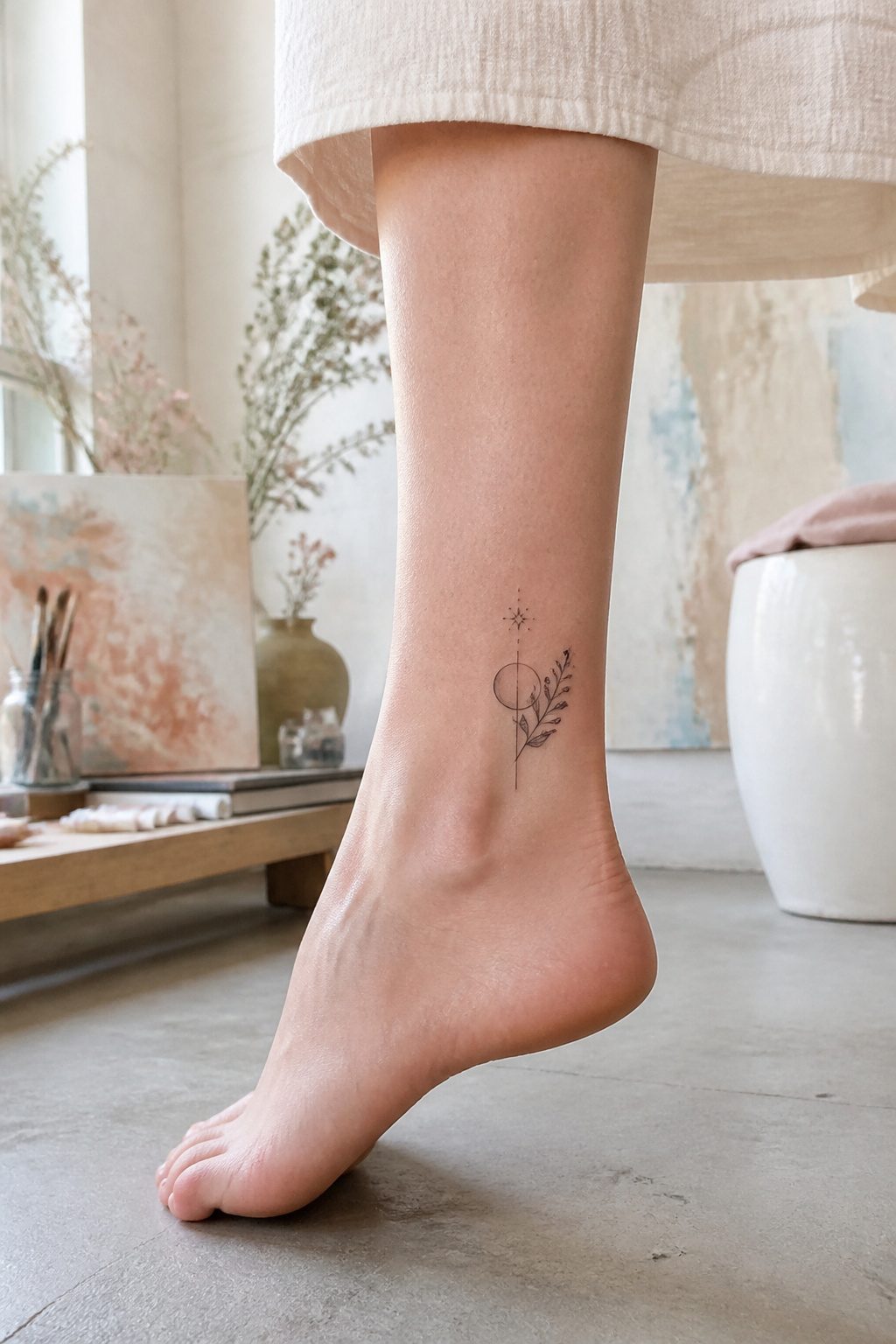
Fine line work lives and dies on skin that stays still. The ankle, thin-skinned and constantly flexing, is where that precision meets its hardest test. Hair-thin single-needle lines can produce something ethereal: a sprig of lavender, a crescent moon, a band of abstract geometry that reads like jewelry drawn in ink. Florals, celestial forms, and minimalist shapes dominate the requests, all of them depending on the same technical gamble.
The risk is not immediate. A line that crisp on day one will blur within five years on this terrain, the ink migrating as the skin ages and moves. Some artists simply refuse the placement, knowing the result their name will outlast. Others will do it but warn first, pricing in the likelihood of a touch-up that rebuilds what gravity and gait dissolve. The ones who take it on without that conversation are the ones to watch for.
If the design matters enough to accept the fade, the payoff is real: nothing else sits so lightly on the body. But the ankle is a commitment to maintenance, not a one-session decision.
30. Daisy Ankle Tattoo
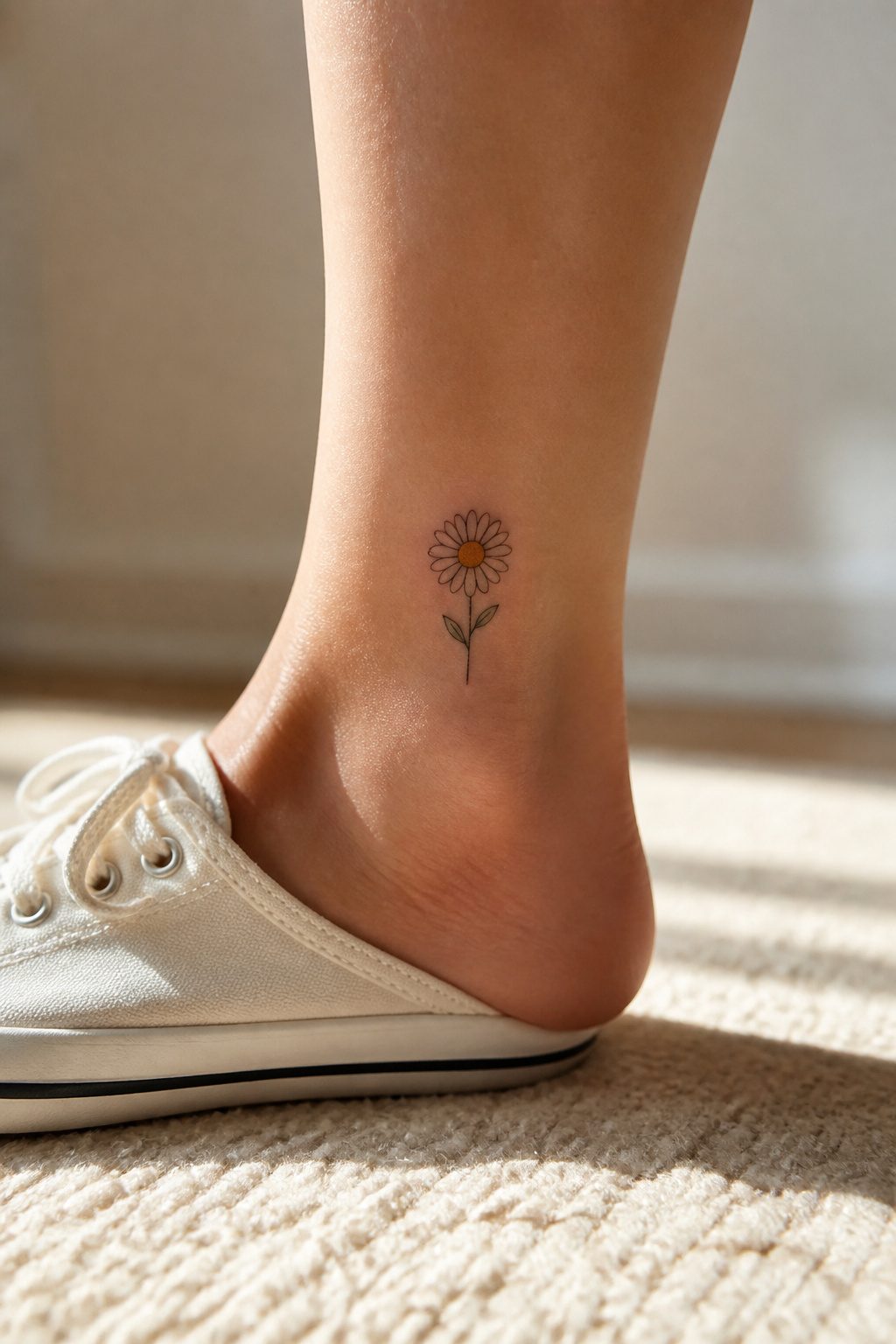
A daisy tattoo on the ankle usually lands as a first piece for people who want something small and readable without the drama of darker imagery. The classic version keeps white petals and a yellow center, though plenty of shops push black-and-gray linework for clients worried about color aging. I have watched this design go wrong most often on two counts: lines that were too fine from the start, and placement too close to the shoe line where friction and sun hit hardest.
The daisy chain variant wrapping the ankle solves some of that by spreading wear across more skin, though it also multiplies the problem if the original linework was shaky. What separates the ten-year pieces from the faded ones tends to be center density. That yellow disk needs enough pigment to hold; washed-out centers turn into pale smudges faster than any petal edge. For a first-timer, the appeal is exactly that it reads as innocent, but the decision to wrap or keep it isolated on the outer ankle changes how it ages and whether future pieces can connect.
31. Ankle Chain Tattoo
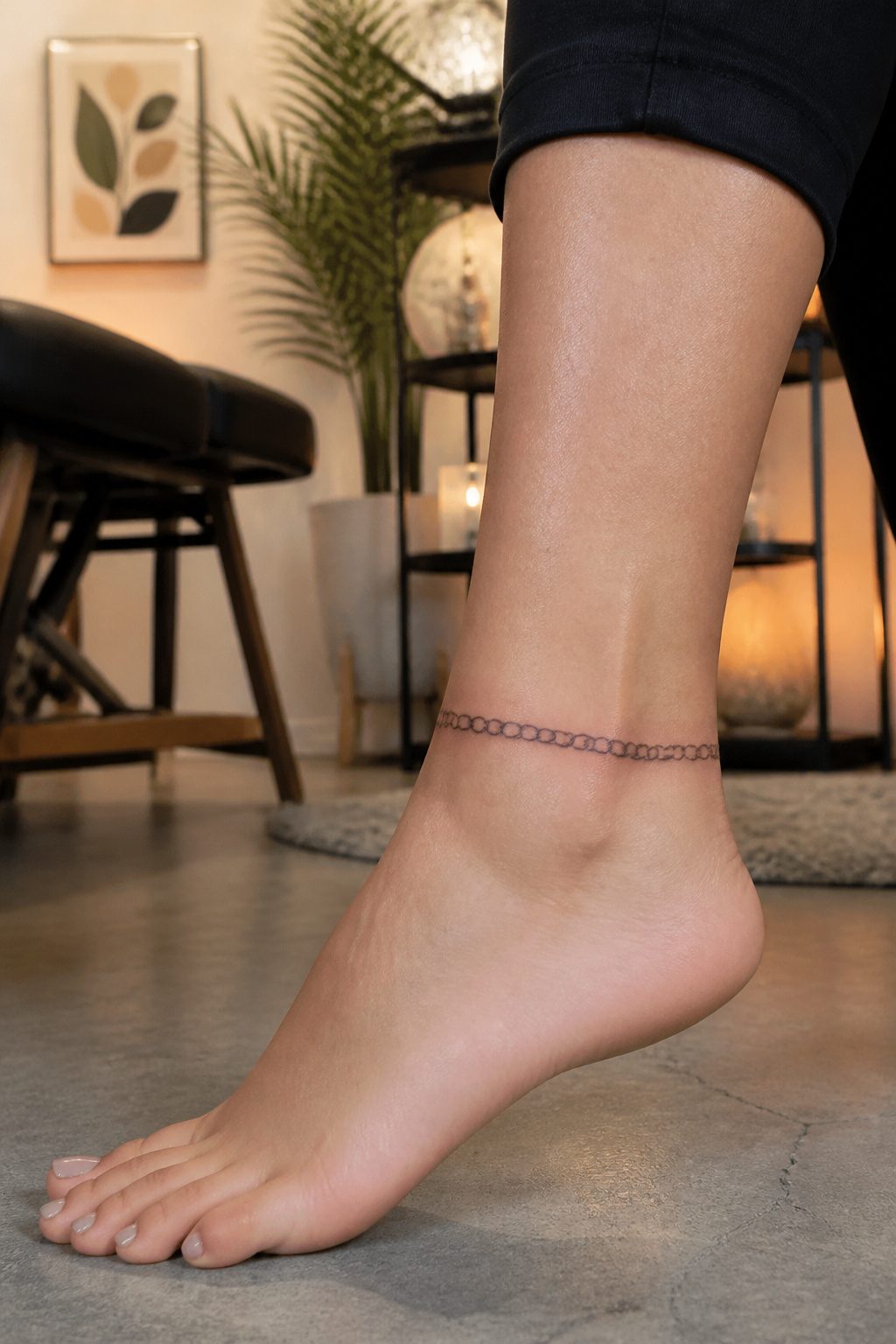
A single chain link pattern circling the ankle reads as jewelry at a glance, but the uniformity is what makes or breaks it. Any wobble in line weight shows immediately against the skin, and unlike a charm anklet with dangling pieces that distract the eye, there is nowhere to hide a shaky hand.
The metal illusion depends on consistent needle speed and saturation. Gold, silver, or rose gold tones are built through warm or cool shading, not color packing, which means the artist is working with negative space as much as ink. A straight band in fine line reads sleek and modern; a wavy or zig-zag pattern adds personality but multiplies the difficulty because every curve must mirror the opposite side across the ankle bone.
This is one of the designs that looks simple and costs the extra hour. The client pays for the restraint of not adding more, and the artist earns it through precision.
32. Ankle Name Tattoo
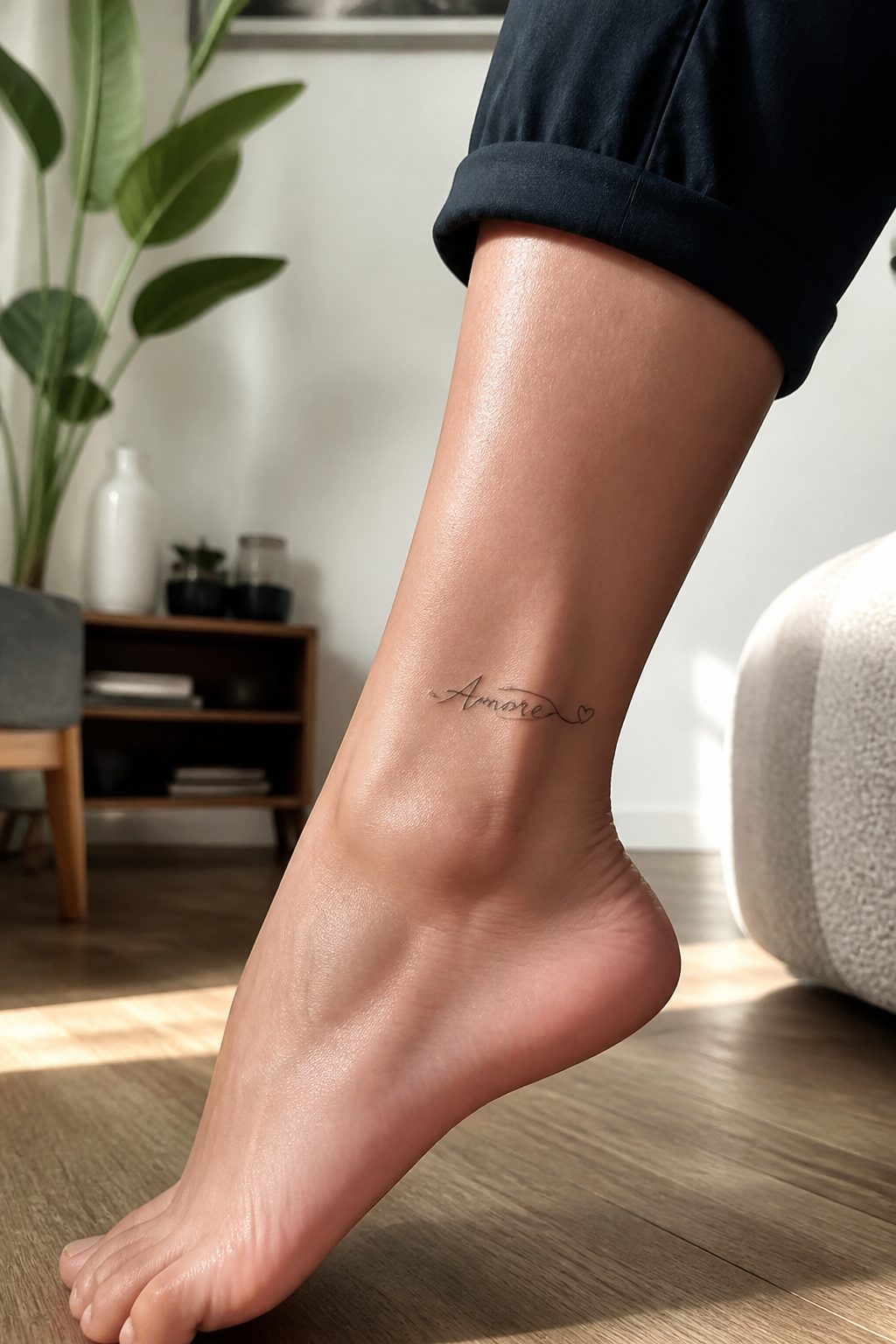
Name tattoos on the ankle live or die by the spacing. The skin there shifts with every step, and script that looks crisp in the stencil can blur inside a year if the letters sit too close together. Keep the height no smaller than a dime if you want the name readable past the first summer of sandals.
The inner ankle hides the work almost completely, visible only barefoot or in flats. That privacy is the appeal, but it is also the trap. A name tucked away where only you see it gathers less daily scrutiny, so the moment it feels wrong arrives late and hard. Cover-up work on ankle bone is common for exactly this reason.
Sizing runs the other problem too. An ankle cannot hold a long name at display size without wrapping onto foot or calf, and once the word crosses those planes it stops reading as an accent and starts reading as a mistake. Short names, dates in numerals, or a single word work best. An anklet of text circling the bone is possible, though the curve forces the letters smaller than ideal.
Two ways to place this: the inner ankle for concealment, or the outer edge where a skirt or cropped pant shows it off. The outer placement risks the name becoming a conversation piece you did not plan for. The inner placement risks you forgetting it exists until the reminder hurts.
33. Phoenix Ankle Tattoo
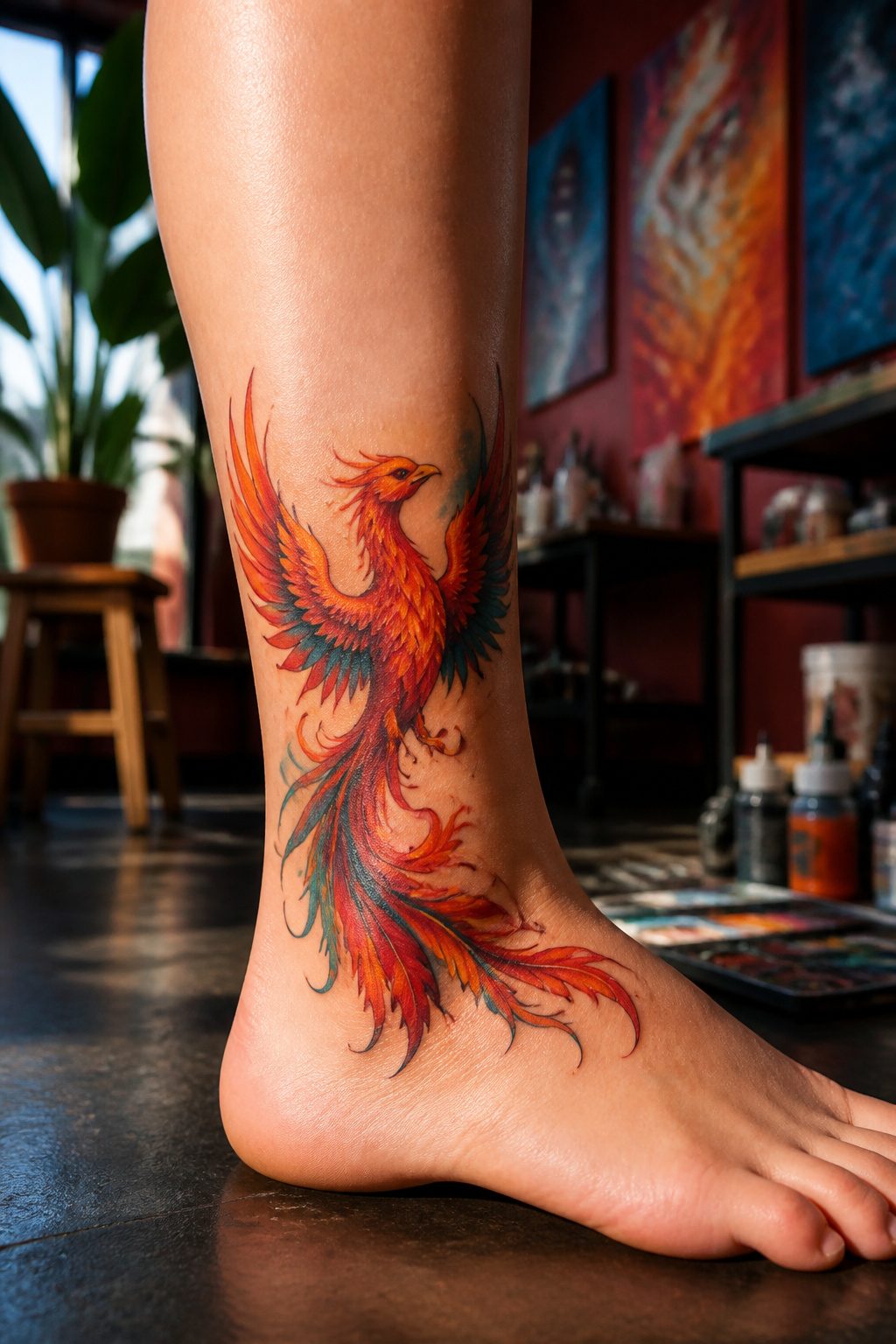
A phoenix on the ankle carries weight before the needle ever touches skin. The bird means rebirth, resilience, the whole cycle of burning and rising again, and that story lands harder when you wear it somewhere the eye catches unexpectedly. What convinced me, looking through portfolios for this spot, is how the wings and tail feathers naturally follow the ankle’s curve. The shape wants to wrap; the flame trails can spiral down toward the heel or sweep up toward the calf without looking forced.
The space punishes ambition, though. I have seen full-color pieces with every feather outlined collapse into a dark smudge after two years of socks and friction. The versions that hold up simplify the form: a strong silhouette, maybe a few key feather lines, the suggestion of flame rather than a full inferno. A friend went the detailed route, spent six hours in the chair, and now owns a gray oval she describes diplomatically as "abstract."
Placement matters as much as design. The front of the ankle, over the bone, takes color poorly and fades fast. The outer ankle, toward the heel, gives the phoenix room to spread without the constant rubbing that kills fine work. Most artists who handle this well will push you toward bolder lines and less detail than you probably pictured going in. Listen to them. The symbol still reads; the skin just keeps it longer.
34. Sea Turtle Ankle Tattoo
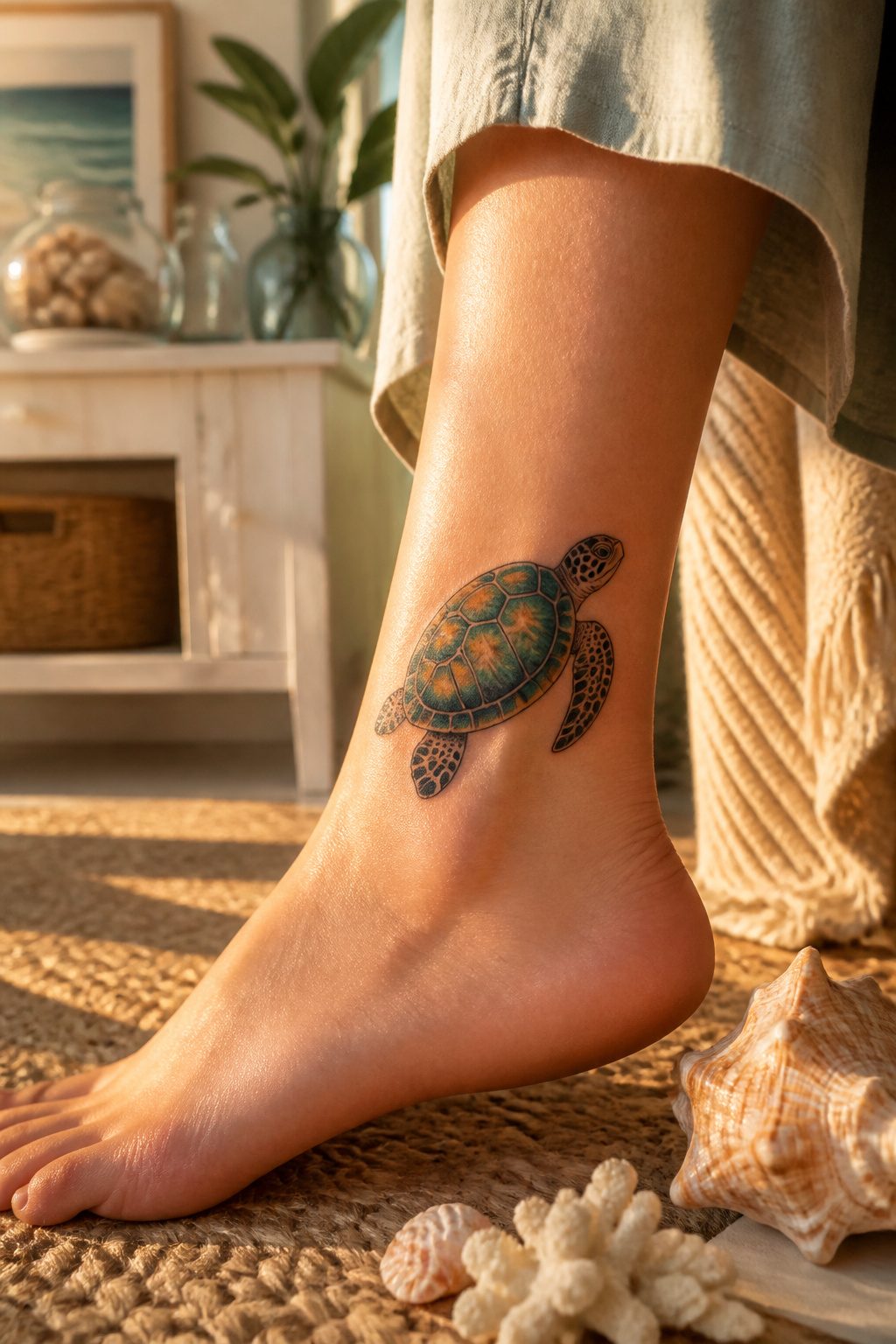
A sea turtle carries different weight than the box turtle your cousin probably got in a roadside shop. The flippers are the giveaway: broad, flattened paddles built for distance swimming, not the clawed, columnar feet of a tortoise that walks on land. An artist who draws feet instead of flippers makes it obvious they never opened a reference photo, and on an ankle where the design sits at eye level for anyone sitting across from you, that laziness shows.
Oceanic context matters too. Coral frames the shell, or water currents trail behind the flippers, or the turtle swims through a small reef scene that wraps the bone. The green sea turtle and the hawksbill carry slightly different shell patterns; the loggerhead’s head is blockier, almost triangular. Most people choosing this design lean into the conservation angle, the long migration, the sense of something that travels thousands of miles and returns to the same beach. The ankle works for this because the turtle reads as passing through, not anchored, and the flipper stroke follows the natural curve above the foot.
35. Hawaiian Ankle Tattoo
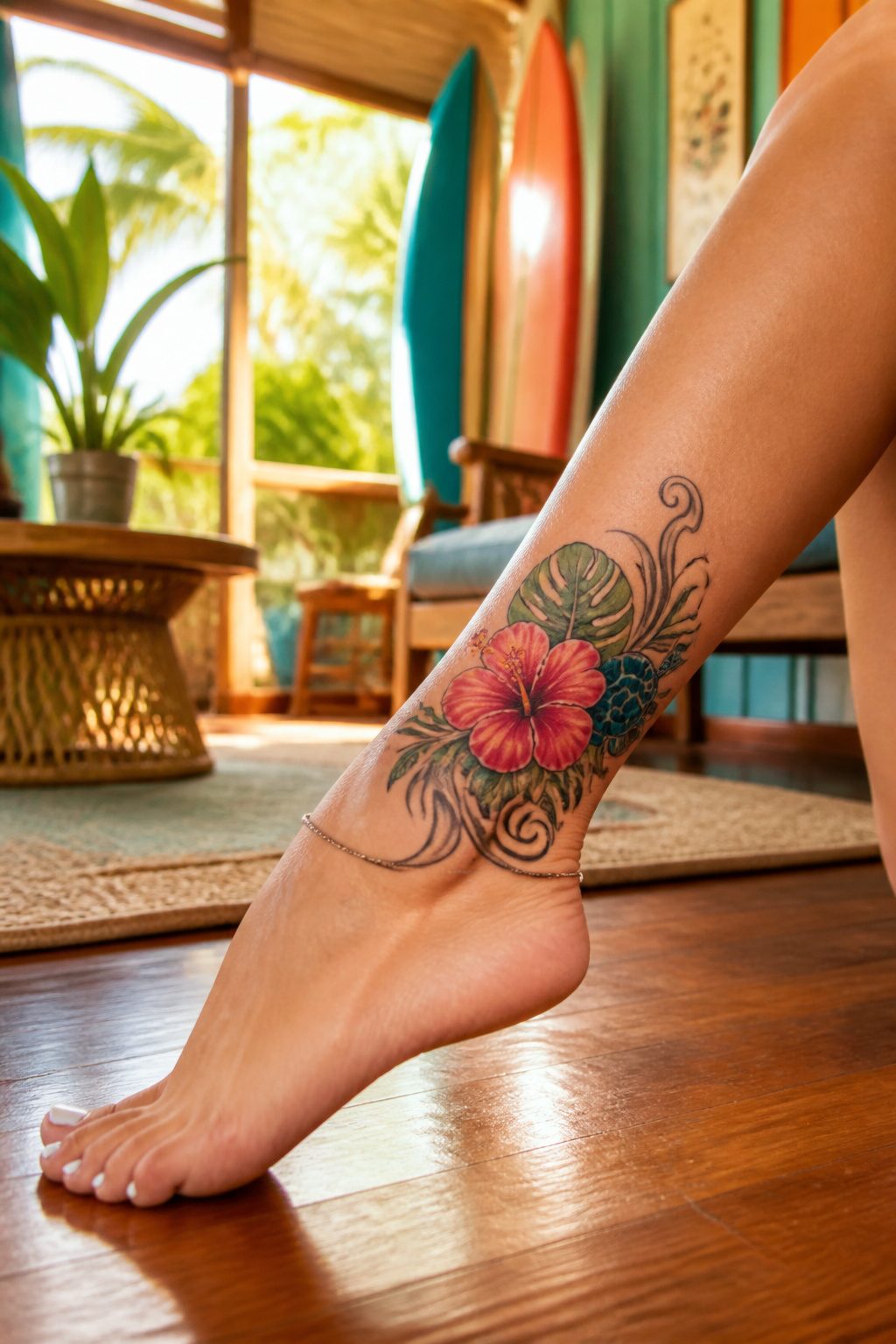
Hawaiian ankle tattoos usually draw from island imagery: hibiscus, sea turtles, or volcanic motifs rendered in bold line work or color. The style can sit as a single flower above the bone or wrap the ankle in a garland. Some designs lean into traditional Polynesian patterns with their strong geometric lines and repeated forms.
Cultural weight matters here. Polynesian and Hawaiian tribal tattoos carry heritage meaning; they are not merely decorative patterns. Wearing them without that lineage or without understanding their significance is widely viewed as appropriation. If you have no Hawaiian or broader Polynesian heritage, the respectful choice is to work with a tattoo artist who can guide you toward island-inspired imagery that does not claim sacred or clan-specific symbols. Research the artist’s background and ask directly how they handle these boundaries.
A simple hibiscus in line art or color avoids that territory while still honoring the aesthetic. The placement works well for a wrap-around band or a small design just above the ankle bone, where it moves naturally with the foot.
36. Octopus Ankle Tattoo
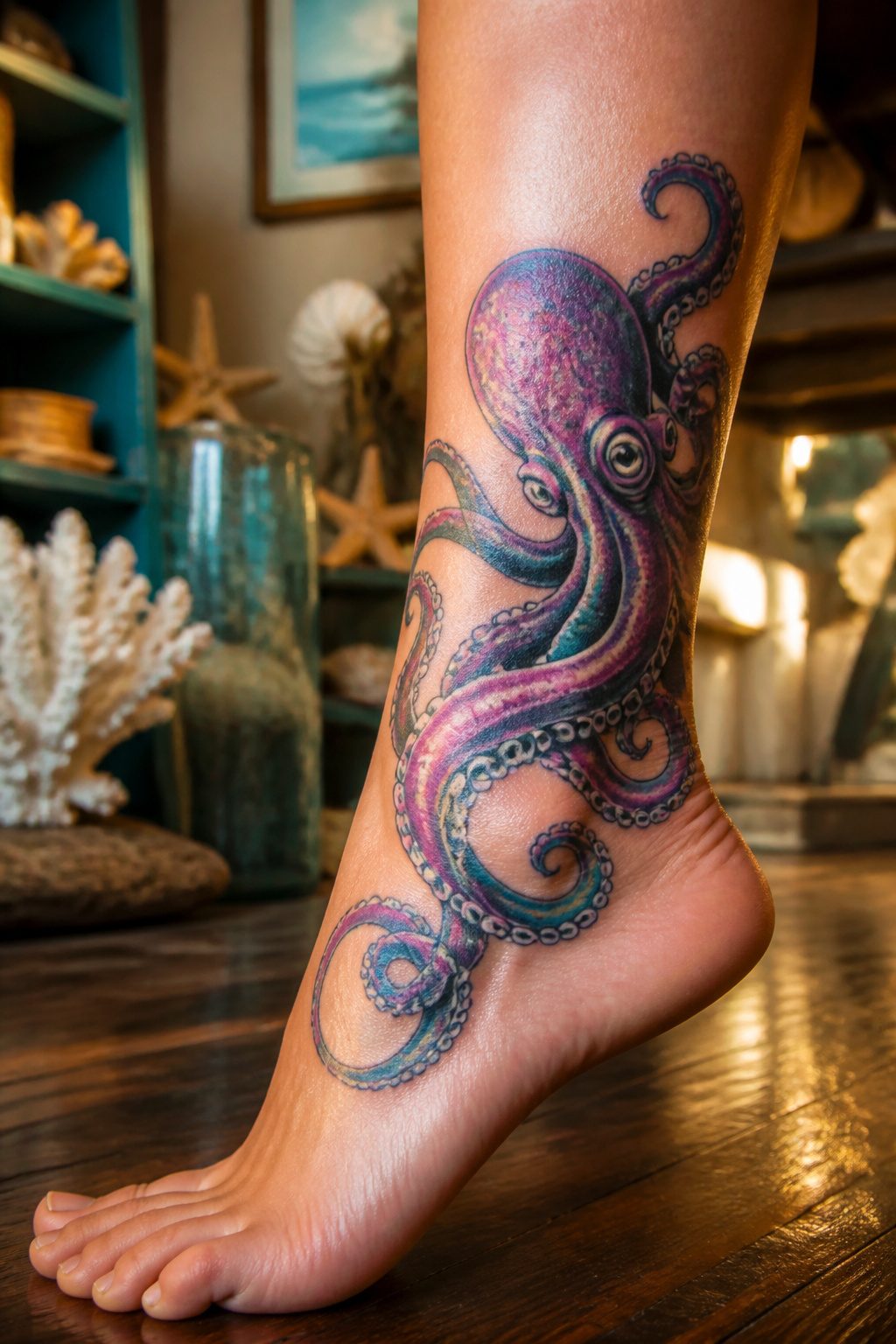
An octopus wrapping its tentacles around an ankle uses the limb’s natural shape better than most designs attempt. The eight limbs let the artist follow the bone, spiral toward the Achilles, or grip the heel without fighting the body’s geometry. What drew me to this design, studying how tattooers solve placement problems, is that the octopus’s intelligence and adaptability aren’t just symbolic afterwords; they justify the creature’s problem-solving posture on a difficult canvas.
The suction cup detail blurs first as the tattoo ages, especially on the inner ankle where socks rub and skin turns over faster. A good artist plans for this by sizing those dots slightly larger than looks perfect on day one, knowing they’ll settle into softer marks within a few years. I’ve watched colleagues weight the line work toward the body and head, where the skin holds ink more reliably, and let the tentacle tips fade into suggestion rather than insist on precision that won’t last.
Color choices run toward deep purple and rust red for the cephalopod’s natural camouflage, or black-and-grey for clients who want the form to read clearly from a distance. Either approach works; what fails is trying to pack both full color and hyper-detailed suction cups into an area the size of a palm.
37. Sun Ankle Tattoo
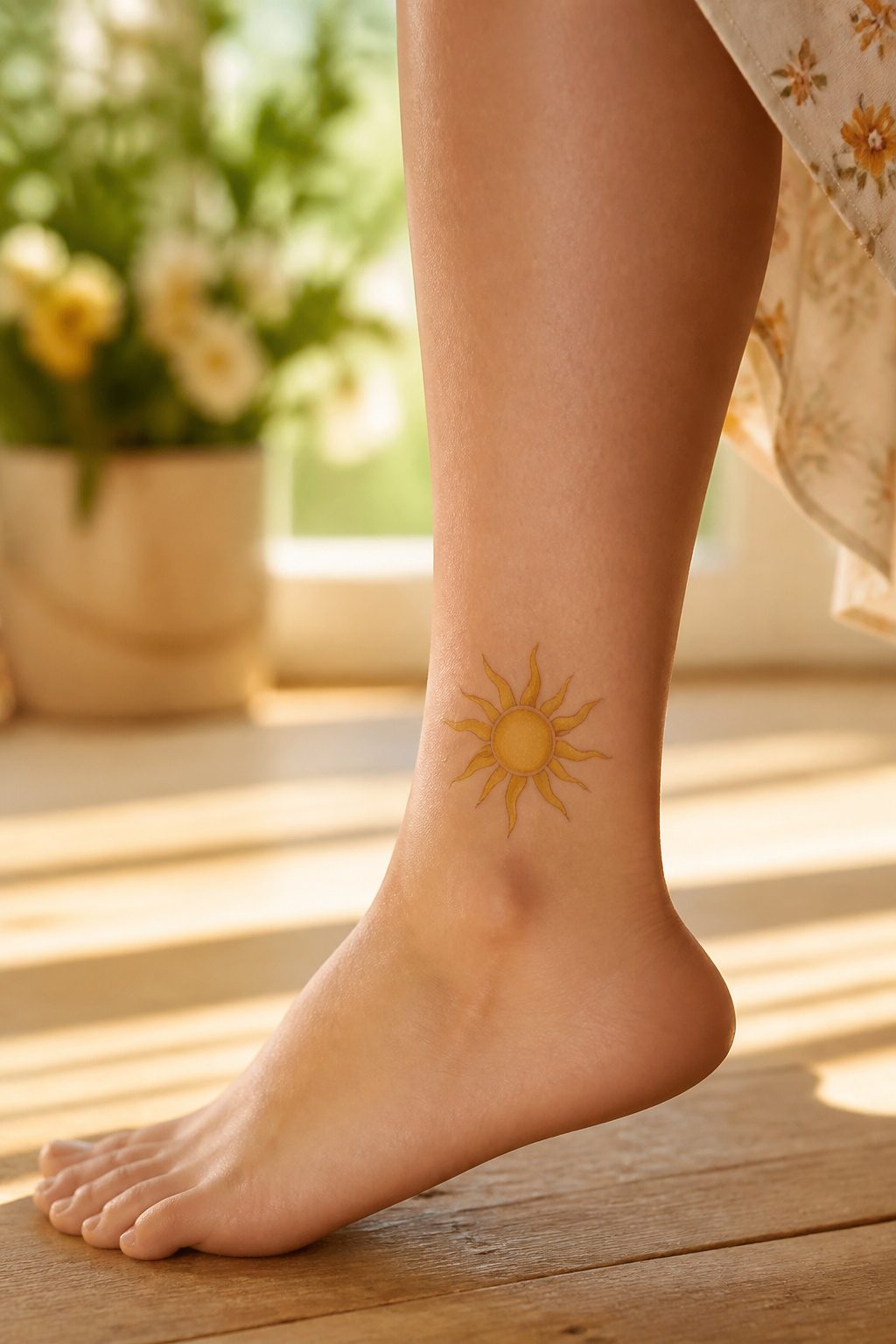
A sun on the ankle sits at that sweet spot between visible and private. Sandals show it off; a sock or shoe line lets it hide. I’ve seen the design range stay tight: a simple circle with short rays takes maybe twenty minutes and heals clean, while a stylized tribal sun with bold black strokes and sharp geometry wraps the ankle like a band. The passage on tribal work notes black, red, and camel color palettes that read especially well on lighter skin, so if you’re considering color, ask your artist to test a small ray first and see how the tone settles after two weeks.
The meaning stays fairly consistent across styles. Sun imagery points to energy, life, clarity, and the idea of coming out of a darker stretch. Placement matters for that symbolism to land: too high on the calf and it becomes just another tattoo; right at the ankle bone, it catches light and attention in a way that feels intentional. A realistic celestial body with proper corona detailing needs more space than most ankle bones offer, so that style usually sits slightly above or wraps onto the foot. The simpler circle-and-rays approach keeps the design readable even at small sizes, which is what most people actually want down there.
38. Paw Print Ankle Tattoo
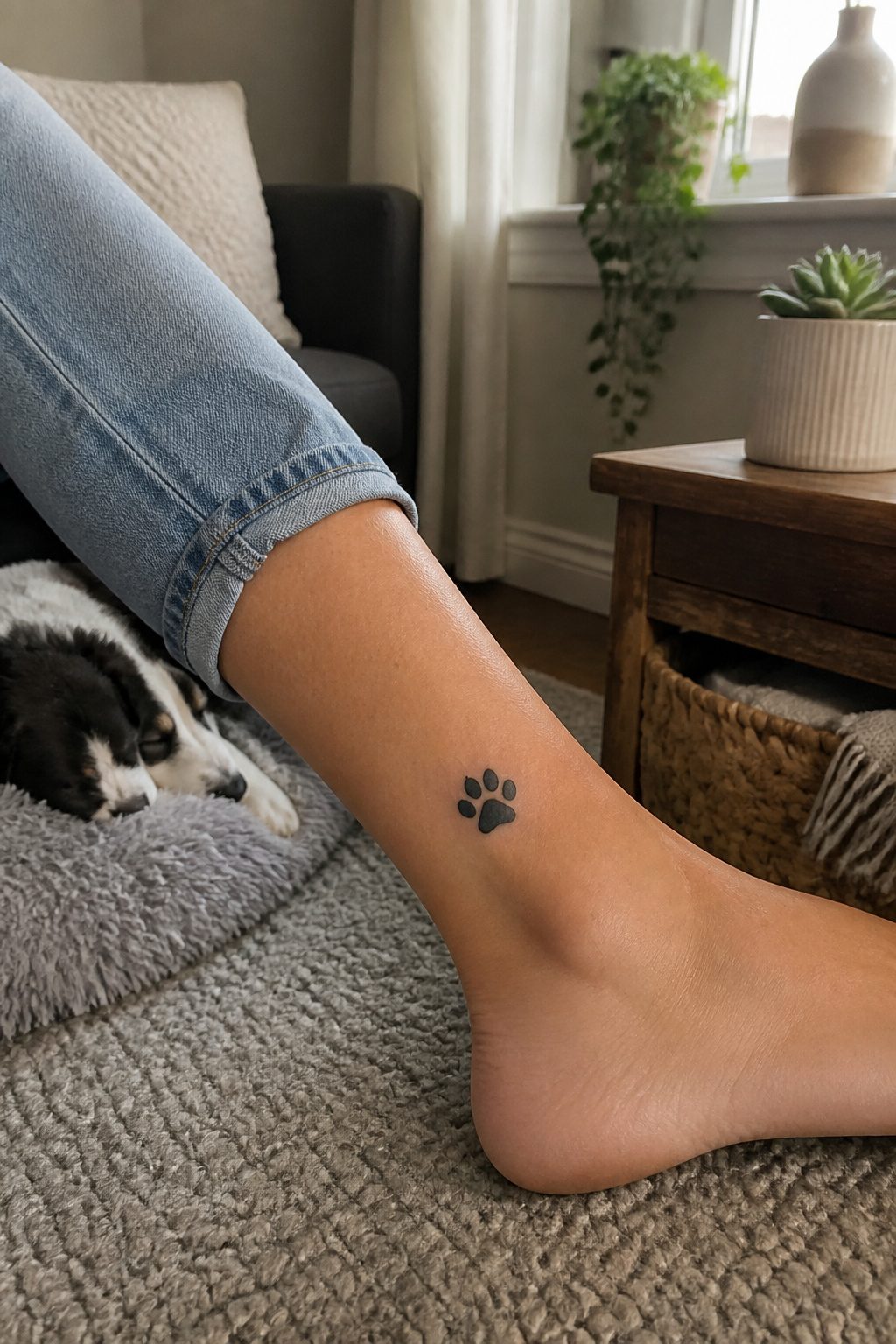
A paw print on the ankle sounds straightforward until you hold an actual dog print against the skin. Most run too large. The pad structure that looks simple in ink is complex in life, and scaling down means simplifying those pads or the detail turns to mud in a year or two.
Artists usually work from a photo or an inked paw impression, then redraw at one-third to one-half scale. A single print with a name and dates sits well on the outer ankle bone. Multiple prints in a walking trail need the inner ankle or wrap toward the heel, where the skin is flatter and holds a line better.
The sentimental weight here is obvious, but the practical limit is size. Too small and the toe pads bleed together; too large and the ankle starts looking like a stamp collection. Ask to see healed photos, not fresh ones. Red ink fades fastest on the foot, so black or dark brown holds the shape longer.
39. Ankle Bone Tattoo
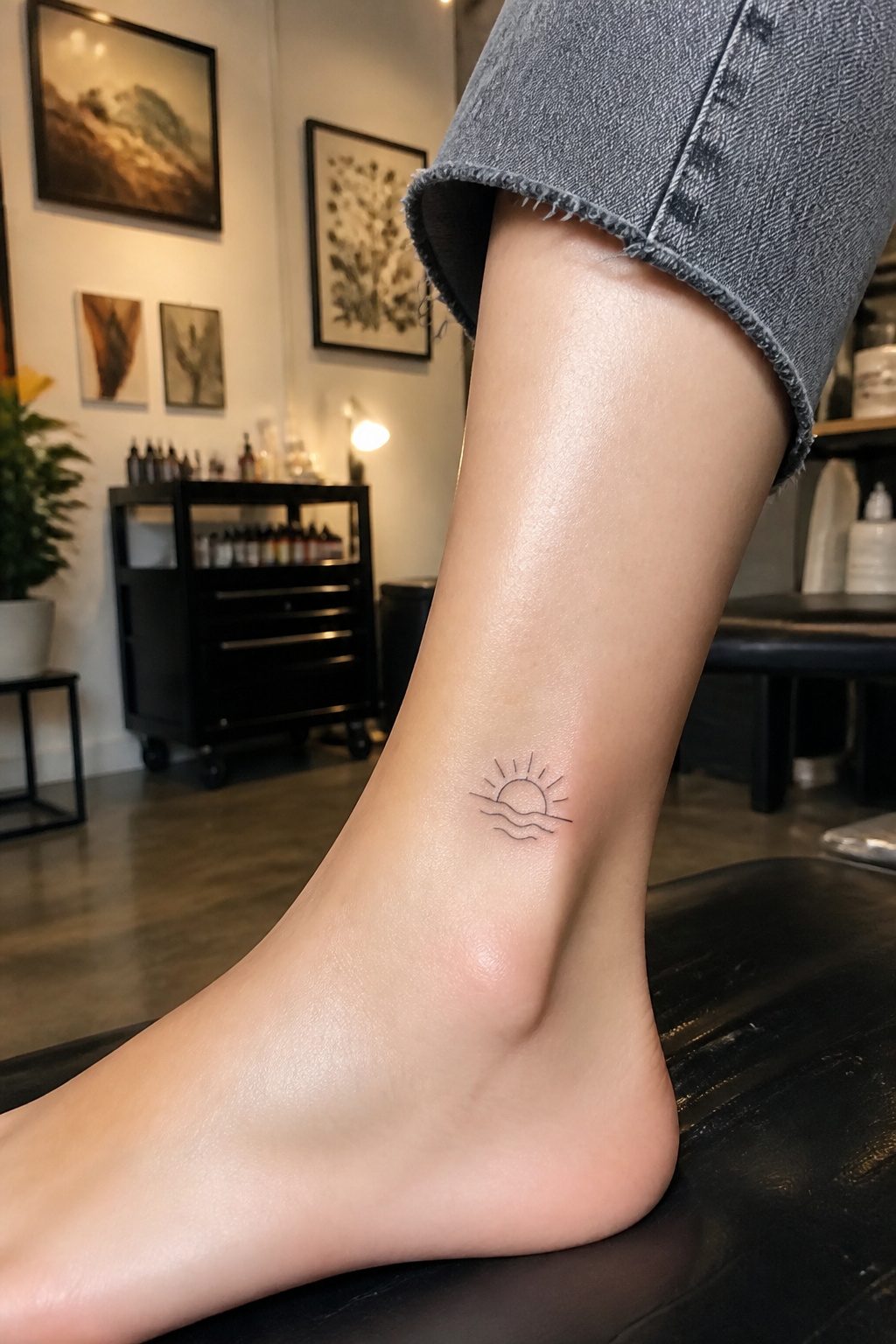
The ankle bone itself sits at the center of every placement decision. Skin here is thin and the bone sits right underneath, which makes the pain sharp and noticeable compared to softer surrounding areas. A standard design takes 10 to 30 minutes, short enough that most people push through without a break, but the sensation stays intense the full time.
Small and simple designs work best here for two reasons. The bone’s curve limits what a needle can trace cleanly, and the spot takes enough punishment that intricate detail blurs faster than on fleshier ground. Stars, simple symbols, and minimal geometric shapes are the usual choices. Clean lines hold up; shading fights the surface.
Visibility is the trade you make. The bone’s prominence puts the tattoo on display whenever shorts or a cropped pant leg enters the room. That same prominence means direct knocks from furniture corners, boot rims, and anything else that catches the outer ankle. Healing takes extra care, and touch-ups down the line are more likely here than on the inner ankle or calf.
40. Large Ankle Tattoos

A large ankle tattoo starts at around $400 to $700, roughly double what a self-contained ankle piece runs. The money goes toward composition work that treats the ankle as a joint between two canvases, not a frame in itself. The design has to read coherently whether the leg is straight or bent, which means the artist builds in visual anchors above and below the ankle bone so the image does not distort into abstraction when you stand up.
Flowing vines, koi swimming upstream, or Eastern-style dragons and lotus flowers that symbolize protection and strength all work well here because they already want to travel. The mistake is choosing a design meant for a flat surface and stretching it across a bend. I have watched clients insist on a mandala centered exactly on the ankle bone, then wonder why the geometry warps when they walk. Better to let the pattern migrate deliberately onto the foot, the calf, or both, with the ankle as a crossing point rather than a focal point.
The session count rises with the territory, and so does the planning. You will sit longer, pay more toward that $500–$700 ceiling, and wait longer between sessions if the piece wraps. The tradeoff is a tattoo that reads as intentional body art rather than a sticker placed where the shorts end.
Frequently Asked Questions
Will my ankle tattoo stretch or warp over time?
Ankle tattoos hold their shape better than ink on many other body parts because the ankle band moves as a single unit. The skin at the narrowest part of the limb distorts together rather than shearing across a joint, so geometric patterns and wrap-around designs stay legible. The real enemy is not stretching but friction from shoes and socks, which speeds fading at contact zones like the Achilles tendon and ankle bone.
Can I wear shoes and socks after getting my ankle tattoo?
You will need to let the tattoo breathe for the first stretch of healing. Loose sandals beat enclosed shoes for the first two days, especially for inner ankle work where trapped moisture softens lines faster. After that, monitor for rubbing and switch to cleaner footwear if you notice irritation building at the inked spot.
Will an ankle tattoo affect my ability to exercise?
Skip high-impact workouts for the first few days. Friction and sweat around a fresh ankle tattoo slow healing and can push ink out before it sets. Once the surface seals, you can ease back in, but stop any movement that makes the area feel hot or irritated.
What designs work best for ankle tattoos?
Smaller, simpler pieces survive longest on ankle skin. Minimalist line work, single symbols, and clean blackwork hold their edges where fine detail blurs. The ankle’s circumference looks small until you try to wrap a complex image around it; scale elements to the real estate or the design softens within five years.
How much does an ankle tattoo cost?
Micro ankle work usually runs $60 to $150 for flash pieces, while ornamental wrap-around mandalas start around $200 to $400. The lower end covers predrawn designs; custom work, tight detail, and the precision required for ankle curves push the price up. Dense blackwork cover-ups cost more still, especially if laser lightening is needed first.