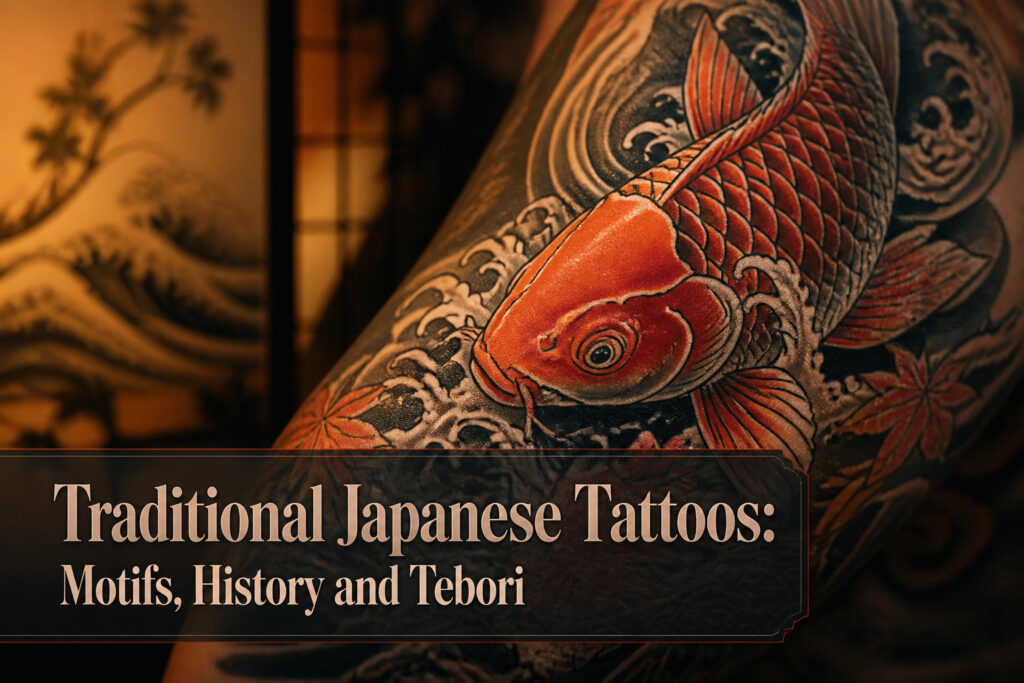
Traditional Japanese tattoos, called irezumi, are a system of permanent body art where every motif carries a fixed meaning and a prescribed placement on the body. The catch is that a dragon on your forearm or a koi swimming the wrong direction betrays the rules that make the tradition coherent. Each design, from the water deity ryū to the protective hebi snake, was codified during Japan’s Edo period and is still applied by hand through tebori, a slow poking technique that produces color fields no machine can replicate.
Dragon
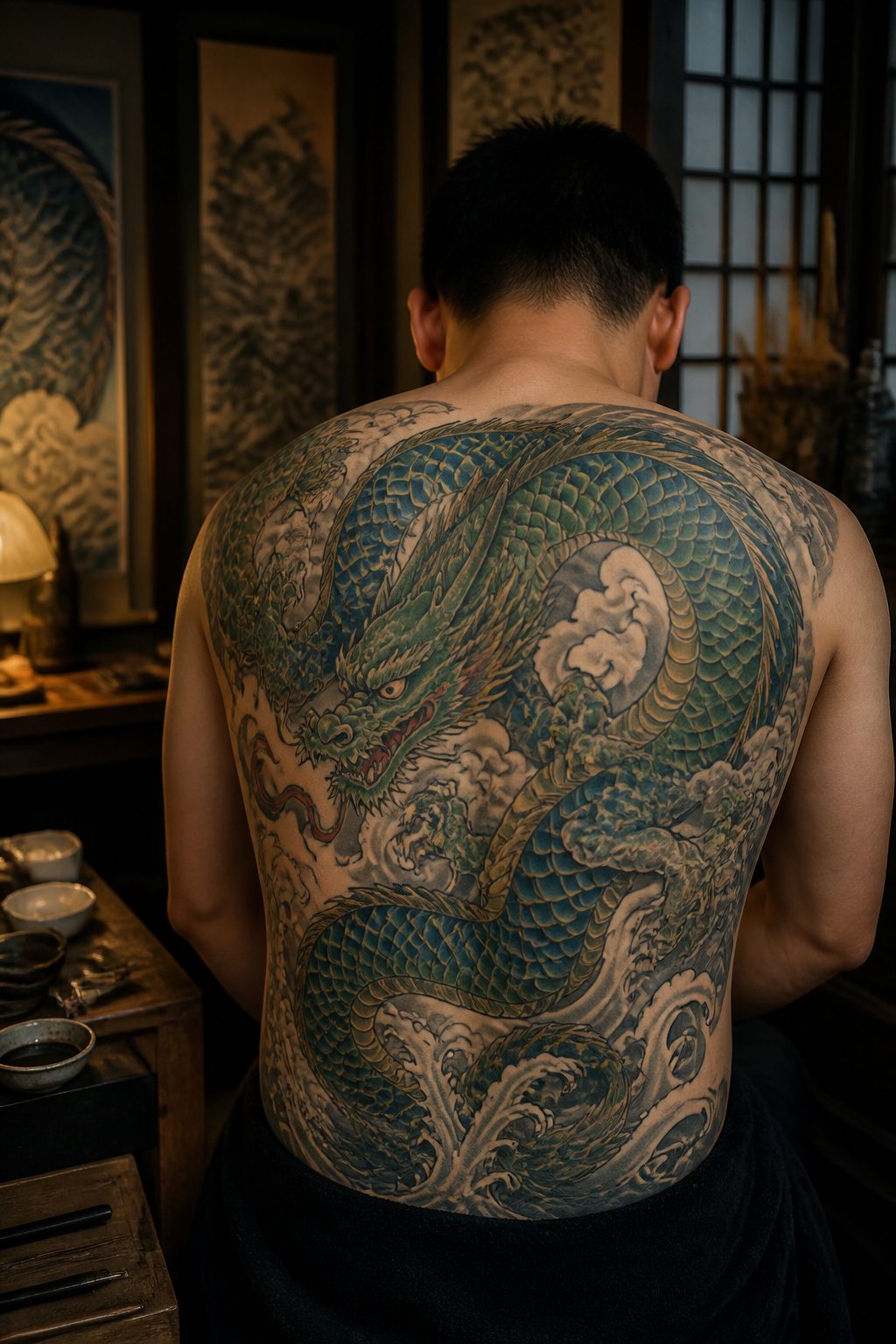
The dragon, ryū, is where most people start when they look into traditional Japanese tattoos, and for good reason. It carries weight without reading as menace; the Japanese dragon is a water deity, not a fire beast, and its meaning turns on wisdom and benevolent strength rather than hoarding or aggression. That distinction matters if you are choosing between a Japanese piece and something more generic.
Placement follows the form. The back is the classic canvas because the body needs room to coil. On a sleeve the dragon spirals, head at the shoulder winding down toward the wrist, or reversed with the head at the forearm looking upward. Direction carries meaning: climbing toward the shoulder signals ambition still underway, descending from the heavens reads as blessing arrived. Clouds and water are the usual companions, and chrysanthemums have long been the floral pairing of choice.
The three-claw convention is often cited as the Japanese marker against four for Korea and five for imperial China. It is a real pattern in East Asian art, not a strict rule, so treat it as stylistic shorthand rather than law. The creature itself borrows its anatomy from the journey: camel head, serpentine neck, koi scales, hawk or eagle talons, stag horns. That composite build is part of what makes each dragon distinct to the work it sits in.
Koi Fish
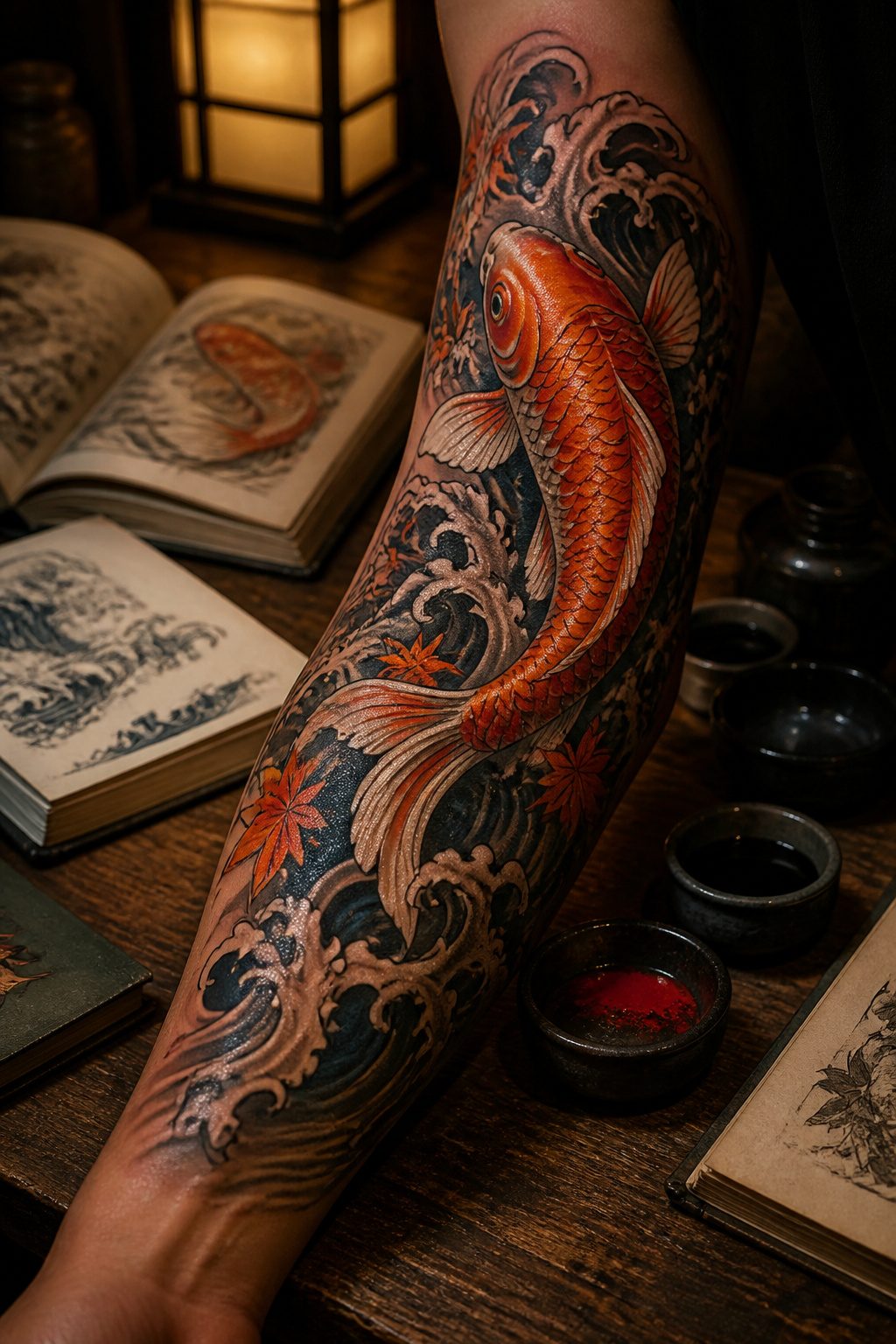
The koi carries a single story, and it is worth telling properly. Chinese sources as old as the Book of the Later Han describe a stretch of the Yellow River called the Dragon Gate where carp gather each spring to leap the falls. The one carp that clears it becomes a dragon. In Japanese the phrase survives as tōryūmon, the gate you pass through into a new life.
That transformation is why the koi stands for perseverance and success in traditional Japanese tattoo work. The fish fights upstream against the current, and the reward is not mere survival but a complete change of being. When you see a koi on a body, it is never just a fish. It is a person who has chosen to wear their struggle and their hope of coming out the other side as something else entirely.
Placement follows the story. Koi run the length of a limb or climb the ribs, because they need water around them and water needs somewhere to flow. A single large koi on a sleeve typically travels the forearm with waves breaking over it. On a back piece they usually appear in pairs or a small school with a waterfall behind. Their standard companions are waves, maple leaves, and lotus, and the maple pairing has a reason: the carp run coincides with autumn, when the maples turn. Cherry blossoms with koi mix spring and autumn and are avoided in strict traditional work.
One modern convention is worth questioning. The rule that a koi swimming upstream means a struggle still in progress and downstream means a battle already won is a tattoo shop invention, not documented in older Japanese sources. Japanese tattooers do not treat it as binding. It is a nice idea and plenty of people mean it sincerely. Just do not present it as ancient.
Tiger
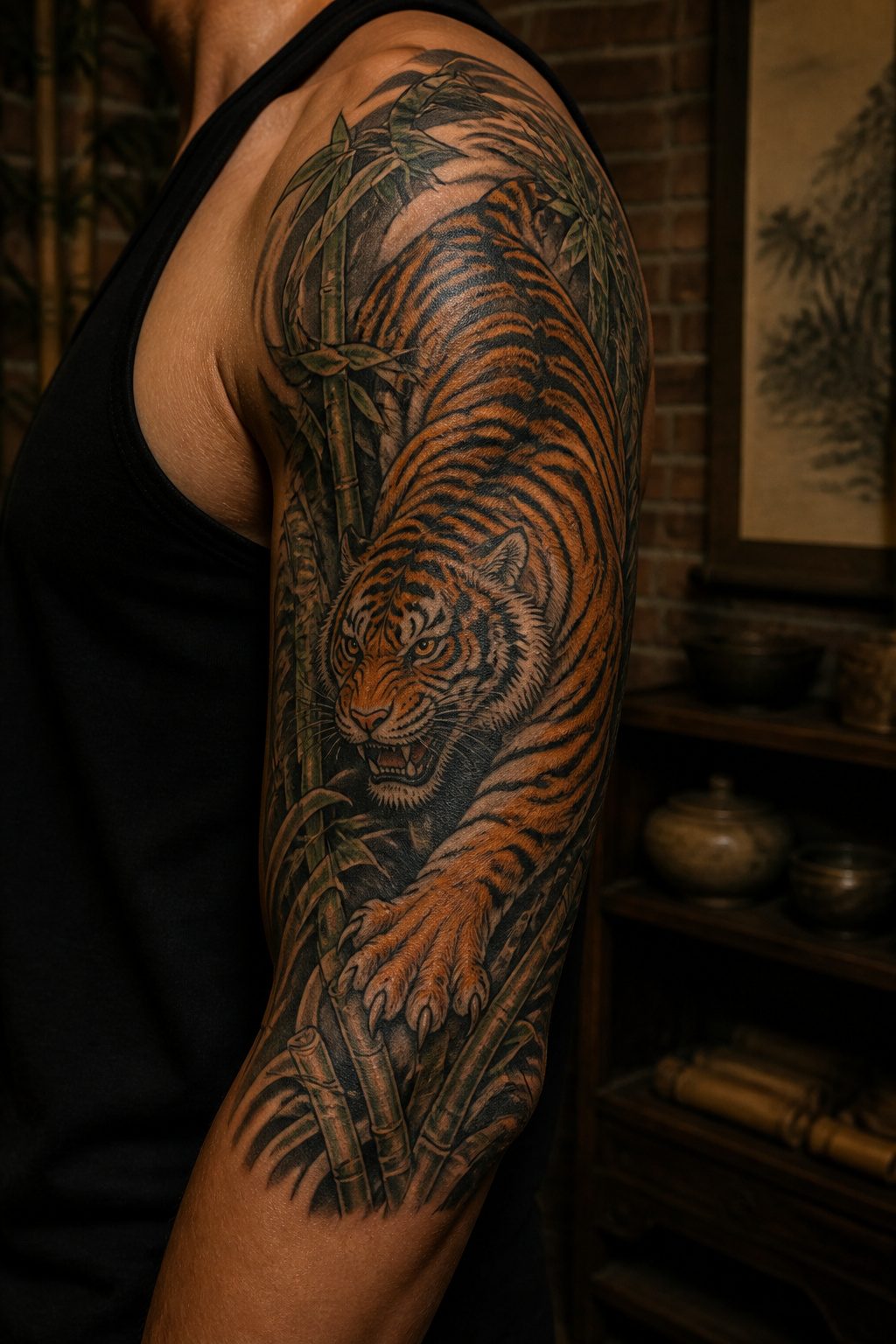
Tigers never roamed Japan, so the tora you see in traditional work was built from Chinese and Korean paintings. That borrowed lineage shows in the old pieces; the faces read more house-cat than predator, a quirk that sticks once you notice it.
The meaning holds anyway. In traditional Japanese tattoo culture, the tiger wards off evil spirits and disease, and carries courage as its central charge. Wind and the earthly realm fall under its governance, set against the dragon’s water and heavens. Artists place it on the outer arm, outer thigh, or upper back, running down a diagonal slope. That descent opposes the dragon’s ascent; the two forces face each other across gaps or occupy separate limbs, rarely sharing a panel. Bamboo stalks fill the background, breaking the limb cleanly, with rocks and wind bars finishing the composition. A tiger fighting a dragon on one arm reads as modern to anyone steeped in the rules.
Phoenix
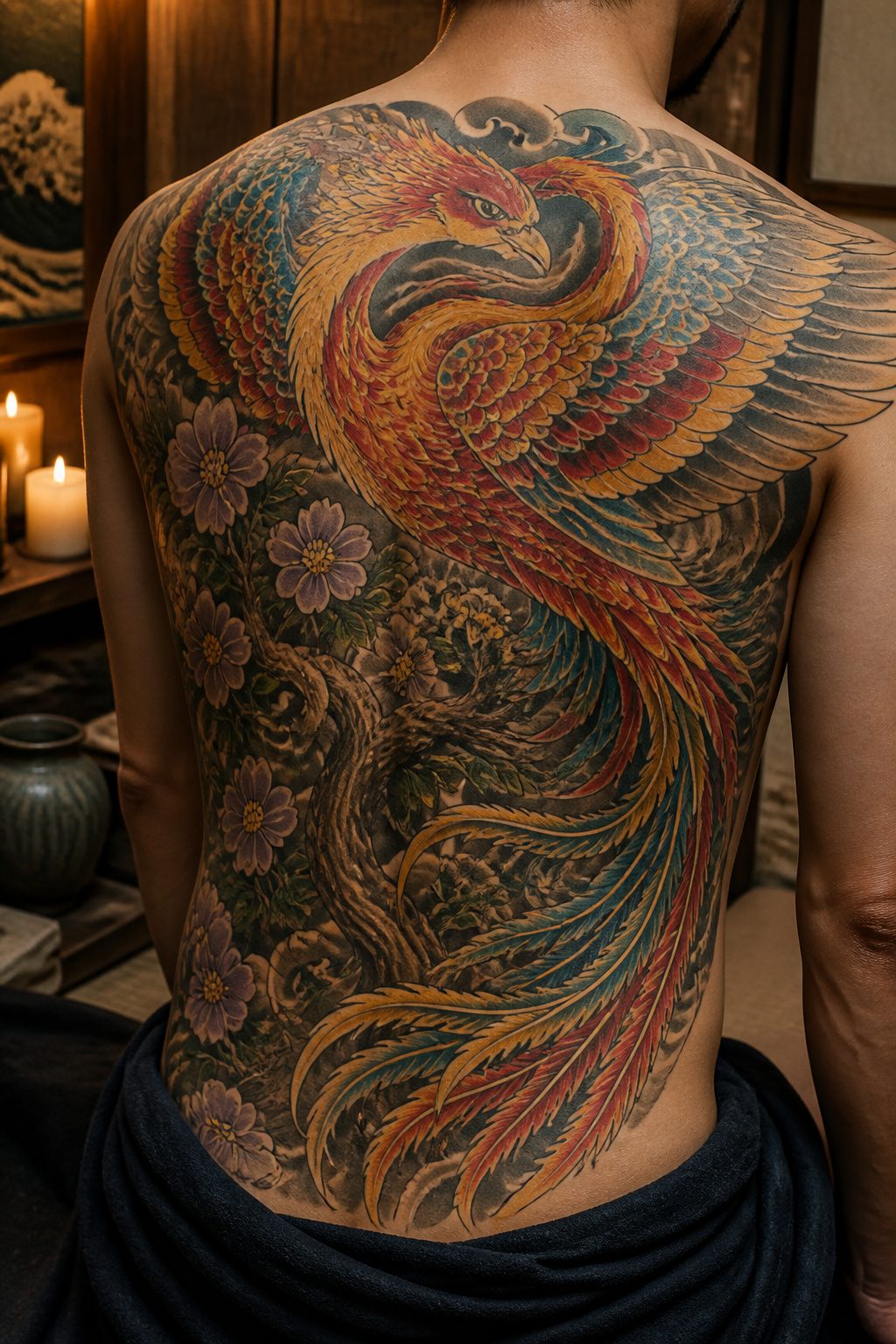
The Hō-ō descends from heaven only when the world is at peace, and vanishes again when order breaks. That conditional appearance gives the Japanese phoenix a different emotional weight than the Western bird that burns and rises from its own ashes. In irezumi, the Hō-ō carries renewal through harmony rather than through destruction, and the five ritual colors of its plumage mark it as a creature of deliberate, balanced design.
Its composite body matters for how the tattoo reads on skin. The long serpentine neck and scaled torso, borrowed from Chinese origin stories, need vertical or horizontal length to unfold properly. A back piece works; so does a chest-and-shoulder panel with tail feathers sweeping toward the ribs. On a sleeve, the bird descends from an open shoulder, wings spanning the upper arm, tail trailing to the elbow. The paulownia tree, called kiri, belongs beside it in the design, since mythology holds that the Hō-ō will land on no other branch.
Placement with the dragon completes the composition. As opposing pair across a couple or across two sides of one body, the two creatures balance fire and water, ascent and descent. What the Hō-ō offers the wearer is less triumph over catastrophe than the promise that good fortune arrives when conditions are right, and the discipline to recognize when they are.
Oni
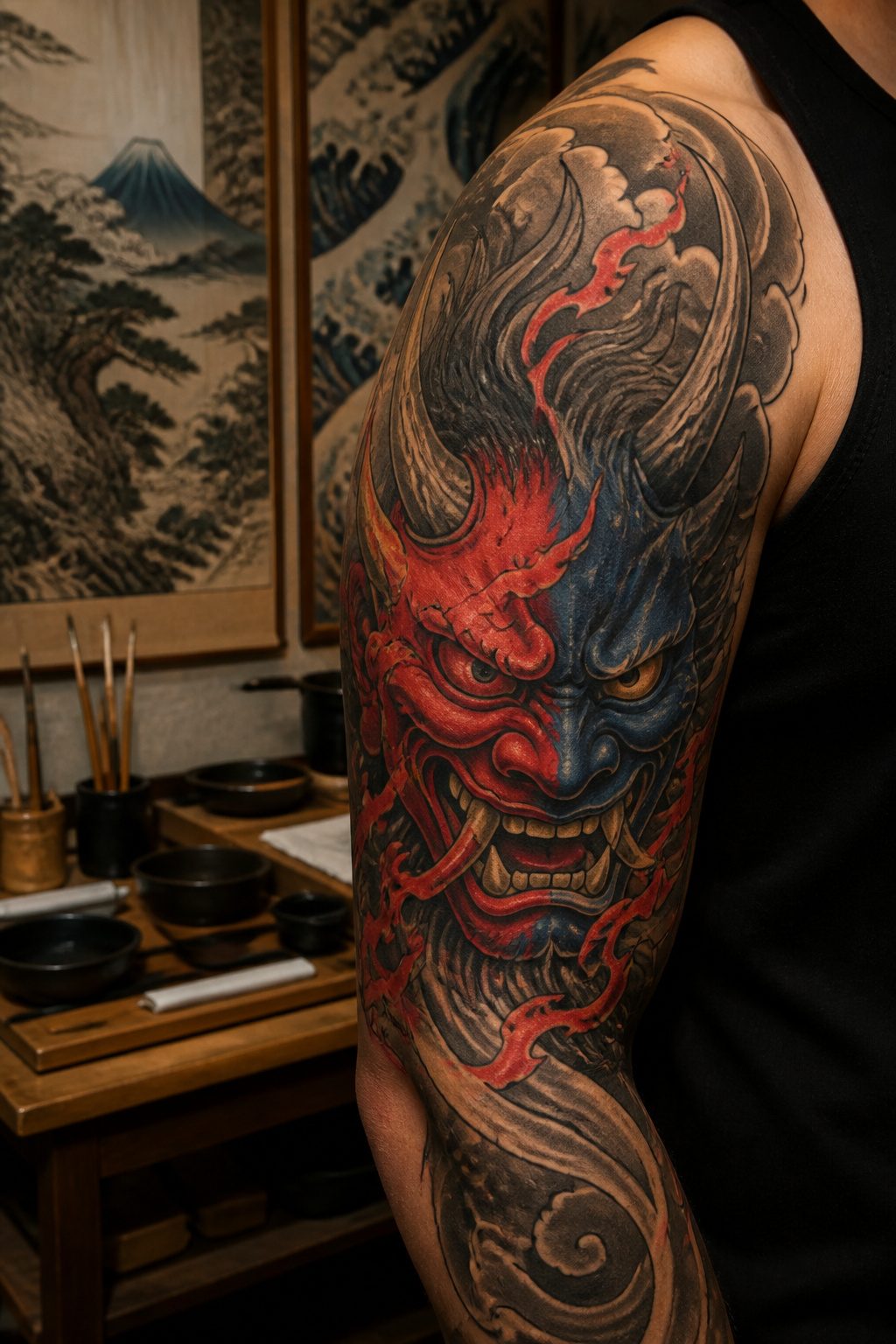
The oni sits at a strange threshold in traditional Japanese tattoos: a horned ogre with wild hair and tusks, club in hand, meant to terrify not the wearer but whatever worse thing might be coming. That is the first thing to understand about the motif. Protection through fear is not a contradiction here; it is the entire logic. An oni on your arm or thigh is a guardian you wear openly, a warning that something already fierce lives there.
The classic pairing shows this balance in literal color: a red oni and a blue oni together, passion against cold logic, two temperaments held in the same body or across two sleeves. Clouds and flame patterns usually back them. What convinced me, reading through the folklore, is how daily the figure actually is. At Setsubun families throw roasted soybeans at an oni to drive bad luck out of the house, laugh at it, chase it. The oni is real enough to fear and familiar enough to invite in. That is the shadow self part. The tattoo acknowledges your own capacity for rage, your own tusks, rather than pretending civility is the whole story.
Placement follows the face. An oni head or mask goes on the outer arm, calf, shoulder cap, or outer thigh, positioned so it reads right way up to someone standing in front of you. Full-figure pieces need a back or thigh panel. They are not demons in the Christian sense, not devils. The distinction matters for the imagery you choose around them.
Hannya Mask
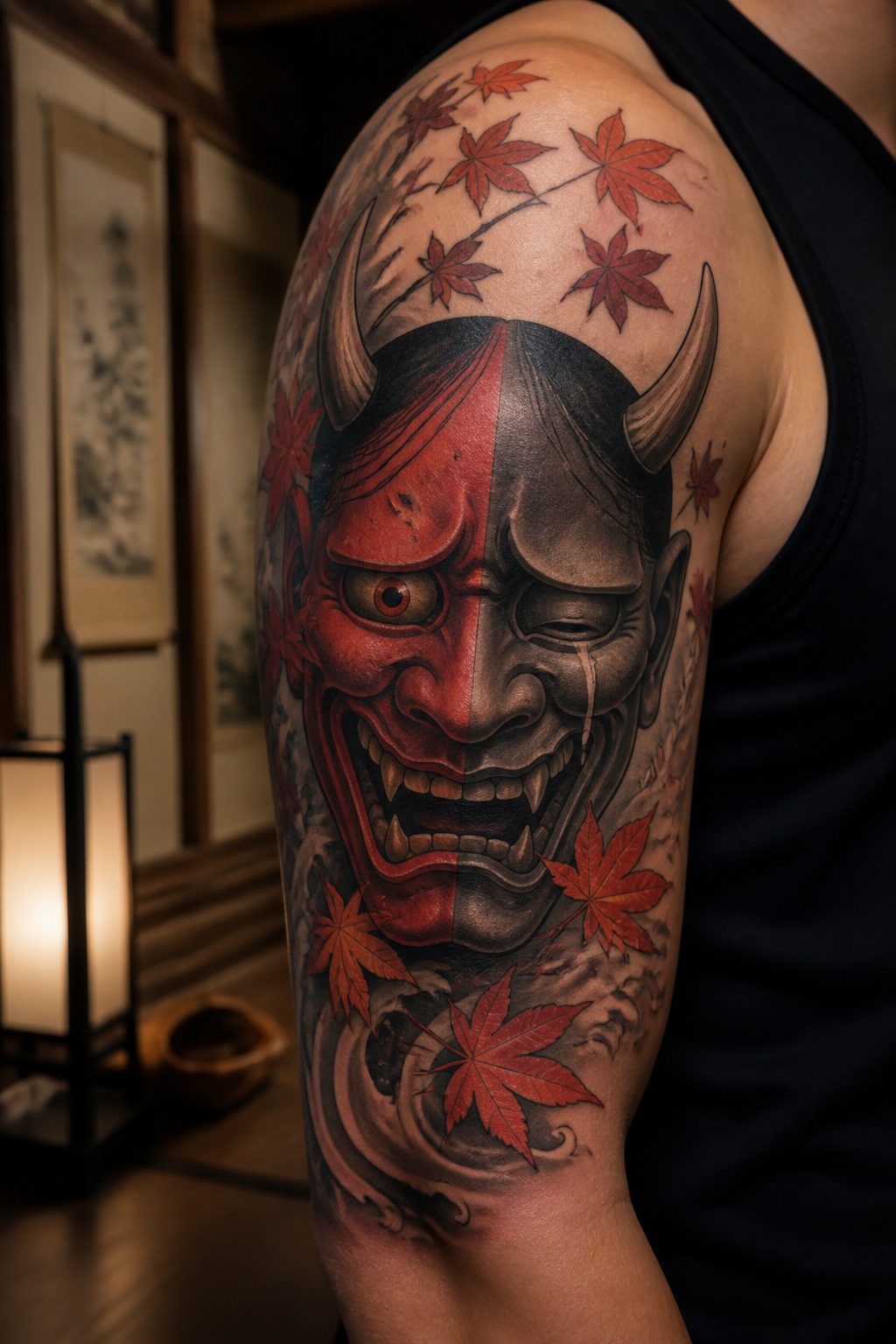
The Hannya mask carries a tension that stops most people cold: tilt your head one way and the face seems to laugh, tilt it another and the same mouth is weeping. That split expression comes straight from Noh theater, where actors wear the mask to play a woman consumed by jealousy and grief until she transforms into something demonic. The horns, the gold eyes, and the stretched grin mark a specific point on a spectrum, not a fixed state. Some performances keep the figure closer to sorrow, others push her to rage, and the mask itself holds both possibilities at once.
Color in a tattoo shifts the meaning further along that spectrum. A white Hannya signals a woman of noble birth still early in her transformation. Red drops the social standing to provincial or peasant. The deepest red and black are reserved for the ones whose humanity has burned away entirely, the darkest demons with no trace left of who they were. The mask is never interchangeable with an oni; calling it one is the most common Western misreading of any Japanese motif, and it flattens a specifically female, specifically emotional transformation into a generic monster. The oldest pairing in tattoo work is with a snake, drawn from the Dōjōji legend where Kiyohime, betrayed by the monk Anchin, becomes a serpent and melts the temple bell he hides beneath. Maple leaves and peonies fill out the composition around the face, but the mask itself remains the anchor, a warning about what jealousy does when it is left to feed.
Snake
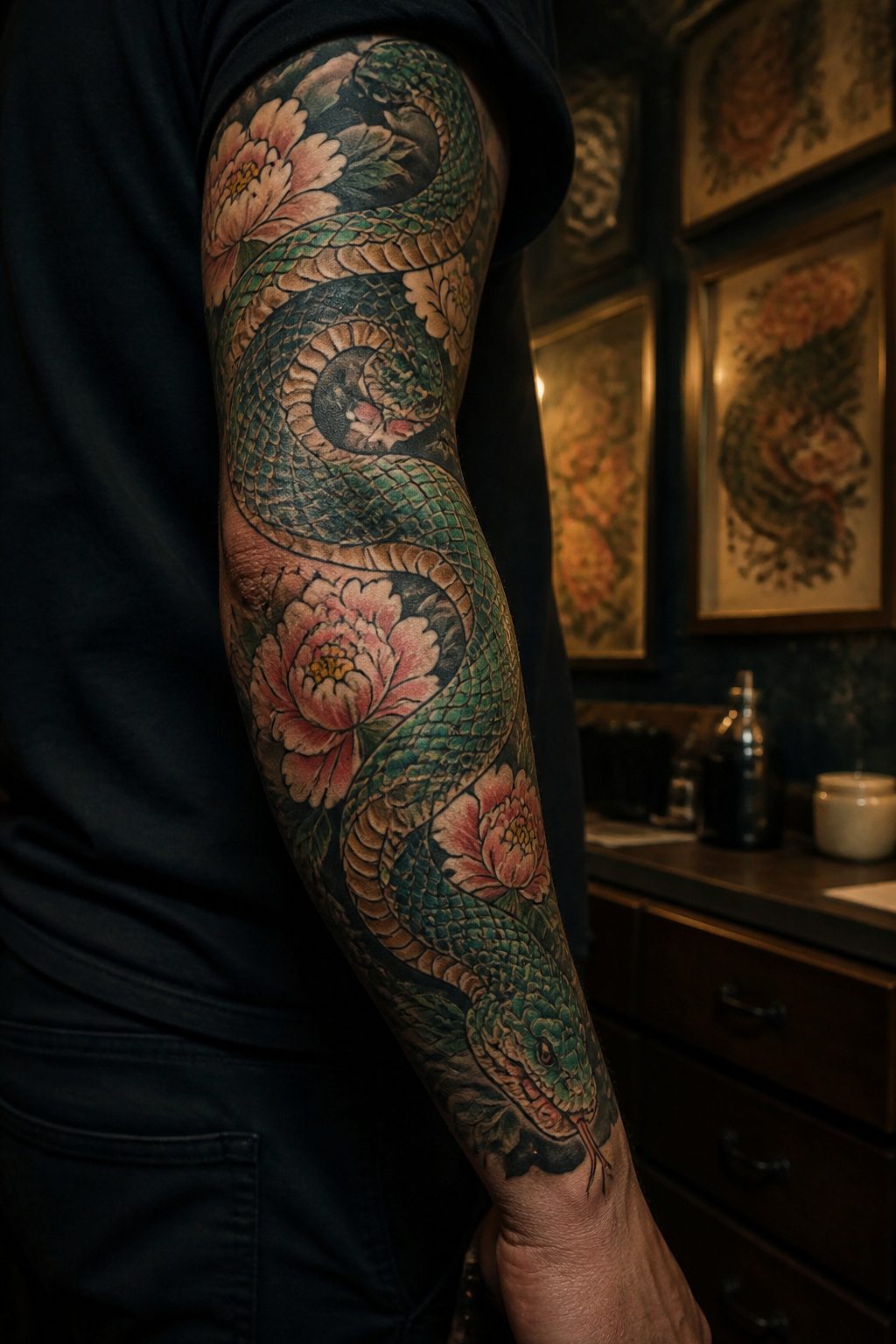
The snake in Japanese tattooing, called hebi, carries a meaning that took me some adjusting to. Coming from a Western background where the serpent lands in Eden, I kept expecting the darker read. In this tradition it does not. Hebi guards against illness and disaster, watches over wealth, and signals regeneration through the shedding of skin. That last part is what artists tend to emphasize: the rebirth is literal, visible, repeated.
White snakes, shirohebi, hold a separate rank as messengers of Benzaiten, the goddess of music, eloquence, and fortune. Shed snakeskin still turns up in wallets here and there as a money charm, which surprised me when I first heard it. The medicinal association runs parallel; the creature protects and renews, and those two functions blur together in practice.
Placement is where the snake earns its keep as a motif. The body is essentially a line, so it follows a forearm, calf, thigh, or torso along the muscle rather than fighting it. Pairings matter: peonies bring prosperity alongside that protection, while the hannya mask pairing shows the snake as what the demon becomes after transformation. A skull with a snake coiled through it reads as life and death together.
What the motif does not mean is worth stating plainly. No deceit, no temptation, no evil. To an informed viewer, a Japanese-style snake reads as guardian, not threat.
Cherry Blossom
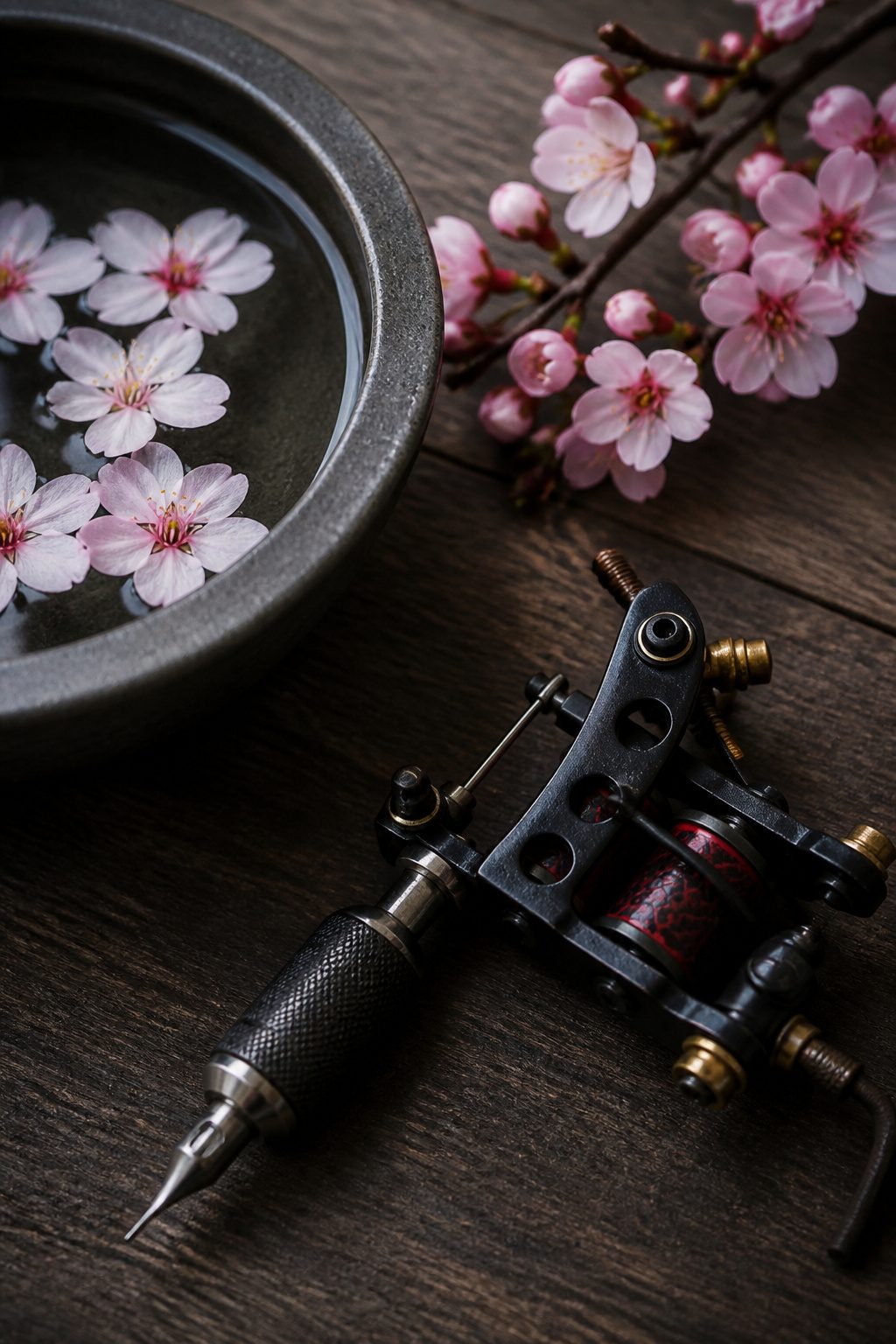
Cherry blossoms in traditional Japanese tattoos carry a weight that belies their delicacy. The flowers bloom and wither in roughly fourteen days, a brief cycle that made them the visual shorthand for impermanence itself. This reading comes straight from Buddhist practice, where accepting that nothing lasts is central to the path.
The motif took on sharper meaning through samurai culture. Warriors paired cherry blossoms with armor and blade to signal a life that should end at its peak, not in slow decline. Kuniyoshi’s warrior prints of the 1820s and 1830s, the source of nearly every samurai pose still used today, often set falling petals against drawn swords. The message was clear: beauty and death arrive together, and the readiness to die well matters more than the length of living.
Youthful clients still gravitate toward cherry blossoms for their color and gentler lines, though the traditional placement alongside warriors keeps the older, harder reading alive. The flowers read one way on their own, another entirely when wind bars or a half-drawn katana share the skin.
Peony
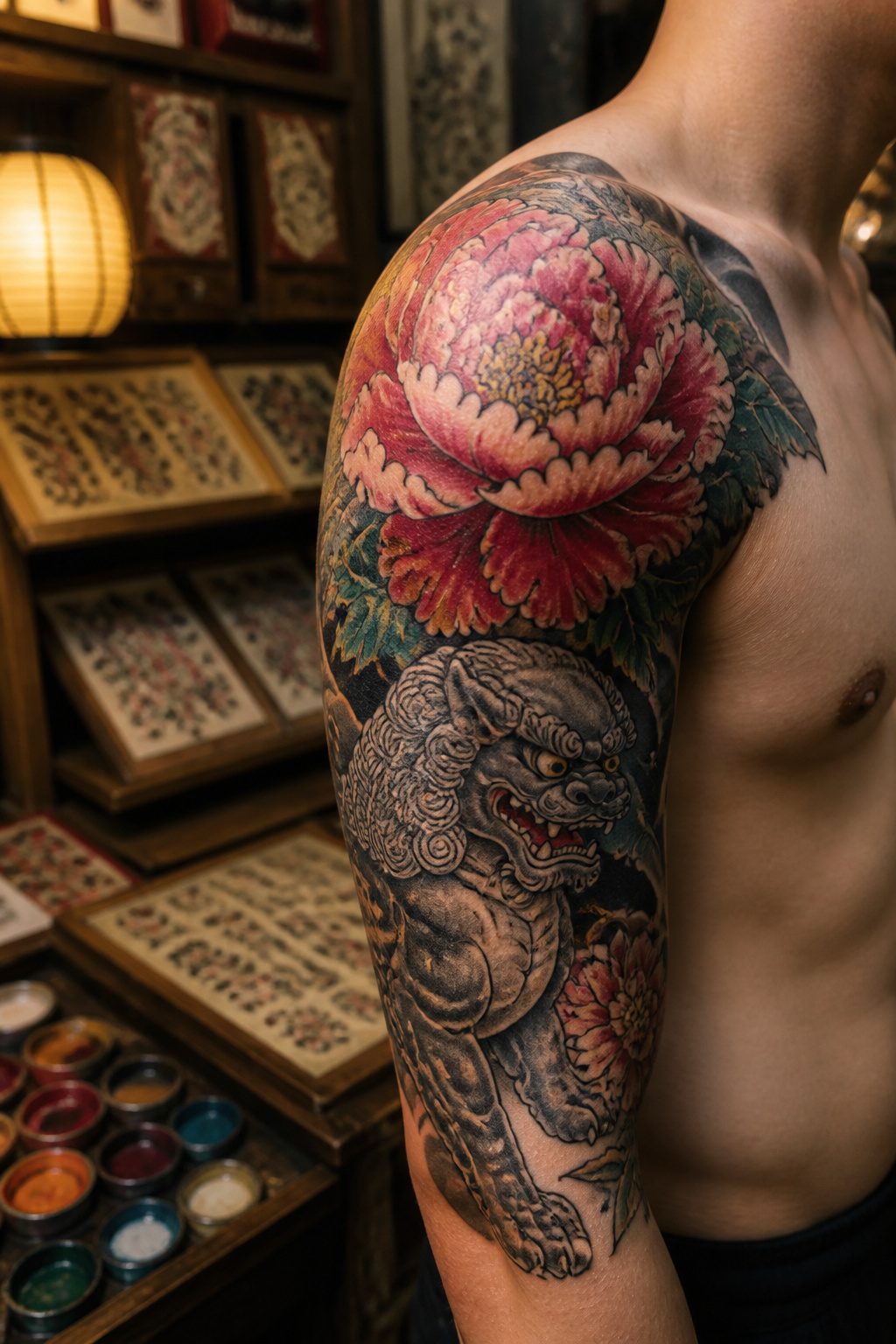
The peony, called botan in Japanese tattooing, carries the settled meaning of wealth and bravery in the fixed vocabulary of irezumi. Sources trace the flower to China, where Buddhist monks first brought it across; Japanese tradition then crowned it the king of flowers, a title it holds without dispute in the motif system developed during the Edo period.
A botan rarely stands alone in traditional work. The standard pairing places it beside the shishi, the guardian lion, where the soft bloom offsets the beast’s ferocity and both elements reinforce each other’s symbolic weight. The lion represents protection and courage; the peony answers with prosperity and honor, creating a dialogue between hardness and delicacy that Japanese tattooing has repeated for generations.
Season and element matter in irezumi placement. The peony’s associations with good fortune and romance make it a flexible companion, capable of filling space around major figures without reading as mere decoration. In traditional grammar, nothing is filler; the botan earns its skin through meaning, not ornament. Its range of meanings, bravery and wealth chief among them, lets it travel across body zones that more narrowly fixed symbols cannot.
Crane
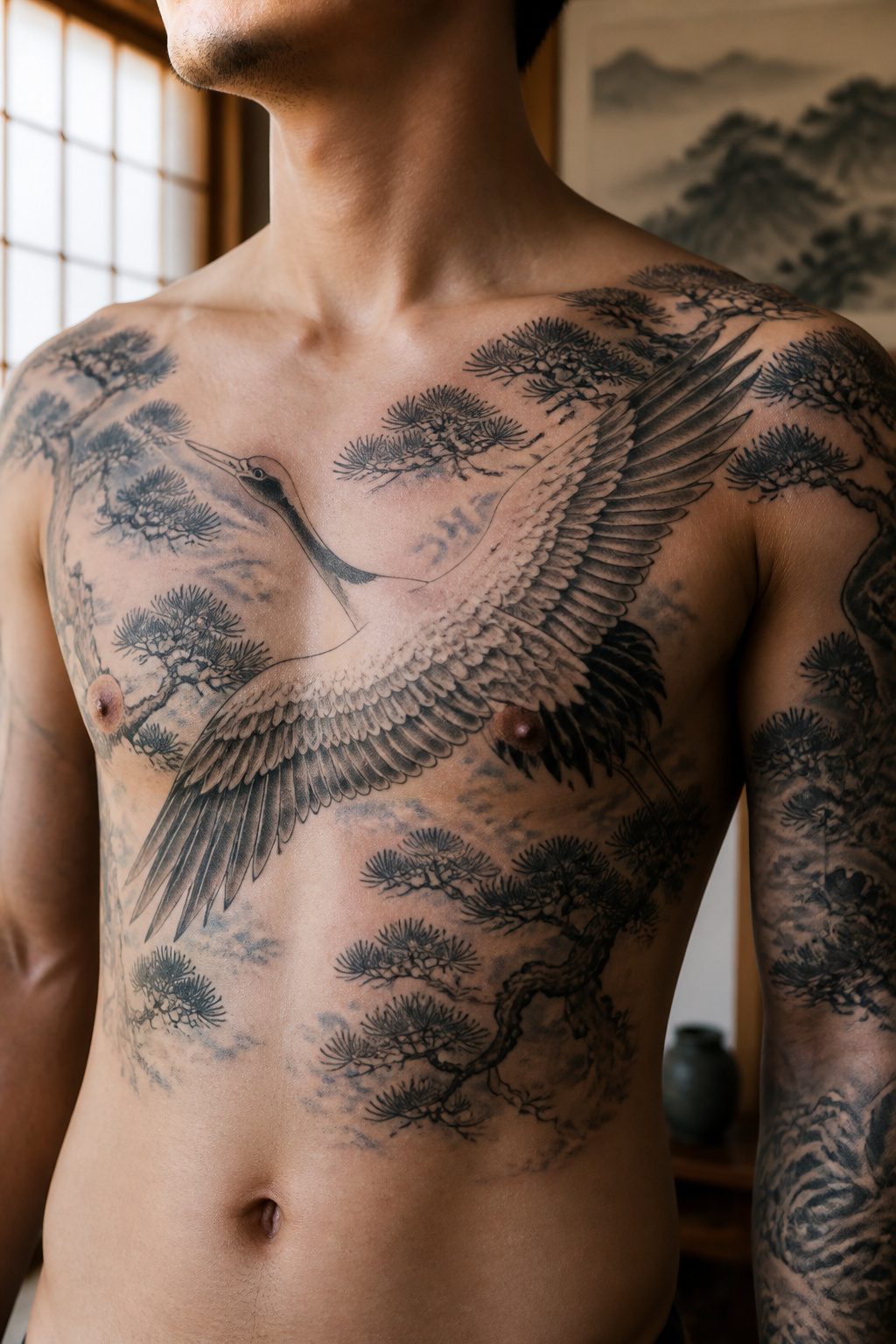
In Japanese tattoo work, the crane, or tsuru, carries weight that outlasts most flash-sheet symbolism. The proverb gives the crane a thousand years and the tortoise ten thousand, so the bird became shorthand for longevity rather than the slower animal. Cranes also pair for life, which folds fidelity into the same image, and that double meaning explains why they show up on wedding kimono and ceremonial wrapping paper. A thousand-year lifespan made cranes auspicious creatures long before tattooing codified the motif, and the association with good fortune runs parallel, not separate, from the life-span meaning.
Placement follows the creature’s nature. Cranes sit high on the body, upper back, chest panel, or across the shoulder, wings spread wide enough to track the shoulder blade’s line. Traditional backgrounds pair them with pine trees and a rising sun, both longevity symbols in their own right, plus moving water. The long clean lines make cranes one of the few Japanese motifs that reads clearly in pure black and grey, which matters when a client wants the symbol without committing to a full color bodysuit.
The senbazuru tradition of folding a thousand paper cranes for a wish is genuine and old, though its modern link to illness and peace grew largely from Sadako Sasaki’s story after Hiroshima. A crane tattoo does not automatically carry that memorial meaning unless the wearer builds it in deliberately.
Namaku and Frog
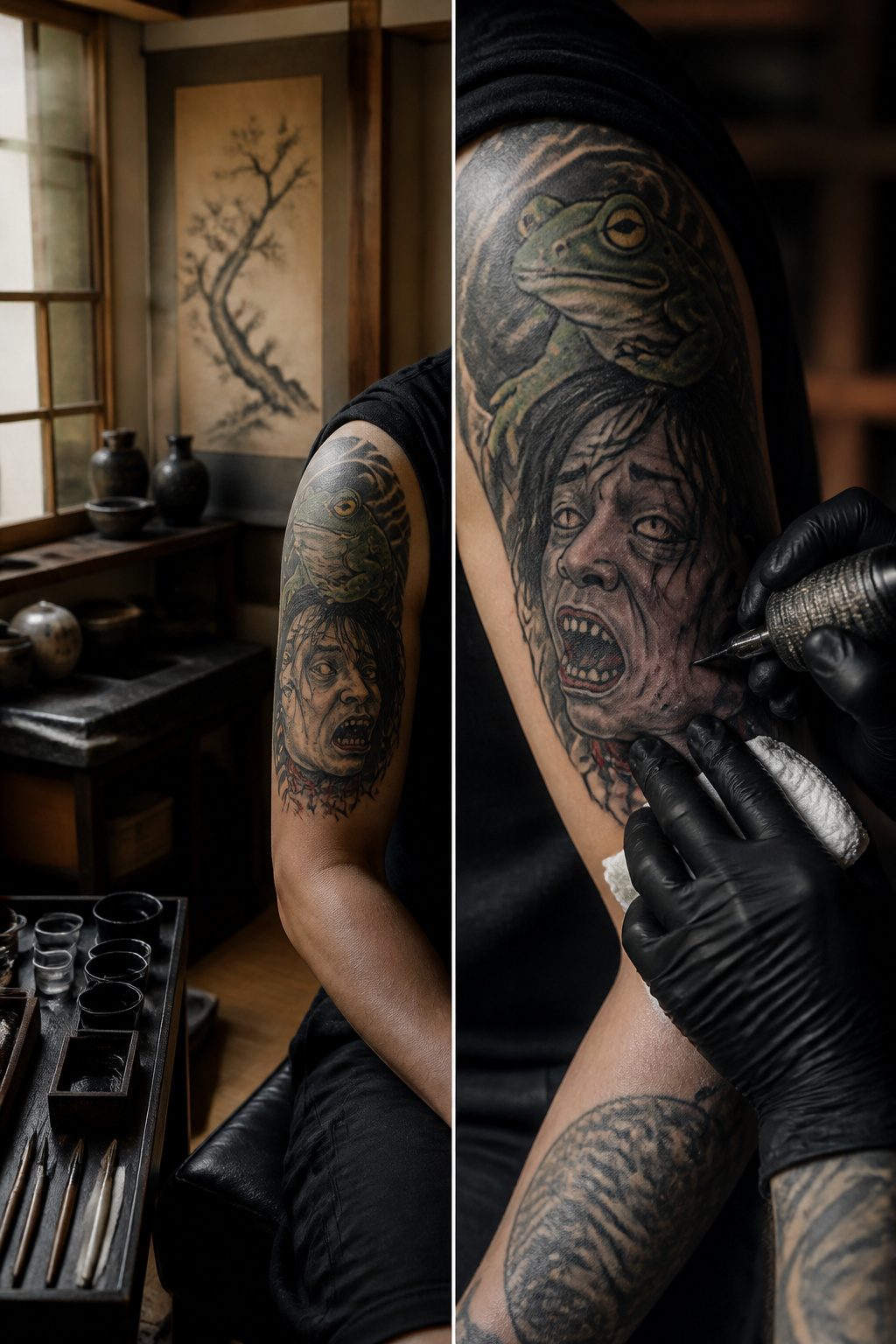
Namaku, the severed head motif, carries a meaning most clients do not guess until the artist explains it. The image represents readiness to face death, a willingness to let go of everything rather than compromise honor. Heavy symbolism for skin, but that is the point of traditional Japanese work; every image earns its place through weight, not decoration.
The frog, kaeru, moves in the opposite direction entirely. The word itself is the charm: kaeru is a homophone for "to return," which made frog amulets standard travel gear for anyone who needed to come home safe. As a tattoo, the meaning extends to good fortune and money returning to you, not just the traveler. Sources differ on the extras; some add fertility and resilience to the list, others keep it to safe return and luck. The design usually reads friendly, almost cartoonish, which makes the backstory land harder when someone asks about it. Two ways to wear it: as a small single on wrist or ankle for the traveler, or worked into a larger sleeve where the pun sits among heavier imagery and lightens the mood. I would skip the fertility angle unless the client brings it up first; it is not the primary meaning, and adding it feels like reaching.
How Japanese Tattoos Began
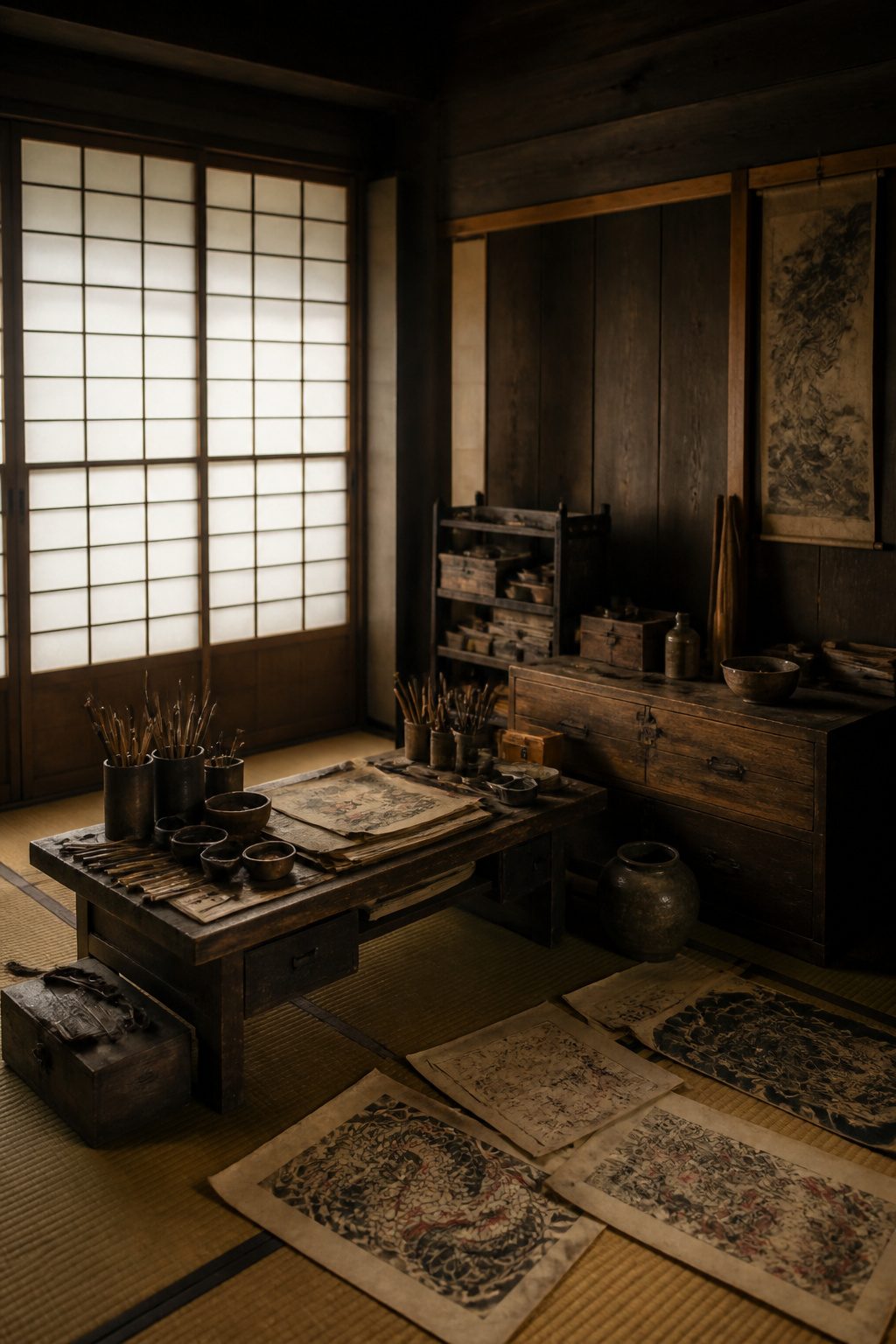
Punitive markings came first. Criminals and outcasts in early Japan wore tattoos forced on them by authorities, a visible record of shame that made the skin itself a prison. The Edo period (1603–1868) slowly turned that story inside out.
Laborers, firefighters, and gamblers, the very people who often carried these marks, began covering them with something else entirely: decorative work so elaborate the original punishment disappeared beneath it. Then the Chinese novel Suikoden arrived, and its tales of 108 outlaws resisting corrupt power spread through ukiyo-e woodblock prints. Utagawa Kuniyoshi and other printmakers showed these heroes wearing magnificent, sprawling designs. The images traveled. The working class of Edo saw rebels they recognized, brave and unapologetic, their tattoos a symbol of loyalty and defiance rather than disgrace.
Ukiyo-e and tattooing grew up together in those years. Print artists borrowed from tattoo culture; tattoo artists lifted the bold outlines, flat colors, and floating-world subjects straight from the woodblocks. Warriors, kabuki actors, courtesans, flowers, animals, and folk creatures all moved from paper to skin. The popular designs of that era, a tattooer named Taki Kitamura noted, remain the popular designs now. Some images simply last.
Tebori Hand Poking
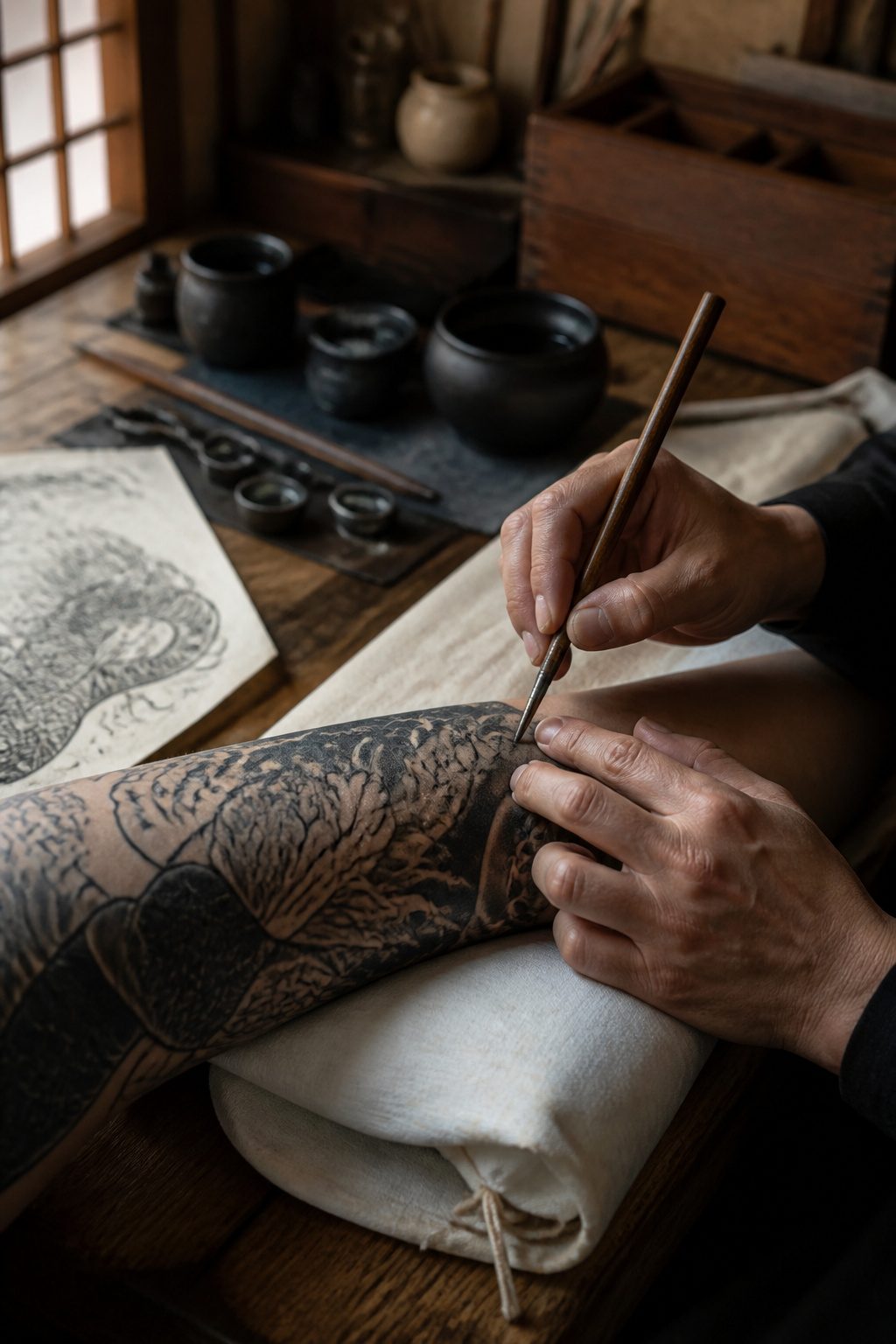
The quiet rhythm of tebori is what pulls most collectors in once they understand what they are looking at. A horishi dips a nomi, a long-handled tool with needle groupings fixed to its end, into ink and pushes pigment into skin by hand. The process is slower and more physically demanding than machine work, but that slowness is the point.
A modern machine punctures skin roughly a hundred times per second. Tebori builds each mark deliberately, and the difference shows in the healed result. The saturation runs deeper, producing a velvety black and solid color fields that carry a three-dimensional quality machine lines rarely achieve. Where machine work draws like a pen, tebori paints, leaving subtle texture that many collectors believe ages more gracefully on the body.
Pain levels vary by report. Some accounts describe tebori as more painful given the extended session time, with clients historically enduring the process as a mark of commitment. Others note it heals faster and with less irritation than machine work. The tool itself differs too: some horishi use a wooden or metal nomi, while others work with a sashibo, bamboo sticks in varying sizes with needles bound to them by cord.
Full tebori bodysuits emerged during Japan’s Edo period from 1603 to 1868, with larger pieces requiring two to five years to complete. Firefighters and laborers wore these works as proof of resilience. Today, Japanese-style tattooing still commands an estimated 15–20% of custom studio work, though true hand-poked tebori remains rare.
The Yakuza Stigma
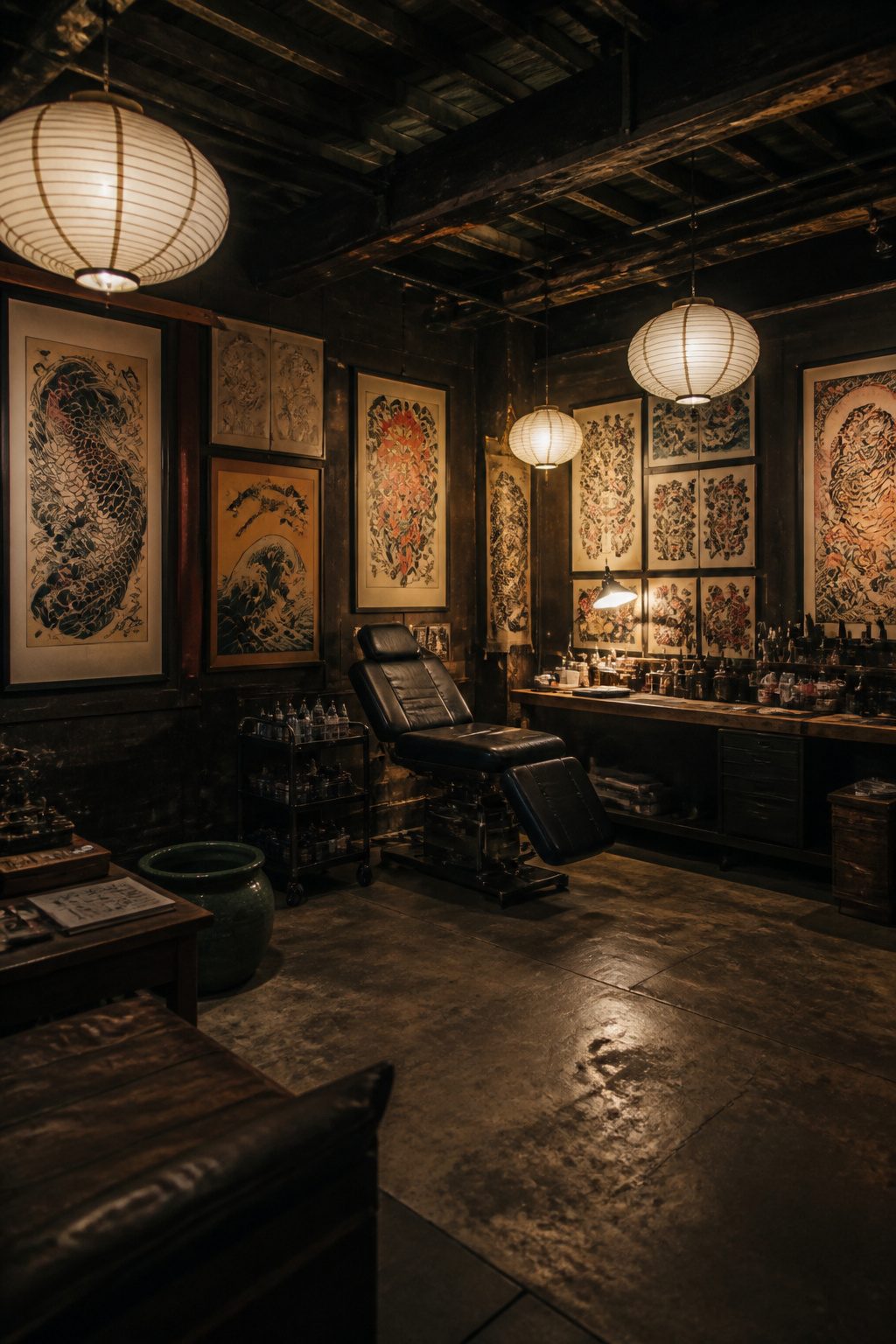
The stigma around traditional Japanese tattoos runs deeper than most Western collectors realize. During the Kofun period, from 250 to 600 AD, authorities branded criminals with punitive marks called bokkei, often placing the character for "dog" on a person’s forehead. That practice forged an association between ink and criminality that never fully faded.
By the Edo period, full-body suits had become markers of several groups: firefighters, laborers, and the yakuza. The 1960s and 1970s yakuza film boom locked the image in place, with Toei studio movies showing tattooed gangsters as a visual shorthand for menace. When government crackdowns intensified through the 1980s and 1990s, culminating in the 1992 anti-gang law, legitimate businesses began banning tattooed customers outright. Onsen owners turned away inked guests to avoid attracting organized crime attention. The yakuza population dropped from roughly 180,000 members at peak to 28,000 by late 2019, yet the blanket bans remained.
"Yakuza always want the best […] they want to look good, so they come here."
Horiyoshi III’s observation, quoted by VICE in 2017, cuts to what collectors now face: the same craftsmanship prized by outlaws is judged by their reputation. Sento public baths never barred tattoos, recognizing them as necessary for residents without home bathrooms. Onsen bans were commercial fear, not law. Today, younger Japanese and foreign visitors wear irezumi openly, and the number of practicing horishi has held steady despite decades of official pressure. The culture persists because the art outlasted the stigma that tried to smother it.
Where Motifs Go on the Body
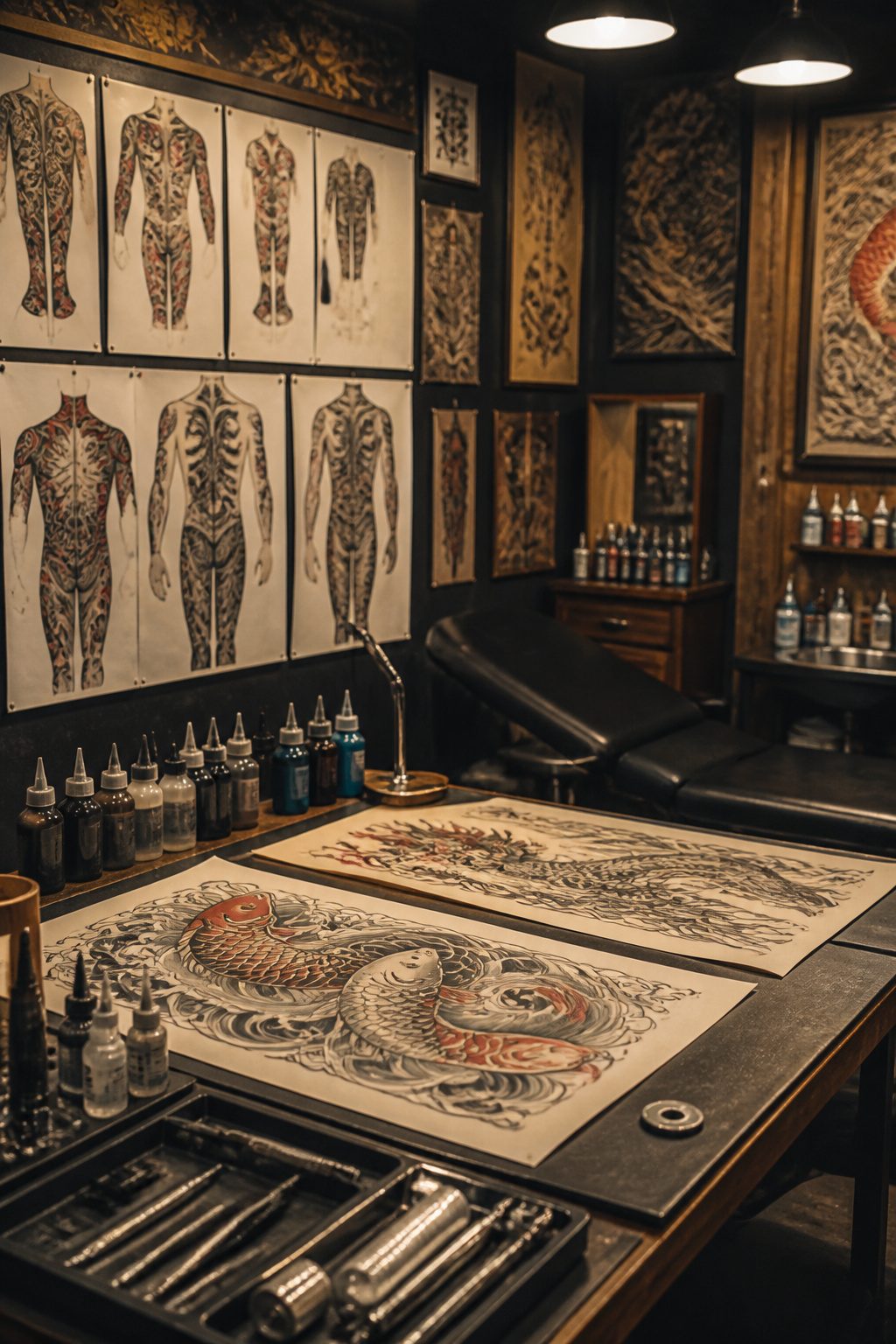
Traditional Japanese tattooing plans the body as a garment first and places the motif second. A dragon needs the broad, unbroken canvas of the back to coil properly; that is why you will nearly always find it there in classical work. Koi travel upstream along arms and legs, the limb’s length giving the fish room to swim and the viewer a story that follows the body’s movement. These are not suggestions. Working Japanese tattooers still keep the convention that a motif belongs where it belongs.
Full-body work has its own vocabulary. A donburi covers everything except hands, feet, head, face, and neck, named after the deep rice bowl decorated everywhere but its rim. A munewari leaves a bare strip down the center of chest and belly so the tattoo reads like an open workman’s coat when the wearer is shirtless. Hikae restricts itself to shoulder and chest, cut so a collared shirt hides it completely. Sleeve lengths run to precise points: nagasode to the wrist, shichibu to mid-forearm, gobu to the elbow.
What separates this system from Western custom is that nothing is added alone. The waves, wind bars, clouds, and companion flowers are chosen to agree with the main subject in season, element, and mood. A koi without current to push against is a fish going nowhere; the background is not filler but grammar.
Western Adaptations
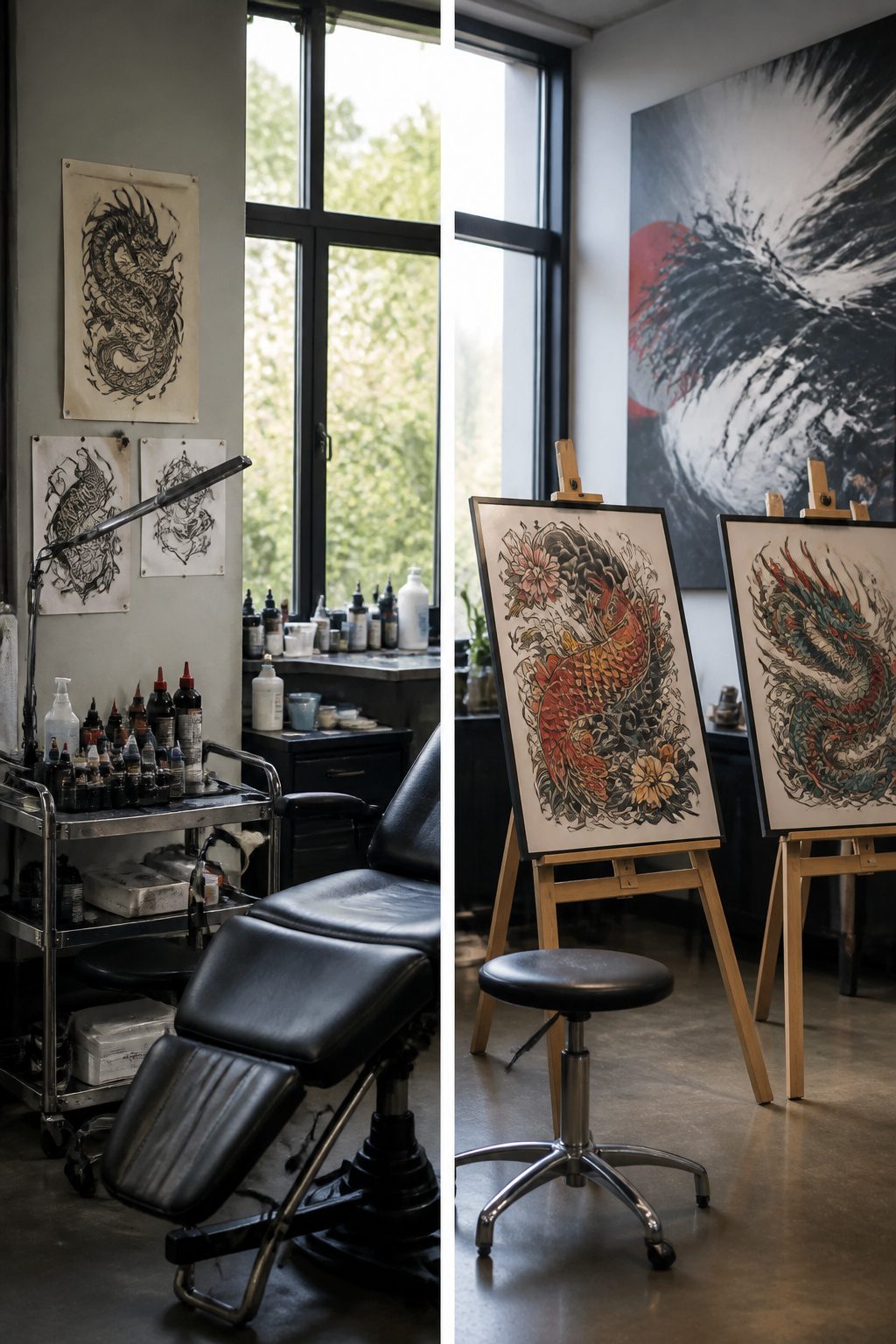
Western tattooers started borrowing Japanese imagery sometime in the late 20th century, and the gap between what they produced and what a horishi in Osaka would recognize is still worth measuring. The traditional Japanese approach builds a single composition that follows the body’s musculature, with integrated backgrounds of water, wind, or clouds unifying the whole piece. Western clients often want that aesthetic without the commitment. A full munewari bodysuit, the jacket-like form that leaves a bare strip from collar to navel for hiding under a kimono, demands years of sessions and a relationship with one artist. Most American collectors instead assemble sleeves or backpieces over time, sometimes from multiple tattooers, which breaks the cohesive flow that defines the form.
Horimitsu, working out of Osaka in 2009, called these small Western-style pieces tengo, a local word for mischief or stain, the kind of mark an adult might excuse in the young. That judgment still circulates in traditional circles. Yet Western demand has also revived techniques that might have faded. Tebori hand-poking, once standard, now draws clients precisely because it is slower and more ritualistic than electric machines. The clientele has shifted too: where Japanese tattooing historically carried criminal stigma through yakuza association, Western wearers often arrive with no exposure to that history, wanting a dragon or koi for its visual weight rather than its narrative meaning. Some Western artists respond by mixing Japanese motifs with unrelated styles, a practice traditionalists read as losing the symbolism that gives each element its purpose.
Frequently Asked Questions
What do traditional Japanese tattoos mean?
Each motif carries a fixed meaning, a conventional place on the body, and a set of companion elements it belongs with. A dragon signals benevolent power, a koi signals perseverance, and a peony signals courage. Nothing in traditional work is filler; every background wave, wind bar, and flower is chosen to agree with the subject in season, element, and mood.
How are traditional Japanese tattoos done?
Traditional tattoos are executed through tebori, a hand-poking method where a horishi dips a nomi, a long-handled tool with needle groupings, into ink and pushes pigment into skin by hand. The process is slower than machine work, but it produces deeper saturation with a velvety black and solid color fields that many collectors believe age more gracefully.
What is the history of Japanese tattoos?
The art took its modern form during the Edo period (1603–1868), when laborers and outlaws began covering punitive marks with decorative work. Utagawa Kuniyoshi’s 1827 print series The 108 Heroes of the Popular Suikoden, showing outlaw heroes in magnificent designs, set off a craze that fixed the visual grammar within a generation. The Meiji government later banned the practice, pushing it underground and tying it to the yakuza.