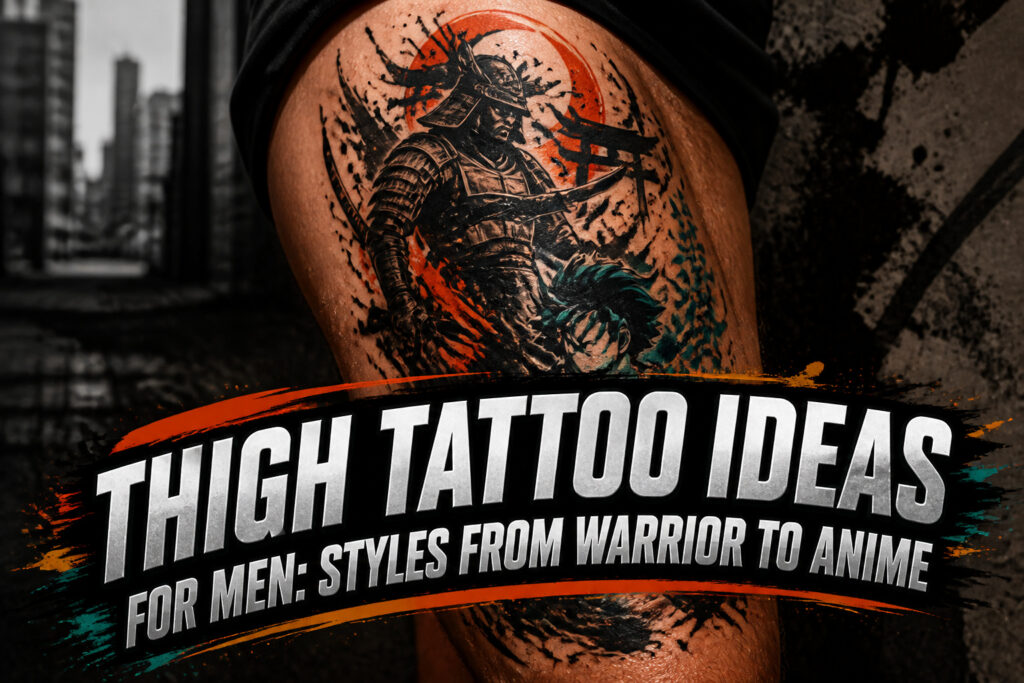
Thigh tattoo ideas for men span from full-leg biomechanical sleeves to single hidden crosses, and the deciding factor is usually how much of the leg you are willing to surrender to the process. The outer thigh rates a manageable 4 out of 10 for pain and heals cleaner than bone-close spots, but move inward and the same session hits 7–8, where thin skin and dense nerve endings leave no buffer. A samurai blade angled down the femur line lengthens the silhouette instead of fighting it, yet a standard Spartan helmet without personal integration reads as stock art. That distinction between placement that moves with muscle and ink that merely sits on it is what separates the pieces that stride when you do from the ones that stay static.
1. Warrior and Mythology Motifs
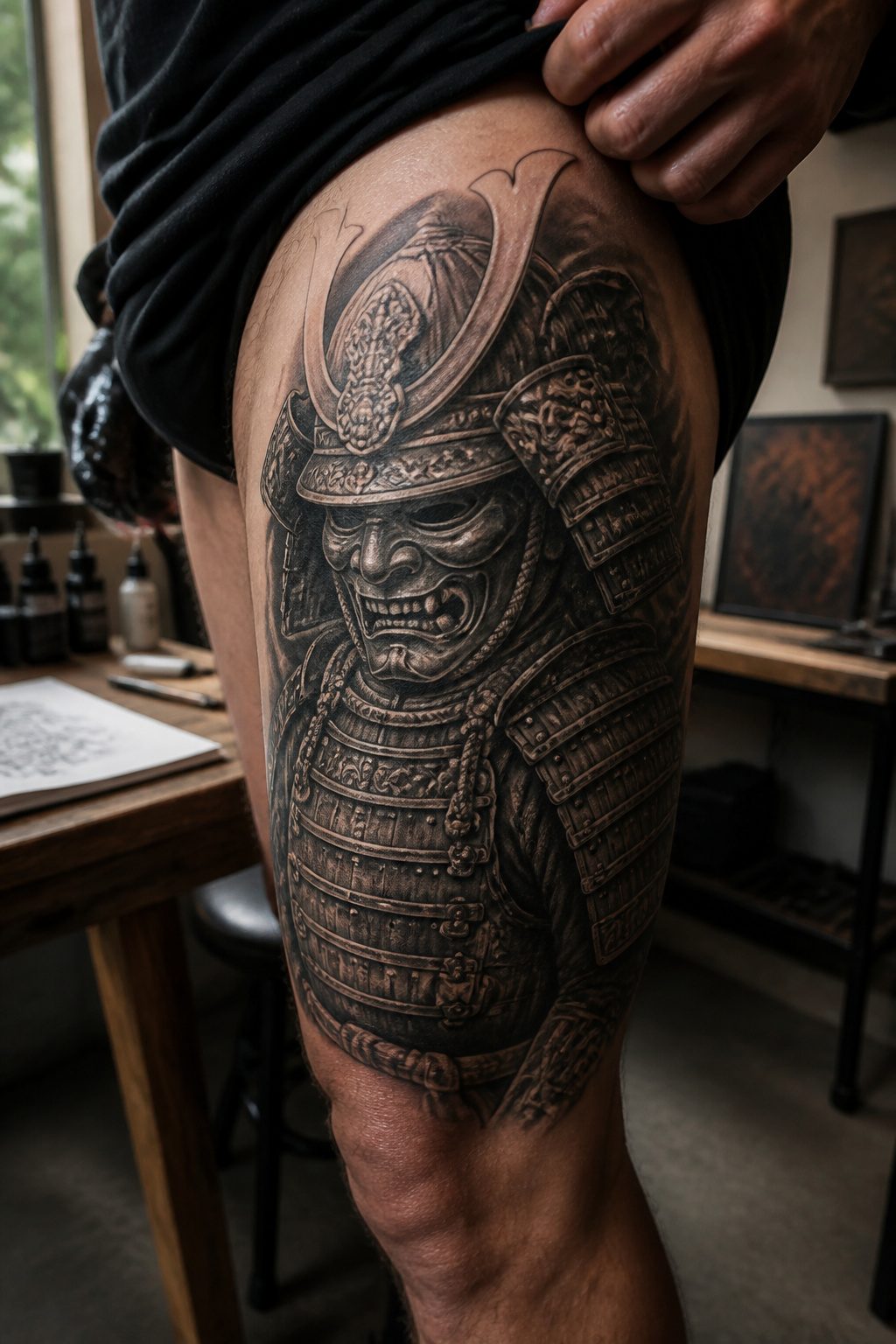
The thigh’s flat canvas carries weight best when the figure on it is already carrying weight. Samurai armor, a Spartan helmet, Thor’s hammer mid-swing, these pieces need room to breathe, and the upper leg gives them more square inches than the shoulder or forearm ever could.
What changed my mind about warrior tattoos was watching how the right design moves with the leg. A samurai blade angled down the femur line lengthens the silhouette instead of fighting it. The plume of a Greek helmet can follow that same curve. Static ink sits there; muscle-aware placement makes the figure stride when you do.
Generic imagery is the risk. A standard Spartan helmet reads as stock art. The fix is integration: family crest worked into the plume, or the Norse runes spelling something personal rather than decorative. The sources back this up. One thigh piece I kept returning to had a samurai’s armor shaded with precision, the Bushido code implicit in the stance rather than spelled out in a banner. That restraint reads as confidence.
Battle scenes work if you commit to the full canvas. A single combatant on a half-thigh patch looks stranded. The continuous narrative, a clash wrapping from outer to inner thigh, turns the leg into a scroll. Painful, yes, but the thigh’s muscle and fat cushion the work better than bone-close spots, so the sessions are manageable for the size you’re getting.
2. Animal Portraits
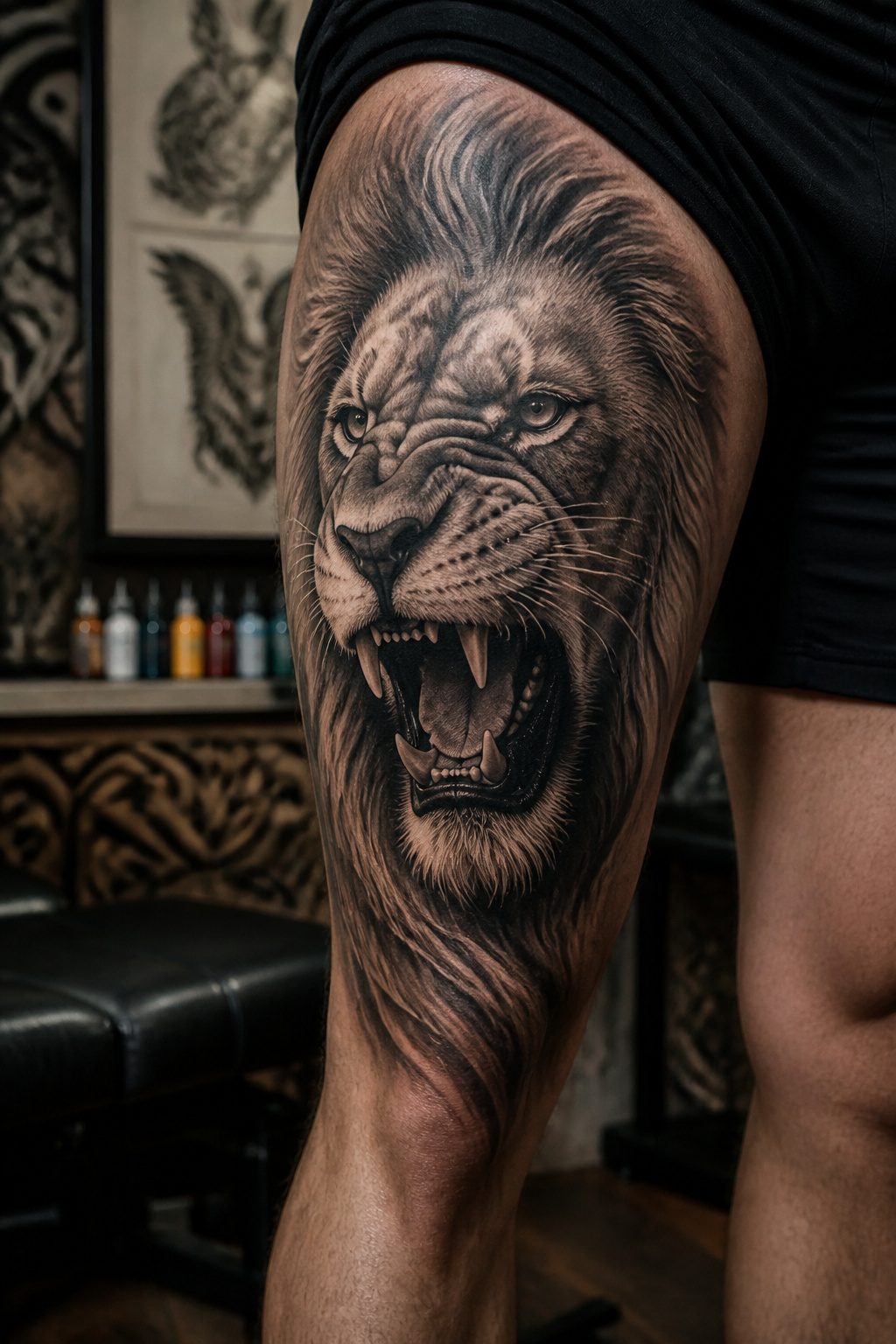
Predators dominate the list when guys start asking about thigh work. Lions, wolves, and snakes sit at the top of nearly every shop’s request sheet, and the reason is built into the leg itself. The quadricep’s natural curve frames a prowling animal the way a flat wall never could. When the vastus lateralis flexes, a wolf mid-howl gains actual movement, the ink shifting with the muscle beneath it.
Placement matters more here than with most subjects. Keep the eyes or jaw centered on the widest part of the quad, where the surface stays relatively flat. Shift that face too far to the outer thigh and the leg’s curvature wraps it into something distorted, a rookie mistake I’ve watched guys discover too late. The front of the thigh carries the least pain of any leg zone, which matters when you’re committing to the detail a lion’s mane demands.
A snake wrapping the outer quad works the same way, using the muscle’s rise and fall as part of the composition. These aren’t just popular choices; they’re the ones that make anatomical sense on this particular canvas.
3. Biomechanical and Industrial Designs
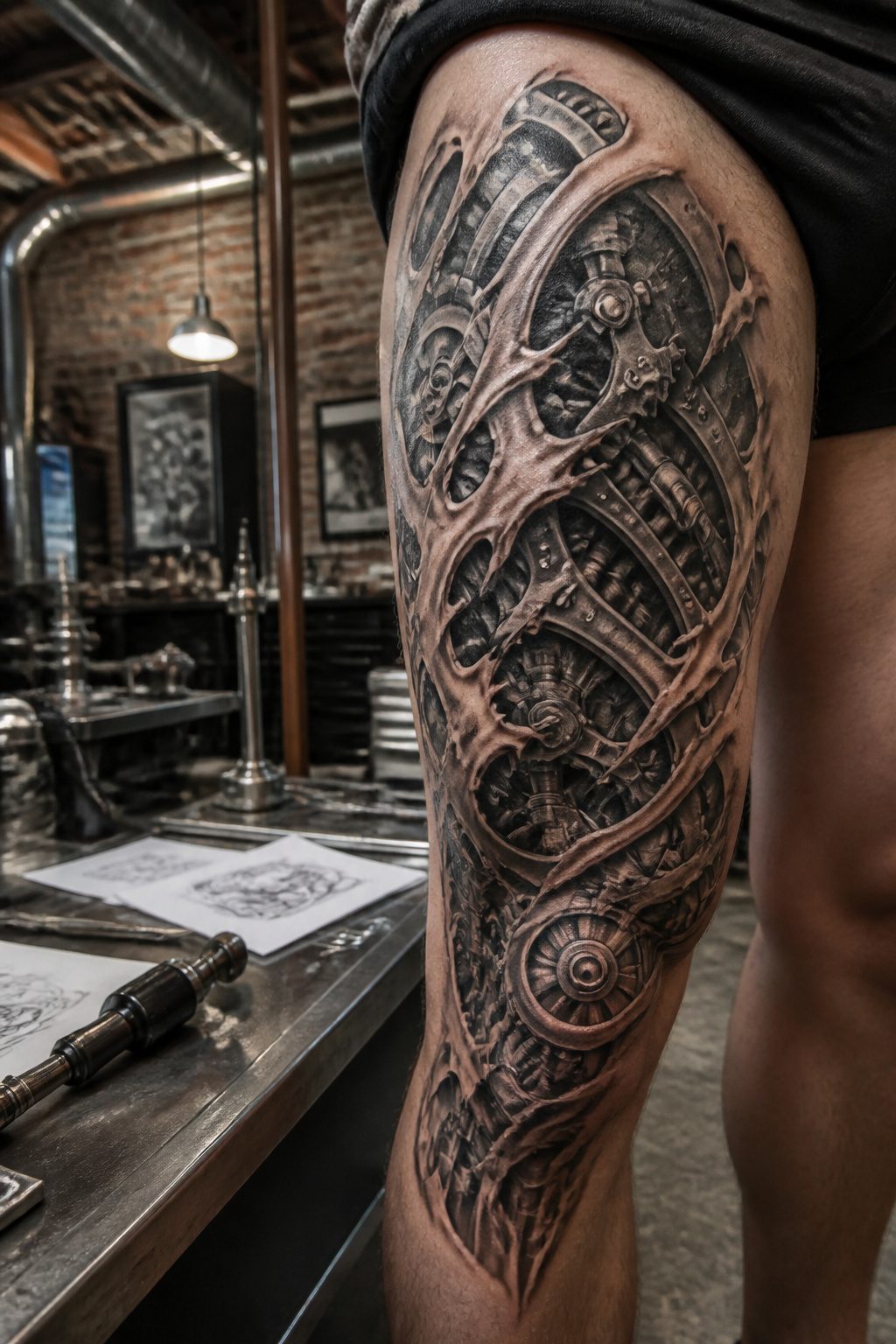
The flat planes of the thigh are where biomechanical work actually holds its illusion, turning gears and pistons into something that reads as machinery beneath torn skin. I have watched enough portfolios to know the difference between a design that sits on the surface and one that seems to replace the femur or quadriceps tendon visually. The alignment with real muscle insertion points is not decorative; it is what makes the eye accept the trick.
This style demands an artist who specializes in light sources and 3D shading, not someone who dabbles. The pistons need to read as cylindrical, the cybernetic panels as recessed behind actual flesh. A generalist working from a Google image will flatten everything into gray wallpaper. Men with engineering or industrial backgrounds often bring reference material from their own work, which helps, but the translation into tattoo pigment is its own discipline entirely.
Consultations matter more here than with simpler styles. Ten hours in a chair with an artist whose healed work you have not studied is a gamble on a result that cannot be revised easily. Look for healed photographs in their recent portfolio, not just fresh, swollen pieces under shop lights.
4. Tribal Tattoos
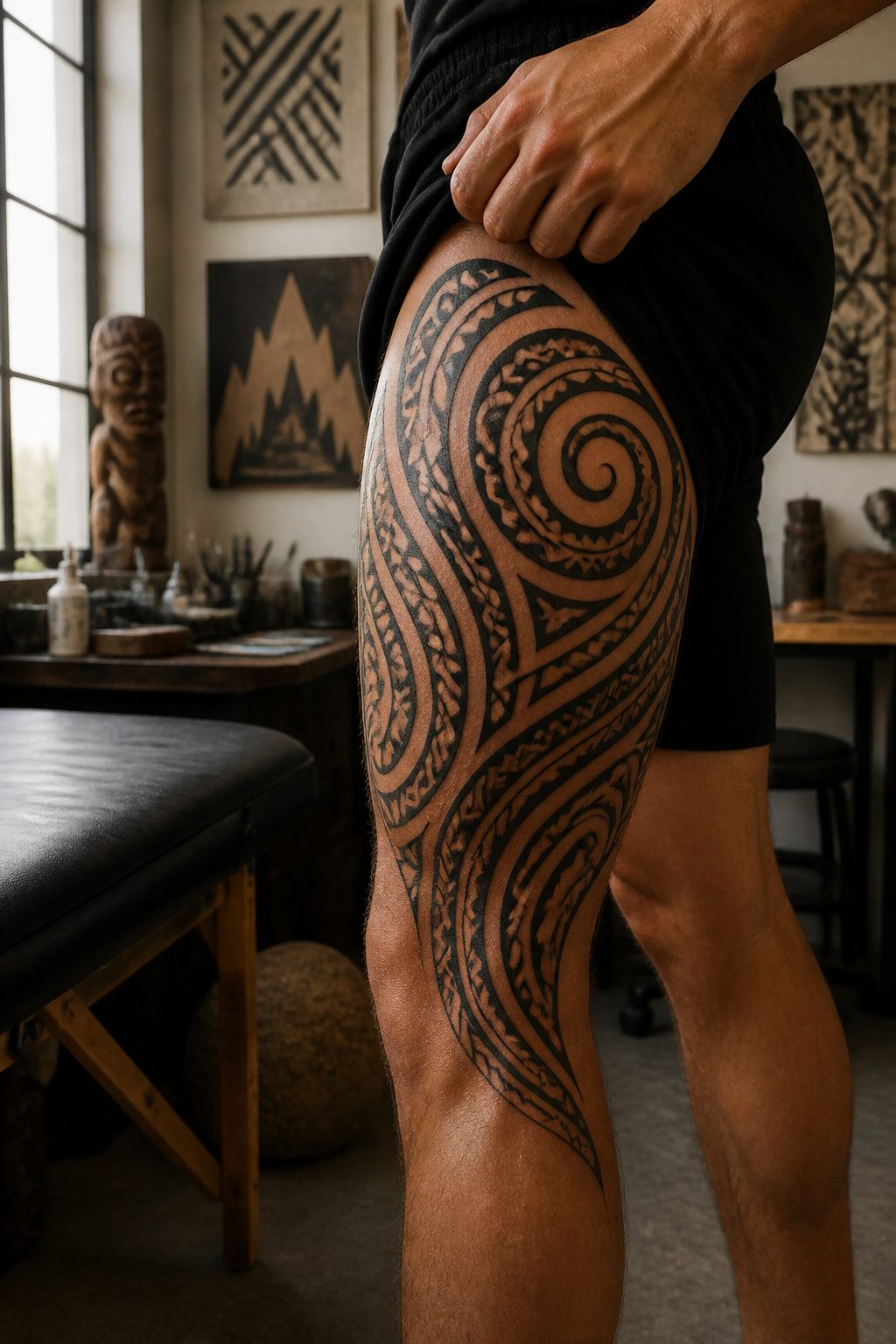
Tribal patterns carry some of the heaviest history in tattooing. Polynesian and Maori designs weren’t decoration; they recorded rank, genealogy, and acts of courage earned through pain. The thigh in particular marked warrior status and the completion of rites that demanded endurance. A full leg piece could take weeks of work with traditional tools.
That meaning gets lost when the pattern is copied without context. The shapes are specific: spirals, spearheads, and knotwork each carry assigned significance, and wearing them without the associated history is something that sits wrong once you know the difference.
The bold black ink and large scale do suit the thigh’s muscle structure. The curves follow natural contours in ways that flatter the leg. But research the symbolism before committing to the form, because the design should reflect something real about the wearer, not just borrow the aesthetic of someone else’s lineage. Modern artists who study under tradition-bearers can adapt personal narratives into authentic style without appropriation.
Thigh placement makes practical sense for these large pieces. The muscle and fat cushion the work, and the canvas accommodates the size these patterns need to read correctly. The option to conceal under professional dress remains intact.
5. Geometric Patterns
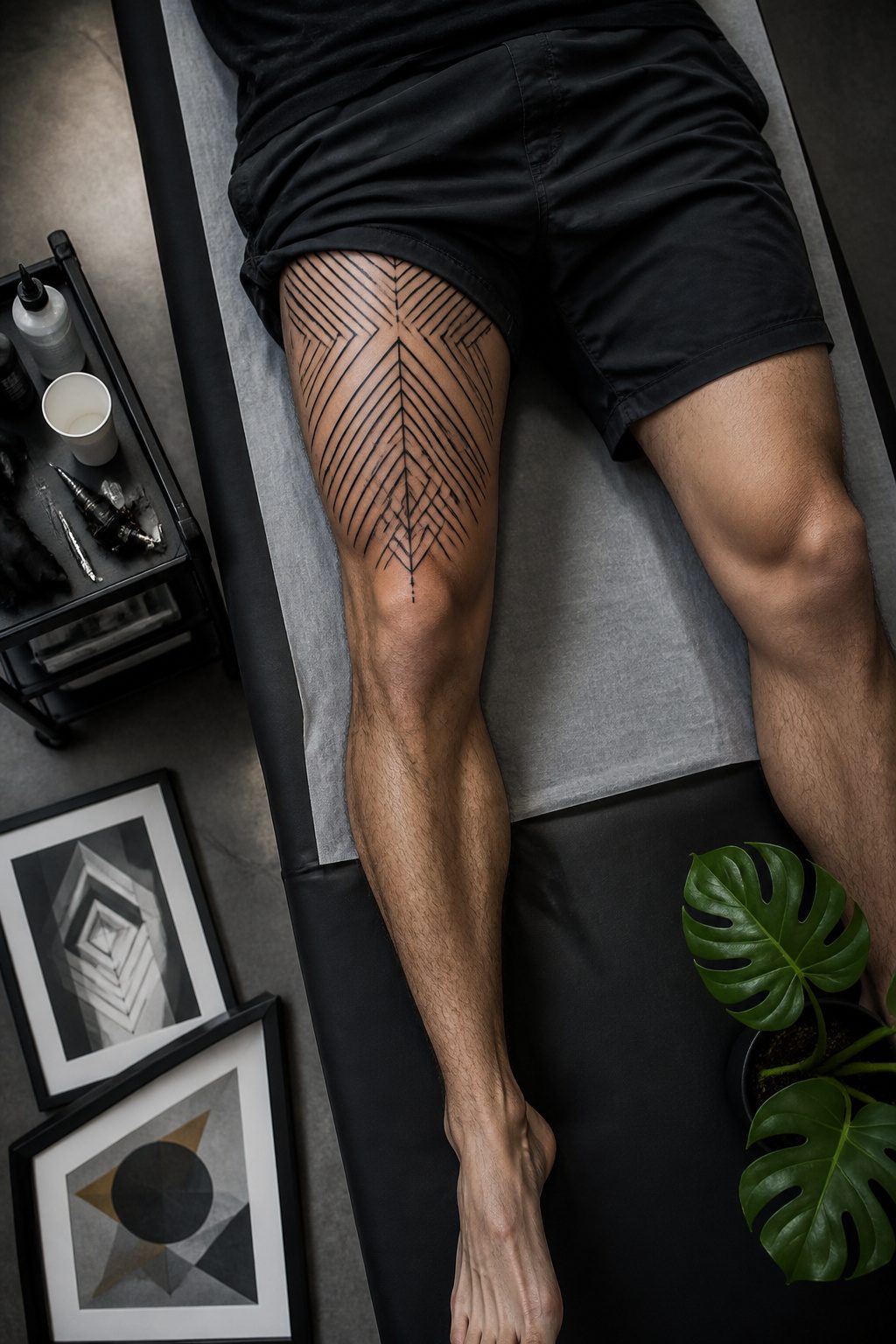
Geometric patterns on the thigh live or die by how precisely they track the leg’s built architecture. The quadricep’s natural striations give line work and dotwork something to ride, so a sacred geometry piece aligned with the vastus lateralis reads intentional rather than arbitrary. That same muscle movement creates dynamic distortion on softer designs, but clean geometry turns flex into feature; the lines appear to shift and reassemble as the leg works.
Thigh skin stability matters here more than most placements. The area carries more fat and thicker dermis than the ribs or chest, which means less needle trauma during the session and, down the road, cleaner aging. Shaded realism can blur and settle unpredictably over decades, but unshaded line work and stippled dotwork hold their edges because there’s less depth variation for gravity and sun to attack.
The catch is precision. A single waver in a geometric thigh piece broadcasts across the entire composition, and the scale of the canvas tempts artists into complexity they can’t execute dead straight. The thigh rewards simplicity executed perfectly over intricacy that sags. Dense hair regrowth obscures fine detail, so commit to regular trimming or keep the line weight bold enough to survive it. Moderate muscle gains of 10–15 pounds won’t distort the work significantly, but anyone planning extreme size changes should reach their goal first; stretched geometric lines never recover their original tension.
6. Religious Symbols
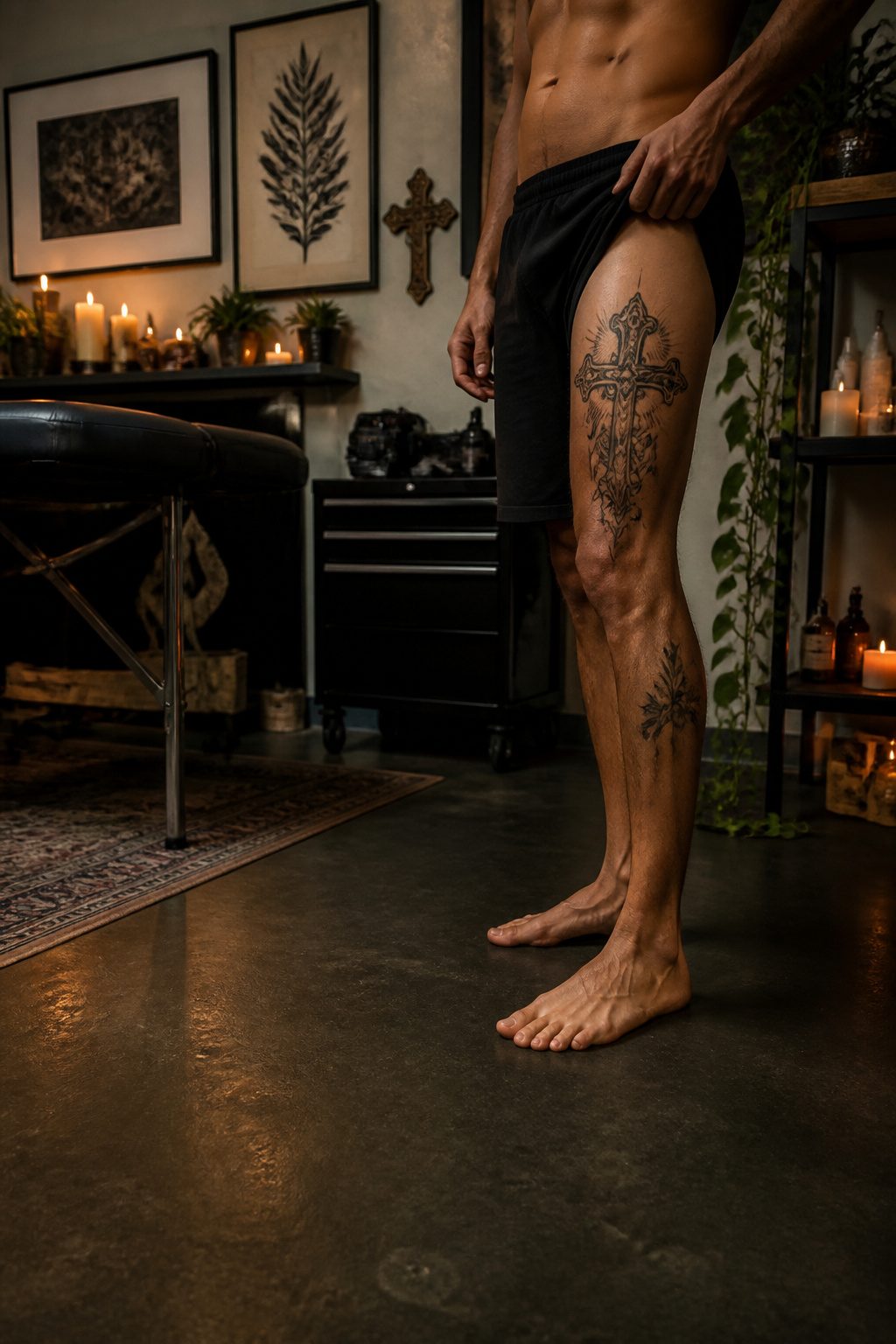
The thigh’s privacy is the point for religious work. A cross can sit entirely inside a suit pant leg, visible only at the gym or by choice. That control matters when faith is personal, not a billboard.
Praying hands and biblical scenes read differently here than on a forearm. The scale lets a Last Supper or a detailed crucifixion breathe across the quadriceps, flowing with the muscle striations rather than fighting them. Rosary beads can wrap the leg like a sleeve, each decade marked in actual size.
The tradeoff is placement. Inner thigh skin shifts more with weight change and ages faster than outer thigh muscle. A cross on the outer sweep holds its geometry; the same design on the inner face may blur sooner.
Iconography also carries less baggage in 2026 than a decade ago. The dual identity the thigh allows, completely hidden in professional settings, means a man can wear a full biblical scene without the assumptions that follow neck or hand ink. The faith is his, the display optional.
7. Floral and Nature Themes
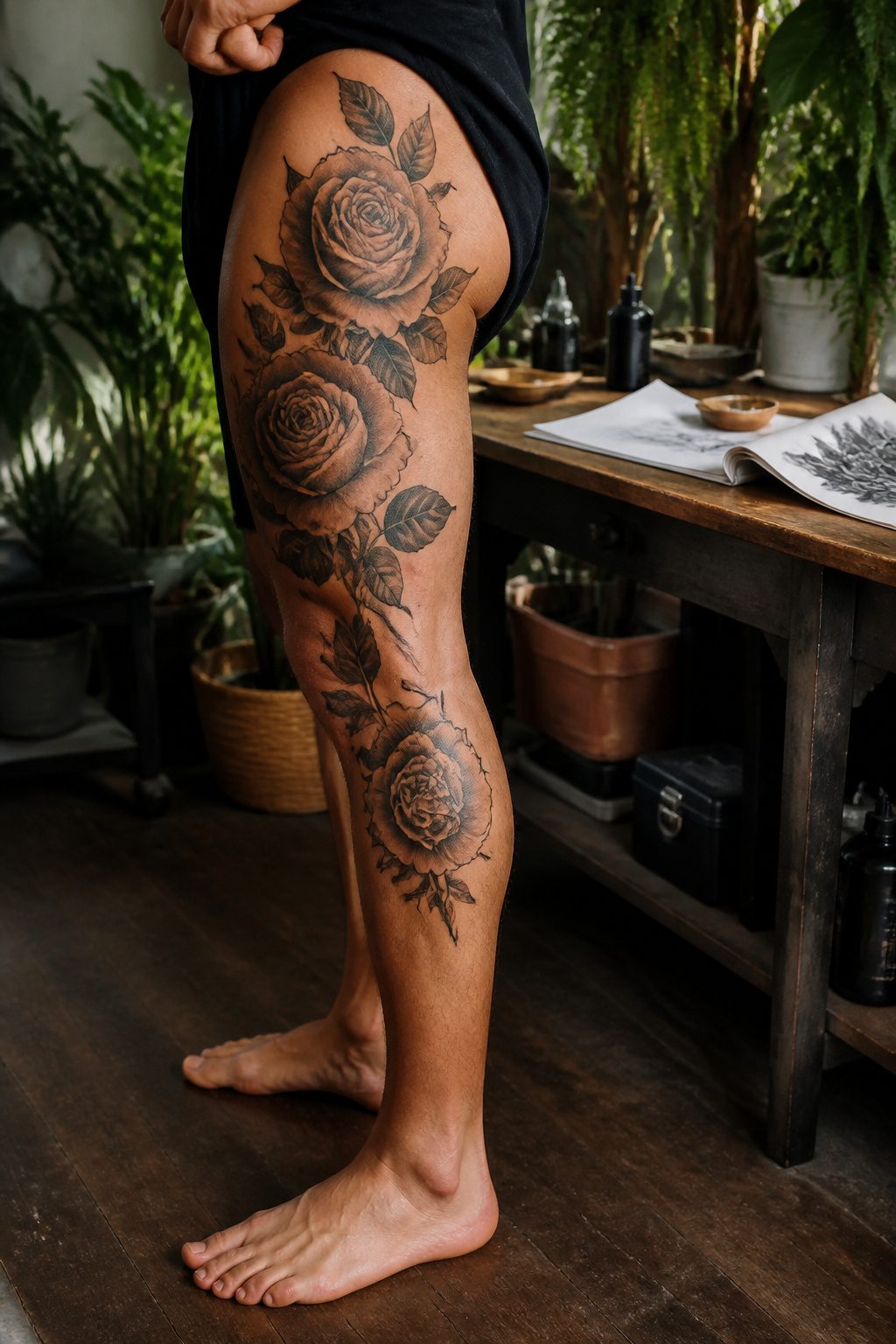
Roses and lotus flowers on a thigh read masculine when the scale goes large and the palette stays restrained. A single black-and-gray rose climbing from knee to hip carries weight that a scattered bouquet of color simply does not; the same flower at eight inches tall versus three changes the entire statement. Trees work similarly. A lone oak or pine rendered in fine-line detail across the outer thigh can look illustrative and soft, but that same tree blown up to wrap the leg, roots digging below the knee and canopy cresting near the hip, becomes something closer to armor.
Full landscape sleeves wrapping the leg are where nature themes prove themselves outright. A mountain ridge that follows the thigh’s curve, snow caps catching light as the muscle moves, reads as geography and endurance rather than decoration. Color choice determines tone faster than subject does: earth tones and desaturated greens hold a steadier masculine register than bright botanicals. Composition matters too. Flowers clustered delicate and central feel ornamental; flowers used as structural elements in a larger scene, or rendered half-wilted, thorned, and oversized, shift the frame entirely. The thigh’s real estate lets you go big enough that the subject becomes atmosphere rather than accent, and that is where the gendered assumption falls away.
8. Anime Characters
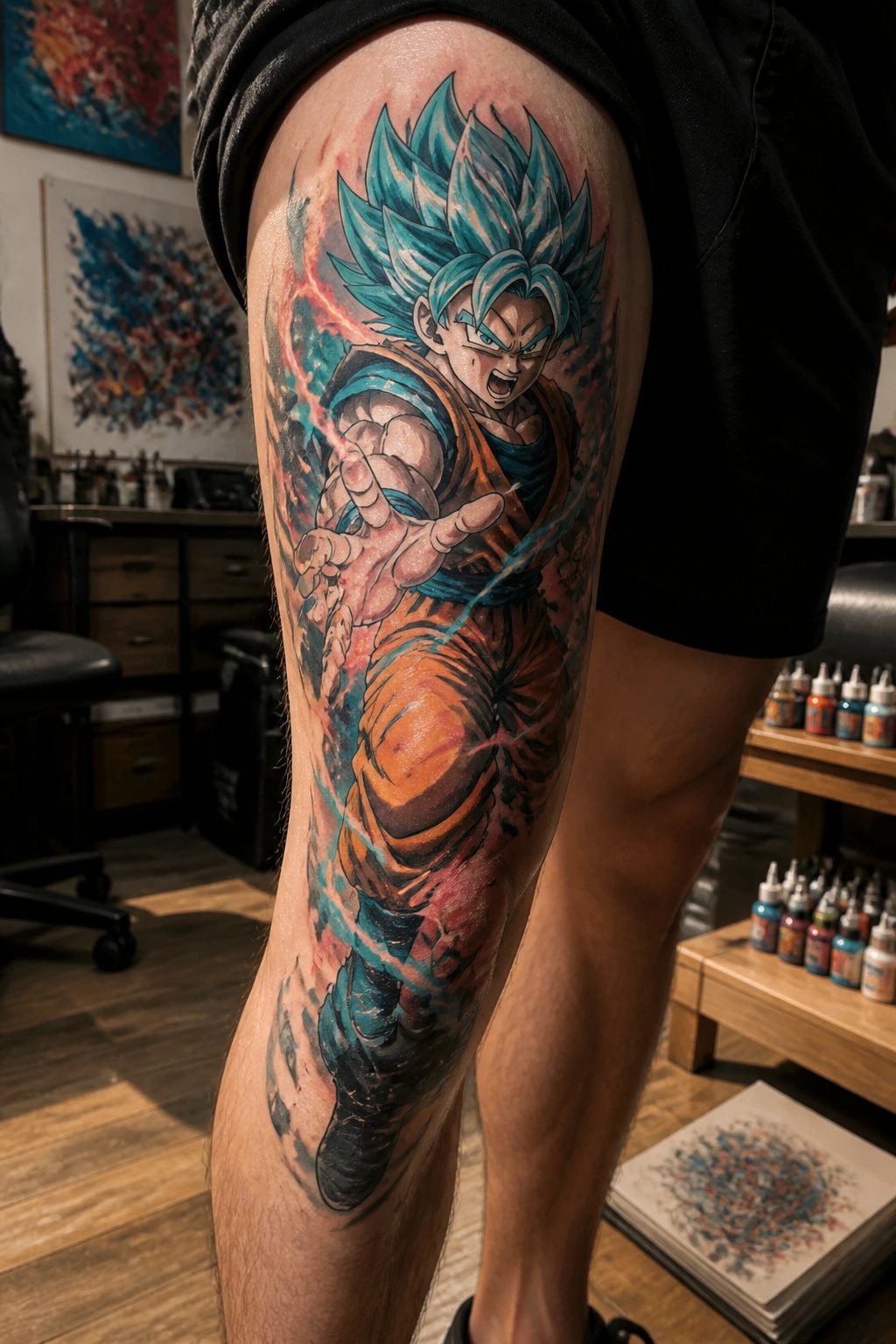
Anime tattoos on the thigh work best when the artist builds the pose from scratch rather than tracing a screenshot. The vertical length of the leg gives room for the kind of action stance that flat wall art can’t accommodate; a character mid-leap or drawing a sword reads naturally when the composition follows the muscle line from hip to knee. Full-color pieces hold saturation well here, though blackwork versions age cleaner if the line weight stays bold enough.
The licensing question matters more than most clients expect. Studios that reproduce official character art exactly can face cease-and-desist orders, particularly for properties with active US distribution. What protects the wearer and the shop is original interpretation: an artist who knows the source material well enough to capture the silhouette and mood without copying the promotional still. The result still reads as Goku or Spike to anyone who recognizes it, but it sits on your skin as a one-of-one piece.
The thigh’s flat plane also means less distortion than a shoulder or calf when the leg moves. A design that looks compressed at the sketch stage will stay compressed once healed. Plan for the pose to work at full leg extension, not just seated in the chair.
9. Skull Tattoos
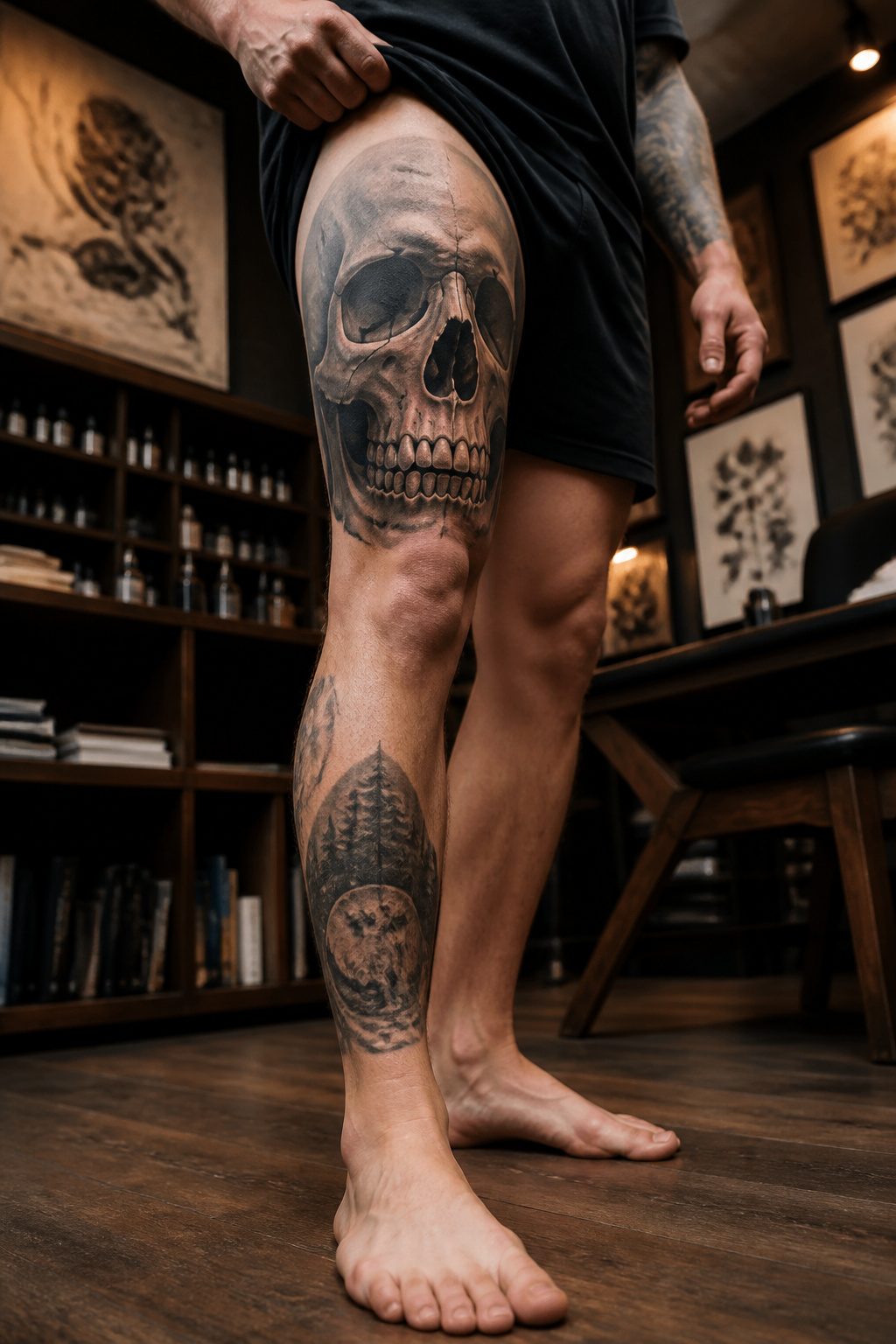
Photorealistic skulls on the thigh have a way of stopping conversation. The flat, broad canvas from knee to hip lets an artist render every crack in the bone, every hollow where light falls through, at a scale that reads as actual anatomy rather than a shrunken symbol. I have seen pieces where the shadow under the cheekbone alone took four hours, and the result made the leg look as though someone had peeled back living tissue.
The real range is stylistic, not just technical. Sugar skulls bring Day of the Dead color and pattern into the same space, trading dread for celebration. Military insignia skulls, crossed rifles or berets in place of roses, borrow from that same tradition but point it elsewhere: not memento mori exactly, but a specific brotherhood’s shorthand for having looked at death and continued.
Pirate imagery sits at the other pole, looser and more illustrative. A skull above crossed cutlasses reads differently than a skull flanked by roses or rosary beads; the thigh’s length lets you build a scene rather than a portrait, ship and sea and smoke included.
Size moves freely here. A single skull can dominate the outer thigh, or a string of smaller ones can climb from knee toward hip. The muscle curve does not fight the design the way a shoulder or rib cage might; the bone sits under fat and flesh, giving the artist a stable plane.
10. Mandala Designs
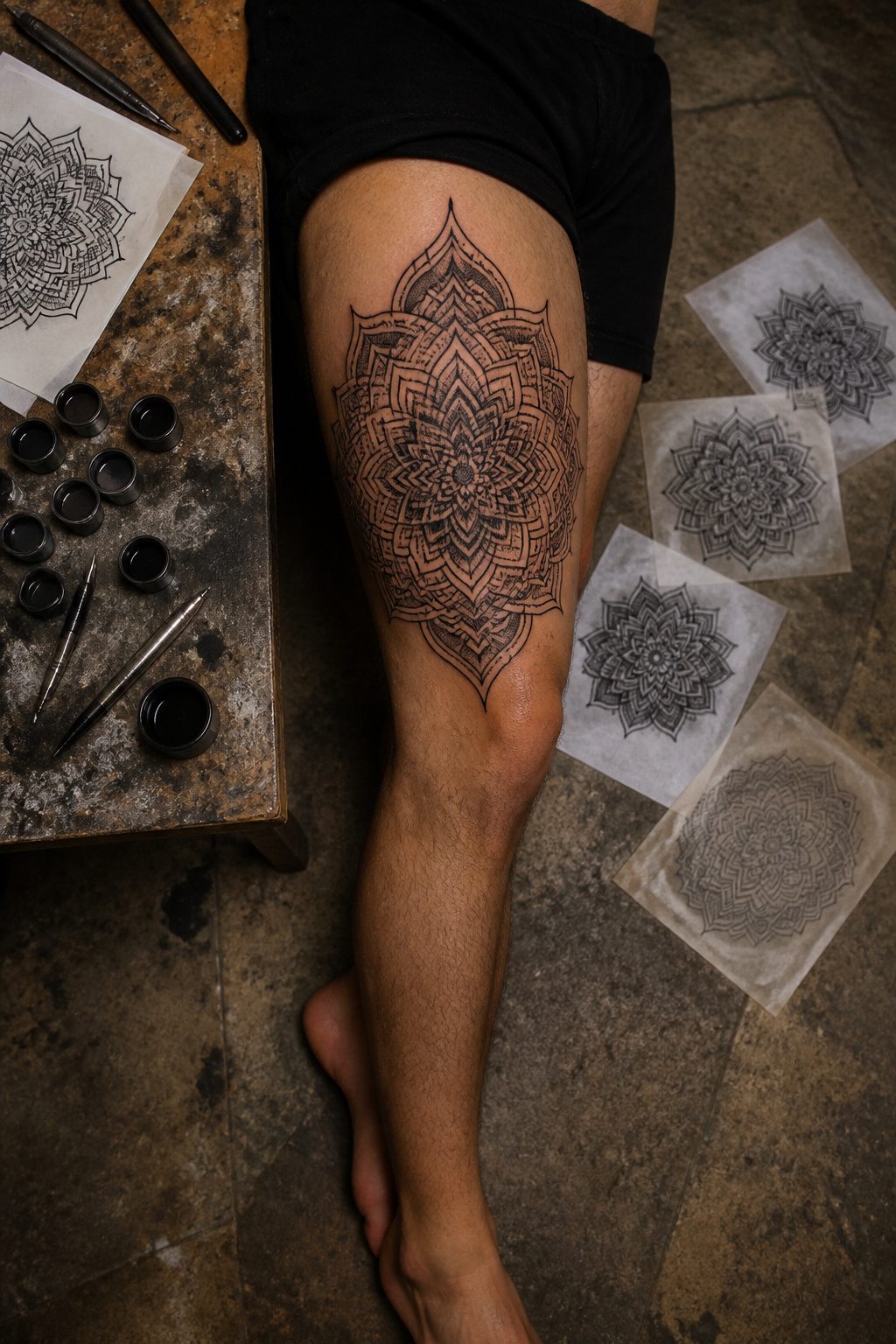
A mandala sits flat on paper, but the thigh curves in every direction. The circle has to distort to look round, so the artist pulls the center slightly wider and lets the outer rings tighten as they wrap toward the hip and knee. Done well, the geometry reads as perfectly symmetrical from the front even though no two quadrants are actually identical.
The thigh’s muscle and fat padding gives the artist time. Large, dense mandalas with layered petals or interlocking knots need that stability, and the skin here heals with less distortion than bone-close spots. A single centered piece works on the outer thigh; repeated mandalas marching down the leg suit the larger canvas.
Color stays optional. Heavy black linework ages cleaner on legs than on hands or ribs, where sun breaks it down faster. If the design incorporates geometry behind it, the mandala’s repetition already provides enough visual weight without extra shading.
The spiritual origin is there for those who want it, but most men I see now treat the form as pure ornament. The tradeoff: a full mandala large enough to carry detail runs toward the longer sessions, though the discomfort stays manageable. What wears poorly is cramming too fine a pattern into too small a space; the lines blur together inside five years, and the thigh’s movement accelerates that. Keep the negative space generous between elements, or the whole piece muddies into a gray disk.
11. Abstract and Surreal Art
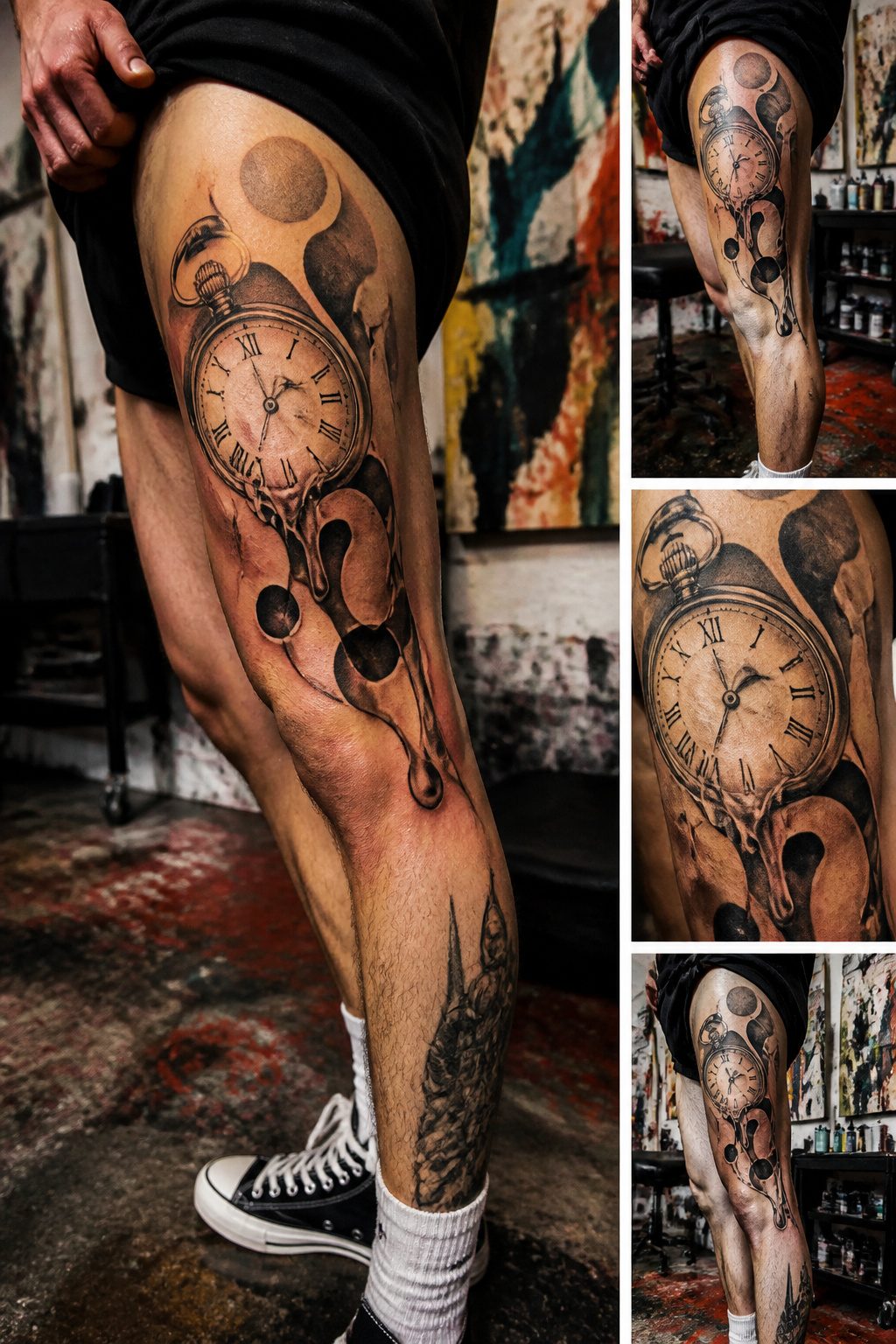
Surreal thigh work lets the artist interpret a loose idea rather than copy a reference photo. A melting pocket watch or staircase that climbs into nowhere reads differently on a leg than on an arm; the thigh’s flat planes give impossible architecture room to breathe, and the muscle curve can make a Dali-influenced form look like it is actually sliding. You have to let go of the sketch and trust the artist’s eye, because the best surreal pieces shift during the session as the skin stretches and settles. I have watched collectors bring in three sentences of dream description and walk out with something that does not match any of it, yet still feels true to what they asked for. That is the gamble. The style fails when the client keeps demanding revisions against the logic the artist is building; you either commit to the interpretation or you pick a different category entirely.
12. Cover-up Tattoos
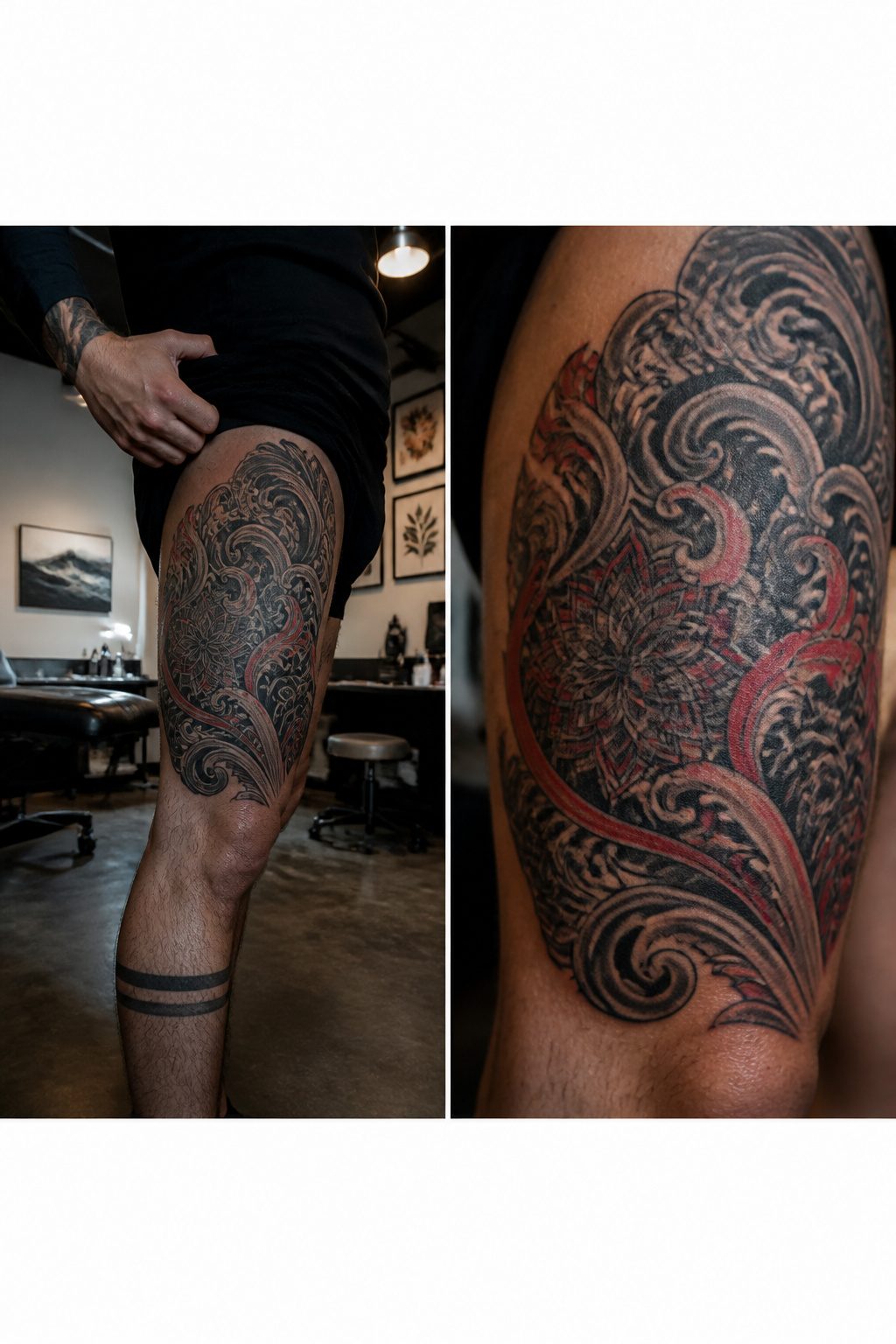
Thigh skin holds ink differently than chest or back skin, and years of walking, sitting, and muscle movement work the dermis over time. An old piece you want gone may have settled in deeper than a straightforward cover-up can mask, especially if the original artist packed in solid black or dense color saturation.
Laser sessions come first more often than clients expect. Fading an existing tattoo two to four shades lighter opens the canvas enough that the new design’s lines read clean and the color sits true. Without that step, the old image ghosts through, usually as muddy browns or unintended grays where the new pigment mixes with what would not budge.
The thigh’s surface area helps. A skilled artist can move the rework onto fresh skin nearby, letting the old piece become background texture or negative space rather than fighting it head-on. That only works when the placement allows, and when the client accepts a larger final piece than they started with.
What the Thigh Tattoo Costs

Full thigh pieces run $800 to $2,500 or more, and that spread comes down to decisions you make before the needle touches skin. Size is the obvious driver: a full front thigh can eat eight to fifteen hours of chair time, and most reputable artists in the United States bill $100 to $300 per hour. Detail pushes the total harder than raw dimensions. Color work slows the pace because saturation demands passes and healing checks that blackwork skips. A specialist who lives in realism or Japanese Irezumi sits at the top of that hourly range and often books months out, which is where the real cost of patience gets added in.
Bargain hunting is a mistake that shows up five years later in blown lines and faded patches. The difference between a mid-range artist and a premium one is not always visible in the stencil, but it is visible at year three when the skin settles. Save the gap, wait the wait, and book the person whose healed work you have actually seen in person.
Pain Levels by Thigh Zone
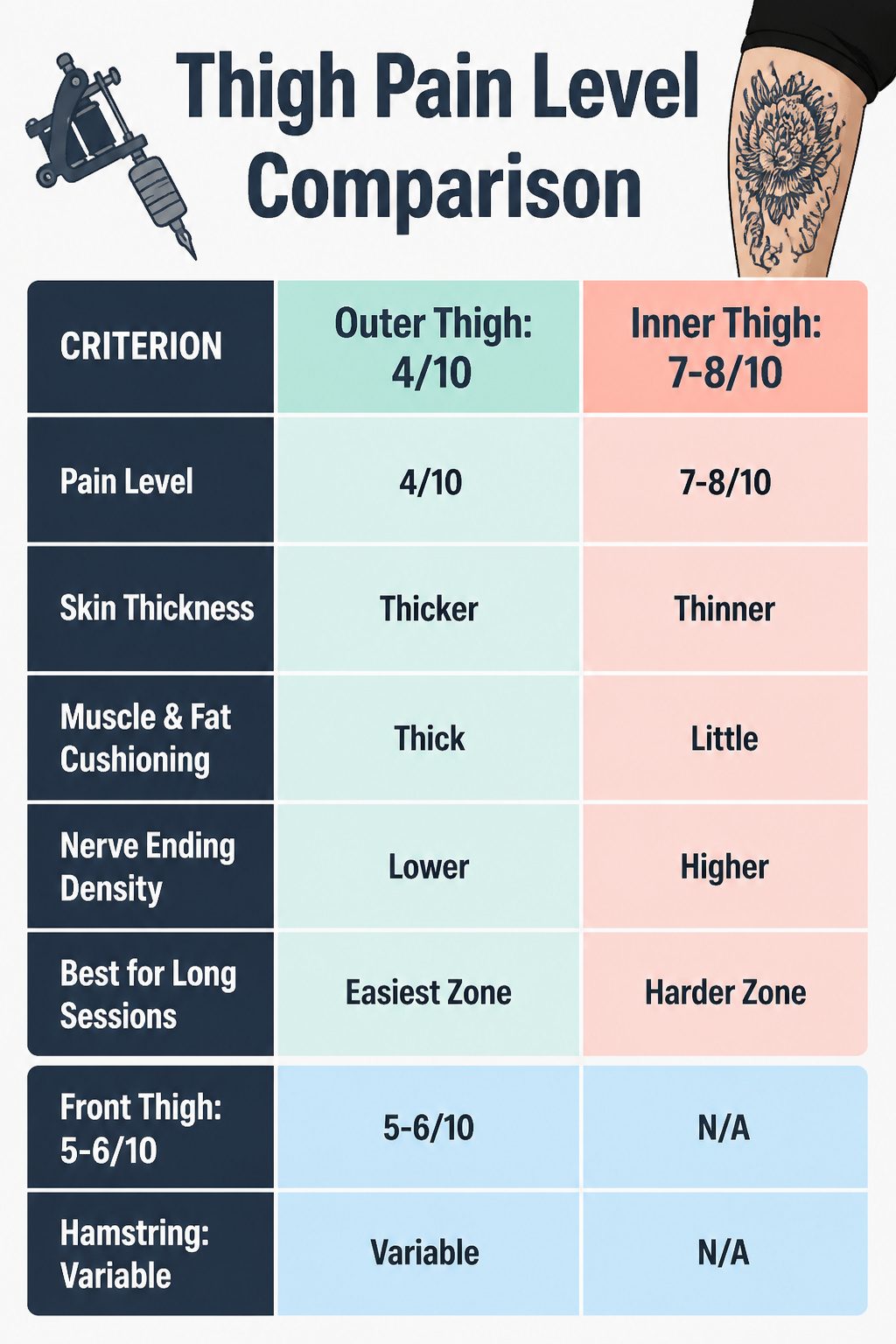
The outer thigh sits at a comfortable 4 out of 10 for most people, the easiest zone for long sessions because thick muscle and fat cushion the needle against vibration. That same padding is why artists can run 10- to 14-inch pieces there in a single day without the cumulative wear grinding you down.
Move inward and the math changes fast. The inner thigh hits 7–8 out of 10, thinner skin and denser nerve endings leaving little buffer between the needle and the sensation underneath. The front thigh splits the difference at 5–6, spiking near the knee where skin thins again, while the back of the leg, the hamstring, carries its own reputation: large muscle, but thinner skin and more nerve endings than the outer quad, so hours of work there test endurance differently.
Session length matters as much as placement. A four-hour sit on the outer thigh versus two hours on the inner thigh can flip which one actually drains you more. The body does not reset between passes; discomfort stacks. Plan accordingly.
Healing Time and What to Expect
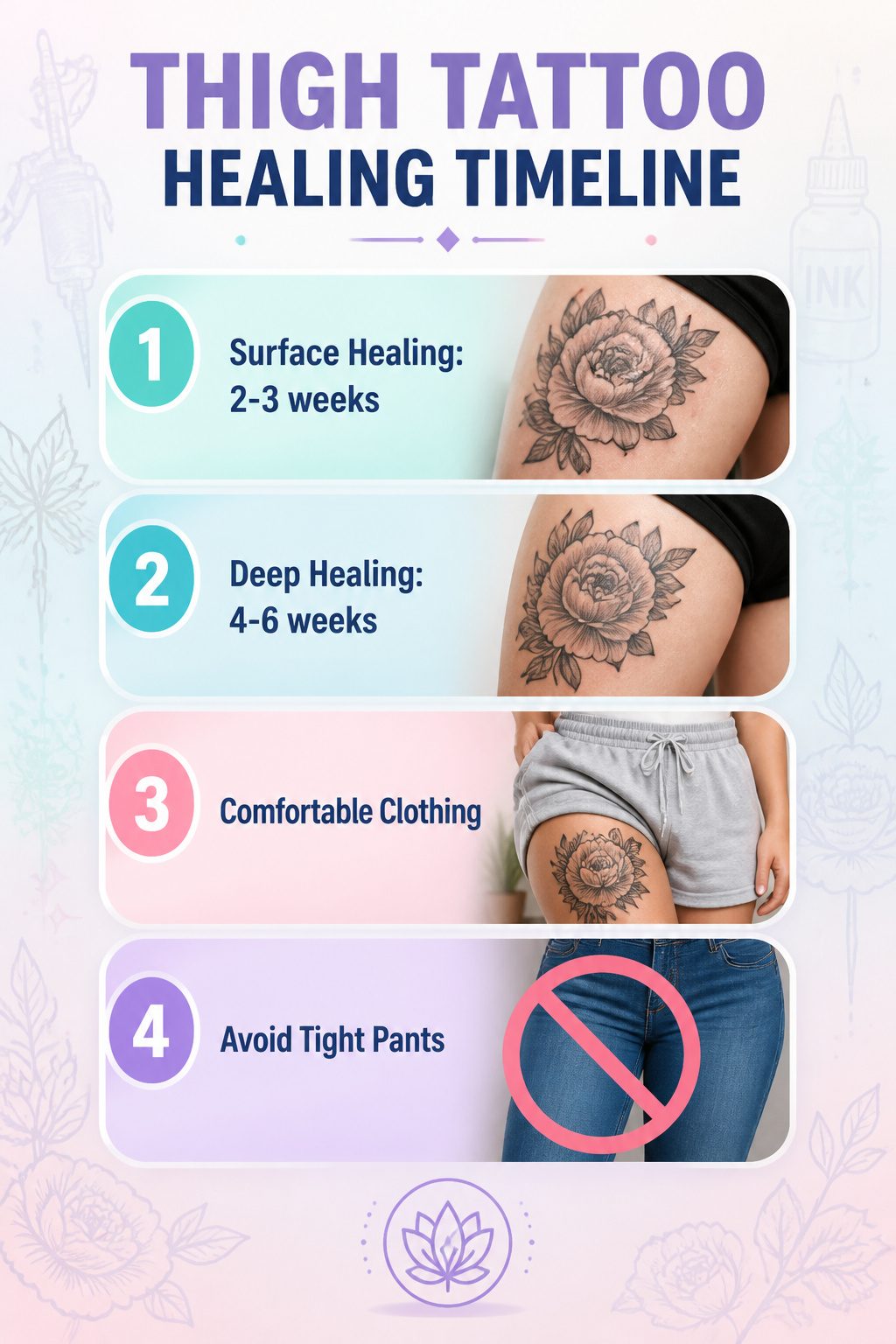
Surface healing on a thigh piece runs 2 to 3 weeks, though the deeper layers need 4 to 6 weeks before the ink has fully settled. The thigh heals cleaner than a lot of spots because the outer quad carries enough muscle mass to act as a natural cushion, and daily life does not rub it the way calf placement does. The catch is night contact. Bedding presses against the inner thigh in particular, so loose shorts during sleep matter more than most clients expect at first.
Loose clothing is the move for that entire window. Regular shorts that can be pinned high without cutting circulation keep fabric off the fresh work while still letting you walk around without flashing the neighborhood. Tight pants in the first few weeks are the single fastest way to push ink out through friction or trap moisture against healing skin. After the surface closes, the thigh still wins for longevity: it sees less sun than arms or chest, and the skin there ages slower than spots that wrinkle early.
Sizing Designs to Leg Musculature
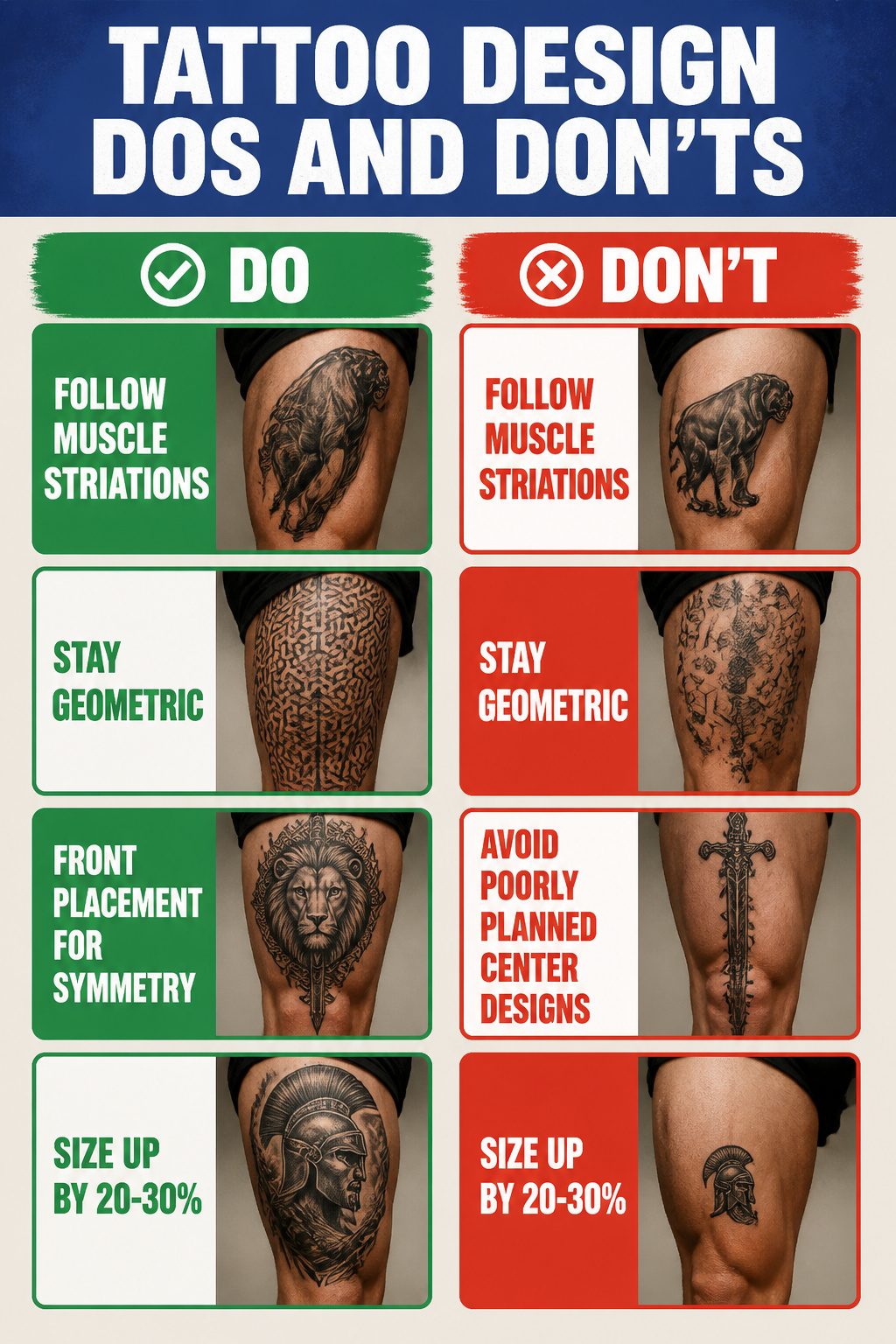
A piece that ignores leg shape will distort when the muscle flexes, and that distortion is the first thing people notice from across the room. The ink should follow the quadricep’s natural striations, not fight them. On a well-built outer thigh, a prowling panther wrapping the quad gains menace when the vastus lateralis contracts because the design was laid to move with that specific muscle, not across it like a sticker.
Geometric patterns aligned with those striations read as architecturally intentional. Random placement looks accidental by comparison.
Front-facing placement works for centered, symmetrical designs: animal heads, daggers, pieces that need to confront the viewer head-on. The tradeoff is the knee joint. A design running straight down the center thigh breaks awkwardly at the patella unless the artist plans for that interruption and carries visual momentum around or through it.
Side placement gives a longer, more vertical canvas for swords, snakes, towers, anything that flows better top-to-bottom than it wraps. The flow of the quad and the muscles around the knee still matter, but the artist works with lateral movement rather than frontal symmetry.
Most men size too small initially. On muscular legs, mass absorbs visual impact. Adding 20–30% to your first instinct keeps the piece present from a distance, which is where most people will see it.
When to Hide It and When to Show It
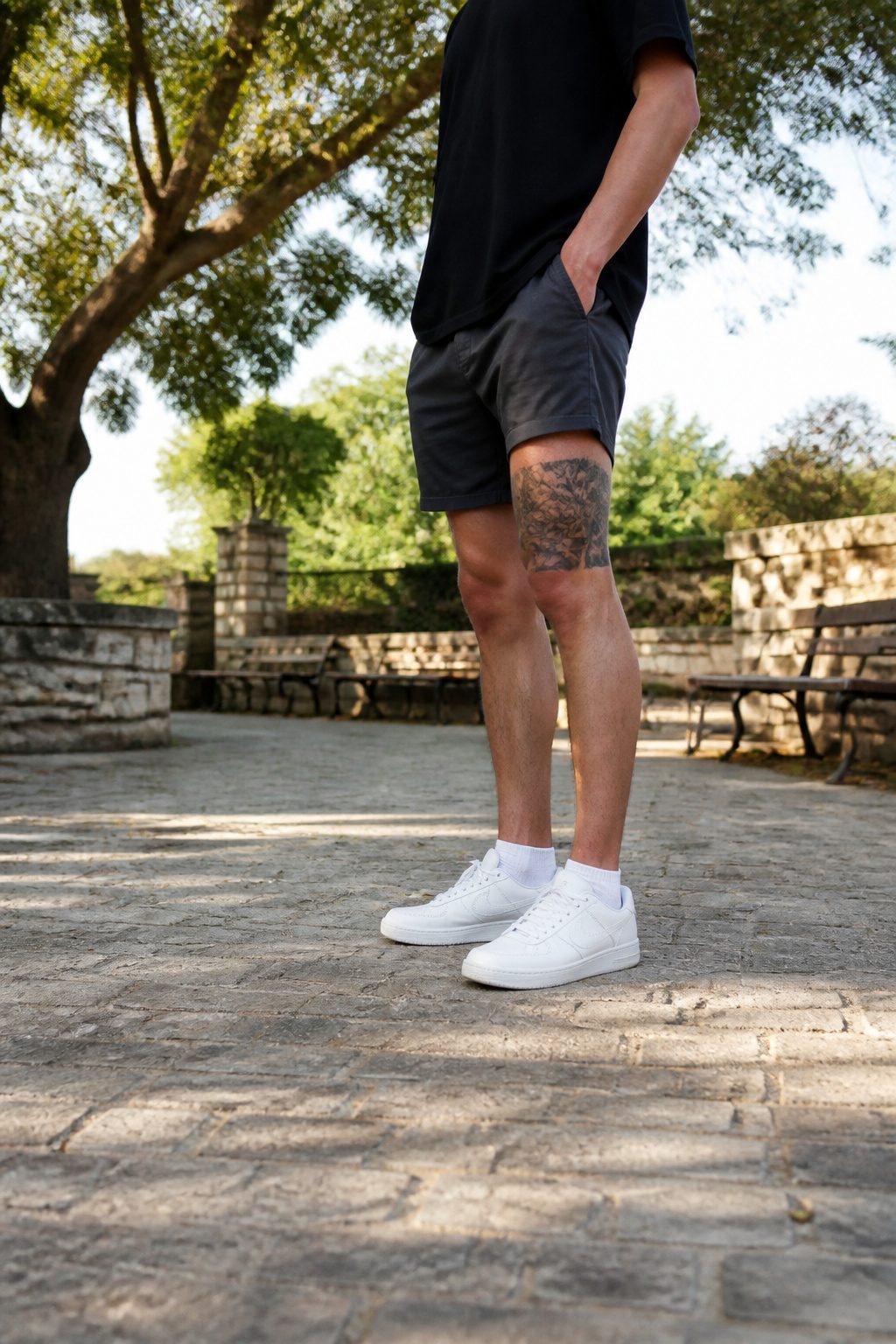
A knee-length pair of shorts hides most thigh work without forcing you into heavy denim on a 90-degree day. That matters more than people admit. The thigh sits below the hem of standard business pants and above the line where athletic shorts ride, so the same tattoo disappears in a quarterly review and reappears at the gym without a wardrobe change.
The control is absolute in a way forearm or calf ink never allows. A family reunion, a conservative office, a first date you want to read before they do: pants cover it, and the decision is yours every morning. What convinced me, reading through how people actually use this placement, is that the thigh gives you the option without the summer heat penalty of long sleeves or high collars. No one asks why you’re wearing pants in July, because you already were.
Visible when you want it, gone when you don’t. That dual identity is the practical reason thigh tattoo ideas for men keep trending in 2026, underneath all the talk about canvas size and muscle flow. The leg does the work; you just choose the shorts.
Frequently Asked Questions
How long does it take to create a men’s thigh tattoo?
A medium piece might take three hours, while a full front thigh can run eight to fifteen hours. The total depends on size, detail level, and whether the artist works in color or black and gray. Specialists often book months out, so the wait can add to the overall timeline.
Where does a thigh tattoo for men rank on the pain scale?
The outer thigh sits around a 4 out of 10 for most people, making it one of the easier spots for long sessions. The inner thigh jumps to a 7–8, while the front thigh lands at 5–6, spiking near the knee. The hamstring carries its own challenge: large muscle but thinner skin and more nerve endings than the outer quad.
What should I wear to my thigh tattoo appointment?
Wear loose, comfortable shorts that give the artist easy access and keep fabric from rubbing the area afterward. Tight jeans or constricting pants will work against you during the session and in the healing days that follow.