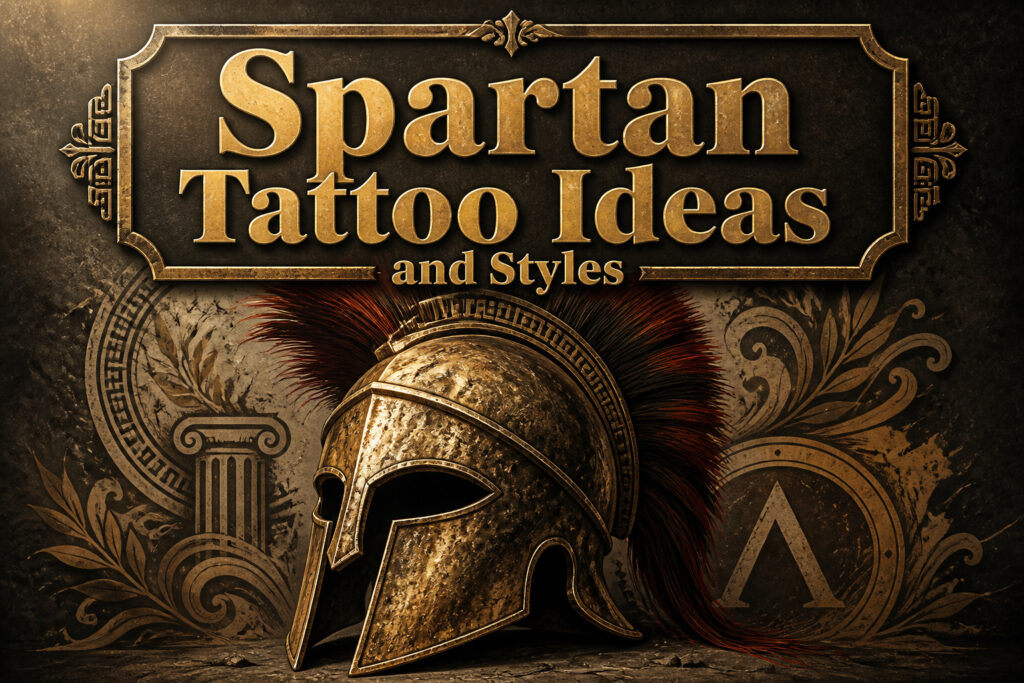
A Spartan tattoo can run anywhere from a quick hour session for a clean black-line helmet to twelve hours of layered shading for a full realistic warrior in weathered bronze.
What separates the piece you keep from the one you regret is not the budget but the artist’s healed portfolio, fresh ink lies about whether those metal textures will hold or blur into mud within a few years.
The 2006 film 300 still walks into shops as reference material, but the designs that age best strip the palette down to desaturated base tones and let the Spartan iconography speak before any pop-culture signal catches up.
1. Realistic Spartan Tattoo
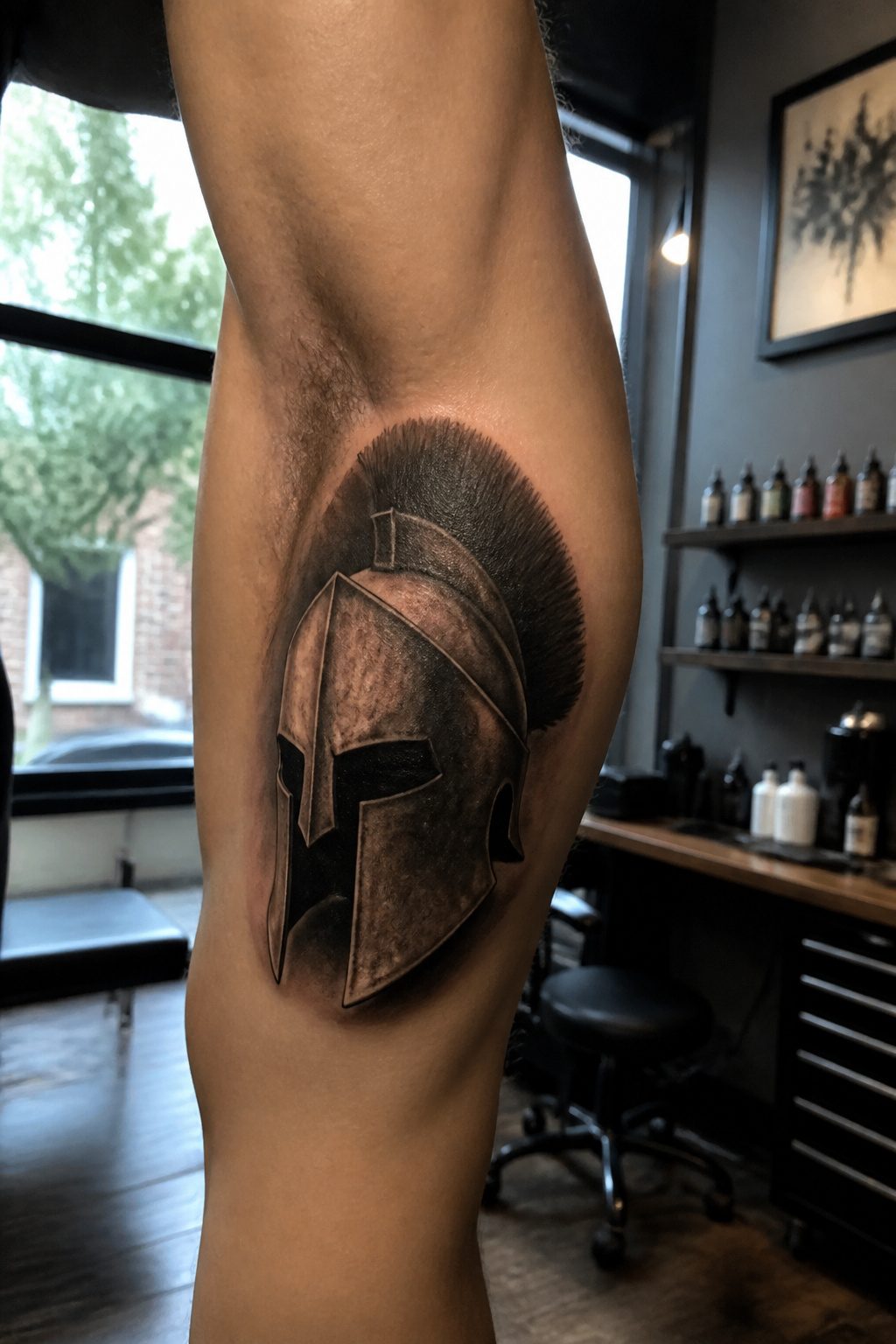
Fine detail changes what a Spartan helmet reads on skin.
In a realistic piece, the cheek guards catch light like worn bronze, the nasal plate shows hammer marks from the forge, and the shadow under the brow ridge sinks deep enough to look three-dimensional.
That depth comes from layered shading, not bold outlines, and the muscle structure of the warrior beneath the armor has to read anatomically true or the whole image flattens.
This style eats hours in the chair. A full realistic Spartan on a shoulder or thigh can run eight to twelve hours across two or three sessions, and the price climbs with the time.
The bigger risk is the artist.
Not every shop has someone who can render weathered metal convincingly; the texture of aged iron against skin tone is a specialty skill, and a weak attempt at realism ages into muddy blur within a few years.
I always tell people to look at an artist’s healed work, not just fresh photos. Fresh ink lies.
Healed ink shows whether they understood how those values settle.
2. Roman Spartan Tattoo
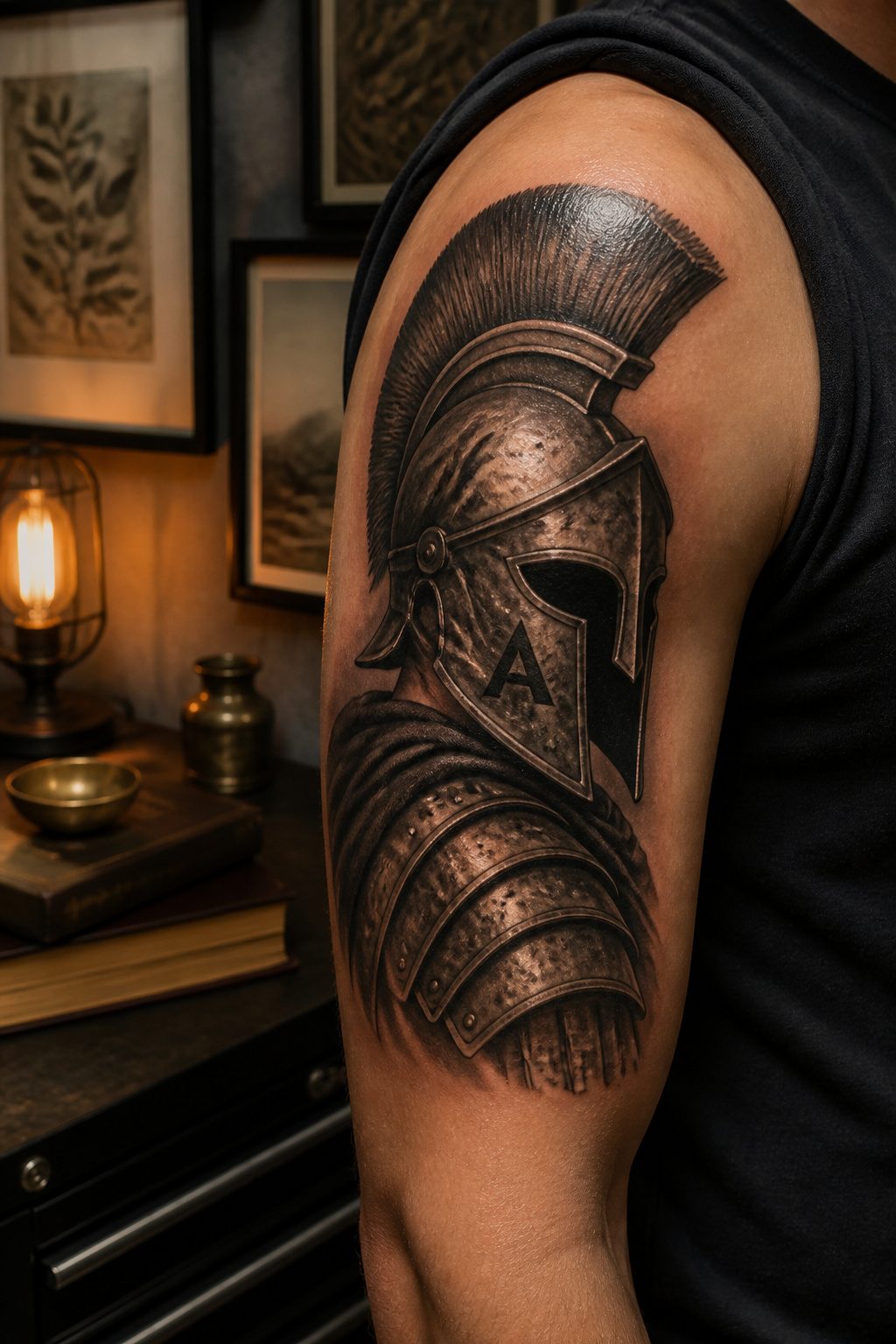
Some artists will fuse Roman legionary armor with Spartan elements into a single warrior design, and the visual logic is clear enough: both cultures read as disciplined, militarized, ancient.
The hybrid usually layers a Roman galea helmet over Spartan lambda markings, or pairs a Corinthian-style helmet with segmented lorica plate armor.
The combination is historically impossible, since Rome and Sparta were distinct cultures separated by centuries and geography, but tattooing has always borrowed across eras when the image carries the right weight.
What I notice in these requests is that the client rarely wants historical lecture; they want the armor to signal endurance across two traditions rather than one.
The better artists handle this by keeping one culture dominant, usually Spartan, and letting the Roman detail read as accent rather than equal partner.
A full sleeve that tries to split the difference ends up looking like costume design from a sword-and-sandal film, and that cheapens the whole piece.
If you are drawn to this route, pick which culture owns the helmet and let the other culture appear in the shield detailing or the background scrollwork. The eye needs hierarchy to read strength.
3. Kneeling Spartan Tattoo
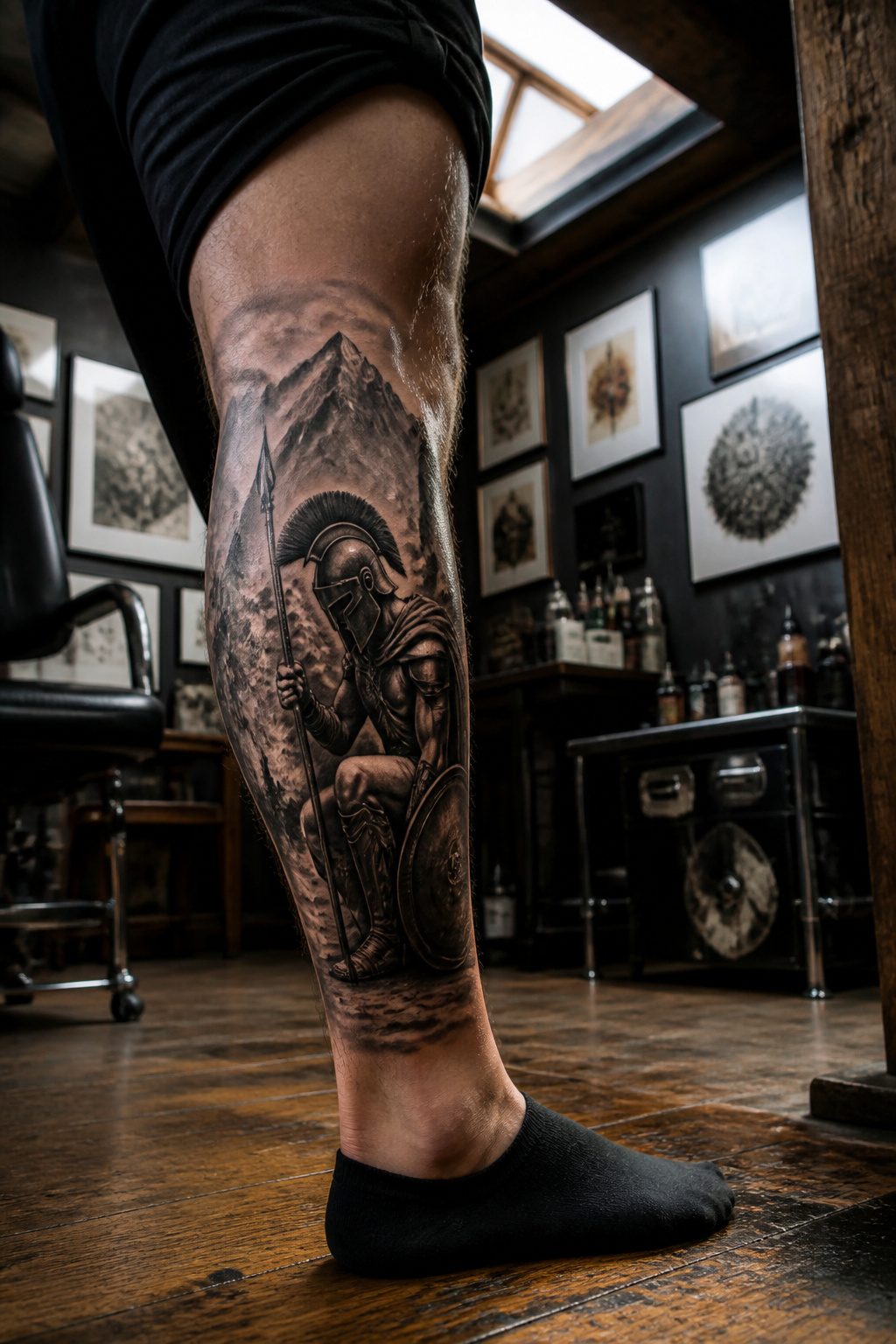
A kneeling Spartan carries weight that standing figures rarely match. The posture reads differently depending on what the artist builds around it: a warrior at rest, a soldier mourning fallen brothers, or a fighter gathering strength to rise.
What separates this from defeat is the tension in the back and shoulders, the helmet still on, the shield within reach. Viewers who work with their hands tend to recognize that stillness as discipline rather than submission.
The kneeling pose works best when the background tells the story. One approach sets the figure against rugged mountain terrain, letting the landscape do the work of suggesting scale and isolation.
The armor and Corinthian helmet stay historically grounded, but the emotional register shifts entirely based on whether the warrior faces upward or keeps the head bowed.
Placement shapes how the pose reads.
On a calf or outer forearm, the vertical compression of kneeling fits naturally; across a chest or back piece, the artist has room to extend the landscape and let the figure occupy the lower third, which changes the viewer’s eye level and makes the Spartan read as monumental rather than diminished.
Black and grey realism handles the metallic textures of armor and the soft gradients of distant rock with less competition between elements than color would introduce.
4. Simple Spartan Tattoo
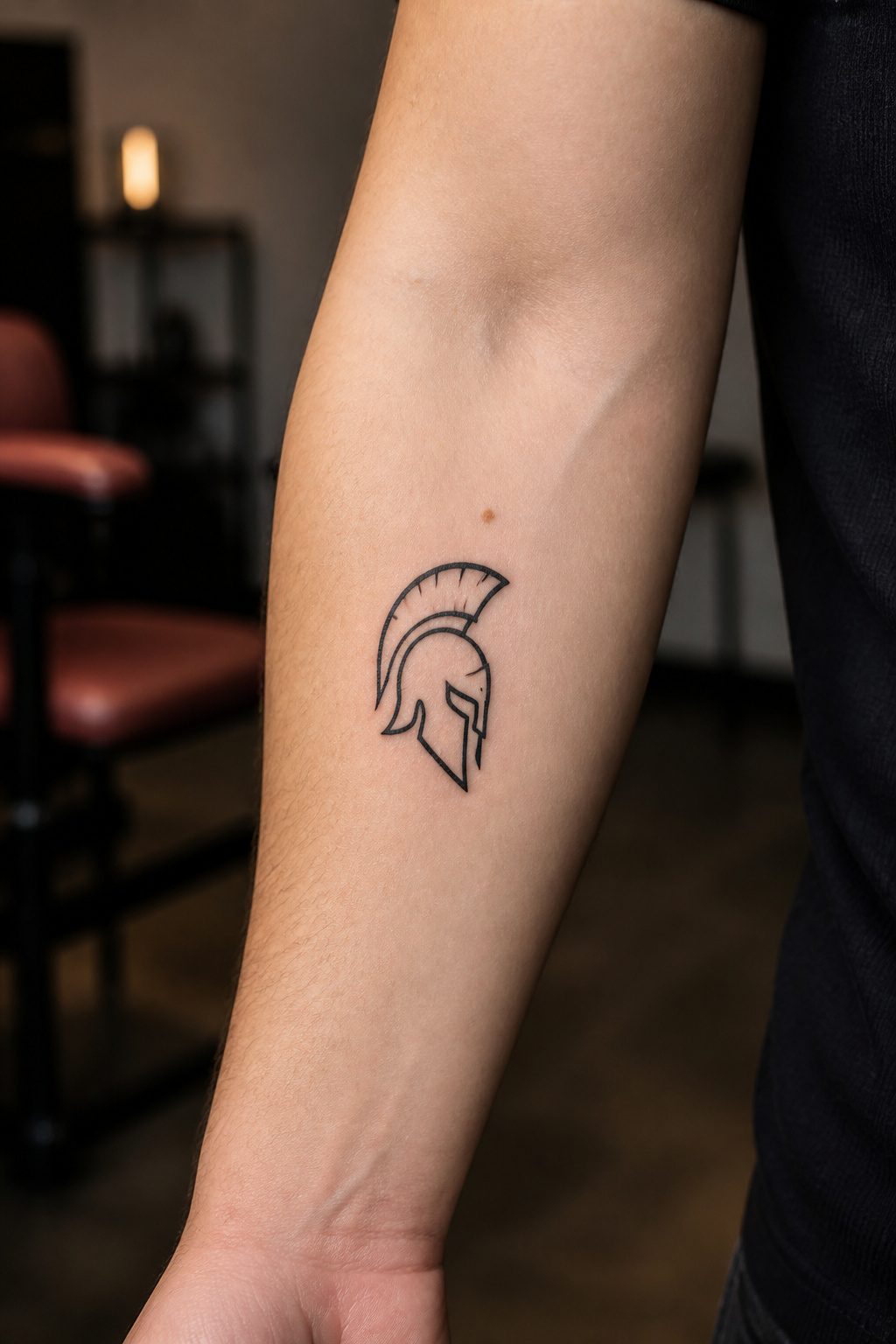
Minimalist Spartan tattoo ideas strip the helmet down to clean black lines and its essential silhouette, nothing more.
The style works best on a flat spot like the inner forearm or the back of the shoulder, where the simple shape sits clean against the skin without fighting curves.
Black and gray ink gives it the bold outlines and that slight gritty, vintage shading the design needs to feel like worn metal rather than a clip-art outline.
A first-timer can sit for this in under an hour, and the limited ink means healing is straightforward. Some add a single arrow piercing the silhouette, which shifts the meaning toward focused purpose and forward direction.
The arrow version reads more personal; the bare helmet reads more timeless. Either way, the reduced palette is what keeps it from looking dated as trends move on.
Skip the urge to add a banner, a quote, or extra ornament. The discipline of the restraint is the whole point.
5. Shoulder Spartan Tattoo
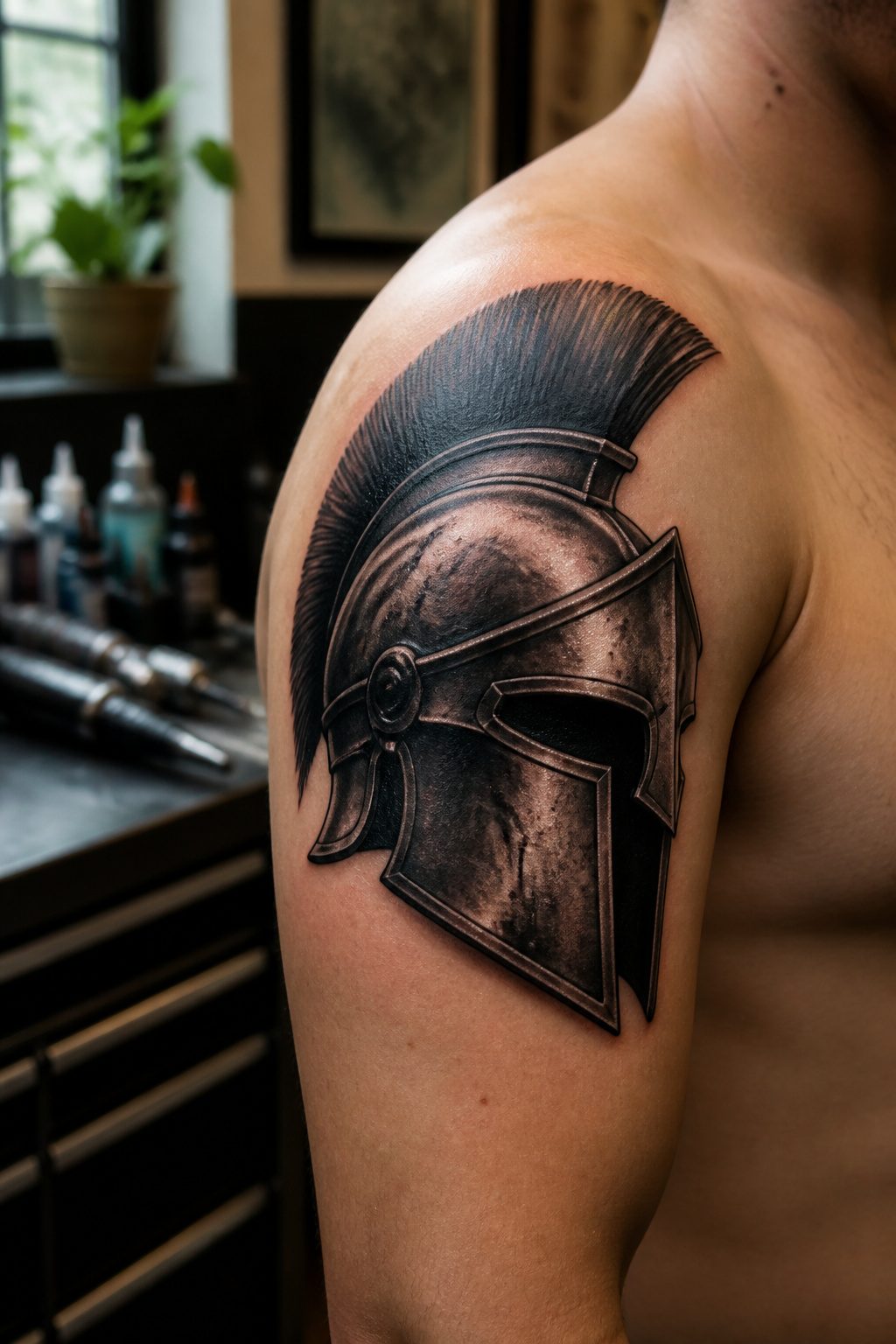
The shoulder cap carries a Spartan helmet better than almost any other placement. The rounded muscle mirrors the curve of the Corinthian helmet so naturally that the design looks built for the body rather than applied to it.
Flow into a chest piece or sleeve later, or let it stand alone; either way, the shape holds.
I have watched this layout work for clients who wanted room to grow and for others who wanted one decisive image.
The helmet profile sitting just above the deltoid peak reads clean from the front and fills out when the arm turns. Stretching is minimal there compared with joints or the collarbone, so line work stays sharp over time.
A full-face helmet works best if you want the piece to anchor a larger plan. The back of the helmet can fade into shading that later accepts a chest panel or sleeve background.
A side profile suits a standalone statement; it follows the shoulder curve without asking for more canvas. Either choice, the muscle does the composition work for you.
6. Half-Sleeve Spartan Tattoo
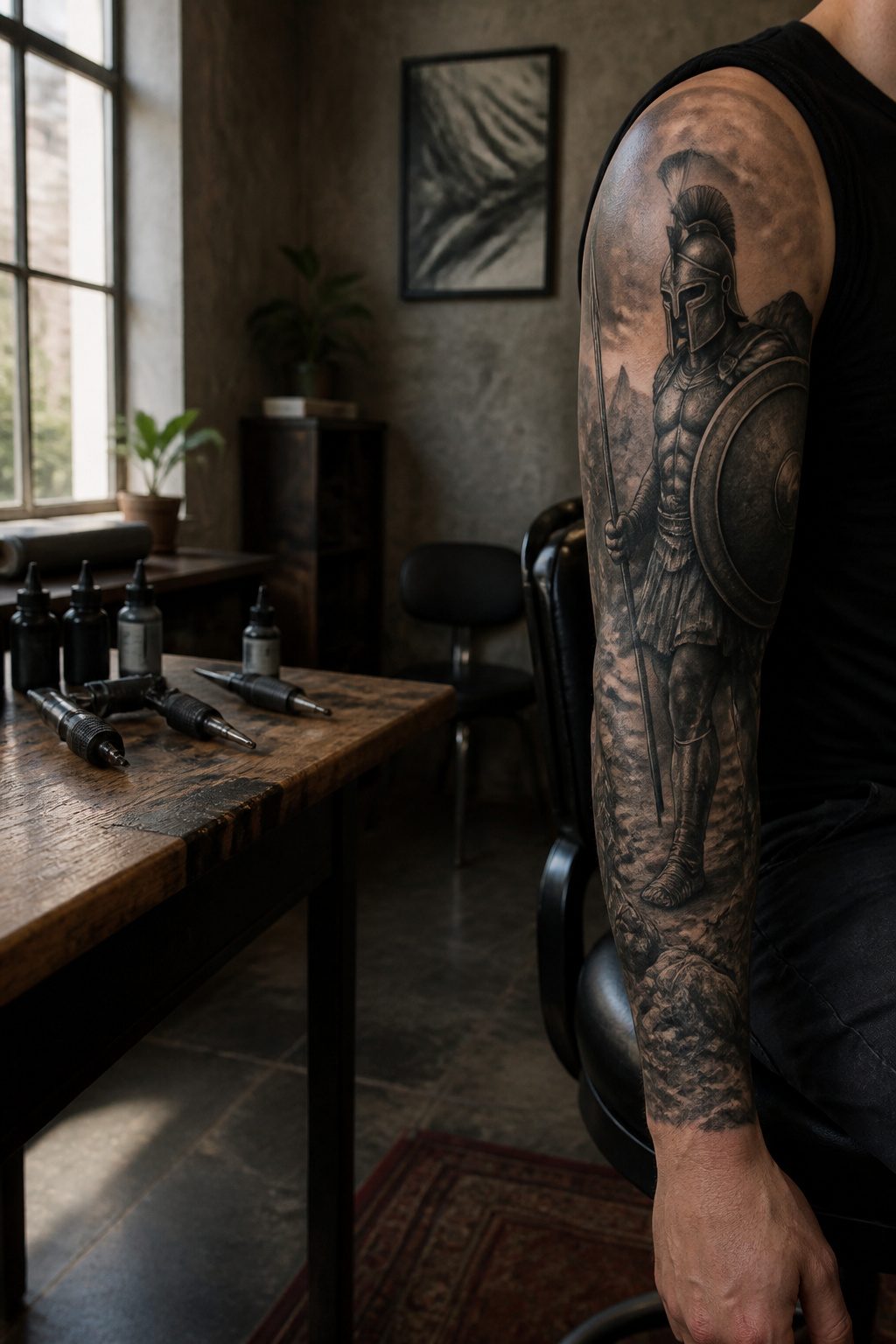
The half-sleeve format gives a Spartan figure room to stand at full height, elbow to shoulder, which means the vertical rise of the helmet and spear reads naturally rather than squeezed.
Shields carve out solid negative space against the upper arm, and a spear can run the full length to tie the composition together.
Sources describe backdrops of rugged wilderness behind the warrior, which sets the armor in context without crowding the main figure.
A battlefield scene behind the Spartan works here because the wider canvas lets distant elements stay readable; on a smaller piece they would blur to gray.
The shield and spear carry the symbolic weight, protection and readiness, while the half-sleeve scale keeps every line sharp enough to age well.
Greek key patterns or olive branches can thread through the gaps between larger elements if you want to push the historical reference further, though the Spartan helmet alone already signals the source.
Painters have told me the elbow ditch is the spot that hurts most and heals slowest, so plan the detail density to thin out there, not cluster.
7. Wolf and Spartan Tattoo
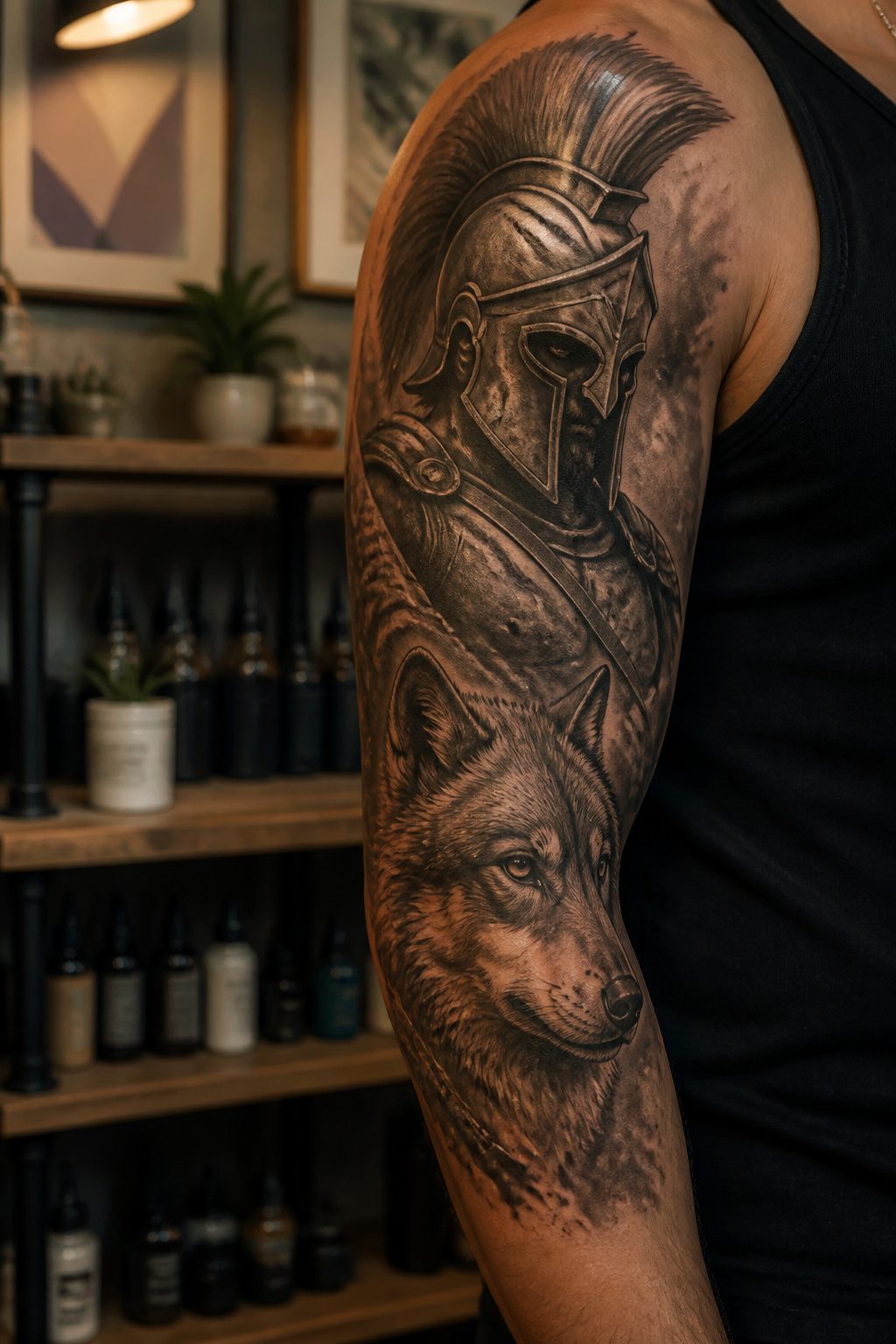
The wolf and Spartan pairing draws from the agoge, the training system where young Spartans lived rough from age seven onward. Wolves became the natural symbol for that life: pack loyalty, survival, and the line between instinct and discipline.
In composition, the wolf can frame the helmet or stand as its own element.
A wolf at the base with leaf patterns tying the two together gives the piece cohesion, while a wolf in profile flanking the helmet creates balance without clutter.
The Spartan side brings calculated discipline; the wolf side brings the primal instinct underneath it. The design works best when one element leads and the other supports, rather than splitting the space evenly and competing for attention.
Color or black-and-grey both hold up, though the helmet’s detail usually reads sharper in black-and-grey while a wolf’s fur gains texture from limited color work.
The forearm or upper arm carry this well; the chest risks flattening the wolf’s depth against the pectoral plane.
8. Spartan Back Tattoo
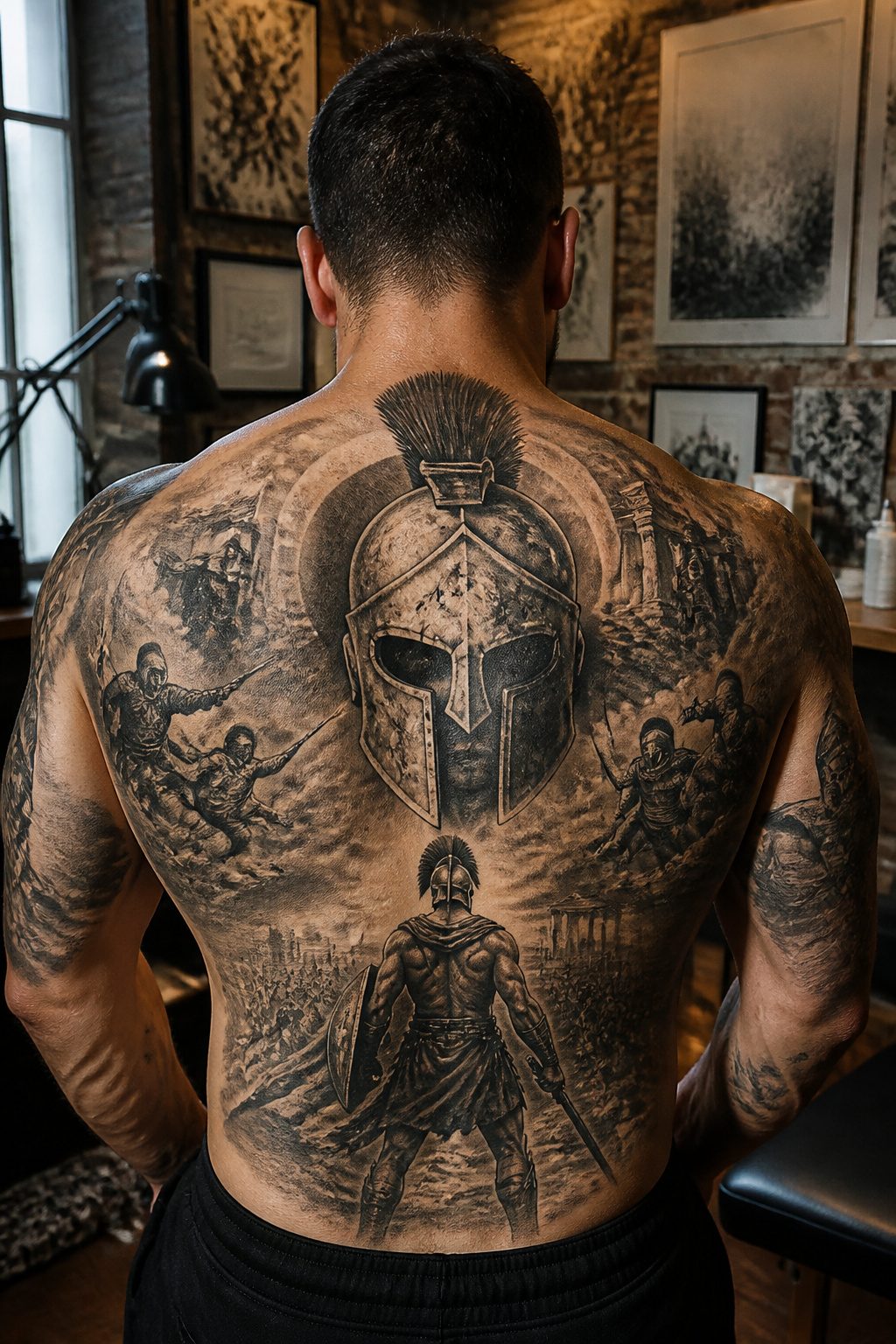
The back is the only place where a Spartan scene can breathe.
A full battle composition needs ten or twelve inches of clear skin just to let the eye travel from shield line to fallen spear, and the shoulder blades sit at the exact height where a helmeted figure faces outward with real weight.
I have watched clients spend three sessions on a single back piece because the artist kept pulling back to check sightlines from five feet away; anything tighter and the phalanx reads as a grey smear.
A single massive helmet works better than most people expect. The cheek guards frame the spine, the crest runs parallel to it, and the negative space around the metal shape lets the black ink do the heavy lifting.
What breaks these designs is cramming too many symbols into the gaps; a helmet plus shield plus script turns into a collage instead of a portrait.
The warrior seen from behind is a quieter choice that uses the body’s own geometry. The figure’s shoulders echo the client’s shoulder width, and a spear held upright can follow the natural line of the spine.
This only holds if the artist scales the armor to actual human proportions; a tiny waist and oversized cape read as fantasy rather than history.
Keep the center clear of detail if you ever plan to expand the piece into a full scene. Crowding the spine early locks you out of later additions.
9. Forearm Spartan Tattoo
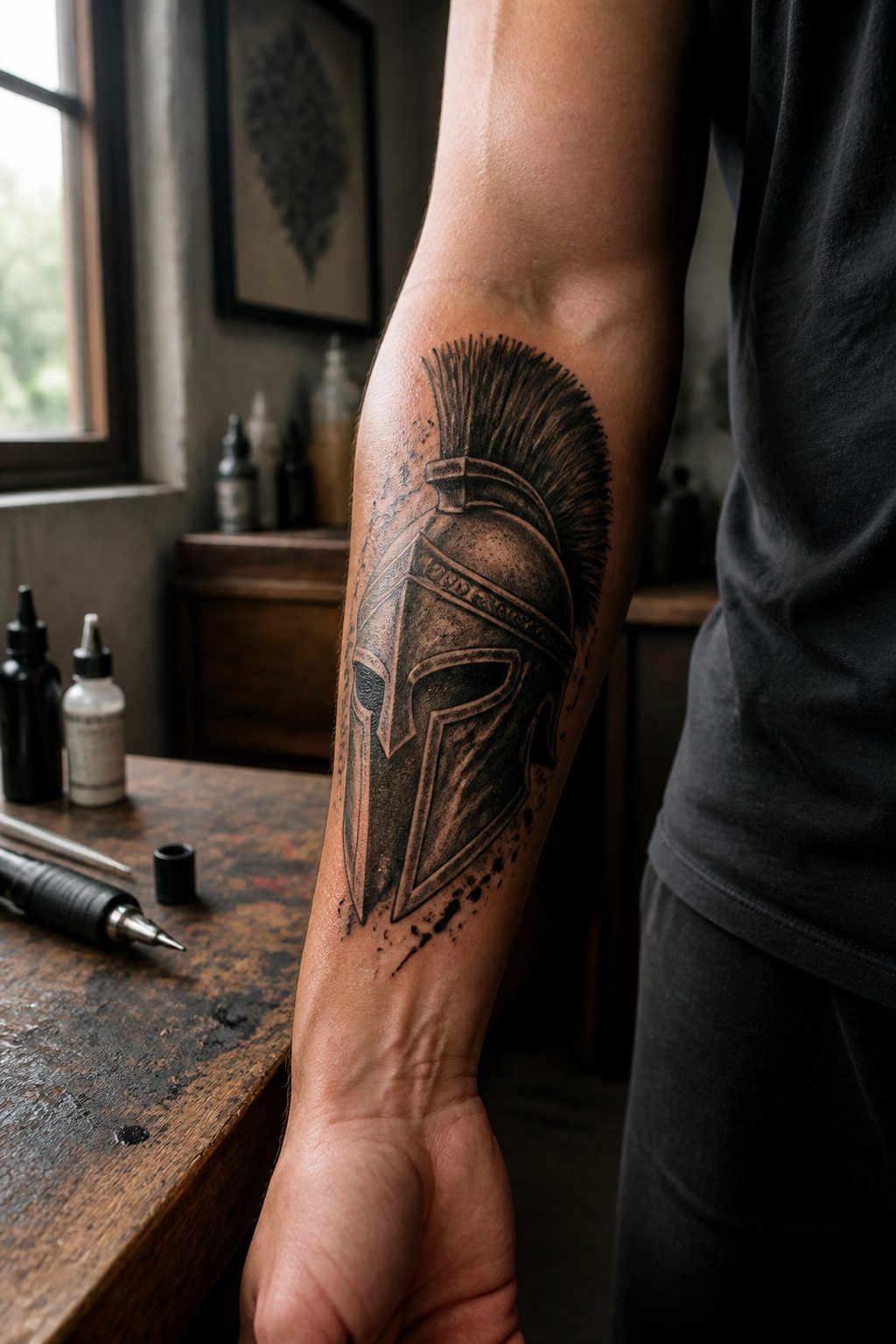
The forearm is daily real estate: you see it typing, lifting a coffee cup, shaking hands. A Spartan design here lives in that visibility, which means orientation decides who the tattoo speaks to first.
Face the helmet outward and the world reads strength before you do; turn it toward you and the reminder is yours alone, checked every time you roll up a sleeve.
The cylinder of the arm shapes what works. Vertical helmet designs follow the bone line, drawing the eye from wrist to elbow with natural momentum.
Horizontal shield bands wrap the circumference instead, reading as armor when the arm hangs at your side.
I have seen both pulled too large, where the curve of the muscle distorts the face at certain angles; keeping the critical detail on the flatter inner or outer plane fixes this without shrinking the piece to insignificance.
Color holds differently here than on a chest or back. The forearm takes sun, sees soap, rubs against desks.
Blacks stay crisp longer than reds or yellows, so a helmet in heavy black and grey keeps its contrast where a full-color shield piece softens faster than most clients expect.
10. Lion Spartan Tattoo
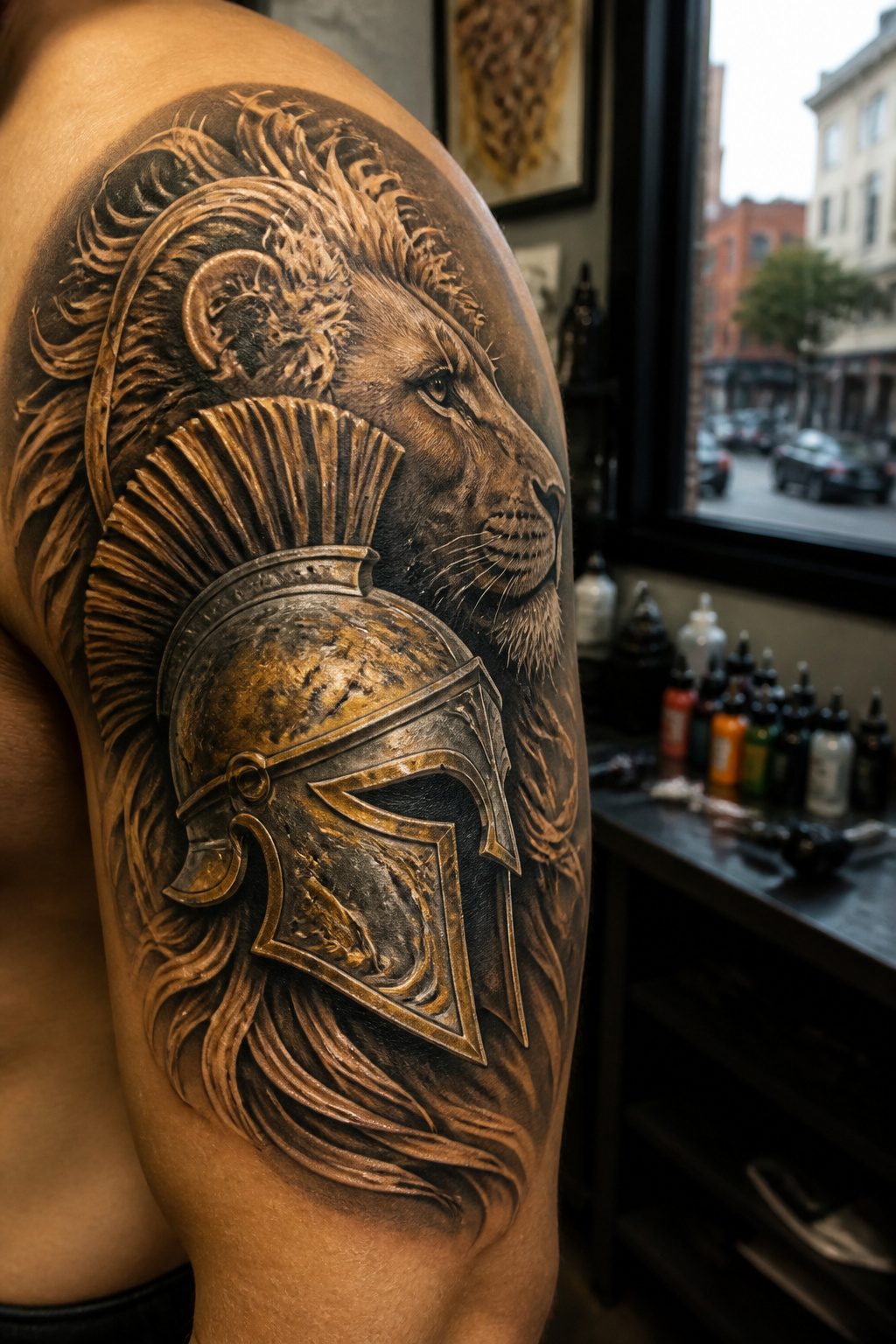
The lion and Spartan pairing basically writes itself once you know the name Leonidas means "lion-like." That etymology gives the design a backbone no generic animal companion can match.
Three ways to use it. The lion stands beside the soldier as a separate figure, both facing forward, which works best on a chest or thigh where horizontal space lets them share a single shield or banner.
Or the lion becomes the shield emblem itself, replacing the usual lambda with a full maned head in profile, the mane flowing into the helmet’s cheek guards.
The third route merges them completely: the helmet’s crest becomes a lion’s mane, the faceplate retaining human eyes that read as both warrior and animal.
The merged helmet reads strongest from a distance, which matters on a body part that moves.
A forearm piece where the mane wraps the wrist and the face sits on the inner arm survives foreshortening better than two separate figures trying to stay in proportion as the arm turns.
Black and grey realism carries the texture of both bronze and fur without fighting for attention.
Color tends to split the focus; if you want it, keep the lion’s eyes or the Spartan cloak as the single accent, not the full palette.
11. 300 Spartan Tattoo
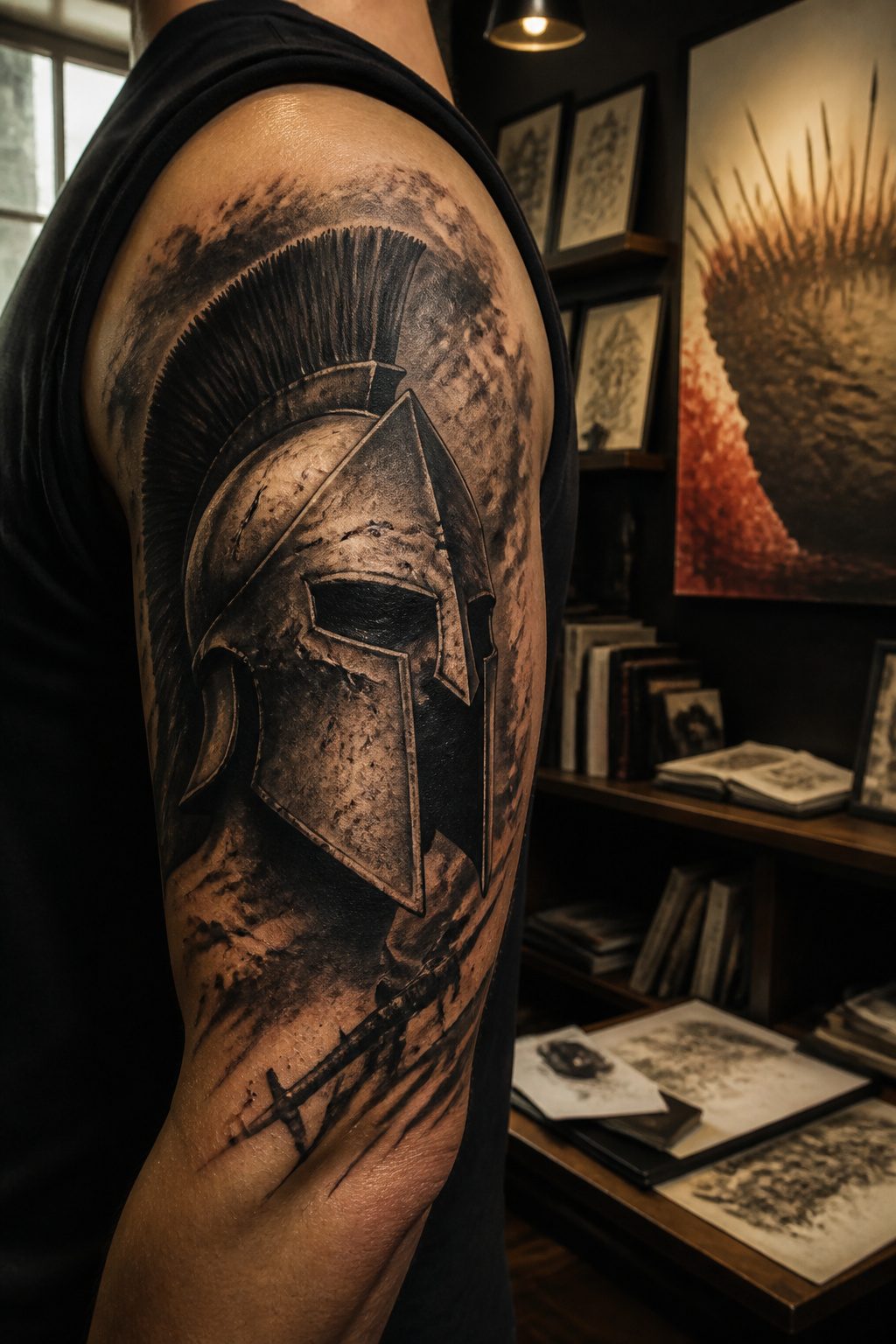
The 2006 film 300 built its own visual language, and that language still walks into shops as reference material fifteen years later.
Clients bring screenshots: the elongated cheek guards on the helmet, the stylized abs rendered as stacked leather strips, the shield with its bronze rim and lambda painted in weathered red.
What they want is not historical accuracy but the movie’s specific sepia wash, that drained color grading where blood reads as deep crimson against grungy grey and black.
A trash polka treatment fits this brief better than most. The style’s built-in grit mirrors the film’s palette: muted red accents against heavy black shading, deliberately unpolished edges.
The side-profile composition from the poster works especially well here, the helmet silhouette carrying most of the recognition even at smaller scales.
The risk is dating yourself to a single pop-culture moment. The 2006 reference lands differently in 2026 than it did in 2010.
What saves it is the palette restraint: keep the red accents minimal and the base tones desaturated, and the tattoo reads as Spartan iconography first, movie merchandise second. The proportions matter more than the subject.
Get the helmet cheek guards too short or the shield too clean, and the whole reference falls apart.
12. Greek Spartan Tattoo
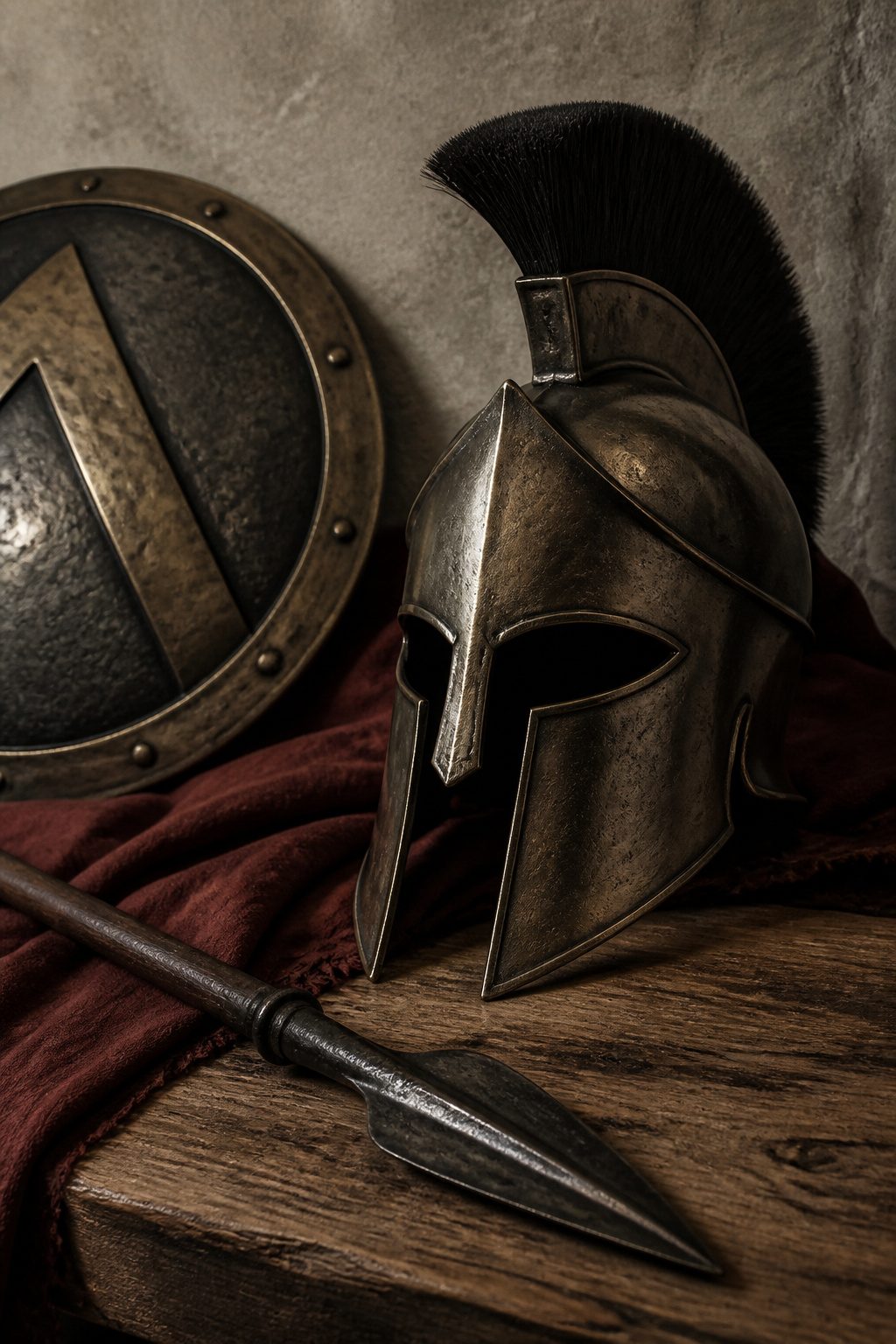
A Spartan helmet floating on skin can look like a logo for a sports team.
Set it against a Greek key pattern, a pair of olive branches, or a fluted column and the same helmet becomes a citizen of something larger.
The Greek key, that running meander of right angles, reads instantly as architecture and time period. It wraps well as a band or frames the helmet like a shield border.
Olive branches soften the war imagery without weakening it; they turn the warrior into a defender of land and harvest rather than pure aggression.
Greek lettering carries weight if you choose it. The Romanized "MOLON LABE" is readable.
The Greek capitals "ΜΟΛΩΝ ΛΑΒΕ" keep the whole piece in one visual world, though you’ll want an artist who can confirm the spacing of ancient characters; a misplaced accent changes the tone from defiant to confused.
For a larger piece, a column on one side and a god’s symbol on the other, thunderbolt or owl, places the Spartan inside a culture that valued intellect and ritual as much as fighting.
The helmet stops being the entire statement and becomes the center of one.
13. Molon Labe Spartan Tattoo
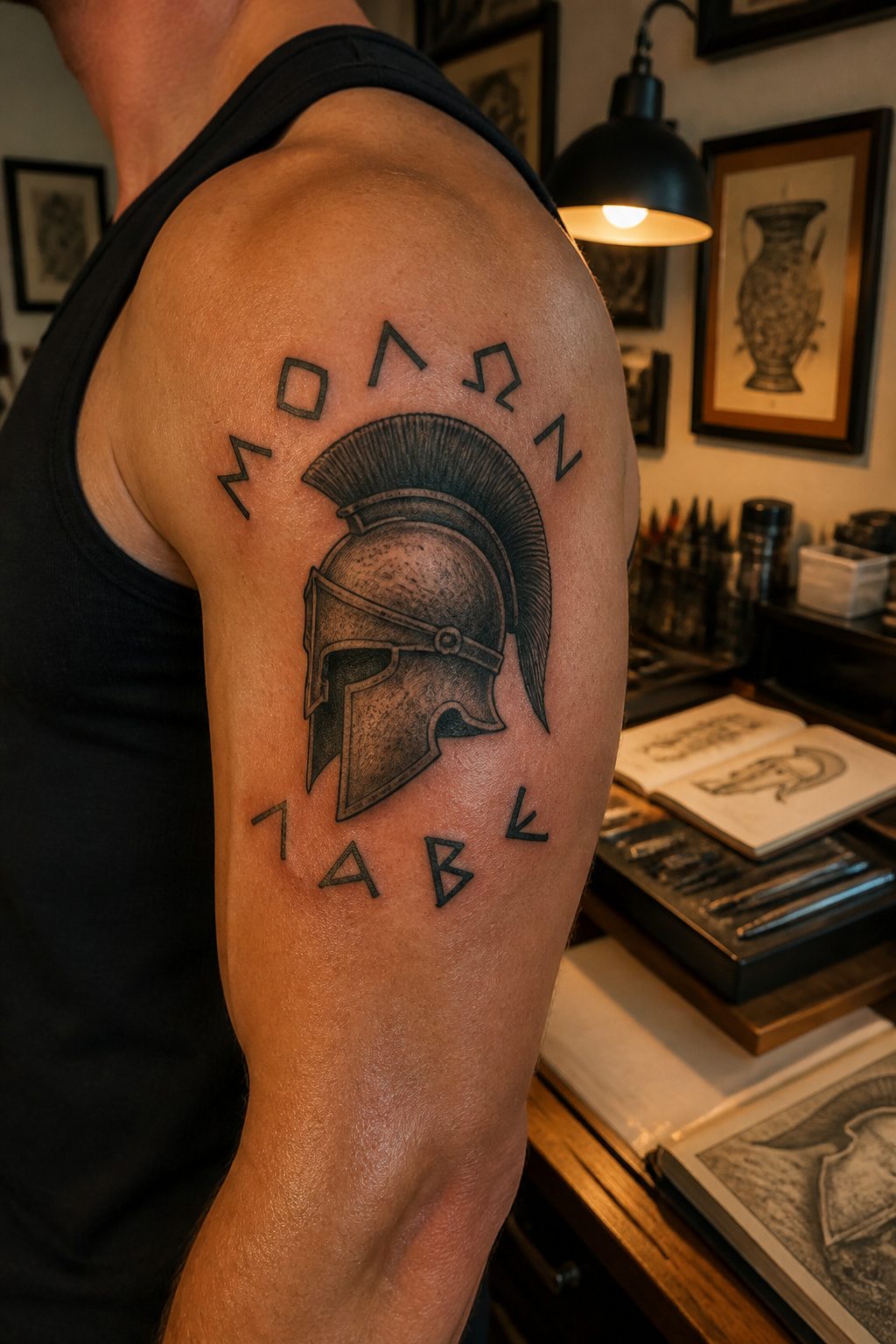
The ΜΟΛΩΝ ΛΑΒΕ script is the most text-heavy of all Spartan designs, and that density makes it the one most likely to go wrong under the needle.
Greek lettering carries diacritical marks and letterforms that Roman characters do not, so the difference between authentic script and a misspelling sits in strokes most English speakers will not catch.
Before booking the appointment, the phrase needs verification from someone fluent in Greek, not just the artist’s reference sheet.
The layout usually pairs the text with the Spartan helmet above or crossed spears below, framing the words in a vertical composition that fits the forearm or the ribs. Romanized versions, "MOLON LABE," circulate in flash books and online galleries.
They read cleaner to an English-speaking eye but strip the historical element that draws most people to this particular phrase in the first place.
Leonidas I reportedly spoke the original in reply to Xerxes I’s demand for surrender, so the tattoo carries the weight of that moment. The Greek version preserves it.
A fluent speaker can confirm the spacing of the lambda and the proper omega form, which changes enough between classical and modern usage that a generic font will betray itself to anyone who reads the language.
The cost of that check, an hour of someone’s time, is minor against a piece that lasts decades.
14. Small Spartan Tattoo
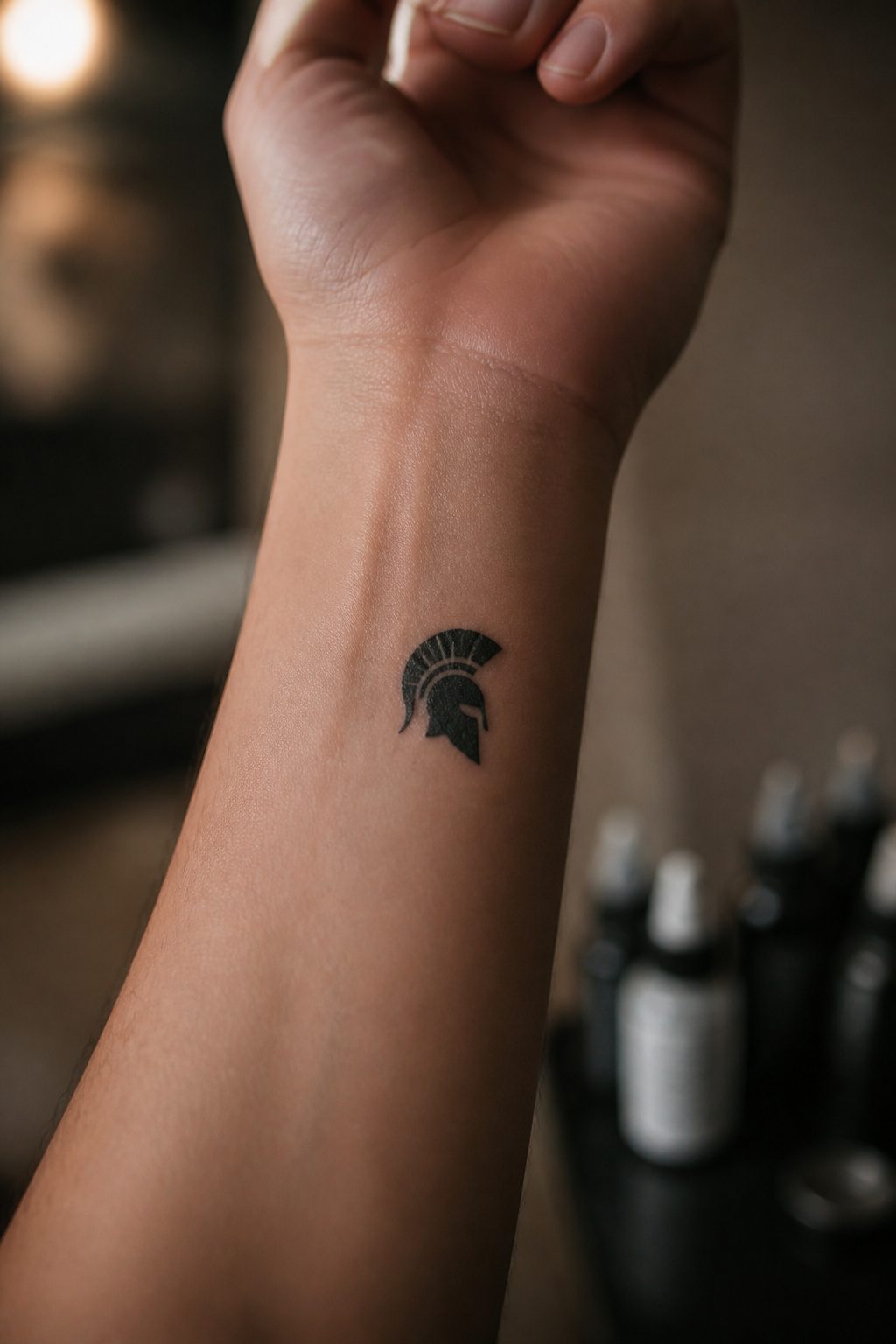
The wrist is the proving ground for a Spartan helmet that actually reads at size.
Anything under two inches square turns the Corinthian crest into a smudge unless the artist strips out the nasal guard detail and the cheek-plate flares, leaving a clean silhouette with just enough shadow under the brow to keep it from looking like a generic motorcycle helmet.
Behind the ear, the curve of the skull does half the work; a piece no larger than a nickel sits well there, but the profile view is almost mandatory because straight-on the face disappears into hairline.
Ankle placement buys you more flat skin and a natural vertical, so the crest can run a half-inch taller without looking stretched.
The simplification that kills most small Spartans is keeping too many interior lines: one weight of black, one pass of gray wash under the dome, and the eye slit dark enough to read as void rather than shape.
StyleCraze’s referenced black-and-gray icon approach works because the vignette shading ages into the skin like a worn coin rather than a crisp illustration that will blur inside three years.
15. Cool Spartan Tattoo
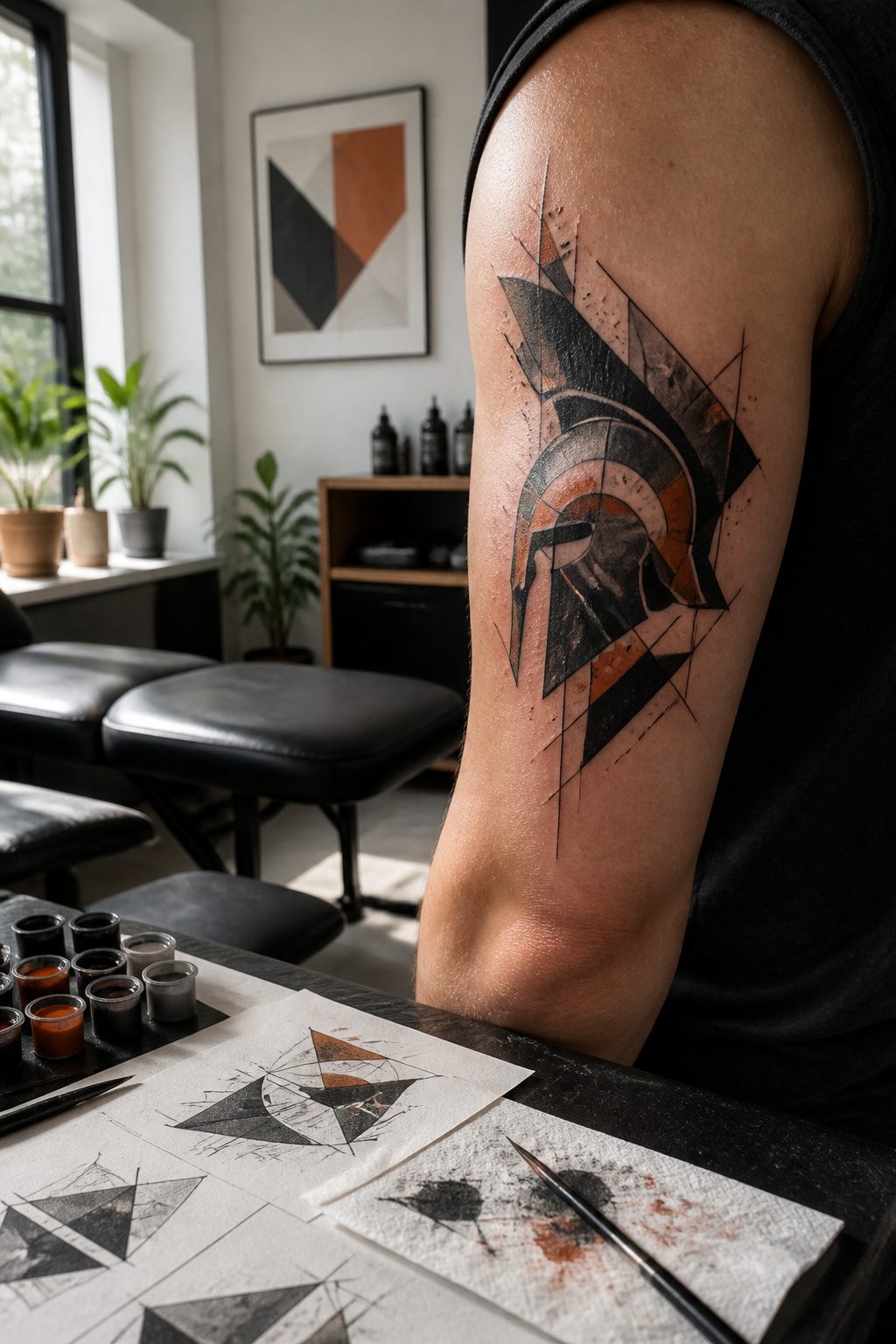
Geometric breakdowns of the Spartan helmet trade the literal for something harder to pin down, and that is where a lot of collectors start once they have already worn the classic version or want to avoid matching every other shield-and-plume design in the shop.
A friend of mine went this route after deciding the standard profile looked too much like a sports logo on his forearm; his artist fractured the face guard into overlapping triangles, dropped the cheek pieces entirely, and ran a single thin line of rust orange through the negative space where the eye slit would sit.
It reads as Spartan to people who know the shape, abstract to everyone else, and it solved his problem of wanting the reference without the costume.
Unconventional color works the same way when the palette is chosen for contrast rather than decoration.
Deep teal against black grey, or a helmet rendered in flat white ink on darker skin, shifts the tone from historical reenactment to something closer to graphic design.
Mashups follow the same rule: a helmet dissolving into circuitry, or the plume reimagined as brushstrokes, only hold up if the two languages actually talk to each other and do not just sit side by side.
The ones that fail, and I have seen this on cover-up consultations, treat the Spartan element as a sticker slapped onto an unrelated sleeve.
The cooler move is to let one system eat the other until you cannot tell where the history ends and the invention begins.
16. American Spartan Tattoo
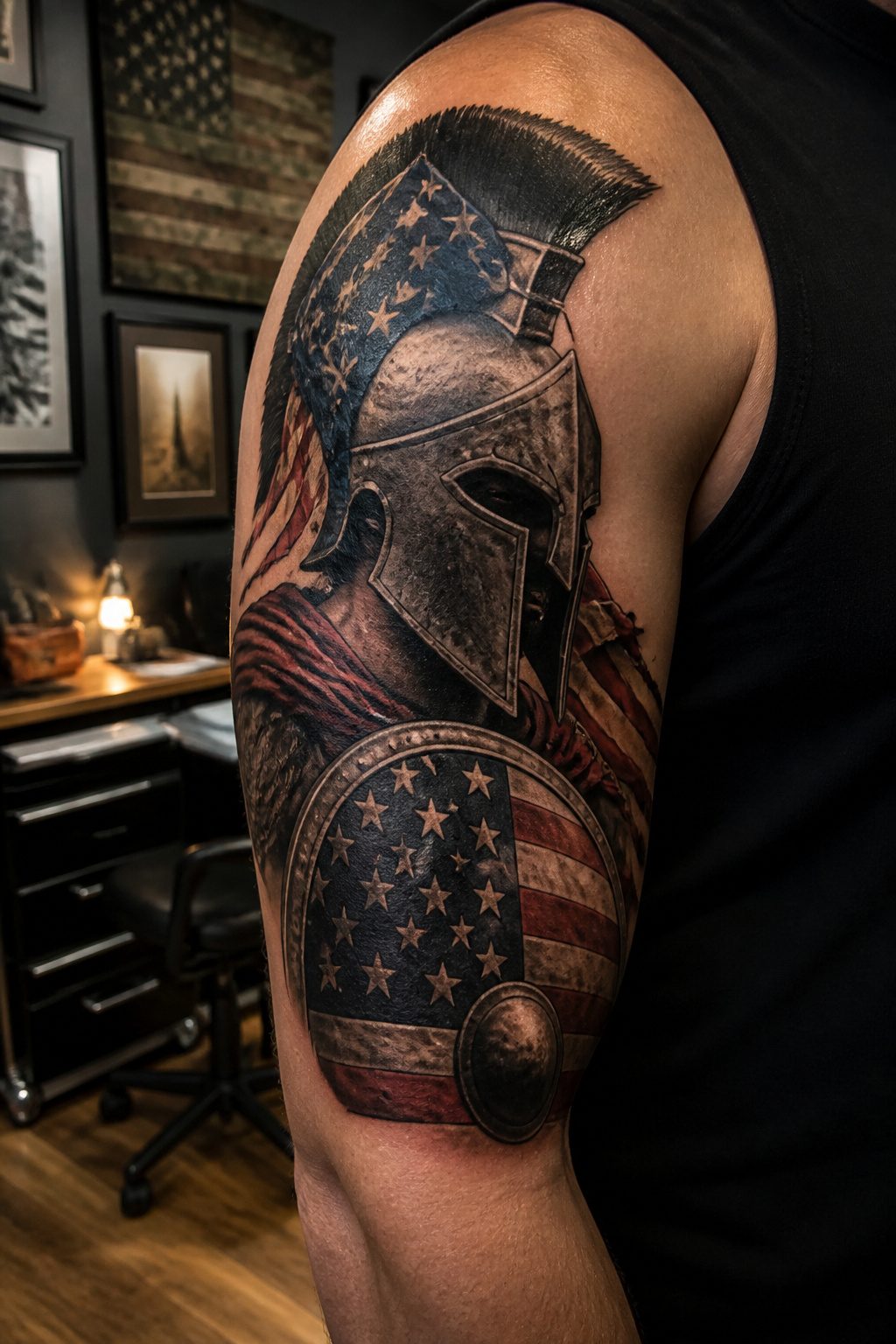
The American Spartan tattoo fuses the Greek warrior helmet with stars-and-stripes color schemes, often weaving in unit insignia or the flag itself across the shield or cape.
Service members and veterans gravitate toward this design because it lets them claim two loyalties at once: the warrior ethos Sparta represents and the national allegiance they signed up for.
The flag placement matters more than the helmet detail. Sources describe the shield as the primary canvas, which keeps the face of the warrior unobstructed and readable from a distance.
The cape works too, though it demands more skin real estate and a color budget most people underestimate.
What separates a strong piece from a cluttered one is restraint on the patriotic elements. One source pushes the full flag; another keeps it to a subdued red, white, and blue palette against black and grey.
The disciplined approach wins for anyone who has to wear this under a uniform or in professional settings. The fusion only holds if both halves remain instantly recognizable.
Overloading the helmet with stripes turns it into abstract noise, and the meaning collapses.
What Spartan Tattoos Mean
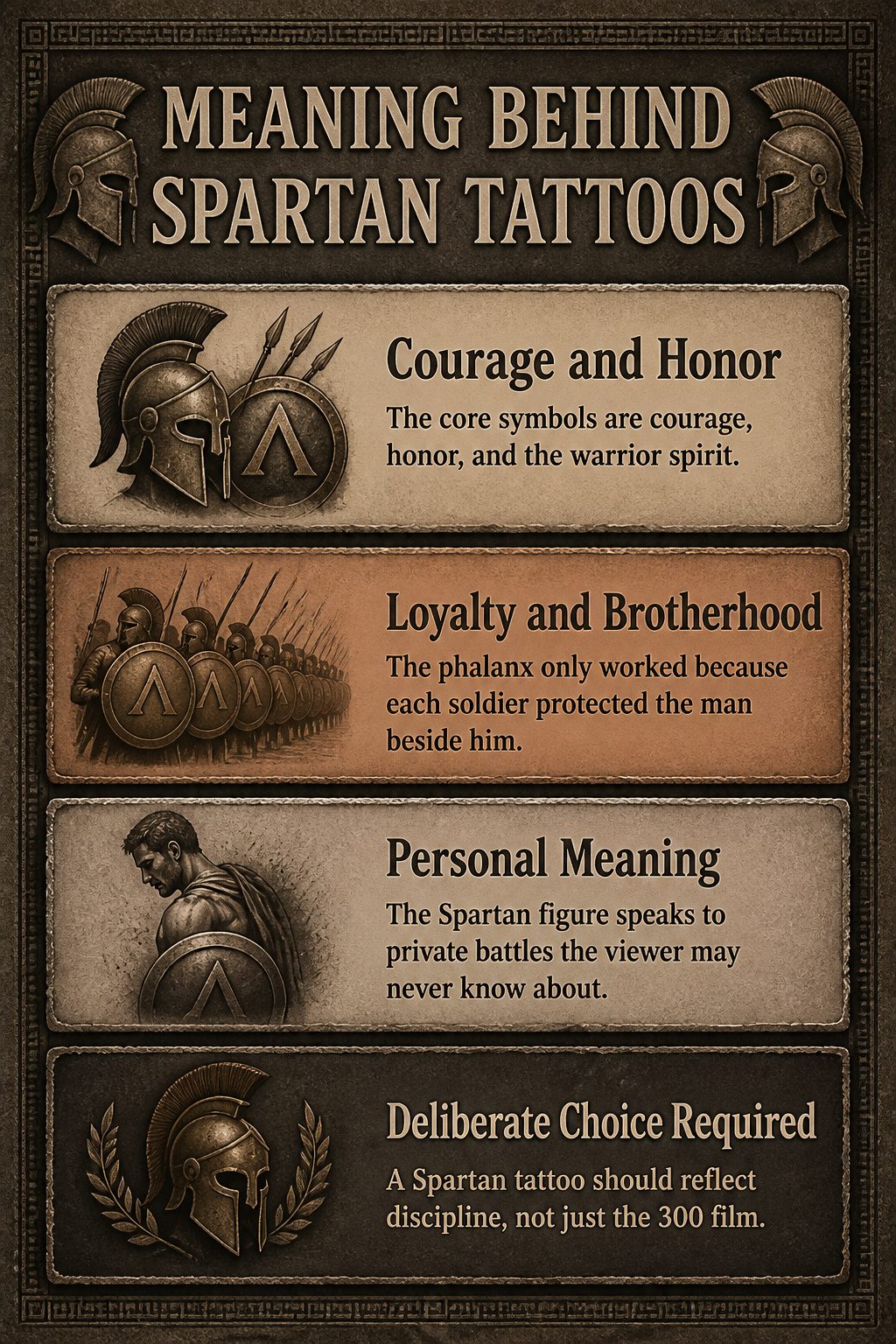
Spartan tattoos carry weight that goes deeper than the image. The core symbols are courage, honor, and the warrior spirit, with discipline and resilience running right behind them.
These are not abstract ideals borrowed from a movie; they map onto the actual values that held Spartan society together.
Loyalty and brotherhood matter too. The phalanx only worked because each soldier protected the man beside him, and that interdependence gets translated into ink when someone wants to mark a bond that outlasts individual hardship.
A piece can also serve as tribute to Greek heritage, connecting the wearer to a specific lineage or to the broader history of ancient Greece.
Personal meaning layers on top of this foundation. Someone who has fought through illness, rebuilt after loss, or committed to a grueling physical regimen often finds the Spartan figure speaks more precisely than generic "strength" imagery.
The helmet or shield becomes shorthand for a private battle the viewer may never know about.
The risk is choosing the symbol without sitting with what it actually asks of you. A Spartan tattoo that only references the 300 film misses the discipline half of the equation entirely.
The designs that hold up over decades tend to come from wearers who can name the specific value they are claiming, not just the aesthetic they liked at twenty-two.
Where to Place One
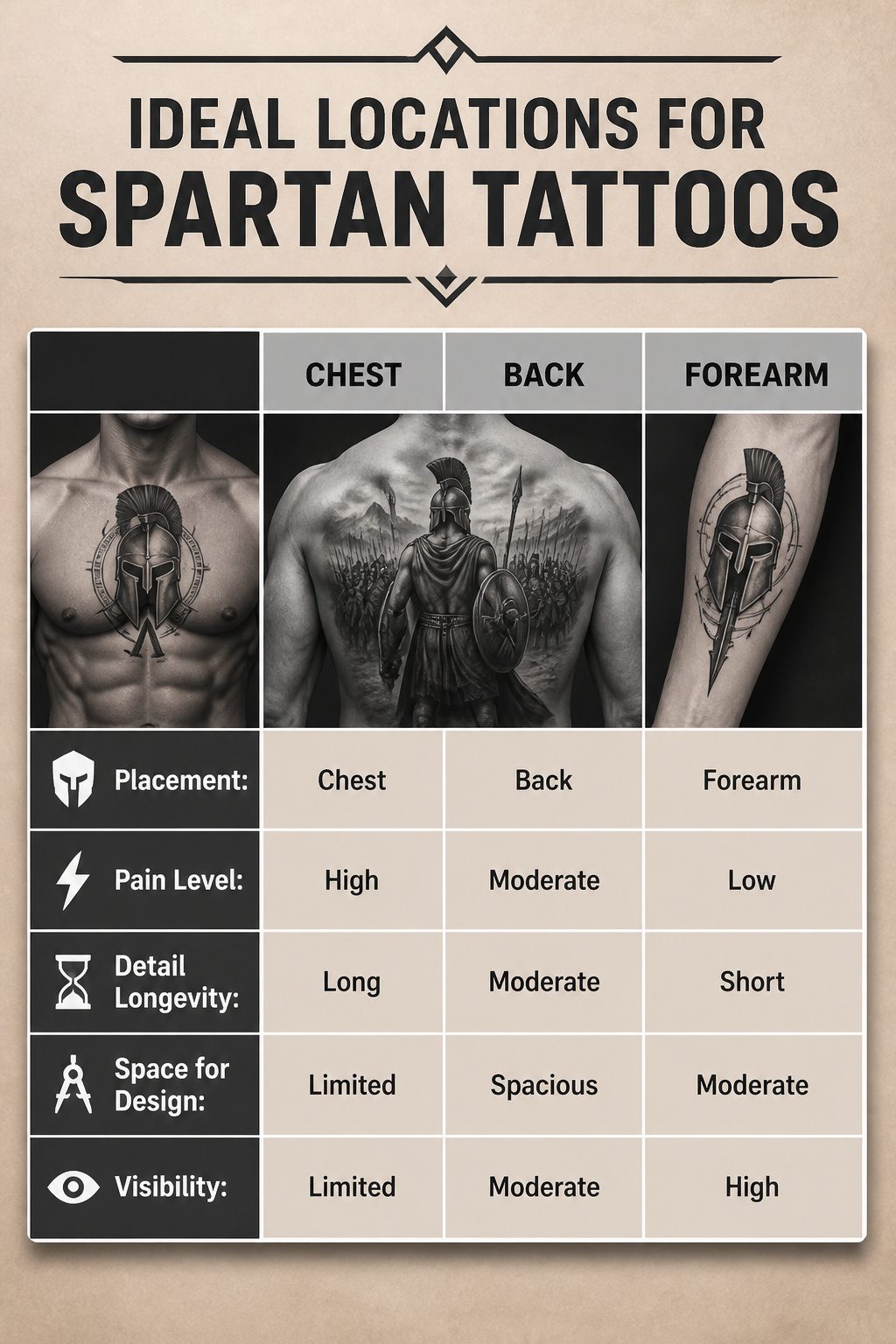
The chest, back, and forearm each carry a Spartan design differently, and the choice matters more than most people figure before they sit down.
A chest placement puts the helmet or full warrior front and center, where the pectoral muscle gives the image a natural shield-like frame.
The skin there stays relatively stable over the years, so fine details in the cheek guards or the lambda symbol hold their edges longer than they would on an area that stretches and contracts all day.
The tradeoff is pain: the sternum and the collarbone edges are tough sits, and anyone who has been through one knows the vibration alone is its own test.
The back offers the most room for a composition that reads as a scene, a phalanx or a single figure with enough space around it to breathe.
Between the shoulder blades, the skin sees less sun than the forearm, which matters for how black and grey ages, though the shoulder blades themselves are another high-pain zone.
The forearm reads as resilience and readiness because the image stays visible, but that same visibility means constant sun exposure and more frequent movement against desks and sleeves. Linework there tends to soften faster.
For a design built on sharp geometry, that is the compromise to weigh going in.
Black and Grey Against Color
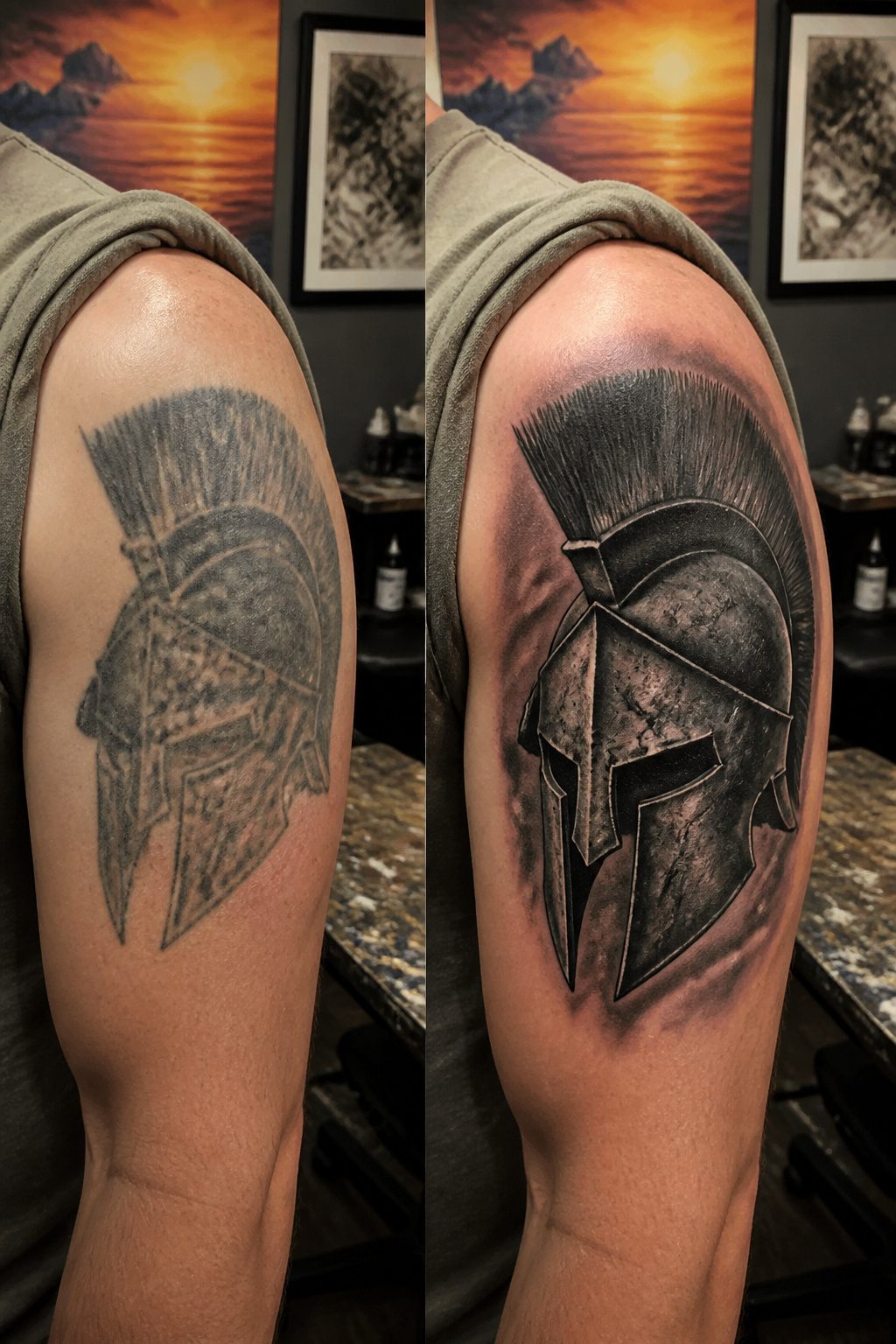
Black and grey realism tends to age cleaner on a spartan helmet or portrait than saturated color. The ink settles into gradients that blur together gracefully, where bright reds and golds can muddy into brown after a decade of sun.
Budget roughly thirty percent more for solid color work, since the piece takes longer and demands an artist who mixes pigment rather than pulls from a bottle.
Artists who specialize in black and grey often come from a background in charcoal or graphite portraiture. Their portfolios show smooth transitions from midtone to black, not just line work.
Color specialists, by contrast, need to understand how different pigments fade at different rates, so a red cape does not outlast the blue shield beside it.
If your design centers on the metallic gleam of a Corinthian helmet, black and grey reads as steel under skin.
Color makes sense when the spartan is part of a larger scene, maybe a battlefield with a burning sky behind him, where the palette carries the story.
Pick the artist first, let their strength dictate the approach, and the tattoo will hold up longer than any trend.
Frequently Asked Questions
What are some popular Spartan tattoo designs?
Popular Spartan tattoo ideas include realistic warriors with weathered bronze helmets, minimalist black-line silhouettes, kneeling figures, and designs that pair the Spartan with a wolf or lion.
Many people also choose Roman-Spartan hybrids, American flag fusions for military members, or geometric abstractions that fracture the helmet into modern shapes. Styles range from black-and-grey realism to trash polka and simple icon work.
What do Spartan tattoos symbolize?
Spartan tattoos carry core meanings of courage, honor, and warrior spirit, with discipline and resilience running close behind. Loyalty and brotherhood matter too, drawn from the phalanx tradition where each soldier protected the man beside him.
For some, the design serves as tribute to Greek heritage or marks personal battles and the pursuit of excellence through hardship.
Where should I place my Spartan tattoo?
The shoulder cap mirrors the Corinthian helmet curve naturally and anchors larger plans well.
The forearm offers daily visibility, though orientation matters: face the helmet outward and the world reads strength first; turn it toward you and the reminder stays private.
The back is the only place where a full battle scene can breathe, while the chest and thigh suit paired figures like a lion and Spartan side by side.