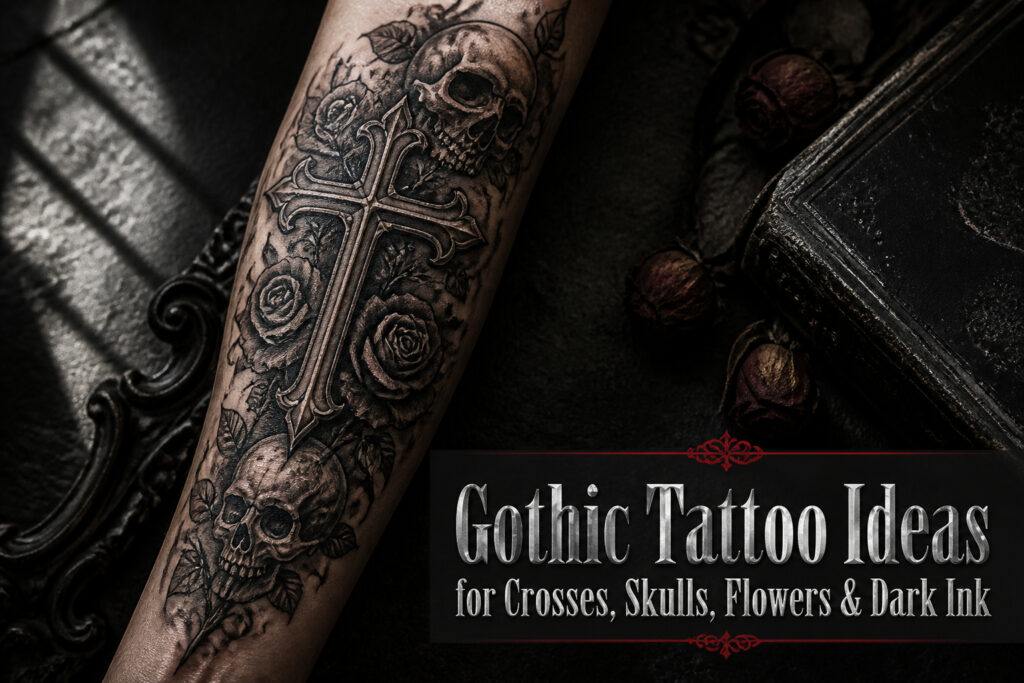
Gothic tattoo ideas span from a $400 forearm cross to a $4,000 full back piece, and the deciding factor is time in the chair rather than size alone.
The heavy black shading that defines the style does not forgive rushed work: soft edges on a gothic cross miss the point entirely, and the saturation demands three to five weeks of healing before the tone settles where it belongs.
What separates a piece that lasts from one that blurs into a dark smear is the negative space the artist leaves between saturated lines, a breathing room that time will close whether you planned for it or not.
1. Gothic Cross Tattoos
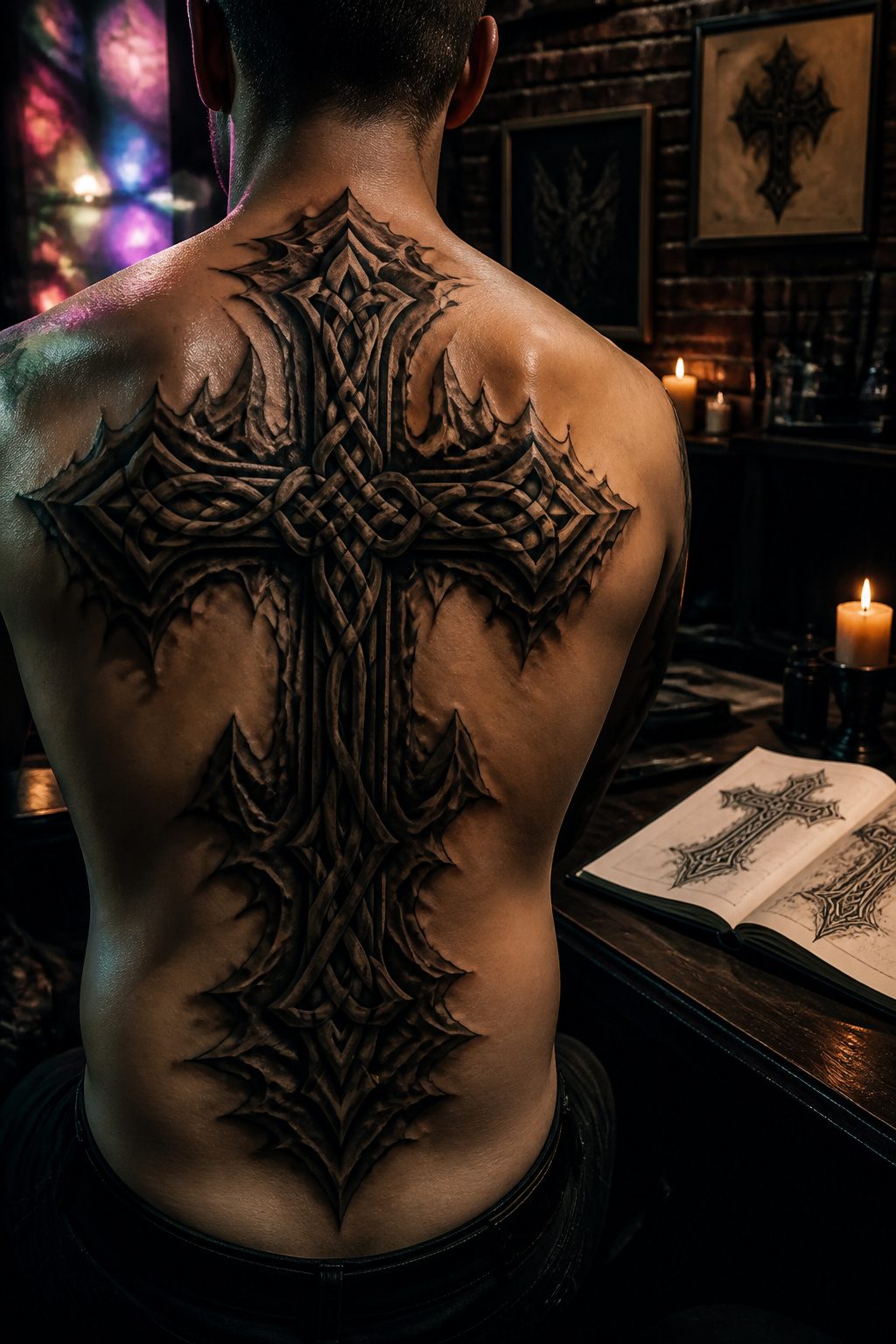
Black and grey rendering sets the tone for gothic cross tattoos, heavy shading pushing the design toward shadow rather than light. The crosses carry weight: passing away, pain, anger, or faith, sometimes all four in a single piece.
Celtic knots and ironwork patterns replace the clean lines of standard religious symbols, edges going jagged where traditional crosses stay smooth.
A gothic cross reads as faith that has weathered something, or a pull toward the ancient and mystical rather than anything modern.
Placement shapes the statement. The forearm keeps it visible, the chest turns it into something nearer the heart, and the back allows the scale these designs often demand.
A full back piece with the detail this style asks for runs $4,000 or more, while simpler forearm work might land closer to $400. The chest sits in between, sizing and complexity deciding the final number.
I have seen the difference between a $400 cross and a $4,000 one, and the gap is in the hours: the heavy shading does not forgive rushed work, and a gothic cross with soft edges misses the point entirely.
2. Gothic Skull Tattoos
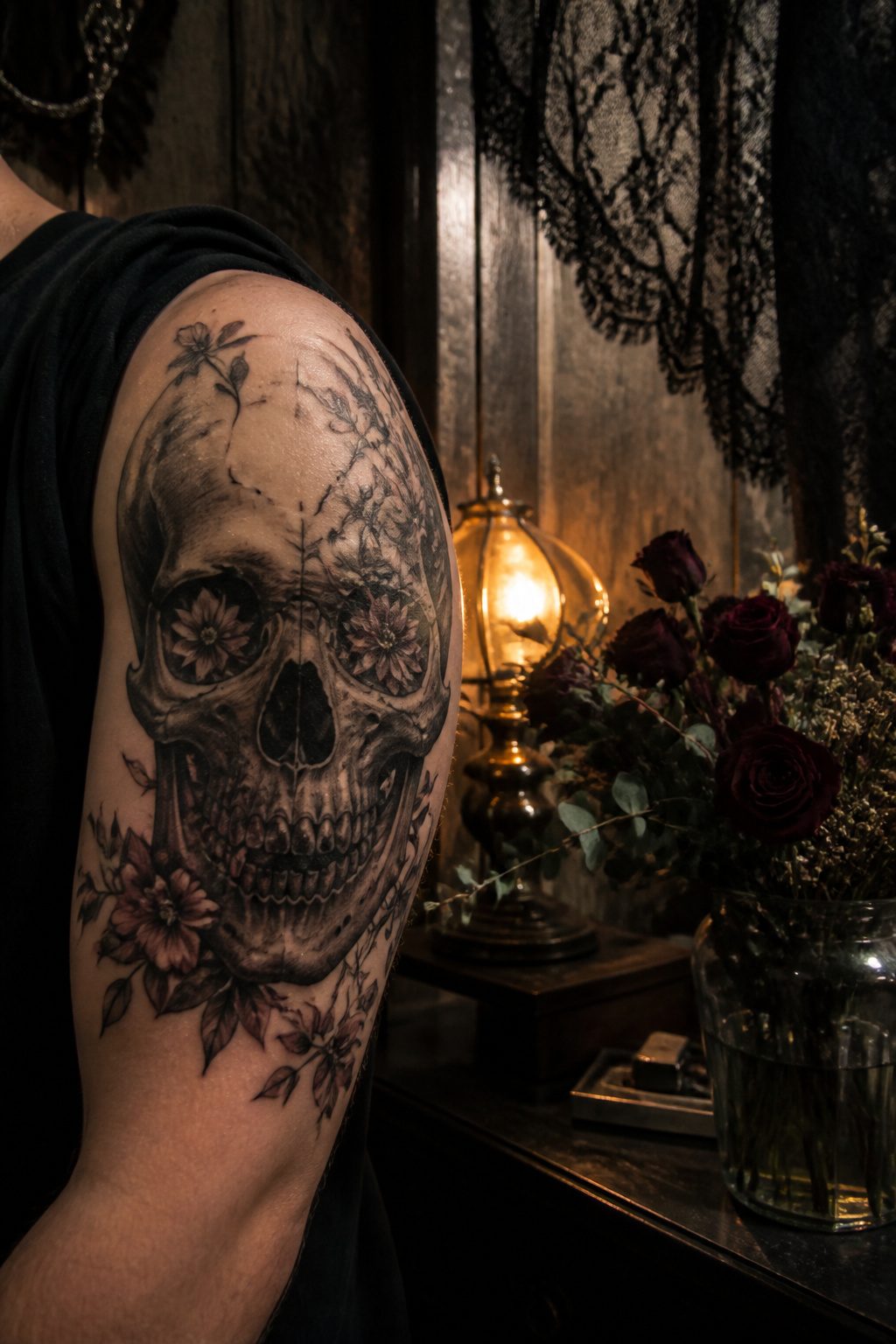
A gothic skull tattoo carries the weight of mortality without softening it. Bones outlast flesh, and the skull sits at the center of that reminder, stripped to what remains after decay.
The design rarely stands alone: flowers push through eye sockets or grass climbs from the jaw, pairing what rots with what regrows. That contrast is the point, not an afterthought.
The heavy black shading these pieces demand pushes pain into the moderate-to-high range, especially on thin skin or bone-close areas.
Plan for three to five weeks of healing, longer than a fine-line piece, because the saturation needs time to settle without scabbing unevenly.
Placement matters more than size here; a compact skull reads just as stark as a spread, but the neck or ribs will test your tolerance in ways the upper arm does not.
3. Gothic Flower Tattoos
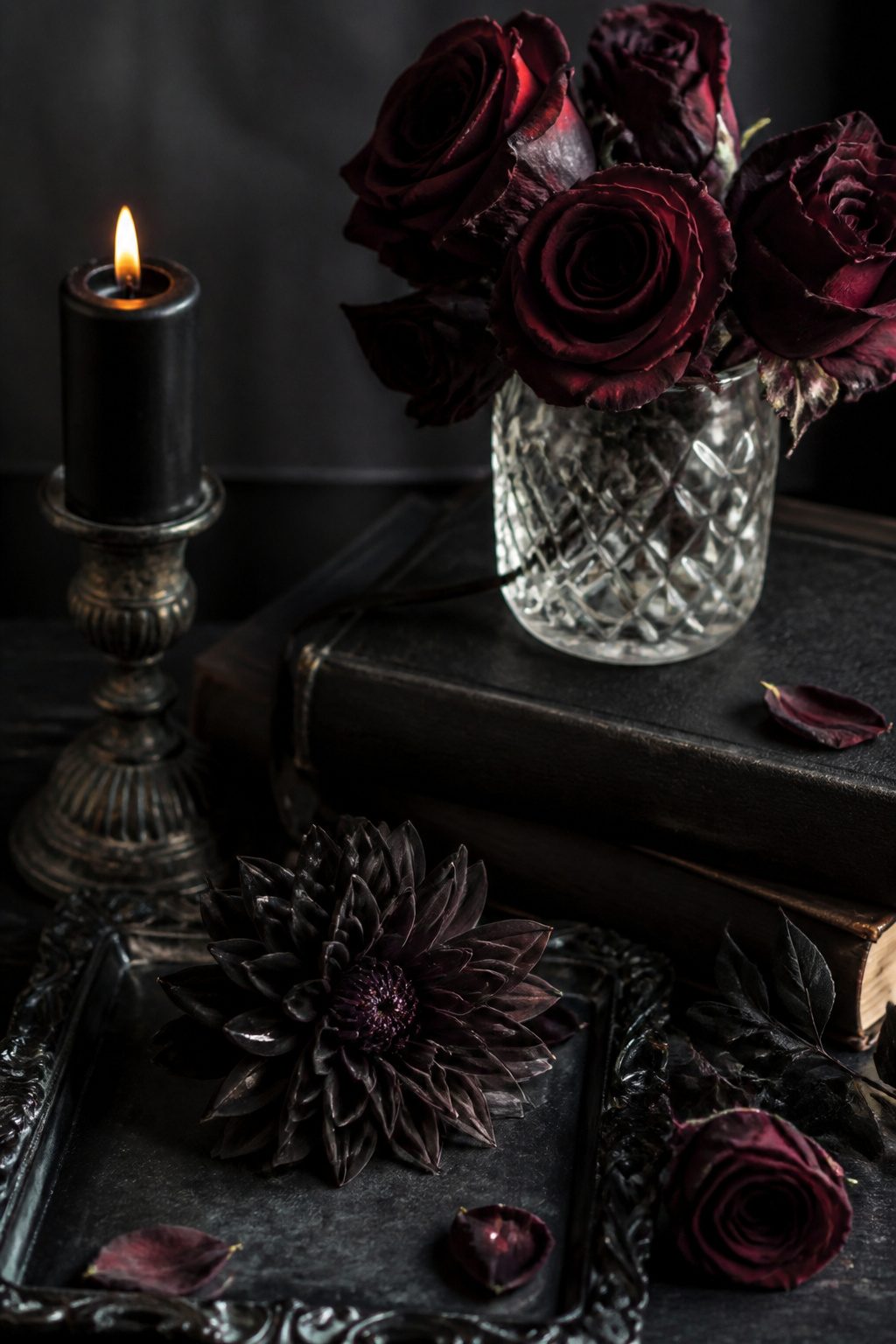
Flowers in gothic ink flip the usual script: decay replaces growth as the central metaphor. A rose rendered in black and grey, petals browning at the edges and thorns sharpened to points, reads more funeral bouquet than garden romance.
White lilies carry their own funeral-home history straight into the design, while orchids, often associated with the afterlife, twist into something stranger when petals droop and darken. The palette stays strict.
Heavy black saturation against grey wash builds the drama, and the contrast does the emotional work. Color would soften the message; the absence of it keeps the tone where it belongs.
A skilled artist will leave skin-tone gaps for highlight rather than add white ink, which heals to a chalky finish. The result is botanical study gone wrong, beautiful precisely because it refuses to pretend otherwise.
4. Gothic Raven Tattoos
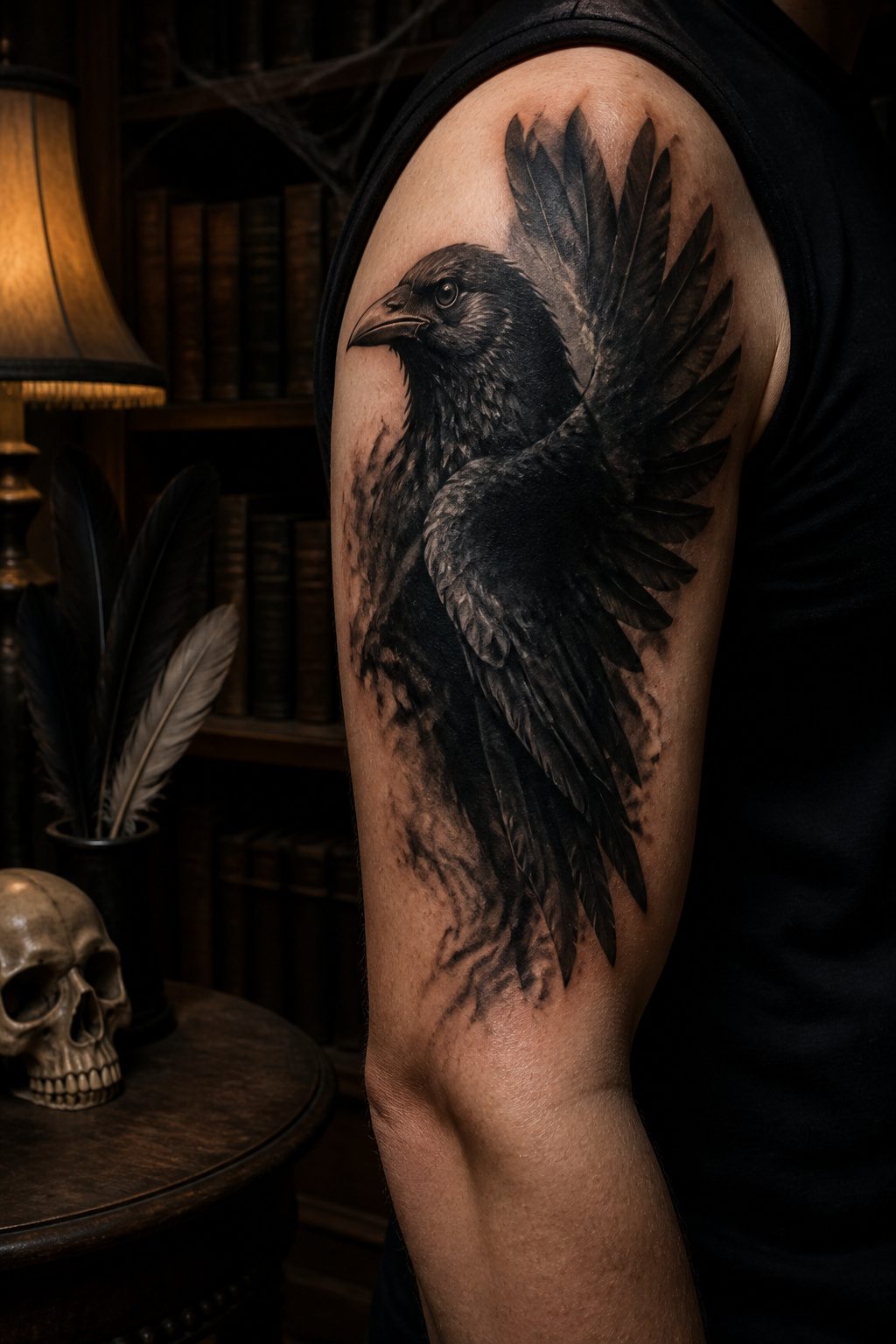
A raven rendered in black and grey ink carries the weight of midnight itself.
The bird’s association with grief and lost love, fixed since Poe set it tapping at the chamber door, makes it a natural fit for gothic tattoo ideas that aim for something more literary than a skull on a shelf.
What distinguishes the raven from other dark imagery is its flexibility: it reads as foreboding or as mourning, depending on how the artist handles the shadow work.
The depth of the black matters more than the detail of the feathers.
Most successful pieces I have seen rely on heavy saturation in the body, then pull back to near-skin tone at the wing edges, so the bird seems to materialize from fog.
The bicep remains the most common placement, though the shape of a raven in flight or perched with wings half-furled adapts to most flat planes.
The medium-to-large size range dominates; too small and the grey wash muddies into a single dark blob within a few years.
The "Nevermore" refrain, quoted in too many designs to count, works best when it is not quoted at all. A raven with no text attached says more than one wearing its reference on a banner.
The apocalyptic reading, the coming dread, the inevitability of death: these land through the bird’s posture and the void around it, not through captioning.
5. Gothic Architecture Tattoos
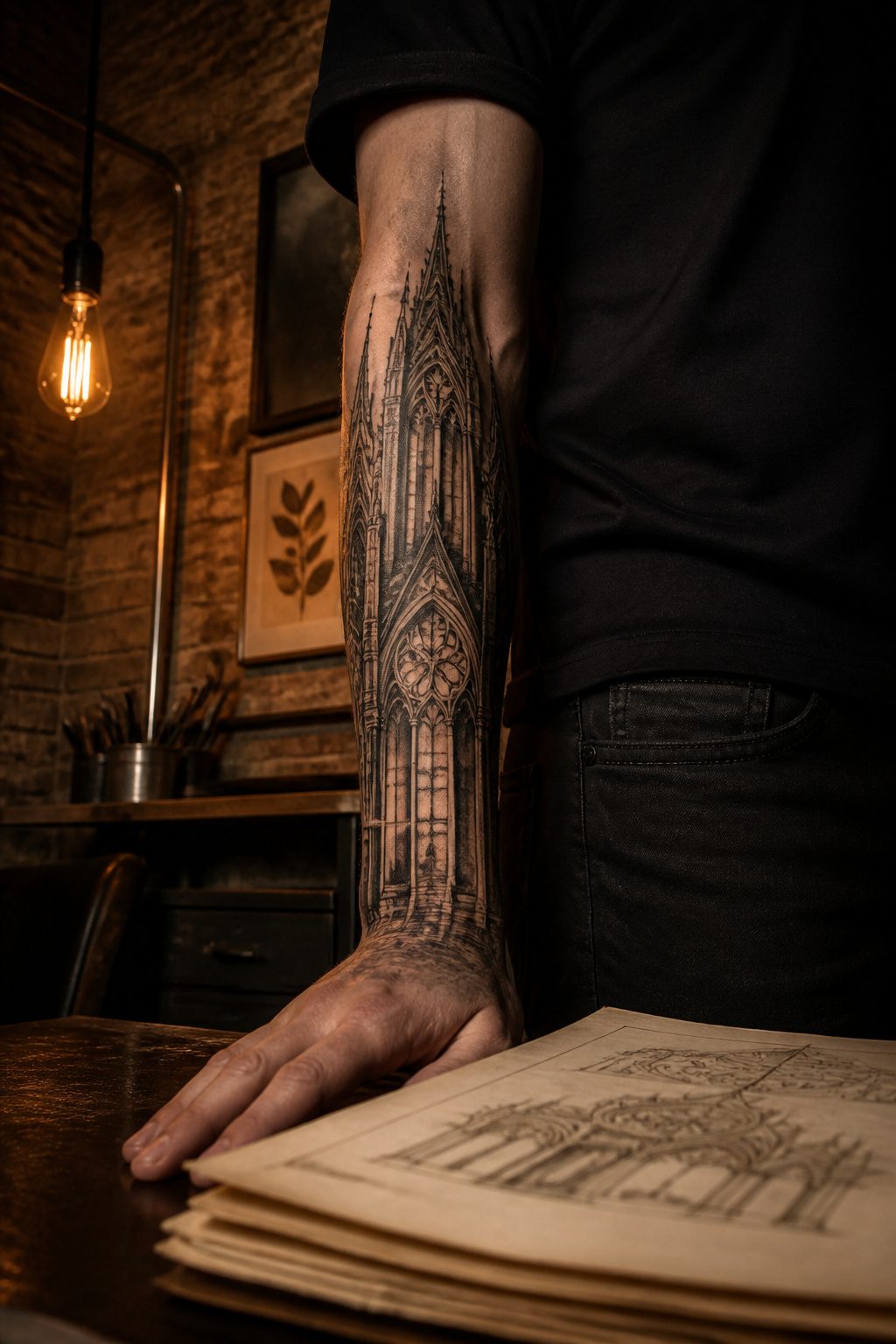
Gothic buildings have stood for centuries, and that staying power is what draws people to wear them on skin. A cathedral sleeve or ribcage piece carries the same promise: something built to outlast its era.
The detail is where these tattoos earn their keep. Arched windows, flying buttresses, and vaulted ceilings give an artist room to work at scale.
Stained glass rendered in greyscale turns what should be a riot of color into something stranger and more striking: light implied through negative space, the skin itself standing in for amber and ruby.
The contrast between saturated black and untouched skin does the job that colored pigment would.
That contrast is also what keeps the piece readable as it ages. Black ink spreads over decades, and the fine tracery in a rose window can merge into a dark smear if the lines sit too close.
The fix is size and breathing room. A gothic architecture piece needs enough negative space that the structure still reads after ten or fifteen years of settling.
Tight detail in a small footprint is a gamble against time, and time usually wins.
6. Gothic Angel Tattoos
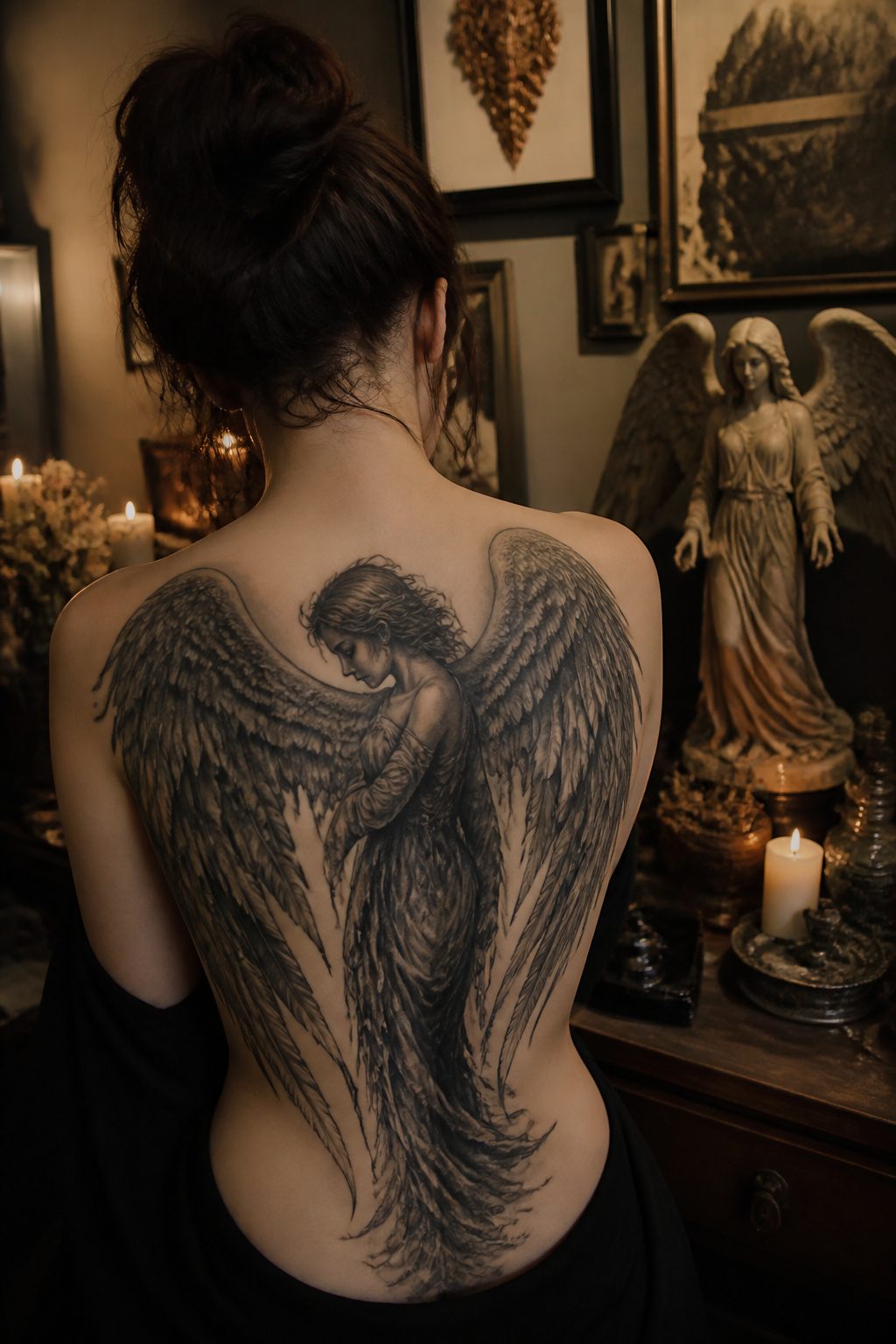
Fallen angels carry the tension between beauty and sorrow that defines gothic ink at its best. Wings that once lifted toward light now droop, tear, or blacken at the edges.
Halos crack, tarnish, or hang suspended like broken crowns. The Victorian Gothic tradition understood this pairing well; weeping angels and mournful figures captured what it meant to find something gorgeous in loss.
Two approaches sit in the chair opposite you. One keeps the angel recognizably celestial but drains the warmth: pale skin, hollow eyes, wings rendered in ash grey and bone white.
The other pushes further into rebellion, borrowing from demon imagery without fully crossing over. Tattered feathers become sharp.
The posture shifts from grief to defiance.
Black and grey shading does most of the heavy lifting here. Depth matters more than color.
A mournful angel needs hollows under the cheekbones, weight in the lowered gaze, shadows where the wing meets the back that suggest something pulled away or torn free.
Placement on the back or thigh gives the span needed for that detail.
What separates a gothic angel from generic dark imagery is the retained echo of what was lost. The halo remains, even broken.
The wings spread, even damaged. Without that remnant, you have a figure in pain but not the specific tragedy the motif demands.
7. Gothic Bat Tattoos
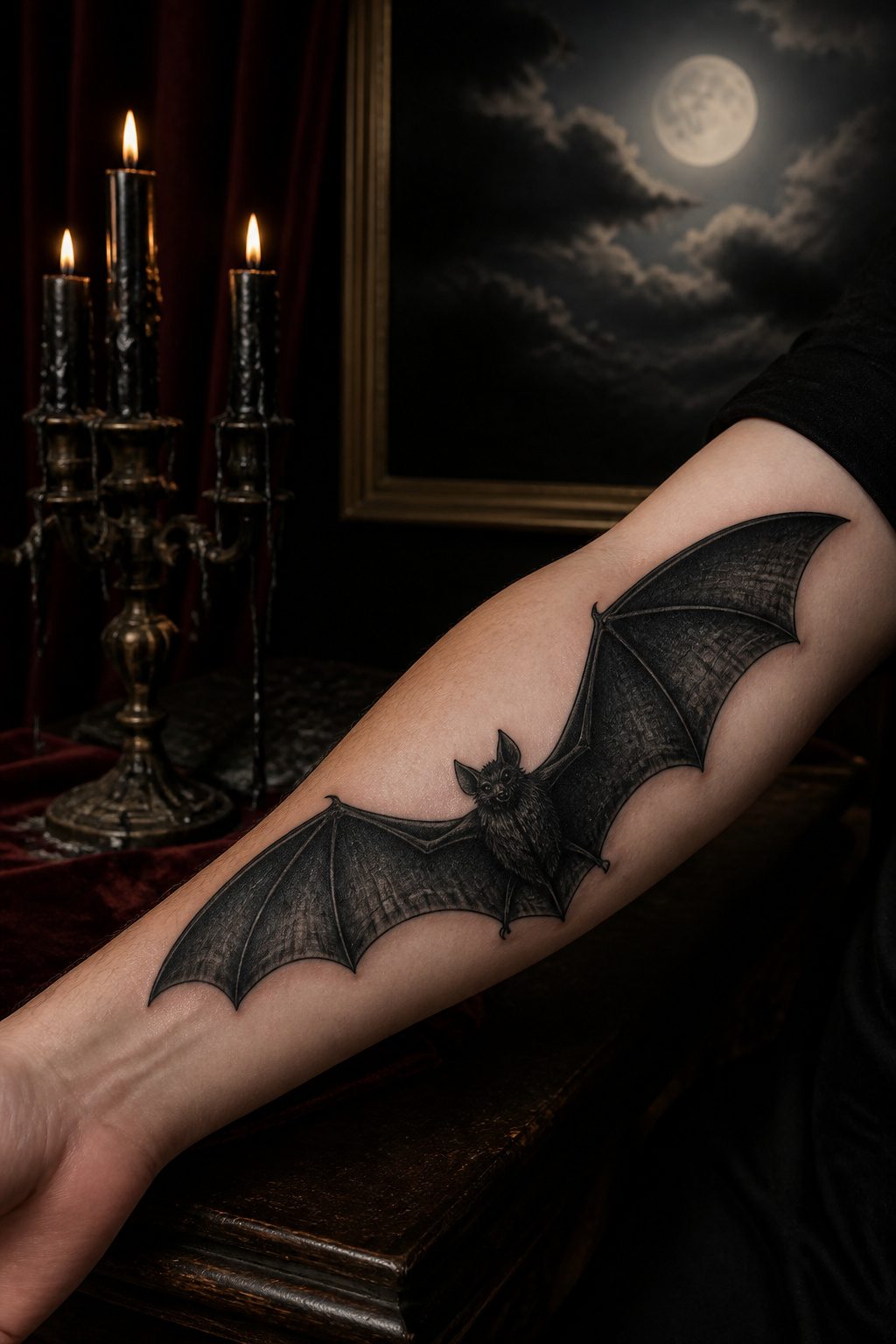
Bats carry the gothic mood more naturally than almost any other creature. Their nocturnal nature and that faintly unsettling presence in flight line up with the same literature that gave us Dracula and the brooding castles of Ann Radcliffe’s novels.
A bat tattoo can read as pure atmosphere, or it can lean into the vampire mythology that made the animal inseparable from gothic identity after Bram Stoker fixed the connection in 1897.
The forearm stays the leading pick for placement, mostly because the span of a bat’s wings needs room to open.
A small single bat tucked behind the ear works, but the full visual payoff comes from letting the wings spread across muscle and bone, either wrapped around the arm or centered on the upper back where the shoulder blades give the wings their anchor.
Scale this wrong and the detail flattens out: too large on too small a surface, and the membrane webbing turns to mush within a year.
For a full wingspan, the shoulder blade or the outer thigh gives the cleanest canvas, with the wings following the body’s natural lines rather than fighting them.
8. Gothic Castle Tattoos
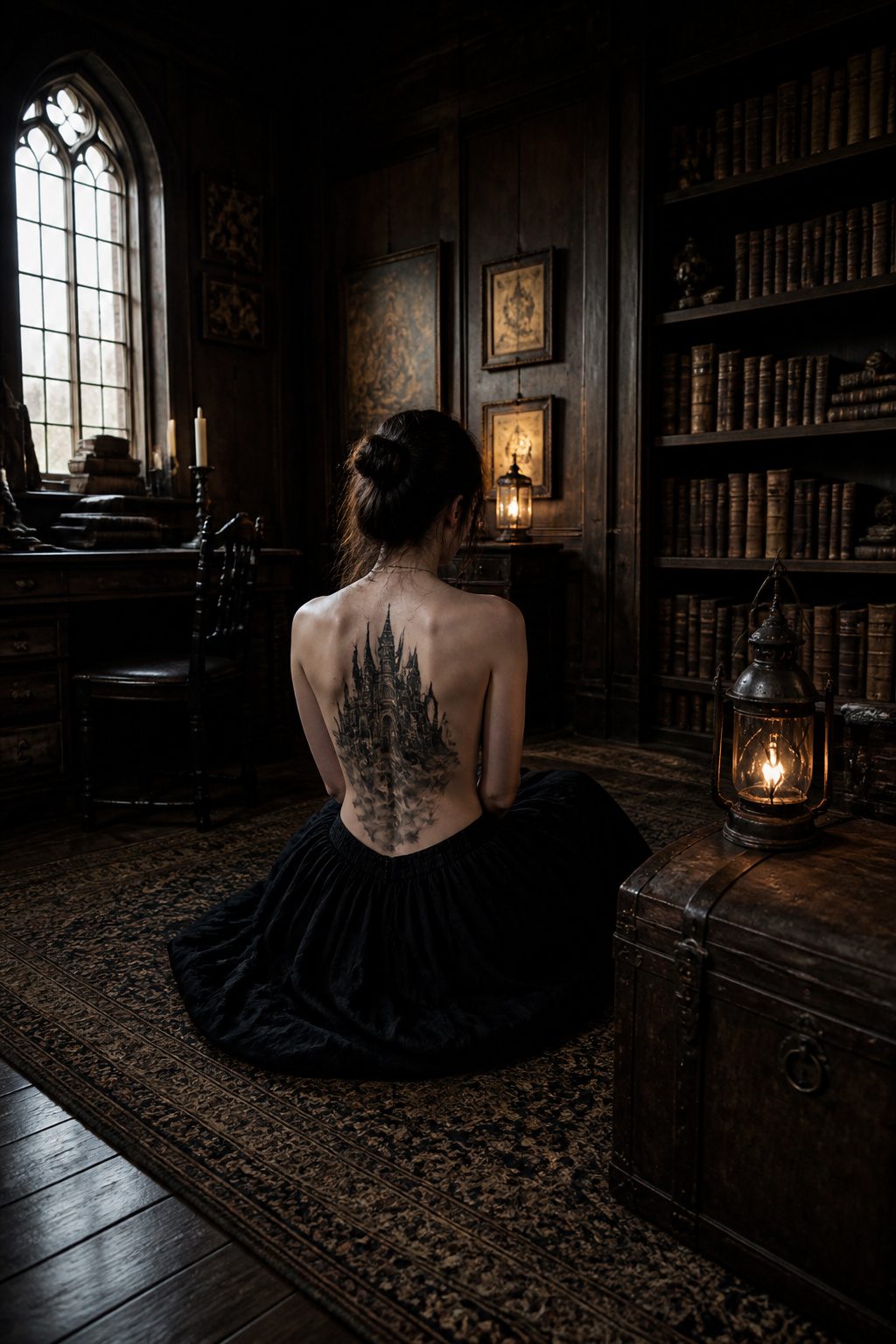
Castles carry the weight of centuries standing still, and that stillness is what draws people to them in ink.
A gothic castle tattoo leans into isolation: the structure sits alone on a cliff or swallowed by bare trees, no village nearby, no road leading home. The mood is deliberate.
Fog does the heavy lifting in these pieces, rendered in soft grey wash that eats the edges of stone until the building looks half-eroded by weather.
Moonlight gives the artist a single hard light source to work against, throwing the turrets into sharp silhouette while the courtyard below stays lost in shadow.
Black and grey is the only palette that makes sense here. Color would break the spell.
The turrets themselves need careful attention: too clean and the piece reads like a Disney souvenir, too rotted and it collapses into abstraction.
What convinced me, looking through portfolios for months, is the artists who leave the windows dark, not black. A solid black window is a hole.
A window with one lighter grey stroke suggests candlelight, or vacancy, and the viewer fills in the story. That withholding is the gothic impulse in miniature.
Skin tone becomes part of the fog on lighter complexions; on darker skin, the artist reverses the value range, letting the stone carry the black while the mist stays in the negative space.
9. Gothic Font Tattoos
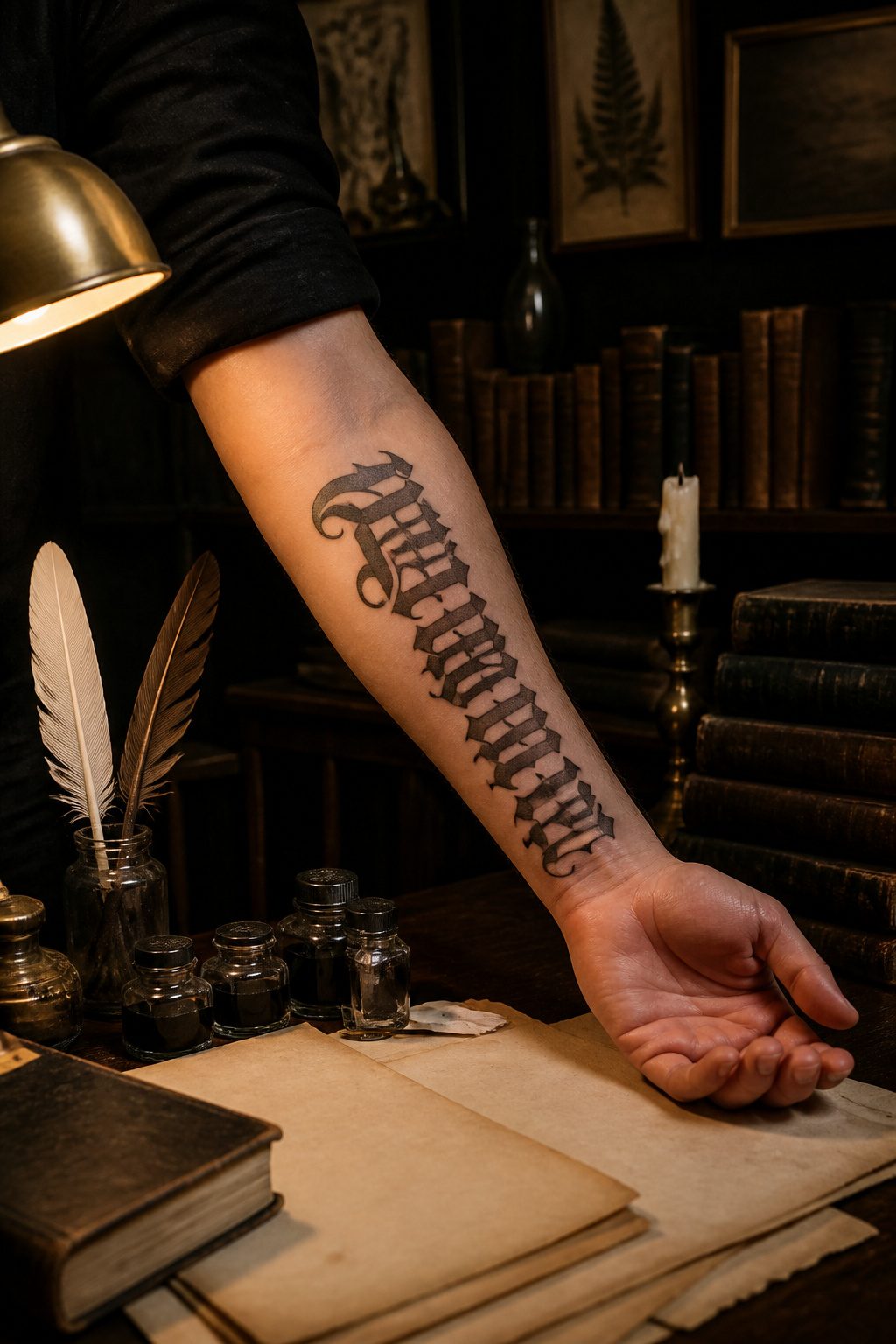
Blackletter and calligraphic scripts carry a weight that lighter fonts cannot fake.
The thick vertical strokes and sharp, ornamental serifs of gothic font tattoos turn even a simple phrase into something that reads like carved stone or church glass, darkening the mood without adding a single skull or raven.
A "sweet message" set in these letters becomes sinister by structure alone, the architecture of the type doing the emotional work.
Ink spread is the real enemy here. Black ink stays stable over decades but still migrates under skin, and gothic lettering is detail-dense by design.
Tight kerning, the space between letters, collapses faster than most people plan for. What reads cleanly at twenty-five can blur into an illegible black mass by forty.
The fix is spacing the letters slightly wider than looks right on the stencil; the gaps will close naturally as the ink settles, and the word survives.
Old English and its calligraphic cousins reward patience in placement. A forearm gives the eye room to trace the vertical rhythm.
A finger or behind-the-ear spot wastes the style, the detail lost to scale and movement. The subculture that revived these fonts in the late twentieth century understood that the darkness lives in the ornament, not the content.
Choose your phrase for meaning, but trust the font to supply the mood.
10. Gothic Coffin Tattoos
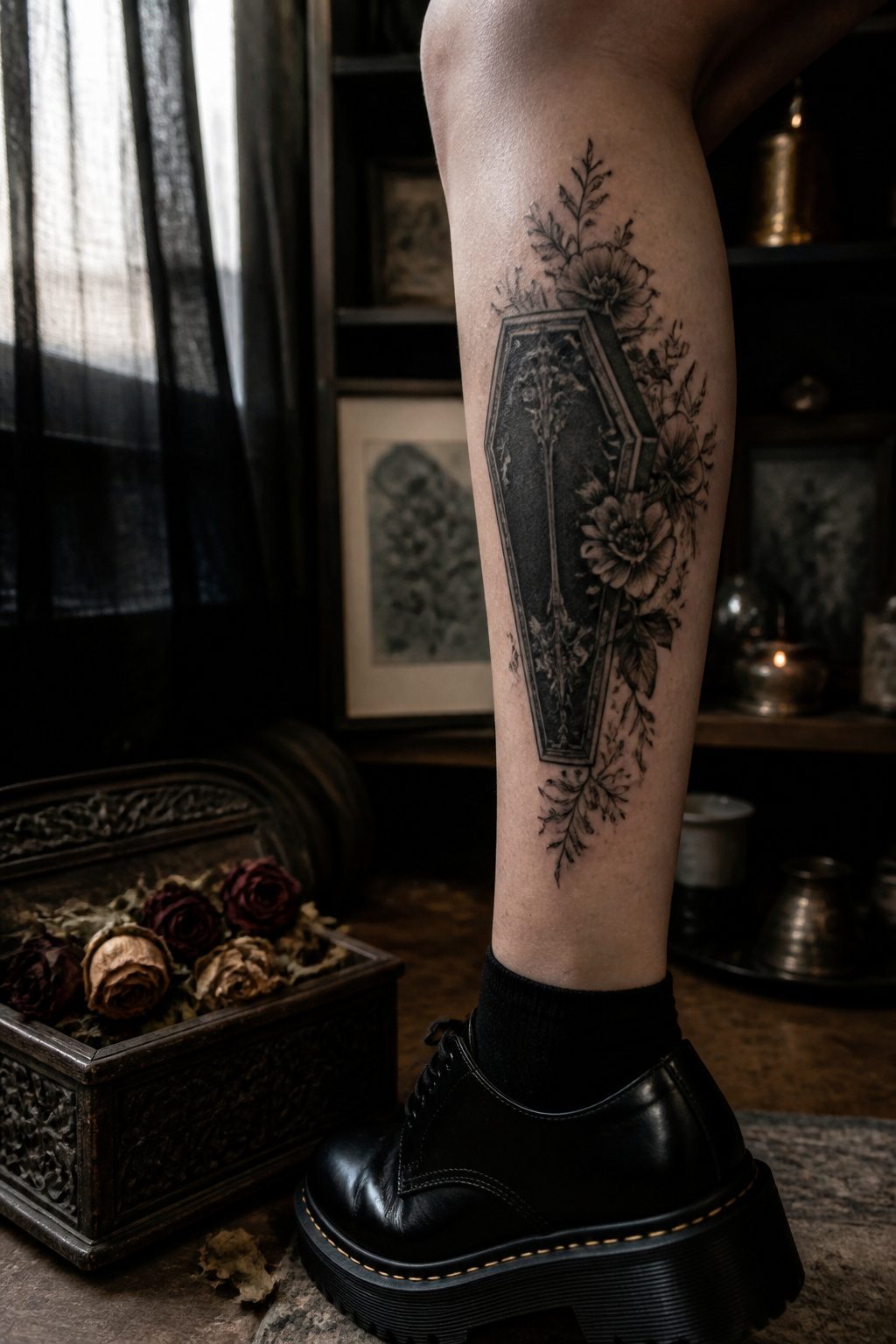
Coffins carry the most direct meaning in gothic imagery: death itself, sealed and final. That bluntness is exactly why they work as tattoos.
The shape is simple enough to read from across a room, but the interior space invites detail that turns a generic symbol into something personal.
Flowers spilling out of the coffin lid soften the edge without weakening the message. Roses are the common choice, though lilies or dried stems read closer to decay and the passage of time.
A cross mounted on the lid or carved into the wood grain pulls the design toward mourning and faith. Some clients add dates, initials, or small objects inside the coffin interior: a book, a music note, a hand mirror.
Those details shift the tattoo from a statement about death in general to a specific loss or a specific life.
The coffin silhouette also frames well on narrow placements: the forearm, the side of the calf, the ribcage running vertically.
Black and grey shading gives the wood grain weight, but a flat black coffin with a single white flower inside can read even harder.
Keep the outline clean; too much filigree on the border turns the shape into a jewelry box and loses the bluntness that makes the symbol work.
11. Gothic Fairy Tattoos
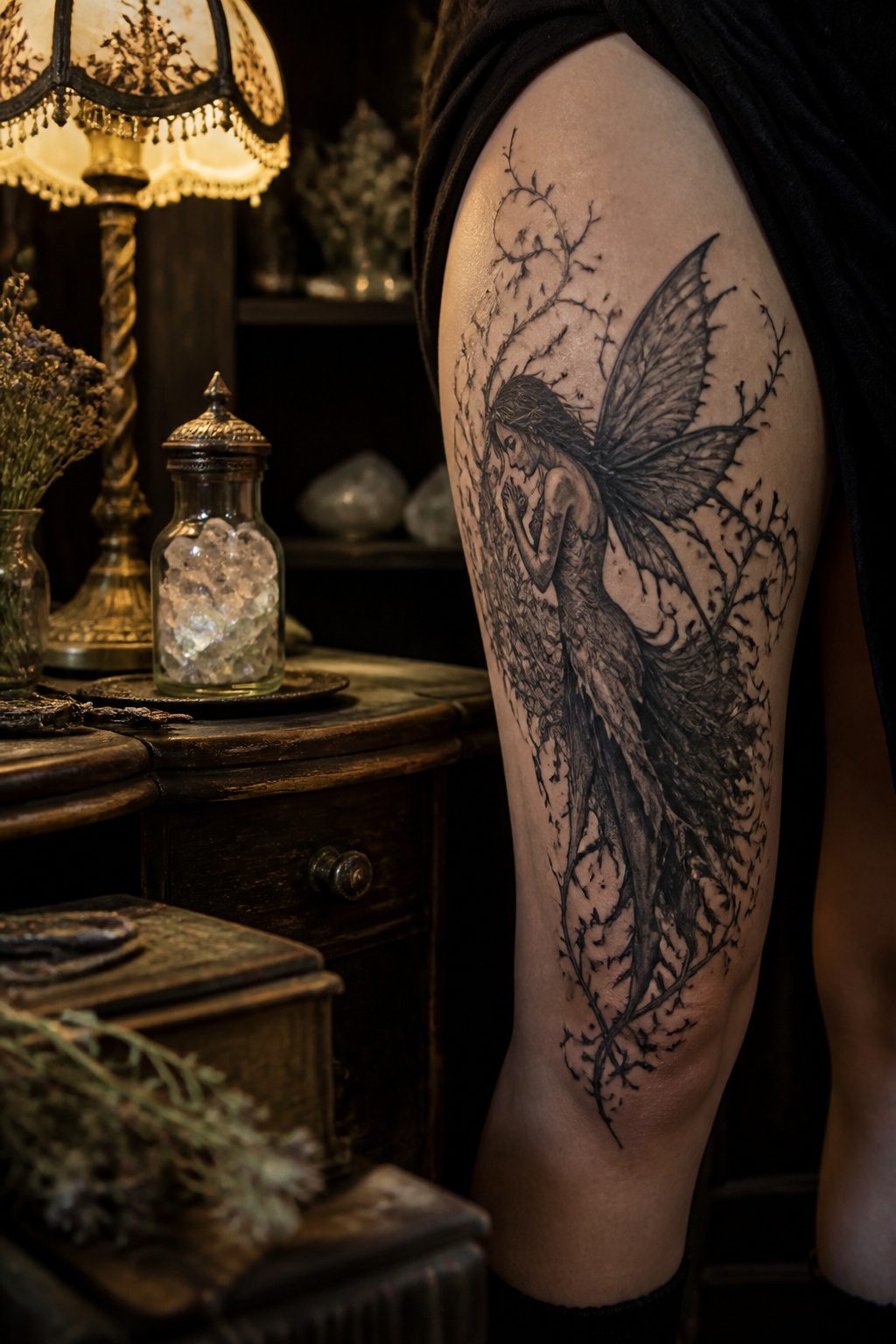
Fairy imagery in gothic tattoo art strips away the Tinker Bell gloss and keeps the silhouette: wings, a figure, sometimes a wand or thorned crown. The shift happens in the palette and the posture.
Neutral shades replace bright primaries, and the detailing inside the frame becomes the focus rather than the fantasy sparkle. Wings get rendered with membrane texture, veining, or torn edges.
Thorns replace flower stems, or twine through them.
Portraits lead the category, and the realism works because the gothic frame gives permission to make the subject solemn. Where a traditional fairy tattoo might float or grin, these figures hold still, look back at the viewer, or guard something.
The subdued color scheme does the heavy lifting here; without it, the same linework would read as woodland whimsy.
Placement follows the same logic as other gothic pieces. Arms, back, and thighs carry the larger portrait formats that let the shading build depth.
The fairy as a companion figure, one that offers guidance during harder stretches, is what keeps the motif inside gothic subculture rather than abandoning it to nostalgia. That meaning lands only if the visual tone commits fully.
Halfway between sweet and dark reads as uncertain; the best versions pick the darker register and stay there.
12. Gothic Dragon Tattoos
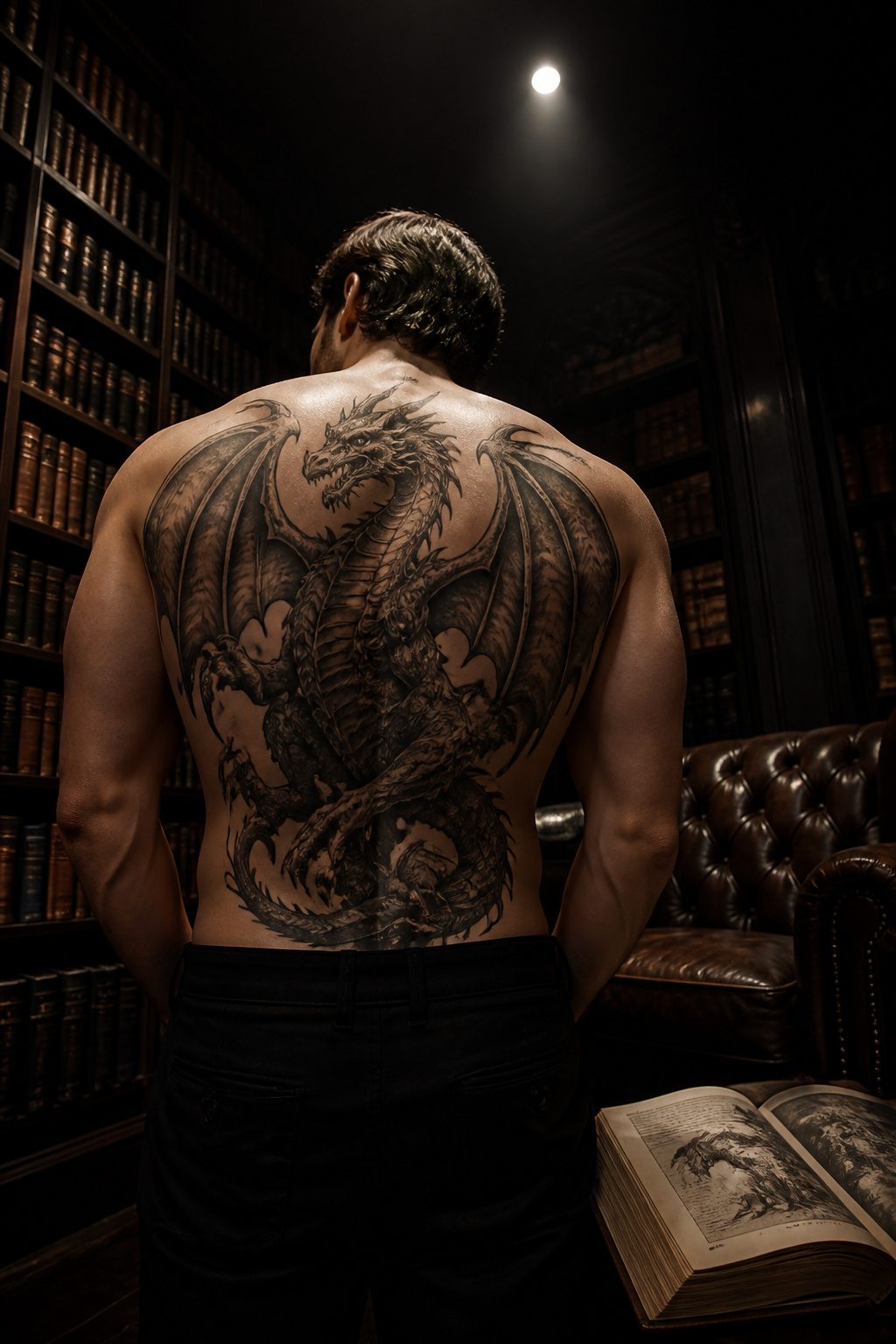
Dragons carry the weight of medieval lore that the gothic style pulls from, and the scale of a full dragon piece suits the darkness of that aesthetic better than most subjects.
The wings, the coiled body, the rows of teeth: each element gives the artist room to build real menace through heavy shading rather than line work alone.
A gothic dragon tattoo doubles down on neutral shades the way traditional gothic pieces do, dropping color for concentrated blacks and deep grays.
That density comes at a cost. The same shading that gives the dragon its weight demands extended session requirements and clear space on your calendar.
These are not afternoon pieces.
The back, the thigh, or a full sleeve offer the only canvases large enough for the design to read as dragon rather than generic serpent, and the hours stack fast once you commit to the scale.
What convinced me, reading through a dozen of these portfolios, is that the best work happens when the client books the time before the art: the tattoo requires time and space, and trying to compress it into short sessions flattens the shading into something more gray than gothic.
13. Gothic Hand Tattoos
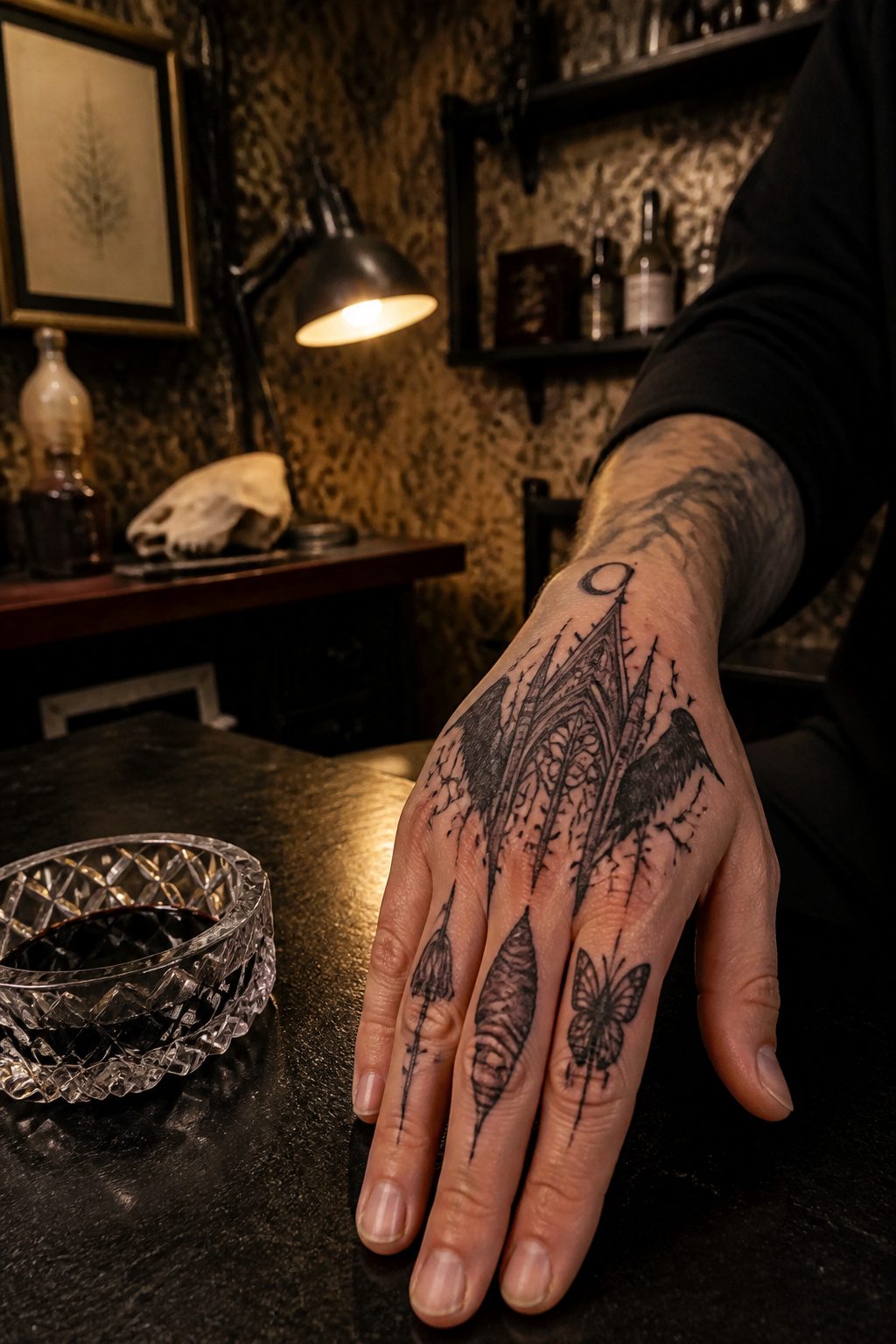
Hand placement sits at the center of gothic tattoo ideas for a reason. The skin there is thin, the bone close to the surface, and the needle work registers as some of the most intense pain in tattooing.
Fingers, hands, and neck are often preferred exactly because of this, not in spite of it. The subculture has long accepted pain as part of life, and that acceptance carries into the choice of where to wear the ink.
A hand tattoo typically needs more frequent touch-ups than blackwork elsewhere on the body.
The gothic style uses heavy coloring rather than solid black alone, and that color fades faster on skin that moves constantly and sees sun, soap, and friction.
The detail possible in a hand piece, cathedrals or large symbolic depictions, competes with biology. The hand will blur and soften sooner than a shoulder or thigh.
The tradeoff is visibility. A gothic hand tattoo is seen in every gesture, every handshake, every reach for a coffee cup.
For someone building a look around the aesthetic, that exposure matters more than the maintenance schedule. For someone who wants the design to stay crisp for years with minimal return trips to the chair, the hand is the wrong canvas.
14. Gothic Window Tattoos
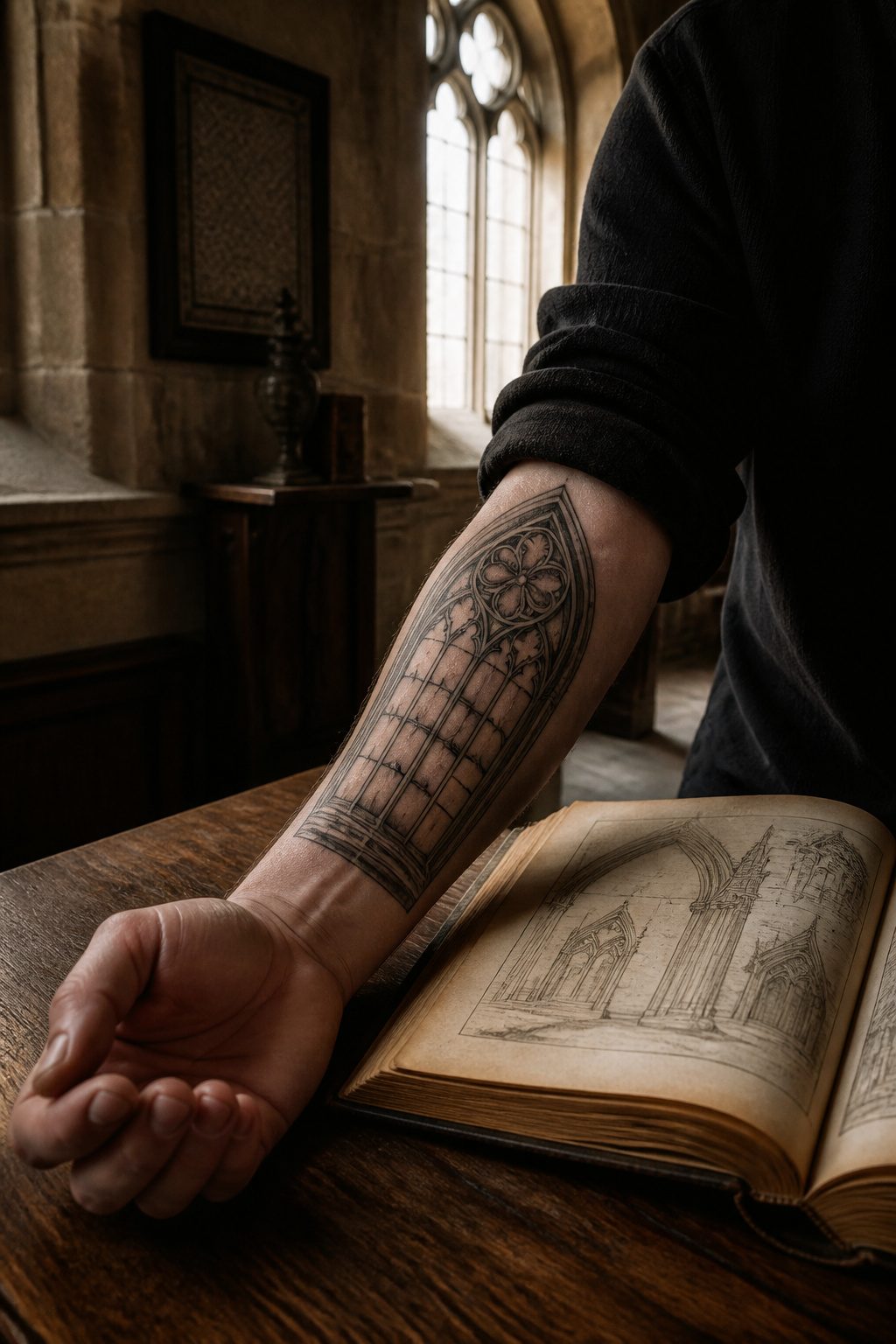
Arched window tattoos carry the same weight as the stone frames they copy: the curve at top draws the eye upward, and the geometry underneath has to be exact or the whole piece looks off.
I have watched artists map these out with a straightedge first, because a line that wanders by even a millimeter reads as a flaw in a design built on symmetry.
Stained-glass versions layer color in panes separated by inked lead lines that read as shadow from a distance, which is the trick that makes flat pigment suggest light passing through glass.
The palette tends toward jewel tones against black, or the inverse, with the window itself in solid blackwork and the "glass" left as negative space.
On skin that sees sun, those pale gaps fade faster than the surrounding ink, so the contrast shifts over years.
A forearm or calf gives enough flat plane for the architecture to hold its shape; curves over ribs or shoulders can distort the frame in ways that break the illusion.
The best pieces I have seen keep the detail concentrated at the center and let the edges soften, so the window appears to glow rather than sit like a sticker.
15. Gothic Knight Tattoos
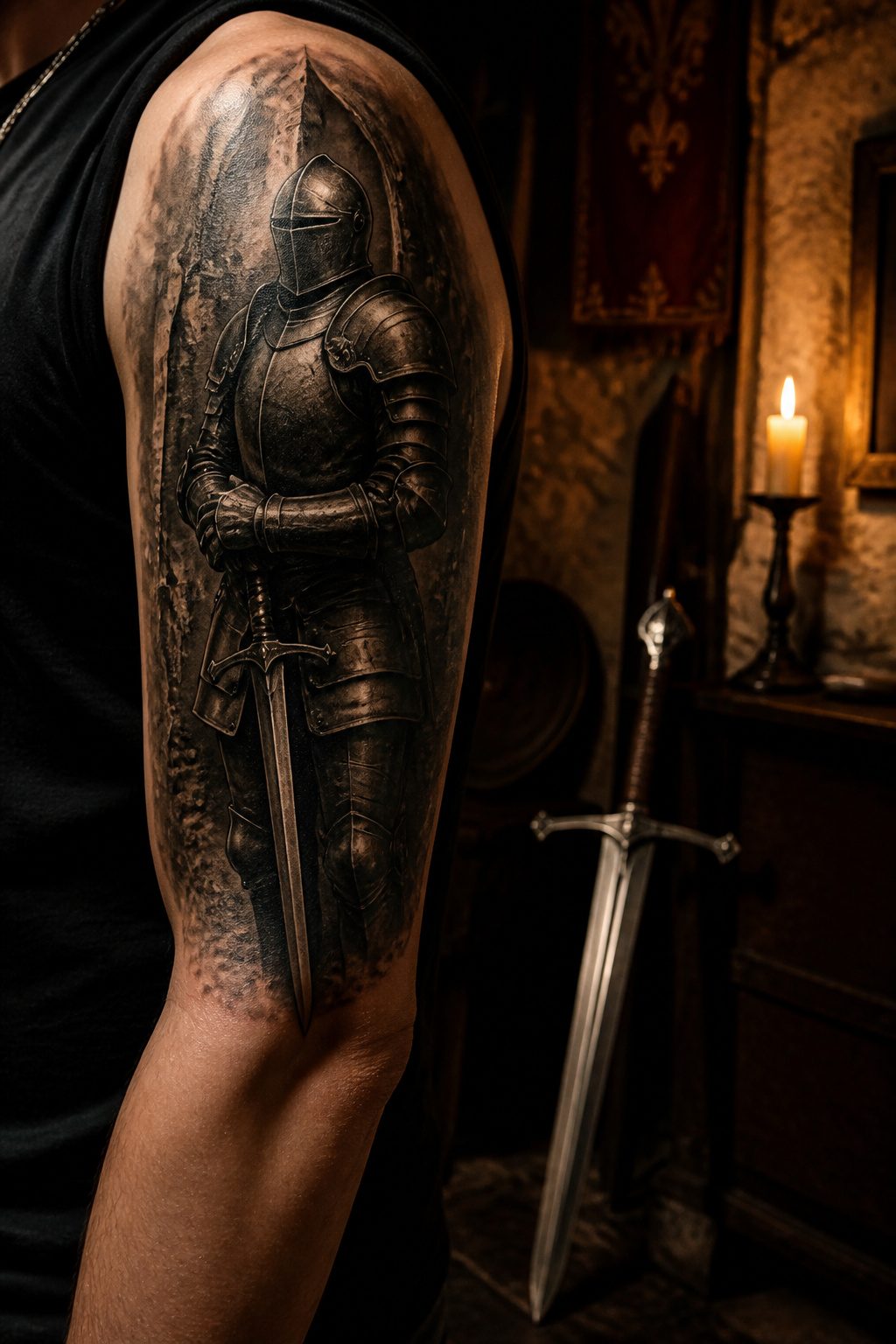
Armored figures carry weight in gothic ink that crosses and skulls sometimes miss. A knight in full plate reads as both protector and prisoner: the shell that keeps death out is the same one that keeps the wearer sealed in.
That tension is what drew me to the design after paging through enough flash sheets where darkness meant only a raven or a thorned rose.
The real test for these pieces is rendering metal so it looks like metal, not gray plastic. Chainmail in particular breaks apprentices because each ring has to catch light differently or the whole field flattens into wallpaper.
A good artist builds the armor in layers, starting with a dark iron base and lifting highlights only where a real breastplate would reflect a torch or a low moon.
Skip that step and the knight looks pasted on, not buried in it.
Swords and shields add focal points, but they also add hours. My own preference runs toward the gauntlet raised in salute or lowered in exhaustion, something that lets the armor do the talking.
The gothic tradition here reaches back to 17th century classical goth art and the medieval darkness it borrowed from, so the more authentic the metalwork looks, the deeper the piece sits in its own history.
16. Gothic Voodoo Doll Tattoos
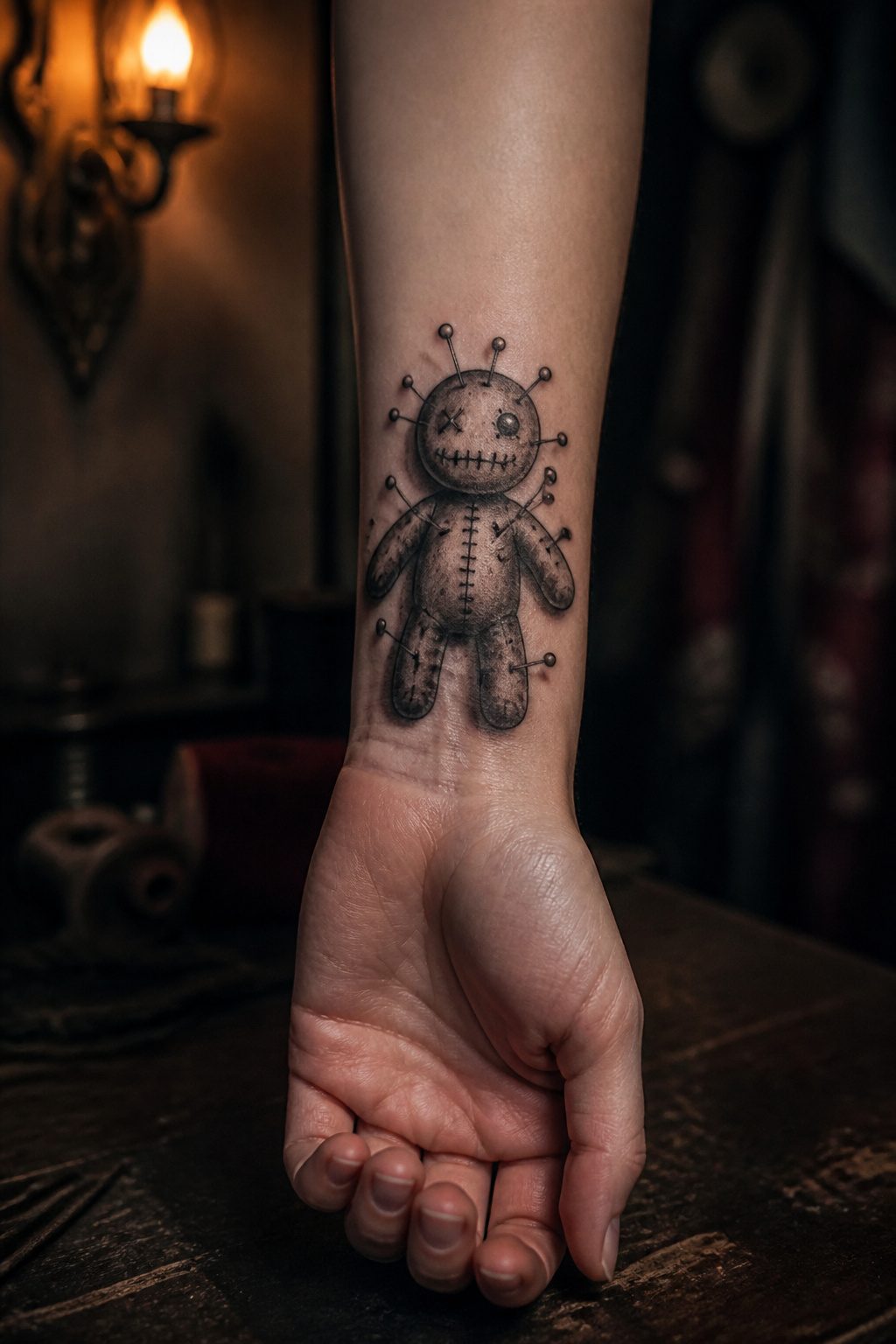
A gothic voodoo doll tattoo sits in tricky territory, and most shops will pause before booking one.
The design carries real weight in Vodou and related traditions, where practitioners see the figure as a tool of healing and intention, not harm. Borrowing it purely for edge risks flattening something sacred into a prop.
That said, the visual language does work within gothic tattoo ideas when handled with intent rather than shock value.
The doll form, stitched seams, and pins can read as metaphor: control, pain carried rather than avoided, the body as something repaired rather than perfect.
One approach keeps the figure anonymous, a small worn thing on a wrist or forearm, shadow pooled around the face so the expression stays unreadable.
Another goes larger, a back piece where the doll holds a nail through its own heart, the shadow work heavy enough to make the linen look real.
What separates a thoughtful piece from a regrettable one is usually the conversation before the needle.
A good artist asks what the image means to you, and "it looks dark" is an answer that should send both of you back to the drawing board.
The design ranks among the least common in gothic portfolios for exactly this reason: it demands a story that holds up.
17. Gothic Tree Tattoos
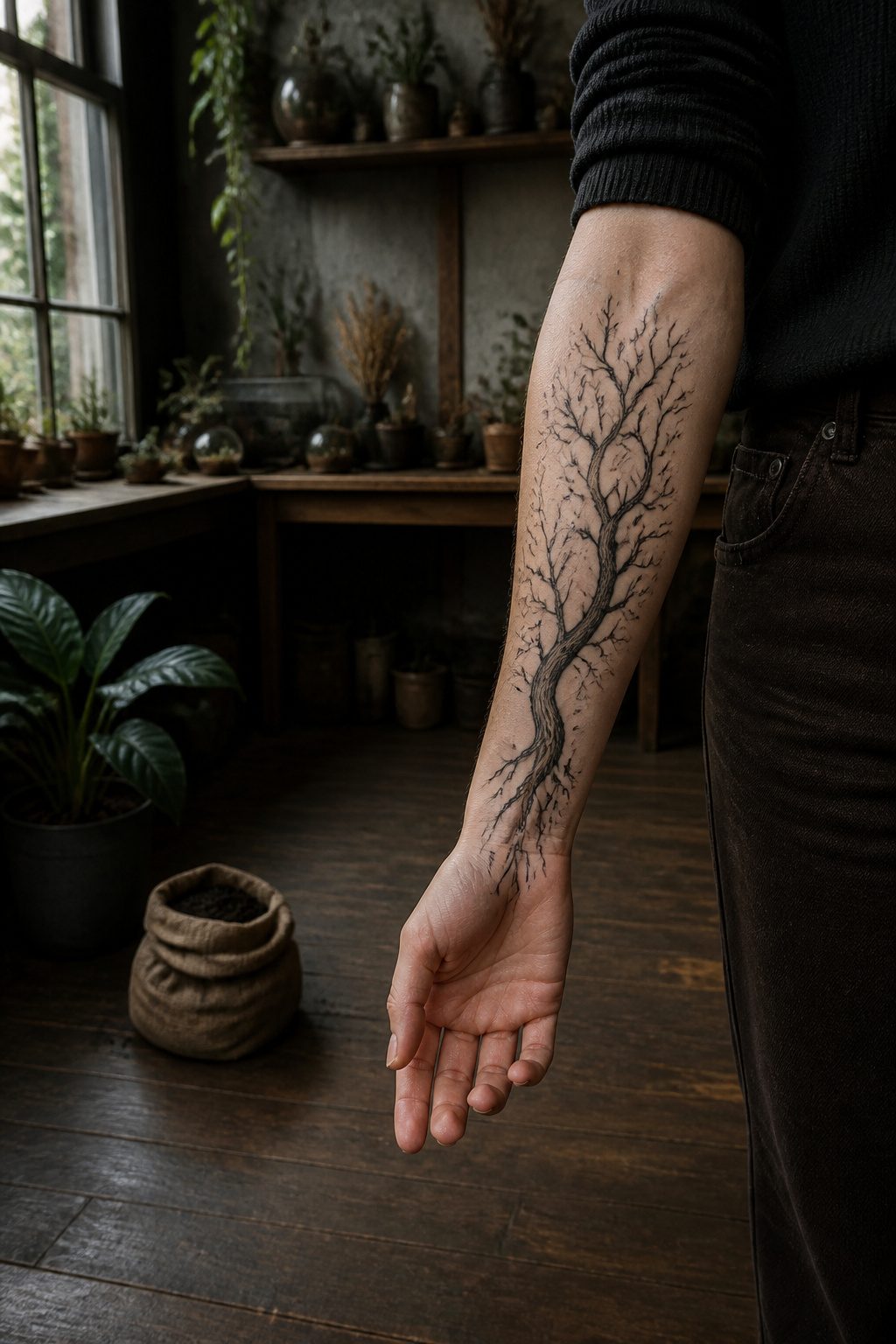
Dead trees carry weight that living ones do not. The bare branches of an oak or birch stripped to its architecture becomes a natural gothic line without needing any added ornament.
Roots that tangle and fork underground mirror the branches above, so wrapping both around a calf or forearm gives the design its own gravity.
Decay reads as honesty in this style; the tree is not pretending to be anything other than what time made it. Ink here works best in stark black with negative space left for moonlight or fog behind the trunk.
An all-black silhouette against skin risks flattening out, which is why the split between branch and sky matters more than the branch itself. The passage of time is the subject, not the background.
18. Gothic Horror Tattoos
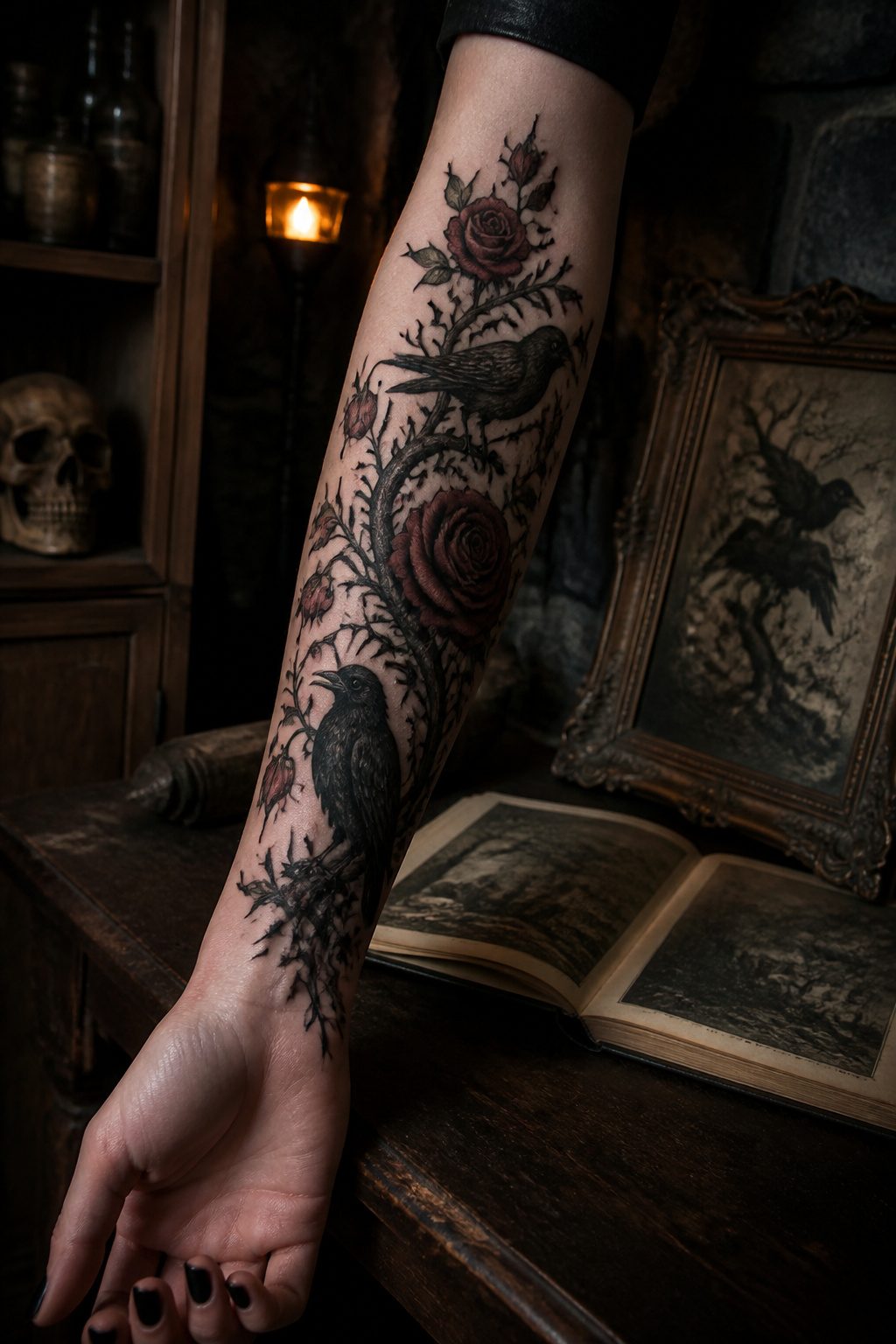
Victorian Gothic literature still supplies the best reference points for horror tattoos that last.
Bram Stoker and Edgar Allan Poe built the visual vocabulary: wilted roses, weeping angels, ravens perched on skulls, the tragic beauty of loss made permanent on skin. These motifs work because they carry a story the viewer already half-knows.
Film horror folds in later but hits the same nerve.
A sleeve pairing Jason, Freddy, and Chucky against a crumbling Gothic church works not as fan service but as a declaration that the wearer sets their own standards for what counts as beautiful.
The macabre here is not shock value; it is non-conformity with the volume turned up.
The 17th-century classical Goth art tradition and the late-1970s subculture both treated darkness as something to inhabit rather than escape. A horror tattoo in this lineage celebrates the shadow rather than fearing it.
The circle of life, the certainty of death, pain as a felt experience rather than a hidden one: these are the meanings that keep a design from becoming mere costume.
Placement matters for commitment. A horror piece visible at the collar or cuff reads as public doctrine; one under clothing reads as private conviction.
Either way, the imagery should draw from sources the wearer can name. A raven without Poe behind it is just a bird.
What Gothic Tattoos Symbolize
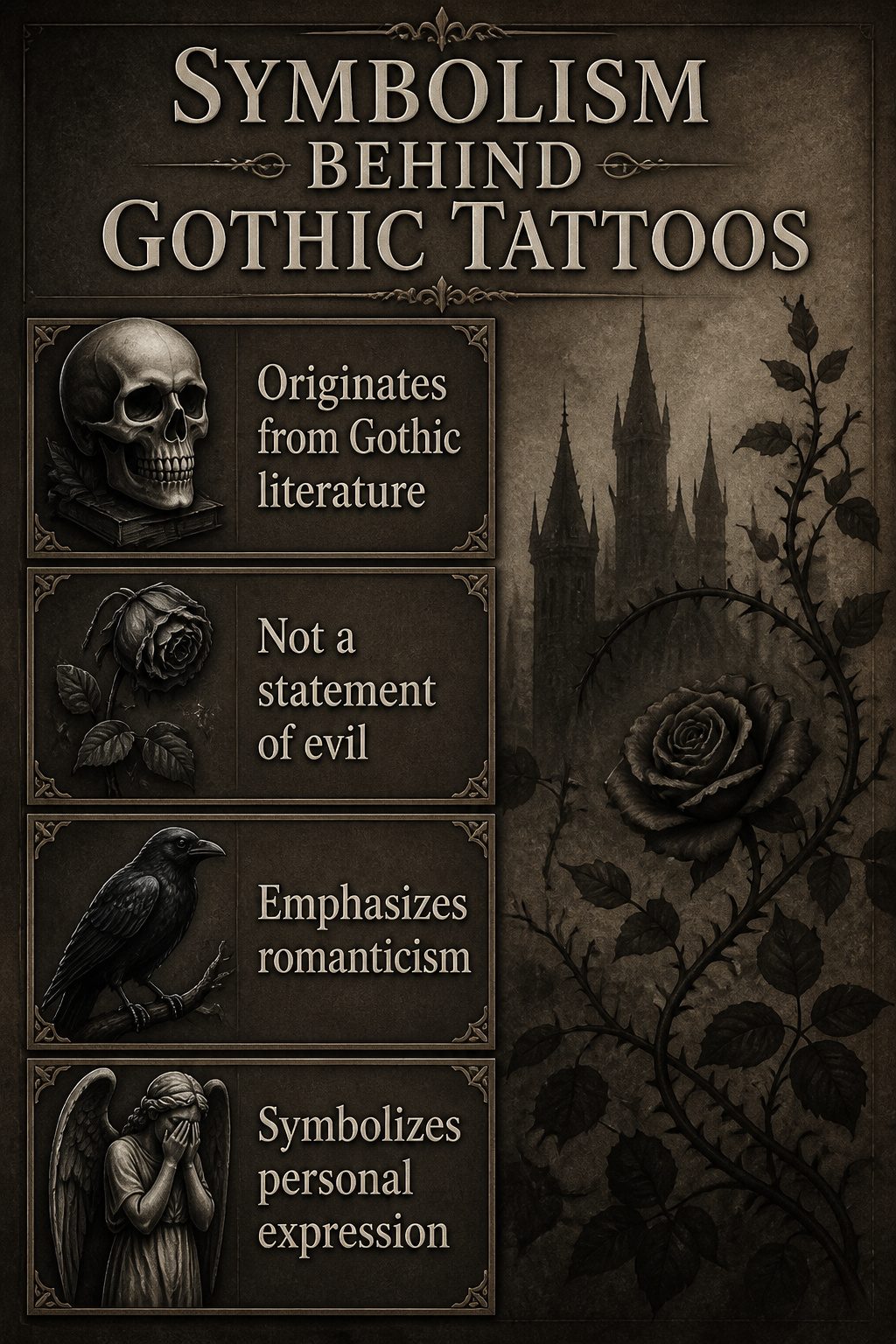
Dark imagery in gothic ink carries weight that casual viewers often misread.
Skulls, wilted roses, ravens, and weeping angels pull from Victorian Gothic literature, the same tradition that produced Poe and Bram Stoker, where the point was never to celebrate death but to sit with loss long enough to find its tragic beauty.
The subculture that adopted these markers in the late 20th century, rooted in punk’s aftermath, valued romanticism and existential questioning alongside the macabre.
Gothic tattoos are not evil. The darkness they embrace is aesthetic and philosophical, not a practice directed against life.
Black and grey shading, the heavy use of shadow, the preference for ornate complexity over clean minimalism, these are formal choices, not moral statements.
What they signal is non-conformity, an individualism that pushes back against mainstream trends through personal expression rather than aggression.
The affinity for mystery matters here too. A gothic tattoo often withholds easy reading.
A cross entwined with thorned vines, a skull half-hidden in climbing roses, the imagery layers meaning rather than declaring it. That opacity is deliberate.
It mirrors how gothic subculture in music and literature has always operated, inviting interpretation instead of demanding agreement. The tattoo becomes a private language made visible, which is a different thing entirely than a public provocation.
Common Themes in Gothic Ink
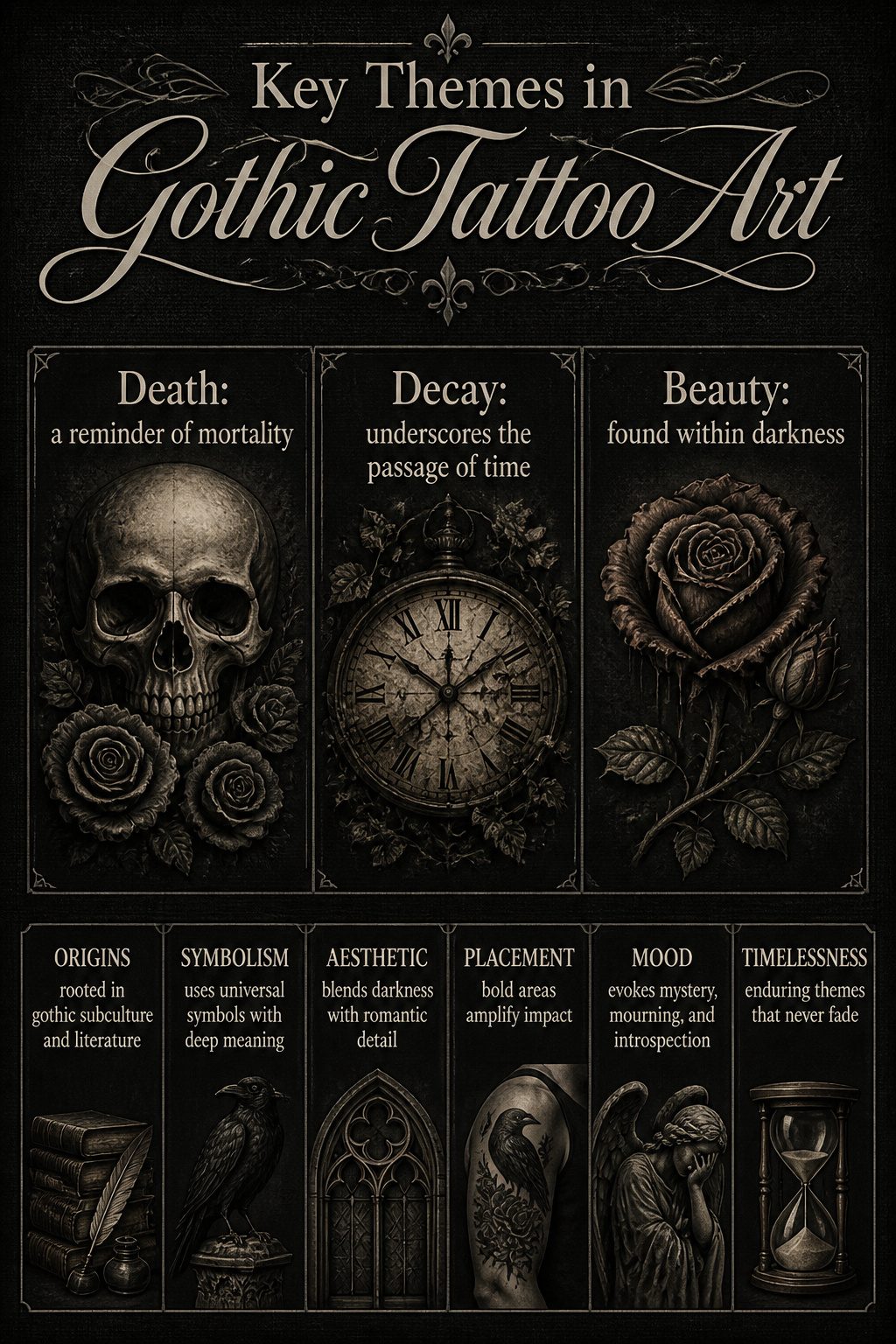
Dark ink carries three threads that keep showing up: death, decay, and beauty found inside both. Skulls sit at the center of this, not as simple shock value but as reminders of what waits and what matters before it does.
Ravens carry the same weight, pulled from Victorian Gothic literature and its fixation on Edgar Allan Poe’s mood, where the bird becomes a messenger rather than a monster.
Roses, especially wilted ones, soften the skull without weakening it, the pairing now so common it reads as a single image rather than two.
This visual language grew from punk’s rejection of mainstream polish in the late twentieth century. The gothic subculture that followed kept the rebellion but traded aggression for romanticism and existentialism, mourning and mystery over pure noise.
A raven on a bicep, a skull tangled in thorny vines, a weeping angel with a cross, each design carries that same origin story whether the wearer names it or not.
Design Characteristics That Define the Style
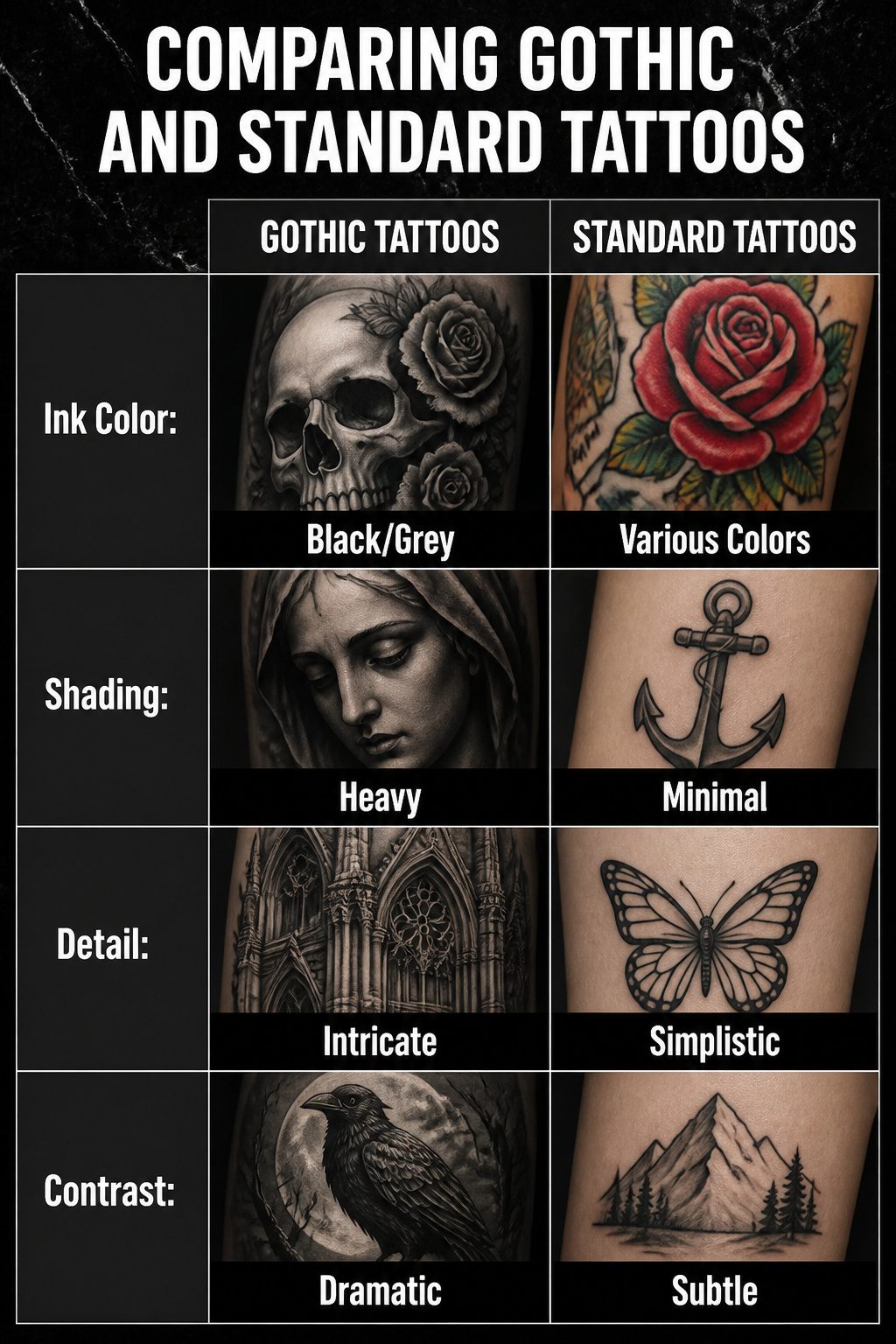
A gothic tattoo lives or dies on its palette. Black and grey ink is the foundation, not an afterthought.
Color reads as hopeful; gothic work wants the drained, candlelit look of a centuries-old etching.
Heavy shading does the heavy lifting here, carving out hollows under cheekbones, pooling darkness in the folds of a rose, turning a flat skull into something that seems to recede into the skin.
Shadows create the depth that separates gothic from merely dark. A raven on a branch without graduated tone looks like clip art.
The same design with the wing feathers dropping through three or four values of wash, with the body catching a single implied light source, becomes something you half expect to move.
Intricate details matter because the style borrows from cathedral stonework, from engravings where every line carried meaning. Leave that out and you have a silhouette, not a gothic piece.
Dramatic contrast is what makes all of this readable at a glance. The eye needs somewhere to land.
A sleeve that shades evenly from wrist to shoulder looks muddy; one that sets bone-white highlights against pitch voids has the punch that gothic demands.
The technical term for this is chiaroscuro, and tattooers who handle it well study the old masters the same way oil painters do.
Placement and Pain to Expect
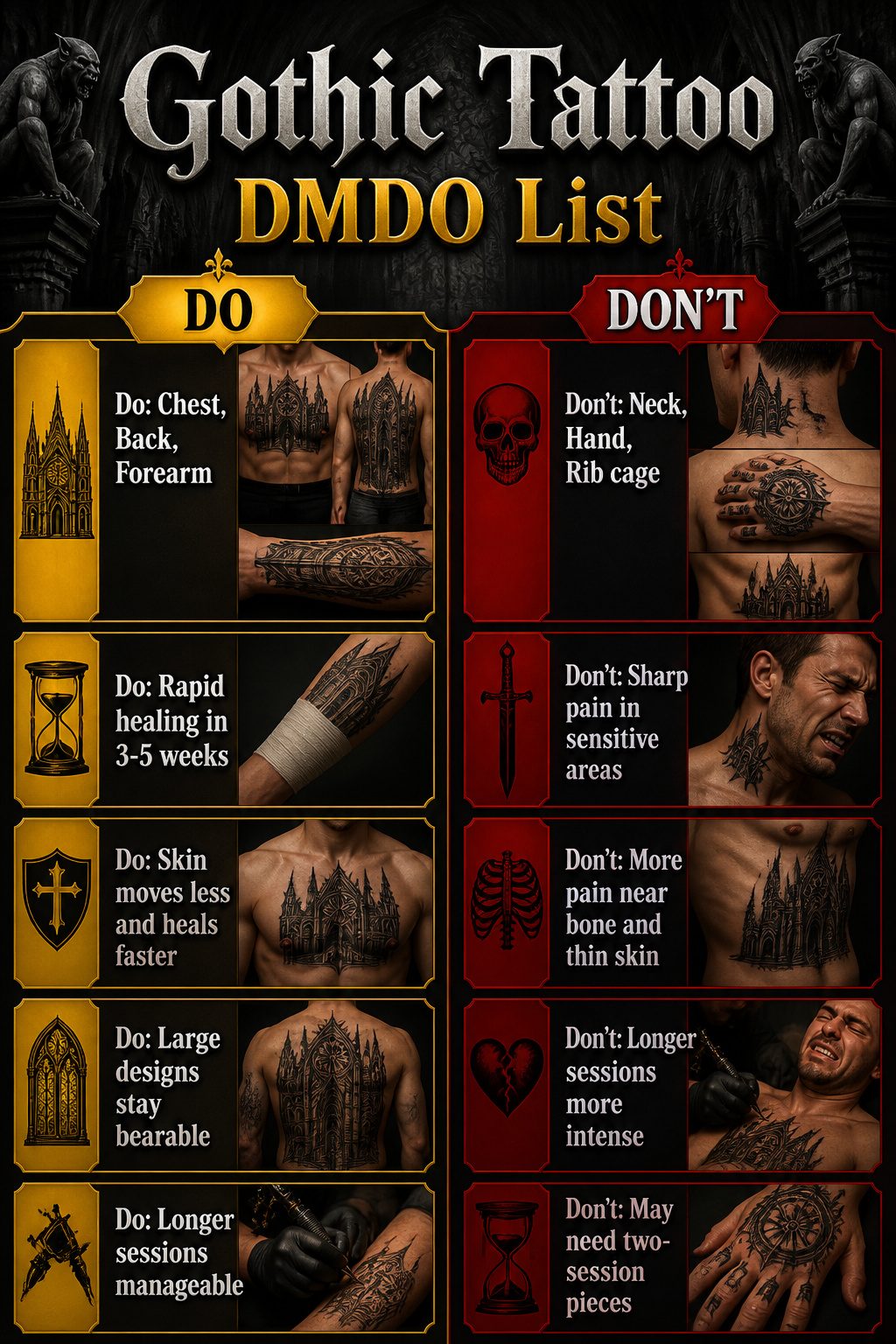
The forearm, chest, and full back carry gothic work best: flat planes let black shading and fine cathedral lines sit clean without warping.
These spots also heal faster, about three to five weeks, since skin there moves less and breathes easier under a bandage.
Neck, finger, hand, and rib cage placements hurt more, sometimes sharply more, yet they keep showing up in gothic portfolios anyway.
The neck in particular ranks high on the pain scale, and the hands stay tender enough that some artists book them as two-session pieces.
The rib cage folds and stretches with every breath, which keeps the needle sensation present and can push a three-hour sitting toward four.
Pain tolerance is personal, but the pattern holds: bone proximity and thin skin turn a moderate session into a grinding one.
Gothic imagery, heavy blackwork and all, tends to need longer sessions than fine-line styles, so placement becomes a real choice between comfort and visibility.
The hand or neck wins if the piece needs to read at a glance; the back or chest wins if the design is large and the sitting needs to stay bearable.
Frequently Asked Questions
Are gothic tattoos evil?
No. Gothic tattoos promote a subculture built around neutral shades and dark aesthetics, not practices that harm anyone. The skulls, ravens, and coffins read as memento mori or personal expression rather than anything malevolent.
Which area is best for a gothic tattoo?
The most painful spots often win out: neck, finger, hand, and rib cage are favorites in the gothic subculture, where discomfort is accepted rather than avoided. Larger pieces like architecture or dragons need the back, thigh, or sleeve to breathe.
Do gothic tattoos need frequent touch-ups?
Yes, more than plain blackwork. The heavy coloring and dense saturation that define the style fade faster, especially on high-friction areas like hands where constant motion and sun exposure wear the ink down.
What does a gothic cross tattoo mean?
It signals faith that has survived hardship, or a pull toward the ancient and mystical rather than the modern. Celtic knots and jagged ironwork replace clean religious lines, and the heavy shading pushes the design toward shadow.
Do gothic tattoos have to be black and grey?
Black and grey is the standard because it keeps the tone where it belongs; color would soften the message. Some artists add deep red or purple accents for roses or jewels, but the palette stays strict and subdued.
Are gothic tattoos offensive?
Generally not. The dark imagery, skulls and reapers included, functions as artistic expression about mortality rather than promotion of evil.
One exception is the voodoo doll motif, which risks flattening a sacred tradition into a prop if handled without intent.
How do I keep my gothic tattoo from turning into a dark blob?
Demand negative space. The heavy black shading that makes the style work will merge into a smear if the artist packs lines too tight or skips skin-tone gaps for highlights.
Size and breathing room beat cramped detail every time.