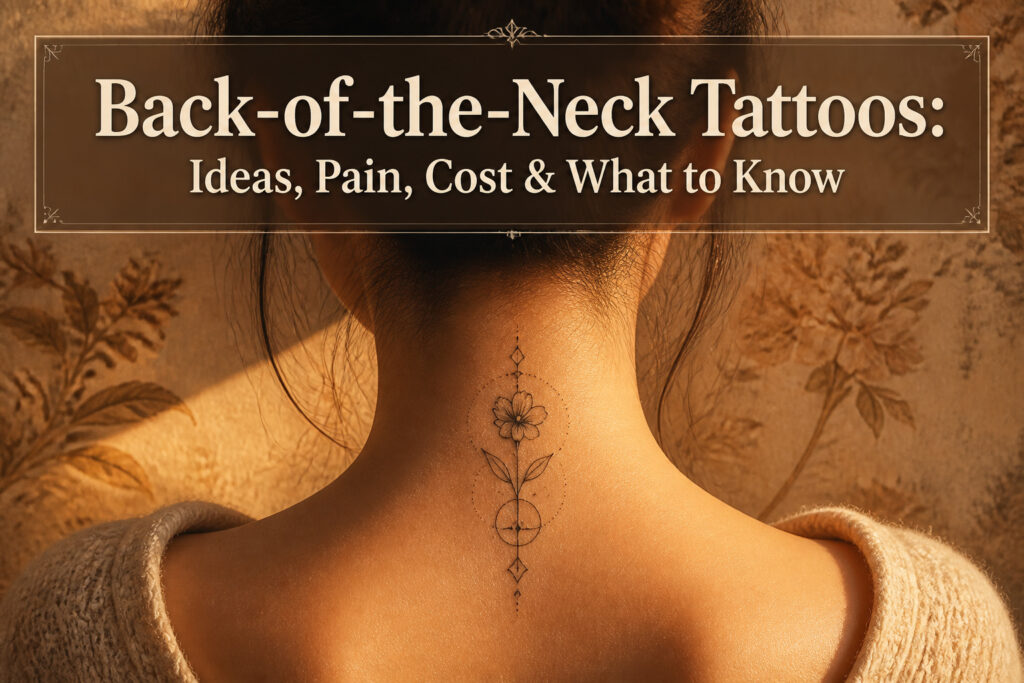
Back-of-the-neck tattoos sit at the nape between the hairline and the upper spine, a placement that hides under collars and ponytails until you choose otherwise.
The catch is the skin itself: thin over bone and tendon, with a pain level that makes a two-hour session feel longer than four hours on a thigh.
Most designs that age well stay small, 2–4 inches vertical and 4–6 inches across, because too much ink turns into a stamp rather than a tattoo.
Dainty Back-of-the-Neck Tattoo
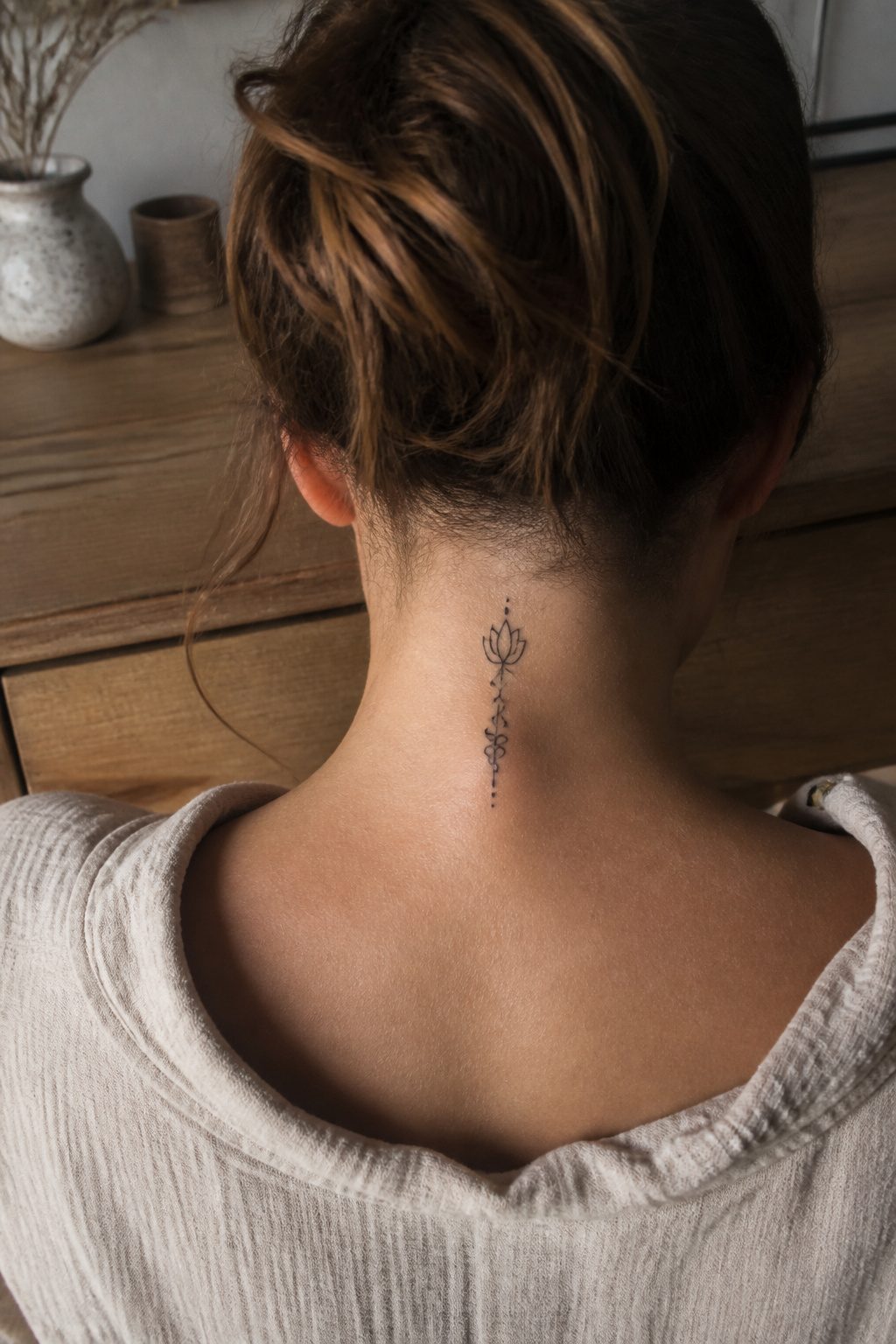
A delicate line or tiny symbol at the nape reads like a secret rather than a statement, which is exactly why the back of the neck works so well for 2–4 inch vertical designs with a 4–6 inch width to play in.
The skin there is thinner, so a heavy black fill fights the body instead of moving with it.
Fine needles and sparse linework suit the real estate; the area is flat enough that a small piece sits cleanly, but too much ink starts looking like a stamp rather than a tattoo.
The neck’s natural shape, usually square or rectangular, frames minimalist work almost like a pendant. I have watched clients bring in elaborate reference photos only to leave with a single word or a sprig no wider than a thumb.
The ones that age best respect that boundary: small enough that a ponytail or collar hides it completely, precise enough that the detail holds from six feet back.
Pain is the honest trade. The skin is thin over bone and tendon, so a two-hour session of stippling feels longer than a four-hour thigh piece.
For dainty work, though, the chair time is short enough that most people stay still without a break.
The result is a tattoo that shows when you want it to and disappears when you do not, which is the whole point of the placement.
Name Back-of-the-Neck Tattoo
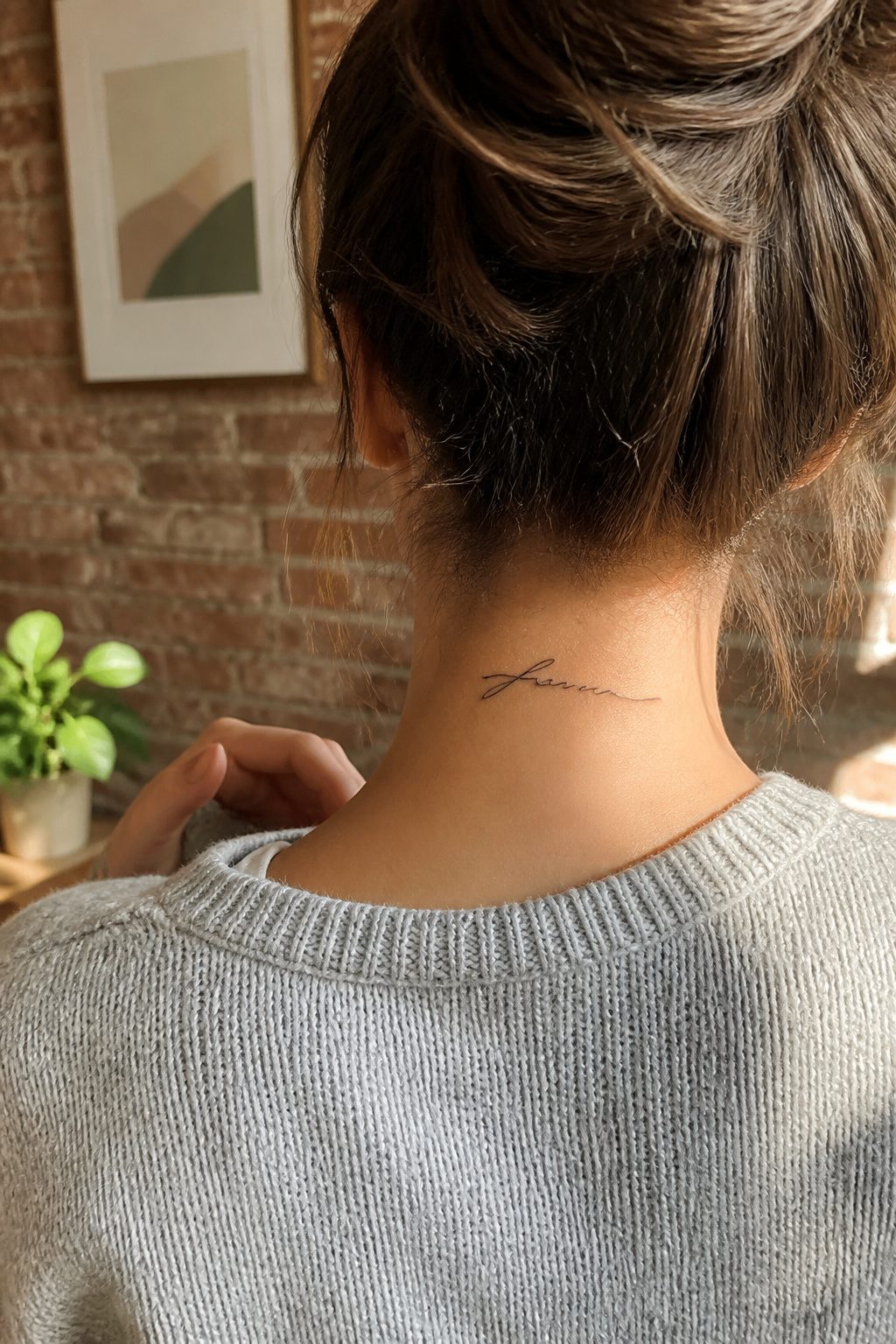
A name across the back of the neck sits at that useful border between public and private. Hair down, and the ink disappears into a standard workday.
Hair up, and it reads like a deliberate choice rather than a full commitment to visible tattoo culture.
The spot works best for short words or initials.
Three to five characters in a clean script fits the natural width without crowding the spine, and the curve of the neck gives cursive a gentle arc that flat placement on a rib or wrist never quite matches.
A longer name forces smaller lettering, which blurs faster anywhere but especially where skin creases with head movement.
Pain registers sharper here than on padded areas. The skin is thin, the muscle layer minimal, and the needle hits with less buffer between bone and surface.
Sessions stay short by necessity, both because of the discomfort and because the canvas is small. Most lettering work finishes in under an hour.
Aging favors this placement. The back of the neck sees limited sun and wind, and hair coverage adds passive protection.
The result holds its line work longer than hand or ankle pieces, assuming the usual aftercare. That longevity matters for script, where readability depends on crisp edges.
The tradeoff is commitment to a single orientation. The neck offers no rotation option.
A name reads one way, viewed from behind, and the wearer never sees it directly without mirrors.
Some clients choose a child’s name or a word in another language specifically for that quality: personal meaning held close, shared only when they choose to reveal it.
Birds Back-of-the-Neck Tattoo
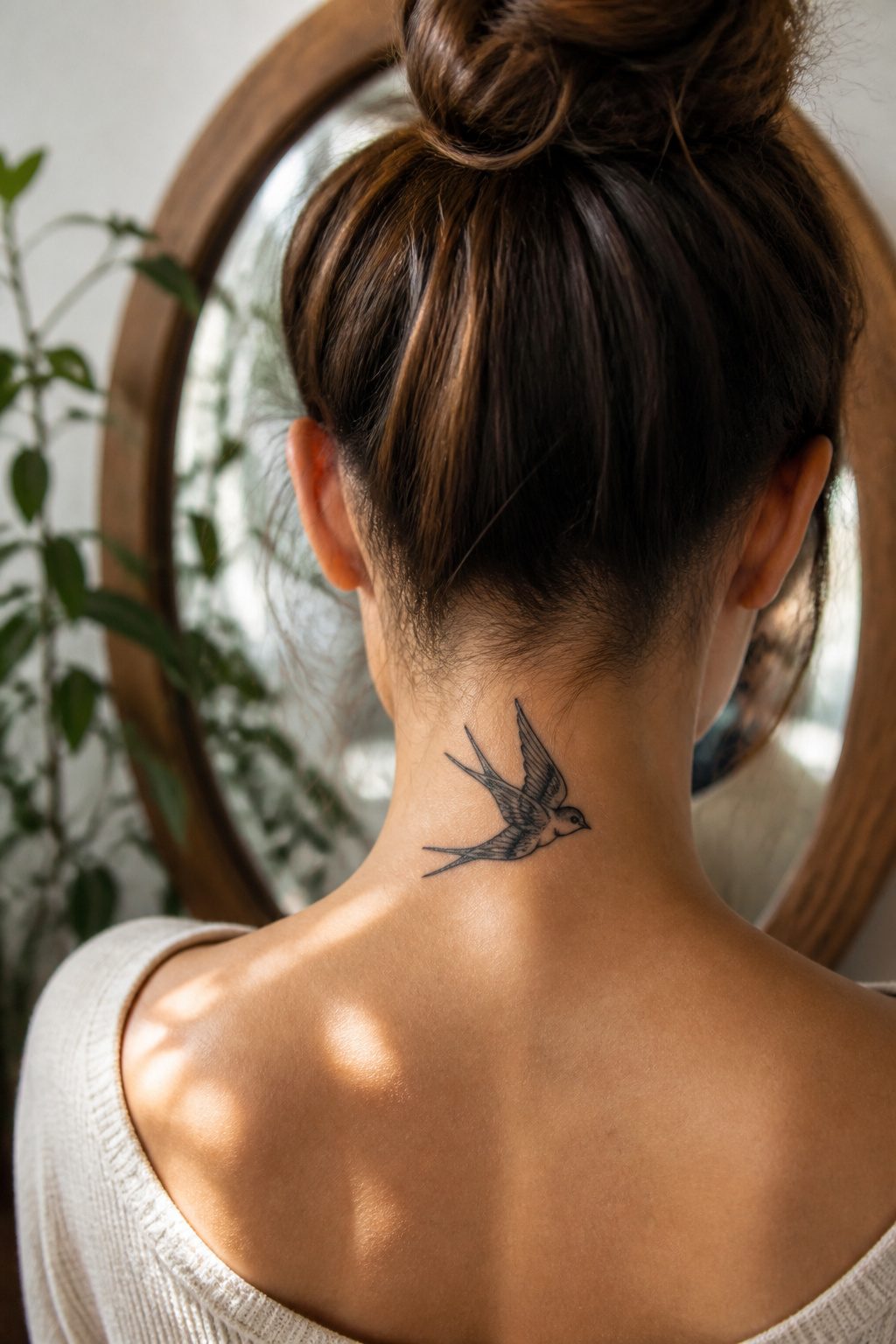
Birds settle naturally into the vertical strip between the hairline and the spine because their wings trace the neck’s curve without fighting it. A swallow in flight, wings swept upward, follows the line where skull meets vertebrae almost exactly.
That alignment matters more than it sounds on a surface that narrows toward the collar and widens at the base of the skull.
Smaller species work better than eagles or hawks unless the person has the height to carry it.
The detail that convinced me, looking through years of healed photos, is how the wing tips at the hairline and tail feathers just brushing the spine create a frame that flatters the neck’s shape rather than floating on it.
Sparrows, finches, and small swallows stay readable from a distance without the blur that kills fine work on this spot.
Color tends to soften faster here than on a forearm or shoulder because sun hits the back of the neck hard and often. Black and gray age more gracefully, which is why traditional-style birds in limited color keep their structure.
A single bird facing upward reads as ascent; a pair facing each other turns the narrow space into something deliberate rather than cramped.
Small Floral Back-of-the-Neck Tattoo
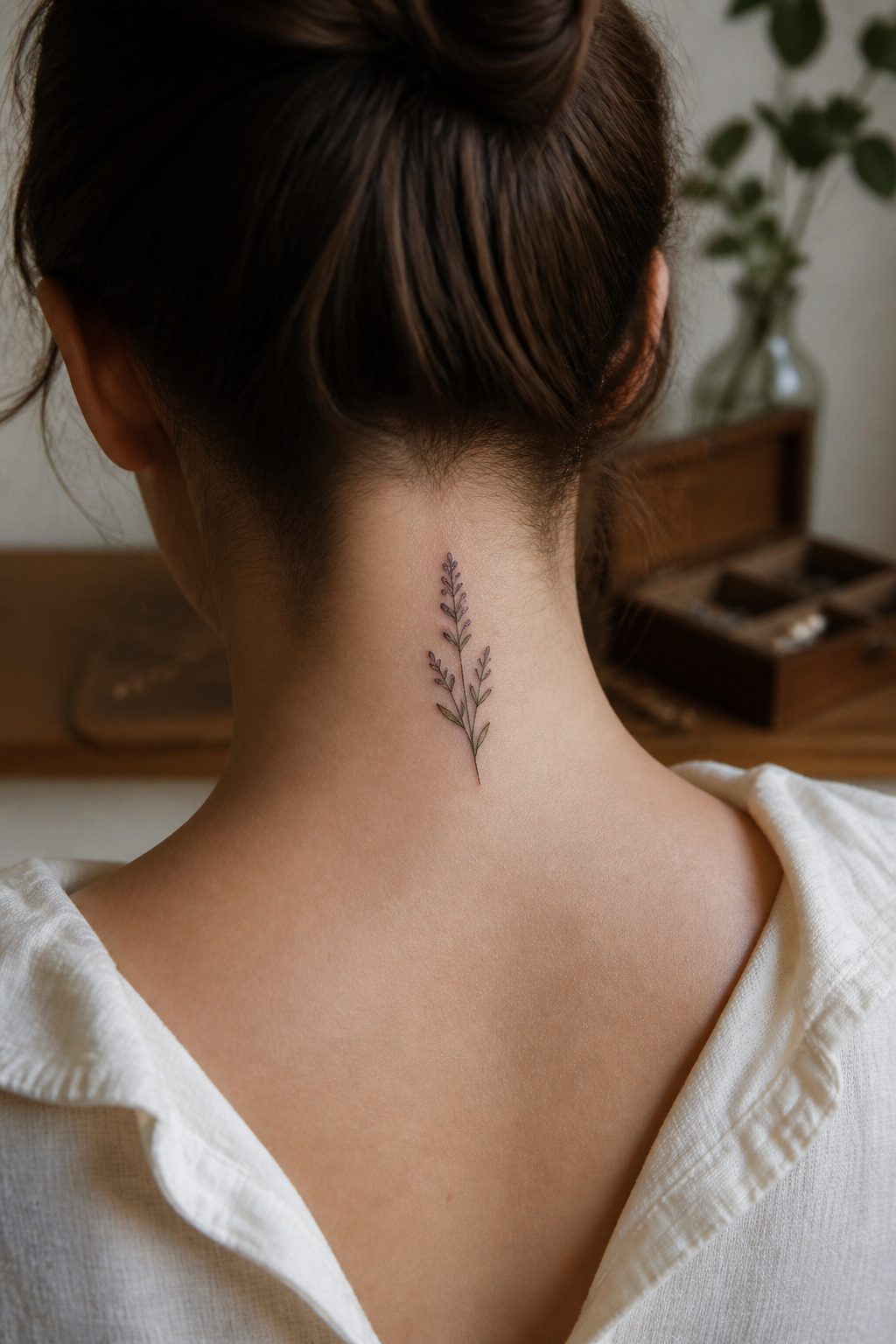
A single-stem rose or tiny wildflower tucked at the hairline reads as a signature rather than a statement.
The skin back there is thin, so line weight matters more than detail; anything under two inches wide heals cleaner and holds its shape longer than dense botanical clusters that blur together after a few years.
What convinced me, looking through portfolios, was how lavender sprigs and single poppies aged on clients five or ten years out.
The back of the neck sees almost no direct sun under normal clothing, so fading happens slower than on the collarbone or hand. A fine-line fern that would need touch-up elsewhere often stays readable here.
The drawback is movement. Hair washing, ponytails, and the friction of shirt collars all pass over the spot daily.
A design that trails too far down toward the shoulders gets rubbed more and tends to soften at the edges. Keep the stem short, the placement high, and the leaves minimal.
That restraint is what makes the piece still look deliberate a decade later rather than like a smudge you forgot to cover.
Stars Back-of-the-Neck Tattoo
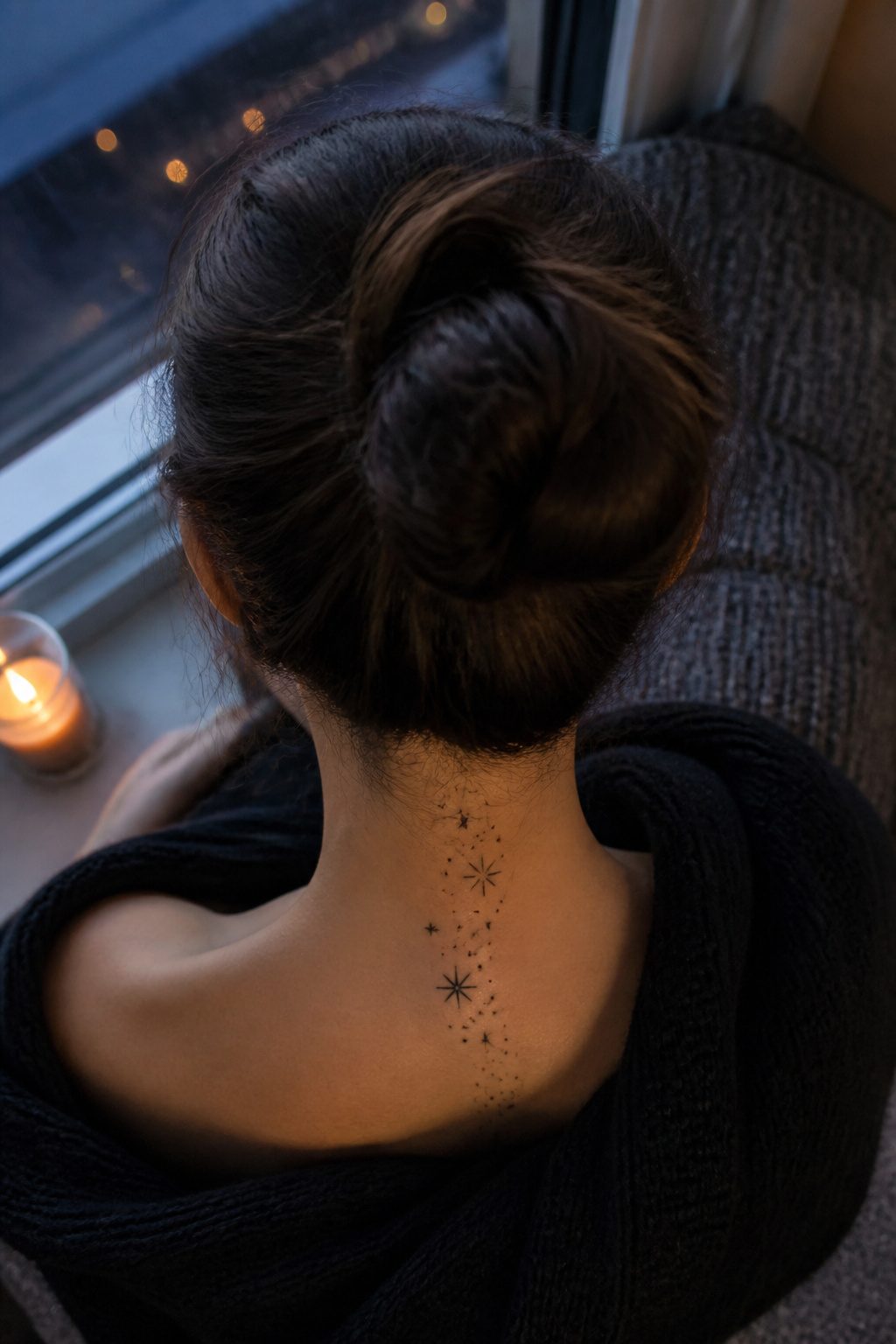
Constellation work follows the neck’s curve better than a single large star ever could.
A scattered cluster that starts high at the hairline and tapers down toward the shoulder blades keeps the eye moving with the body’s natural line rather than fighting it.
Orion’s belt works well for this, three stars in a row that angle slightly with the spine.
I’ve seen clients bring in their own birth constellations, and the smaller ones, like Cancer or Pisces, often need a few extra surrounding dots to fill enough space without looking sparse.
The gap between stars matters more than the stars themselves. Too even, and the design goes flat; too random, and it looks like an accident.
A good artist builds in tighter groupings near the base of the skull and lets them breathe lower down.
Most people heal this area in about two weeks, though the collar of a work shirt can rub the fresh ink, so plan the timing around your wardrobe, not just your calendar.
Eyes Back-of-the-Neck Tattoo
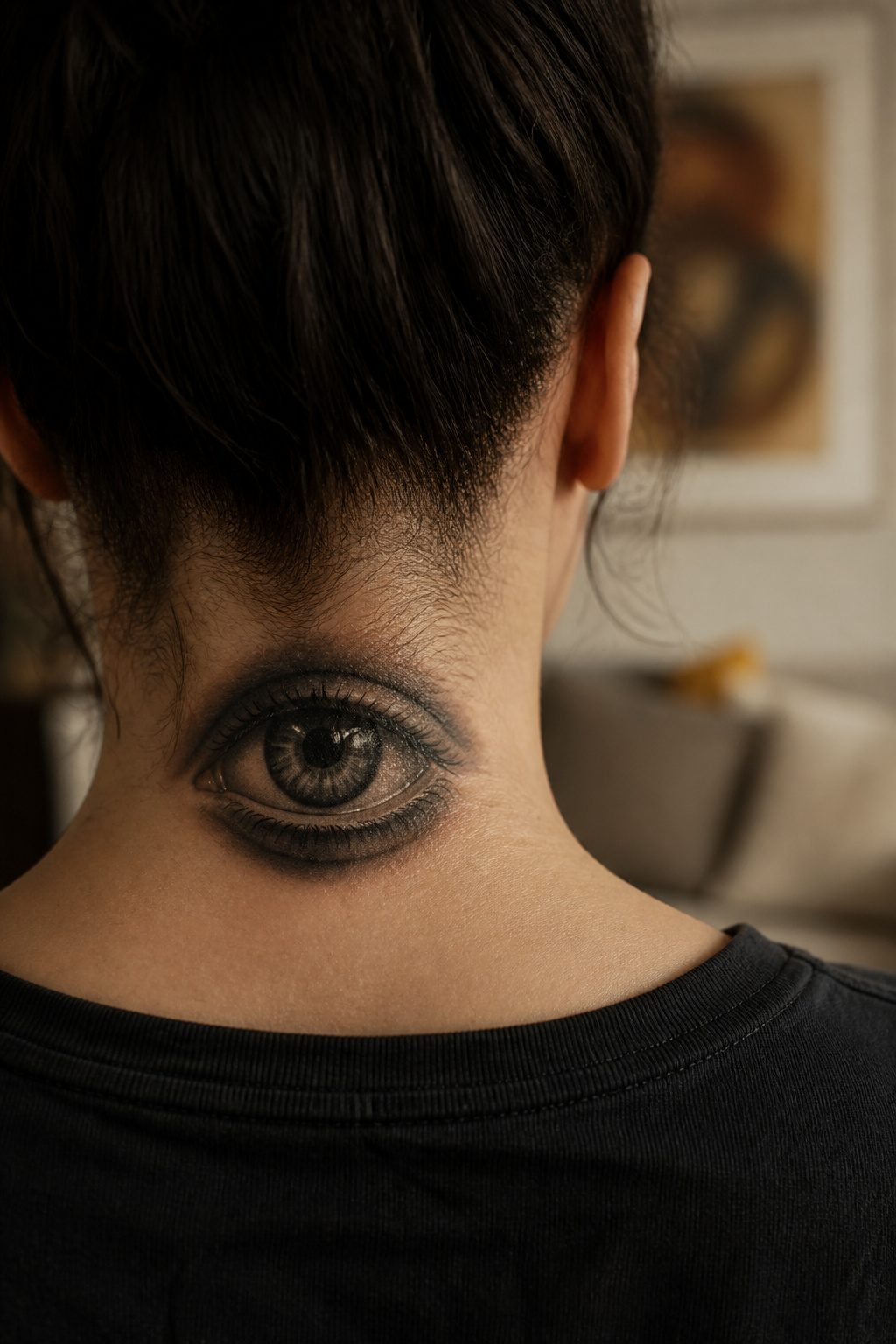
An eye placed at the back of the neck turns the body into a canvas that watches the world behind you.
The design only fully reveals itself when the hair goes up, which makes the moment of tying a ponytail feel deliberate, almost ceremonial.
Most people choose a single realistic eye, lid slightly lowered, the kind of gaze that follows someone without blinking.
Others split the image so half sits on each side of the spine, completing itself only when viewed straight on from behind.
The skin here sits thin over bone, so the detail that makes an eye convincing, the iris gradation, the wet reflection along the lower lid, takes a steady hand and heals with some blur.
Plan for two sessions if you want photographic precision; the first pass establishes the shape, the second sharpens the whites and darks once the swelling settles.
A simpler graphic eye, bold black outline with flat color, ages cleaner on this spot and costs less sitting time.
The nape draws attention in updos, at the gym, in summer heat, so this is not a design for someone who wants casual concealment. It performs.
Moon Phases Back-of-the-Neck Tattoo
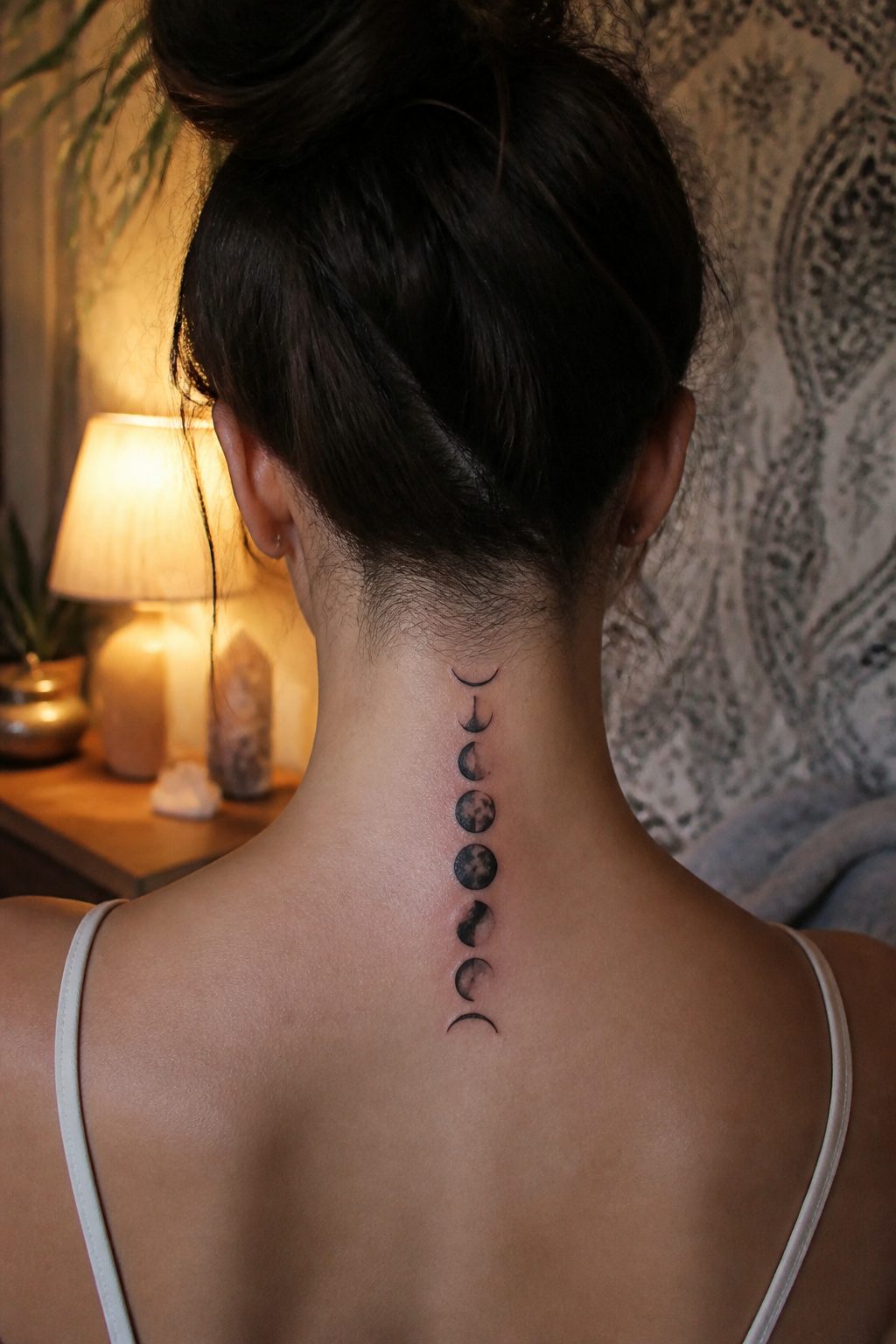
A vertical line of moon phases running from the hairline down toward the shoulders follows the neck’s natural column better than almost any other motif.
The crescent at the top, swelling through gibbous to full, then tapering back to new, gives the eye a reason to travel that straight path.
The spine’s slight curve even accommodates the full moon’s widest point without the design feeling squeezed.
What convinced me, looking through portfolios for this piece, was how the phase sequence handles the neck’s limited width. Each moon sits small enough, usually dime- to quarter-sized, that the line reads as one flowing unit rather than separate stamps.
Negative space between phases matters more than I’d expected; too tight and they blur together, too loose and the rhythm breaks. Most artists leave a gap roughly equal to one moon’s width.
The appeal is partly symbolic and partly practical. Moon phases carry obvious meaning, cycles and change, but they also hide easily.
Hair down covers the whole sequence; hair up exposes it cleanly. No twisting or angling needed to show it off or keep it private.
Black and gray ink dominates here, since the moon’s surface reads through shading alone. Color risks making the phases look like generic circles.
If you want something extra, a faint wash of blue or silver behind just the full moon gives a focal point without overwhelming the line’s simplicity.
Word Back-of-the-Neck Tattoo
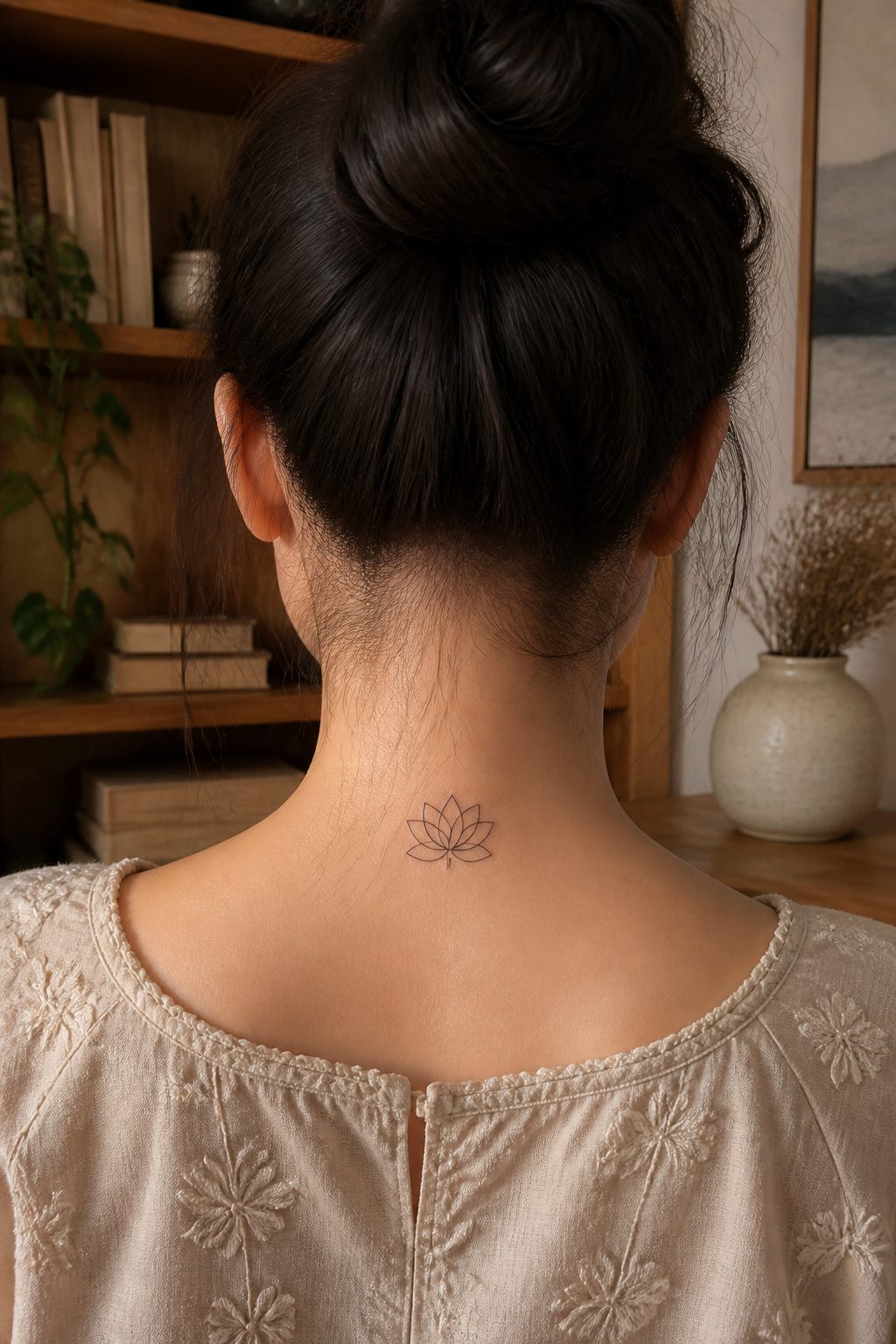
A single word across the back of the neck reads clean from a distance and ages better than intricate linework that can blur together as skin changes.
The thin skin and direct contact with bone beneath make this spot one of the more sensitive areas to sit through, especially if the lettering runs along the spine where the needle vibrates against the vertebrae.
Most people I have watched in the chair describe the sensation as a sharp, dragging pressure rather than a surface sting.
Short phrases work best when they stay under three or four words; longer lines wrap awkwardly and force the artist to scale down the font to a size that may lose legibility in a few years.
Sans-serif fonts hold up predictably, while scripts with hairline details can close in during healing.
Placement matters too: centered along the nape sits the most comfortably for the artist and reads symmetrically when the hair is up, but it also catches the most friction from collars and pillowcases during the two-week heal.
Flowers and Quote Back-of-the-Neck Tattoo
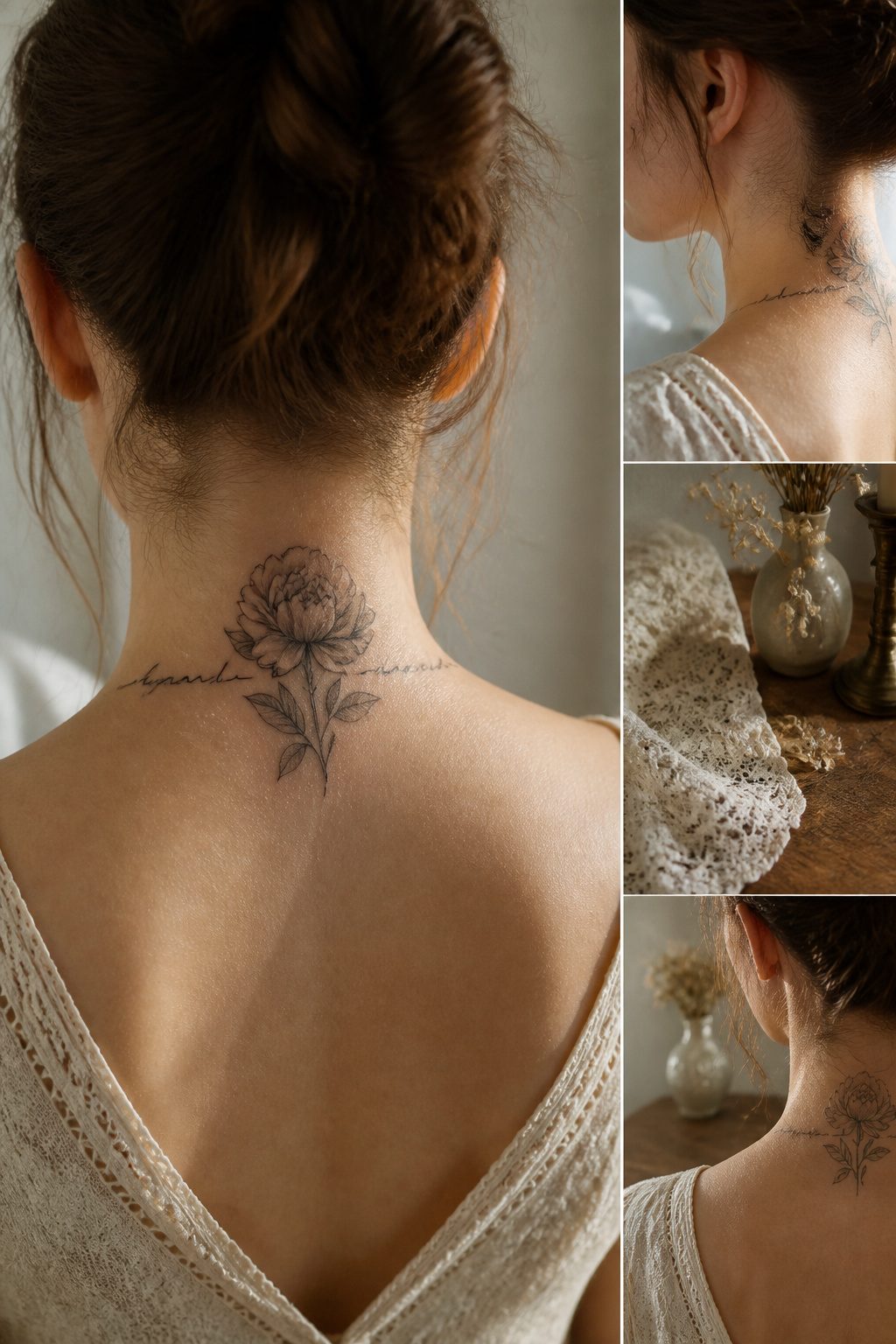
A single stem of lavender trailing into a line from The Prophet takes up more room than most back-of-the-neck work, and that is the first thing to plan for.
The 4–6 inch width across the upper back is what you actually have to work with, which sounds generous until you try to fit a full rose and three lines of script without everything shrinking to illegibility.
I have seen designs where the lettering won out and the petals became pinpricks, and others where the quote got split awkwardly across the spine to make room for the bloom. Neither compromise ages well.
The pairing works best when one element carries the visual weight and the other supports it.
A bold peony with a few words tucked beneath its leaves reads cleanly from a distance; tiny blossoms framing a long paragraph turn into gray smudges as the years pass. Placement matters too.
Text that rides the spine blurs faster than text offset to one side, so most artists I have spoken with will push the quote toward the shoulder blade and let the flower anchor the center.
Ink density is the hidden cost. Black lettering beside soft gray shading on petals requires different needle groupings and usually adds a session.
If your budget is tight, commit to one strong element and let the other stay minimal.
Geometric Shapes Back-of-the-Neck Tattoo
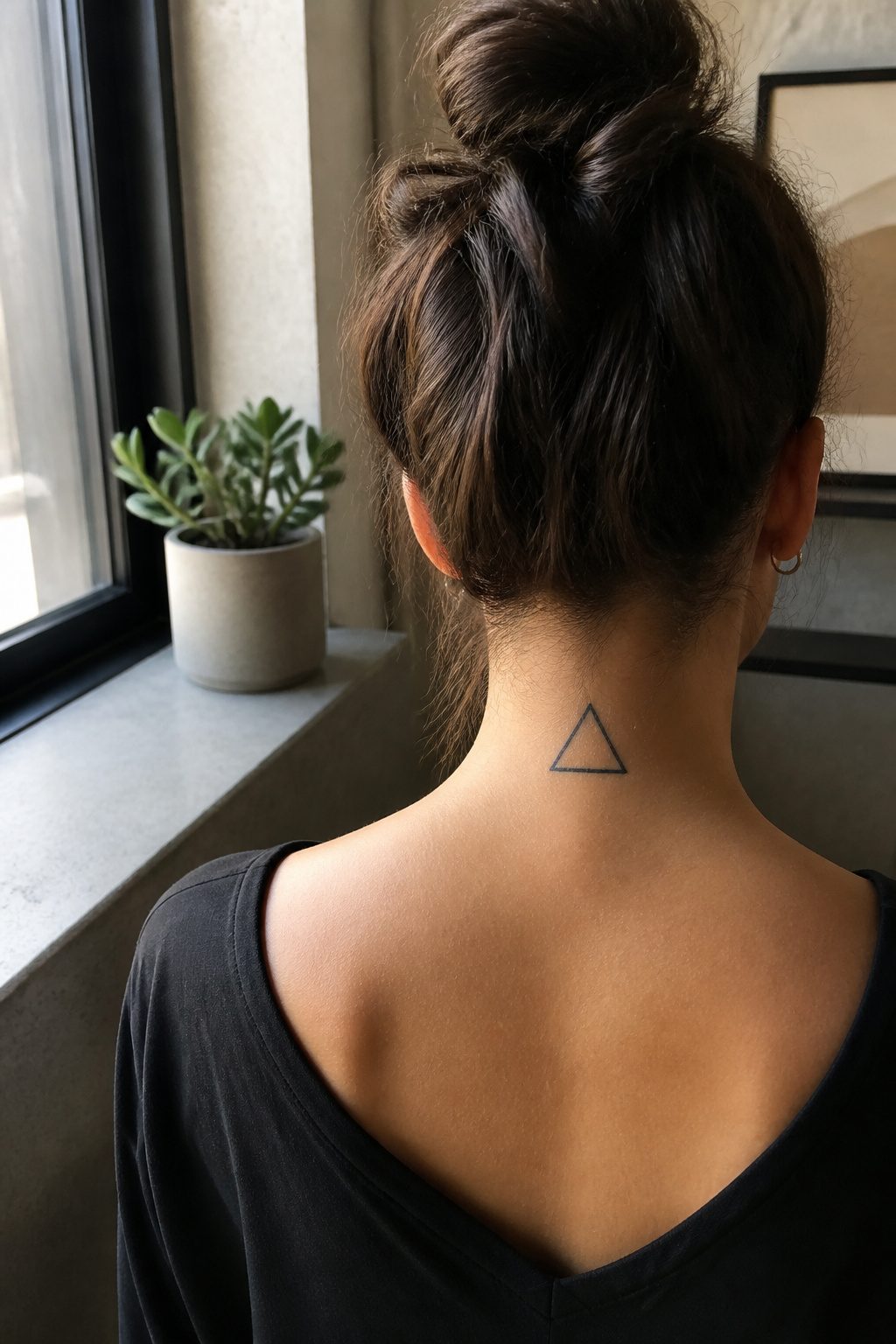
Clean lines sit flat against the upper neck in a way curved designs rarely manage.
The skin back there is thin and relatively taut, which means a geometric pattern, a triangle or a set of parallel bars, holds its edge without the distortion that comes from movement or muscle flex.
I have watched hexagons and fine-line grids age better in that spot than anything with a gradient or soft shading, simply because there is less ink packed in and less chance of the pigment spreading under the surface.
A single bold shape, centered or offset to one side, reads clearly from a distance and does not fight the natural lines of the hair or the collar the way a busy composition does. The tradeoff is precision.
Geometric work shows every waver, so the artist needs a steady hand and a machine running on the tighter side.
I would book someone who specializes in this style rather than hoping a generalist can pull off the straightedge effect freehand.
Color tends to distract from the form. Black or very dark gray keeps the geometry sharp and lets the negative space do its job.
If you are considering something with multiple shapes, keep the spacing generous. The neck is a small canvas, and crowding it turns a clean concept into a blur.
Dog Back-of-the-Neck Tattoo
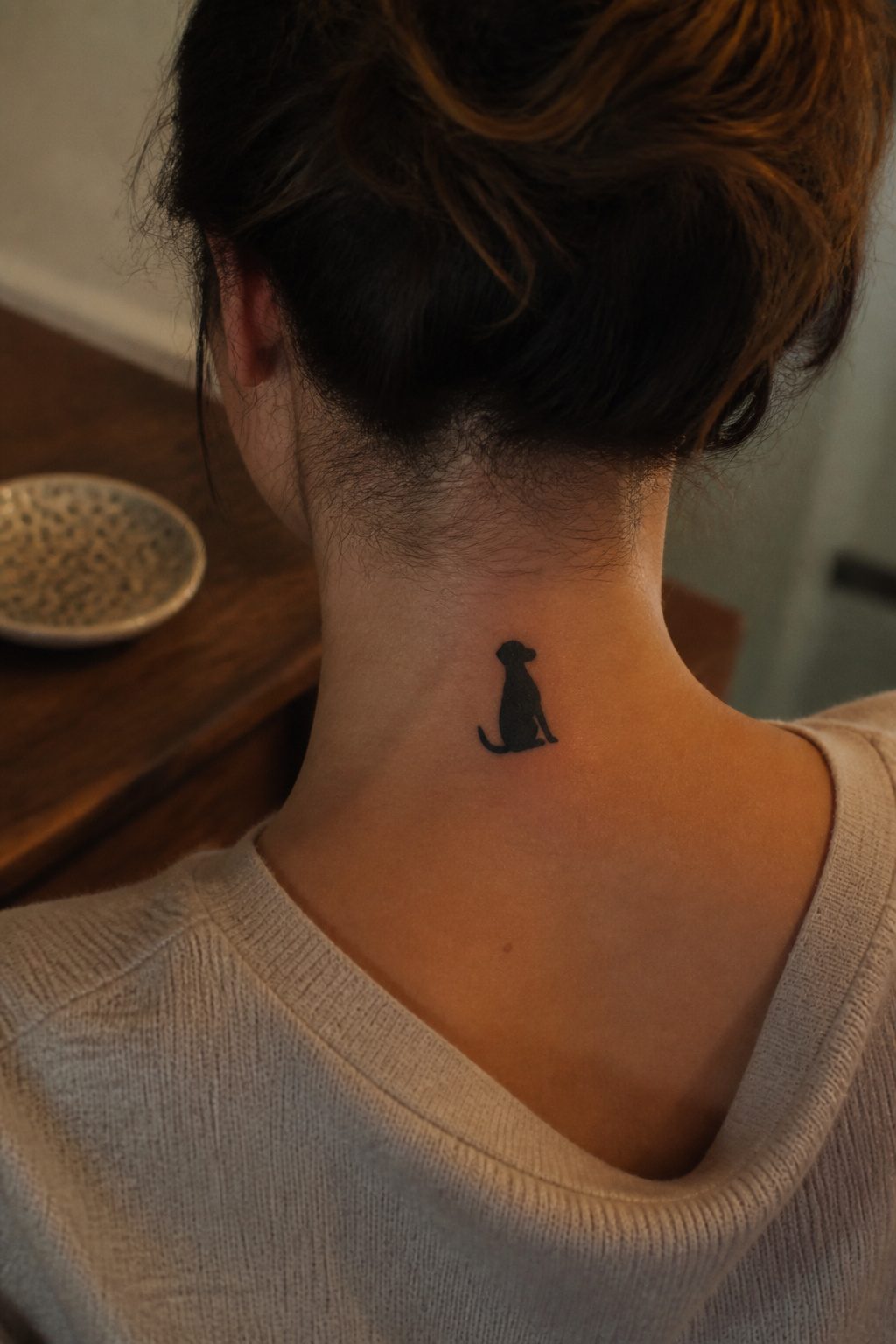
A dog portrait on the back of the neck works best when the design reads clearly at a glance from behind.
The nape gives you roughly three to four inches of vertical space, which forces a choice: either a close-up of the face filling that frame, or a smaller full-body silhouette sitting higher, closer to the hairline.
I have seen both succeed, but the face-forward option tends to hold up longer since the features stay readable even as the tattoo ages.
Stylized approaches usually outperform strict realism in this spot.
Line-work dogs, negative-space designs where the collar forms a natural break in the ink, or geometric builds that suggest the breed without cataloging every whisker, these survive the stretching and sun exposure the neck gets.
The skin here moves constantly with head turns and settles into expression lines early, so heavy black fill in a portrait can blur faster than the same work on a shoulder or thigh.
Color choices matter more than people expect.
A golden retriever in full color reads as a specific dog, which is the point of a tribute, but the yellows and warm browns fade faster on neck skin that sees daily sunscreen, or doesn’t.
Grayscale with one accent color, the collar in red or the eyes in amber, tends to stay legible five years out without a touch-up.
Placement within the nape matters too. Centered high, the tattoo shows above most collars and ponytails.
Dropped an inch lower, it hides easily but risks competing with necklace lines and shirt tags. For a tribute piece you want seen but not announced, the upper edge of the hairline usually wins.
Sword Back-of-the-Neck Tattoo
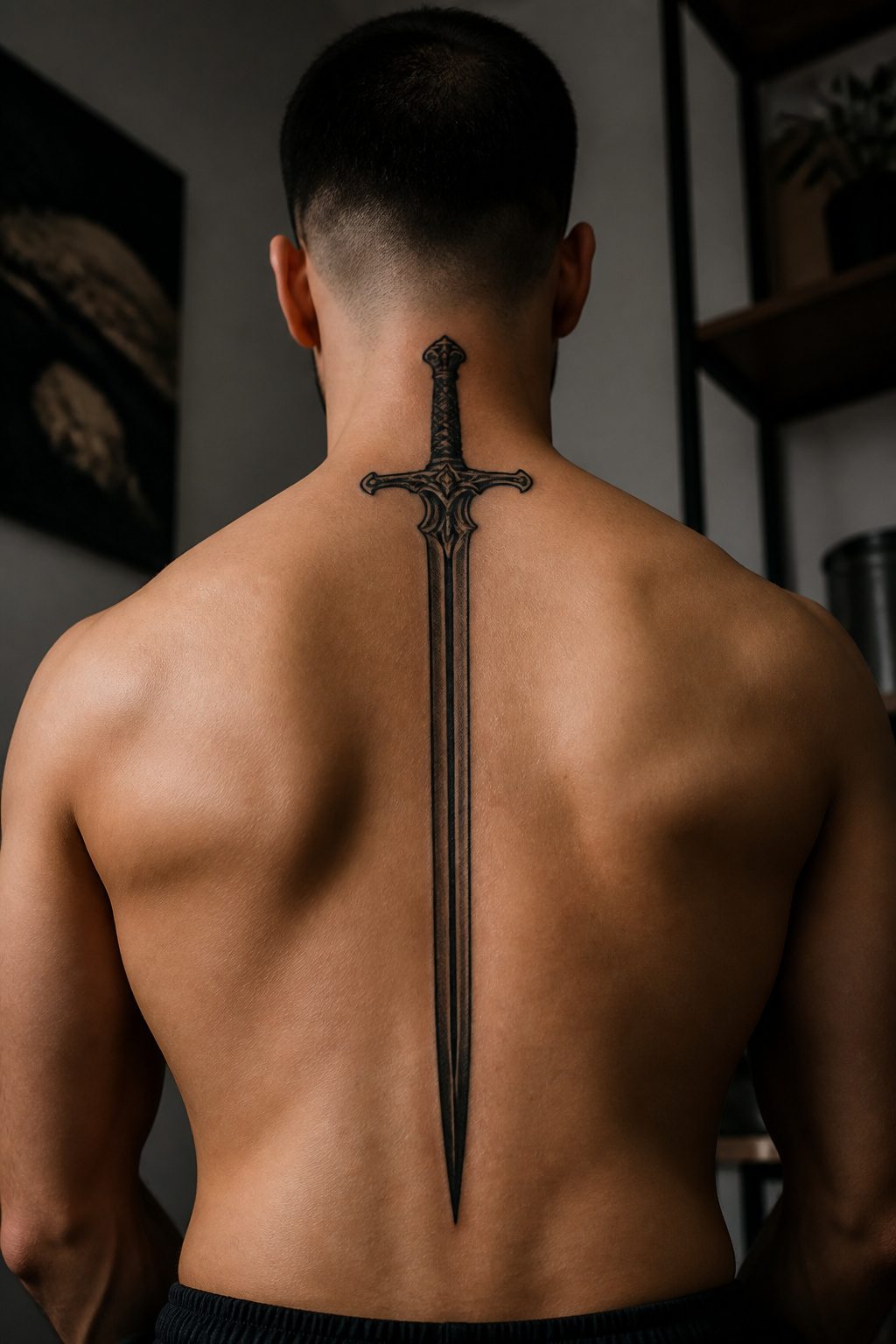
A vertical sword following the spine line turns the neck’s narrow channel into an asset rather than a constraint.
The blade runs straight down from the hairline, hilt sitting just where the skull meets the neck, point drifting toward the upper back. This placement reads as intentional and architectural in a way that horizontal designs rarely manage.
The geometry demands precision. A sword even slightly off-center looks like a mistake you see every time you pass a mirror, and the spine itself is not always the straight reference people assume.
Your artist needs to map the design to your standing posture, not the table position; shoulders roll forward, heads tilt, and the blade must account for that.
Pain sits moderate to sharp depending on how close the work gets to the bony knobs at the base of the skull.
The skin there is thin, the vibration from the needle travels, and sessions stretching past an hour tend to outstay most people’s welcome. A simpler hilt without filigree keeps the time down and the line clean.
Healing is uncomplicated if you keep hair product off the fresh line and avoid collars that rub.
The real risk is sun: a black sword on pale skin draws UV hard, and fading shows first along the edge where the blade meets skin. Sunscreen or a covered neckline preserves the contrast that makes this design work.
Paw Prints Back-of-the-Neck Tattoo
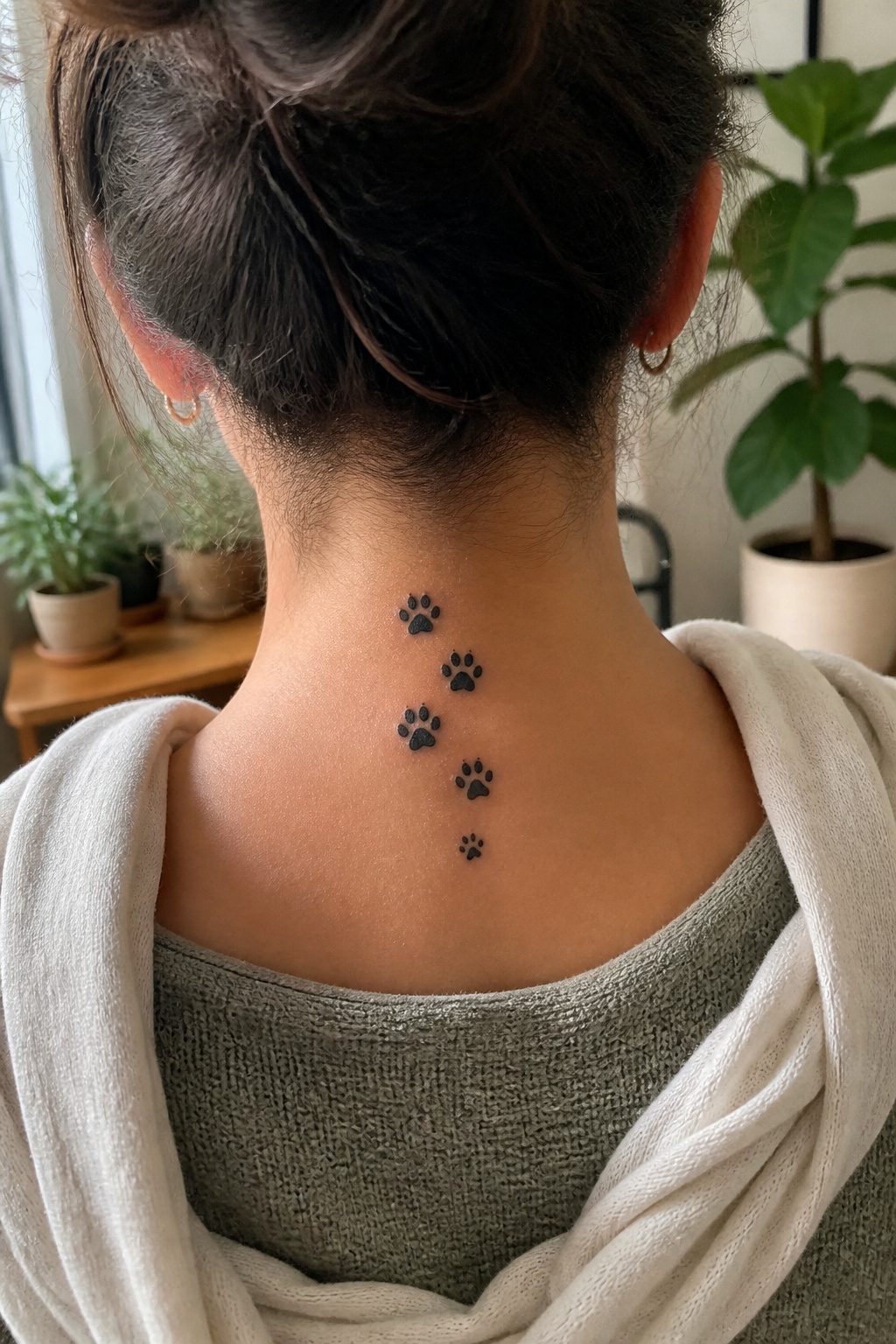
A single paw print at the hairline, with three or four more trailing downward toward the shoulder blades, reads as movement on a neck. The spacing matters more than the size of each print.
Too tight and the line looks like a bracelet; too loose and the connection between them dissolves. Leave about two finger-widths between pads so the eye travels with the design rather than jumping.
Hairline placement is the safer bet for longevity. The skin there sees less sun and less friction from collars.
A cascade that drops lower, past the nape, will soften faster and need touch-ups sooner.
That trade is worth making only if the longer line serves the specific pet you are honoring, a tall dog whose stride you are trying to catch.
Black ink holds up best for this. Color in paw pads tends to fall out in that thin skin, and a touch-up on the neck is more annoying than most spots because of the constant motion.
Ask the artist to keep the pads solid rather than shaded; the simpler the fill, the cleaner it heals.
Sun and Moon Back-of-the-Neck Tattoo
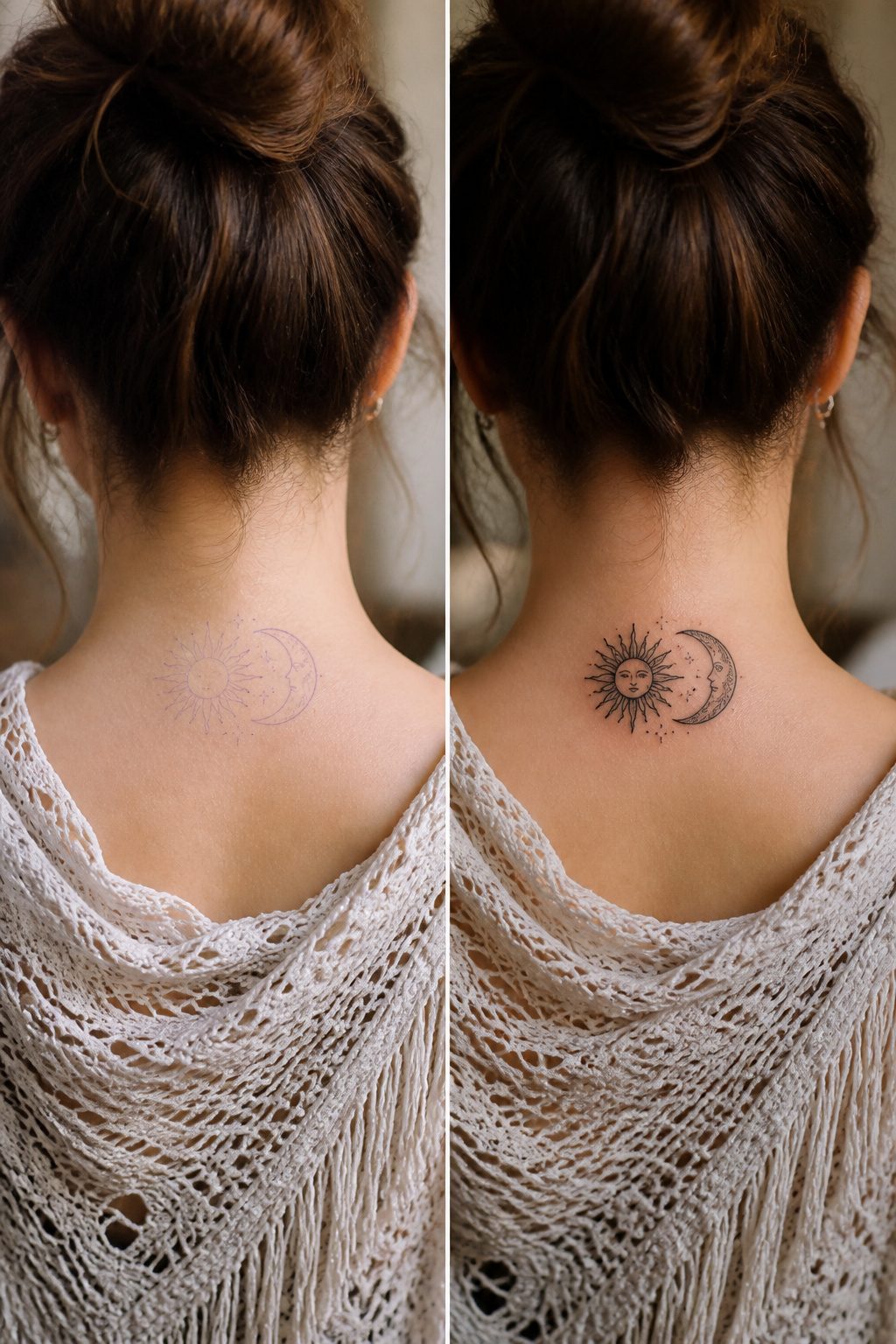
A sun and moon pair sits naturally across the upper neck, each one tucked behind an ear with the rays or crescents reaching toward the spine.
The balance reads as deliberate without needing to be perfectly mirrored; one side can carry a bolder outline while the other stays fine-lined, and the asymmetry still holds together from a distance.
Color choices shift the meaning more than most people expect. A warm sun in amber or gold against a cool blue or gray moon turns the pair into a temperature contrast, which reads clearly on skin that tans or flushes.
All black-and-gray keeps the focus on shape alone, and that tends to age cleaner on an area that sees irregular sun.
The gap between them matters. Too close to center and the design crowds the vertebrae; too wide and the pair stops reading as connected.
Leave at least an inch of bare skin at the spine itself, which gives each symbol its own space and keeps the natural curve of the neck from distorting either one when you turn your head.
Healing on the back of the neck involves hair, collars, and sunscreen that you cannot see yourself applying. Plan for touch-ups; the fade is rarely even between sides, and the moon’s finer lines usually soften first.
Tiger Back-of-the-Neck Tattoo
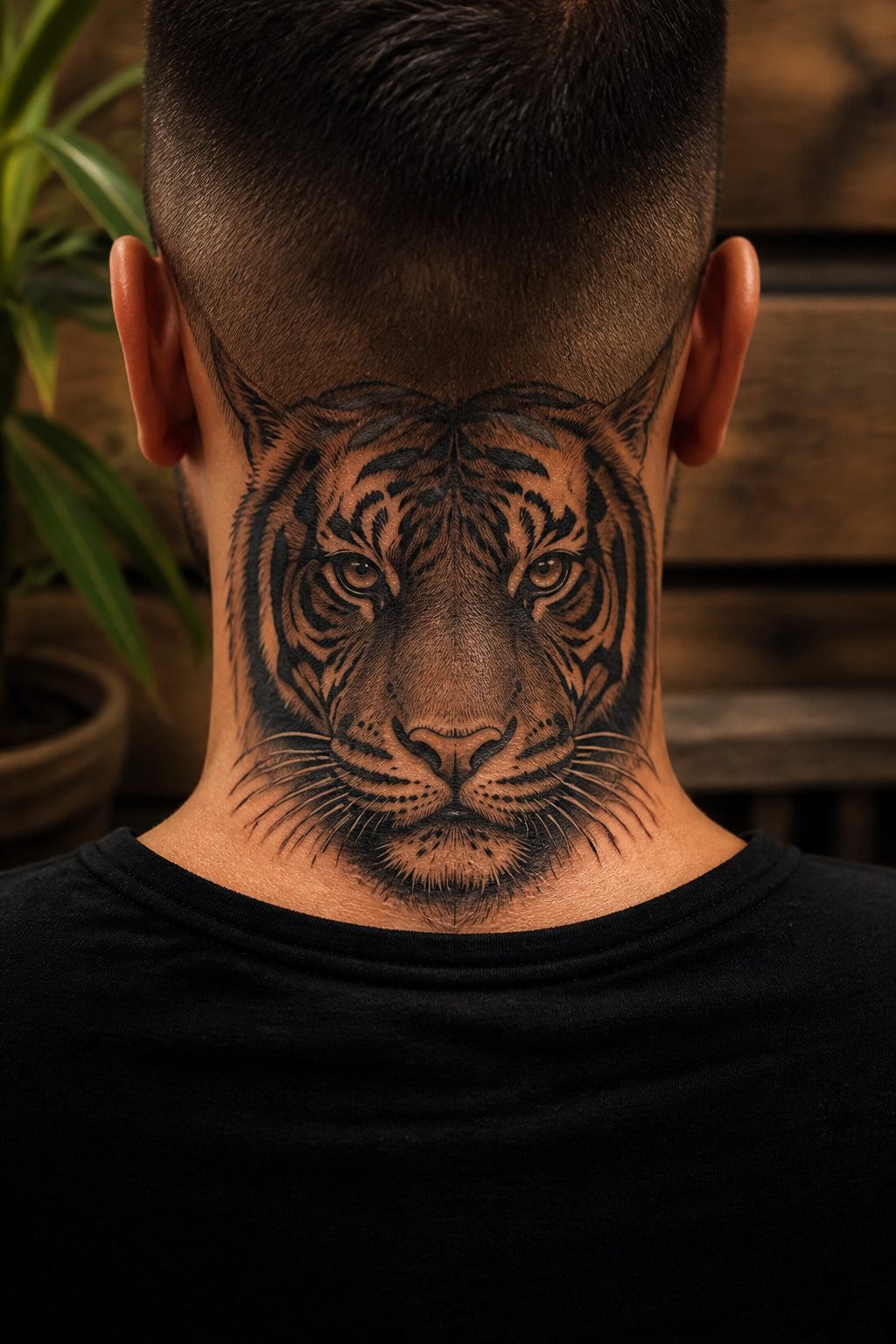
Tiger faces and profiles demand more from this spot than most back of neck tattoos because the skin sits thin over bone and shifts whenever the head moves.
A full face needs the eyes level, the nose centered, and the stripes reading clearly from a distance; tilt any element and the whole piece looks off.
In my years watching designs settle and blur, the detail that made the tiger alive on day one is the same detail that spreads first in that unforgiving area between the hairline and the collar. Profiles solve some of this.
The single direction of the gaze, the clean line of the jaw running upward, gives the artist a shape that ages better when the skin starts to move.
Still, the whiskers and fur texture tempt you toward fine lines that will not hold. If you want the face front-on, keep the stripe pattern bold rather than photographic.
The power of a tiger tattoo lives in the read of it, not in every hair being counted.
Hand and Wave Back-of-the-Neck Tattoo
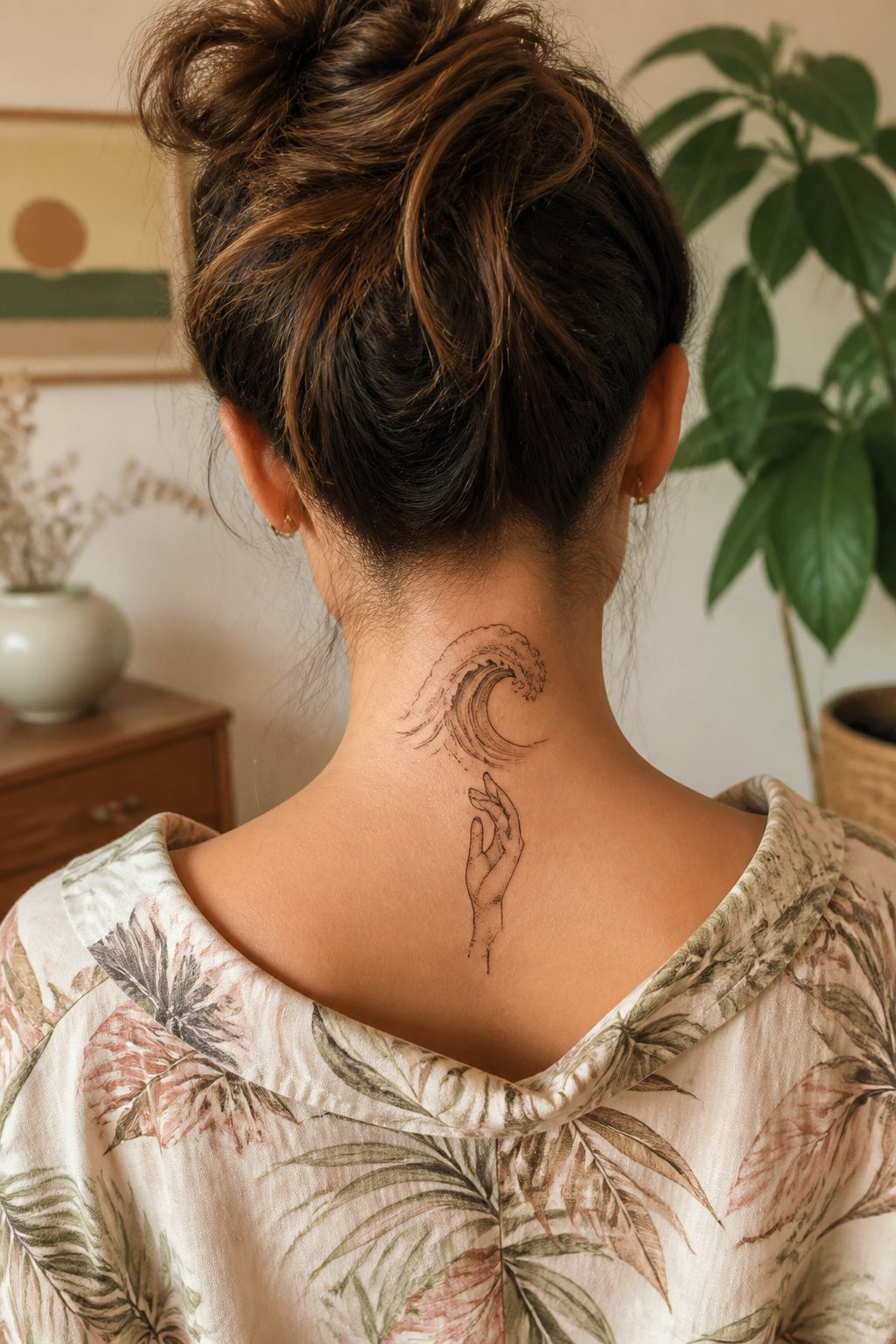
A hand reaching toward a breaking wave, inked at the nape, turns the body into a canvas for perspective play that only works at this spot.
The design reads one way in the mirror and another to someone standing behind you, which is the whole point.
I have watched this composition shift from a straightforward beach memento to something closer to surrealist image-making, and the change is in the placement more than the art itself.
The sun, hand, and wave together build a small narrative that sits just above the collar line. Hair up, the full scene shows.
Hair down, it disappears. That toggle between visible and hidden suits people who want meaning without constant explanation.
The nape gives the hand a natural downward reach, the wave a place to crash that follows the spine’s curve.
Pain sits moderate here. The skin is thin over bone, but the area is small enough that sessions run short.
What matters more is the commitment to imagery that courts double-takes.
Number Back-of-the-Neck Tattoo
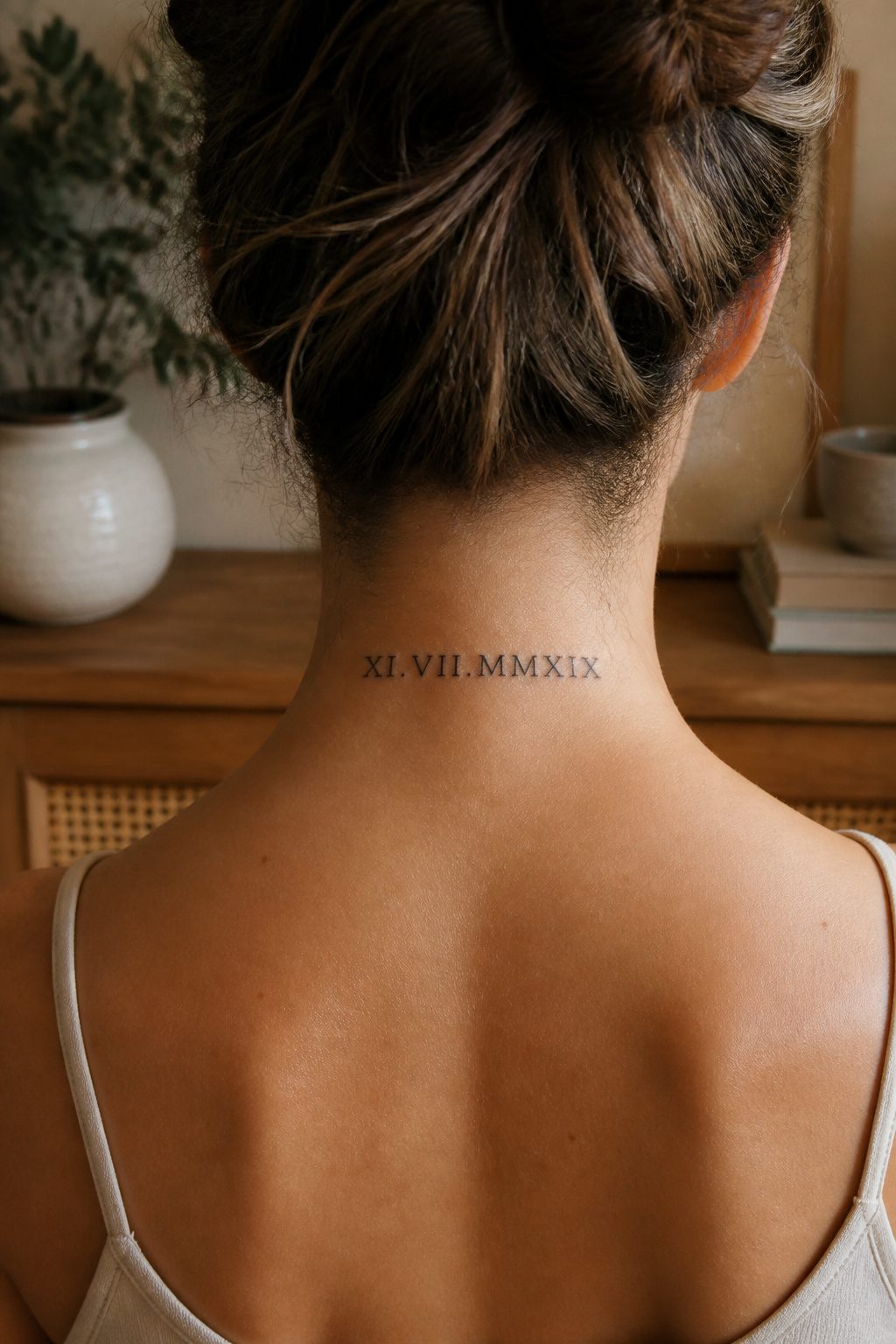
Roman numerals across the nape carry well there because the straight lines stay crisp even at small scale.
A birth year, an anniversary date, or a single digit rendered in Roman form sits flat against the spine and reads as jewelry from a distance rather than statement ink.
Lucky numbers work the same way. Seven, three, thirteen, whatever carries weight for you: the back of the neck keeps it private enough that the meaning stays yours, visible only when hair is up or shirt is off.
Arabic digits are simpler to execute small, but they lack the structural dignity that makes Roman numerals worth the extra needle time.
The risk with any number back there is placement too high toward the hairline. Hair grows, styles change, and a date that peeked out prettily at twenty-five can fragment into partial visibility by forty.
Position the tattoo with at least an inch of clear skin below the occipital bone, where the neck meets the skull, to keep your options open.
I’ve watched clients choose children’s birthdates, parents’ death dates, and numbers from sports jerseys they no longer wear.
The ones that hold up best are the ones with personal story attached, not the ones chosen because they photographed well on someone else.
Eye of Horus Back-of-the-Neck Tattoo
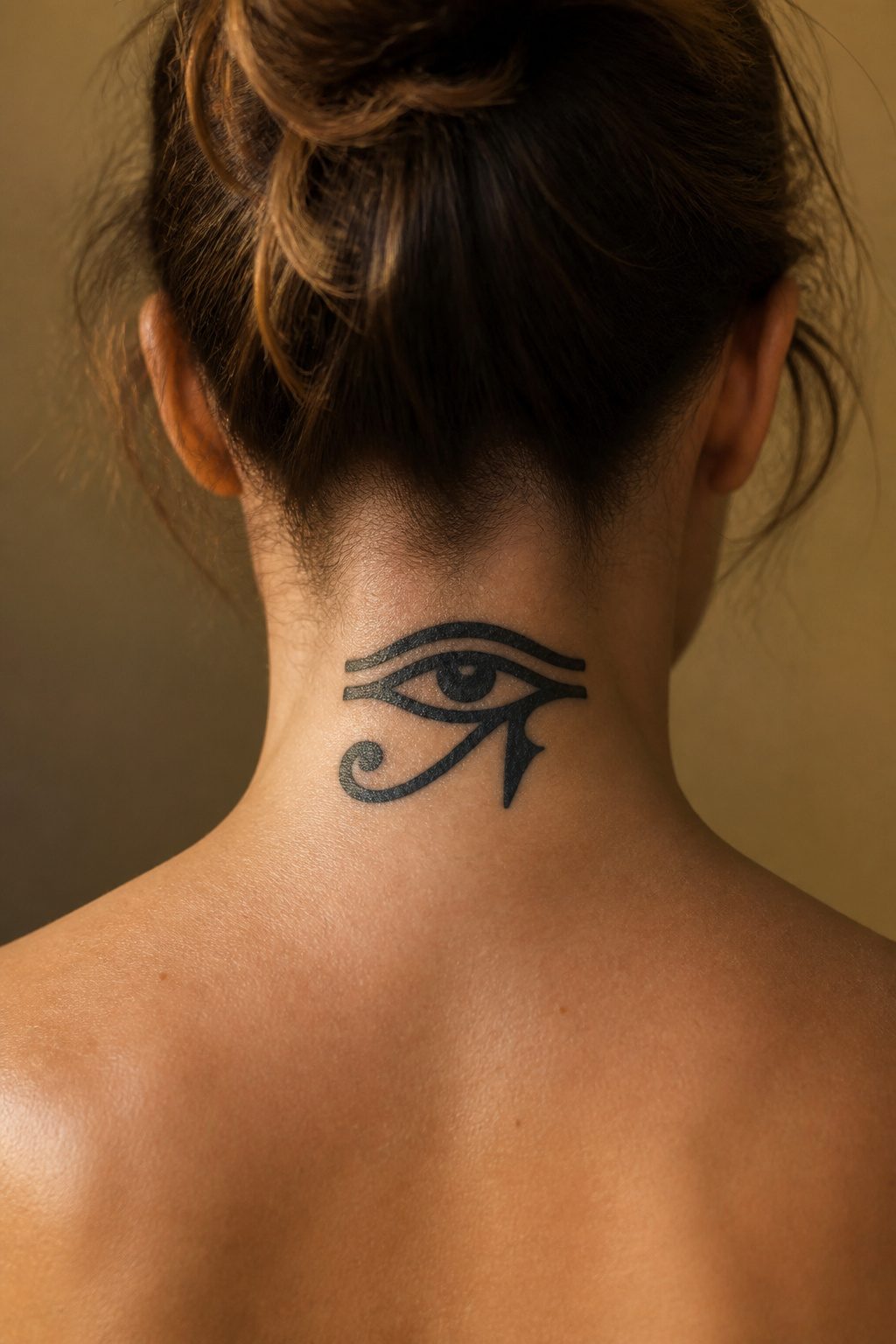
The Eye of Horus carries a protection meaning that reads clearly even at small scale, which matters on a neck where canvas space is tight and a hairline or collar can swallow detail.
The symbol’s horizontal sweep and central eye fit the natural width between the spine and the hairline without fighting the body’s curves.
What drew me to this design, reading through collections of healed work, is how the compact geometry behaves under real conditions.
A client can wear it high enough to hide under a ponytail or let it sit just below the occipital bone where a bob or an updo frames it.
The symbol’s own structure does the work of looking intentional even when the tattoo is only an inch or two across.
Placement precision here is worth planning. Too close to the hairline and regrowth softens the edge within a year.
Too low and shirt collars rub the fresh line during healing. The sweet spot sits where the neck begins to curve into the upper back, a zone that stays relatively stable whether the head turns or drops forward.
Quote Back-of-the-Neck Tattoo
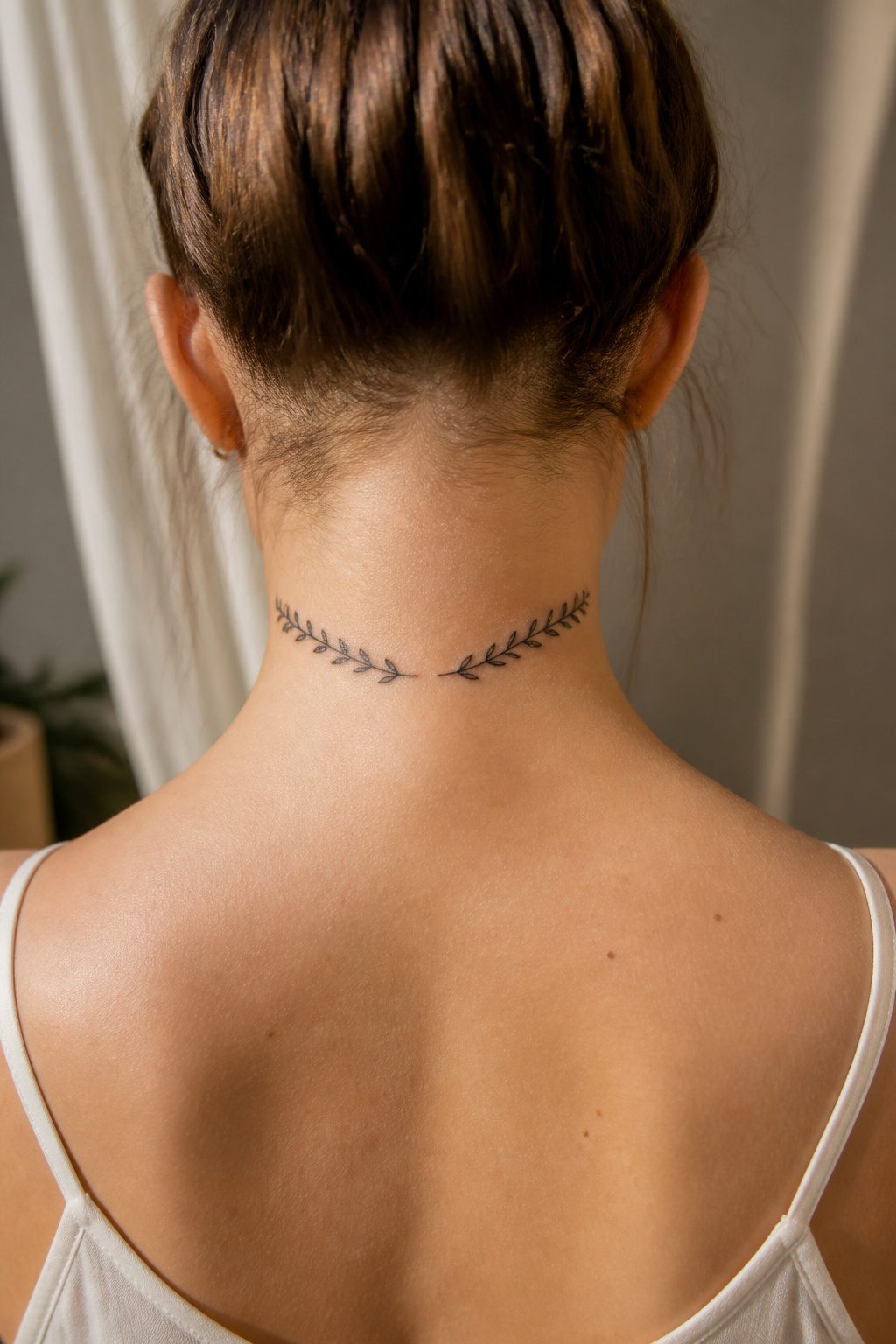
A line of text that follows the natural curve of your neck can sit beautifully along the base of the hairline or arc slightly higher toward the occipital bone.
Horizontal placement reads cleanly when the words are short; longer phrases almost always need to curve with the anatomy or risk looking like a straightedge pressed against a round surface.
I have seen script that looked elegant in the stencil go stiff once the skin settled, because the artist did not account for how the neck widens toward the shoulders.
Keep the font weight medium to bold; hair-thin lines in this spot tend to blur within a few years from the constant movement of turning your head and the friction of collars.
What reads as delicate at six months can look like a smudged pencil line at five years.
For professional settings, the collar of a standard button-down or a blouse with a back seam will usually cover a tattoo placed low along the hairline.
Anything that rides higher, or script that wraps toward the sides of the neck, becomes visible the moment you pull your hair up.
If your workplace has a conservative dress code, place the quote where a half-inch of growth hides it completely.
Butterfly Back-of-the-Neck Tattoo
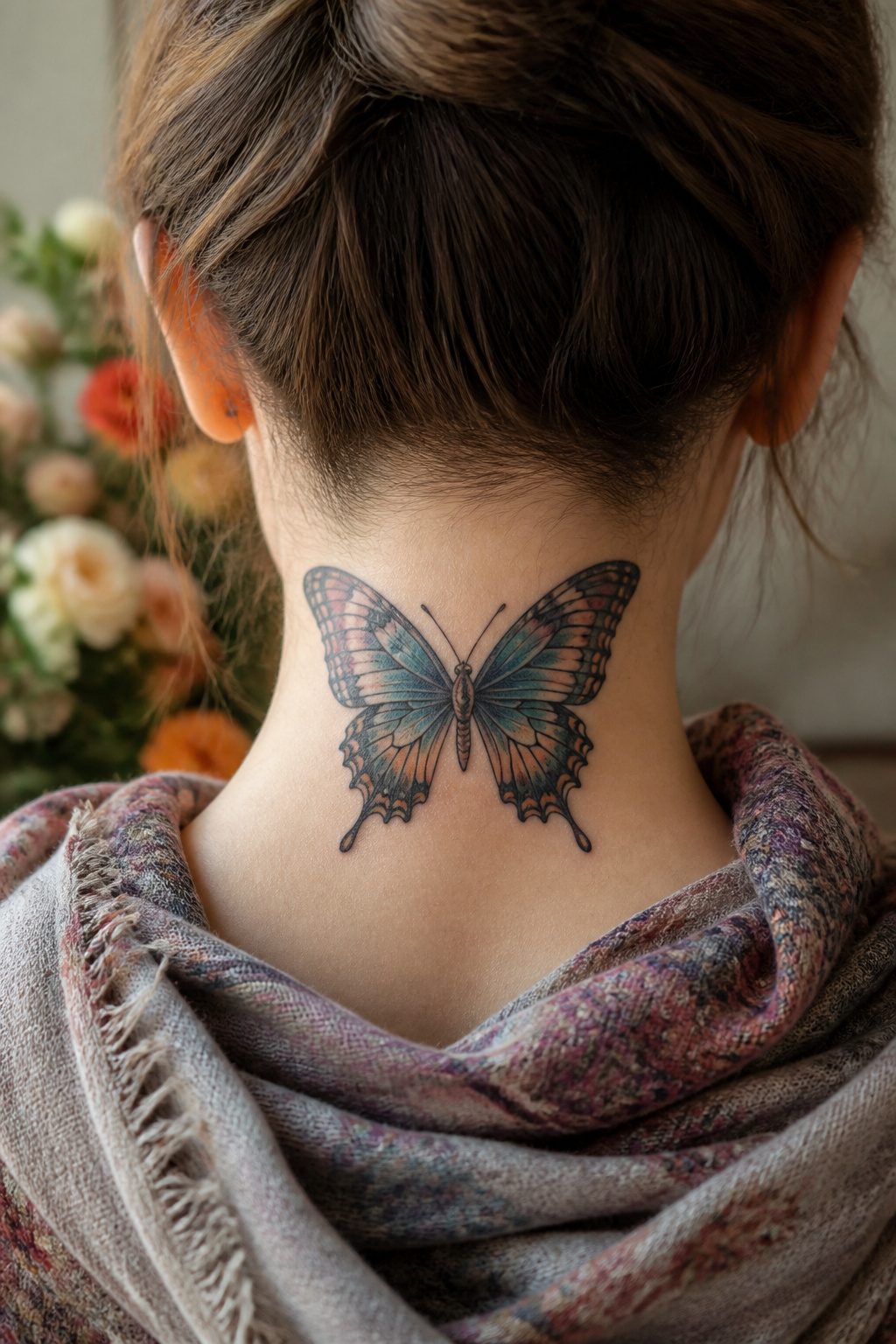
Butterflies sit at the top of the request list for back of neck tattoos, and the reason is simple geometry.
A wingspan of 4–6 inches fits the natural width between the hairline and the shoulder blades without crowding the bone or stretching awkwardly over the spine.
The placement lets the wings spread flat when you stand straight, then fold and shift as you move your head, which gives the design life that a static image never quite matches.
In the shop, women tend to arrive with a Pinterest board full of monarchs and swallowtails but leave with something redrawn to their own proportions.
The body tapers at the neck, so a butterfly copied straight from a flash sheet often looks pinched at the center or too wide at the tips.
A good artist will pull the thorax up toward the hairline and angle the wings slightly outward to follow the trapezius muscles underneath.
That adjustment takes an extra twenty minutes in the chair but prevents the "sticker" look that ages badly.
Color choice matters more here than on an arm or a thigh.
The back of the neck catches sun every time you forget sunscreen on a morning walk, and black and gray hold up better than the oranges and yellows that fade to mud in three or four years.
If the brightness is non-negotiable, plan for a touch-up every eighteen months and budget for it.
Artwork Back-of-the-Neck Tattoo
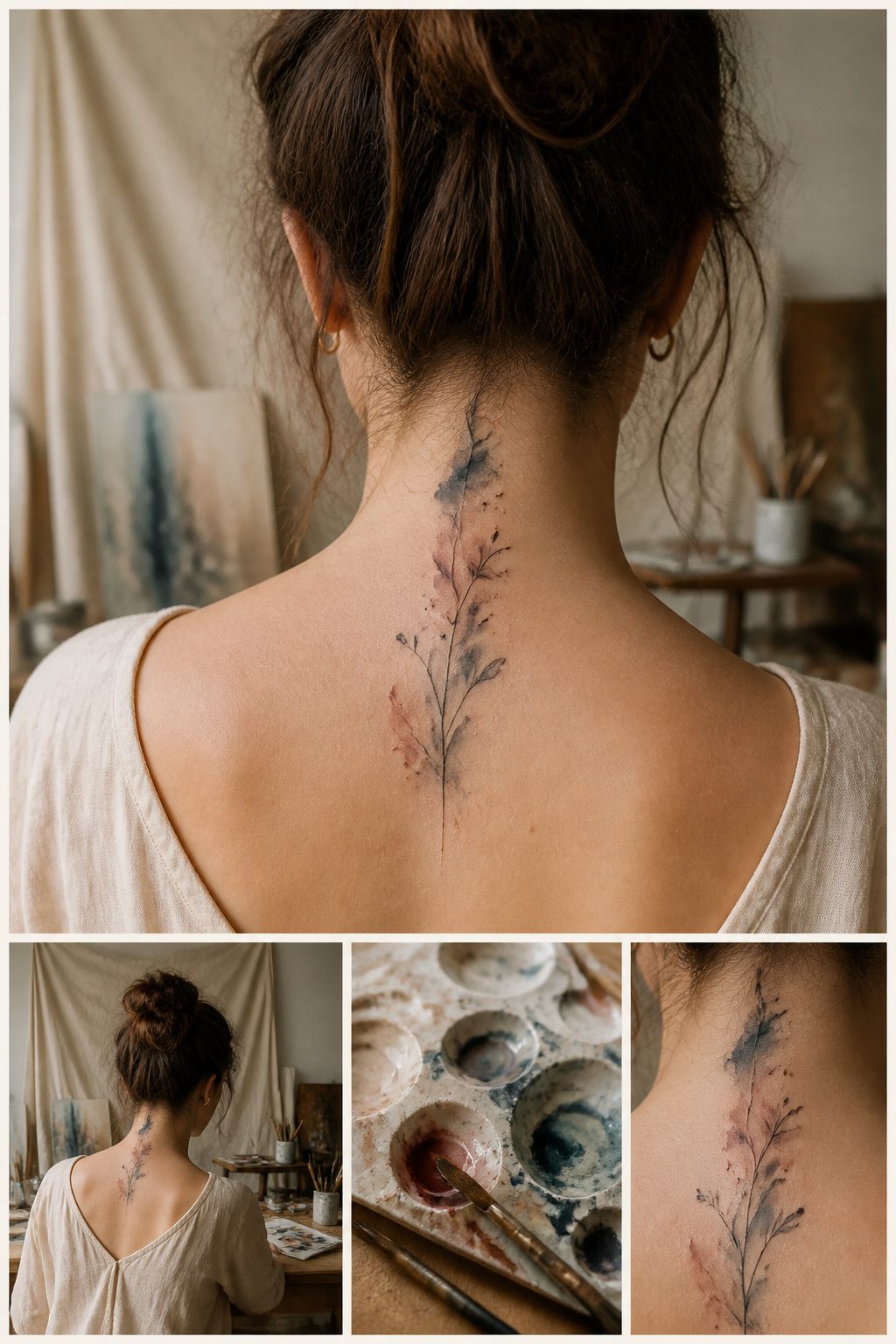
Reproductions of paintings and illustrative styles on the back of the neck demand more from an artist than most spots.
The canvas curves, it moves when you turn your head, and the space is narrow enough that a full composition has to shrink without losing its lines.
What convinced me, looking through portfolios of artists who specialize in this, is that watercolor-style pieces fail here more often than they succeed unless the artist has spent real time studying how pigment pools on skin versus paper.
Fine-line illustrative work tends to hold up better. Think Art Nouveau borders, single botanical studies from old herbals, or the simplified figures you see in Japanese woodblock prints.
These were built for flat surfaces to begin with, so the translation to a curved neck loses less.
A colleague at a Vancouver shop told me she turns down half the "reproduce my favorite painting" requests that walk in because the client picked a Baroque oil with twenty figures and expects it readable at two inches wide.
The neck’s other limit is sun. Illustrative pieces rely on subtle gradations that age faster here than under clothing, so bolder outlines within the style usually outlast pure wash work.
If you are set on a reproduction, pick an image that already reads clearly at postcard size and ask the artist how they would simplify the shadows into linework your eye still reads as depth.
Matching Back-of-the-Neck Tattoo
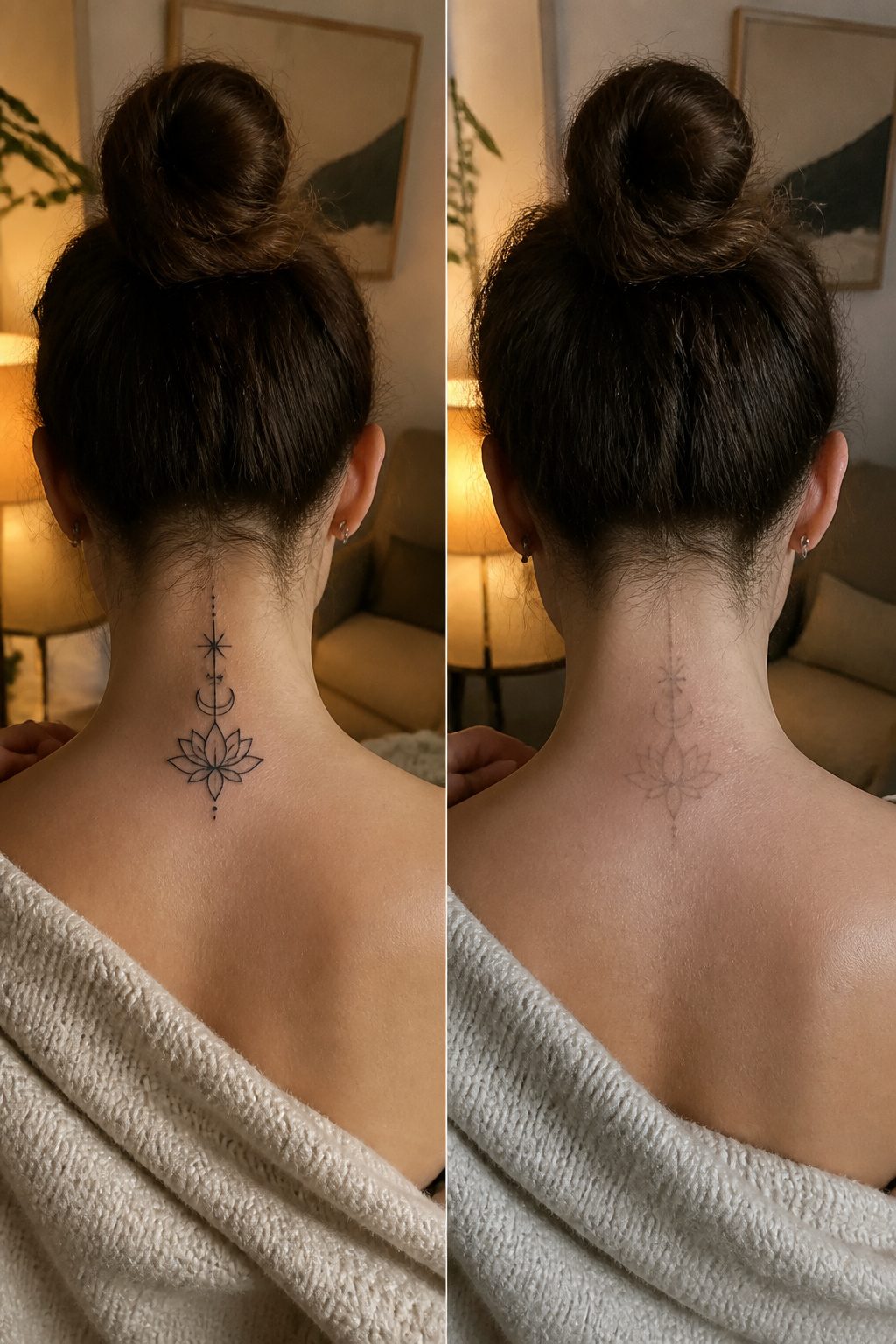
Matching tattoos at the back of the neck have become a quiet language between pairs, something you spot when two people turn to leave a room at the same moment.
The placement works because it sits at the same height on most bodies, so a half-moon on one neck meets its partner on the other.
Celebrities have pushed this forward, the flash of ink visible at premieres and in paparazzi shots from behind, and that visibility has made the idea stick.
The designs that hold up are the ones that read as complete alone and as part of a pair together.
A single feather, a shared constellation, a line that continues from one neck to the next, these work better than identical copies because the tattoo should mean something even if the relationship shifts.
The neck is not a forgiving place for cover-ups, so choosing a symbol with its own standing logic matters more than matching for the sake of it.
Pain sits at a solid seven or eight for most people here, the skin thin and the bone close, and the artist has to work around the spine’s natural curve.
Two people booking together should expect separate appointments, not back-to-back work, since the body needs the full session without compromise.
Flowers Back-of-the-Neck Tattoo

A full bouquet across the back of the neck reads differently than a single stem tucked behind the ear.
The space between the hairline and the shoulder blades, roughly the width of a spread hand, gives room for peonies to overlap with eucalyptus, or for wildflowers to trail in an asymmetrical sweep toward one shoulder.
The arrangement needs enough dark leaves or stems at its base so the design does not float; without that grounding, the flowers can look like stickers rather than something growing from the skin.
Dense packing means more needle time and more sessions if color saturates each petal. Black-and-grey botanical work heals faster and ages more forgivingly on this spot, where sun hits hard and touch-ups are awkward to schedule.
Watercolor-style blooms without outlines blur within a few years here; the neck skin moves constantly and the ink migrates where borders are soft.
Placement matters for wearability. A bouquet that sits fully below the occipital bone, the bump at the skull’s base, stays visible with a ponytail.
Work that climbs higher gets chopped by haircut changes and draws more attention than most people want in professional settings.
I have redrawn more neck bouquets downward than upward; clients underestimate how much they will want to hide the thing in the first six months.
Buddha Back-of-the-Neck Tattoo
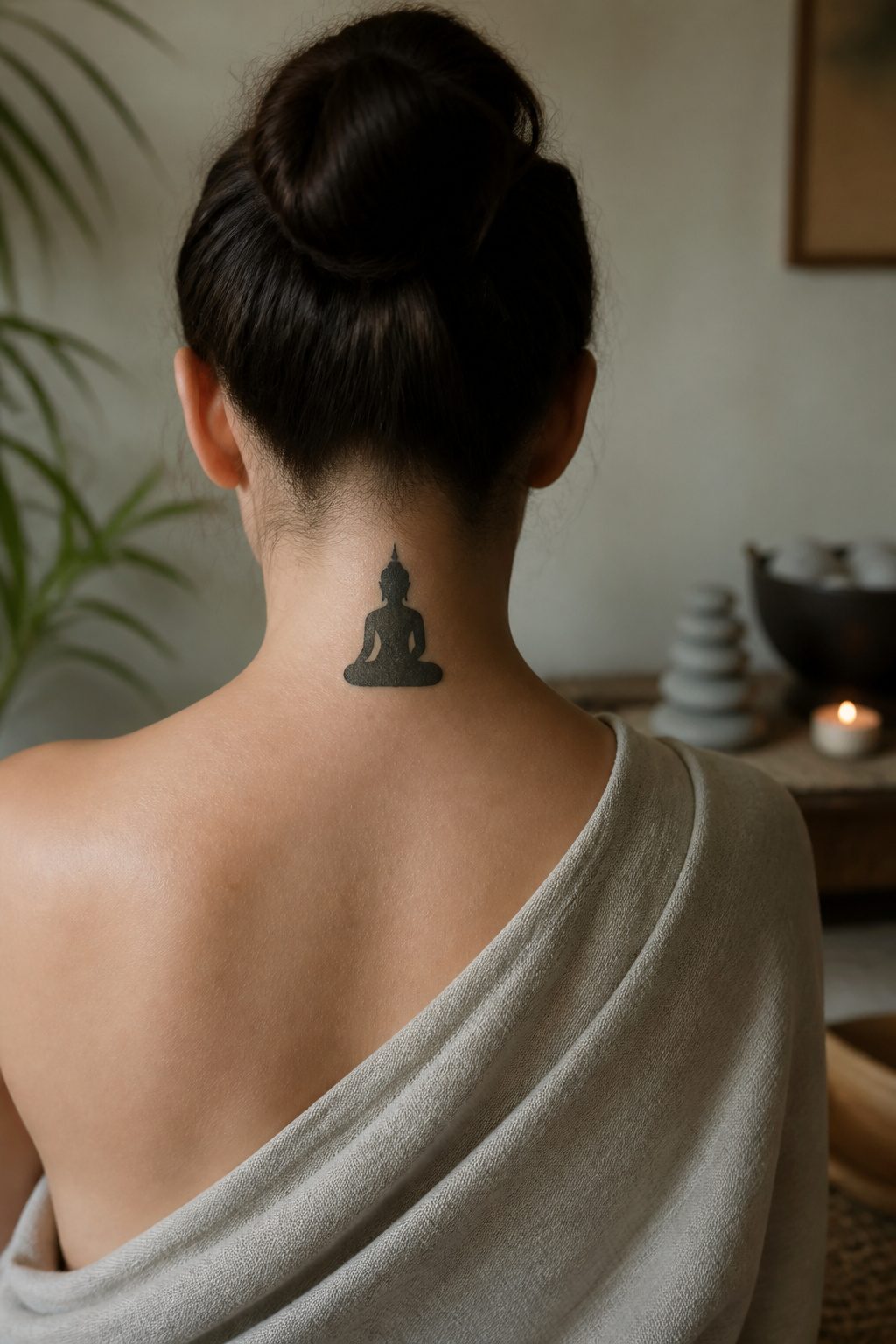
A Buddha image at the back of the neck sits right where the head meets the spine, a junction some traditions call a point of stillness.
The placement turns the tattoo itself into a private meditation aid, visible to the person behind you in a yoga studio or a mirror, but not screaming for attention across a room.
Fine linework around the facial features tends to blur faster here than bolder shading, since the neck skin moves constantly with speech and swallowing, so the simpler silhouettes and solid black profiles usually age cleaner than photorealistic portraits.
Most artists I’ve watched work this spot recommend keeping the design under three inches tall; anything larger fights the natural curve and starts looking like a sticker rather than something that belongs to the body.
The pain surprises some people because the skin is thin over bone, though the session finishes fast at that size.
If the spiritual meaning matters more than the specific figure, a lotus or dharma wheel from the same visual vocabulary carries the same weight with less risk of cultural misstep.
Dragon Back-of-the-Neck Tattoo
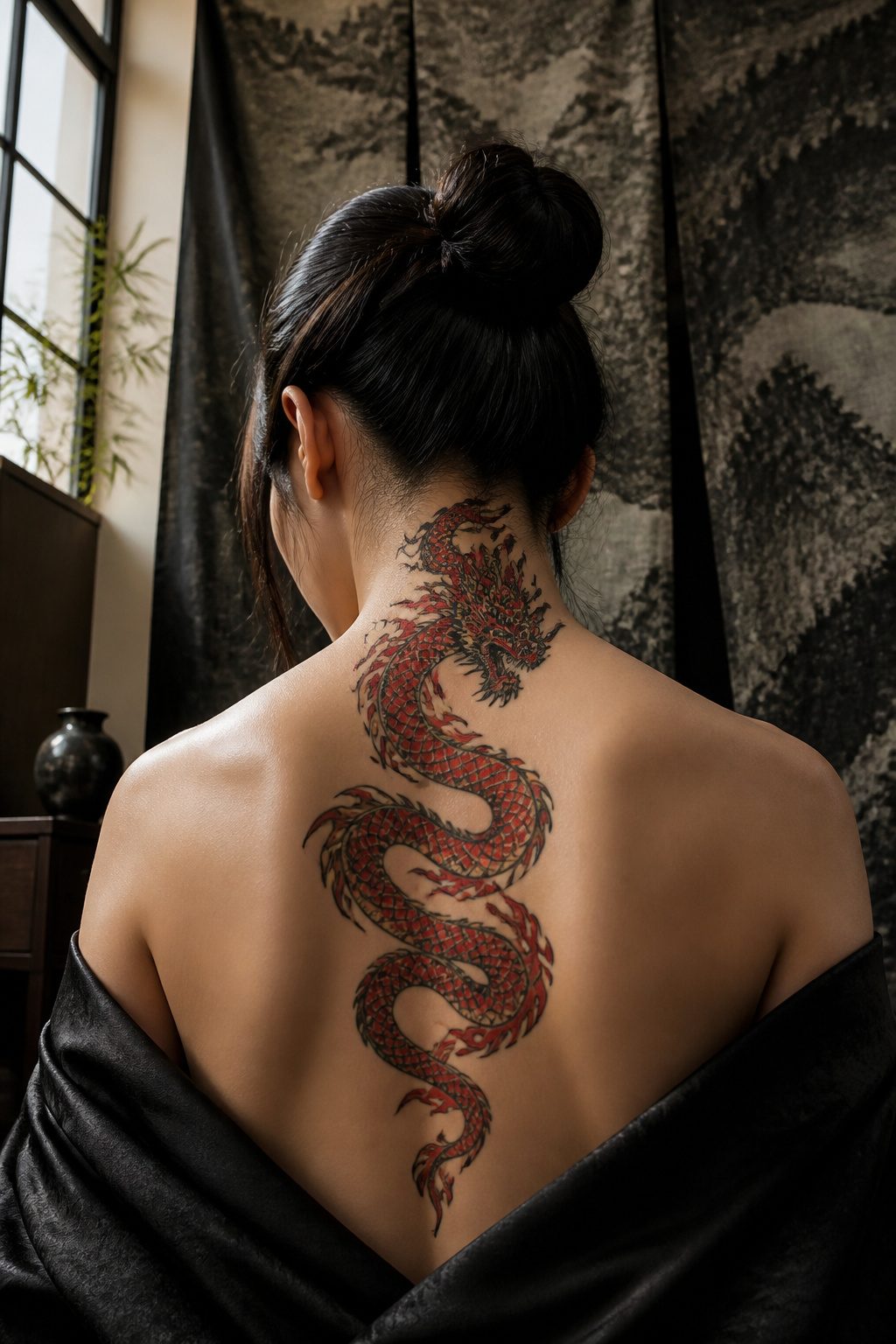
Dragon bodies follow the neck’s natural column in a way few other subjects manage.
The spine becomes the dragon’s own, so the tail can drop toward the shoulder blades while the head rises at the hairline, sometimes breaking into the scalp if the hair is short enough to show it.
That vertical stretch gives the artist room to work the full length of the body, and the curves read as movement even when the head is still.
The dramatic effect comes from the silhouette more than the detail. A dragon wrapped around the back of the neck reads from a distance as a dark, coiled shape, and the viewer’s eye fills in the scales or the claws.
Up close, the linework carries the weight, and a body that twists properly will catch light along one edge and shadow along the other.
The mistake is asking for too much width. A dragon that spreads its wings across both shoulders fights the narrow vertical space and ends up looking pinched.
The pieces that age best keep the wings folded or absent, letting the body do the work of filling the canvas. Color shifts this, and not always for the better.
A black dragon keeps its drama for years; a red or green one can soften faster than the owner expects, especially where the sun hits.
Pain Level and What to Expect
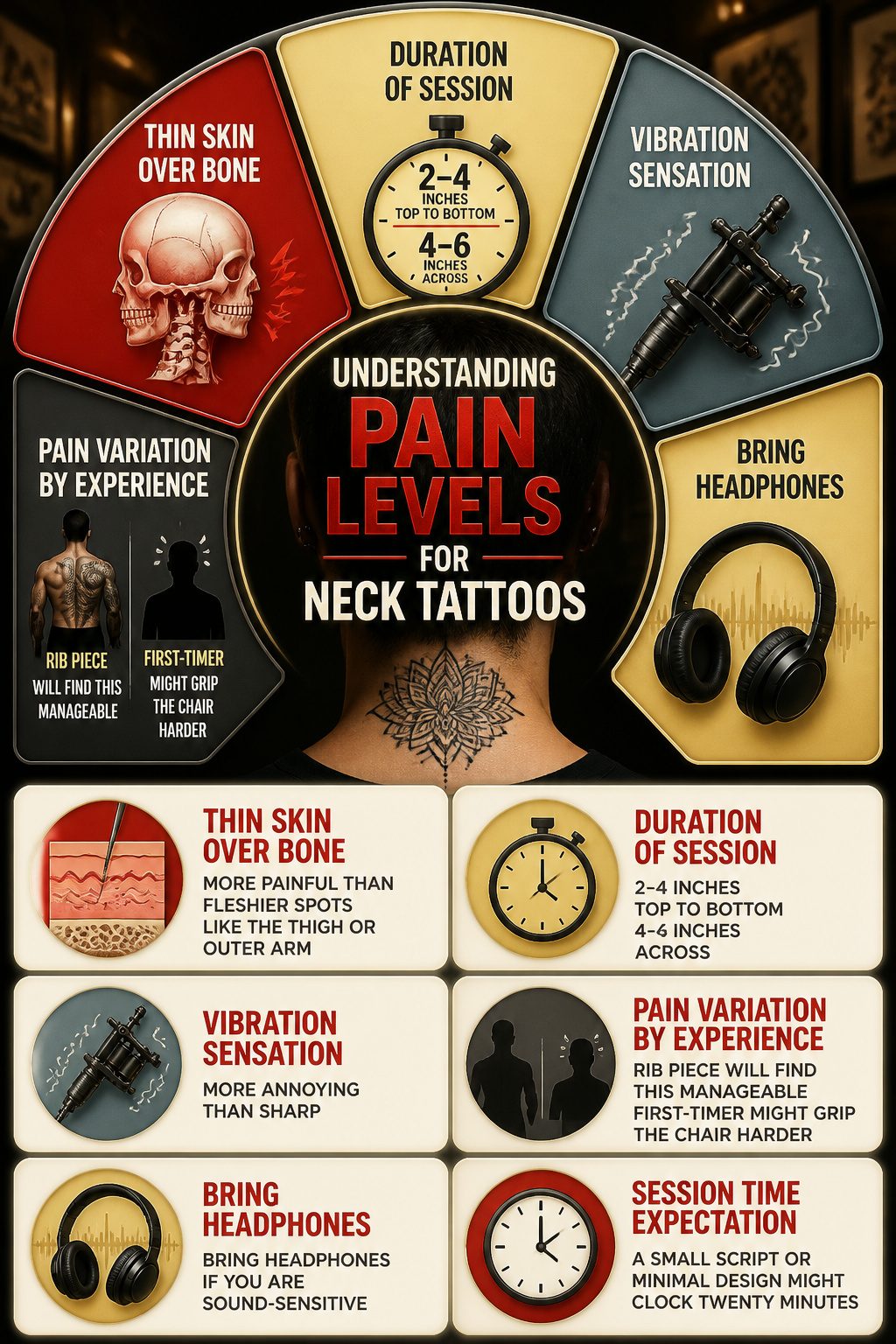
The skin at the back of the neck sits thin over the spine and skull, which makes the area more painful than fleshier spots like the thigh or outer arm.
Bone close to the surface leaves less cushion for the needle, so you feel each pass more directly. That said, the neck is only about 2–4 inches top to bottom and 4–6 inches across, so most back-of-neck tattoos wrap up fast.
A small script or minimal design might clock twenty minutes, and the intensity stays brief enough that clients rarely tap out.
Pain thresholds vary; someone who sat through a rib piece will find this manageable, while a first-timer might grip the chair harder than expected.
The vibration from the machine against the occipital bone can also rattle in a way that feels more annoying than sharp. Bring headphones if you are sound-sensitive.
Visibility and Hiding Your Tattoo
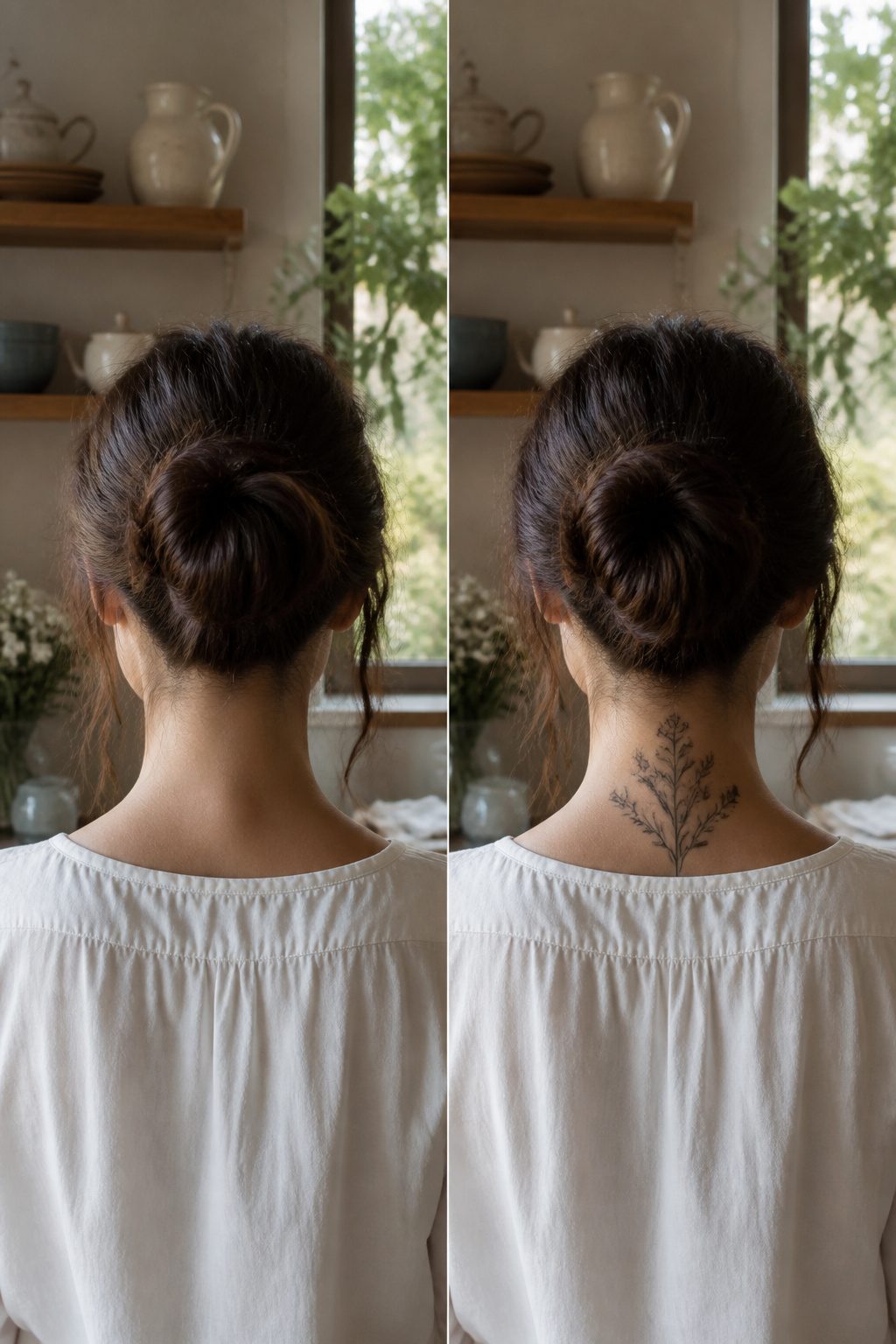
A loose chignon or a side fishtail braid does the work of hiding or revealing a back-of-the-neck tattoo in about ten seconds.
Hair is the only cover-up tool you already own, which makes this spot unusually practical for anyone whose office still leans conservative or who simply wants control over when the ink shows.
A back-of-the-neck tattoo can easily be hidden by hair or shown off to the world like a piece of permanent jewelry, depending on your mood.
— PopSugar
That flexibility matters more than it used to. Long hair gives you the full toggle: down for the Monday morning meeting, up for Saturday night.
Shorter cuts limit the camouflage, though a small, high placement can still sit under a collar.
What sold me on the location, reading through the practical accounts, was how little effort the hiding takes compared to a forearm or ankle piece that needs strategic clothing every single day.
Aging and Sun Exposure
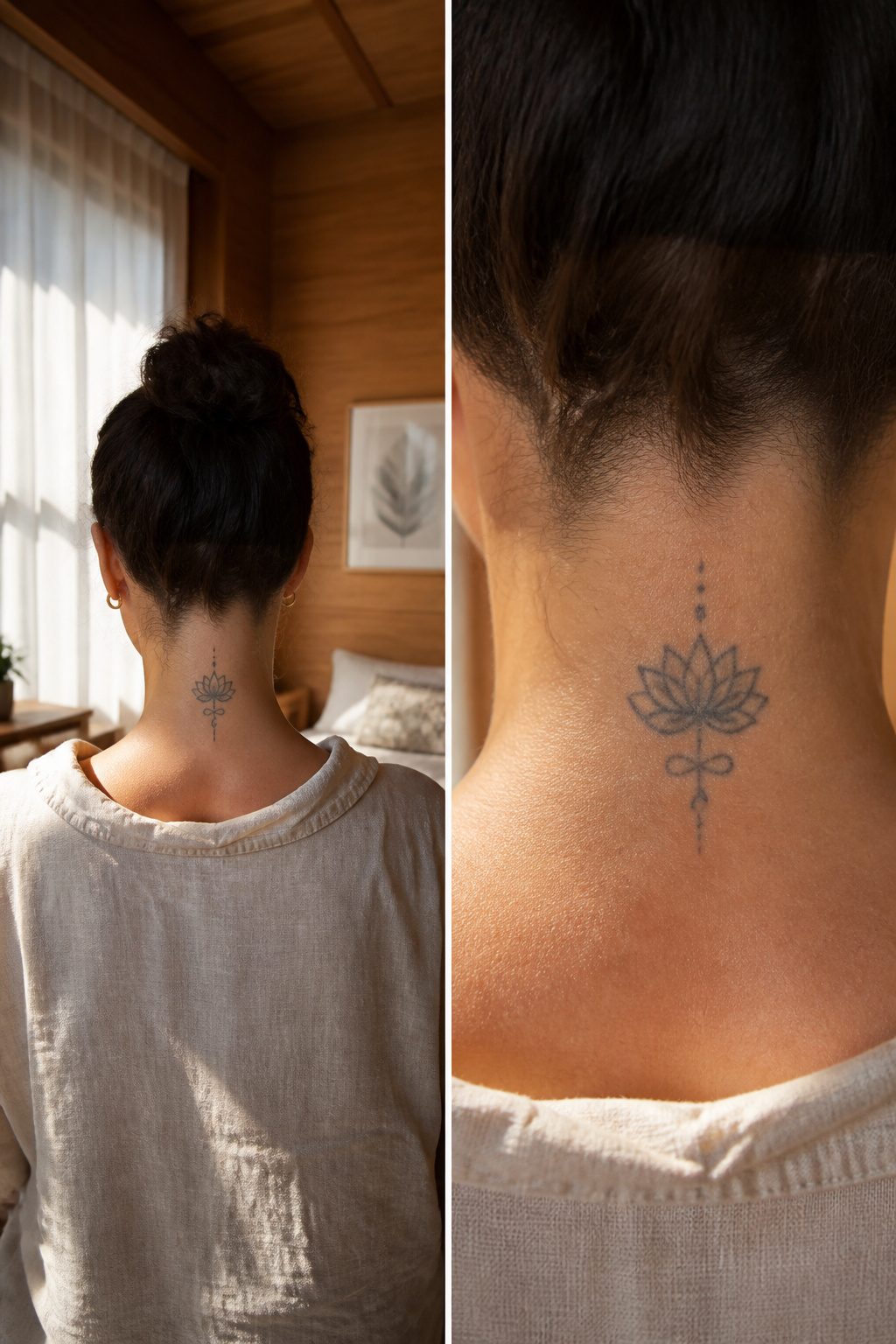
The back of the neck catches less direct sun than your forearms, shoulders, or chest, which means the ink fades slower and the lines stay sharper for years.
Hair covers most of the area for a lot of people, adding another layer of protection without any extra effort on your part.
I have watched tattoos on the sides of necks and hands blur and soften within five or six years while pieces placed at the nape hold their original weight for much longer.
That slower aging makes the spot worth considering if you want something delicate, fine-line, or detailed.
The trade is that you still need sunscreen when your hair is up or if you keep the area shaved, because any exposed skin accumulates damage over time.
Aftercare for Healing
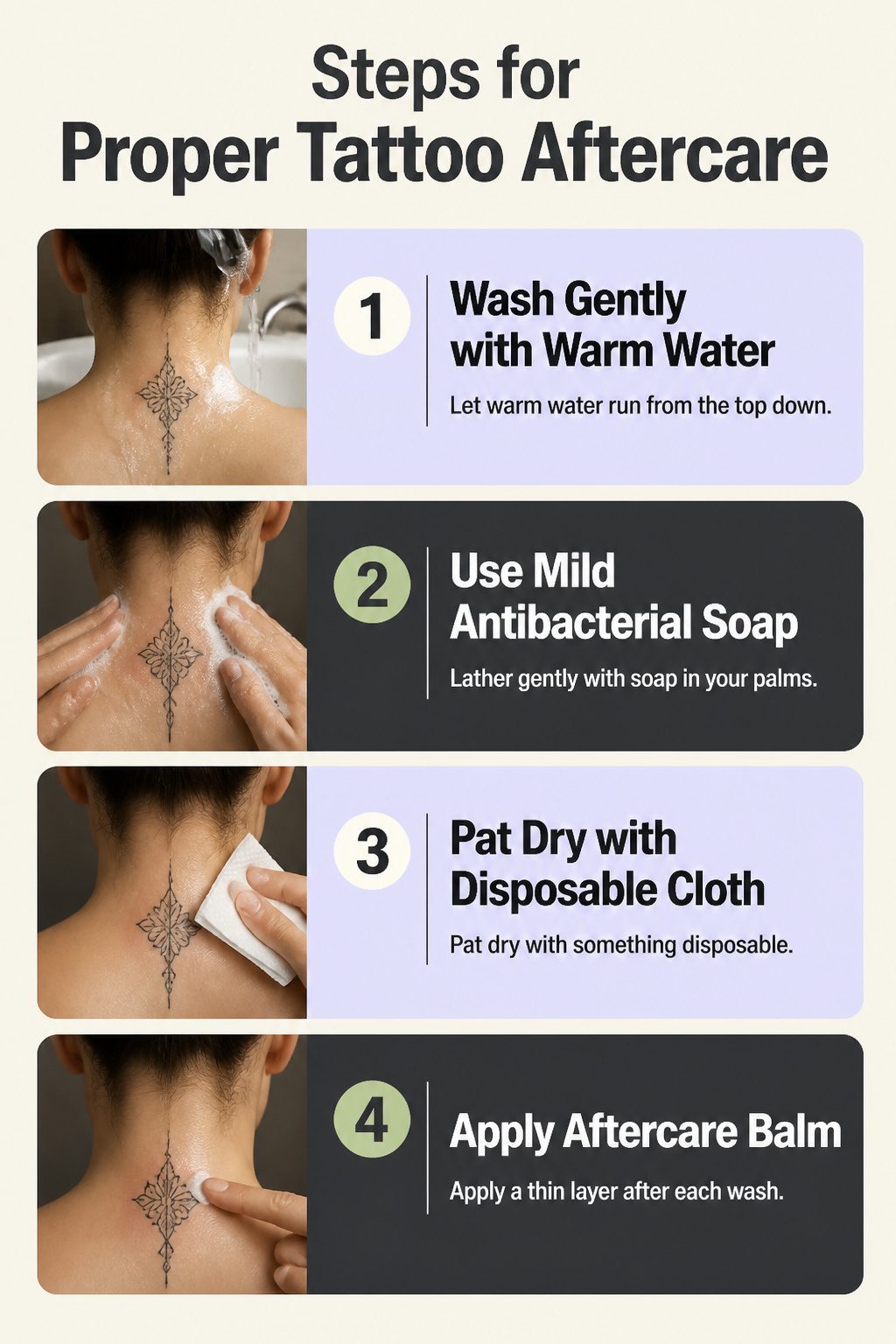
Washing a fresh back-of-neck tattoo means leaning over a sink and letting warm water run from the top down, never scrubbing upward toward the hairline where residue collects.
A mild antibacterial soap lathered in your palms first keeps the pressure light; the skin back there is thinner than it looks and easy to irritate.
Pat dry with something disposable, not the bath towel that hangs in your bathroom and breeds bacteria between washes.
Keeping the area moisturized matters more than most people expect, since the collar of your shirt rubs this spot dozens of times a day.
A thin layer of whatever aftercare balm your artist recommends, applied after each wash, forms the barrier that keeps fabric from pulling at the new surface.
What struck me, looking through the available guidance on back of neck tattoos specifically, is how little of it isolates this location from general aftercare advice. Most sources treat all tattoos as if they sit on flat, easily reached skin.
The hairline complicates things, the angle complicates things, and the constant contact with clothing complicates things most of all. Your own attention to those three factors ends up doing more of the work than any branded protocol.
Cost and Consultation
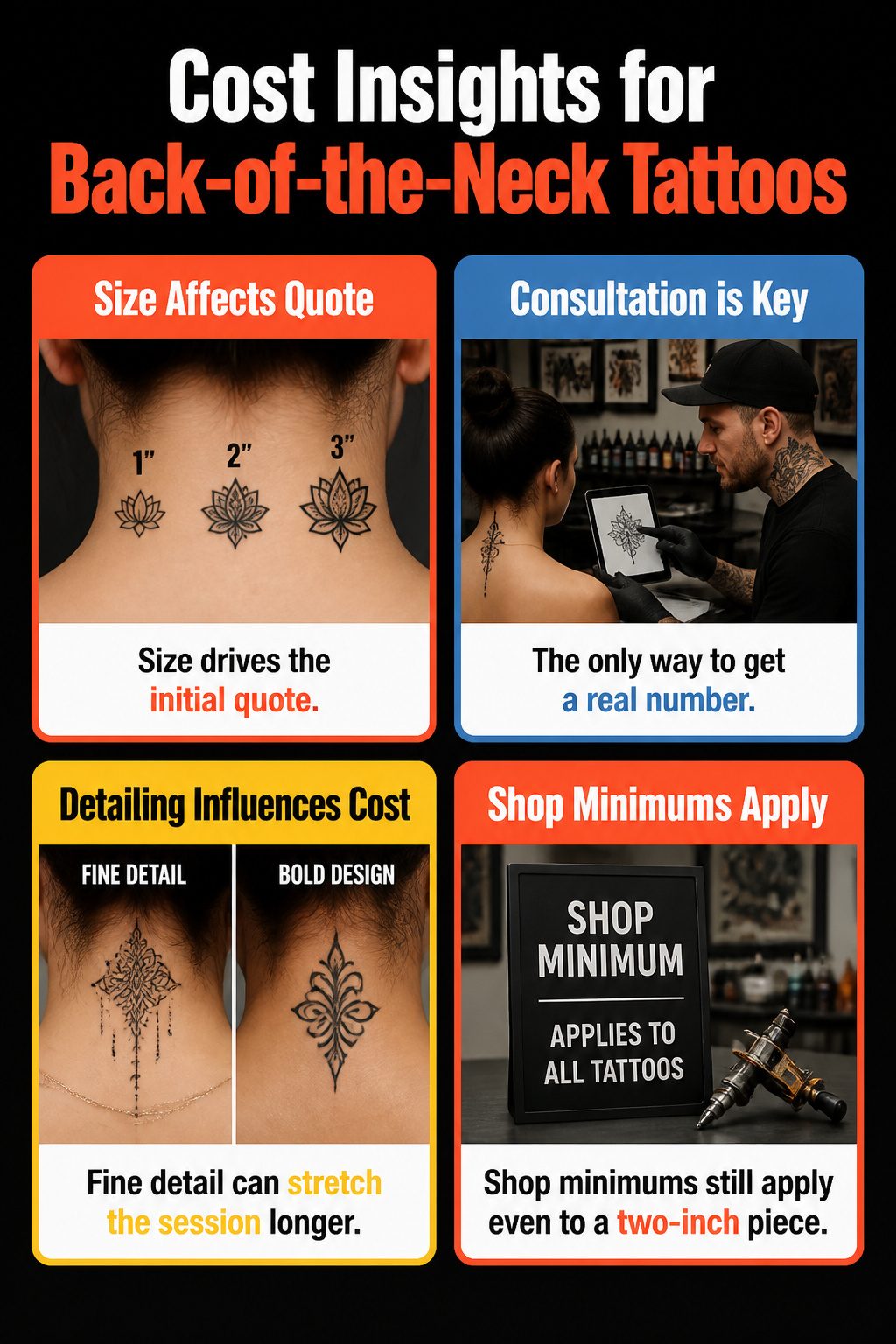
A back-of-the-neck tattoo runs smaller than most placements, which usually keeps the price lower than a full sleeve or back piece, but the only way to get a real number is to sit down for a consultation.
Size drives the initial quote, though fine detail can stretch the session longer than a bolder design of the same dimensions.
An artist who specializes in single-needle work or delicate linework typically charges more per hour than someone working in a bolder traditional style, and shop minimums still apply even to a two-inch piece.
I have watched friends walk in expecting a flat rate based on what they read online, then walk out surprised when the artist counted the lettering and adjusted for the curvature of the neck.
The skin there moves differently than a flat forearm, and some studios add a small premium for the precision that requires.
What convinced me, reading through a dozen of these breakdowns, is that the range is too wide for any useful average.
A simple black outline from a newer artist might clear the shop minimum alone; the same footprint filled with color by someone with a ten-year waitlist multiplies from there.
Book the consult, bring your reference, and ask whether the quote covers the sitting or scales with actual time. That is the figure worth leaving with.
Frequently Asked Questions
Are back-of-the-neck tattoos painful?
Yes, they tend to hurt more than padded areas because the skin is thin over bone and tendon, producing a sharper, dragging pressure rather than a surface sting.
Most back of neck tattoos are small, though, so sessions stay short and the pain does not last long. A two-hour session of stippling on the neck can feel longer than a four-hour thigh piece.
How visible is a back-of-the-neck tattoo?
They are easy to hide and easy to show, which is the main appeal of the placement. Hair down covers the ink completely for a standard workday; an updo or ponytail exposes it cleanly.
No twisting or angling needed to toggle between private and public.
How do I care for a back-of-the-neck tattoo?
Wash it with warm water and mild antibacterial soap, then keep the area well moisturized with an odorless product designed for tattoos. The neck is constantly in motion, so dryness sets in faster than on other spots.
Keep hair product off the fresh line and protect it from direct sunlight, since the back of the neck sees hard and frequent UV exposure.