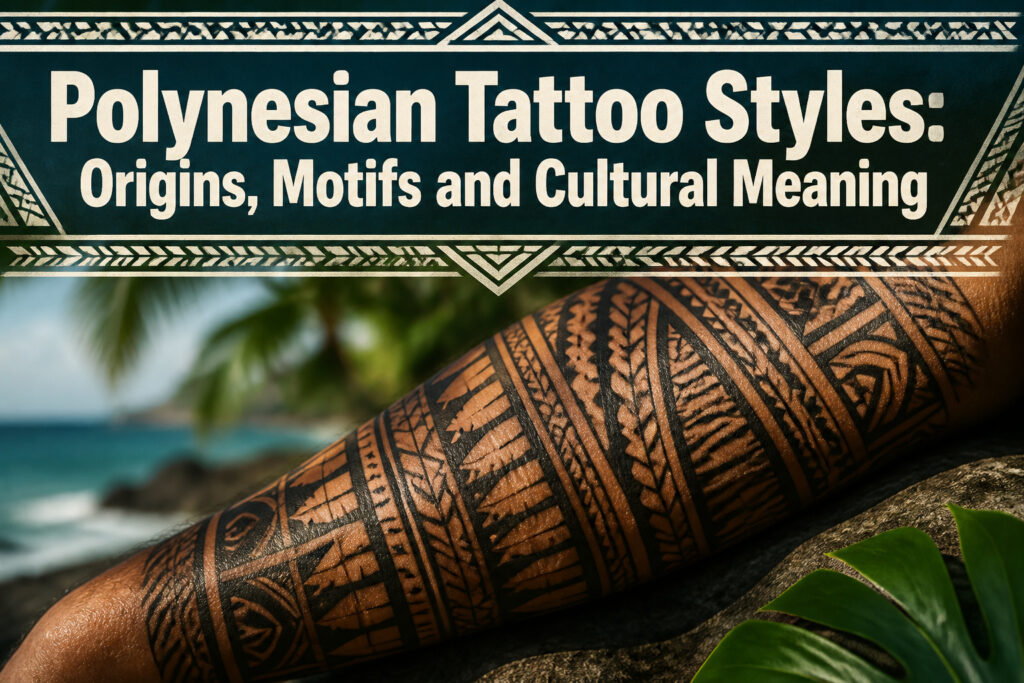
Polynesian tattoos are a family of distinct regional styles, each with its own visual grammar and cultural rules. The catch is that wearing them without understanding which symbols belong to which island tradition risks treating living heritage as decoration. A full Samoan pe’a still takes days of hand-tapping and remains reserved for Samoan wearers; even adapted studio work demands that the artist know why the geometry was built in the first place.
Maori Tattoo Style
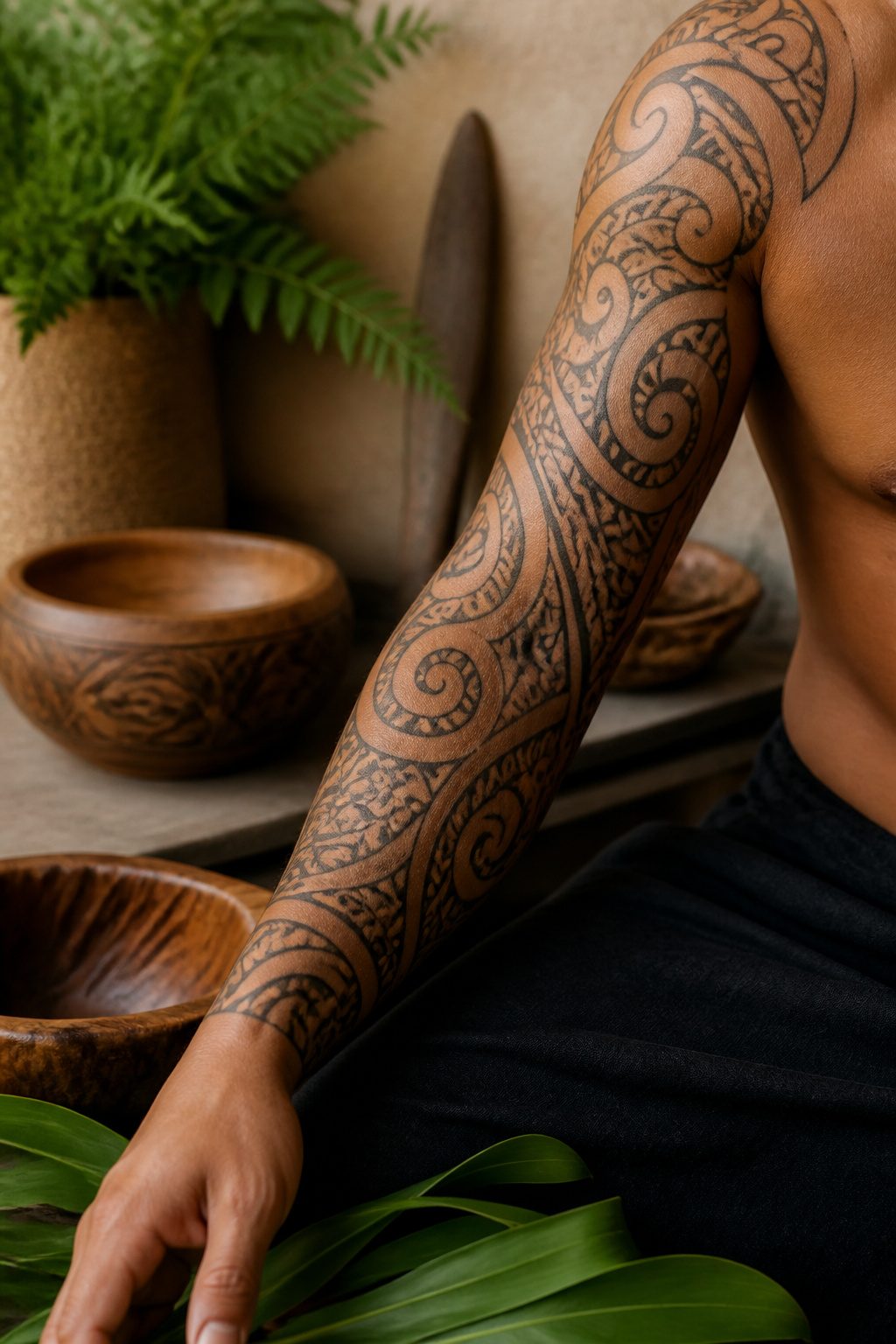
Maori tattoo work, the tā moko tradition of Aotearoa, runs on a visual rhythm you can spot across a room. The koru spirals and curvilinear patterns flow where Samoan work locks into geometry, and that difference starts with how the design breathes. The spiraling thin lines wind outward, then return inward, creating movement that dense panel traditions do not attempt.
The blank space matters as much as the ink. Rather than filling every inch, Maori composition leaves deliberate shapes untouched, letting negative space carry part of the design. Those un-inked areas give the eye somewhere to rest, which makes the filled passages read louder when they arrive.
Intricate fillings sit inside the spiral arms, not as decoration alone but as the structural grammar of the piece. Where other Polynesian styles build weight through repetition, Maori work builds it through contrast: fine line against solid fill, motion against stillness, marked skin against skin left bare.
Facial moko carries the strictest boundary. Moko kauae for women and the full-face mataora for men remain reserved for Maori wearers by cultural protocol. Outside that line, motifs inspired by the tradition can enter contemporary Polynesian compositions, but the distinction between inspiration and appropriation is one the best artists keep visible in the work itself.
Marquesan Tattoo Style
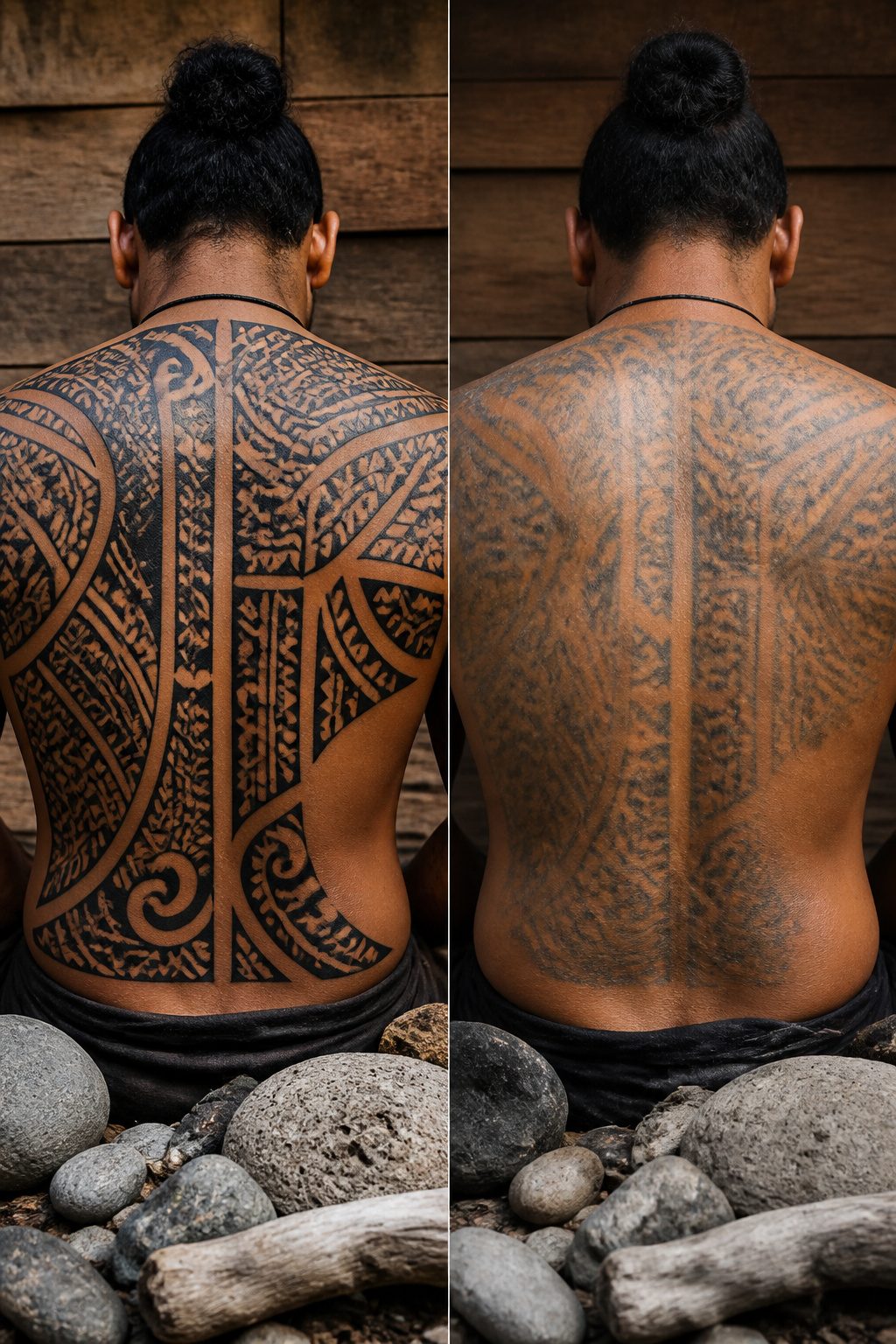
Marquesan work sits at the densest end of the Polynesian spectrum, historically covering almost the entire body in compositions that left little skin untouched. The style’s defining feature is its heavy geometry: large blocks and solid black areas create the darkest visual weight of any regional tradition, with asymmetrical designs traditionally worn by men and symmetrical patterns by women. Three sources confirm this gender distinction in layout.
Several motifs carry the structure. The etua and ipu appear alongside the Marquesan cross, a geometric form representing balance between elements, directions, and forces in the universe. That cross often anchors larger sleeve or back pieces, functioning as a stabilizing center within dense panel arrangements.
For anyone building a modern Polynesian sleeve, Marquesan tradition provides the visual foundation. Its panel-rich, highly geometric approach translates directly into contemporary dense compositions, though the near-total body coverage of historical work rarely transfers one-to-one to a single arm or leg.
Samoan Tattoo Style
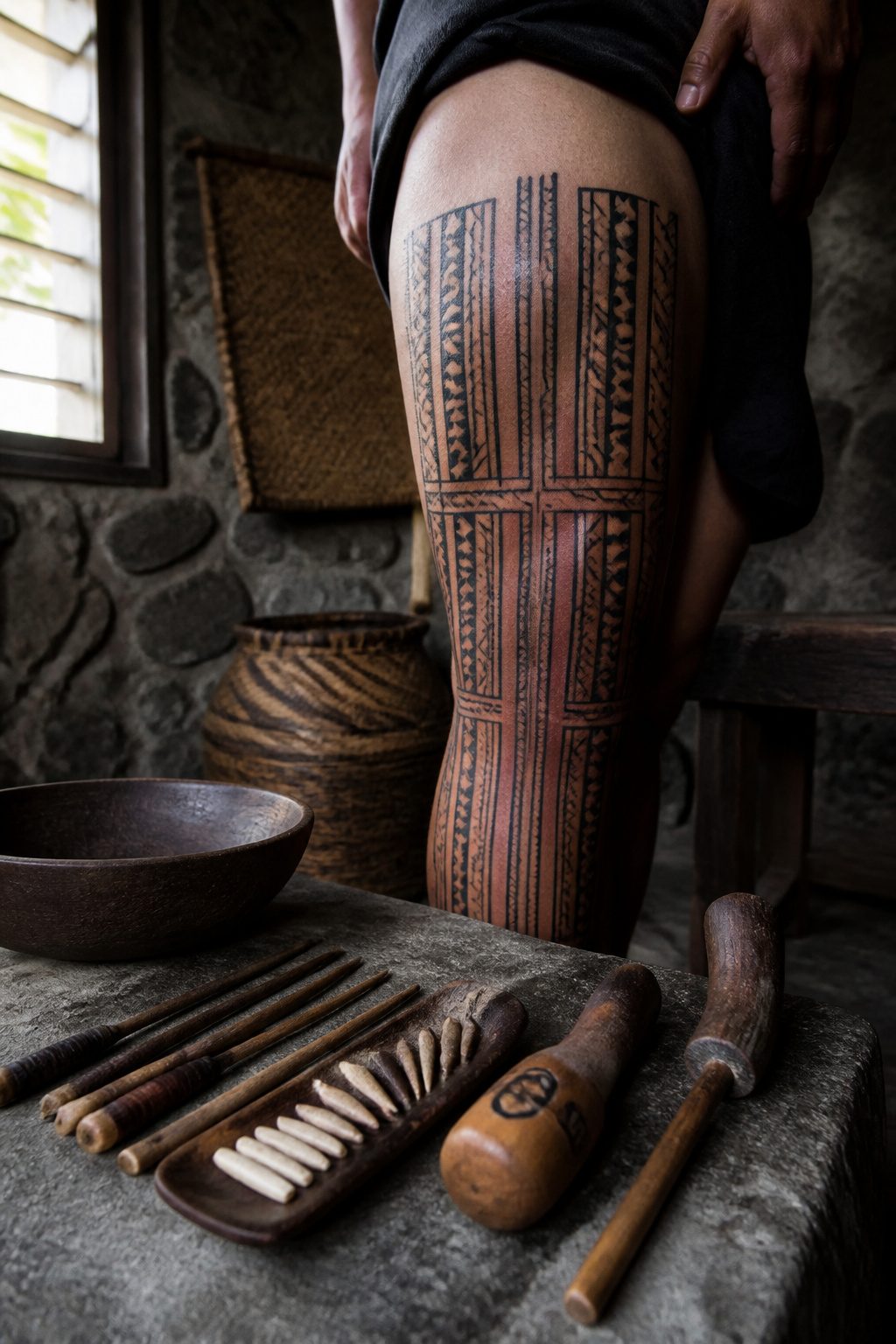
Samoan tatau carries the deepest unbroken Polynesian tattoo lineage still practiced today, and its visual grammar is the most structured of the family. Where other island styles let curves flow, Samoan work locks into rectilinear, geometric patterns that repeat with almost architectural discipline and demands highly symmetrical body sides. The male pe’a runs thigh to knee; the female malu covers knee to upper thigh. Both are applied by hand-tapped tools across multiple days, the composition mapped beforehand so nothing sits crooked.
Contemporary studio work in this style borrows the density, the symmetry, and the bold black fill, but draws a hard line at replicating ritual marks reserved for Samoan people. That distinction matters. The geometry reads as protection and rank to those who grew up with it. Wearing the full pattern without the rite is not homage; it is a category error, and most skilled artists will steer a non-Samoan client toward adapted geometric work rather than the pe’a or malu themselves.
Tahitian Tattoo Style
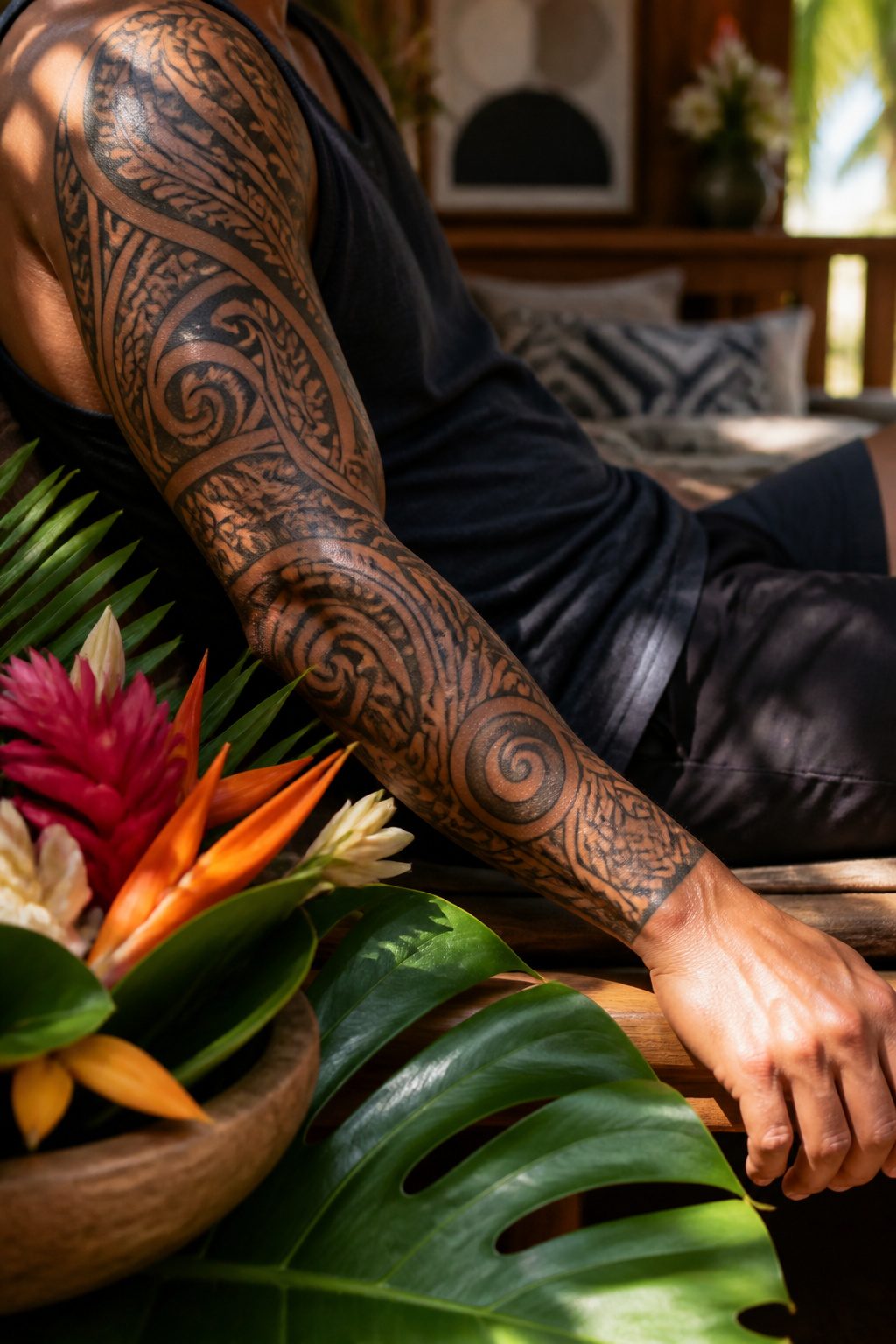
Tahitian tattoo work stands out for its smooth, rounded elements and highly figurative, naturalistic style, a look that borrows openly from neighboring traditions. Where Marquesan and Samoan vocabularies appear in Tahitian pieces, they arrive blended with modern Western art sensibilities rather than preserved in strict form. This gives Tahitian work the most flexible modern dialect in Polynesian tattooing today.
The word "tattoo" itself traces back to the Tahitian tatau, and contemporary Tahitian-style pieces lean into bold black silhouettes with strong negative-space compositions. Dramatic motif scale is common, and the style adapts readily into custom sleeves that read as island work without claiming to be ceremonial. For someone weighing which Polynesian style to request, Tahitian offers the widest bridge between traditional reference and personal modification.
Hawaiian Tattoo Style
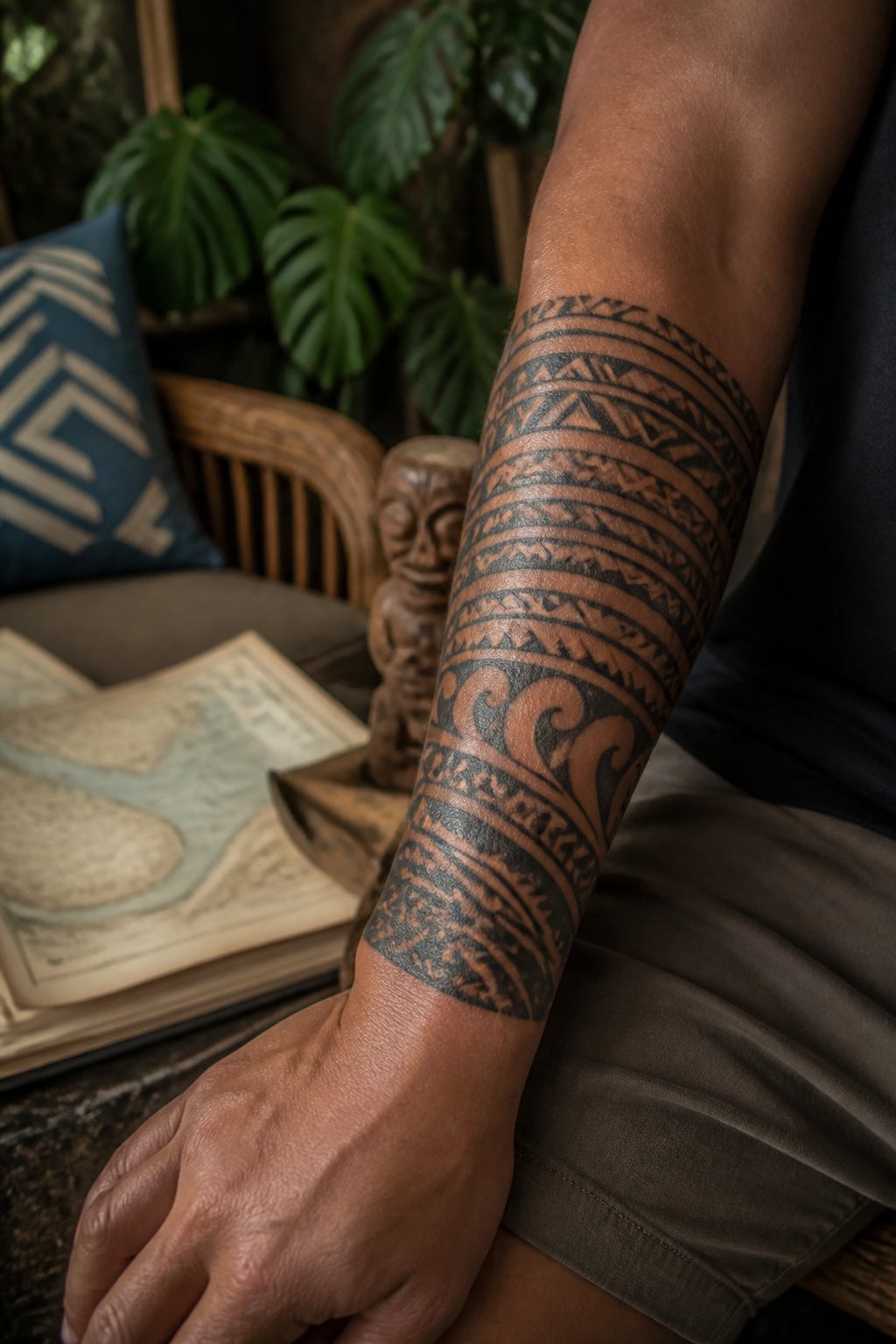
Hawaiian kākau carries a visual language built on repetition: black geometric units stacked and mirrored until the skin reads like a coded genealogy. The shark teeth (niho mano), waves, and the eight-pointed star recur not as decoration but as markers of family origin and place. Protection runs parallel to lineage; the aumakua, ancestral guardians, find their way into these marks as spiritual shielding rather than ornament.
The word kākau itself means both to write and to tattoo, which tells you how Hawaiians understood the practice: not as image-making but as inscription. Bone or turtle ivory combs lashed to wooden handles delivered candlenut soot ink through a rhythmic tapping, kākau uhi, that could stretch across days for a single large piece. Missionary suppression in the 19th century nearly erased this, and the revival underway now treats it as living culture rather than museum piece.
What distinguishes kākau from the denser Samoan pe’a or the spiral-flowing Māori tā moko is this tighter focus on linear repetition and negative space. The patterns read as protective architecture first, personal narrative second. For anyone drawn to Polynesian work, understanding that priority matters: Hawaiian marks are not interchangeable with the broader style family, and artists worth their chairs respect which symbols belong to which island grammar.
Motifs and Their Meanings
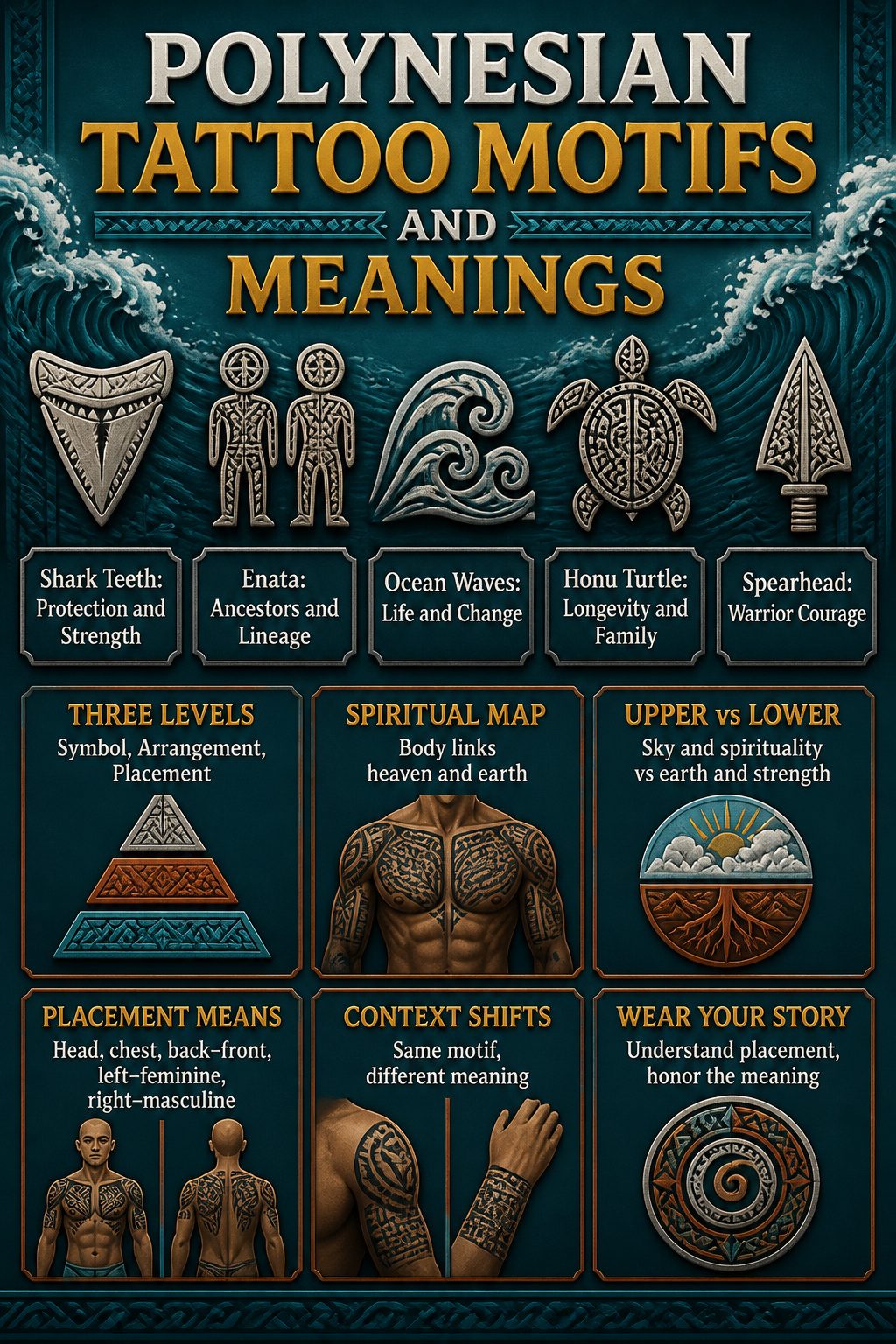
A Polynesian tattoo reads like a language built from the skin up. The vocabulary is made of repeating symbols: shark teeth, or niho mano, carry protection and strength; enata figures stand for people, ancestors, and lineage; ocean waves mark life, change, and journey; the honu turtle signals longevity, family, and navigation. A spearhead speaks to warrior courage, a fish hook to prosperity and safe passage.
Meaning lives at three levels, though, and the symbol alone is only the first. Arrangement matters: which motifs sit beside which, how they flow together, what story that composition tells about heritage and faith. Placement matters just as much. The body is understood as a spiritual map, the link between heaven and earth. Upper body placement, above the navel, ties to spirituality, intellect, and sky; lower body placement grounds the design in earth, physical strength, and life here. The head connects to knowledge and intuition. The chest occupies the space between Rangi and Papa, heaven and earth, so tattoos there balance generosity, honor, and reconciliation. The back carries association with the past, the front with the future. Left side links to feminine energy and intuition; right side to masculine energy and strength.
Where a motif lives reshapes what it says. The same niho mano on a shoulder reads strength and bravery; at the wrist, the meaning shifts. A row of enata wrapping the forearm speaks to ancestry across generations; across the chest, it moves closer to identity itself. This is why copying a design without understanding its placement risks wearing someone else’s story, not your own.
The Tattooing Process
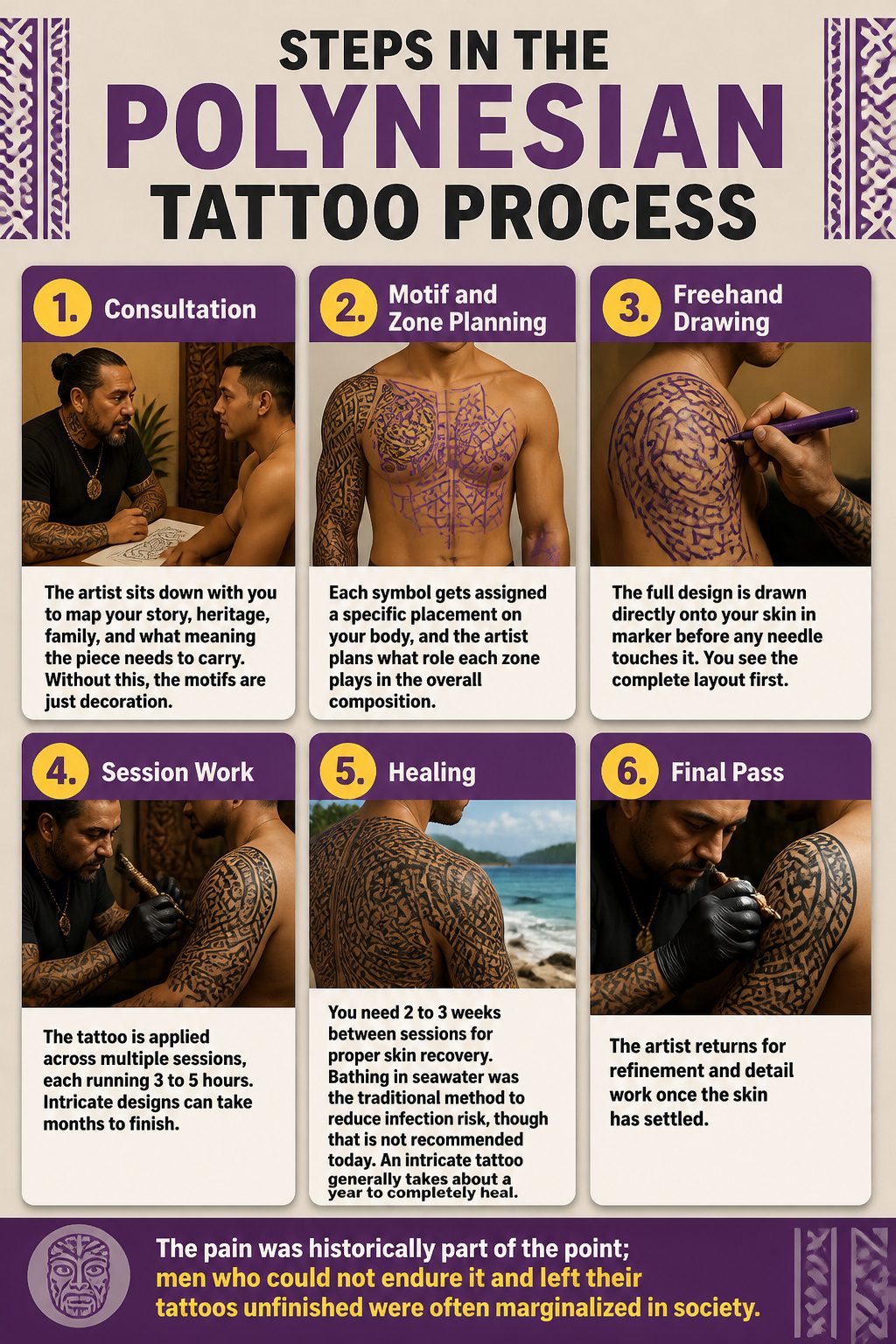
A real Polynesian tattoo builds in six stages, and skipping one is what turns a meaningful piece into generic tribal wallpaper.
1. Consultation. The artist sits down with you to map your story, heritage, family, and what meaning the piece needs to carry. Without this, the motifs are just decoration.
2. Motif and zone planning. Each symbol gets assigned a specific placement on your body, and the artist plans what role each zone plays in the overall composition.
3. Freehand drawing. The full design is drawn directly onto your skin in marker before any needle touches it. You see the complete layout first.
4. Session work. The tattoo is applied across multiple sessions, each running 3 to 5 hours. Intricate designs can take months to finish.
5. Healing. You need 2 to 3 weeks between sessions for proper skin recovery. Bathing in seawater was the traditional method to reduce infection risk, though that is not recommended today. An intricate tattoo generally takes about a year to completely heal.
6. Final pass. The artist returns for refinement and detail work once the skin has settled.
The pain was historically part of the point; men who could not endure it and left their tattoos unfinished were often marginalized in society.
Cultural Significance and Identity
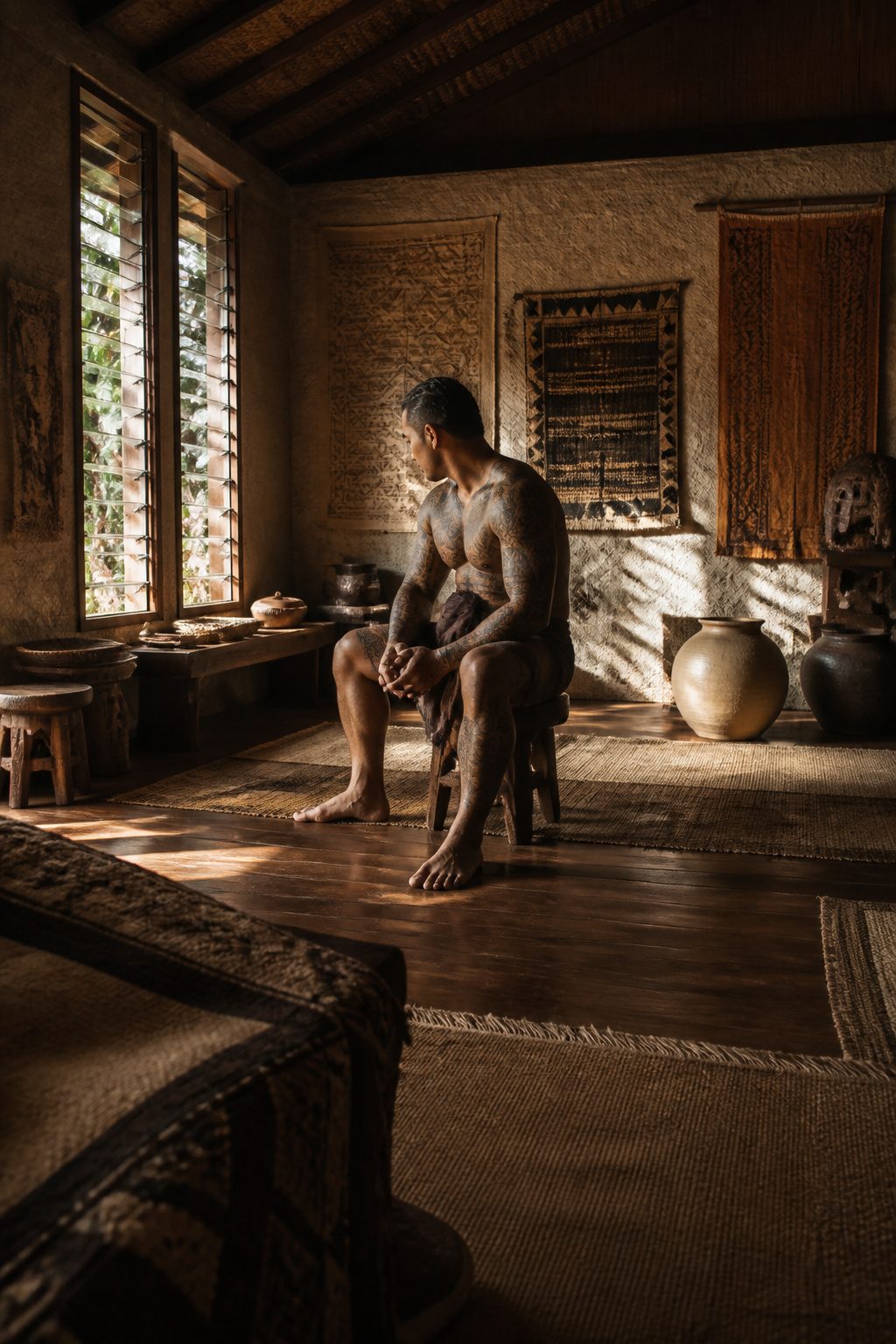
Polynesian tattoos carry meaning that runs deeper than decoration. In ancient times, the body itself served as a living record: tatau marked genealogy, social rank, and the milestones that shaped a life. The practice functioned as identification in a world without written documents, with specific symbols signaling where a person came from and what they had accomplished.
Rites of passage demanded the most extensive work. Samoan tatau still illustrates this clearly: the male pe’a, running from thigh to knee, and the female malu applied to the same region, both require days of hand-tapping with traditional au tools. The pain endured and the permanence assumed marked a permanent change in social standing.
The geographic variation matters as much as the shared tradition. Someone from a mountainous island wore different earth symbols than a person from an atoll where coconut trees dominated the landscape. The peka ‘enana cross, among the most popular Marquesan motifs, depicts the human form with four curving limbs inside a block shape. A dancing flame keeps death at bay; a fiddlehead fern spiral signals new beginnings.
"Traditionally, tatau served as a form of ID or social rank, keeping track of the genealogy of the family, and representing important milestones."
For anyone considering Polynesian work today, this means the patterns are not a style to browse like a catalogue. They are a language tied to specific islands and specific lives. The respect due is not abstract; it is built into the fact that the same design spoken on one island might mean something else, or nothing at all, on another.
Traditional Techniques and Tools
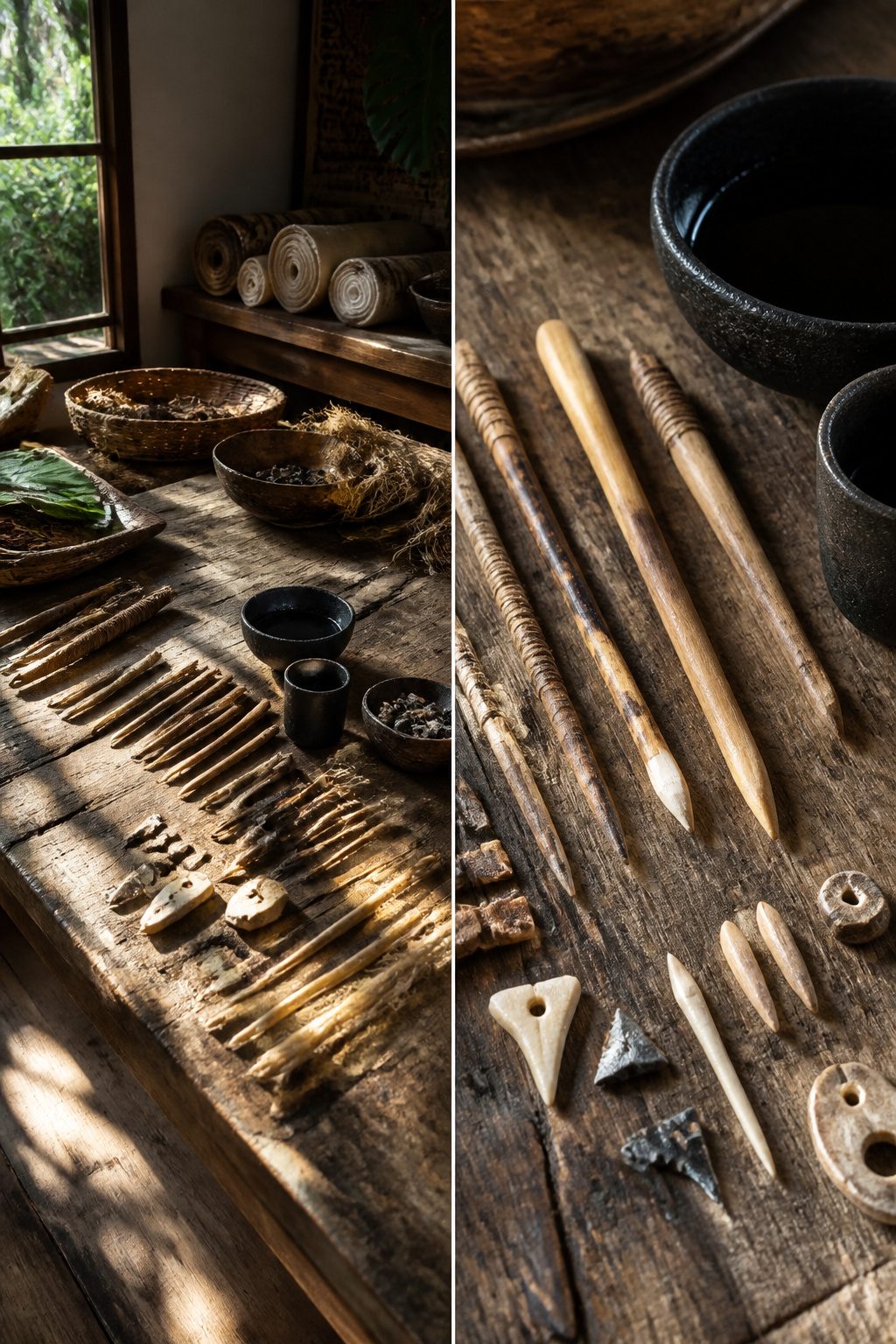
Sharpened bone, turtle ivory, and shark teeth formed the working edge of Polynesian tattooing tools long before metal existed in the islands. Craftsmen lashed these combs to wooden handles and dipped them in ink made from candlenut soot or other natural pigments. The practitioner then tapped the implement rhythmically with a mallet, driving pigment under the skin dot by dot in a technique that could stretch across hours or days for a single large piece.
Modern machine work replaces this entirely. A rotary or coil gun moves a needle bar at thousands of cycles per minute, laying down lines and shading the artist controls through a foot pedal. What took days of tapping now fills in hours, and the blood and plasma pooling on the surface look nothing like the cleaner wound hand-tapping leaves behind. The endurance requirement is the real difference: machine clients sit through discomfort, but the sustained pain of traditional kākau uhi or Samoan tatau, without the numbing speed of modern needles, made the tattoo itself a test of courage and a visible mark that the wearer had earned their place.
History and Resurgence
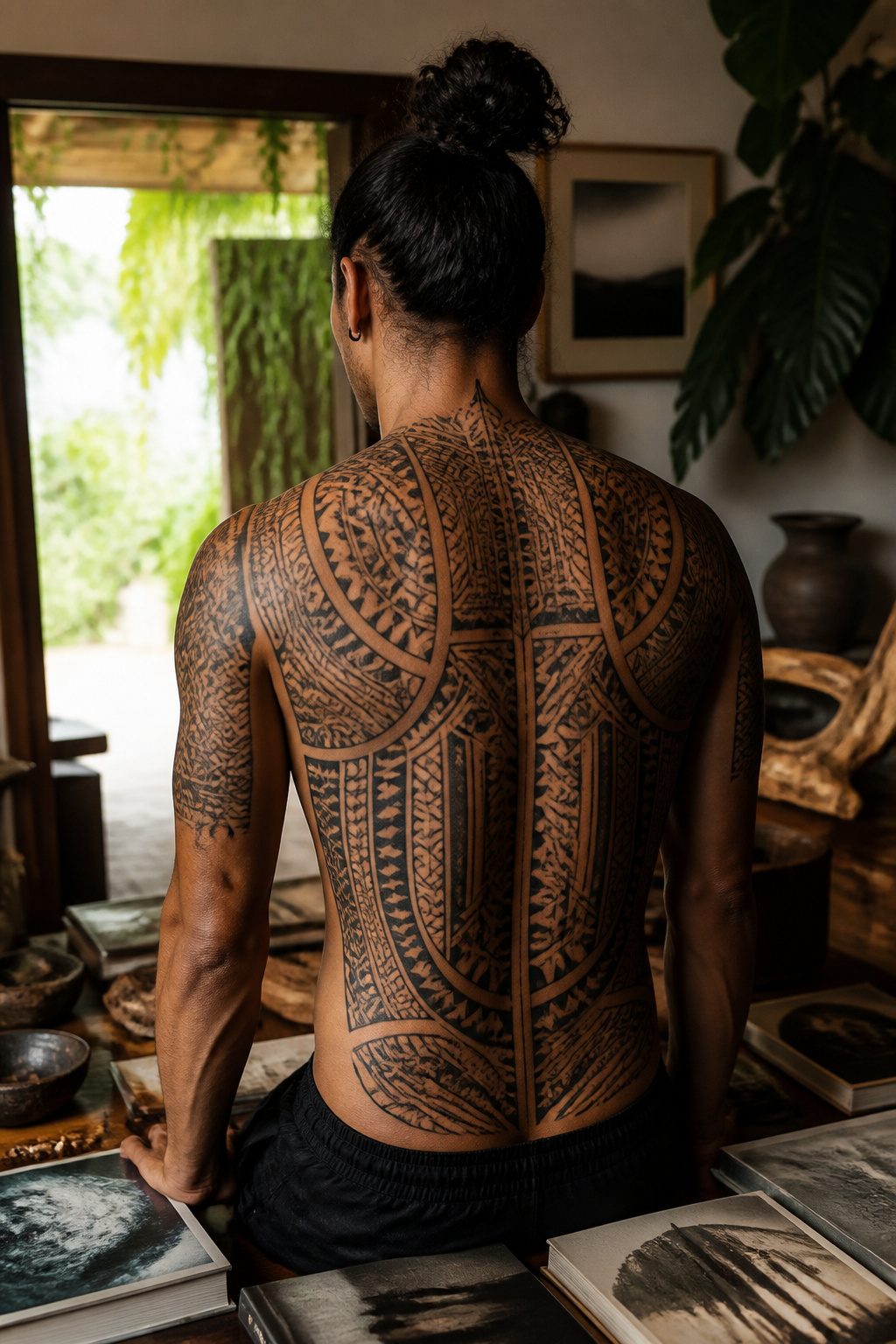
Polynesian tattooing has a documented history stretching back roughly 2,000 years, with designs that functioned as identity markers long before written records existed. The patterns inked across skin indicated island of origin, family lineage, social standing, and occupation, making the tattooed body a kind of living document in cultures without a written word.
Colonial contact brought suppression. Missionaries banned the practice across the Pacific, and tattooing was driven underground or extinguished entirely on some islands. What survived did so in defiance, passed quietly between practitioners and worn as an act of resistance against colonial rule.
The revival picked up speed in recent decades. Hand-tapped methods have returned alongside machine work, with younger generations apprenticing under elders to recover techniques nearly lost. Community programs and international festivals now spread this knowledge beyond the islands, though the tension remains: the same global attention that funds preservation also fuels demand from outsiders who may not grasp what the symbols carry.
Modern Adaptations
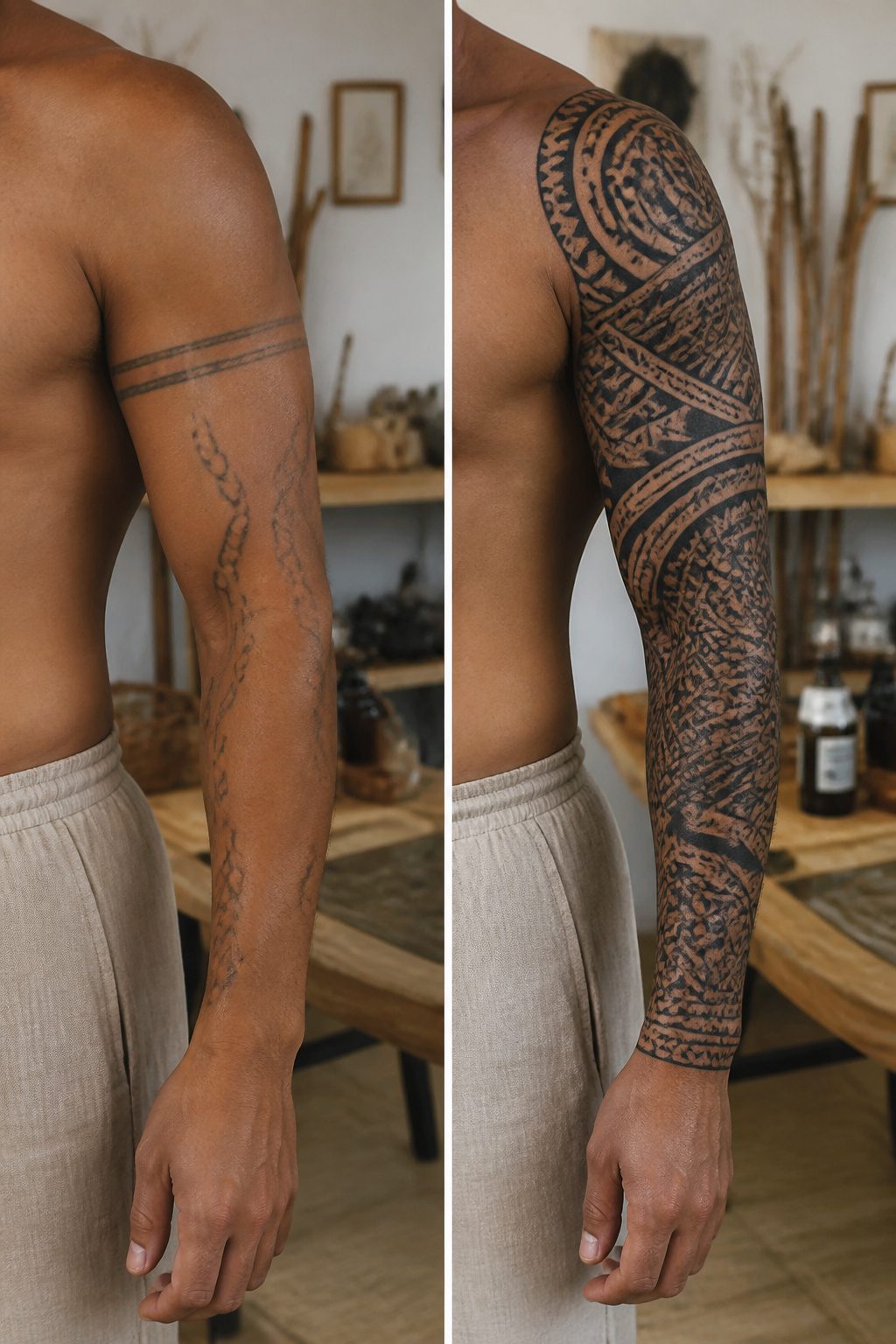
Most Polynesian tattoos today are done with modern machines rather than the bone, wood, and shark-tooth tools used for hand-tapping, though traditional methods still appear in ceremonial contexts in Samoa and among select Hawaiian practitioners. The shift to machines brings precision and hygiene standards that a traditional apprentice system could not guarantee.
The real tension sits between aesthetic appeal and cultural weight. Some clients arrive with Samoan, Tongan, Maori, or Native Hawaiian lineage and want marks that belong to their specific heritage. Others want the visual language without claiming ancestry. Either path demands that the artist understand what each symbol carries. Tribal tattooing holds responsibility for both the person holding the needle and the one wearing it permanently.
Contemporary artists are blending Polynesian motifs with fine line details, black and gray realism, and ocean imagery woven into full sleeves. The result is work that honors tradition while meeting today’s aesthetic standards, though the symbols must still be placed thoughtfully rather than borrowed for pattern alone.
Polynesian tattoo is not one style but a family: Samoan tatau with its dense geometry, Maori tā moko with flowing koru spirals, Marquesan panel-rich density, Hawaiian kakau grounded in lineage and protection, and Tahitian bold silhouettes that gave the English language the word "tattoo" itself. Modern work draws from each tradition while remaining clear about which marks belong to which culture.
Cultural Appropriation and Respect
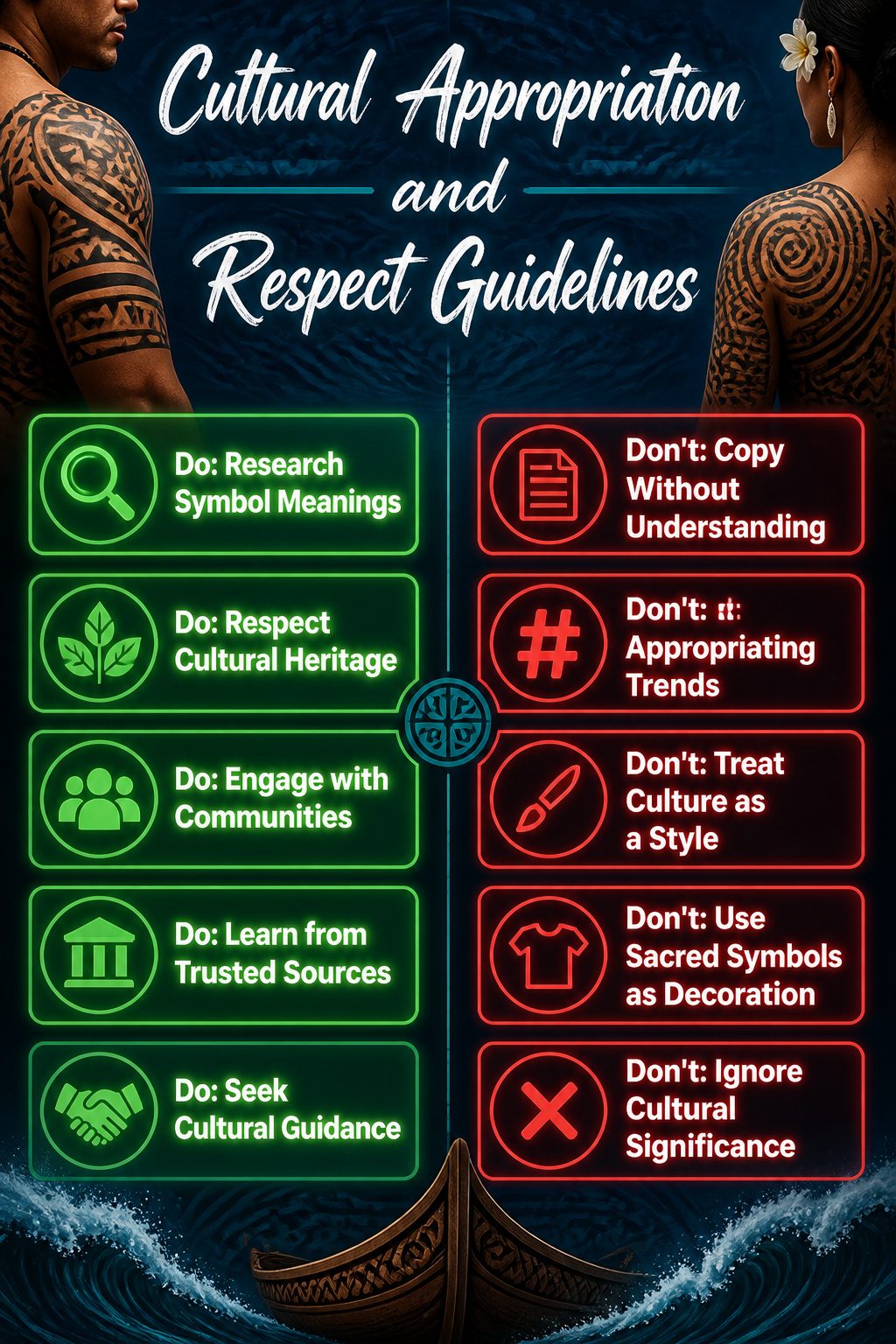
The spread of Polynesian tattoos beyond their native boundaries has sparked real debate about who has the right to wear these designs. Non-Polynesians who get these tattoos without understanding their origins often face criticism for wearing symbols that belong to someone else’s heritage, and that criticism is fair. These are not decorative patterns. They are living cultural practice, tied to lineage, identity, and spiritual belief in communities across Hawaiʻi, Samoa, Tonga, Tahiti, and Aotearoa/New Zealand.
If you are drawn to this art and do not carry Polynesian heritage, the work is on you before the needle touches skin. Research the specific symbols you are considering and what they represent to the people who created them. Find an artist who treats the culture seriously, not as a style to copy. The difference between appreciation and appropriation sits in that preparation, and in whether you approach the tradition with genuine respect or because you saw it trending. Visiting museums, reading books on Polynesian history, and engaging with cultural centers that preserve these practices will tell you quickly whether this commitment is real.
Frequently Asked Questions
What is the significance of Polynesian tattoos?
Polynesian tattoos served as living records of identity, social rank, and genealogy in cultures without written documents. The body functioned as a spiritual map where placement above or below the navel, on the head, chest, or back, reshaped what each motif communicated about the wearer’s heritage and place in the world.
How do I choose a Polynesian tattoo design?
Start with a consultation where the artist maps your story, family background, and what meaning the piece needs to carry. The design is then drawn freehand directly onto your skin before any needle touches it, shaped around your specific narrative rather than copied from an existing piece.
What are the different styles of Polynesian tattoos?
The five main styles are Maori tā moko with flowing koru spirals and deliberate negative space; Marquesan with the densest geometric panels and large black blocks; Samoan tatau with strict rectilinear symmetry and architectural repetition; Tahitian with bold silhouettes, rounded elements, and the most flexible modern adaptation; and Hawaiian kākau built on stacked geometric units marking lineage and protection.
How painful is getting a Polynesian tattoo?
Traditional hand-tapped methods demand serious endurance, with the sustained pain itself serving as a test of courage and a visible mark of earned status. Modern machine work is faster and less grueling, though intricate designs still require multiple sessions of 3 to 5 hours each across months of healing.
Can non-Polynesians get Polynesian tattoos?
Yes, but only with genuine preparation and respect. Research the specific symbols and their origins, find an artist who treats the culture seriously rather than copying patterns for aesthetic effect, and understand that certain ritual marks like the Samoan pe’a and malu or Maori facial moko remain reserved for those with heritage. The line between appreciation and appropriation sits in whether you do the work before the appointment.