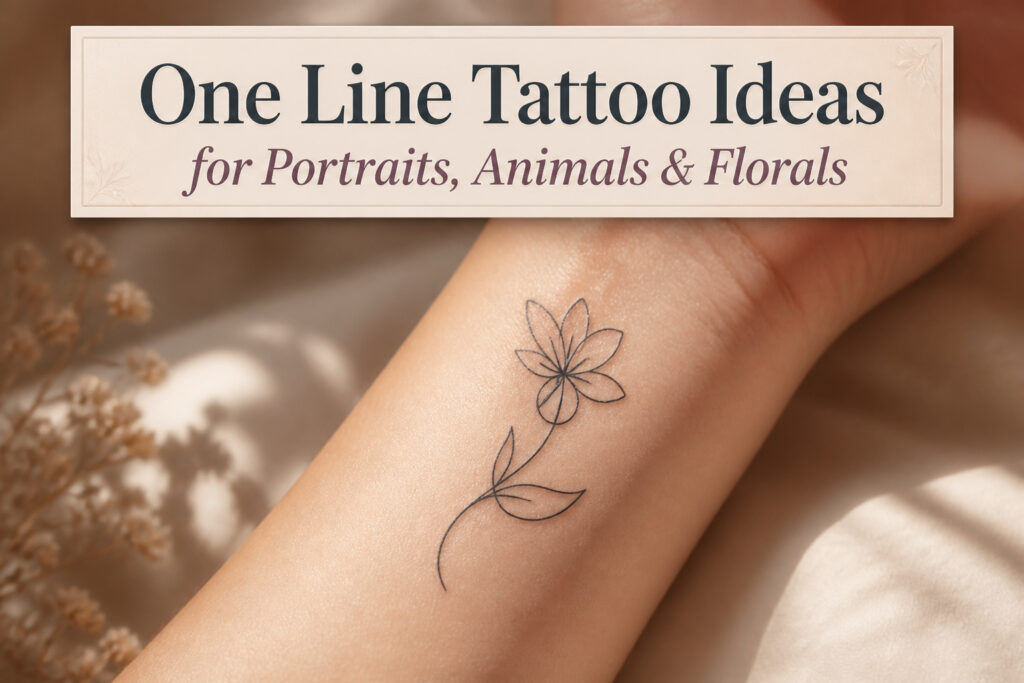
The span runs from a 45-minute wrist mark to a 3-hour portrait, and the single deciding factor is how much you trust a single stroke to carry meaning without any safety net of shading or stops.
The catch is that the needle never lifts: one waver at a jawline or a joint, and the whole likeness collapses.
Most artists who list fine-line work have never trained the specific coordination this demands, so healed one-line pieces in a portfolio matter more than fresh ones.
1. One Line Portraits
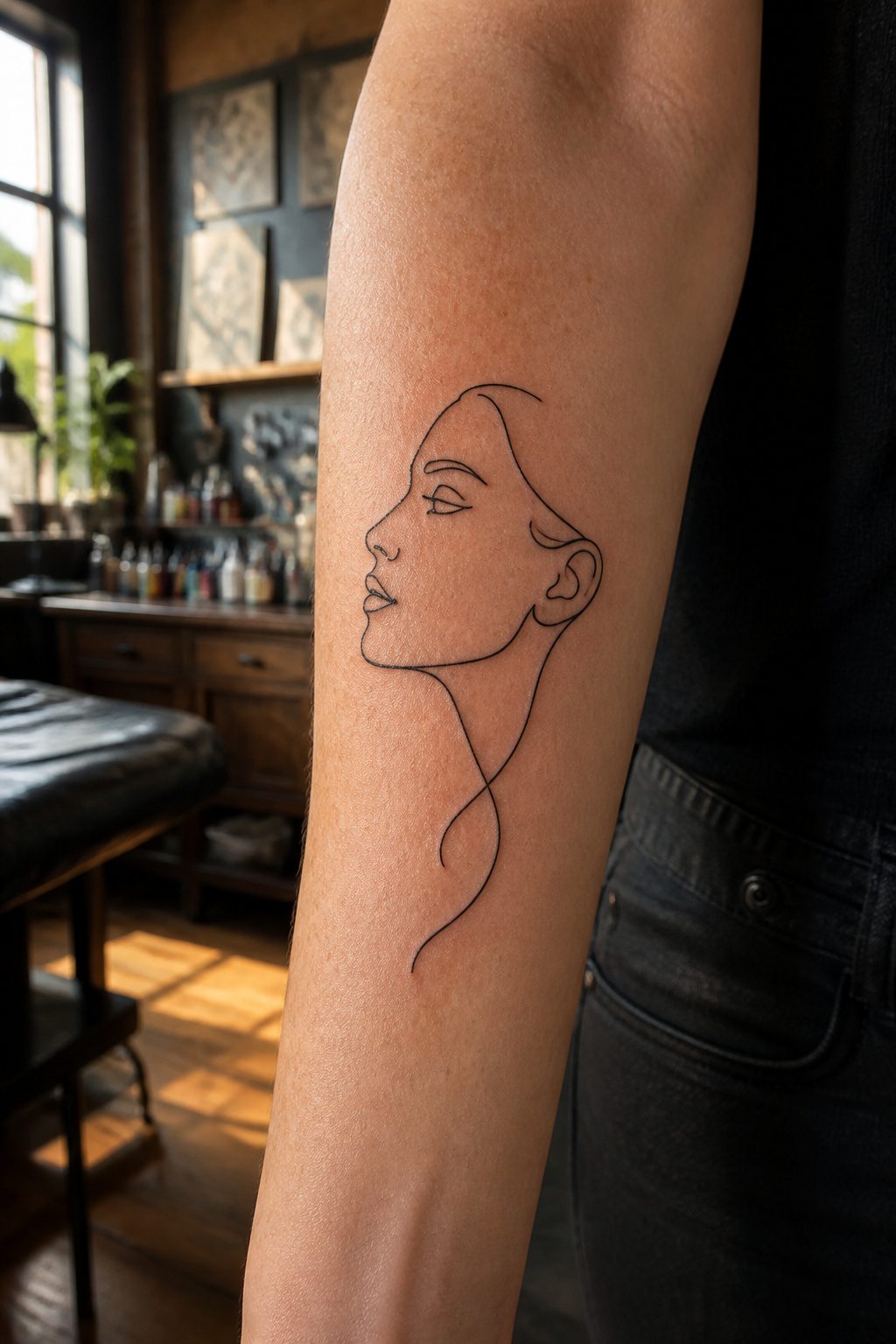
A single line portrait lives or dies by the jawline.
The artist never lifts the needle, so that one continuous curve has to carry the whole likeness: the angle where chin meets neck, the slight hollow beneath the cheekbone, the turn into the ear.
Get the jaw wrong and the face collapses into a generic oval. Get it right and two dots for eyes read instantly as that person.
Profile work is the natural starting point. The nose, lips, and forehead stack in one direction, so the line flows without doubling back on itself.
Full figures demand more; the hand at a partner’s nape, the drape of a shoulder, these have to merge into the same stroke without the eye losing its place.
Small pieces run 1–2 hours, while complex compositions stretch to 3, still shorter than shaded work at the same size because the needle makes fewer passes.
The readable face at this scale needs restraint. Every feature competes for the same thin ink, so most artists let the jawline do the structural work and suggest eyes and mouth with the lightest pressure change.
The result is less a drawn face than the idea of one, completed by the viewer’s own pattern-matching. That collaboration between needle and eye is what makes the form work.
2. One Line Animals
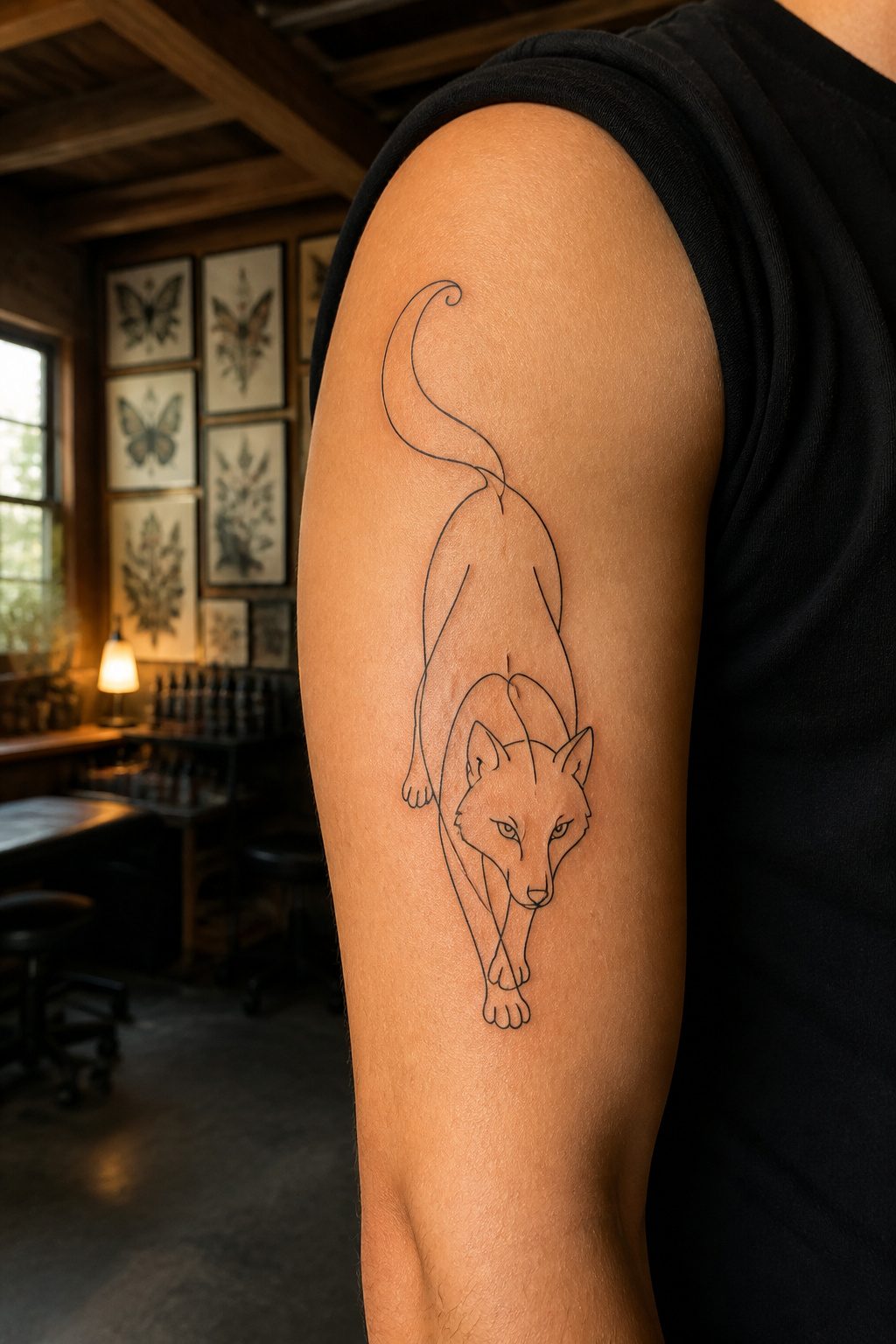
Wolves, cats, birds, and deer dominate search volume for one line animals, and the reason is practical: each has a silhouette the eye fills in automatically.
A wolf’s raised tail and forward ears need no interior detail to register as predator; a sleeping cat’s single curved spine says the whole thing.
The ear and eye placement are where artists leave deliberate gaps in the line, letting negative space do the work. A bird in flight reads clearest when the wing’s trailing edge is suggested by where the line simply stops.
The best small-scale pieces, under two inches, stick to animals with long necks or extended limbs that stretch the continuous stroke naturally. Deer excel here; their legs and antlers give the line room to breathe without crowding.
Joints are where the technique gets subtle: most artists thicken the stroke slightly at knees and shoulders, just enough to suggest bone underneath without breaking the single-line rule.
A rearing horse or leaping cat carries that same logic through the body, weight shifting from thin to thick and back again in one pass.
Sessions run shorter than shaded work, typically 1 to 2 hours for a small piece, but the precision is unforgiving. One waver at a joint and the whole gesture collapses.
3. One Line Florals
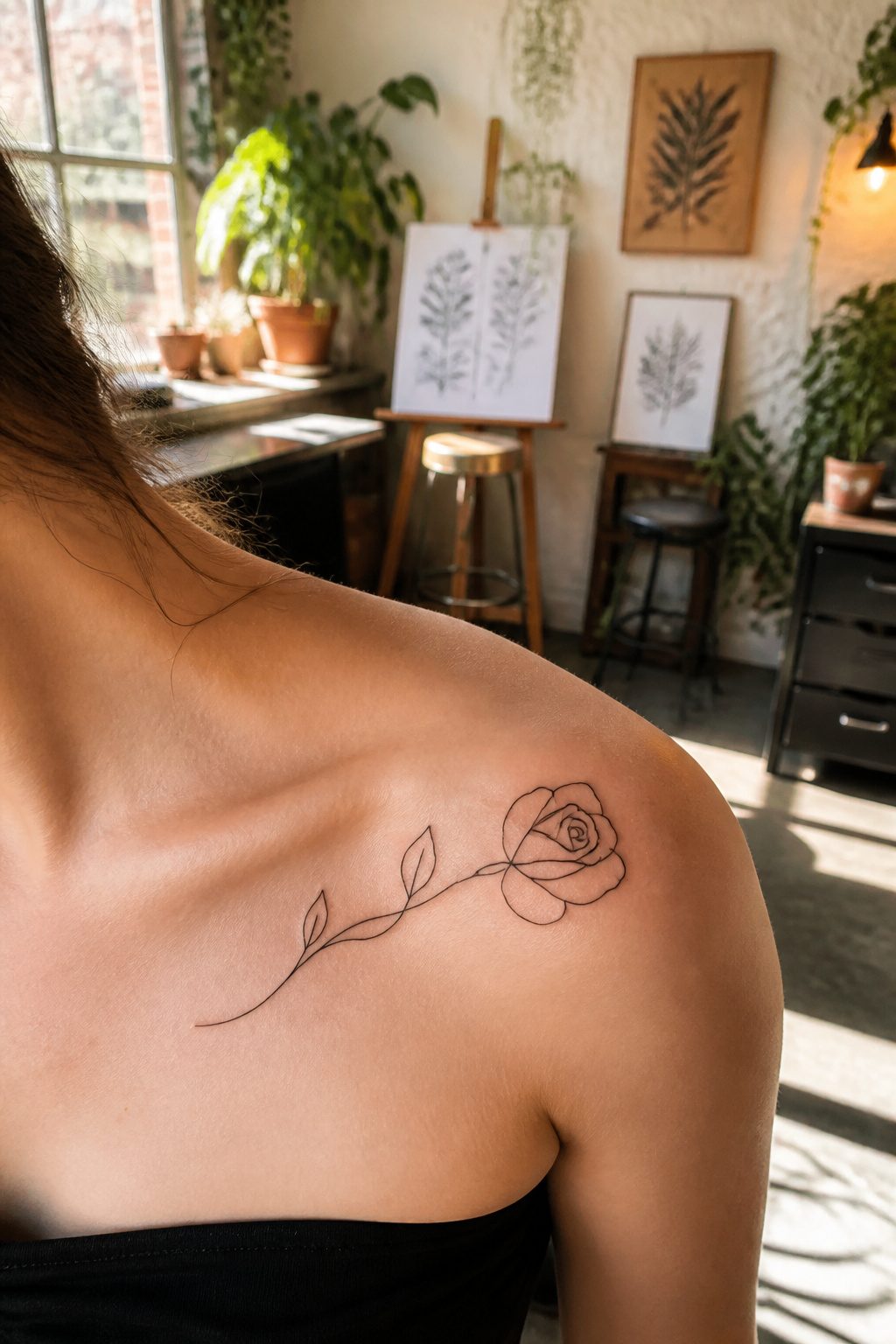
A real rose growing in a garden never opens symmetrically, and the best one line tattoo ideas for florals lean into that unevenness.
The stem curves, the petals overlap at odd intervals, and the line loops back on itself to suggest depth without ever lifting the needle.
Roses, peonies, and wildflowers all work with this constraint. The continuous line technique gives each bloom a gestural quality, more botanical sketch than botanical illustration.
Placement changes how the design reads. A wrist piece wraps slightly with the natural bend of the arm.
Collarbone placements sit flatter, the line tracing the bone like a horizon. Ankle designs stay small and vertical, either standing alone above the bone or wrapping just enough to catch from two angles.
The appeal is in the imperfection. A petal that droops lower than its neighbor, a stem that kinks where a real stem would kink, that is what keeps the design from looking like clip art transferred to skin.
4. One Line Abstracts
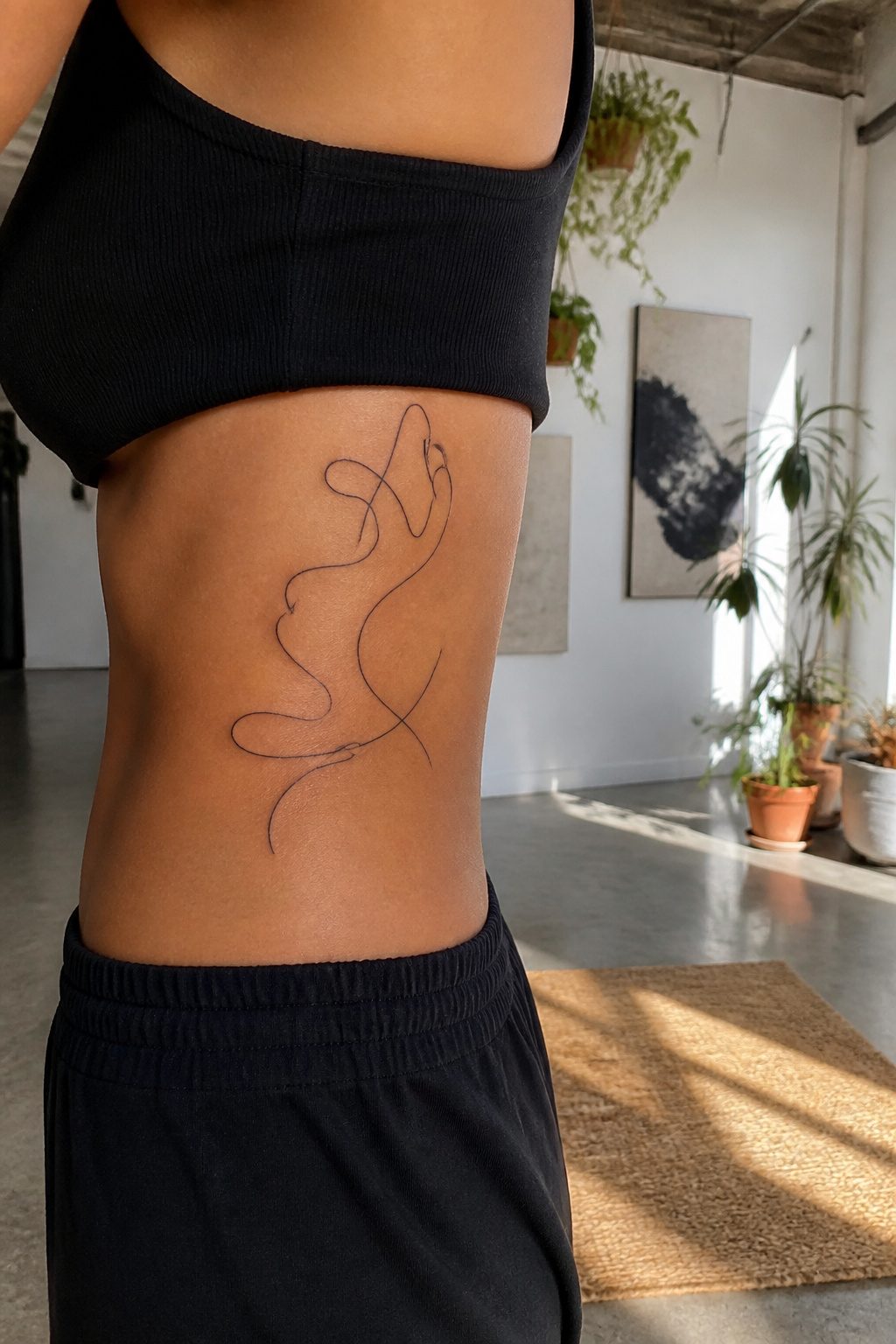
A single continuous stroke can carry the energy of a gesture without ever resolving into a recognizable shape, and that ambiguity is exactly why abstract one line tattoos hold up over years.
The rhythm does the work: a tight spiral that suddenly opens into a long, unhurried run, or a fast curve arrested by a single slow loop.
These pieces are essentially gestural drawings made permanent, carrying the artist’s mark in its purest form.
The meaning stays private because there is no literal subject to read. A spiral might register as sound to the person wearing it and as motion to someone else, and neither reading is wrong.
That openness is the point. What changes is the pace of the line itself; the contrast between quick, nervous marks and calm, extended ones creates the emotional register without needing a symbol to anchor it.
The constraint of one continuous stroke is what makes this difficult. One break in flow turns the piece into something else, so the artist has to balance boldness and finesse across the entire design.
The best abstract one line work comes from collaboration: you bring the feeling, the artist maps the rhythm, and the final piece stays interpretable only to you.
5. One Line Landscapes
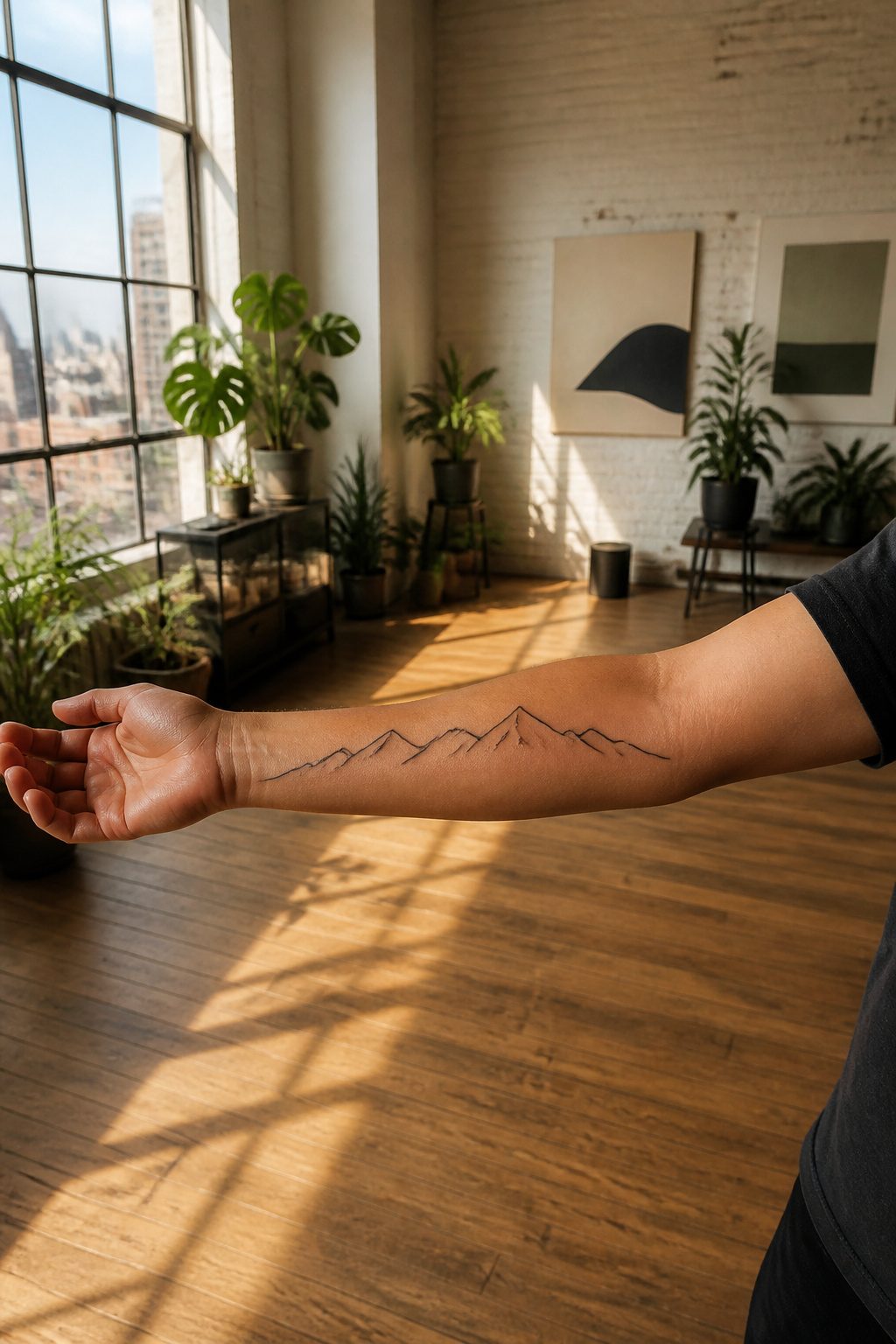
A horizon drawn in one unbroken stroke reads as distance because the eye fills in what the line leaves out.
Mountains work the same way: a single ridge that rises, flattens, and rises again can stand for three peaks or one long slope depending on how the artist spaces the angles.
Seascapes compress even more, a wobble between two steady borders suggesting waves without ever drawing water.
These pieces need room. The sweep of a forearm or the long plane of the ribs gives the line enough travel to build that illusion of depth.
Wrists and ankles crowd the composition; the eye has no space to complete the picture, so the mountains flatten into a squiggle.
After watching a few of these age, the ones that held up were always the larger ones where the artist varied pressure, thickening the line at the base and fading it toward the peak like a distant ridge catching less light.
My own preference runs to rib placement, where the curve of the body echoes the curve of the land.
6. One Line Geometrics
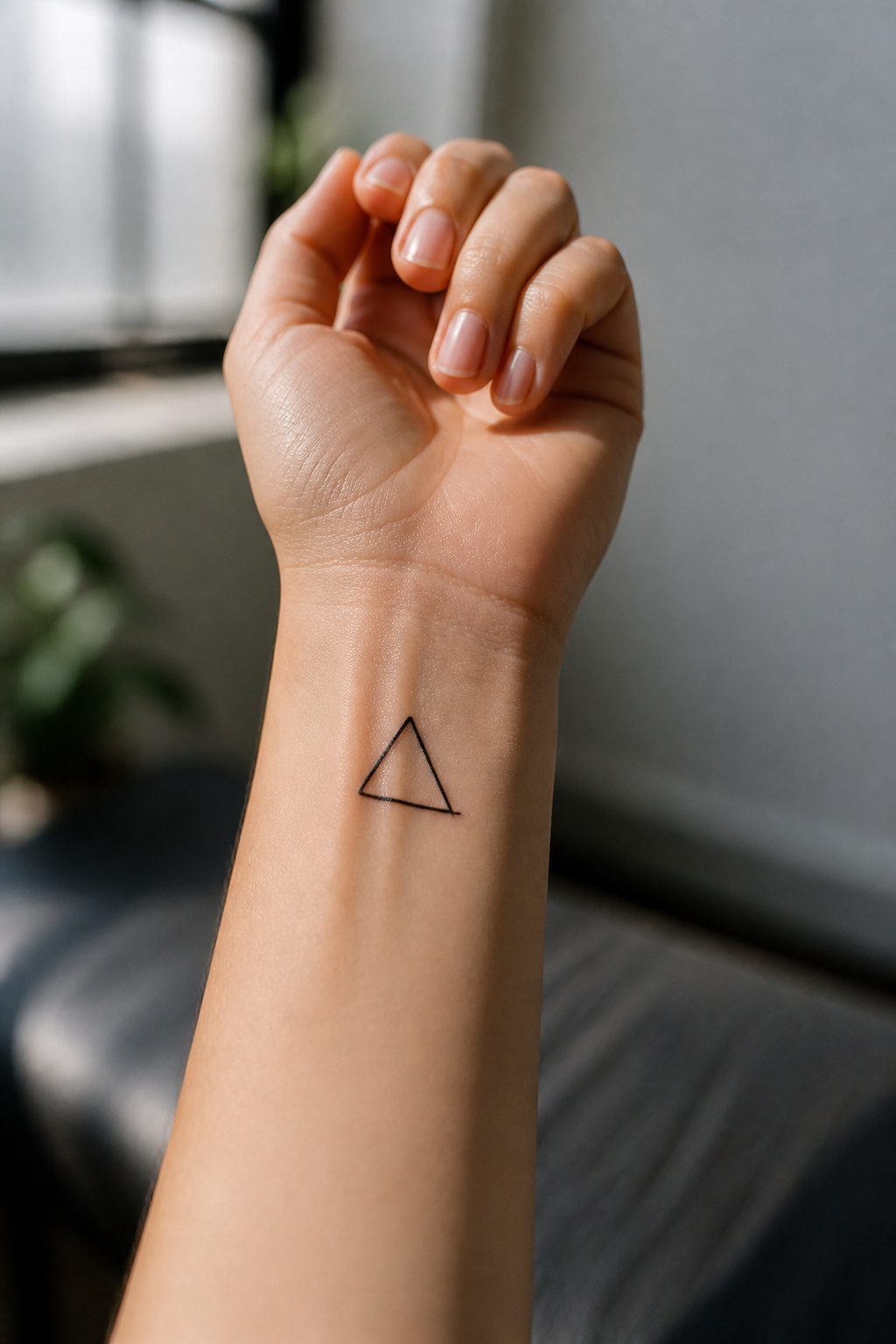
A perfect circle in one unbroken mark is the kind of challenge that separates an experienced hand from a steady one.
The line has nowhere to hide; any waver in skin tension or breathing shows up as a slight oval or a flattened edge.
That slight imperfection becomes part of the character, though, and most people who choose these one line tattoo ideas for a circle or triangle want exactly that: proof a human held the tool, not a plotter.
Impossible shapes, the Penrose triangle or an endless loop, work the same way. The brain reads the geometry first and only later notices the line never lifted.
Behind the ear, the curve of the skull turns a simple circle into something that seems to orbit the bone. The inner wrist gives less room but more visibility; a triangle there points with the arm’s natural line.
Placement matters for longevity as much as for looks. The back of the ear and inner wrist see less friction than fingers or feet, where fine lines blur fastest.
A geometric one line tattoo in either spot, kept out of direct sun with high-SPF lotion, holds its edge longer than the same design on an ankle that rubs against boots daily.
7. Minimalist Marks
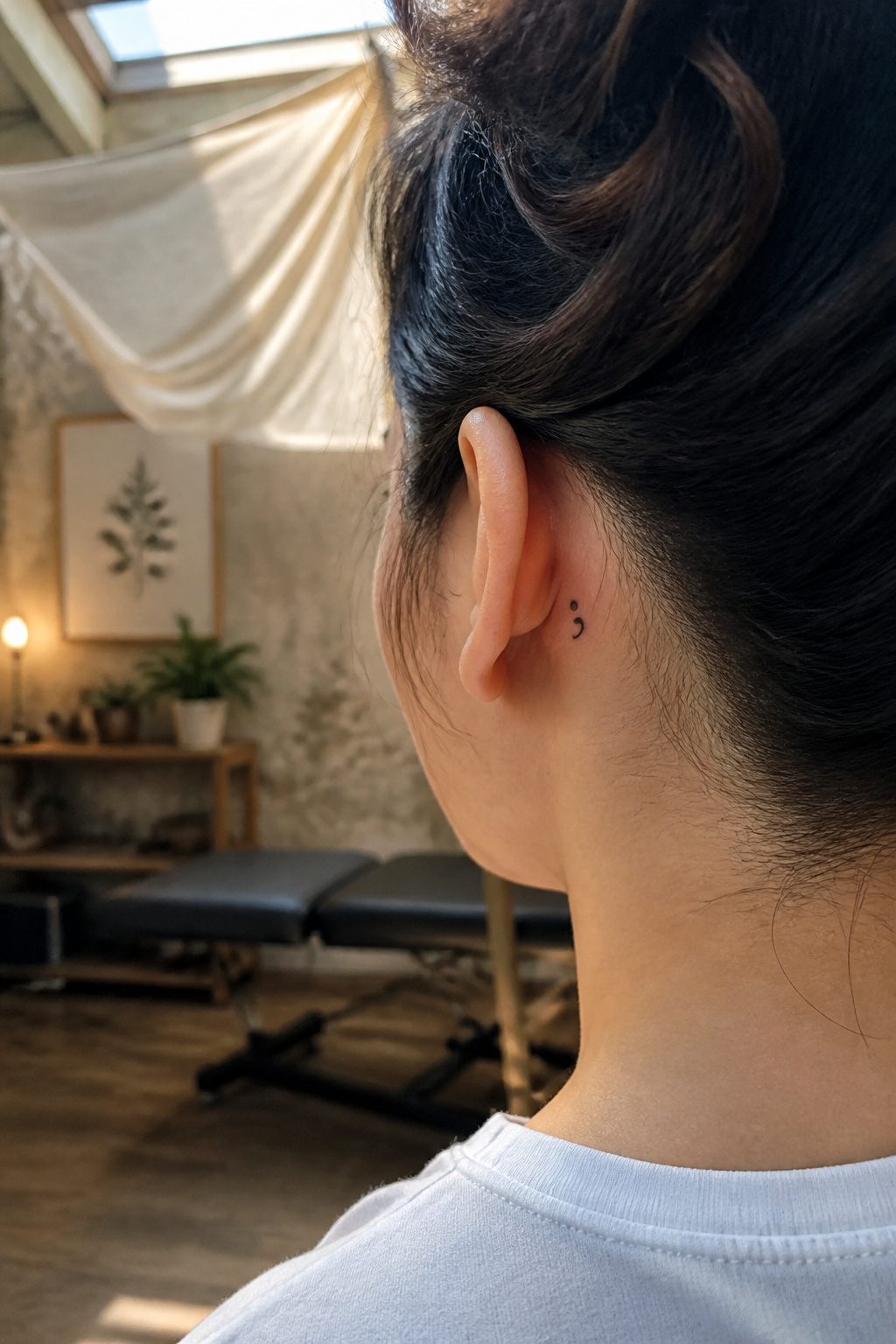
A single comma-shaped mark behind the ear, a short arc tracing the collarbone, a wave no longer than a thumb: these are the smallest possible gestures in one line tattoo ideas, and they carry more weight than their size suggests.
Most sit under 2 inches, finished sometimes in under an hour, and the discipline is in stopping before the line becomes a drawing.
The constraint of a single unbroken mark makes every decision visible. Add a second curve to suggest an eye, and the piece shifts from abstract to portrait.
Leave it as one clean sweep, and the viewer supplies the rest. I have watched artists argue with clients over this threshold, the client wanting "just a little more detail," the artist knowing the reduction is the point.
Abstract marks carry visual energy without depicting anything specific; they are gestural drawings made permanent. The energy lives in the imperfection of the hand, not in the recognition of a subject.
A line that wobbles slightly at its end, where the needle lifted, records the moment of decision better than any planned symmetry could.
The cost runs lower than representational work because the time is shorter, but the real economy is in commitment. A 45-minute piece on the wrist line asks less of your future self than a sleeve that took six sessions.
The question is whether you trust a single mark to mean enough, or whether the silence needs filling.
8. Hearts, Infinity Signs, and Simple Symbols
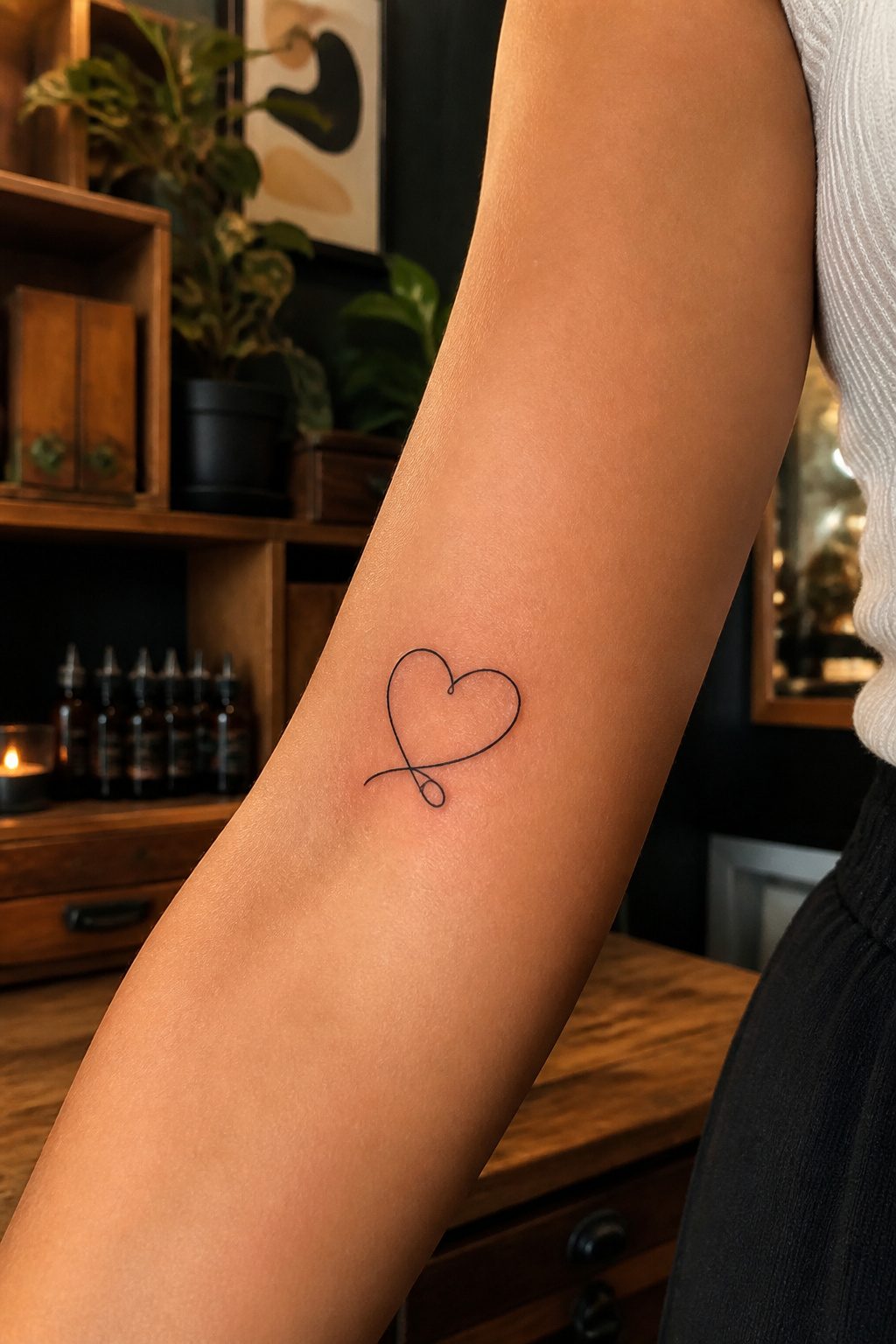
A heart drawn in one continuous line looks nothing like the grade-school icon. The familiar two-lobed shape collapses into a single loop that resolves only at the last stroke, and that surprise of recognition is what makes it work.
The same goes for infinity signs, arrows, and anchors: the symbol has to be earned by the line, not traced from memory.
Clients return to these icons precisely because they are worn smooth by overuse. A single line strips away the clip-art quality and reclaims the meaning underneath.
I have watched people sit with flash books for twenty minutes, dismiss every original drawing, and light up at a one-line heart no larger than a nickel. The familiarity is the point; the restraint is what saves it.
The template look is the risk. Artists vary the weight of the stroke, let the line wander slightly off-axis, or break the symmetry so the heart leans like handwriting rather than signage.
Some tuck the infinity sign into a figure-eight of vine or rope so the symbol only reveals itself once you follow the path twice.
The best ones keep the line so light it almost lifts off the skin, trusting the viewer to complete the shape from habit while the body does something new with it.
9. Initials, Dates, and Personal Marks
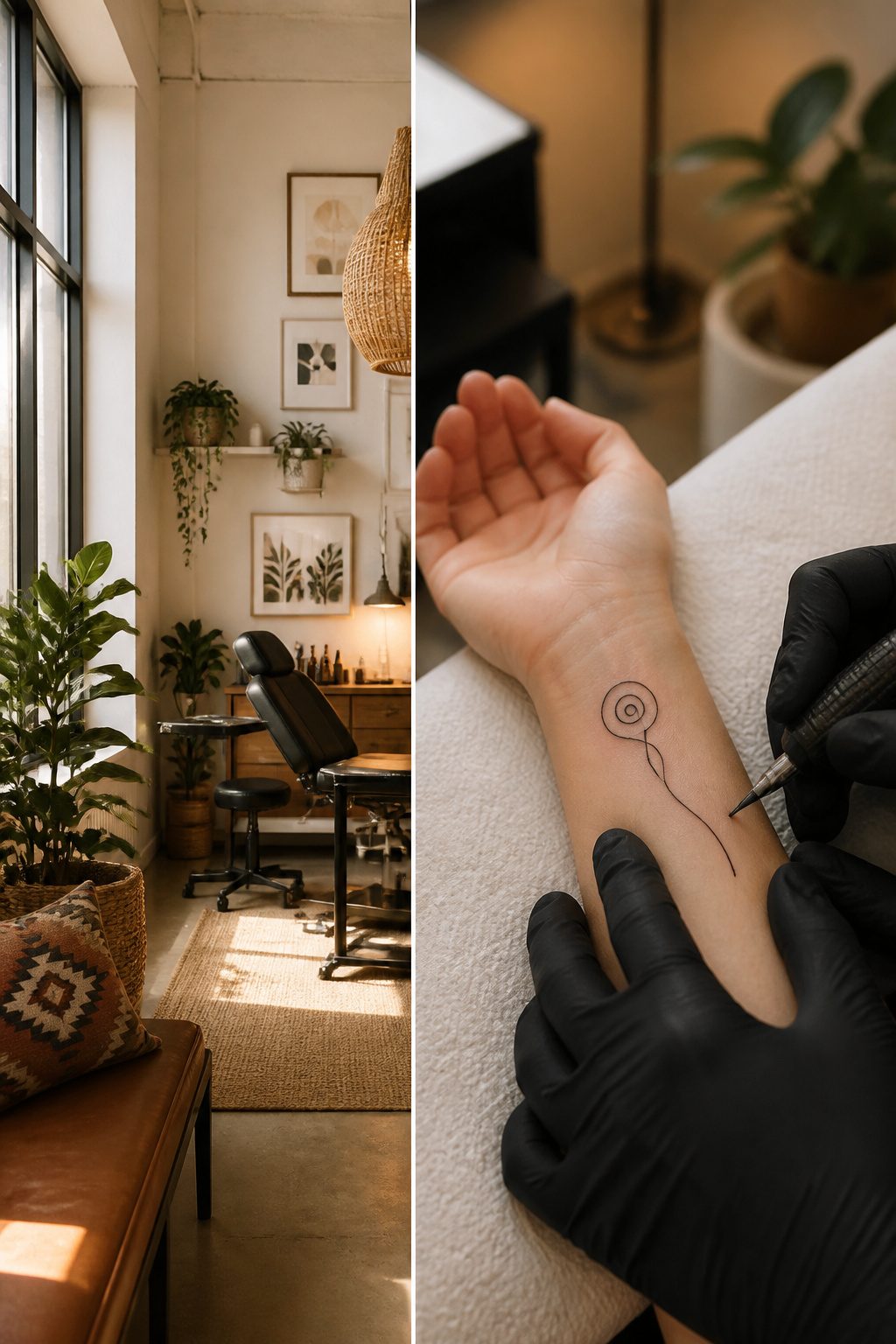
A child’s birth date drawn as a continuous spiral reads like a private orbit rather than a calendar entry.
The line curls inward, marks the day, and curls back out, and the person who sees it daily knows what it means while a stranger sees only geometry.
That gap between public and private is the whole point of a personal mark.
The consultation for this kind of work runs thinner than you’d expect. Bring the date, the initials, the symbol, and one story about why it matters.
The artist does not need your life history. What they need is enough to know whether the line should loop, tighten, or break deliberately at one point.
A wedding date rendered in the partner’s handwriting needs different spacing than the same numbers in a typeface.
The artist will test three, maybe four weights of line before settling on the one that carries the information without turning into a barcode.
I have watched consultations where the client brought seventeen reference images and left with a single letter. I have watched others where one sentence about a grandmother’s signature produced the entire design.
The second kind goes faster and ages better. The more the design depends on explanation, the less it works as a tattoo.
A personal mark should still read as beautiful to someone who knows nothing, even if the meaning stays locked.
What One Line Tattoos Mean
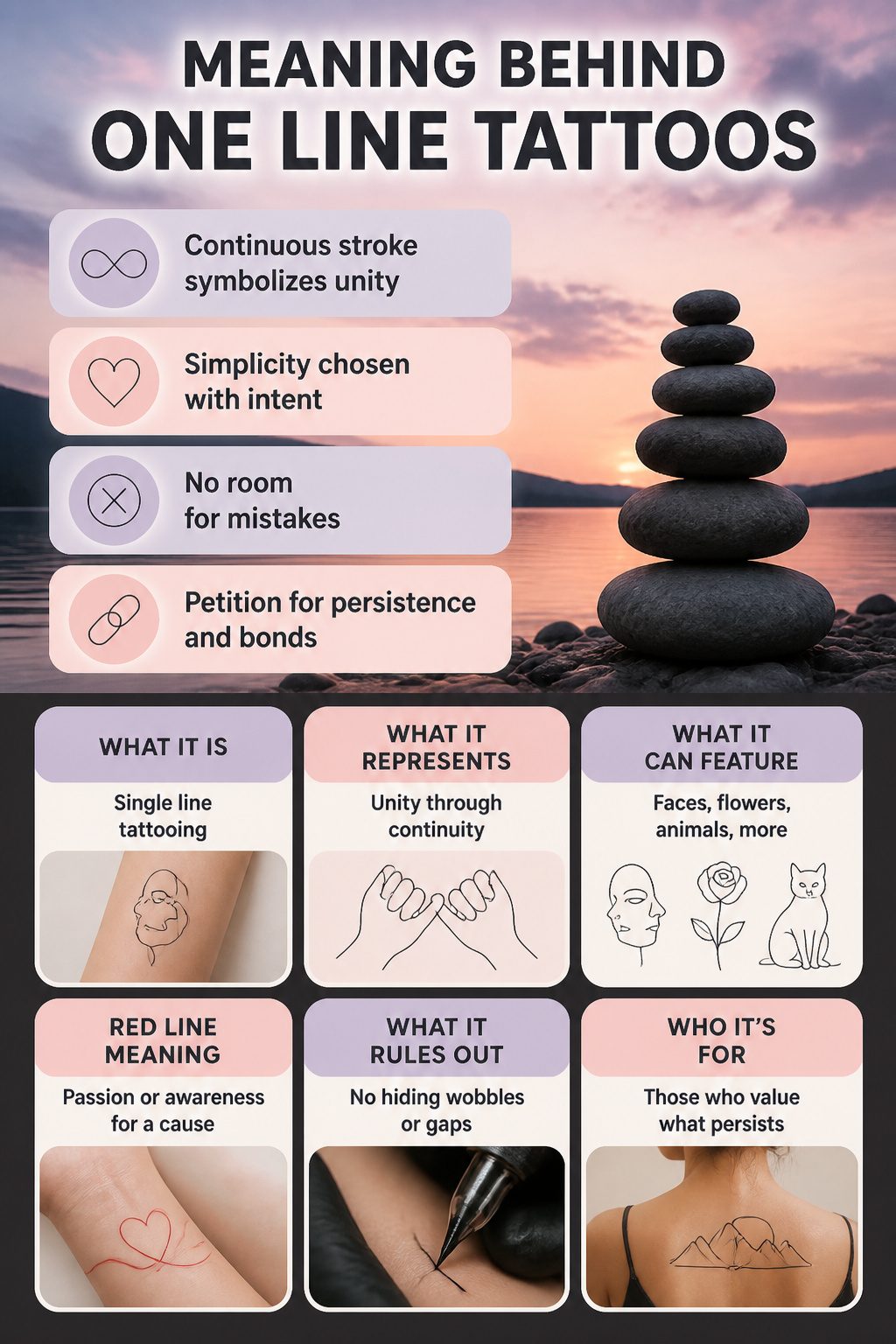
The meaning of a one line tattoo sits in the technique itself more than any fixed symbol. A single continuous stroke, never lifted from the skin, carries its own quiet statement: simplicity chosen on purpose, not arrived at by accident.
That unbroken path reads as continuity, and most people who sit for these designs come in already thinking of something that persists, a bond or a thread through difficulty that does not snap.
Artists working in this style call it single line or fine line tattooing, and the names matter less than the constraint. One line leaves no room to hide a wobble or a gap.
What survives in the final image is only what the eye truly needs to recognize a face, a flower, a spine of an animal. The wearer decides the rest.
Unity, an unbroken connection to someone or to some version of themselves, surfaces again and again in the reasons people give.
A red line shifts the tone toward passion or awareness for a cause, but the form stays the same: one path, start to finish, no retreat.
Where to Place Them
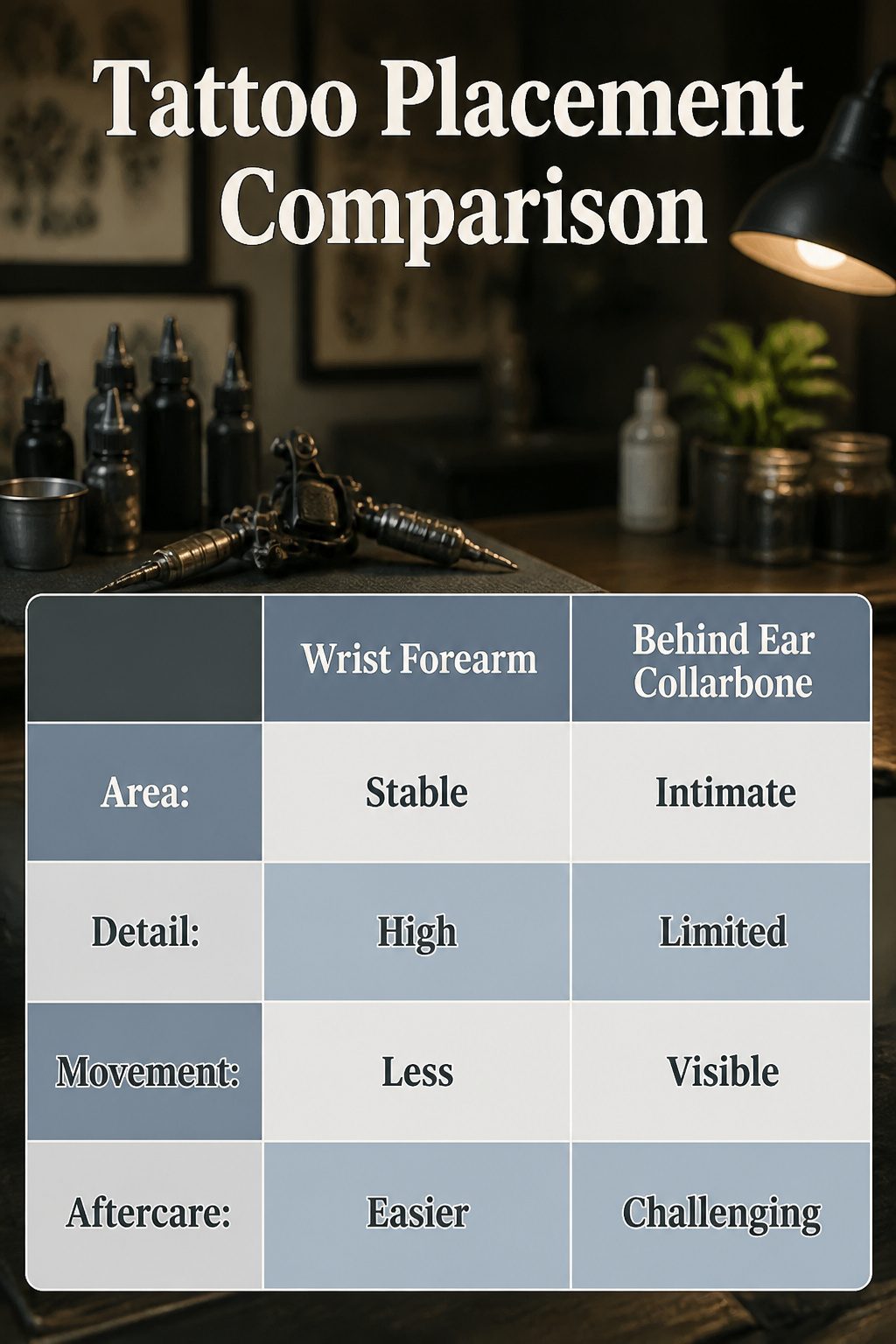
Wrist and inner forearm remain the most requested spots for single line work, and the reason is practical as much as aesthetic.
The surface is relatively flat, the skin stays stable through most daily movement, and a portrait or animal piece there reads cleanly at conversational distance.
That same stability matters less for bold traditional tattoos; thick lines hold their shape even across joints and stretching skin, but a single needle line at a millimeter wide can wander or blur where the body moves most.
Behind the ear and along the collarbone offer the intimacy people want from this style, though both come with tradeoffs.
The space behind the ear allows only a very small composition, and the collarbone, while elegant as a horizontal flow, sits on skin that shifts visibly with shoulder and neck motion.
Ankle pieces follow the same logic: subtle, easily covered, and limited by how much detail can survive on an area that sees friction from socks and shoes.
The ribs and upper back have room but rarely get chosen. Rib skin expands and contracts dramatically with breath; a line that looks straight standing still can distort completely in certain poses.
Upper back movement is less extreme, but the area is harder to reach for aftercare, and sunscreen application, which matters for longevity, tends to get skipped.
Tighter, less stretched skin keeps fine lines crisp longer, which is why forearm and bicep placements outlast flashier locations despite being more conventional.
How the Artist Works
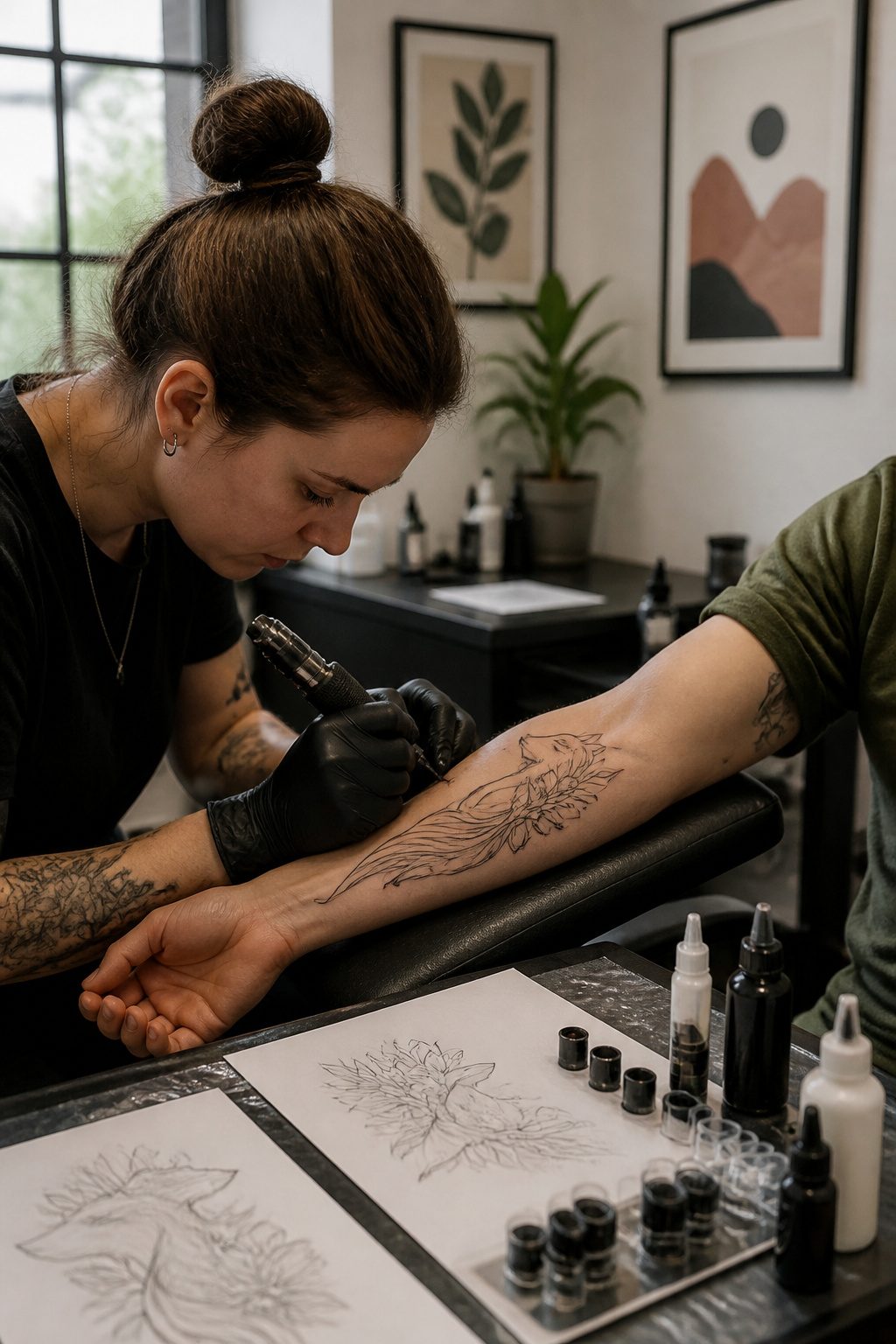
A single line tattoo is executed in one unbroken mark: the needle never lifts from the skin until the image is complete. That constraint is radical, and the results, when a skilled artist is holding the machine, are extraordinary.
The hand has to maintain identical pressure and speed for hours, because a single waver becomes a permanent kink in the portrait, the animal, the stem.
Experienced artists read the vibration of the skin and correct in real time, slowing the stroke or tightening the stretch without breaking the flow.
Where the line begins and where it ends matters as much as what happens between them.
The join has to hide inside a natural fold: the dark of an eye, the crook of a petal, a shadow the design already claims. If the eye catches the seam, the illusion of effortless continuity collapses.
Not every fine-line artist takes one-line work, and the distinction matters. Single needle refers to the tool, a single needle grouping for precise, delicate ink application.
Single line is a compositional approach, an image defined by one continuous mark regardless of needle count.
Many artists who excel at fine-line technique have never trained the particular coordination this style demands, and others simply prefer the safety of stops and starts.
Ask whether they have healed one-line work in their portfolio, not just fresh photos, and whether they choose the start point before the session or adapt it to your specific skin tension that day.
Keeping the Line Clean
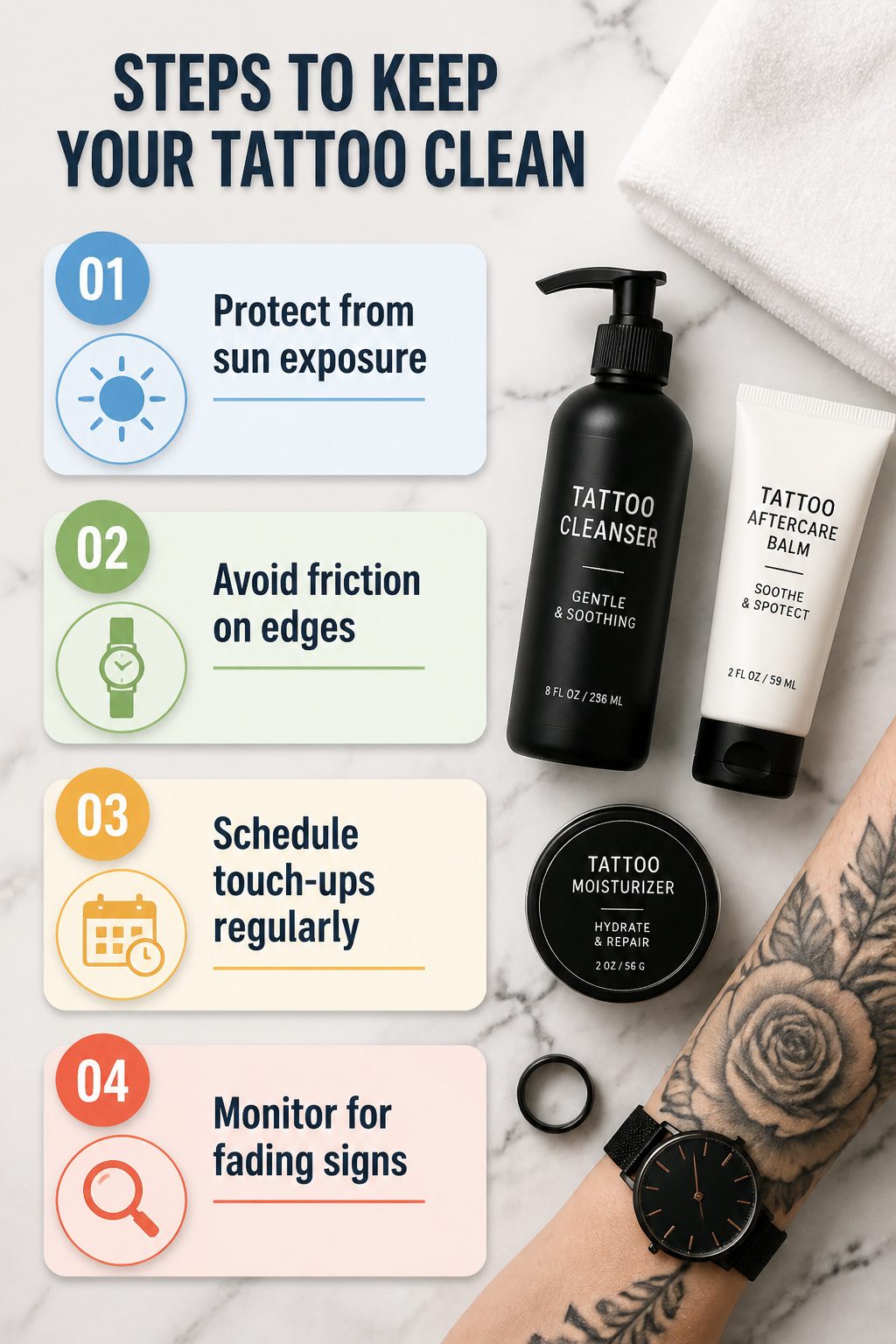
Fine line ink sits closer to the surface than traditional work, so the sun hits it harder and the body sheds it faster.
A single summer of unprotected afternoons can push a crisp portrait into something that reads like a blunt pencil drawing instead of a sharp one, and that comparison matters because it is exactly how a ten- to fifteen-year-old one line tattoo will look if you are not deliberate now.
Friction does the rest. Collar lines, watch bands, and rings wear the edges down months before the pigment actually fades, so placement is part of aftercare in a way it is not for thicker pieces.
The ankle line from a bracelet rubbing against it? That blurs before the color drops.
Touch-ups come sooner than you would expect with bolder work.
Most artists I have spoken with book the first refresh around the two-year mark for fine lines, sometimes earlier if the design sits on a high-wear zone like the hand or elbow where skin turnover is aggressive.
A healed line that is holding well stays a single continuous stroke with clean edges, not a soft halo where the ink wandered.
If you are seeing spread before year five, either the aftercare lapsed or the line was too complex for the scale from the start.
Frequently Asked Questions
What does a single line tattoo mean?
A single line tattoo carries meaning in its technique: one unbroken stroke from start to finish, chosen deliberately as a statement of simplicity that was not arrived at by accident.
The continuous path reads as unity or continuity, and most people who sit for these designs connect it to something that persists, a bond or a thread through difficulty that does not snap.
The wearer supplies the specific subject; the form supplies the idea of an unbroken connection.
How long does a one line tattoo take?
Small one line pieces run 1 to 2 hours, while complex compositions stretch to 3.
The session stays shorter than shaded work at the same size because the needle makes fewer passes, but the precision is unforgiving: one waver at a joint or curve and the whole gesture collapses, so the time is concentrated and cannot be rushed.
Where is the best placement for a one line tattoo?
Wrist and inner forearm remain the most requested spots because the surface is flat and the skin stays stable through daily movement, letting a portrait or animal read cleanly at conversational distance.
Behind the ear and along the collarbone offer more intimacy but limit size or shift with motion. Tighter, less stretched skin keeps fine lines crisp longest, which is why forearm and bicep placements outlast flashier locations despite being more conventional.
Do single line tattoos fade faster?
Yes, they can fade faster than thicker tattoos because fine line ink sits closer to the surface, so the sun hits it harder and the body sheds it faster.
A single summer of unprotected afternoons can push a crisp portrait into something that reads like a blunt pencil drawing.
Friction from collars, watch bands, and shoes wears edges down before the pigment actually fades, so placement is part of aftercare in a way it is not for bolder work.
How much does a one line tattoo cost?
The cost varies based on the artist’s experience, location, and design complexity. Small minimalist marks under two inches may run shorter sessions and lower rates, while complex portraits or landscapes demand more time and a higher price.
Spending more often means the difference between a special piece and a disappointment, since the unforgiving technique rewards a skilled hand.