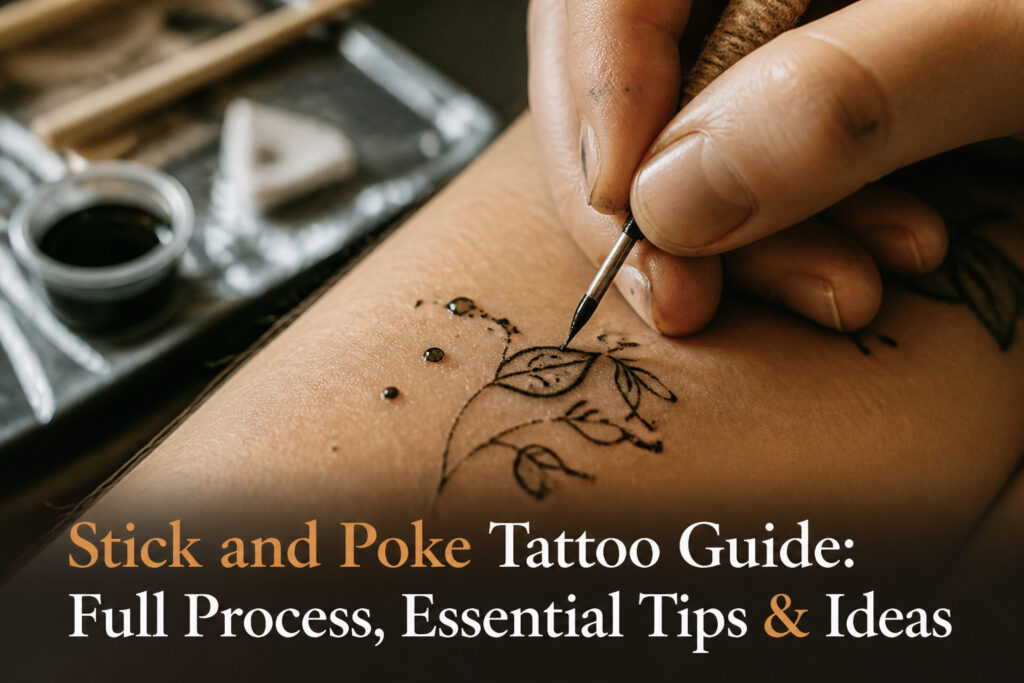
A stick and poke tattoo is pigment worked into the dermis by hand, one needle and one dot at a time, with no motor involved. The method costs between $50 and $200 for a full kit of sterile supplies, and the same patience that earned Ötzi the Iceman his marks around 3300 BCE still matters now. What trips people up is treating the setup as casual: the ones who get clean results stretch the skin flat, control needle depth to avoid blowouts, and prep the station as seriously as any professional would.
What Stick and Poke Tattoos Are
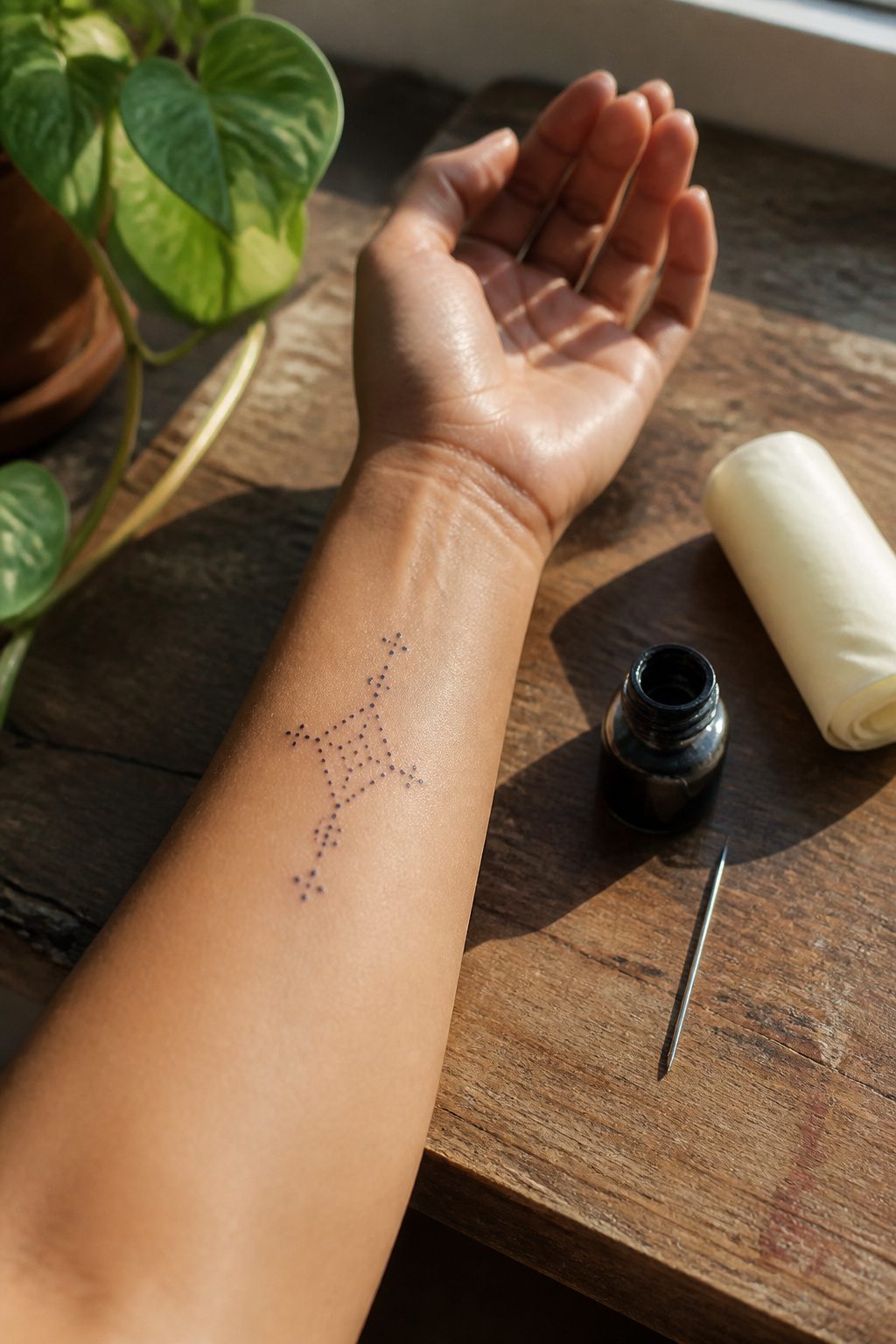
A stick and poke tattoo is pigment deposited into the dermis by hand, one needle, one dot at a time. No motor. No voltage. Just manual control and patience. The method goes by other names too: hand poke tattoo, handpoked, or DIY tattoo when done outside a shop.
The oldest known evidence sits with Ötzi the Iceman, whose skin carries marks from around 3300 BCE. His tattoos were made by hand, long before anyone imagined an electric machine. That timeline held across cultures for millennia; Japanese artists, for instance, built rhythmic needle techniques that produced detail machine work still struggles to match.
Electric tattoo machines arrived in 1890 and hand poking faded from common use. What resurfaced recently is not a new trend but a return to the original craft. The draw is partly the look, hard to replicate with a motor, and partly the process itself. The hand tool causes less trauma to the skin, which means reduced swelling and inflammation during longer sessions. More than that, the method offers something machines cannot easily fake: the mark of a human hand, the time it took, the choice to stay manual when automated options exist everywhere.
Materials Needed
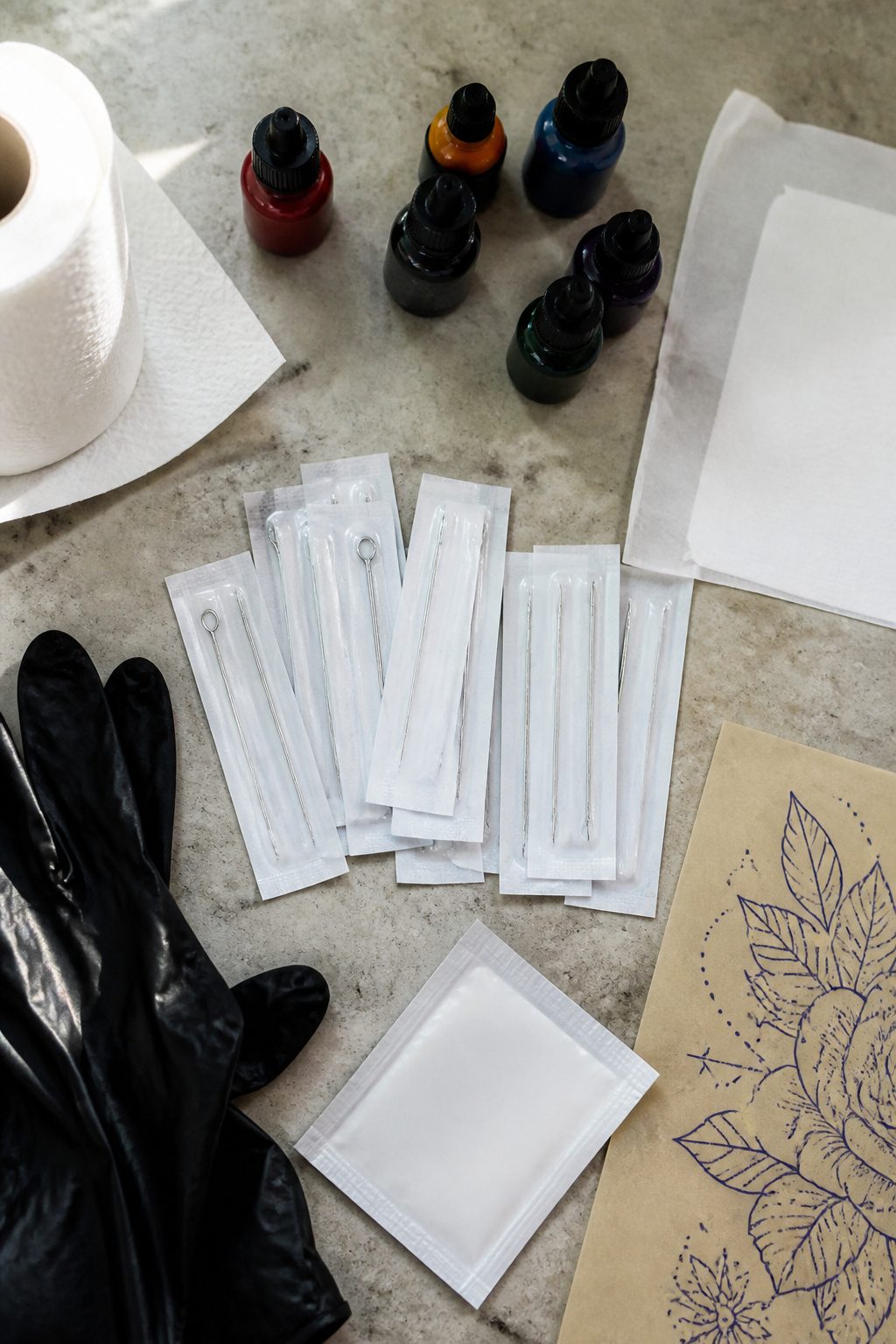
Sterile tattoo needles are the starting point, and the individually sealed kind used in shops are the only ones worth buying. A single needle gets used once on one person, period. Sewing needles are duller, hold less ink, and carry a hygiene risk that professional needles avoid.
Professional tattoo ink runs around $10 to $17 per bottle for reputable brands, with larger kits climbing toward $100. Pen ink or India ink might seem convenient, but the savings aren’t worth the infection risk and the faded, blurred result you’ll live with for years.
Medical gloves, alcohol wipes, and fragrance-free antibacterial soap handle the cleaning side. Paper towels pat the skin dry and catch drips. A stencil paper helps if your design needs precision, though freehand suits simple shapes. Needle wrap or a taped pencil serves as a handle.
The full kit lands somewhere between $50 and $200, with the upper end covering larger pieces or multiple ink colors.
Skin Preparation
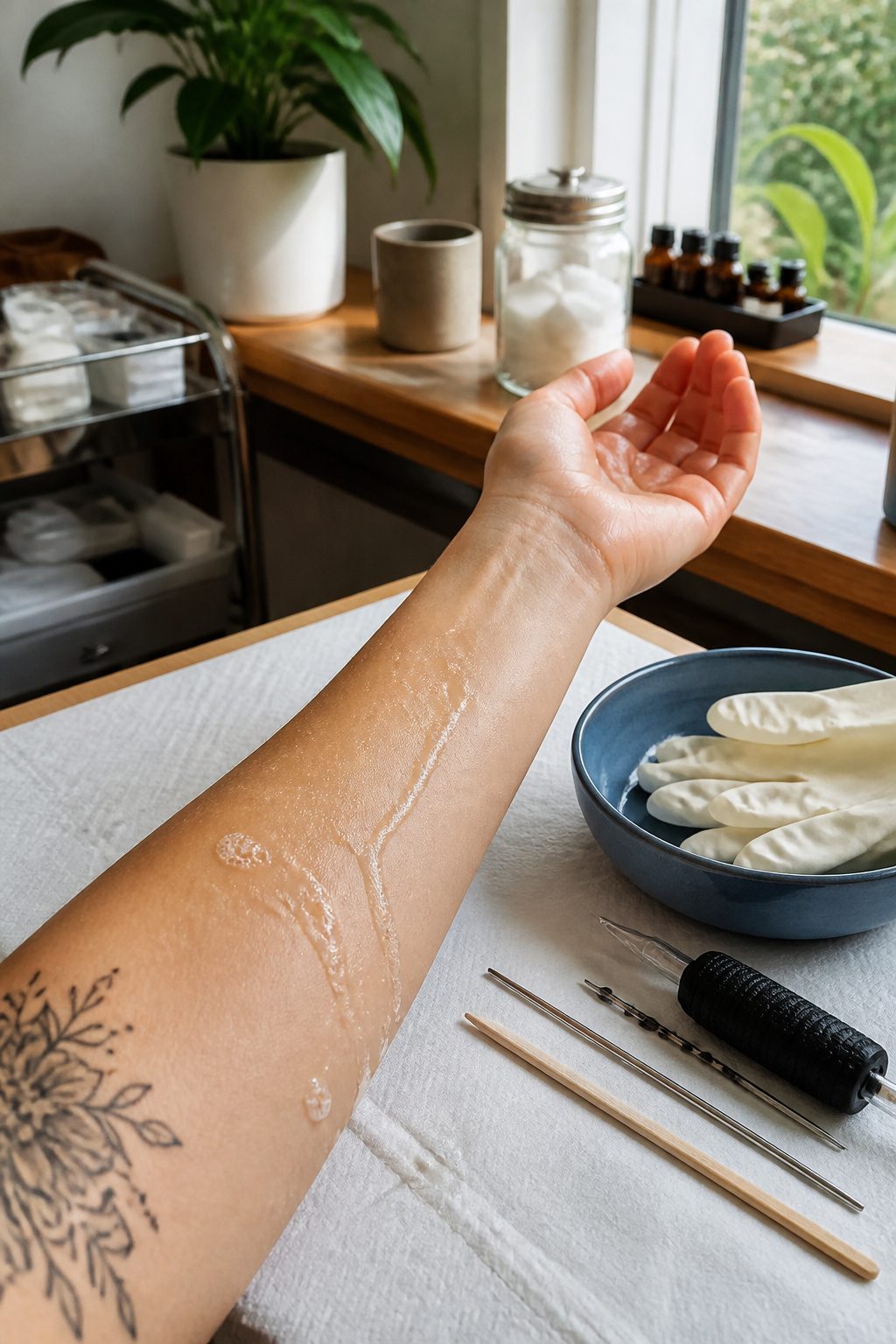
Clean skin is the first thing to get right, and most people who end up with an infection skipped a step they assumed was good enough. A stick and poke session starts with fragrance-free antibacterial soap, worked past the wrist and up to the elbow, paying attention under the fingernails where bacteria tend to hide. Gloving up comes next, and the area itself needs the same thorough wash before any needle touches it.
A stencil helps keep the design where you want it, but only if you let it dry fully before the first poke. Rushing this is the mistake that shows up two hours in, when the ink starts migrating outside the lines and your reference has become a smear. Patience during prep saves the work later, and in handpoke tattooing that means waiting until the transfer product has set completely.
The station matters too. Barriers go down first, tools stay within reach and sterile, and nothing from the last session lingers on the table. A designated trash bag and a sharps box for used needles keep the cleanup from becoming a hazard for anyone else. The minimalist look of stick and poke tempts people to treat the setup as casual; the ones who get clean results treat it as seriously as any professional would.
Stretching the Skin
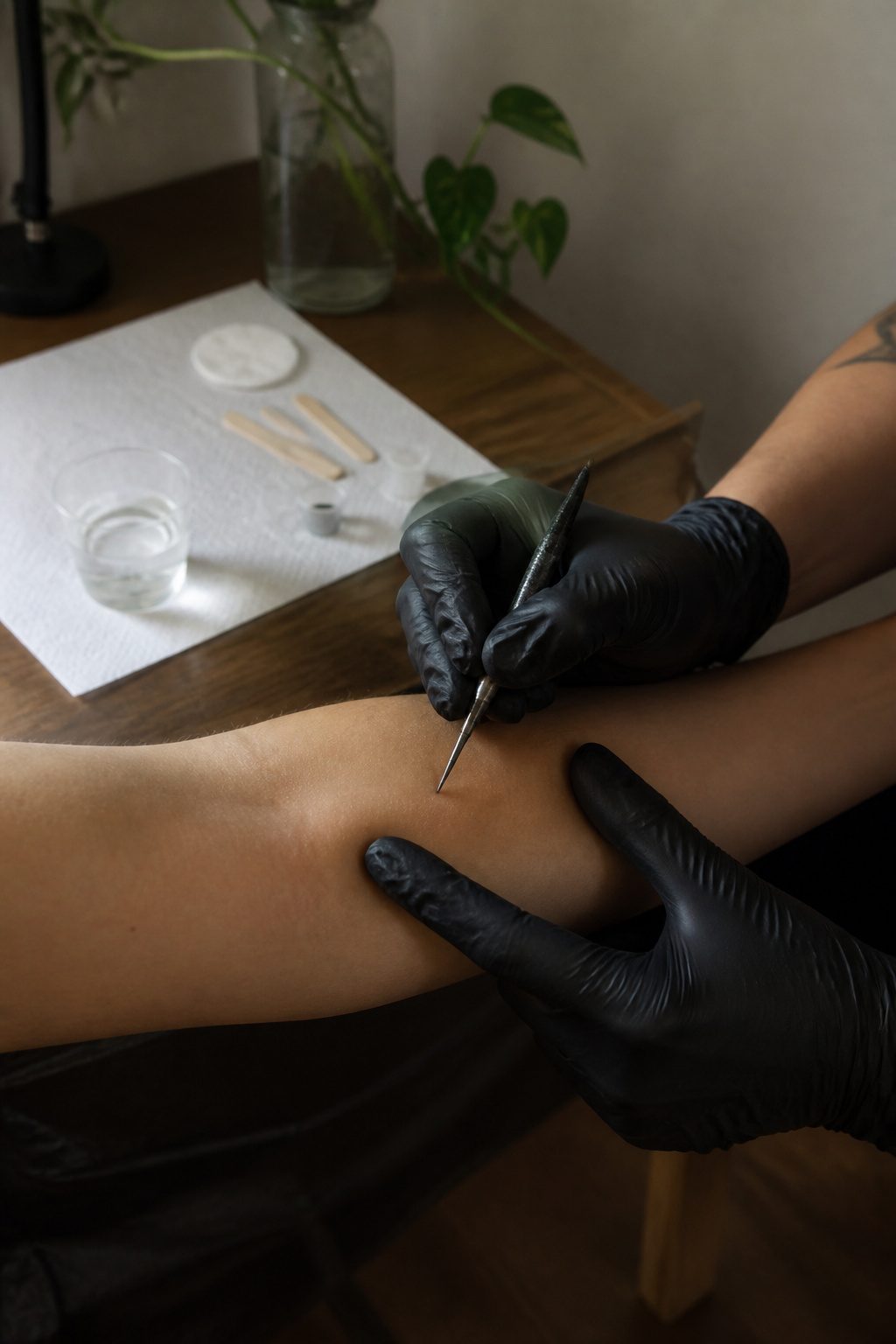
Tension on the skin is what separates a clean stick and poke from a fuzzy one. Without it, the needle skips, the line wavers, and the ink deposits unevenly. One hand stretches the skin flat while the other works the needle, and both jobs matter equally.
The stretch does two things at once. It stabilizes the surface so each puncture lands where intended, and it opens the pores enough for the needle to slip in at a controlled depth. Loose skin lets the needle angle wander; the result is a line that looks drawn by someone in a moving car. Most beginners focus entirely on the poking hand and treat the other arm like an afterthought. That is the mistake that shows up in the healed tattoo six weeks later.
A 45-degree angle works for most placements, but the angle means nothing if the canvas beneath it is shifting. The direction you poke matters too: pulling a line upward, from bottom to top, gives more control than pushing against gravity. The stretch hand adjusts as you move, maintaining even pressure without pulling so hard that the skin distorts. Think of the needle as placing tiny pixels rather than drawing a continuous stroke; each dot needs a stable target.
Start light. You can always add ink in a second pass, but you cannot lift a blown line back out of the dermis. The stretch makes that precision possible.
Poking the Needle
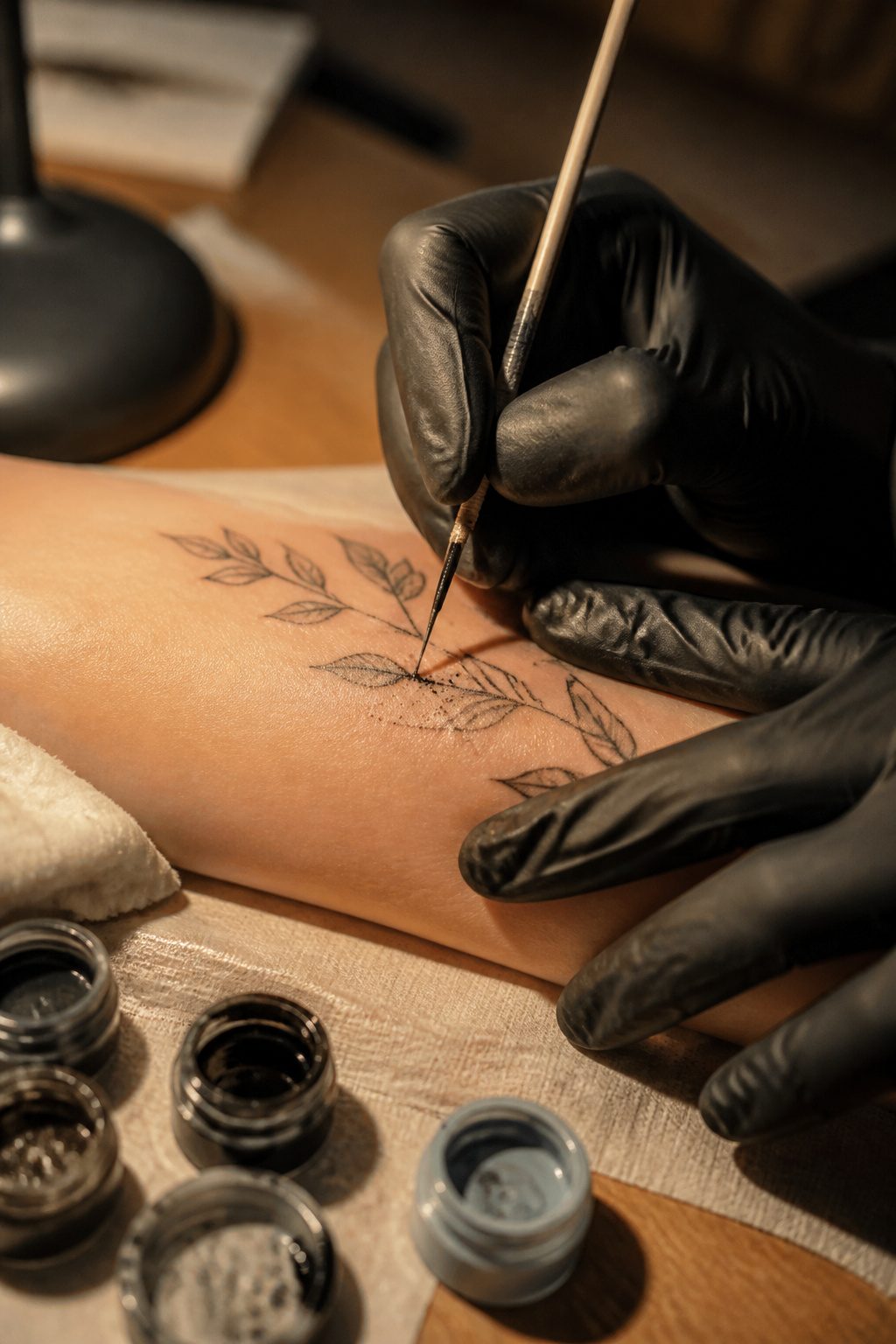
The needle meets skin at roughly a 45-degree angle, not straight down, and deposits ink one puncture at a time. That angle matters: too shallow and the pigment sits in the epidermis and falls out with healing, too steep and you risk going deeper than intended. Each dot is a deliberate decision, hundreds of them forming what looks like a line from a few feet back. The rhythm is closer to placing pixels than drawing a continuous stroke.
Machine work runs on voltage and repetition; hand poking runs on patience and the steadiness of your own hand. A line that takes a machine thirty seconds might take ten minutes by hand, but the needle enters at a gentler, more controlled pace. Many collectors find it less painful for exactly that reason, and the result carries a slight softness of line that machine work cannot replicate. That handmade quality is not a flaw; it is the point.
Vivien Su, a hand poke artist in Singapore, put it to VICE that the difference is like drawing on a sheet of paper versus drawing on your iPad: machine tattoos give a cleaner look, but both offer different effects.
"I do think hand-poked tattoos can look just as nice as machine tattoos," Vivien Su, a 21-year-old part-time tattoo artist in Singapore told VICE. She started hand-poking last year, while the country was in lockdown, and recently opened her own studio. Vivien likens hand-poked tattoos to "drawing on a sheet of paper," and machine tattoos to "drawing on your iPad." While machine tattoos will probably give a cleaner look, she thinks that both offer different effects.
— Vice
What that means for anyone trying this: embrace the medium instead of fighting it. The slight texture, the visible dot pattern up close, the organic line quality, these are the marks of hand poking done well, not signs of amateur work.
Needle Depth
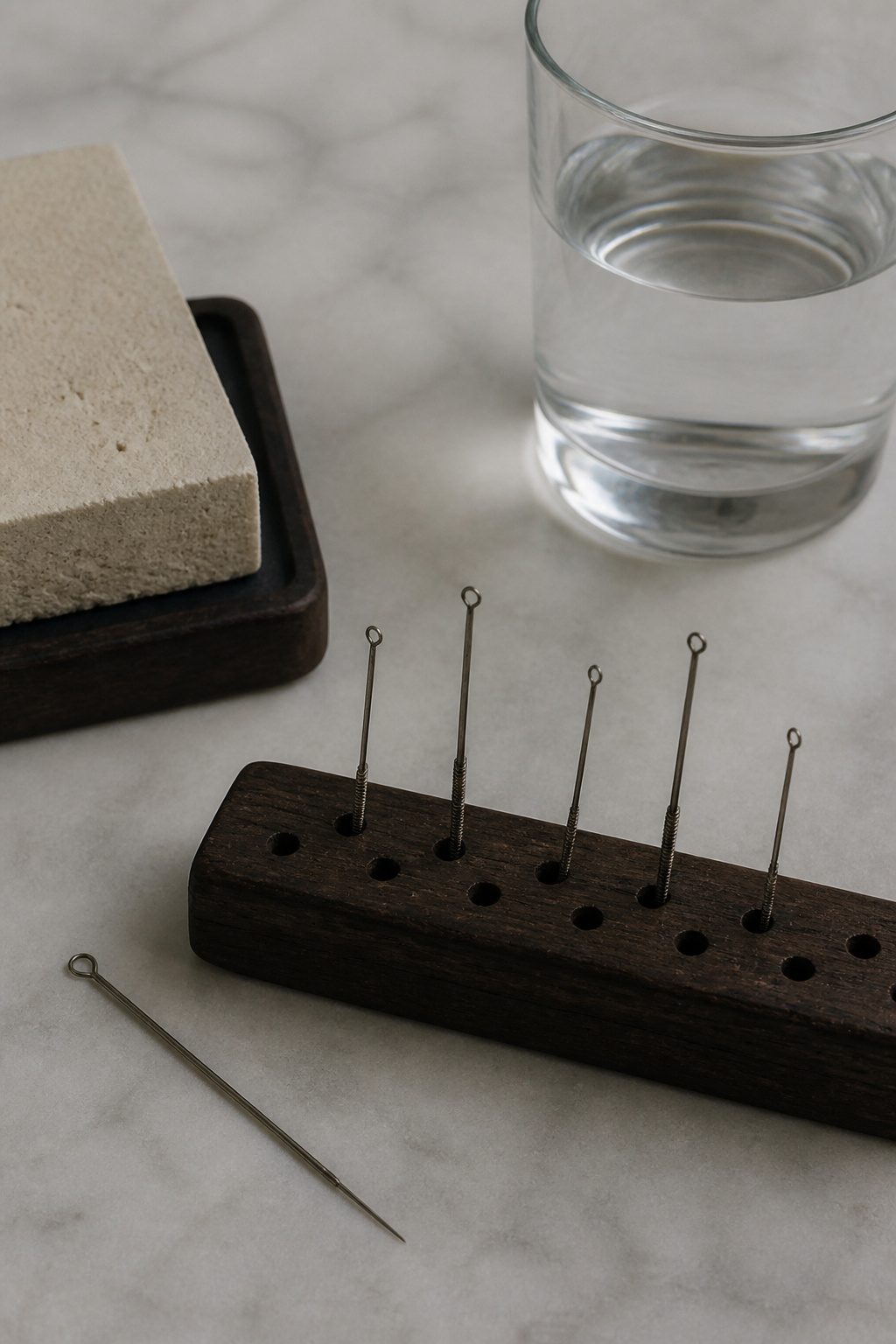
Professional tattoo needles give you the control to set depth exactly where it needs to be. Start shallow: the ink belongs in the upper dermis, not buried underneath it. If the line looks too light after it settles, you can always pass again and sink a fraction deeper. Going too deep from the first poke is where the real damage happens.
A blowout looks like a blurred halo spreading from the line itself, the ink feathering outward into surrounding skin instead of holding its edge. This happens when pigment passes through the dermis and into the fat layer beneath, where there is nothing to anchor it in place. The result is permanent: no aftercare fixes it, no touch-up sharpens it back. The only prevention is restraint with the needle. A skilled hand poke artist achieves the same consistent depth as a machine, and that consistency is what separates work that lasts from work that spreads.
Cleaning and Covering
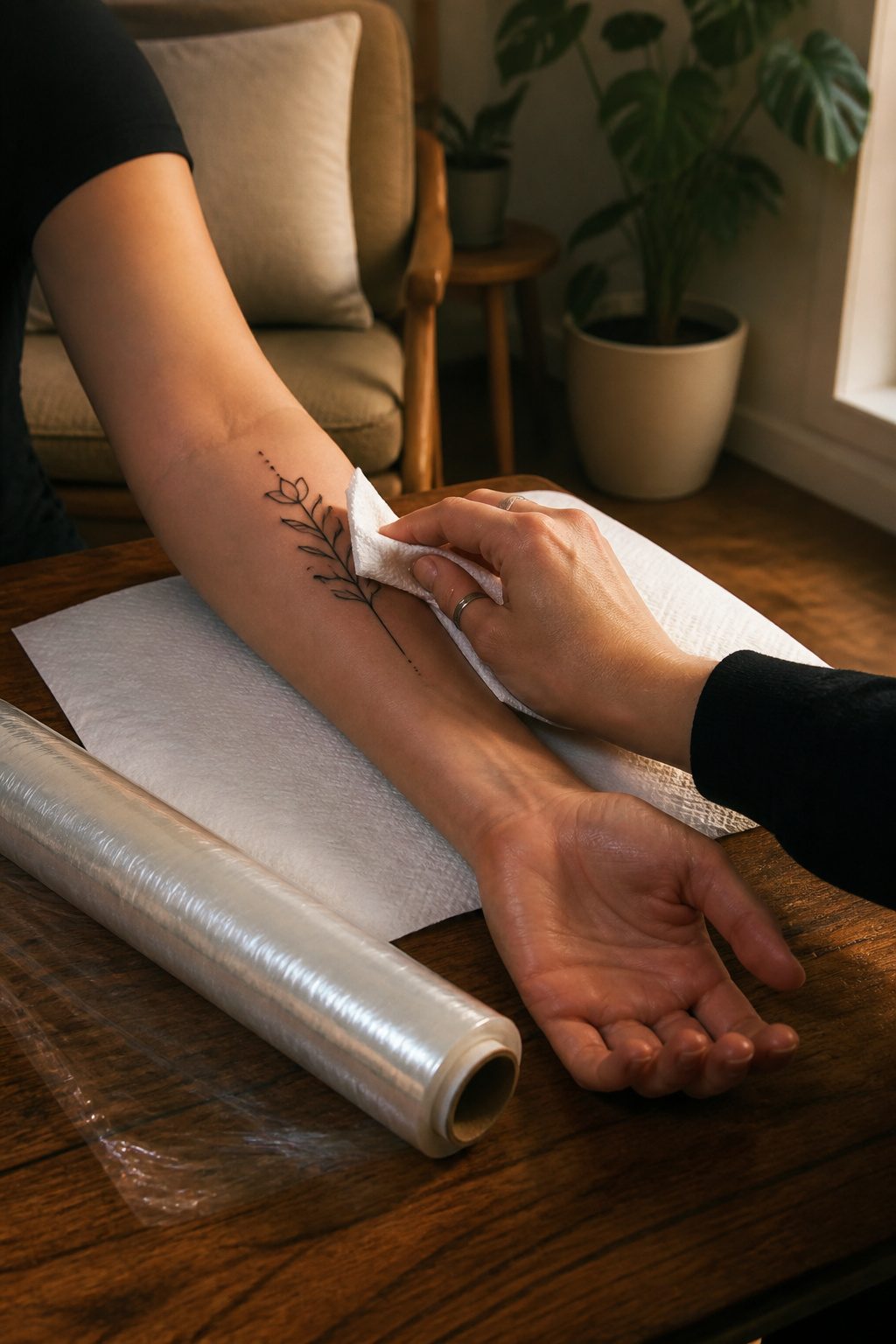
The skin is open and needs shielding right away. Patrick, a hand-poke artist, covers fresh work with cling wrap for at least five hours. Others use Tegaderm or an equivalent transparent bandage, which lets you check the area without exposing it. The goal is simple: block bacteria during the first hours when the tattoo is most vulnerable.
Clean the area first. A gentle wash removes excess ink and the plasma that rises to the surface. Do not scrub. Pat dry, then bandage. The covering stays on while you travel home, sleep, and move through environments you do not control.
Avoid baths, pools, and sun during these early hours. A tattoo is a wound, and the first covering is its only protection before aftercare begins.
Aftercare
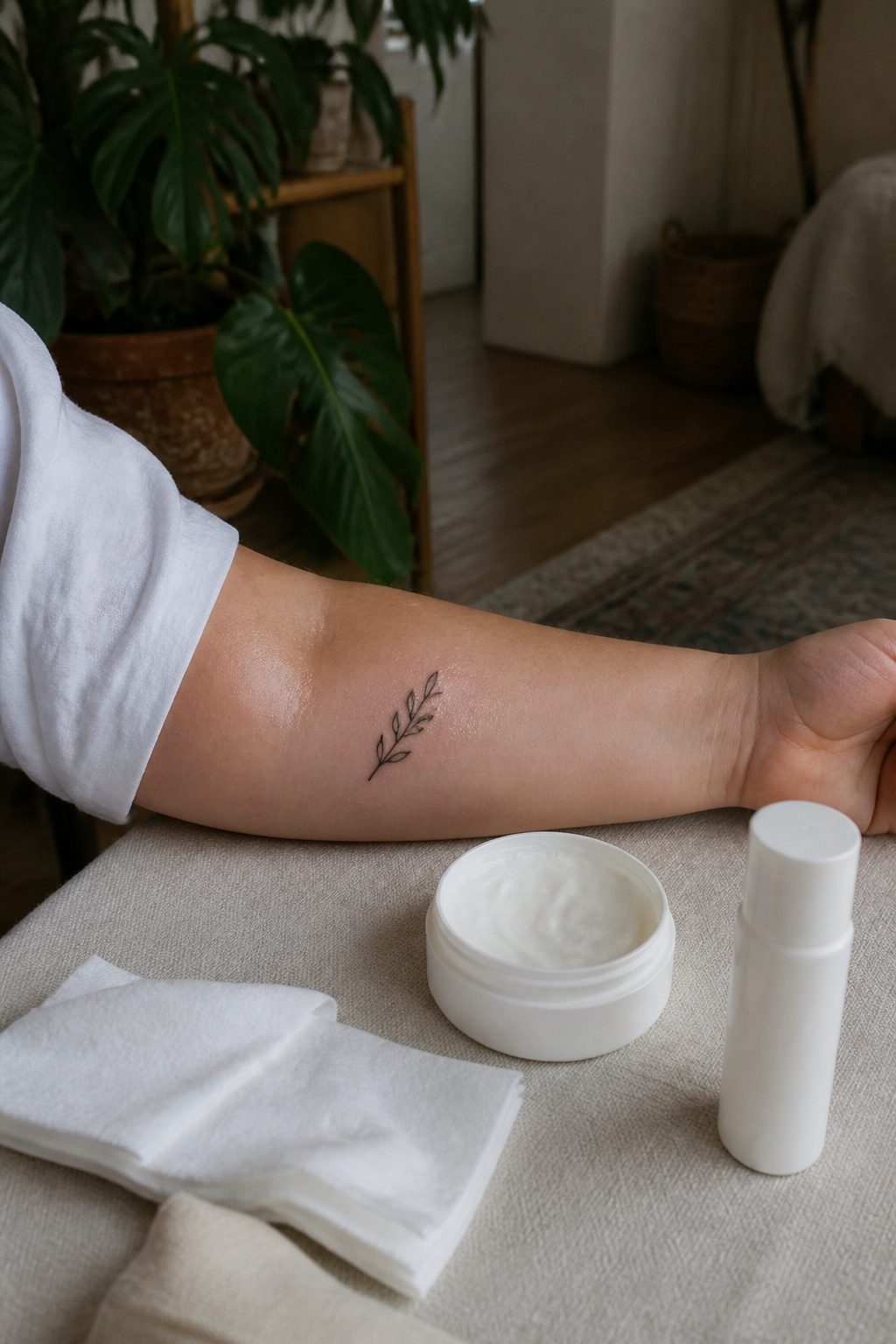
The first two weeks after a stick and poke tattoo are when the work lives or dies. Keep the area clean, pat it dry, and apply a thin layer of fragrance-free moisturizer, nothing heavy or petroleum-based that would suffocate the skin. Sun exposure is the enemy here, same as with any tattoo, but hand-poked lines sit more delicately in the skin and burn away faster if you skip the SPF.
Scabbing will happen. Let it flake off on its own schedule. Picking at it pulls ink out with the scab, and that gap becomes permanent. The healing runs longer than a machine tattoo, closer to two weeks and sometimes more, because the puncture is gentler and the skin closes slower from the outside in.
With proper aftercare, these tattoos last a lifetime. Without it, fading starts within months. The difference is not the ink or the artist’s hand. It is whether you kept that fresh work moisturized, out of the pool, and out of the sun while the skin rebuilt itself.
Stick and Poke vs. Machine Tattoos
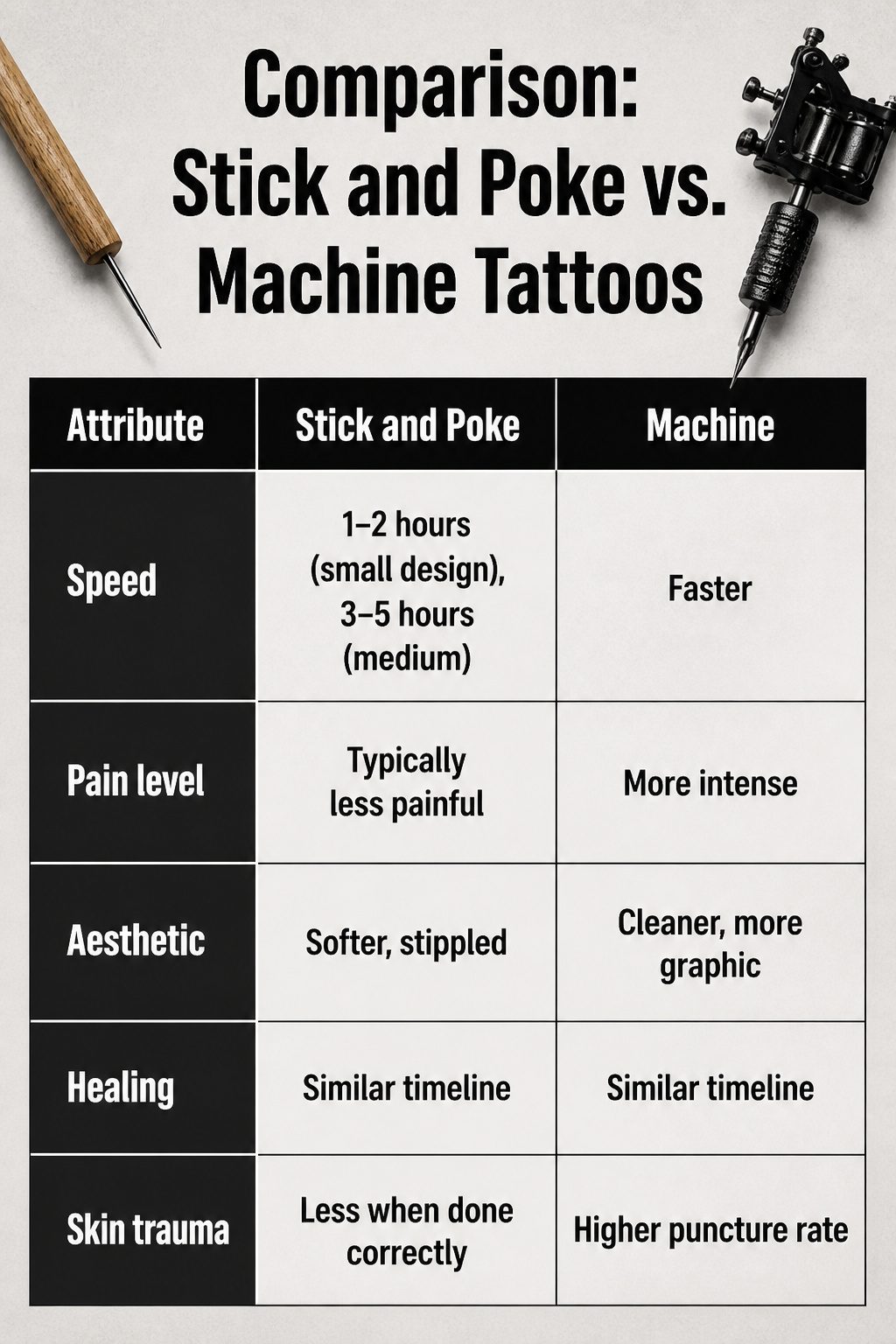
Machine work runs fast. A coil or rotary machine can puncture the skin thousands of times per minute, so a small piece that might take an hour with a gun can stretch to three to five hours by hand. That slower pace changes the feel of the session. The buildup is gradual rather than intense, and many people find stick and poke less painful because of it.
The skin also takes less trauma when each mark is placed deliberately. Healing times end up roughly similar between the two methods, but the gentler session itself is part of why people seek hand poke work.
Where they really diverge is look. Machine tattoos deliver cleaner, more uniform lines, closer to drawing on a tablet. Hand-done lines carry a softer, stippled texture that machine work cannot replicate. Neither is better. They are different tools for different results.
| Attribute | Stick and Poke | Machine |
|---|---|---|
| Speed | 1–2 hours (small design), 3–5 hours (medium) | Faster |
| Pain level | Typically less painful | More intense |
| Aesthetic | Softer, stippled, hand-drawn character | Cleaner, more graphic, uniform |
| Healing | Similar timeline | Similar timeline |
| Skin trauma | Less when done correctly | Higher puncture rate |
Design Ideas for Beginners
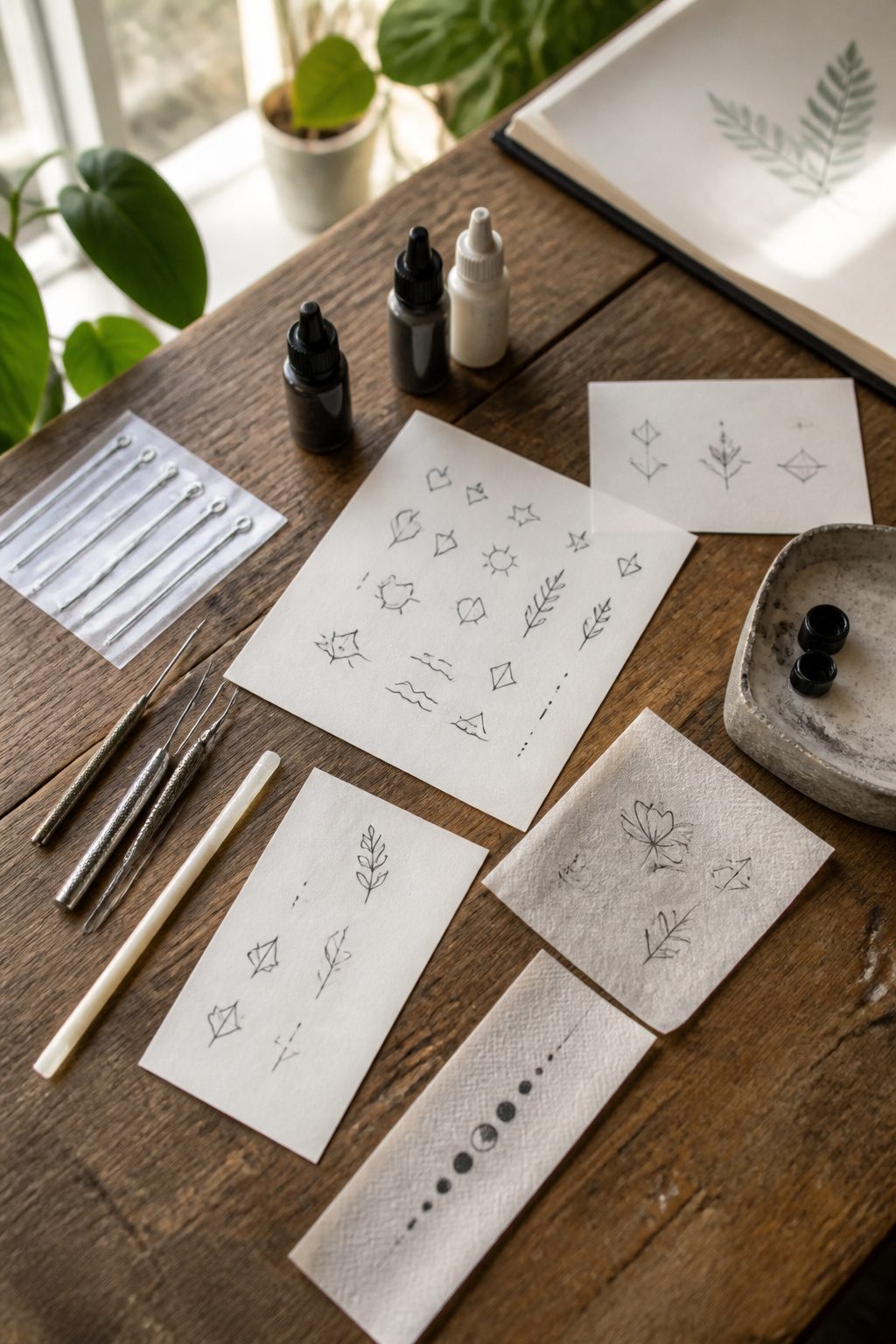
A single line drawn between two points taught me more about stick and poke tattoos than any complex sketch I had planned. The technique builds one dot at a time, and the design should respect that rhythm: small symbols, straight lines, and geometric shapes give the cleanest reward for the patience this method demands.
Words work well for a first attempt. An "X," a short letter, or a tiny lightning bolt keeps the needle moving in predictable directions where a slip shows clearly and can be corrected on the next pass. Curves are harder than they look; the skin shifts under the hand and a circle that seemed simple on paper becomes a wobble of joined dots.
Minimalist designs carry a different weight in stick and poke than they do from a machine. The slight irregularity of hand-placed dots becomes part of the piece, not a flaw, which is why personal sigils and simple figurative marks suit this approach. Color and heavy shading ask for skills that come only after the basic rhythm of depth and spacing feels automatic. Four passes over any area is the practical ceiling before the skin needs rest, so a design that reads clean in those four passes is the one to start with.
Practice on an orange or grapefruit first. The resistance of the peel is wrong, but the repetition of spacing and angle is real preparation, and the fruit forgives what skin remembers.
Common Mistakes
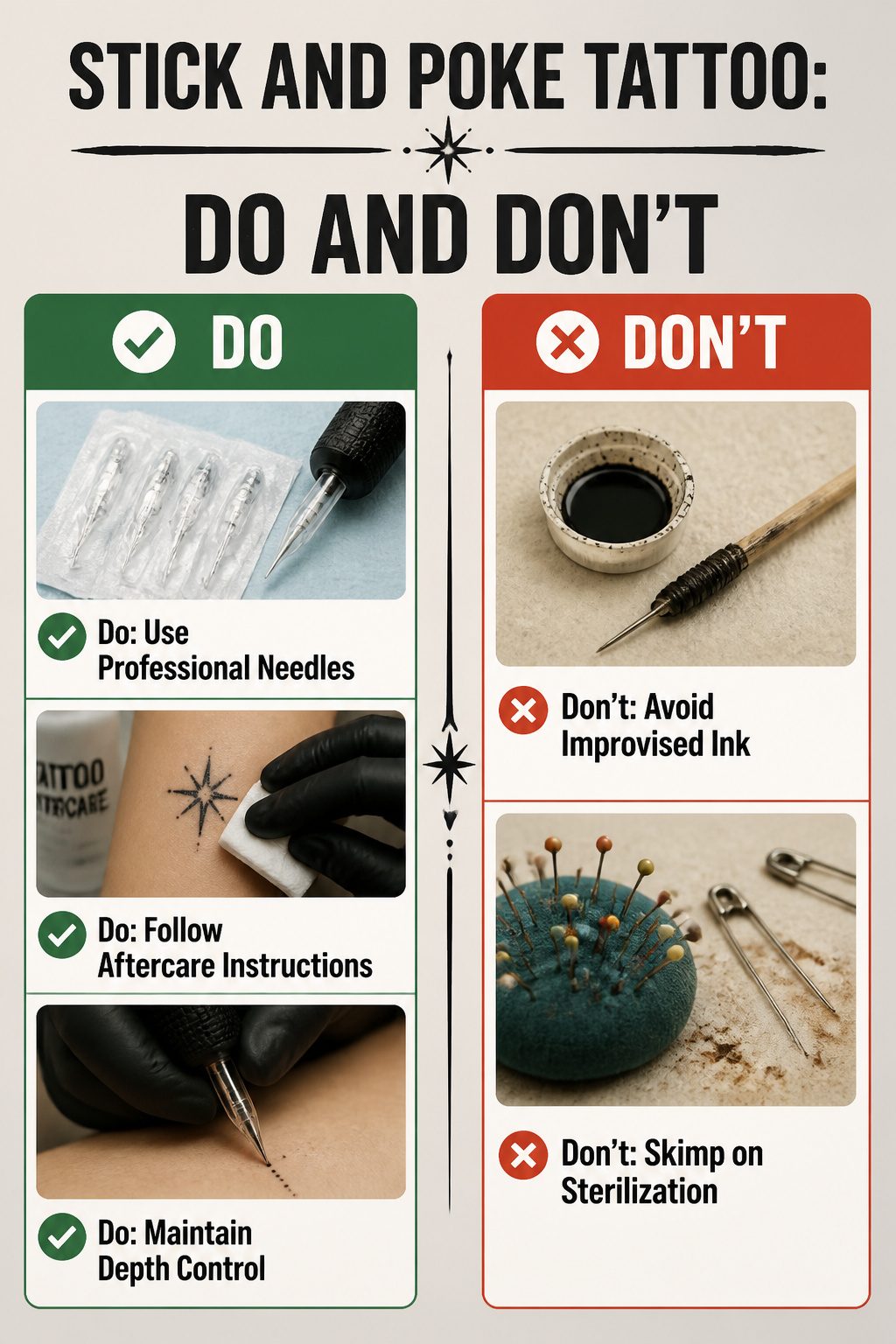
The first time I watched someone pull a sewing needle from a pincushion and call it a tattoo tool, the skin healed with a raised, blurry line that looked nothing like the star she’d drawn. Loose sewing needles and pins are impossible to sterilize properly, and their dull points tear rather than deposit pigment cleanly. Professional handpoke artists use sterile, single-use tattoo needles, either mounted in a dedicated holder or as pre-sterilized disposable tools. Anything less belongs nowhere near skin.
Improvised ink carries the same risk. The "prison tattoo" approach, using whatever pigment is handy, often leads to infection or scarring, and even when the skin heals, the inconsistency between pokes produces a muddled image that fades unevenly. Professional tattoo ink exists for a reason; substitutes don’t meet safety standards and can’t be trusted.
Depth control separates a clean line from a blowout. Too shallow and the pigment falls out; too deep and it spreads beneath the skin, blurring the design. A proper handpoke setup gives the stability needed to keep each poke consistent.
Aftercare gets skipped because stick and pokes are smaller and simpler than machine work, so they heal faster and rarely scab. That faster healing doesn’t mean no healing. The skin still needs protection, and the person receiving the tattoo needs clear instruction on preserving what was put in.
Frequently Asked Questions
What is a stick and poke tattoo?
A stick and poke tattoo is pigment deposited into the dermis by hand, one needle and one dot at a time, without any electric motor or voltage. The method is also called hand poke tattoo, handpoked, or DIY tattoo when done outside a professional shop. It predates electric tattoo machines by thousands of years, with evidence going back to Ötzi the Iceman around 3300 BCE.
How long do stick and poke tattoos last?
Stick and poke tattoos can last a lifetime with proper aftercare. The key factors are needle depth, professional ink quality, and how well you protect the healing tattoo from sun, pools, and picking at scabs. Without proper aftercare, fading can start within months.
Are stick and poke tattoos safe?
They are safe when performed by a professional in a sterile environment with proper supplies. The risks spike with improvised materials: sewing needles cannot be sterilized properly, and pen ink or India ink raise infection risks and produce faded, blurred results that barely resemble the original design.
How do you do a stick and poke tattoo?
You dip a sterilized tattoo needle in professional ink and manually poke the skin at roughly a 45-degree angle, depositing pigment one puncture at a time. Skin must be stretched taut with the non-poking hand, and each dot is placed deliberately to form lines and shapes. A small design typically takes one to two hours, while medium pieces run three to five hours.