Mexican tattoos range from a single hummingbird wrist piece to a full-back Aztec calendar stone, but the difference between heritage and costume comes down to whether you can name why the symbol matters. A glyph copied off the web without knowing its day sign reads as empty decoration, while a sugar skull carrying a specific name becomes an altar you wear year-round.
1. Hummingbird Tattoos
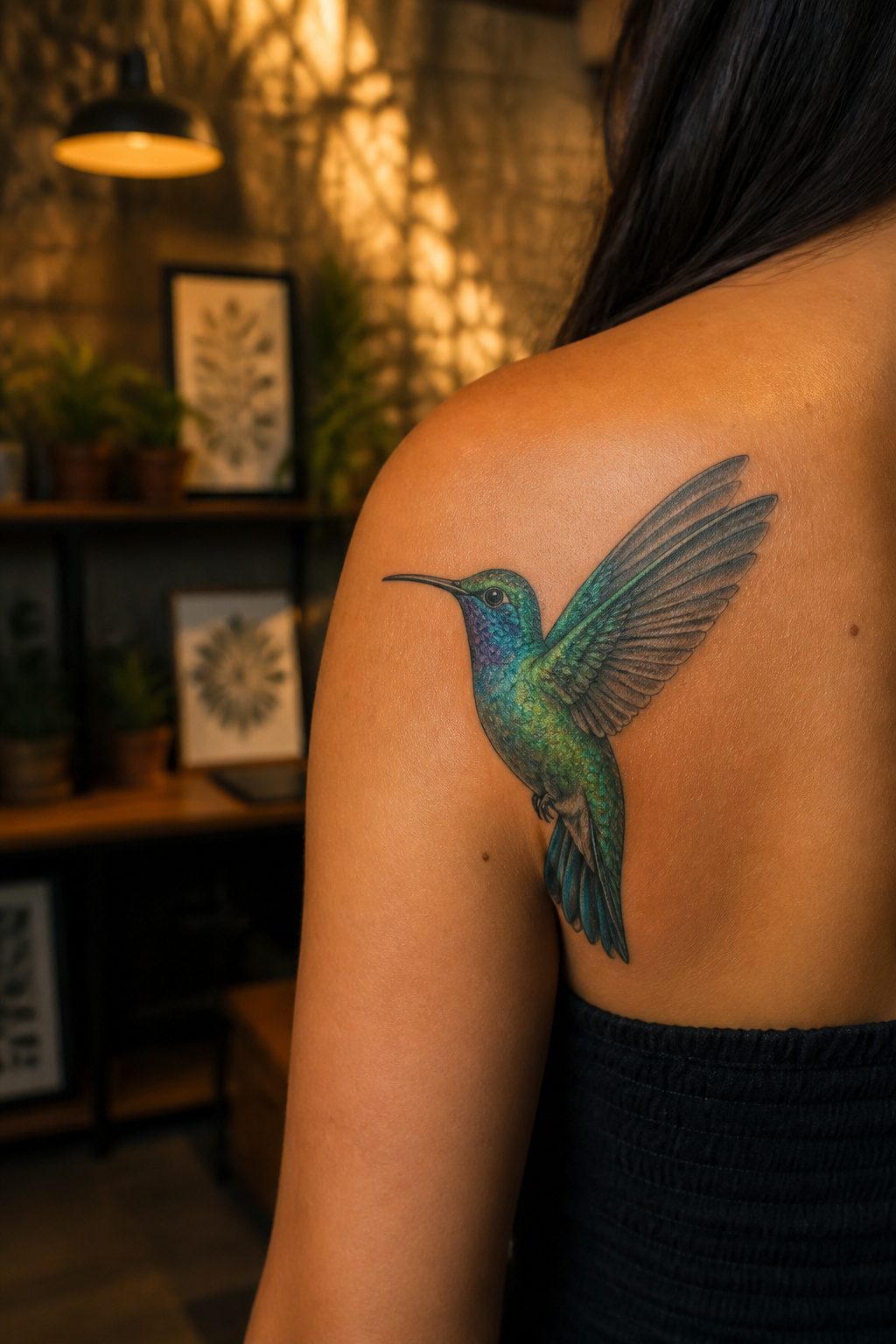
A hummingbird in flight carries more weight in Mexican tattoo work than its small frame suggests. In Aztec belief, the god Huitzilopochtli took form as either a hummingbird or an eagle, and this deity governed the sun, war, and youth. Warriors who fell in battle were thought to return as these birds, carrying what the culture considered an immortal essence.
The perseverance angle comes directly from that warrior link: the hummingbird’s tireless motion, its refusal to stay still, mirrors the Aztec ideal of the fighter who does not yield. Someone choosing this design today often wants that meaning rather than just the visual appeal.
Mayan tradition adds another layer, framing the hummingbird as a messenger that carries human thoughts between places. Modern interpretations sometimes blend this with the belief that a hovering hummingbird brings comfort from someone who has died. The design works at small scale, which appeals to people who want placement flexibility, or as larger pieces where artists render the bird in three dimensions to catch that mid-flight energy.
2. Frida Kahlo Tattoos
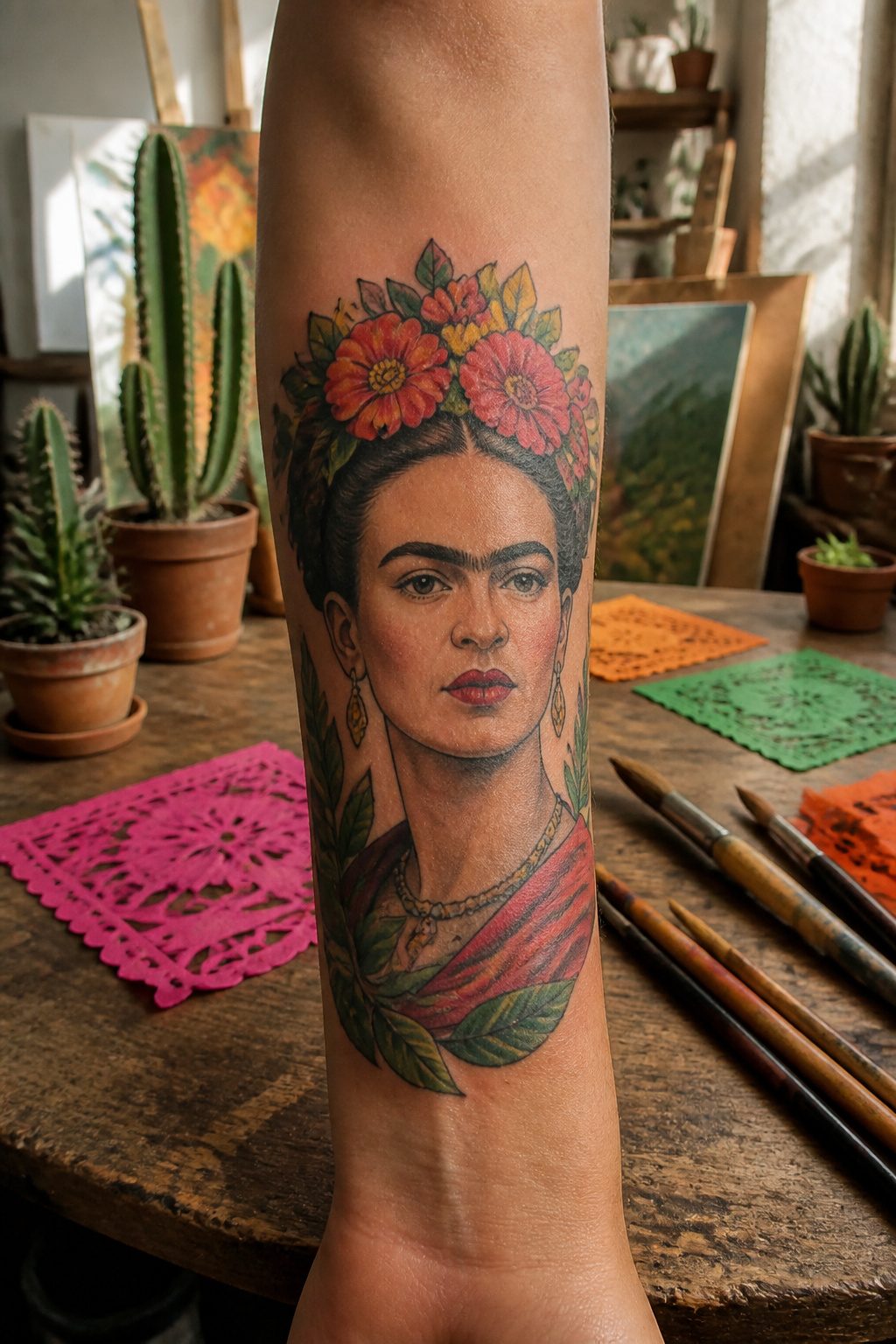
Frida Kahlo’s face on skin carries weight that goes beyond liking her paintings. The eyebrows, the flowers, the unflinching stare straight back at the viewer: these elements make her instantly readable even at small scale, which matters for ink that lasts decades. What draws people to her as mexican tattoos is the pairing of cultural identity with resilience. Kahlo celebrated Mexican and indigenous culture in her work while translating physical pain and personal fracture into something visible and unapologetic. That dual register, national pride and private endurance, gives the portrait layers a generic female face does not have.
The design choices split two ways. Some go literal: a reproduction of her self-portraits, the Tehuana dress, the monkey or cat, the palette she used. Others abstract her into symbols, a single eyebrow, a thorn necklace, a hummingbird, letting the reference do the work without the full face. Both approaches keep her rebellious nature intact, which is part of why the image persists. She has been reproduced in dolls, movies, street murals, and songs, so the visual vocabulary is already common ground between the person wearing the tattoo and whoever sees it.
A Frida portrait is not a quiet choice. The face demands space to read; the detail in traditional Tehuana jewelry and floral crowns needs a competent hand with color saturation. Go too small and the features muddy. Go too stylized without the eyebrows and it becomes any woman with flowers in her hair. The sweet spot is mid-size, upper arm or thigh, where the brow line and the direct gaze survive.
3. La Loteria Tattoos
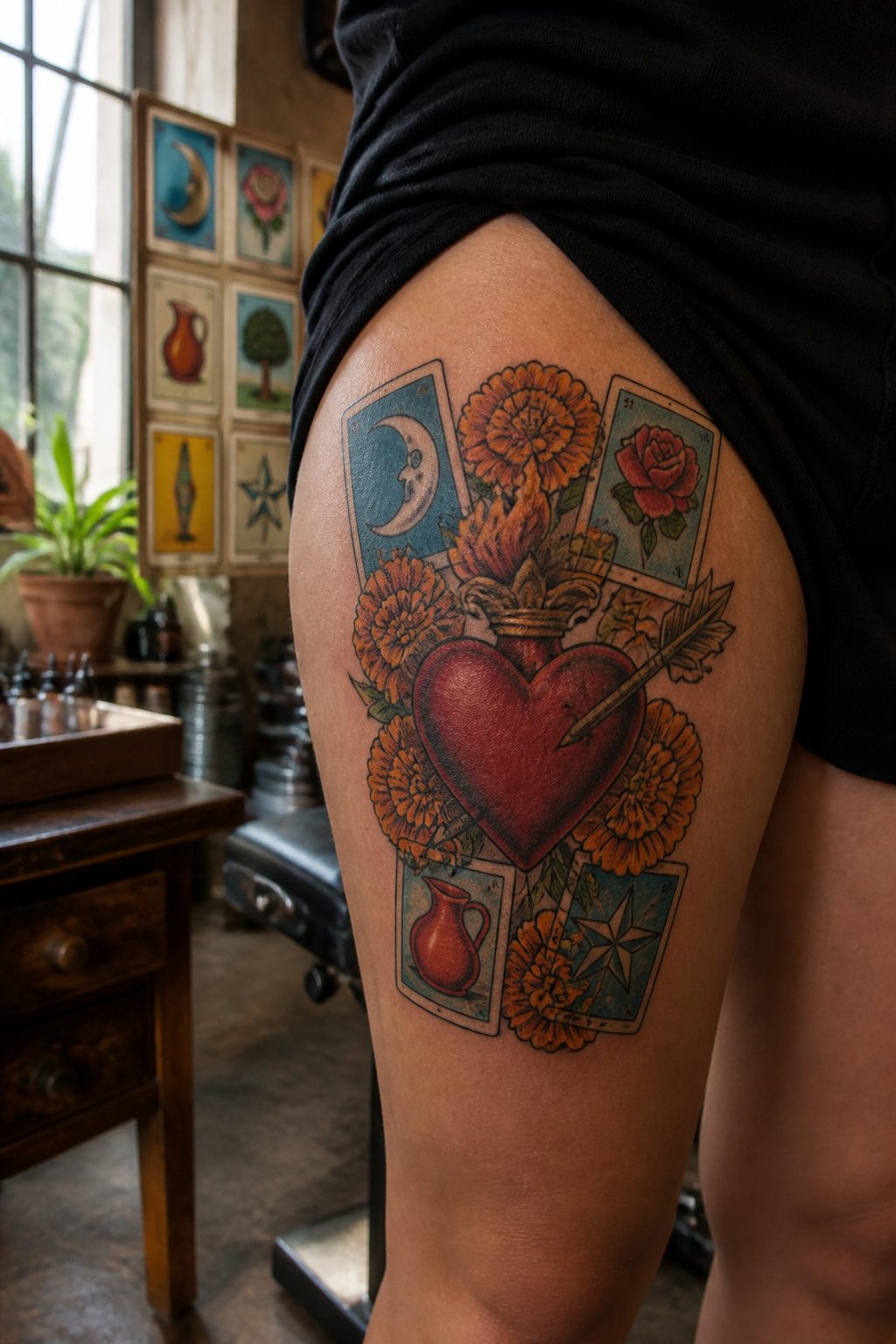
La Loteria imagery lands in tattoo shops because the cards already carry the weight of memory. The game traces back to 1769, when Italian missionaries brought it to New Spain, and by 1887 it had embedded itself in Mexican popular culture deeply enough that soldiers received decks in their supply kits. Those same illustrations now reappear on skin, and the choice of which card to wear matters more than the art style.
El Corazon, La Calavera, and El Sol show up most often for reasons the game itself established long before tattooing went mainstream. El Corazon, the heart pierced by an arrow or thorns, speaks to romantic risk in a visual language older than the wearer. La Calavera borrows from the same skull tradition that runs through Day of the Dead imagery, but framed as a game piece it carries the lighter touch of family gatherings rather than solemn memorial. El Sol, with its radiating face, connects to older indigenous sun worship filtered through colonial-era illustration.
The distinction worth making is between wearing the full card with its number and title, or isolating the image itself. Both approaches read as Mexican heritage rather than generic Latinx aesthetic because the specific iconography is unmistakable to anyone who played the game at a kitchen table. A scorpion or a cactus rendered in La Loteria style signals something concrete; the same image in a realistic style might not.
4. Sugar Skull Tattoos
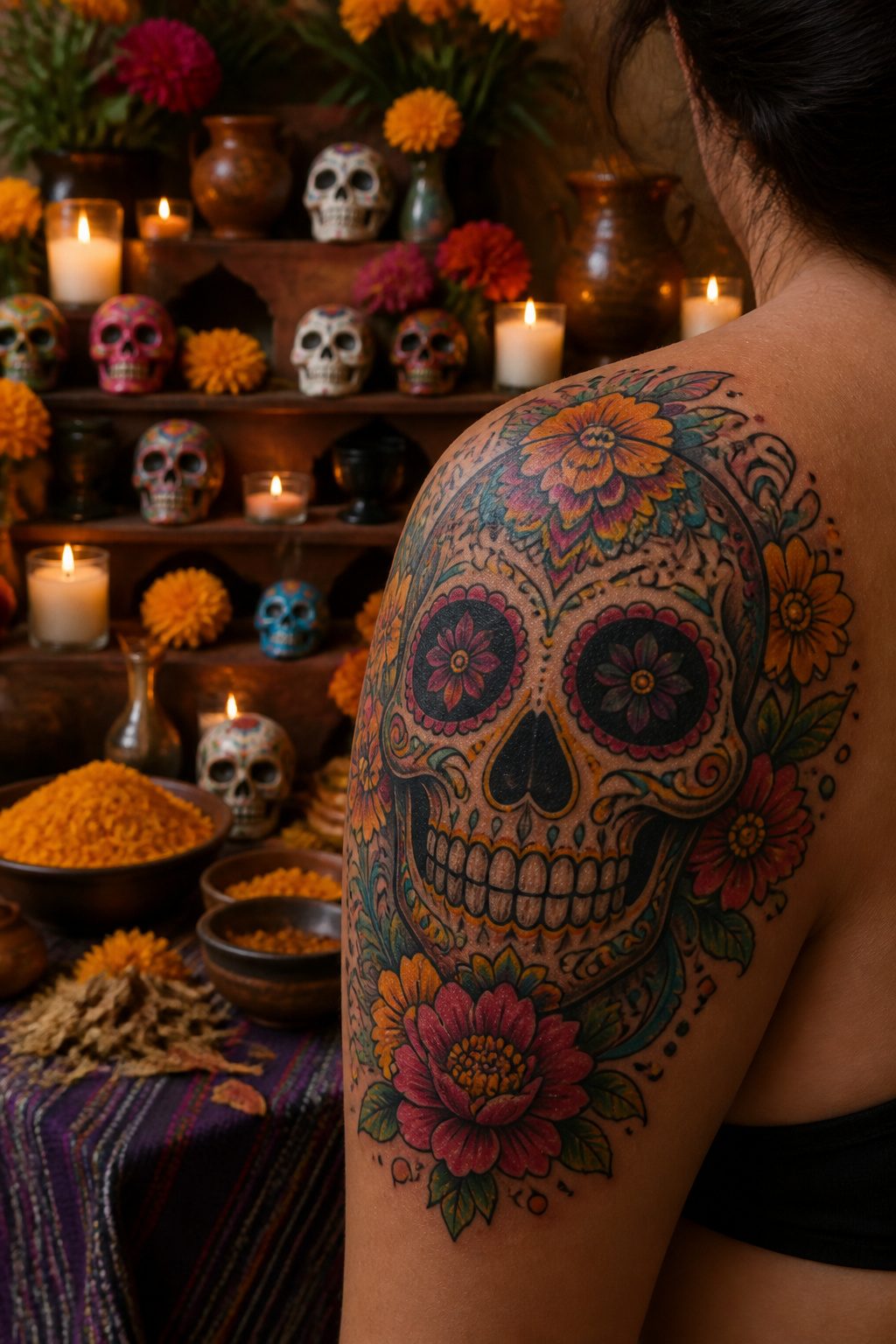
The sugar skull, or calavera, carries one of the most misunderstood meanings in all of mexican tattoos. These designs trace back to Día de los Muertos, the November 1–2 holiday when families build ofrendas to welcome returning spirits. The molded sugar figures themselves arrived with Italian Catholic missionaries in the 1600s, not from pre-Hispanic tradition, though Mexico’s abundance of sugarcane let the form take root and grow its own identity.
A real sugar skull placed on an altar bears the departed person’s name across the forehead. That same detail translates naturally to skin: the name of a lost parent, a child, a friend becomes the center of the design, surrounded by marigold petals, cobwebs, or whatever symbols marked that actual life. The skull does not mourn; it celebrates. The point is that death continues the cycle rather than ending it, a distinction that separates these tattoos from darker skull imagery elsewhere.
Color reads festive; black and grey reads permanent. Bright pinks, yellows, and electric blues match the ofrenda aesthetic and the holiday’s tone, but they fade faster and demand touch-ups. Black and grey settles into skin like a photograph, though some of the joy gets lost without those saturated hues. Either way, the name matters more than the palette. A sugar skull without a name is just a skull; with one, it becomes an altar you carry year-round.
5. Aztec Tattoos
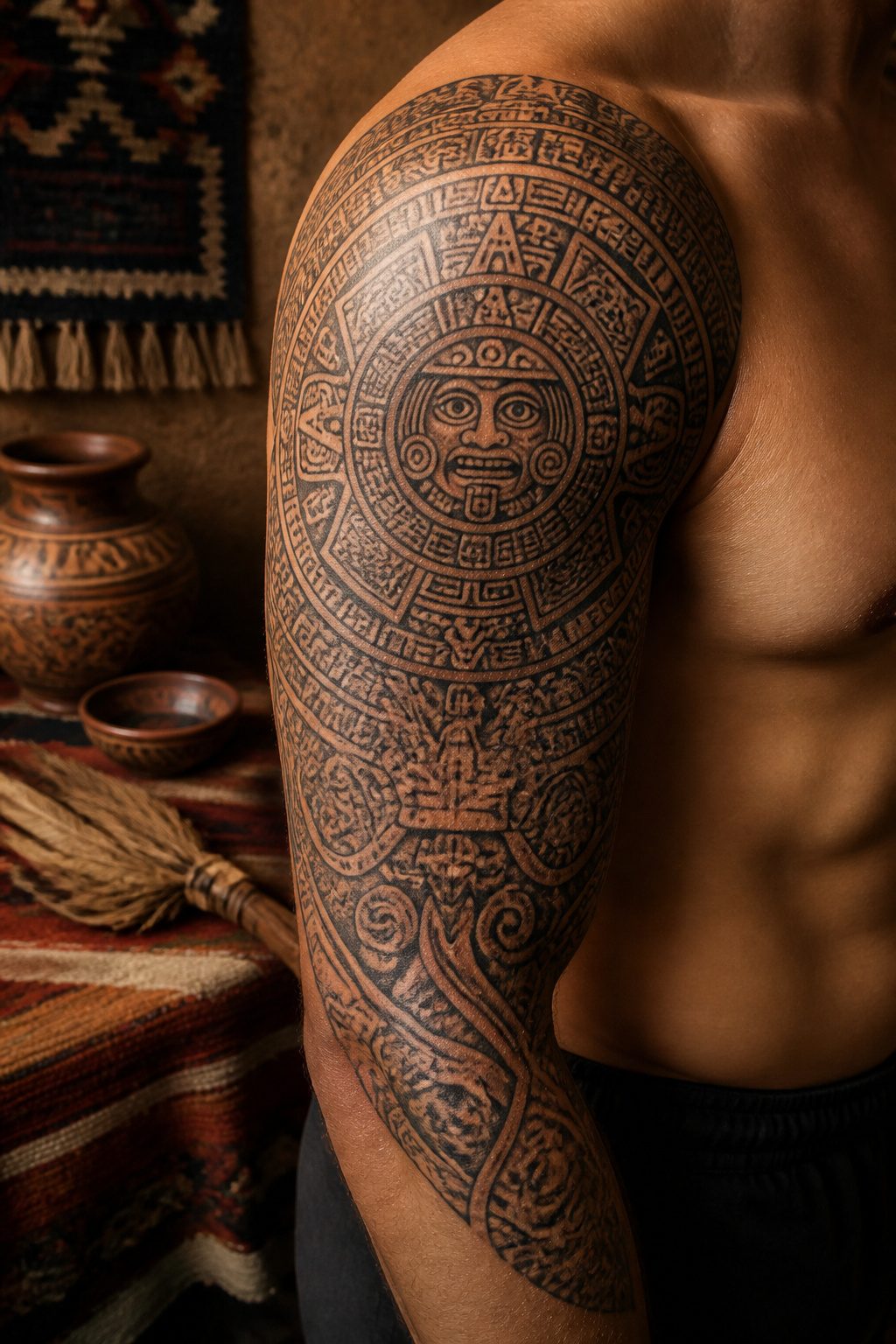
The Aztec calendar stone, with its concentric rings of day counts and sun symbols, is probably the most requested design from this tradition. Black or gray ink was the rule historically, and most serious wearers still keep to that palette. Quetzalcoatl, the feathered serpent, appears in two forms: the Aztec name or the Maya Kukulkan, depending on whose lineage the client is claiming. Huitzilopochtli, god of sun and war, anchors the eagle-and-serpent image at the center of the Mexican flag.
The line between appreciation and appropriation with these designs is thinner than most clients expect. A name-date tattoo in Nahuatl script, copied off a web image without knowing the month or meaning, reads as costume to anyone from the culture. The better approach is to work with an artist who can explain the specific glyph: which of the twenty day signs it represents, what tonalli it carried. The same care applies to warrior portraits or skeletal figures in headdress. These were status marks earned, not aesthetic choices, and modern wearers who skip that context wear something empty where something loaded used to sit.
6. Maya Tattoos
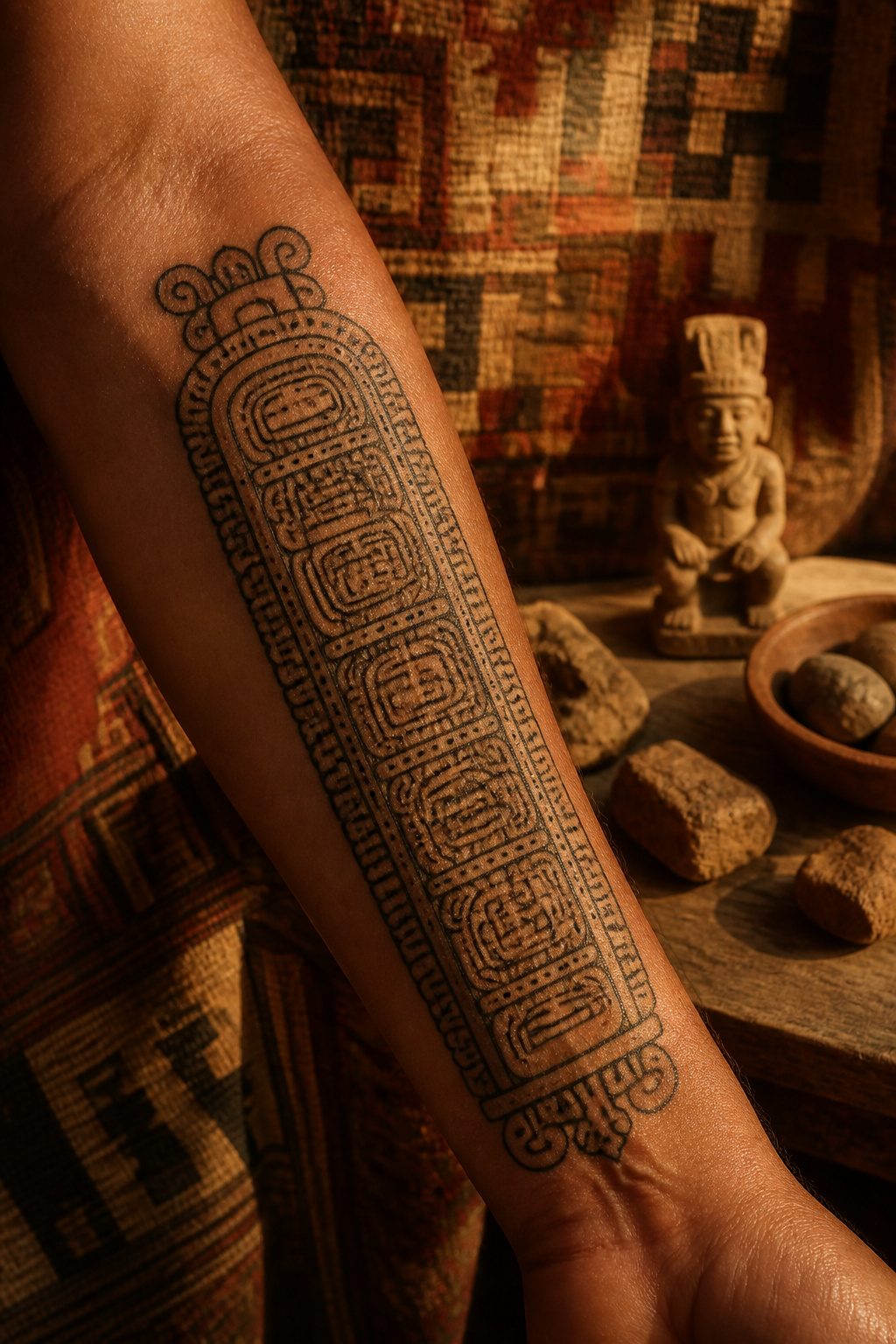
Maya tattoos sit apart from Aztec work once you learn where to look. The Maya occupied the Yucatan Peninsula, Guatemala, and Belize, and their visual language favors flowing glyphs and astronomical precision over the martial imagery of Central Mexico. A Maya glyph of a date or personal name carries the full weight of a civilization that tracked Venus and built calendars without iron tools, and that density is what makes it hold up on skin.
The two civilizations shared the feathered serpent, but the names tell the story. Quetzalcoatl belongs to the Aztec. The Maya called the same deity Kukulkan, and the difference in pronunciation points to a difference in artistic treatment. Maya temple carvings run more horizontal, more narrative; Aztec stone tends toward the vertical and monumental. A tattoo drawn from a Maya lintel or stela reads differently on a forearm than an Aztec sun stone scaled down.
For imagery that translates, the goddess Ixchel appears in both surviving codices and modern tattoo portfolios. She carries medicine, weaving, and the moon, so the meaning shifts with what the wearer needs to claim. Small hieroglyphs work for wrists or behind the ear. The full Maya calendar, or a scene of daily life from a palace relief, needs the back or a full thigh to breathe. The power in Maya civilization was not only military but intellectual; a tattoo of their astronomy or agricultural cycle claims that second kind of strength.
Spanish imposition layered Catholic symbols over Maya territory, and some modern tattoos mix the strata deliberately. Whether you keep the layers separate or let them overlap depends on whether your aim is historical accuracy or personal heritage.
7. Cactus Tattoos
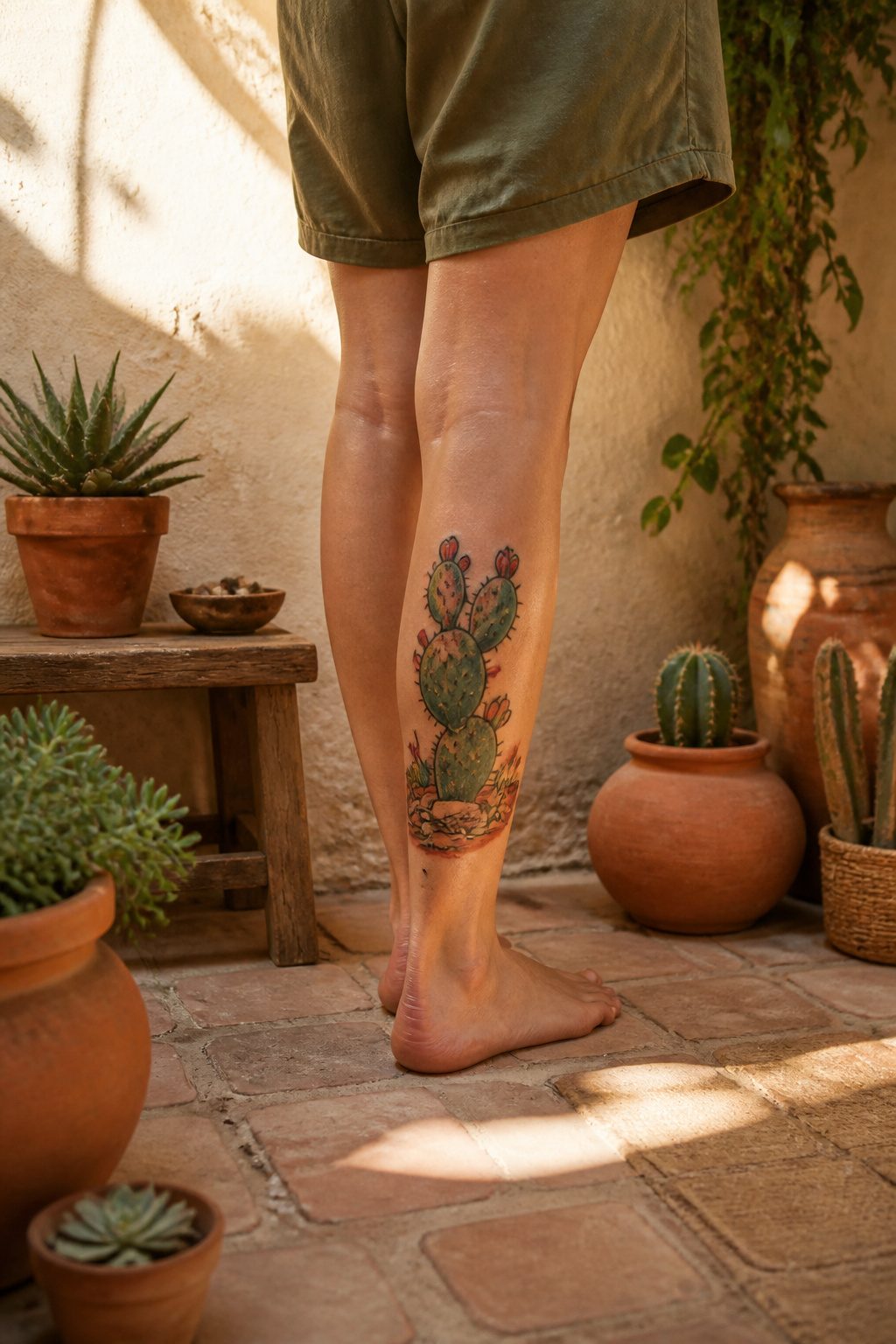
The nopal cactus carries weight that desert Americana imagery usually skips. On the Mexican flag it marks Tenochtitlan, literally "the place of the cactus rock," and for the Aztecs it was never just scenery. Art historian Renee McGarry notes that cactuses served as boundary markers and as points where heaven, earth, and underworld met, limiting the universe at times and expanding it at others.
That layered meaning is what separates a Mexican cactus tattoo from the stripped-down Southwestern style you see on Arizona tourism boards. Where Americana desert ink tends toward empty-space minimalism, the nopal arrives loaded with survival and sacred geometry, the same plant feeding people and marking cosmic thresholds.
Your design choices split here too. A single paddle in fine line blackwork reads as heritage shorthand, quiet enough for a wrist or behind an ear. Build it into a larger piece and the spines, the fruit, the red beetle cochineal that lives on it, all become available as detail work. Color shifts the register: the deep green of living nopal against pink fruit looks like folk art, while a bleached skeleton-style cactus in black and grey lands closer to Chicano blackletter traditions.
Placement stays open, though the shape helps. A tall columnar species like saguaro, vertical and reaching, fits a forearm or calf. The nopal’s spreading paddles work better on a shoulder or thigh where the form can open without distortion.
The risk is flattening it into generic "desert" iconography. Ask the artist whether they know the difference between nopal and saguaro, and whether the design includes the fruit, the spines, or the beetle that produces the red dye. Those specifics are what keep the tattoo Mexican rather than just arid.
8. Virgin Mary Tattoos
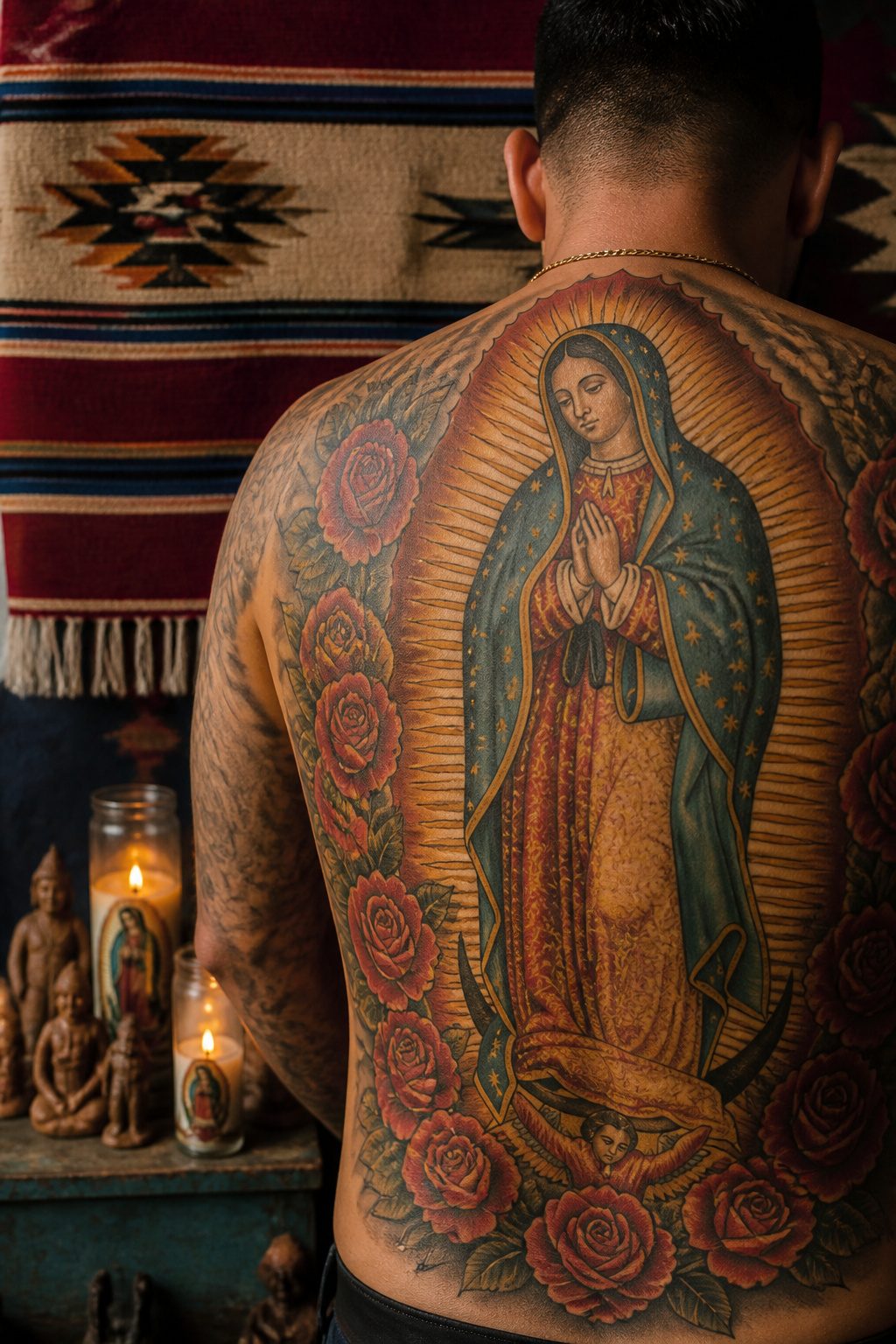
The Virgin of Guadalupe sits at the center of most Mexican and Mexican-American Virgin Mary tattoos, and the difference between her and a generic Madonna matters. Artists working in this tradition know her by the dark blue mantle, the standing moon, the rays of light that frame her. She is not distant or crowned in gold; she is down-to-earth, loving, and humble, someone the wearer can talk with, sing to, dance with daily.
Faith here looks like access. The imagery carries motherhood not as an abstract ideal but as lived protection, the kind a woman might call on for her children or her own mother called on for her. Feminism enters through that same door: a saint who appeared to an indigenous man, who spoke Nahuatl, whose image became a banner for justice movements and community struggle. Chicano tattoo tradition picked this up directly, placing her alongside roses, tear-streaked women, and portraits of Jesus.
Black and gray work dominates for these pieces, delicate etching that lets the serene gaze do the heavy lifting. The back is common placement, large enough for the full portrait with its mantle and rays. Smaller versions exist, but the detail suffers; the face needs room to breathe.
What you are choosing is not just religious heritage but a specific relationship to it: the Virgin as companion rather than authority figure. That distinction separates a Guadalupe tattoo from other Catholic imagery, and it is why the design has outlasted trend cycles that swallow less rooted symbols.
9. Chicano Tattoos

Chicano tattoos carry a visual language built from the 1960s Chicano Movement, when Mexican-Americans demanded civil rights and cultural recognition after generations of discrimination following the Mexican-American War. The style that emerged speaks to that specific experience: black and grey realism with deliberate white highlights, lowrider culture references, religious imagery of Jesus and the Virgin Mary, and the payasa, a female clown figure marking the duality of struggle and survival in Mexican-American communities.
The distinction from tattoos made in Mexico matters. Where Mexican tattooing often draws on indigenous heritage, national symbols, or folk art in full color, Chicano work is rooted in the borderlands, in barrio life, in the political act of claiming space in a country that questioned belonging. Roses, tear-streaked women, gang imagery, and clown masks appear not as decoration but as documentation, a community-based art tradition continued on skin.
Sources disagree on whether color belongs in the style at all. Some Chicano pieces incorporate sugar skull vibrancy; others stay strictly monochrome. The question is less about rules than about what you are claiming: a heritage across borders, or a specifically Mexican-American identity forged in resistance.
10. Traditional Mexican Tattoos
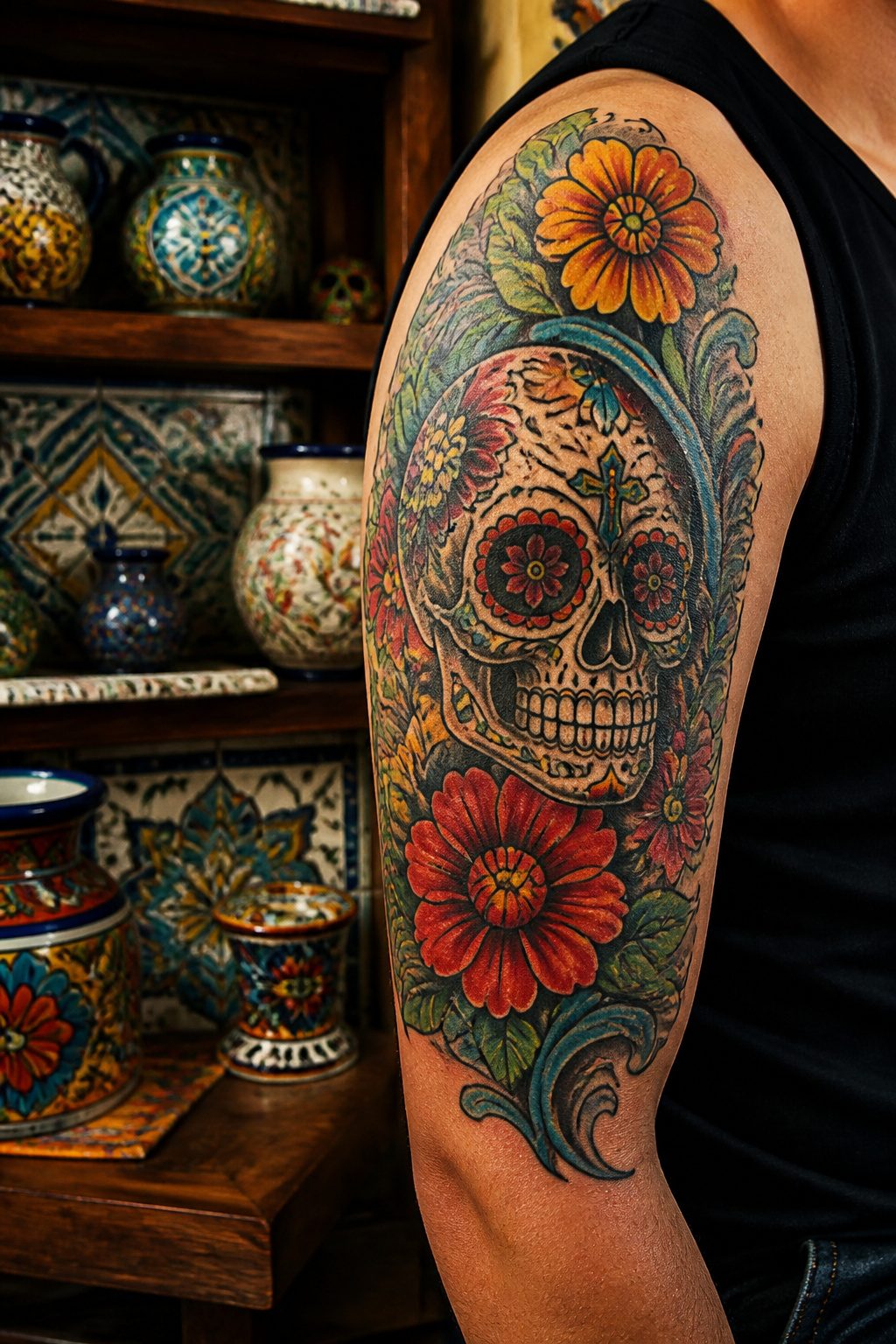
Traditional Mexican tattoos draw from a palette that makes them unmistakable: reds, blues, and yellows laid in with enough saturation to read across a room. The sombrero-wearing woman in classic flash sheets is one recognizable figure, but the broader category covers any piece where color itself carries the heritage signal rather than just decorating it.
What separates these from, say, a bright neo-traditional panther is the motif set. Calaveras lead, but so do portraits rooted in Chicano identity, folk-art patterns, and the visual language of daily Mexican life rendered large. Sources note the upkeep runs demanding, which makes sense: those saturated pigments need skin that holds them and a wearer willing to commit to the aftercare.
The distinction between heritage celebration and generic "vibrant tattoo" comes down to specificity. A rose is a rose until it is paired with the right banner, the right color temperature, the right regional detail. The same red that reads Mexican folk art in one composition reads Sailor Jerry in another. Placement tends toward arm, chest, or back, where the scale lets the color blocks breathe and the detail work does not crowd itself silent.
If you are weighing this against the more defined categories, traditional Mexican work offers flexibility at a cost: without the instant readability of an Aztec glyph or a named saint, the piece leans harder on the artist’s understanding of the culture to avoid drifting into costume.
Symbolism and What These Tattoos Mean
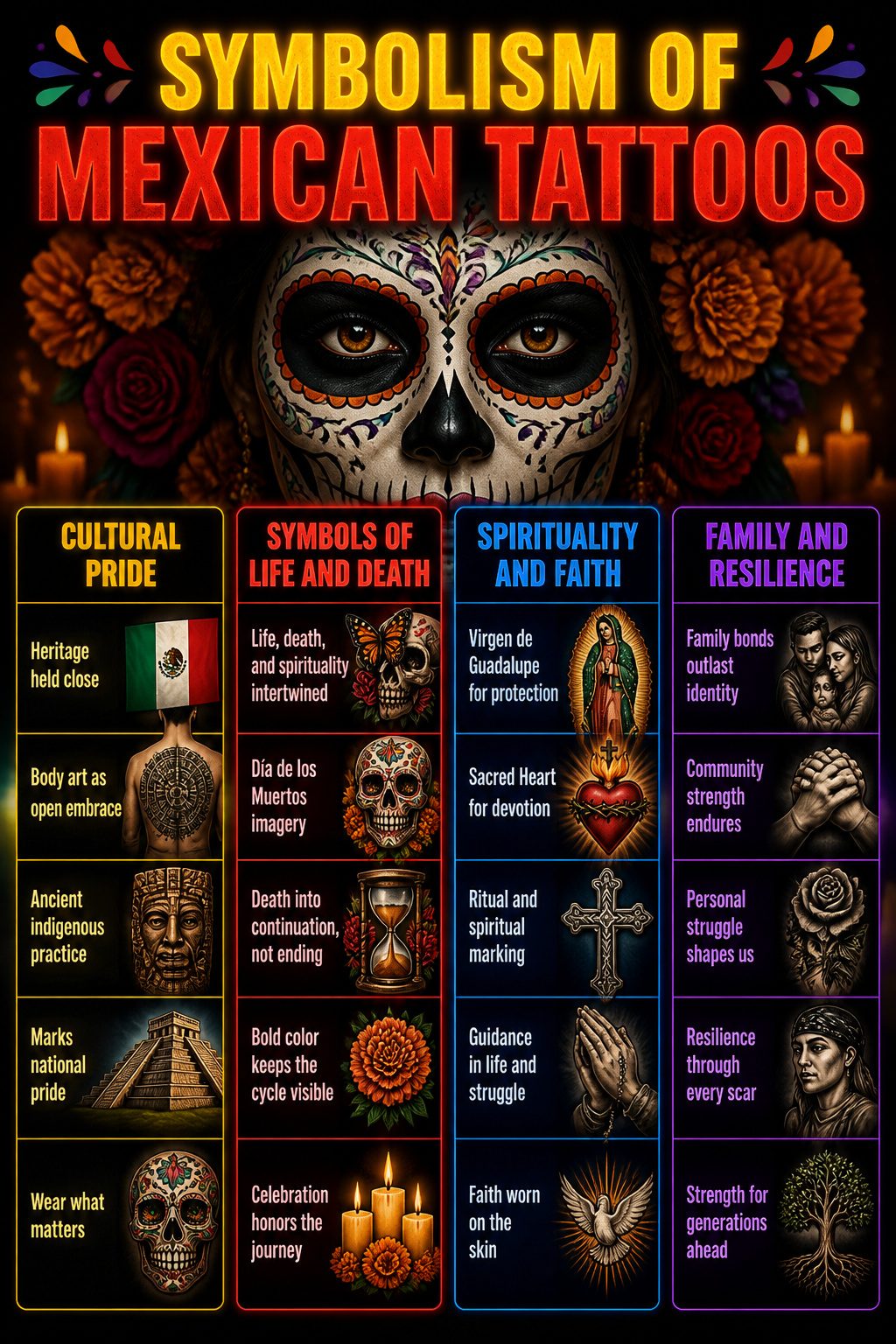
Mexican tattoos carry weight because the culture itself treats body art as an open embrace rather than a mark of shame. Pride runs through every design, whether the wearer was born in Mexico or simply holds the heritage close.
The recurring themes are life, death, and spirituality, often intertwined rather than separated. Día de los Muertos imagery turns death into continuation, not ending: sugar skulls, bold color, and celebration keep the cycle visible. Ancient indigenous practice set this tone long before modern tattooing, using body art for ritual and spiritual marking rather than mere decoration.
Faith appears in symbols like the Virgen de Guadalupe for protection, the Sacred Heart for devotion. Family and resilience surface as often as any single icon, reflecting community bonds that outlast individual identity. A Mexican tattoo can mark national pride, personal struggle, or both at once; the style varies by person, but the function stays constant. It is a way to wear what matters without explaining it every time.
Cultural Significance and Modern Practice
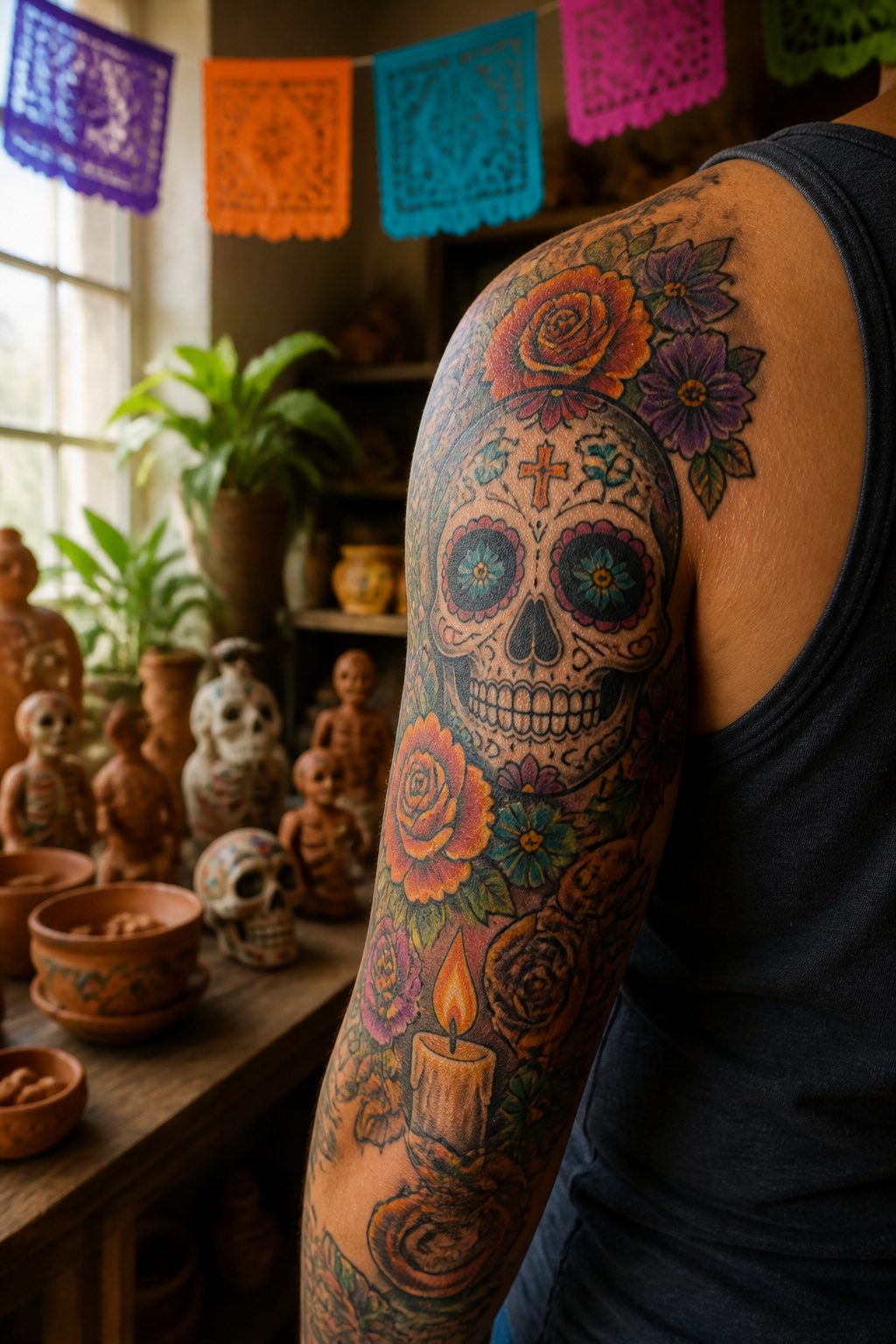
Tattooing in Mexico carries a lineage that runs from ancient ritual to personal declaration. The Aztec and Mayan civilizations used body art to mark status, religious devotion, and achievements earned through specific rites. That same impulse, the need to wear meaning on the skin, persists now in different form. Contemporary Mexican tattoos often draw from Día de los Muertos imagery and indigenous symbols not as costume but as lived connection to heritage, family memory, and the resilience those traditions represent.
What changed is who controls the narrative. Where ritual specialists once applied markings with spiritual authority, today’s wearer chooses the symbol and the story together. The shift carries risk. A sugar skull or Aztec motif separated from its context becomes decoration, and the wearer may not know what they have flattened. The artists who do this well, in my observation researching how shops handle these requests, ask questions before they stencil anything. They want to know whether the design marks a specific loss, a family lineage, or a broader cultural pride, because the answer changes how the work should sit on the body.
Color and intricacy have their own vocabulary in this tradition, drawn from Mexican folk art’s density of pattern. But density without grounding reads as noise. The tattoos that hold up over years, the ones collectors point to as worth the skin they occupy, are those where the person wearing them can name why the symbol matters beyond its visual appeal. That naming is the modern practice, and it is harder than it looks.
Popular Styles and Finding an Artist
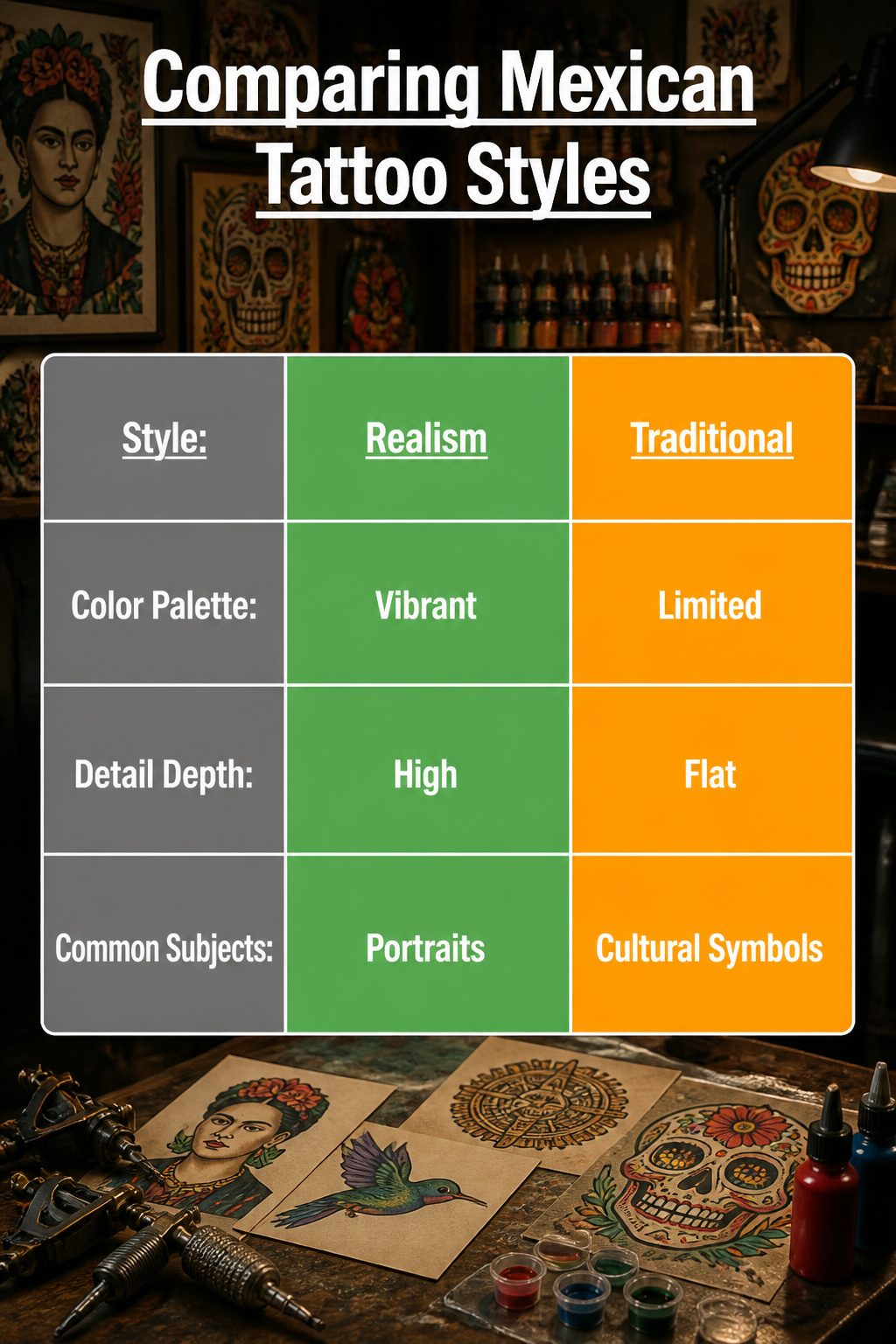
A Mexican tattoo can mean a lot of things, but the style you choose changes what the symbol actually says. Realism, traditional, and neo-traditional are the three approaches most artists use for Mexican subject matter, and each carries a different weight.
Realism works well for portraiture, whether that is Frida Kahlo’s face or the detailed feathers of a hummingbird. The traditional style, with its bold lines and limited color palette, reads closer to American classic tattooing and tends to flatten the cultural symbols rather than celebrate their complexity. Neo-traditional splits the difference: bolder outlines than realism, more color variation and depth than strict traditional, so an Aztec sun stone or a sugar skull keeps its detail without looking like a photograph.
When you are looking at an artist’s portfolio for a Mexican-themed piece, check whether they have rendered the specific symbols before, not just whether they can tattoo well. An artist who has worked with Day of the Dead imagery understands how the skull’s decorative elements read at different sizes, and that matters if you want the marigold petals to stay legible five years out. Ask to see healed photos, not just fresh work. Color saturation in Mexican folk-inspired palettes, those deep reds and cobalt blues, fades differently than black and grey, and an artist who tracks their own healed pieces is one who has already done the learning you do not want to pay for.