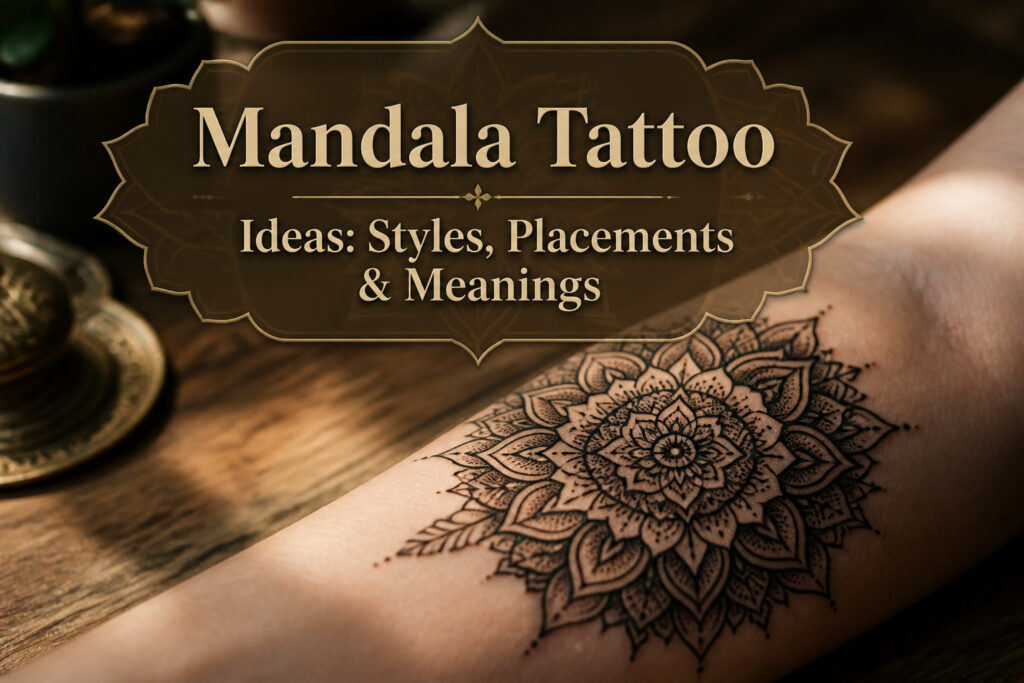
A mandala tattoo can run from a 45-minute wrist piece to a 40-hour full back commitment, and the deciding factor is not budget but how much symmetry your skin can hold over decades.
Watercolor bleeds where blackwork holds; the inner elbow distorts what the shoulder keeps flat. Kenny at Mr. Inkwells maps band placements to avoid the joint flex that ruins sleeves.
The detail that separates a piece that lasts from one that dissolves is whether the design was redrawn for your specific curve, not pulled from a circle meant for paper.
1. Watercolor Mandala Tattoo
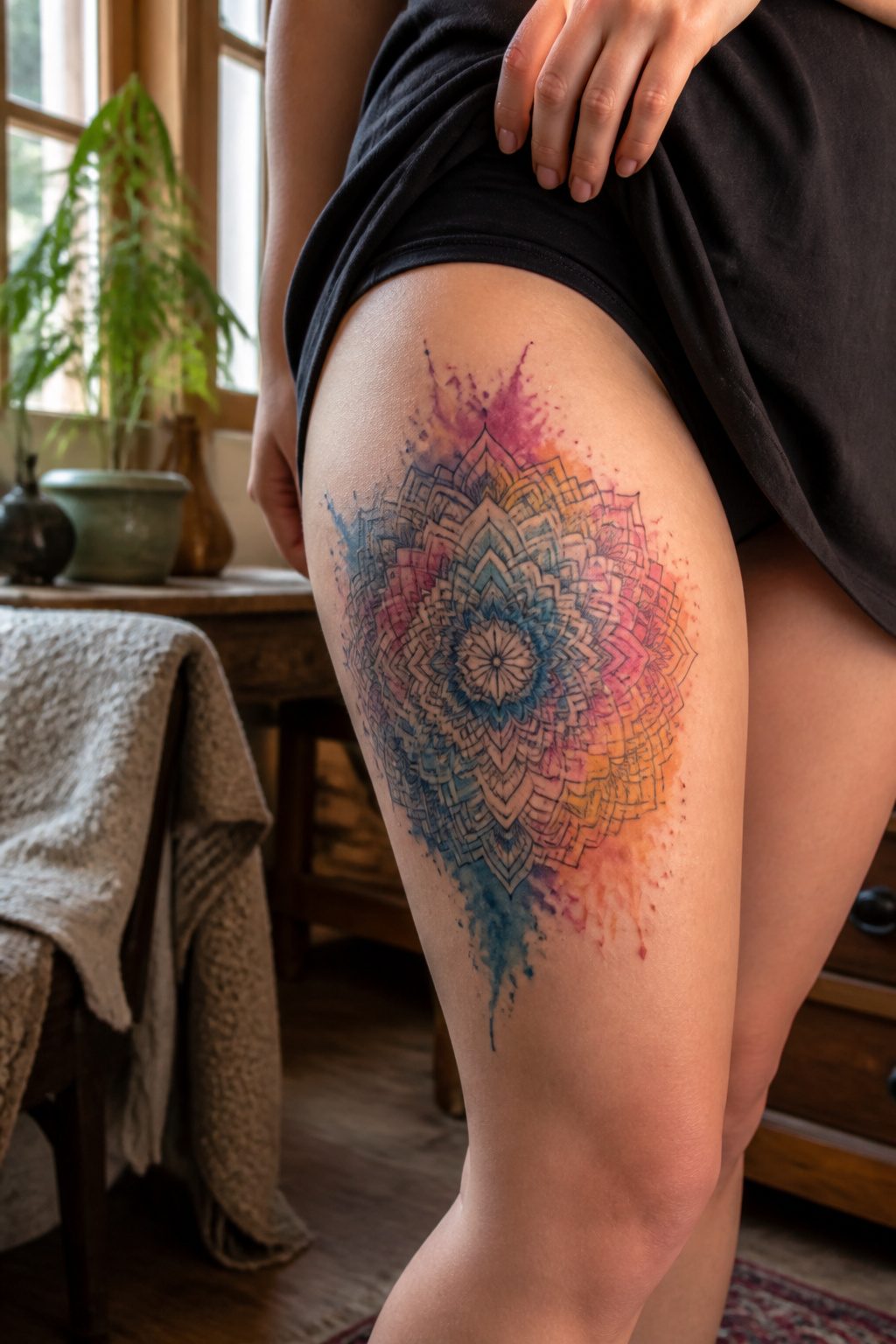
Watercolor washes can sit behind a mandala or fill it completely, and the effect is entirely different from traditional black linework. Where a standard mandala relies on crisp geometry, watercolor lets color bleed and transition without hard edges between tones.
That softness creates something whimsical, almost dreamlike, against the structure underneath.
The contrast between the two approaches is also the catch. Mandalas are built on precision, every line calculated and symmetrical.
Watercolor, by nature, moves where it wants. The fluid technique fights the design’s need for clean edges, and over years that tension shows.
A watercolor mandala will soften faster than its black-line cousin. The colors feather, the boundaries blur, and the geometry that made it a mandala in the first place starts to dissolve.
I would not put this somewhere the sun hits daily. The back, the upper thigh, anywhere a shirt or pants covers, that is where the investment lasts.
If you want the color, plan for the upkeep.
2. Minimalist Mandala Tattoo
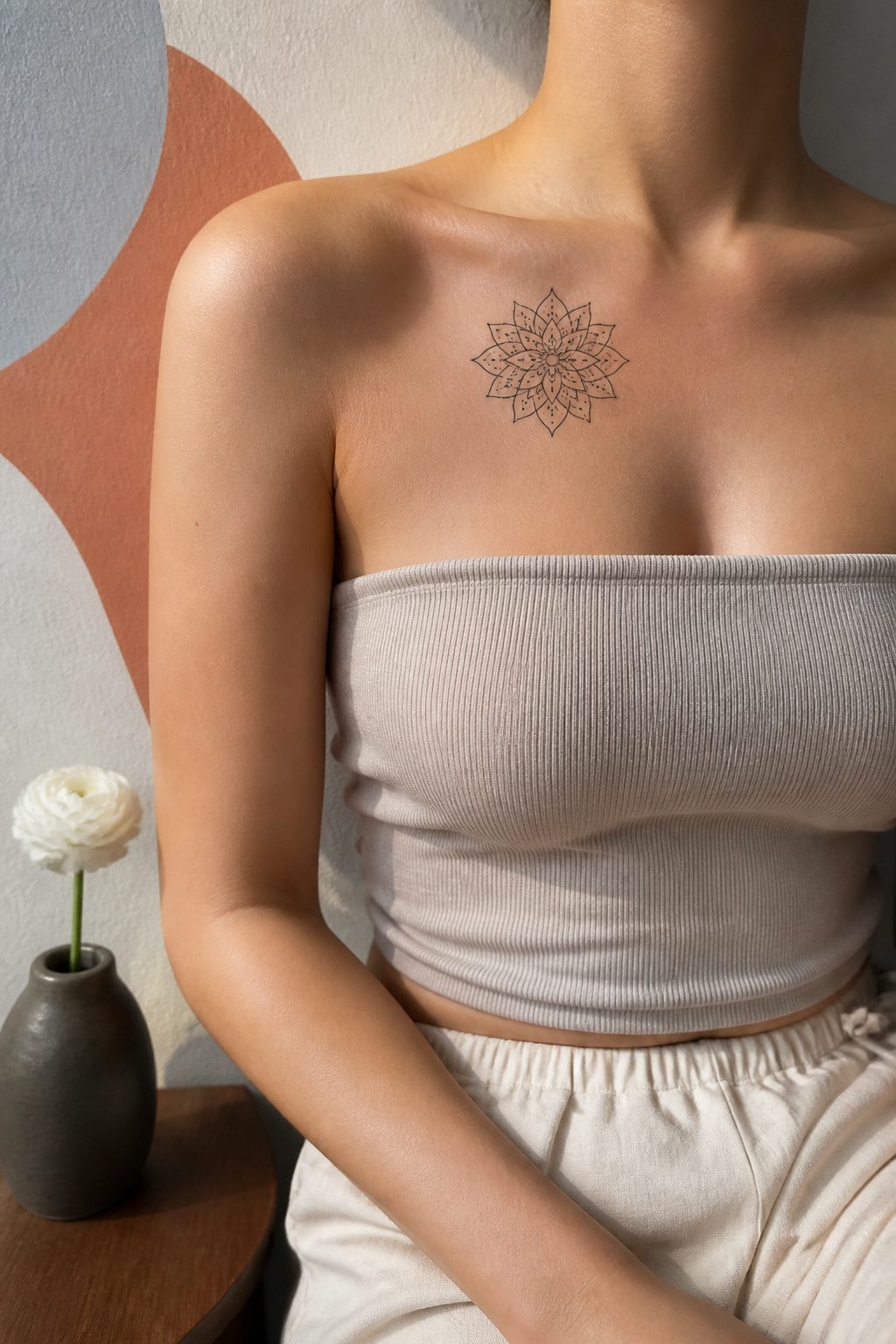
A minimalist mandala tattoo strips the form down to a central point, a few radiating layers, and clean geometric shapes.
Thin lines and deliberate open space replace the dense patterning most people picture, and the small scale suits wrists, collarbones, or behind the ear where larger work would crowd.
This restraint is not a reduction but a complete composition in itself. The same symbolic weight remains; what changes is how the design lives on skin over time.
Fine lines spread and soften with age more predictably than heavy black fill, and the negative space around each element gives the ink room to settle without blurring into a solid mass.
A detailed mandala with packed dotwork or saturated black can age into something muddier if the skin shifts or sun exposure accumulates.
The distinction matters when you are choosing between approaches. Ornamental periphery and dense fill read as traditional; the minimalist version keeps the mandala’s visual logic intact while reading as modern restraint.
Collectors who prefer their tattoos to whisper rather than announce tend toward this camp.
3. Mandala Coverup Tattoo
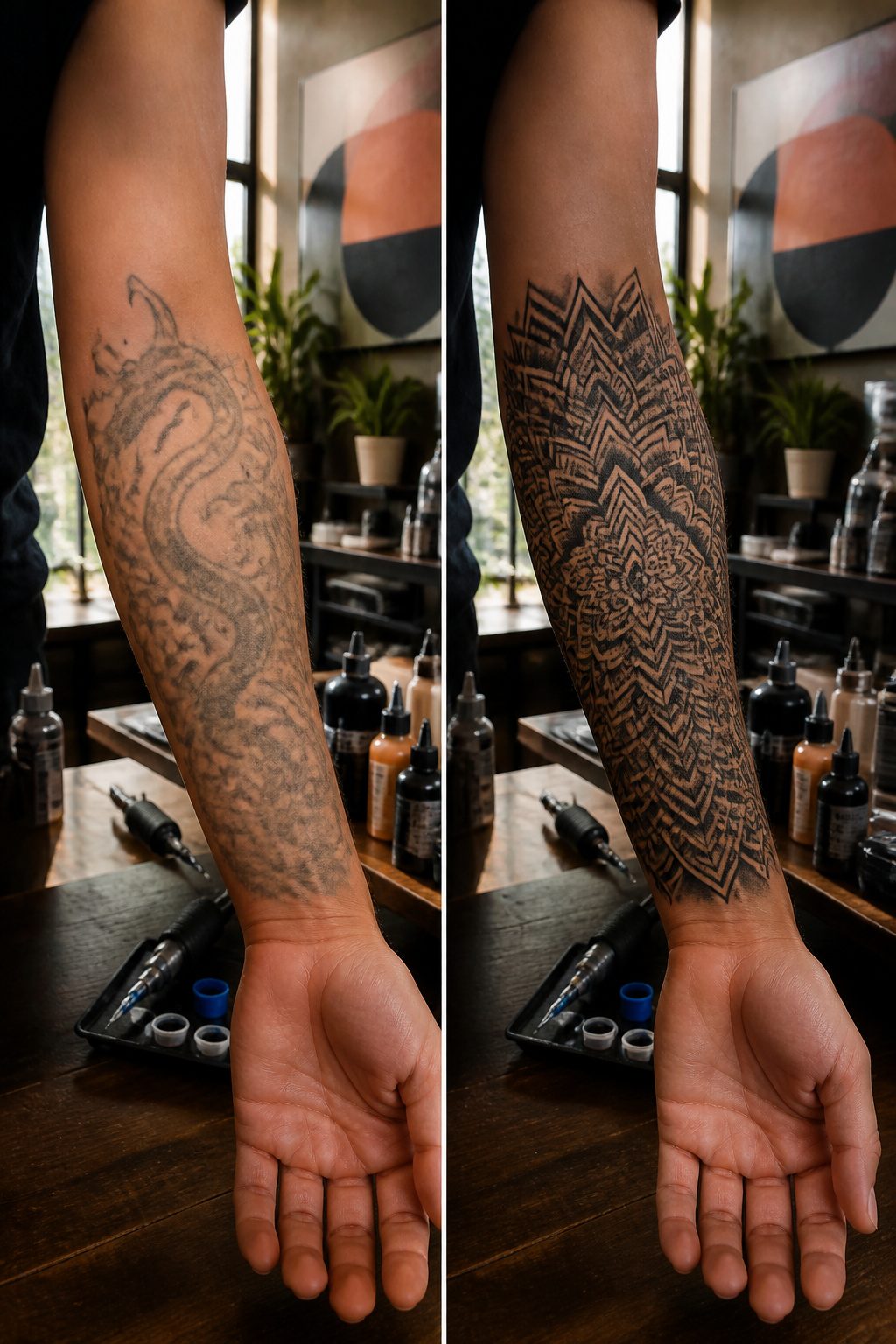
Radial symmetry gives mandala coverups an advantage that freeform designs rarely match. The pattern draws the eye outward from a center point, and dense linework between those repeating sections does the heavy lifting of masking older ink.
More shading makes the coverup more effective because packed blackwork and graduated tones leave less room for the old tattoo to peek through.
The catch is timing. A medium complexity mandala on the forearm, upper arm, or thigh already takes 6–12 hours across multiple sessions.
Add the prep work of designing around existing lines that won’t cooperate with the new geometry, and the chair time stacks up fast.
I’ve watched artists map these out with tracing paper and markers for an hour before the needle touches skin, checking how the old piece distorts when the mandala’s radius expands.
Skip that step and you end up with a beautiful pattern that somehow still frames the ghost of a tribal band or a faded name.
The planning matters more than the pain threshold. A mandala is always geometric; a geometric tattoo is not always a mandala, and that distinction runs straight into coverup work.
The radial structure has to hold, which means the old tattoo dictates where the center sits and how large the piece must grow to maintain clean symmetry.
Your artist needs to see the existing ink healed, not fresh, and needs room to expand. Small coverups that try to stay small usually fail.
4. Reminder Mandala Tattoo
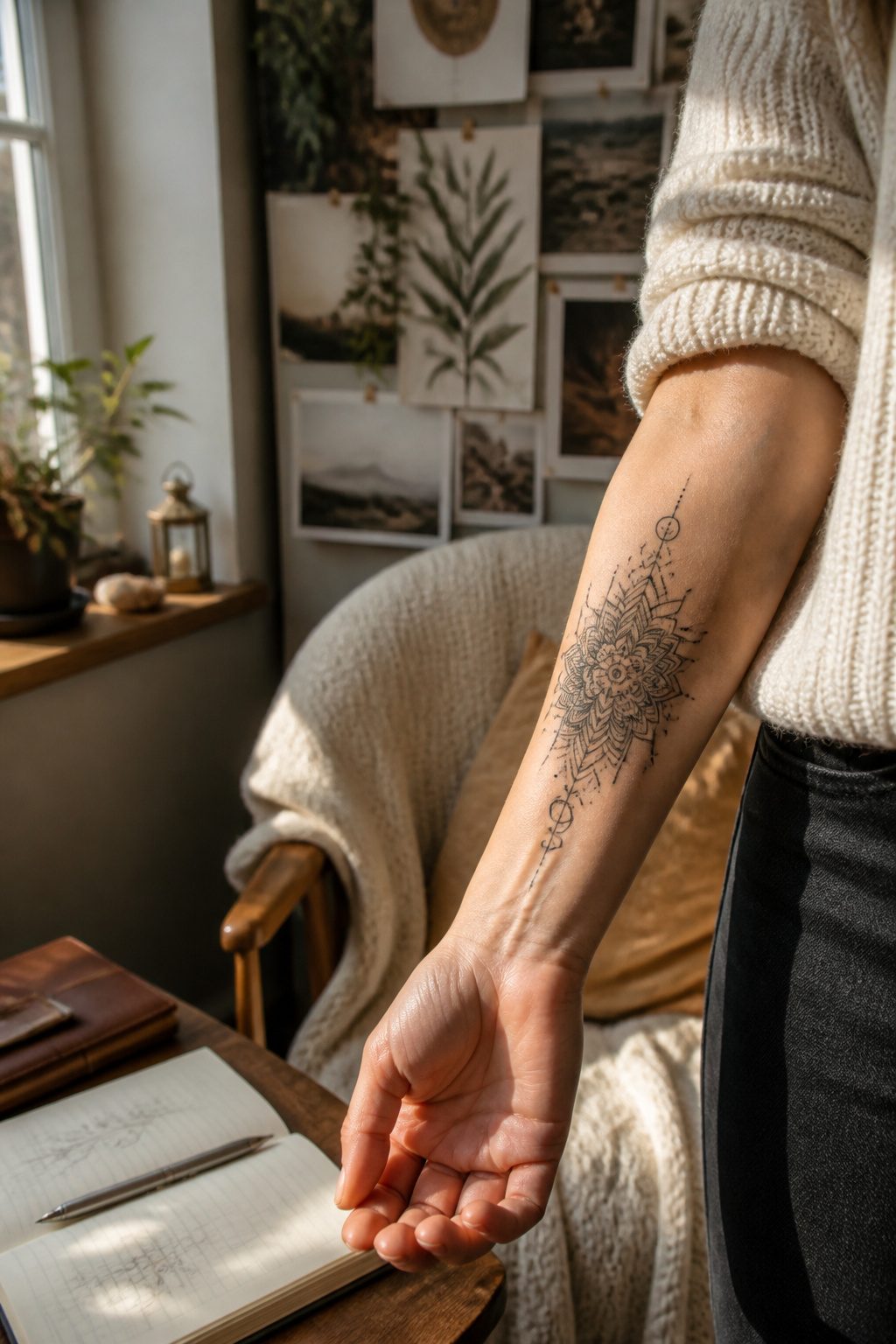
A reminder mandala tattoo works best when the symbolism is built around your own intention rather than borrowed from traditional spiritual meaning.
The Sanskrit root of "mandala" means circle, and that shape of wholeness becomes a private anchor when you place it somewhere your eye lands daily.
I have seen clients lose sight of why they got a piece because the imagery spoke to someone else’s story, not theirs.
The center point can stand for a core value you are trying to hold onto, and the layers radiating outward can map a transformation you are still living through.
Keep the design visible to you, not tucked away for others to notice, or the reminder function fails.
A wrist, forearm, or upper arm placement puts the mandala in your line of sight during ordinary moments, when the reminder actually matters.
5. Elephant Mandala Tattoo
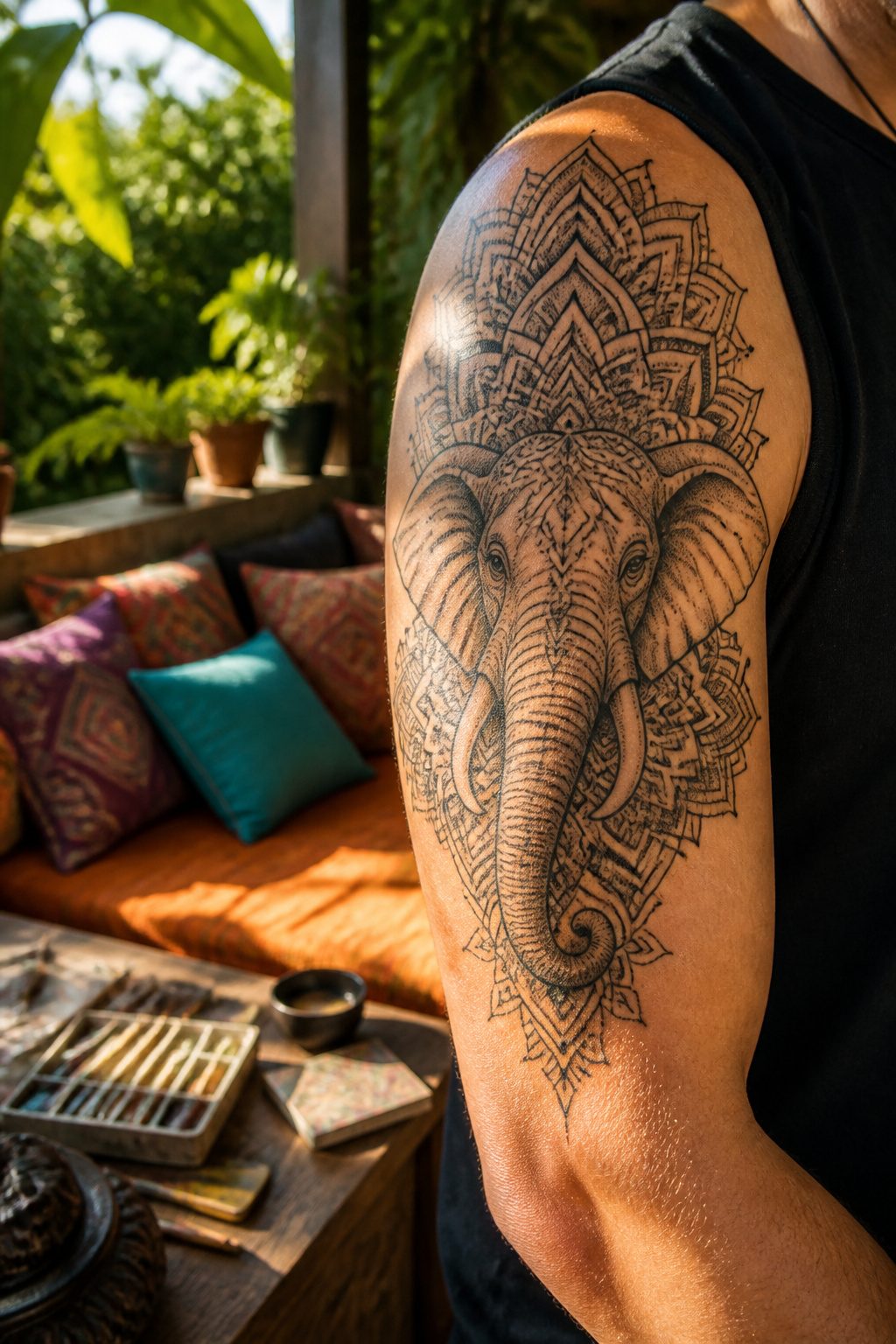
An elephant mandala tattoo builds the animal’s silhouette from radial geometric patterns or wraps the trunk and ears inside a larger mandala frame.
The pairing carries real weight: elephants stand for wisdom, calmness, and prosperity in the traditions that shaped both symbols, while the mandala’s repeating geometry was born from the same Sanskrit roots in Hinduism and Buddhism.
Layering the two does not just decorate; it pushes the spiritual reading further, the kaleidoscopic structure making the whole form look sacred rather than illustrative.
The technical demand runs high. Geometric mandalas already rank among the most difficult designs in tattooing, and an elephant’s anatomy adds curves that fight the radial symmetry.
Hand-poked work, the bamboo method still used in Thailand, holds the lines cleaner on curved skin than a machine for this particular combination.
The shape of the ear or the sweep of the trunk can swallow detail that would read fine on flat paper, so the artist has to map the density carefully.
I have watched sessions where the mandala filigree won and the elephant’s weight disappeared, and others where the animal dominated and the geometry looked like mere background.
The balance is the whole point, and it takes an artist who has done the math on both halves.
6. Floral Mandala Tattoo
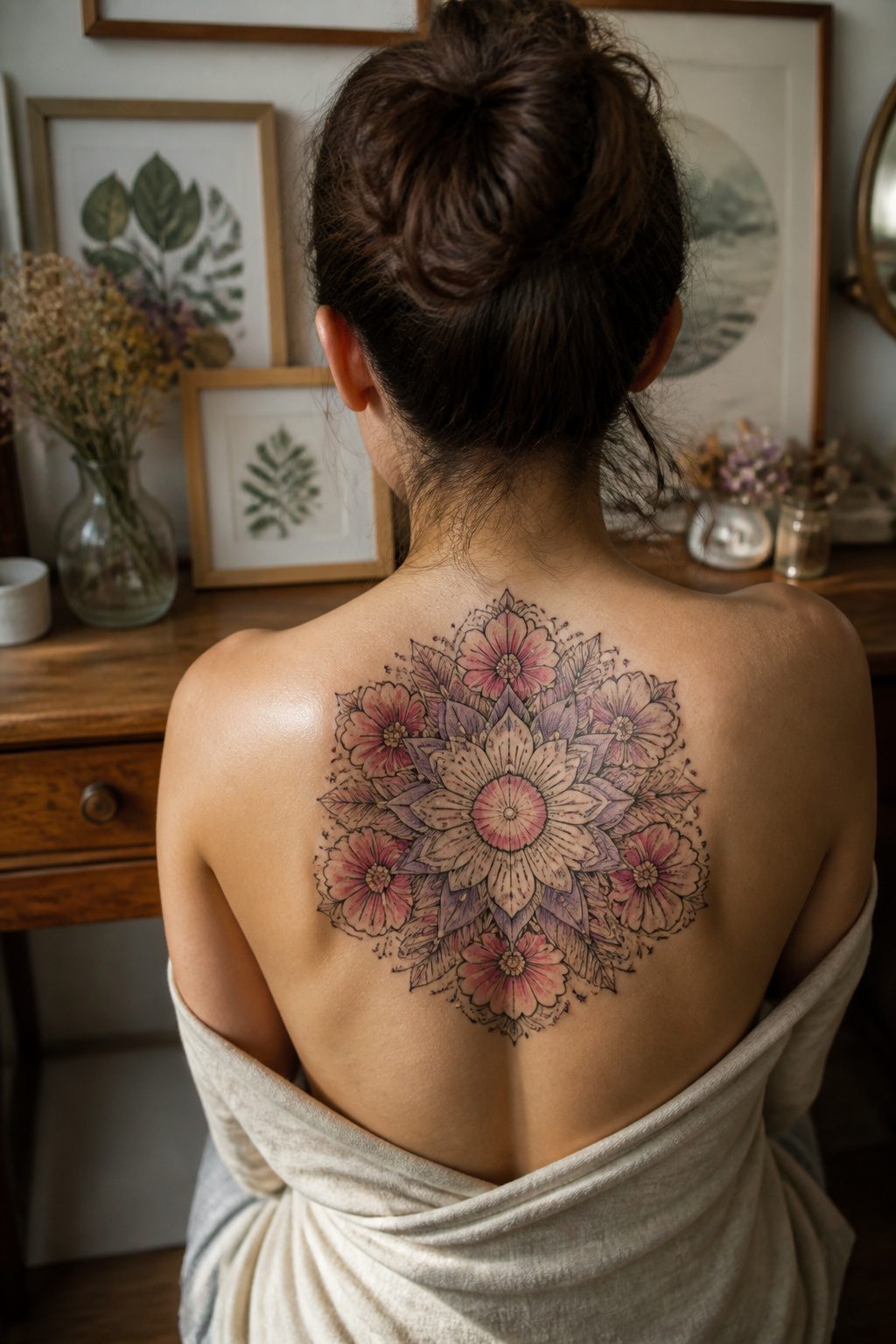
Petals radiate from a center point in a way that already is mandala geometry. A flower’s natural architecture, with its repeating segments fanning outward, translates into tattoo work almost without forcing the shape.
The lotus gets its own subset here for good reason: in the Buddhist and Hindu traditions that originated mandala art, the lotus carries specific weight as a symbol of purity and spiritual awakening, its growth from muddy water into clean bloom mapping onto the same idea of inner work that mandalas represent in meditation practice.
The petal count and layering become your guide for how dense or open the design reads on skin.
A six-petaled lotus center can stay delicate enough for a wrist or ankle, while stacked outer rings of leaf forms and geometric fillers build toward something that holds up on a shoulder or back piece.
I’ve watched this bridge between botanical tattooing and hard geometry work best when the artist lets the flower’s natural curves soften the mandala’s precision rather than fighting it; too much rigid symmetry kills the living quality, too little and the mandala structure collapses into busy floral wallpaper.
The meaning layers add something you don’t get with pure geometry. Purity, faithfulness, the reminder not to give up when conditions are muddy, those come built into the lotus form itself.
Whether that matters to you depends on whether you wear symbolism as personal anchor or as aesthetic choice; the design works visually either way, but the depth is there for people who want it.
7. Neo-Traditional Mandala Tattoo
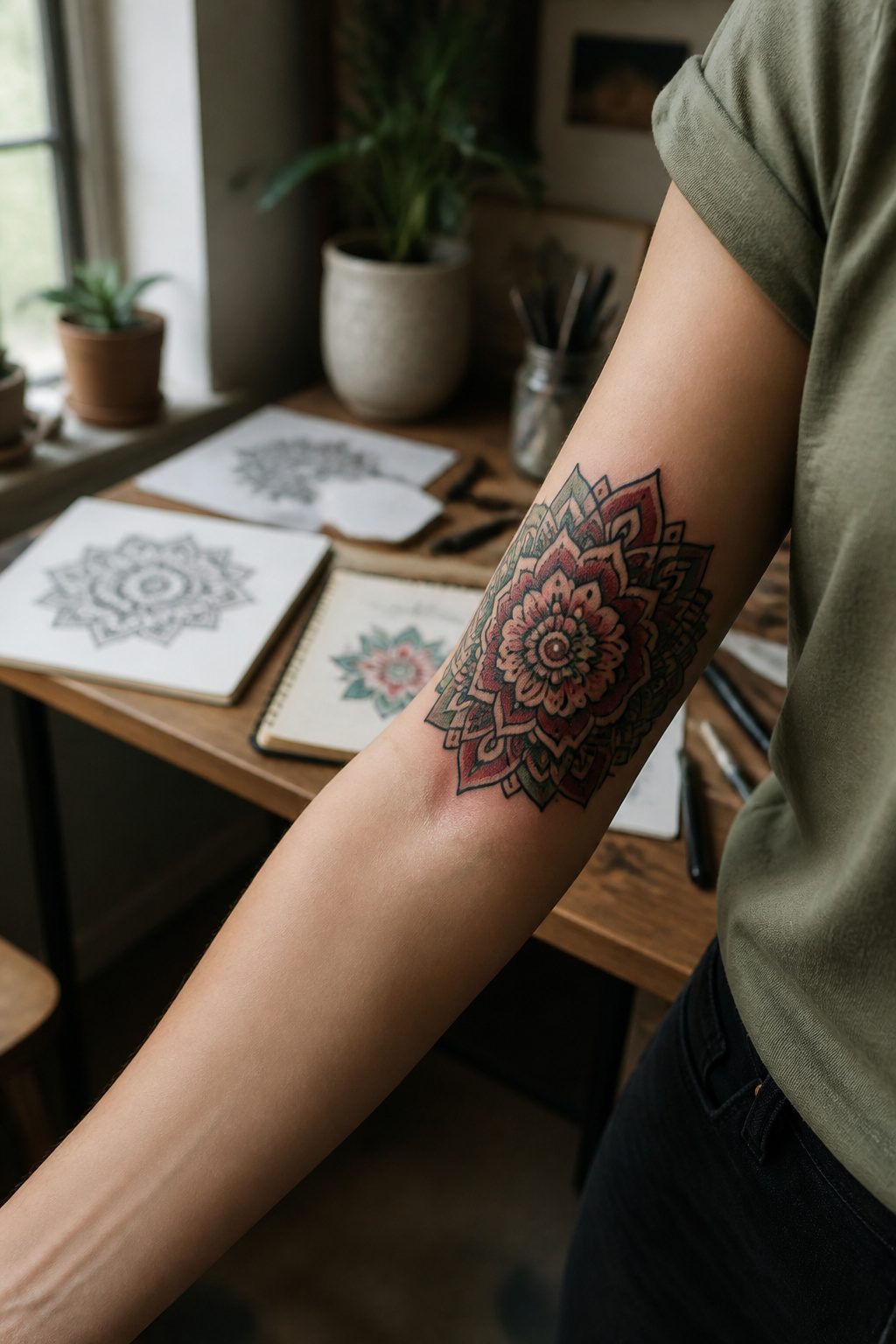
Neo-traditional mandala tattoos take the radial geometry of classic mandalas and push it through a filter that prizes bold, unbroken outlines and a deliberately narrow color range.
The palette stays tight, maybe three or four saturated hues at most, but each one hits at full strength rather than fading into gradients.
Illustrative shading builds volume through clean transitions rather than the soft, airbrushed effects you see in realism.
This is where the style splits from traditional American work. Old-school American tattooing leans on heavy black, a limited set of archetypal images, and flat color packed into skin with almost no visible shading technique.
Neo-traditional borrows that confidence in line weight and the commitment to readable, long-lasting color, but it loosens the subject matter and gets more sophisticated with how light and shadow get rendered.
A traditional mandala might read as a symbol first and an image second; neo-traditional treatment makes the mandala read as an object sitting in space, with petals or geometry that catches light from one direction.
The style works best when the mandala’s complexity is built into the linework itself, because the color blocks need room to breathe.
Too many competing hues and the neo-traditional discipline falls apart; too little and you are back in traditional territory.
What convinced me, looking through portfolios of artists who specialize in this, is that the best pieces use color almost as an accent to the geometry rather than the main event.
8. Delicate Mandala Tattoo
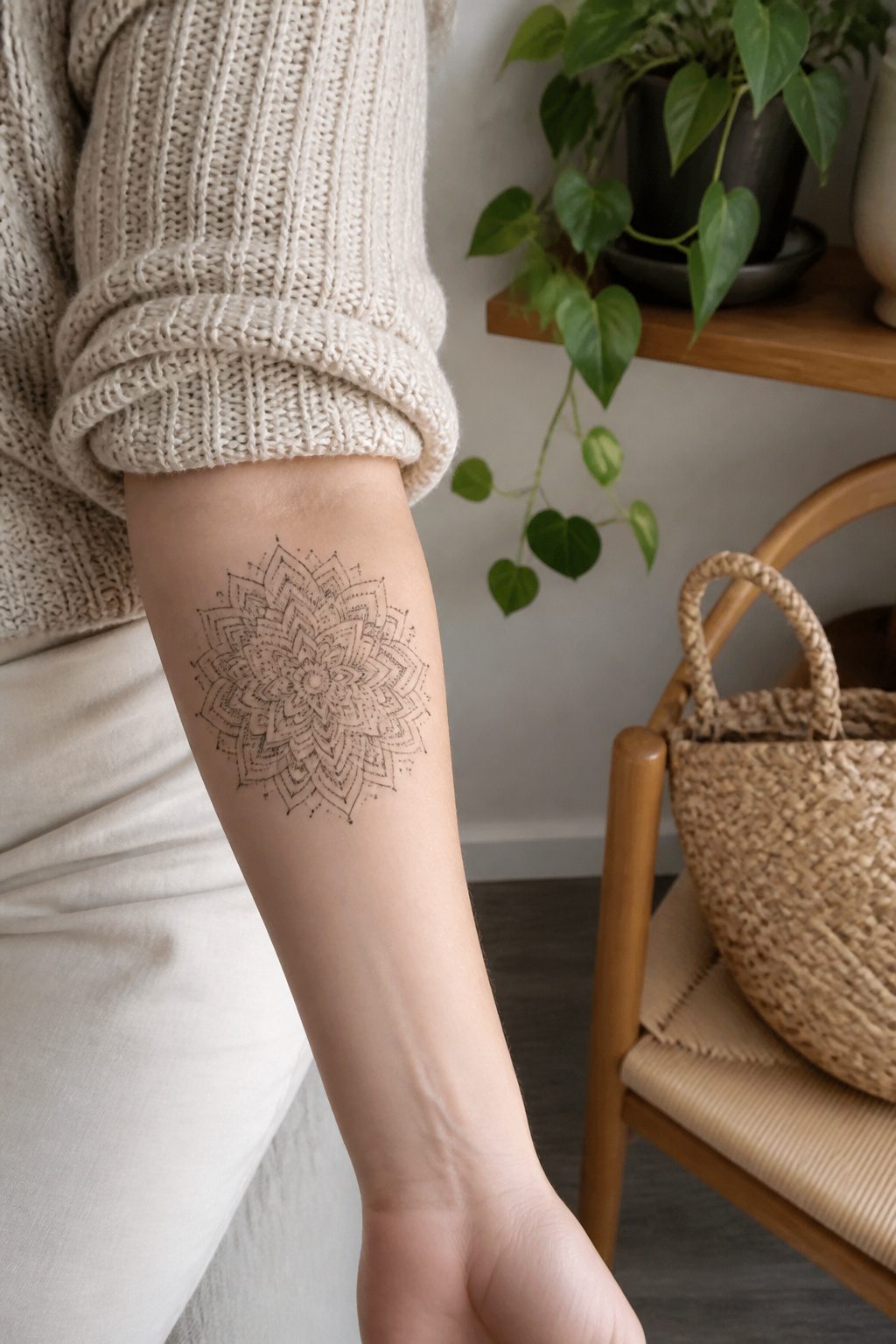
Fine-line mandala work lives or dies by the needle width.
The 0.25 mm grouping that shows up in this style leaves no room to hide a wobble; every radiating layer has to be laid down in a single pass or the ink mushrooms and the geometry collapses.
I have watched apprentices learn this on inner elbows, where the skin stretches and settles unpredictably, and the ones who succeed treat the area like it is made of wet paper.
A lighter gray wash paired with the black, not instead of it, keeps the mandala from reading as a bruise from a distance.
Flat placement matters more here than with heavier styles.
The symmetry of a mandala needs a stage where both halves settle evenly; shoulders and forearms give that, but the inner elbow calls for a smaller diameter and fewer layers so the design does not distort every time the arm straightens.
A simple mandala with clean geometric forms and a small number of radiating layers carries the same symbolic weight as a complex one, and on soft areas that is the smarter composition.
The chest and back work for larger pieces, but for this lightweight aesthetic the smaller placements win; restraint reads as intention, not as something left out.
9. Full Sleeve Mandala Tattoo
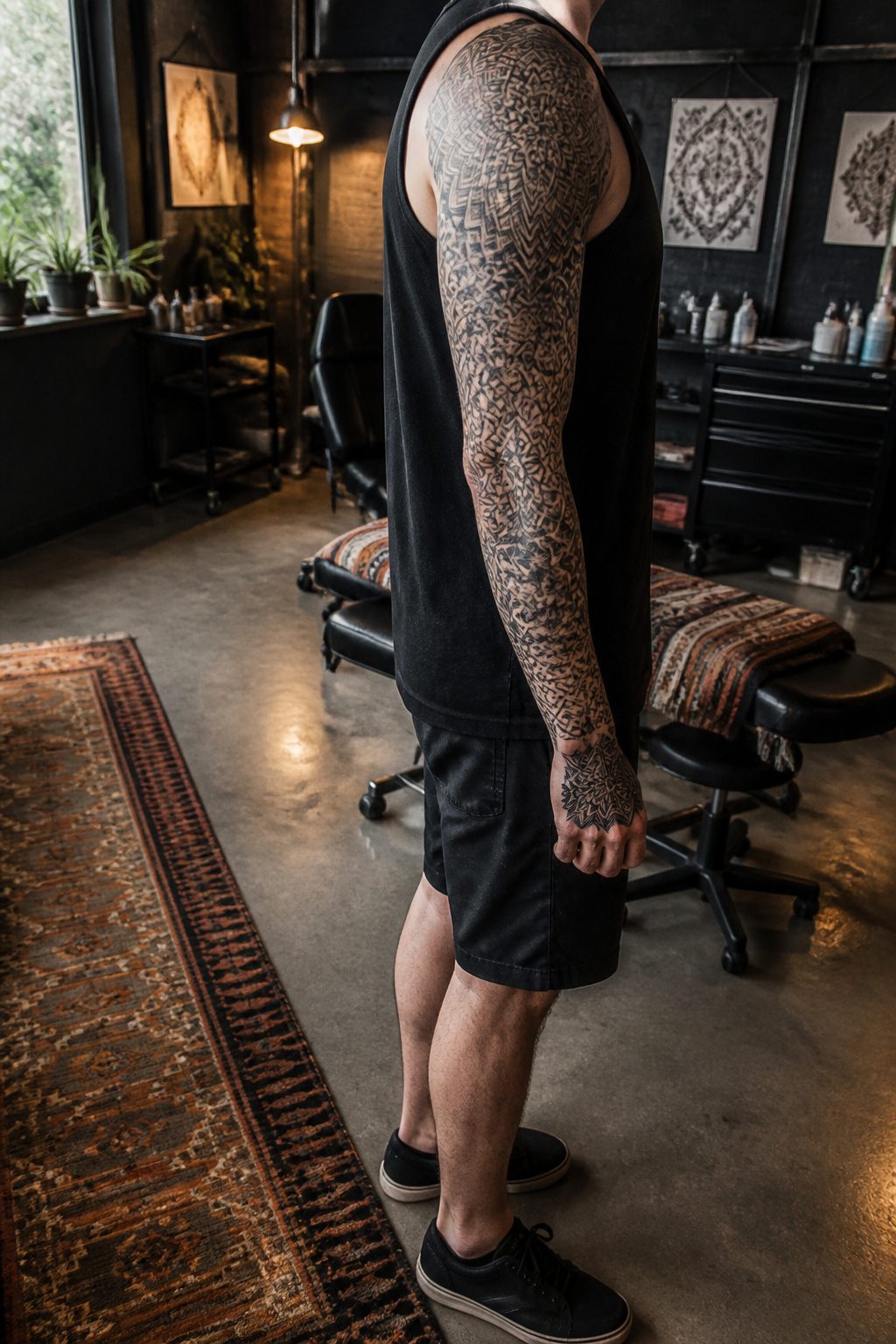
A full sleeve mandala tattoo wraps from wrist to shoulder, and the design either fights the arm’s natural shape or flows with it. The pieces that read best follow the muscle and bone rather than sitting flat like a sticker.
That means the mandala’s center might land at the elbow or the shoulder cap, with petals and geometric rings stretching and compressing to match the forearm’s taper or the bicep’s swell.
The visual payoff is high, but 20 to 40-plus hours is the realistic session commitment for large-scale work, and that is spread across months of healing time.
Blackwork-heavy sleeves, where solid planes of black ink replace fine linework, tend toward the upper end of that range.
The style reads bolder and holds up longer, though it also limits how much the design can be opened up later if you want to add color or surrounding pieces.
Two ways to approach the composition: let the mandala repeat in smaller units down the arm, or build one massive central mandala that dominates the shoulder and fades into supporting geometry toward the wrist.
The single large piece wins for visual impact, but it requires a collector who can sit still through long sessions and a tattooist who maps the flow before the first line goes in.
10. Mandala Back Tattoo
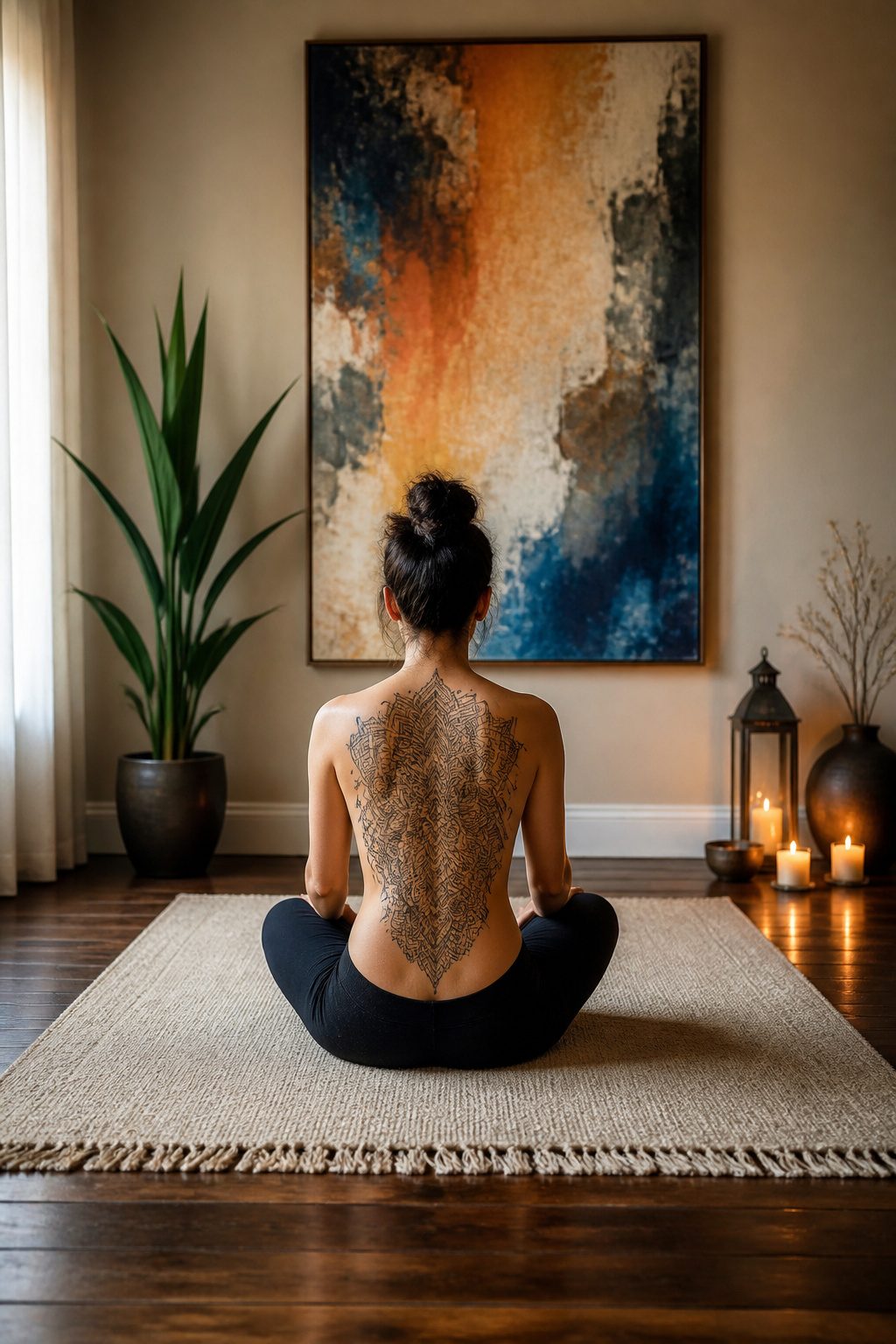
The flat plane of the back gives a mandala what nowhere else can: room to expand outward in perfect symmetry without a joint or curve breaking the pattern.
A full back piece radiating from the upper or lower center becomes one of the most visually extraordinary tattoo compositions possible, with complexity and scale that smaller placements simply cannot match.
I have watched clients sit through the hours this demands. A detailed ornamental back mandala running top to bottom and side to side, with matching triceps pieces that frame the larger work, turns the whole body into a single canvas.
That scale is the point. The back lets an artist build layers of linework and dotwork that would blur together compressed onto a shoulder or forearm.
What convinced me, looking through portfolios of healed work, is that the time investment scales with the symmetry. A large back mandala is not a single session decision.
The flat surface heals more predictably than curved areas, which matters when you are returning for multiple passes to keep those fine details crisp. The tradeoff is the chair time and the commitment to a composition that dominates your silhouette.
For someone who wants the mandala idea at its most commanding, this is the placement that justifies the hours.
11. Armband Mandala Tattoo
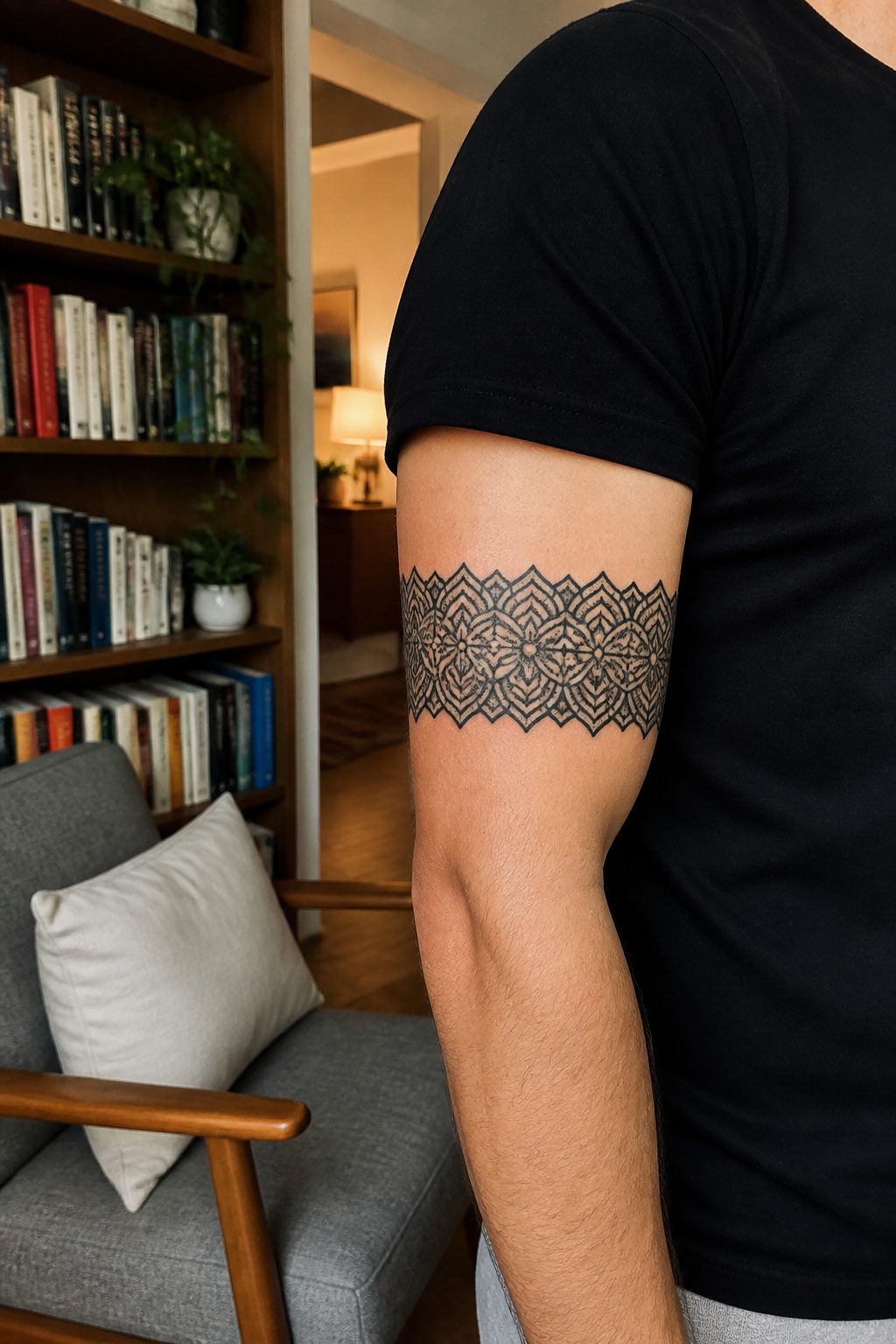
A band mandala tattoo wraps the pattern around the arm in a continuous circle, usually placed on the upper arm just below the shoulder or circling the forearm.
The format keeps the geometry intact without demanding the real estate of a full sleeve. Where a sleeve builds narrative across the whole arm, the band isolates the mandala’s repetition into something self-contained.
I have watched clients hesitate between the two, and the band wins when they want the visual weight without the commitment to elbow ditch and wrist work.
The circle reads from every angle; the sleeve only reads when the arm is positioned for it.
Kenny, who works out of Mr. Inkwells, put it plainly: the band is just the mandala’s natural shape seen from another perspective, and that simplicity is where its character sits.
The placement also ages better. A band on the upper arm shifts less with skin change than a full sleeve, which distributes detail across joints that flex thousands of times a day.
For someone already running a routine that includes sun protection and moisturizer, the band is easier to monitor for fading and simpler to have touched up without booking a second sleeve session.
12. Linework Mandala Tattoo
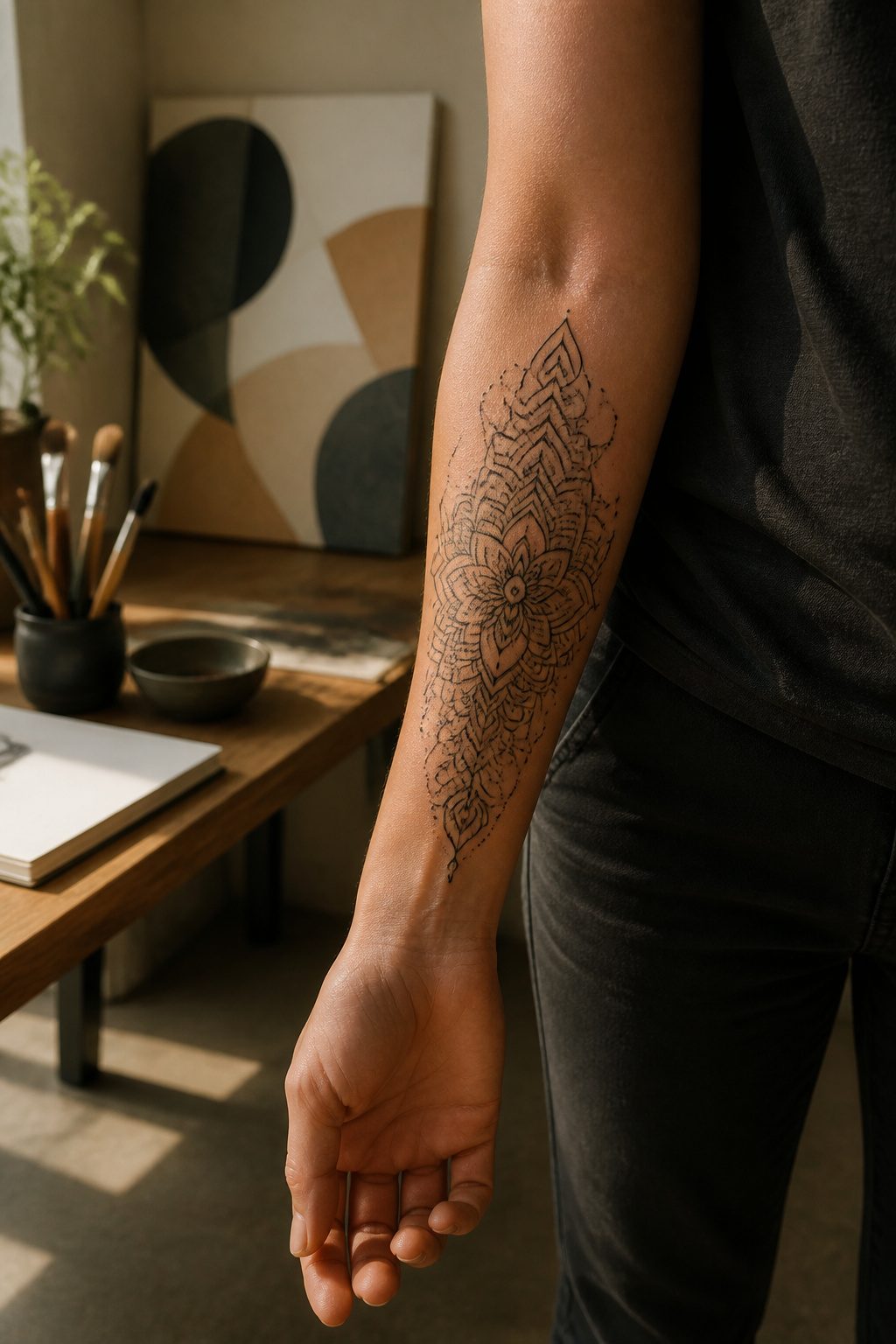
Linework mandalas strip the design down to consistent line weight with no shading at all, letting the geometry itself carry the whole piece.
The pattern and precision do the work that color or gradient would otherwise handle, which means every circle and petal has to be drawn clean the first time. There is nowhere for a wobble to hide.
Dotwork builds tone through stippled points, and blackwork fills large areas solid, so both read heavier on skin.
Linework sits lighter, closer to a pen-and-ink drawing, and tends to age sharper because there is no saturated black to soften or blur.
A traditional mandala can get intricate enough to feel crowded; linework keeps the detail readable by spacing it out and trusting the eye to follow the line rather than the contrast.
The style pairs well with decorative additions if you want them. A name, a date, or a small symbol tucked into one quadrant still reads clearly because the surrounding geometry stays open.
What you gain in clarity, though, you trade for coverage: scars or existing ink underneath may show through where a shaded piece would camouflage.
13. Neck Mandala Tattoo
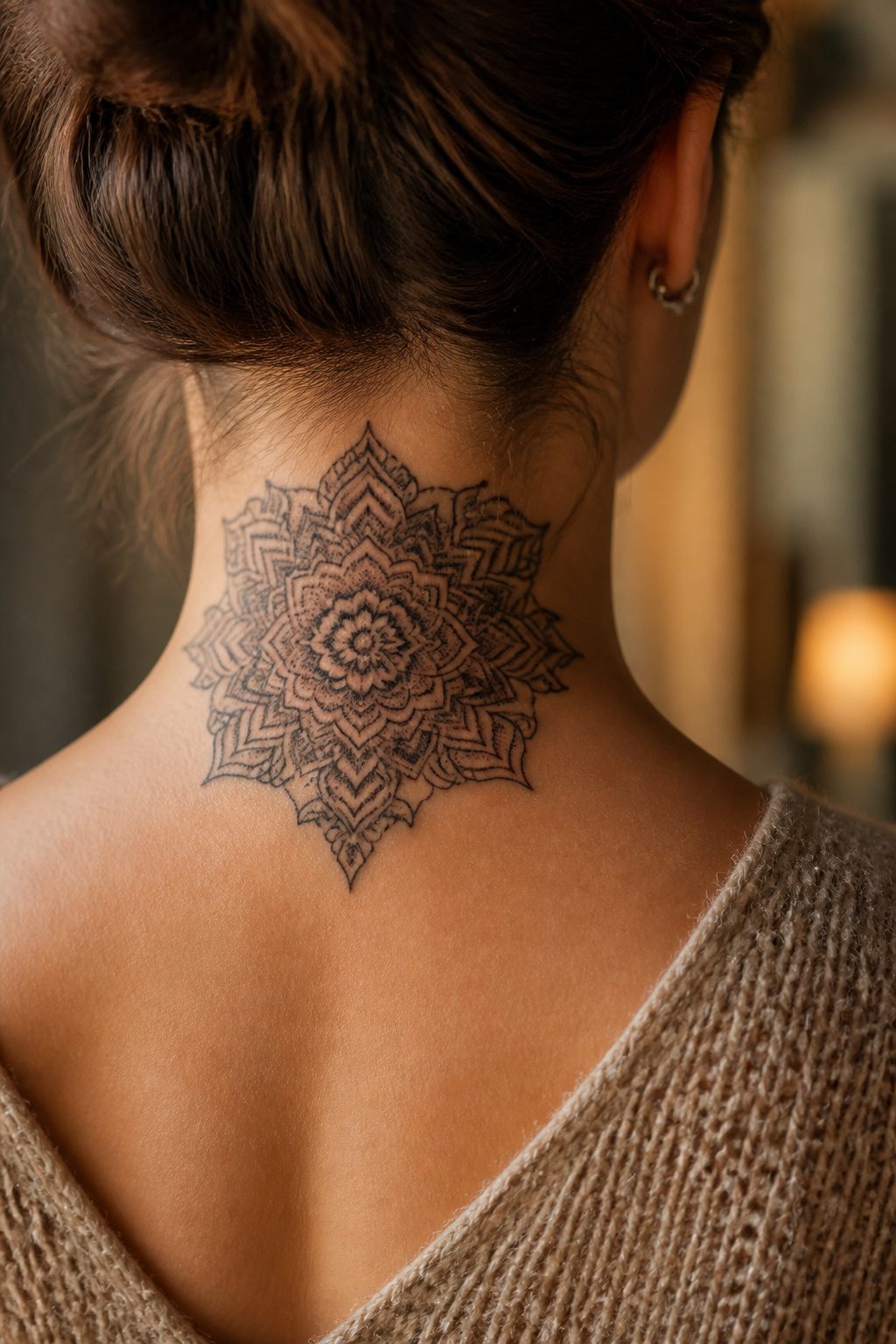
A neck mandala tattoo sits right at the edge of where personal expression meets professional reality.
The curved surface of the throat and nape forces the design to stretch and compress, so a pattern that looks perfectly balanced on flat paper will warp the moment it wraps skin.
The artist has to account for that distortion during the stencil phase, mapping the geometry so it reads symmetrical to a viewer standing in front of you.
Visibility is the trade you make. Side placements peek above a collar or hairline; a full front piece stays exposed unless you layer scarves or high necklines even in summer.
What convinced me, reading through a dozen portfolios, is that clients who love the look after year one are the ones who accepted that maintenance before the needle touched them.
The skin here also turns over faster and sees more sun, so linework softens sooner than on a shoulder or thigh.
For mandala tattoo ideas that actually hold their geometry, the back of the neck offers the flattest canvas. The throat demands simpler radial forms; too much detail crowds together when the curve tightens.
14. Pointillism Mandala Tattoo
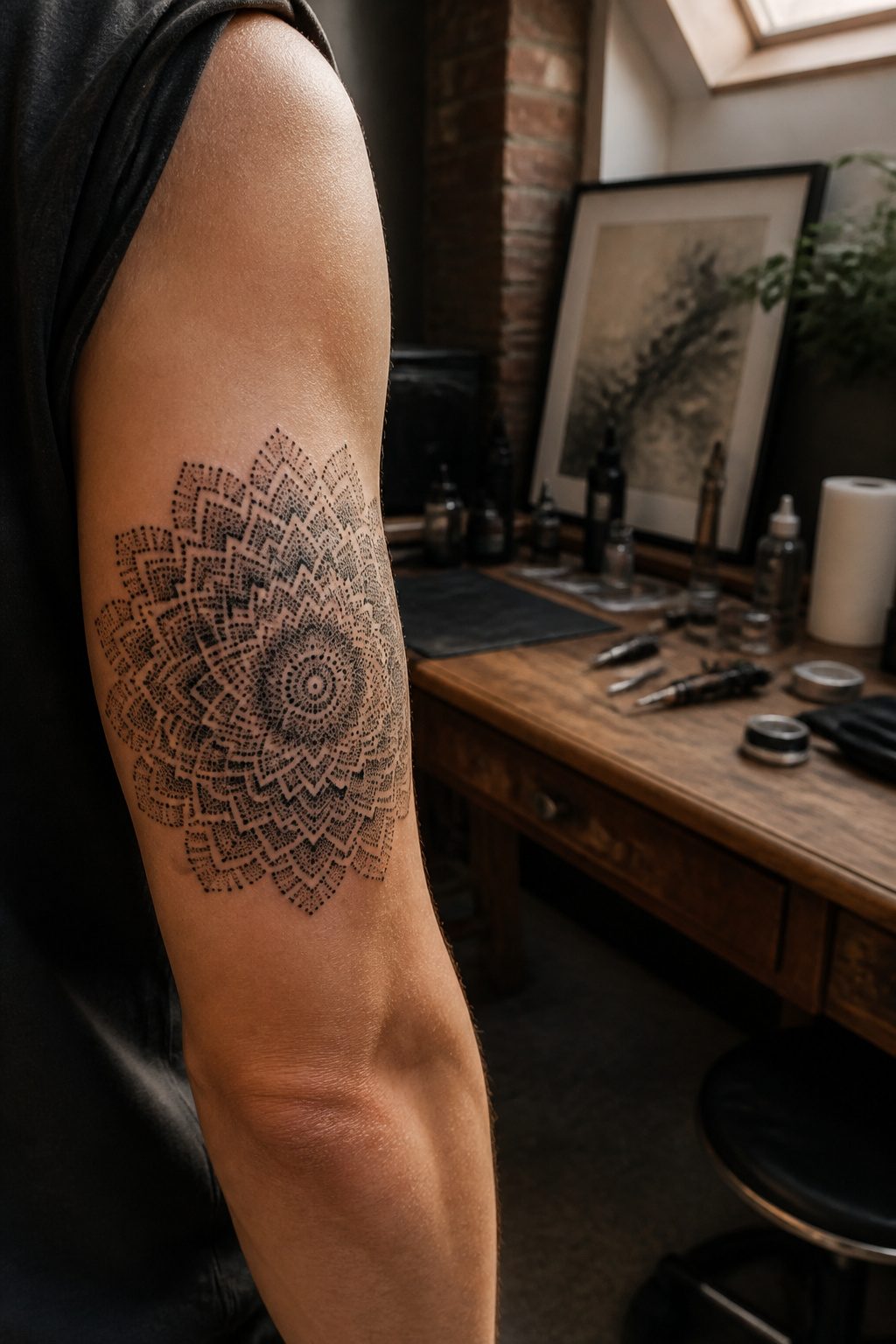
Pointillism builds a mandala from stippled dots, not lines or solid fill, and the patience that technique demands becomes part of the design’s presence.
An artist working in this style places dots close enough to suggest continuous tone but never lets them touch, letting the viewer’s eye blend the density into gradients and form.
This creates a softer, almost luminous surface than conventional shading, especially effective in the central circle of a knee placement where the dotwork can follow the body’s natural curve without hard edges breaking the geometry.
A thigh-sized piece lets the technique stretch out across leaves or portrait elements, and the tapered shape of the mandala can echo the muscle’s own taper rather than fighting it.
The tradeoff is sitting time; what reads as effortless lightness from a few feet away required hours of single-dot decisions.
If you want the dotwork to read as texture rather than accident, plan for a larger minimum size, because clusters compressed too small collapse into gray smudges as the skin ages and settles.
15. Heart-Shaped Mandala
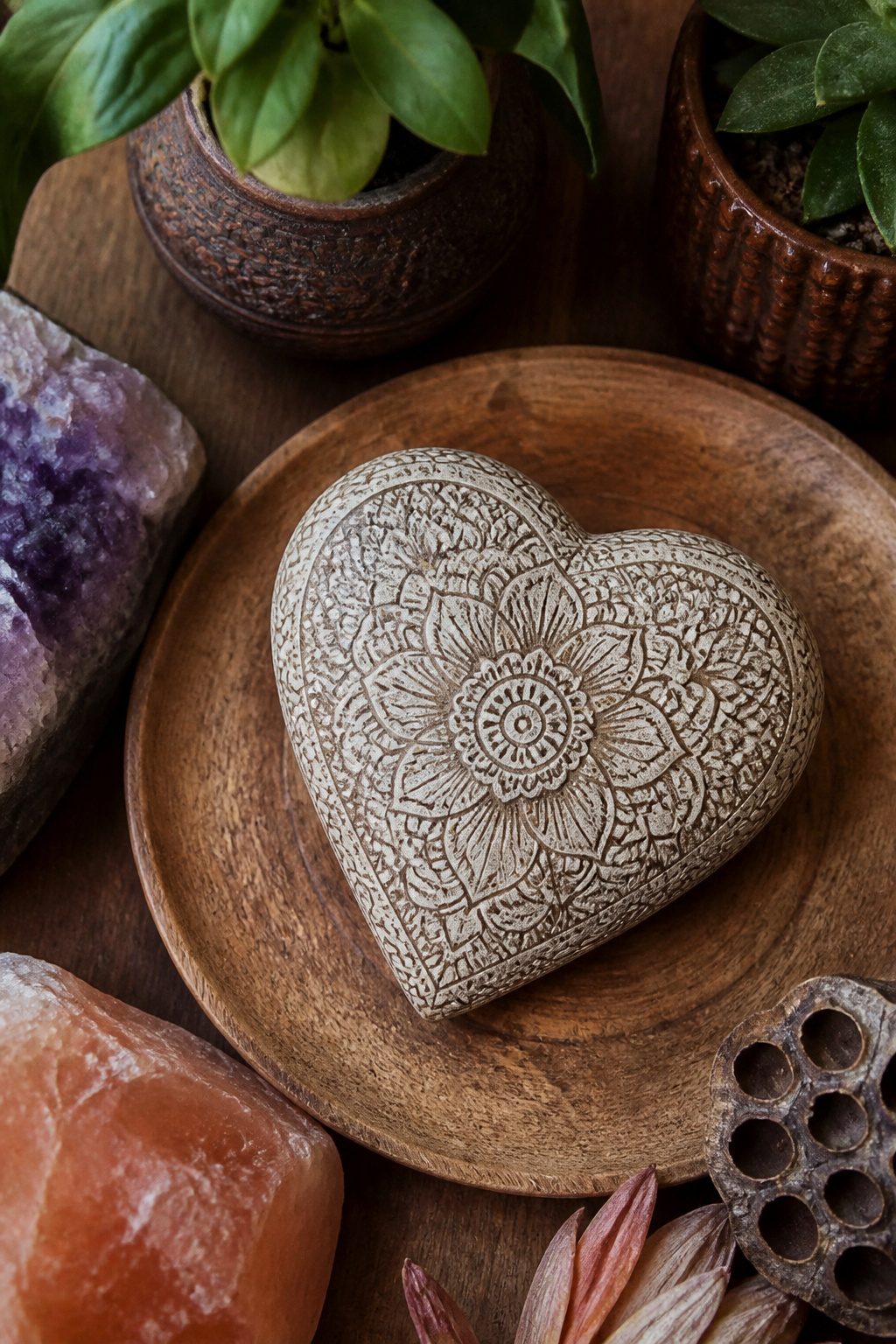
A traditional mandala’s radial symmetry, with its concentric rings of geometric petals radiating from a center point, does not want to bend into a heart outline.
The curve at the top of a heart creates two lobes that fight the mandala’s natural circular balance, so the design has to compress or stretch its rings to fit.
The cleanest solution I have seen keeps the mandala’s center at the heart’s deepest point, where the two curves meet, and lets the outer rings follow the heart’s silhouette rather than forcing a full circle inside it.
What suffers is the mandala’s outer edge: the fine detail that would extend evenly in all directions gets clipped at the heart’s top V and tapered at the bottom point.
The result reads more as "mandala-inspired" than textbook sacred geometry, which is not a flaw if you know what you are asking for.
The heart frame works best when the mandala inside stays bold and simple, since intricate linework at the edges will distort where the outline pinches.
A skilled artist will redraw the geometry fresh for the shape rather than squeezing a stock circular design into it, and that custom work is where your money goes.
16. Mandala Tattoo Around an Eye
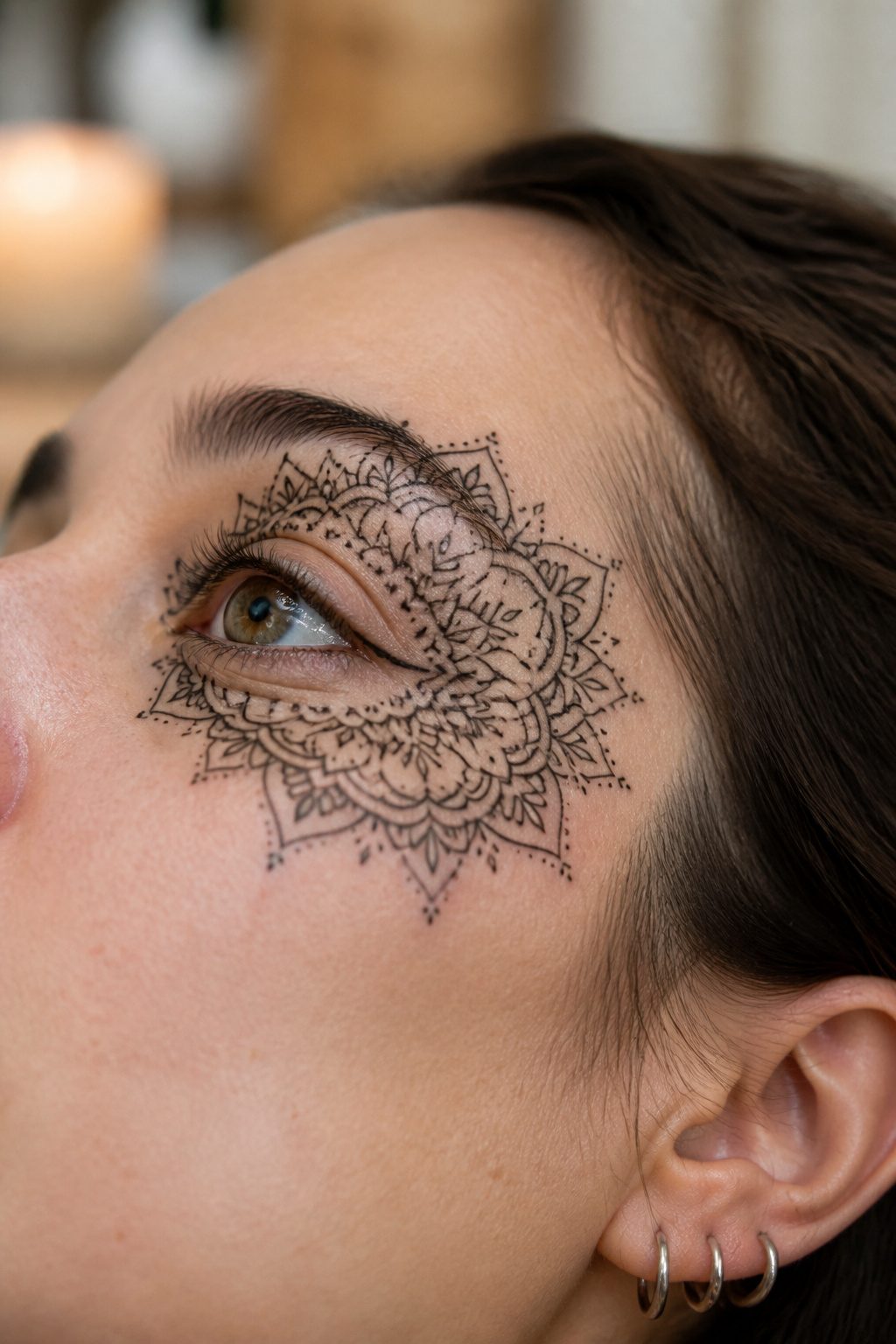
A mandala tattoo around the eye demands more from an artist than any placement on flat skin. The orb itself curves, moves, blinks, and sits on a face where symmetry is judged instantly by every viewer.
That geometric balance mandalas rely on becomes a technical exercise in compensation: the design must read as centered even when the eye’s motion distorts it, and the linework must hold up where skin is thin, vascular, and prone to faster fading than the back or forearm.
Face tattoos have grown more visible in recent years, and the forehead mandala in particular has found its audience. But the eye area adds a complication the forehead avoids.
Lid skin shifts constantly; what looks precise in a stencil can skew the moment the client opens wide.
An experienced artist will map the design across multiple expressions, not just the neutral face, and will keep detail minimal near the lash line where ink spread is hardest to control.
The symmetry that makes mandalas satisfying is also what exposes flaws. A shoulder piece can be adjusted in the mirror; an eye mandala is judged in every glance by standards no other placement faces.
For women in the 35–54 range who already scrutinize ingredient lists for results they can see, this placement offers no place to hide. The commitment is total, the maintenance ongoing, and the choice of artist matters more than the design itself.
17. Mandala Band Tattoo
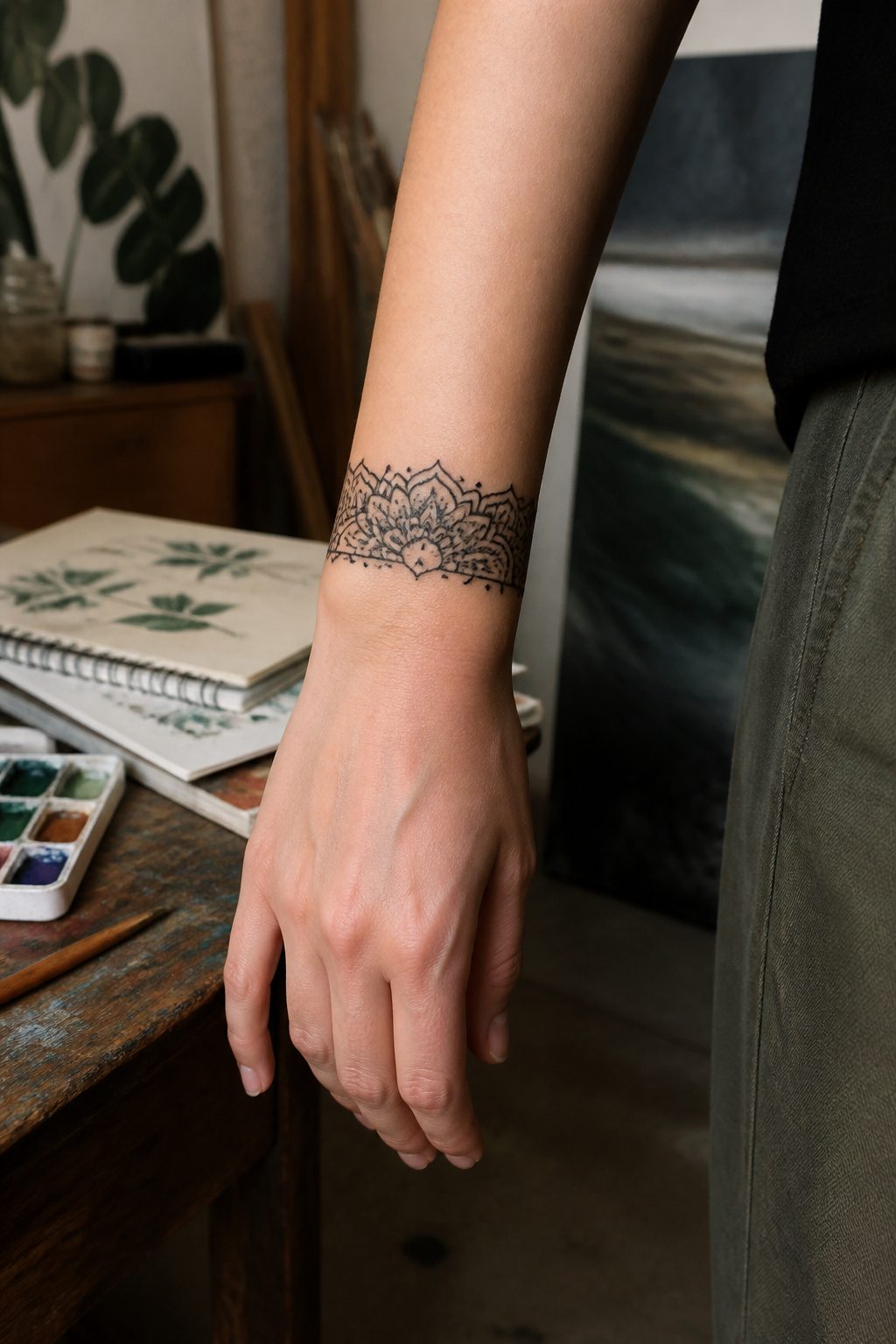
A mandala band tattoo wraps the pattern around a limb or finger so the design meets itself, completing the circle in a way a flat back piece never does.
The arm or leg becomes the frame, and the geometry adjusts to the curve of skin rather than sitting on top of it like a sticker.
The format works because the band shape hides nothing and excuses nothing; every gap in the pattern shows, and the line weight has to stay consistent all the way around.
A wrist or finger band tightens the detail into a smaller field, which either simplifies the design or pushes the artist toward finer needles and more sessions.
A forearm or calf band gives the pattern room to breathe, but the circumference changes with muscle and weight, so the circle has to be drawn to fit the limb at rest.
Placement above or below the elbow, above or below the knee, changes how the band moves when the joint bends.
Too close to the joint and the mandala distorts every time you move; too far and it reads as a stripe rather than a ring. The balance is the whole job.
18. Detailed Back Mandala Tattoo
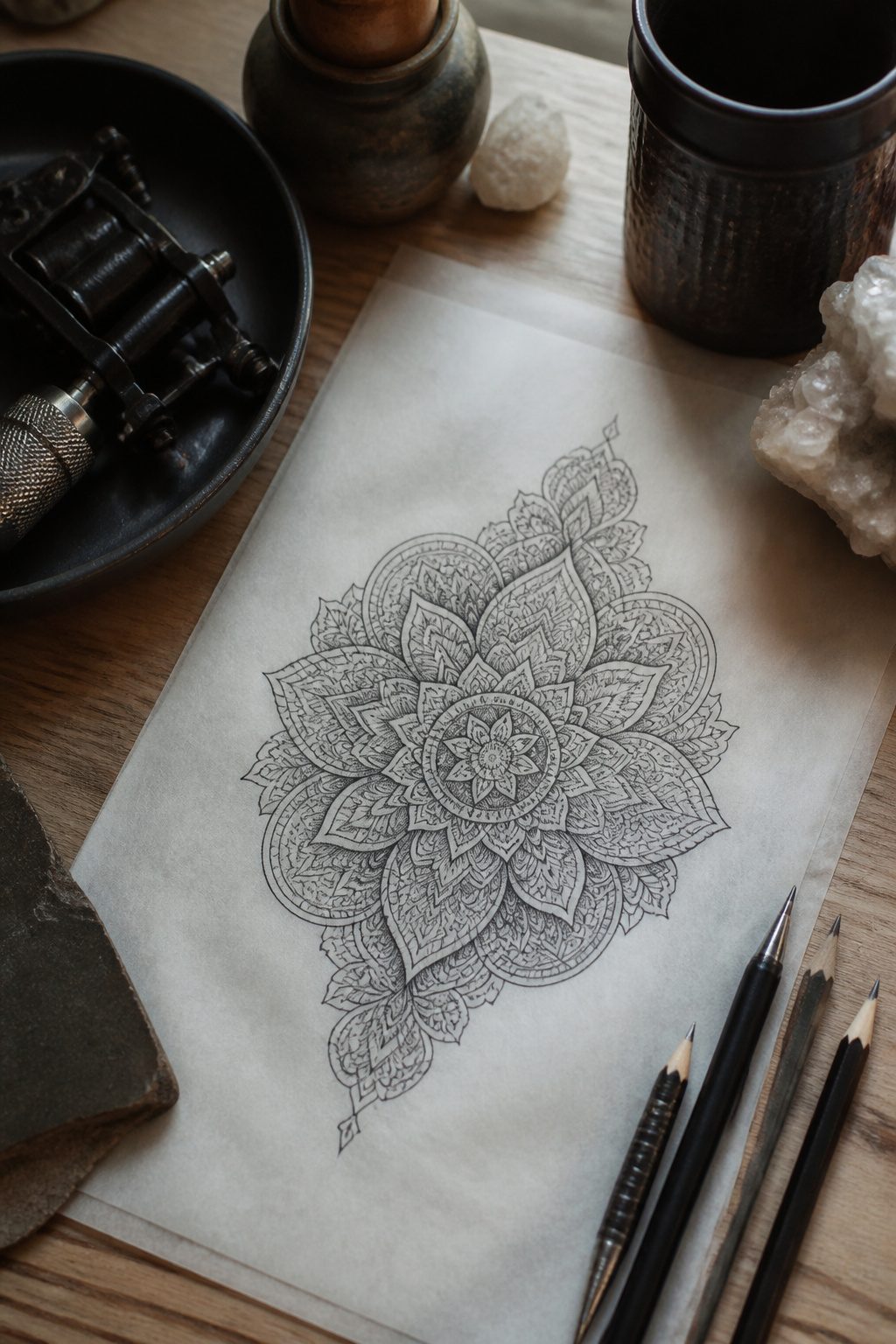
A detailed back mandala leaves room for the kind of radial complexity that smaller placements simply cannot support.
The spine becomes the center point, and the design builds outward in layers that can include interlocking geometry, fine dotwork, and gradations of line weight that read as texture from a few feet away.
What separates this from a simpler back piece is the density: the eye keeps finding new structure the longer you look.
A large back mandala typically requires 20 to 40-plus hours across multiple sessions. That time is the cost of maintaining symmetry across a living surface that shifts with breath and position.
The artist works methodically, often from the center outward, so the composition does not drift off-axis as the sessions stretch across weeks or months.
The extended timeline also means the skin has recovery windows between sittings, which matters when the same needles return to adjacent areas repeatedly.
The commitment is substantial, but so is the result. A back this fully worked becomes a single integrated piece rather than a design that happens to sit on a large canvas.
19. Small Mandala Tattoo
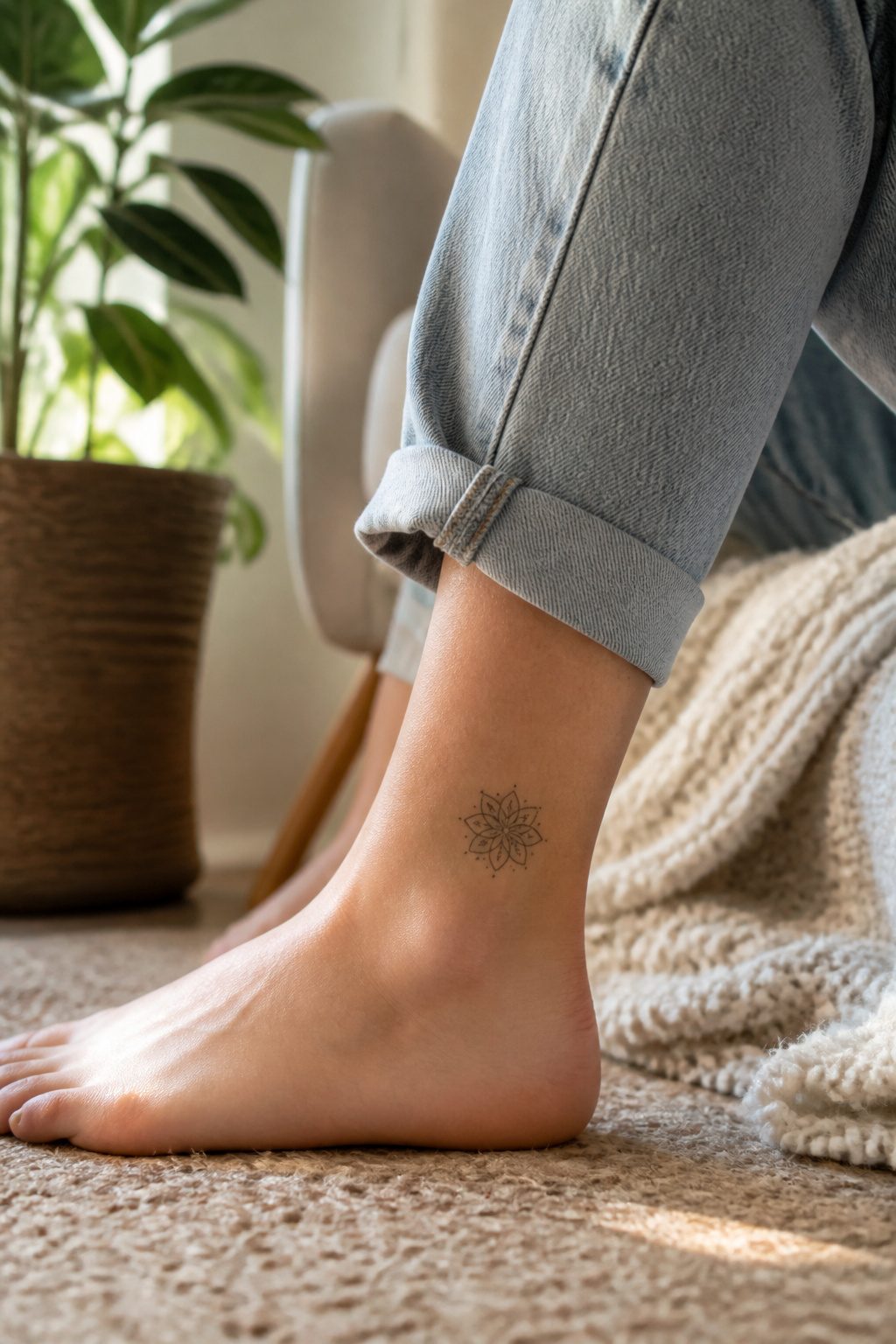
A small mandala tattoo on the wrist, ankle, or behind the ear forces the design to answer a harder question: what can drop away while the symbol still reads as complete. The passages show two workable approaches.
One keeps the mandala’s core geometry, a central point with radiating layers and clean forms, treating the reduction as a distillation rather than a compromise.
The other folds in fine-line ornamental work at the edges, letting a central lotus carry the weight while thin peripheral detail fills the space without crowding it.
Behind the ear is the placement that tests this most. The curve of the skull gives the artist almost no flat plane, so the mandala either mirrors that contour closely or fights it.
One approach pairs the round shape with the ear’s natural geometry, letting the design trace the shell like a reflection. Another route adds dreamcatcher elements, which stretches the bohemian reading but also gives the eye more reason to travel upward.
Solid black areas can survive at this scale if they stay small and deliberate, though the passages lean toward delicacy. Fine lines dominate the examples that hold up, with black used as accent rather than structure.
The risk with any small mandala is overloading the compass: three layers read clearly, five become mud.
20. Mandala and Flowers Tattoo
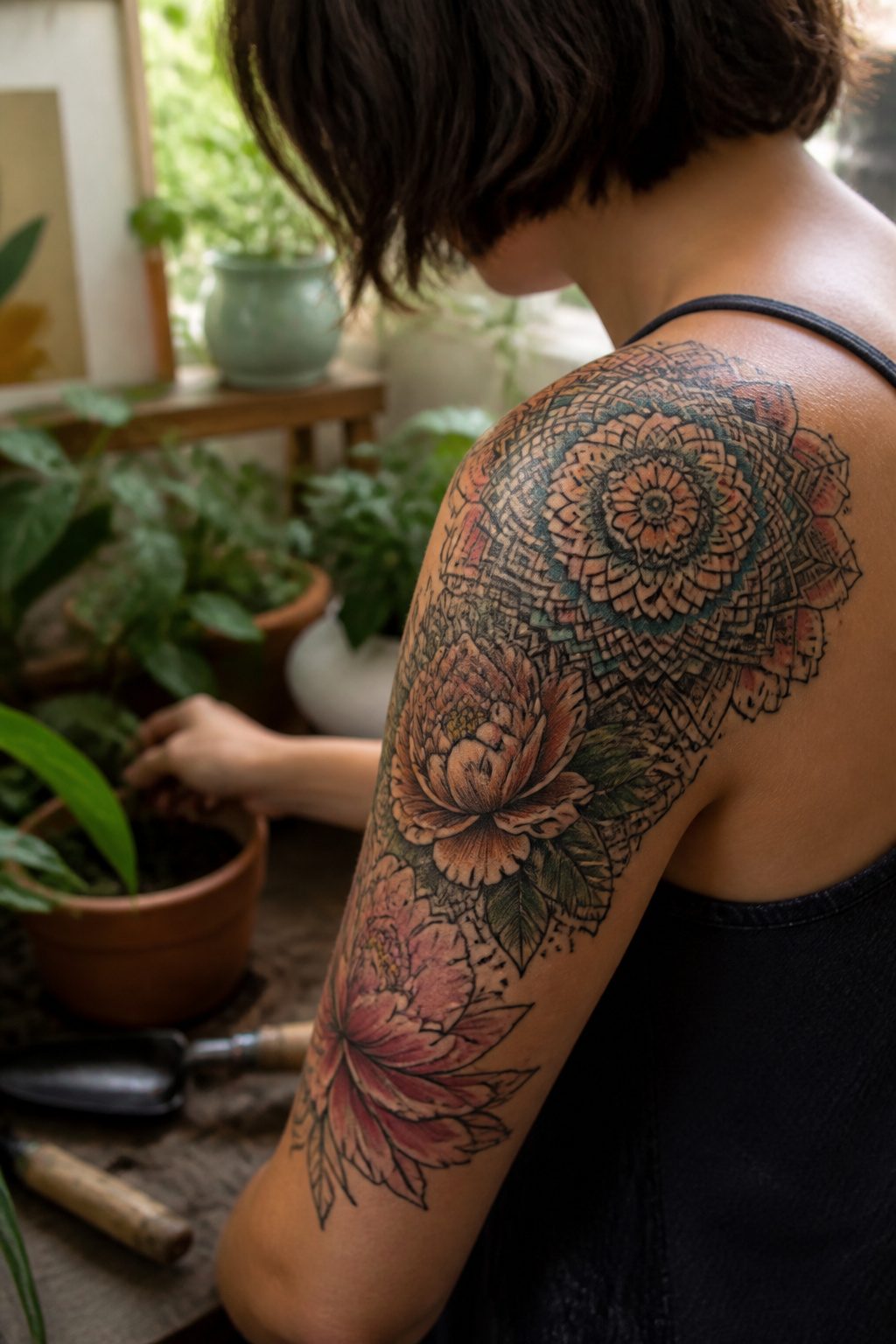
A mandala and flowers tattoo treats the two elements as separate visual forces that happen to share the same skin, not as a single fused symbol.
The mandala might sit at the shoulder while roses climb the collarbone, or a lotus stem might thread through the outer ring without ever becoming part of the pattern. The geometry keeps its structure; the blooms keep their organic weight.
This differs from a floral mandala, where petals and stamens replace the traditional rings and dots. In that style, the flower is the mandala.
Here, the contrast between the two is the whole point: the rigidity of the mandala makes the flowers look softer, and the loose curves of the flowers keep the geometry from feeling mechanical.
A design I saw recently paired a tight black-and-grey mandala on the inner forearm with a spray of wildflowers that wrapped around to the outer arm, and the break between the two gave each its own breathing room.
The risk is visual clutter. Two complex systems fighting for attention can turn into noise unless the artist commits to scale: the mandala usually needs to dominate, or the flowers need to stay sparse and line-based.
Color choice is the other split decision. Keeping the mandala in black linework while the flowers carry color gives each its own territory.
Matching the palette across both tends to flatten them into one mushy shape, which defeats the purpose of pairing them at all.
21. Owl Mandala Tattoo
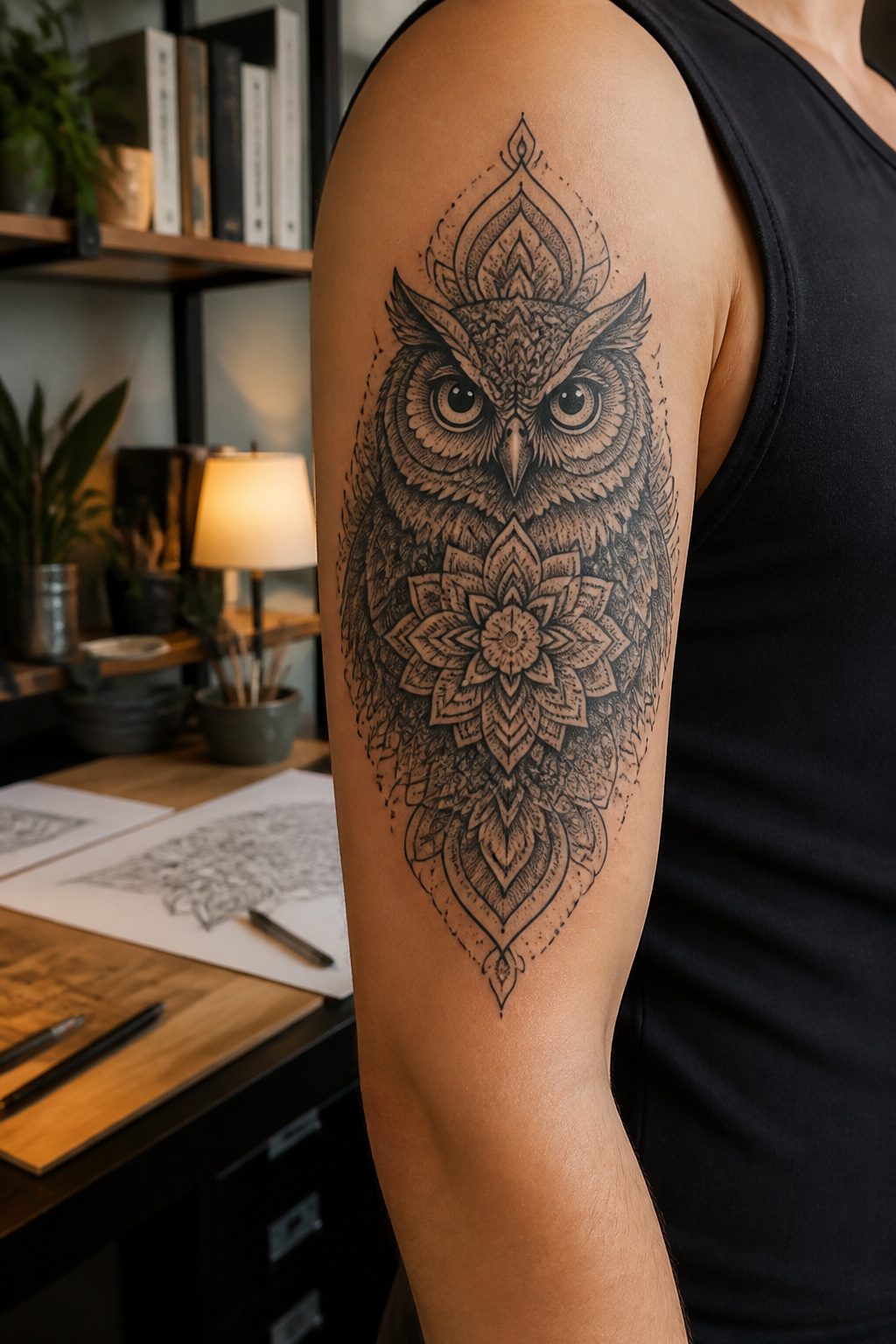
An owl mandala tattoo merges the bird’s natural silhouette with repeating geometric forms, either building the feathers from petal-shaped segments or framing the head inside a circular border.
The eyes work especially well as the center point, since their concentric rings already echo mandala structure; from there, lines radiate outward through the brow and into the wings.
This pairing carries weight across several symbolic registers, with owls representing wisdom and intuition in Western tradition while mandalas center on wholeness and spiritual focus.
Placement shapes how much detail holds up. The upper arm or thigh gives enough flat surface for the facial disc to read clearly at a distance, where the chest or ribs require simpler linework to survive skin movement and aging.
Color tends to fight the geometry here, so most strong examples stay black and grey, using dotwork or fine hatching to soften the transition between the bird’s organic curves and the pattern’s hard edges.
A common misstep is overloading the design, trying to render every feather as a separate geometric cell; the result looks busy and blurs within a few years.
Better to let the mandala live in the negative space around the owl, or limit the pattern to the wings and crown while keeping the face relatively open.
22. Forehead Mandala Tattoo
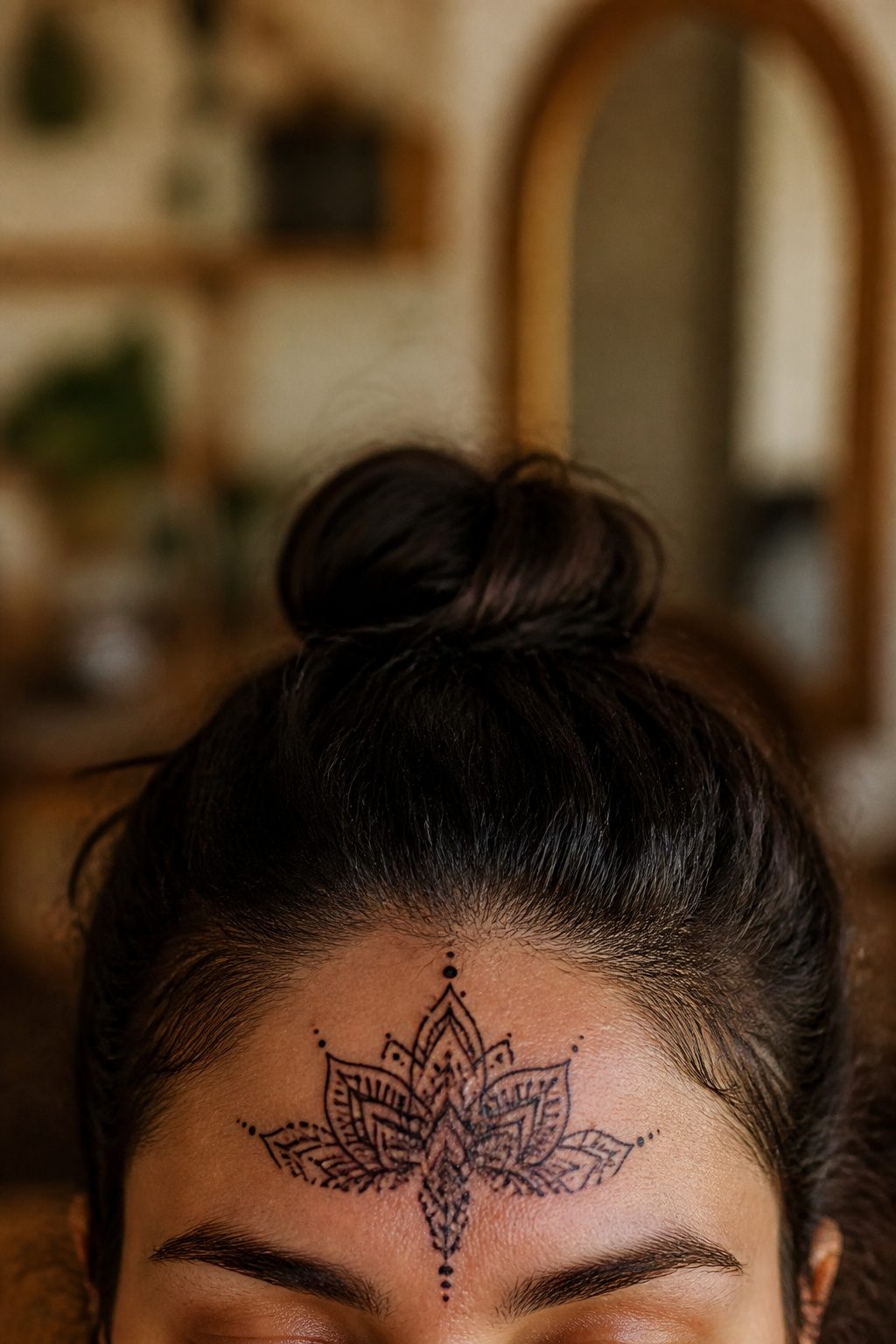
A forehead mandala tattoo sits at the intersection of ancient spiritual practice and modern body art visibility.
In Hindu and Buddhist traditions, the mandala represents the cosmos and serves as a meditation tool, the geometric structure drawing the mind toward stillness.
Moving that symbol to the face carries the weight of those traditions while amplifying the personal stakes.
The forehead specifically is one of the most visible placements possible, impossible to cover without deliberate effort, which makes the choice of a mandala here a statement about public identity rather than private meaning.
The technical challenges are substantial. Forehead skin is thin, sits directly on bone, and endures constant sun exposure, all of which affect how ink settles and how the piece ages.
A mandala’s precision, those radial lines and concentric circles, demands skin that holds detail evenly.
The face also moves with every expression, so the design must be sized and placed to read correctly at rest and in motion, not just in the stencil phase.
Artists who work this area regularly tend toward simpler geometry or heavier line weight to account for these constraints.
The cultural context runs deeper than aesthetics. Mandalas connect to South Asian ceremonial traditions, including henna practices where sacred geometry adorns the hands and forehead for ritual occasions.
A permanent version on a non-South Asian wearer raises questions of appropriation that a hand or arm placement does not, given the forehead’s specific role in those ceremonies.
What reads as edgy or spiritual to one viewer reads differently to another, and the forehead leaves no room for the viewer to choose when to engage.
23. Elbow Mandala Tattoo
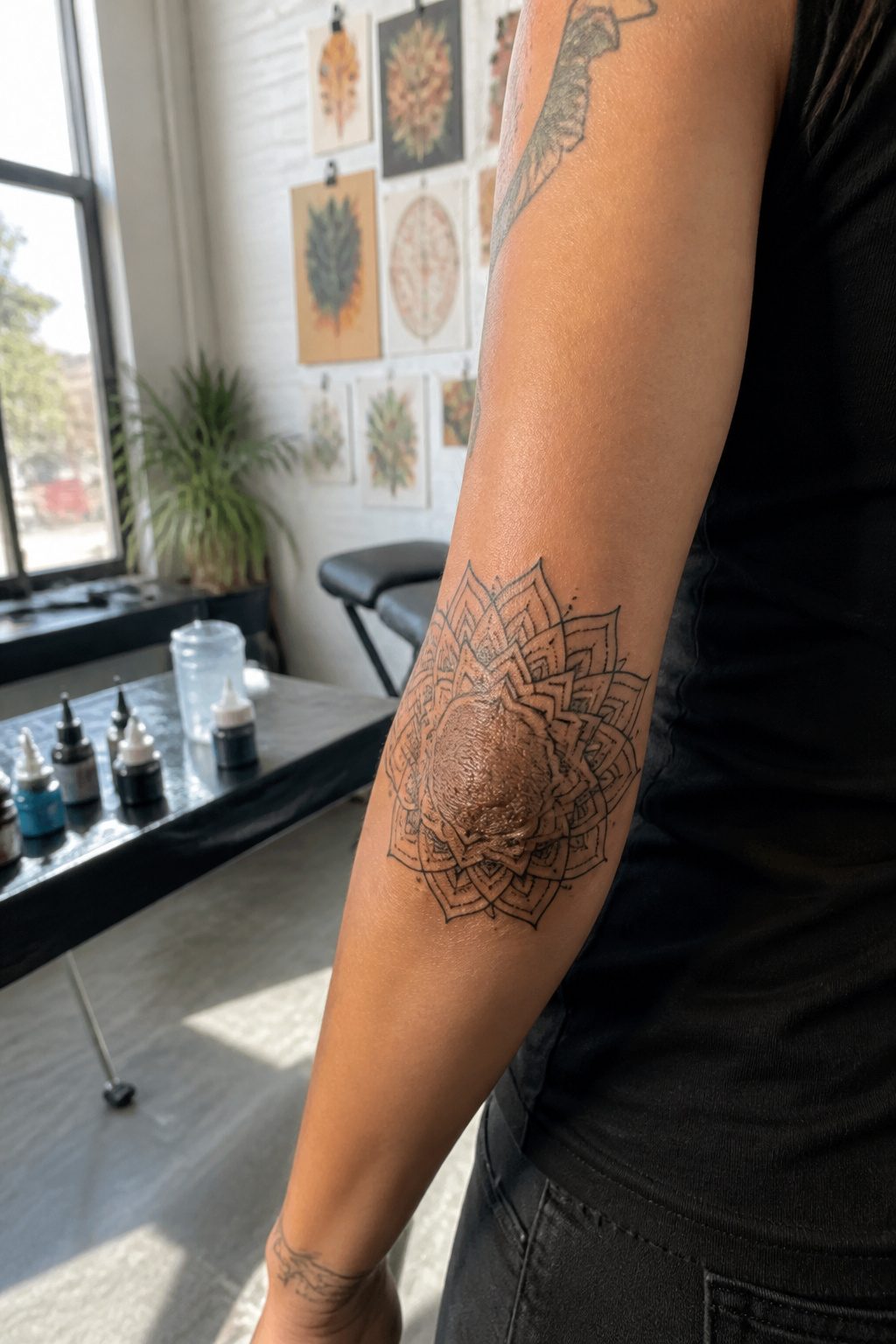
The elbow’s bone sits close to the skin, which means any mandala here needs to account for how the joint stretches and folds.
A design that looks centered with your arm straight will distort into an oval when you bend it, so experienced artists plan the geometry around the position the client uses most.
The inner elbow, being softer, calls for lighter work; fine line mandalas with a lotus center settle there without looking forced, and a lighter ink beside the black keeps the detail readable rather than heavy.
The outer elbow can take weightier patterning since the skin moves less dramatically across the bone, though both placements demand an artist who has worked joints before.
Knees and elbows share that round structure, which is why the same design logic applies to either: match the mandala’s natural circle to the body’s, or the mismatch grates every time you move.
24. Pointillism Chest Mandala
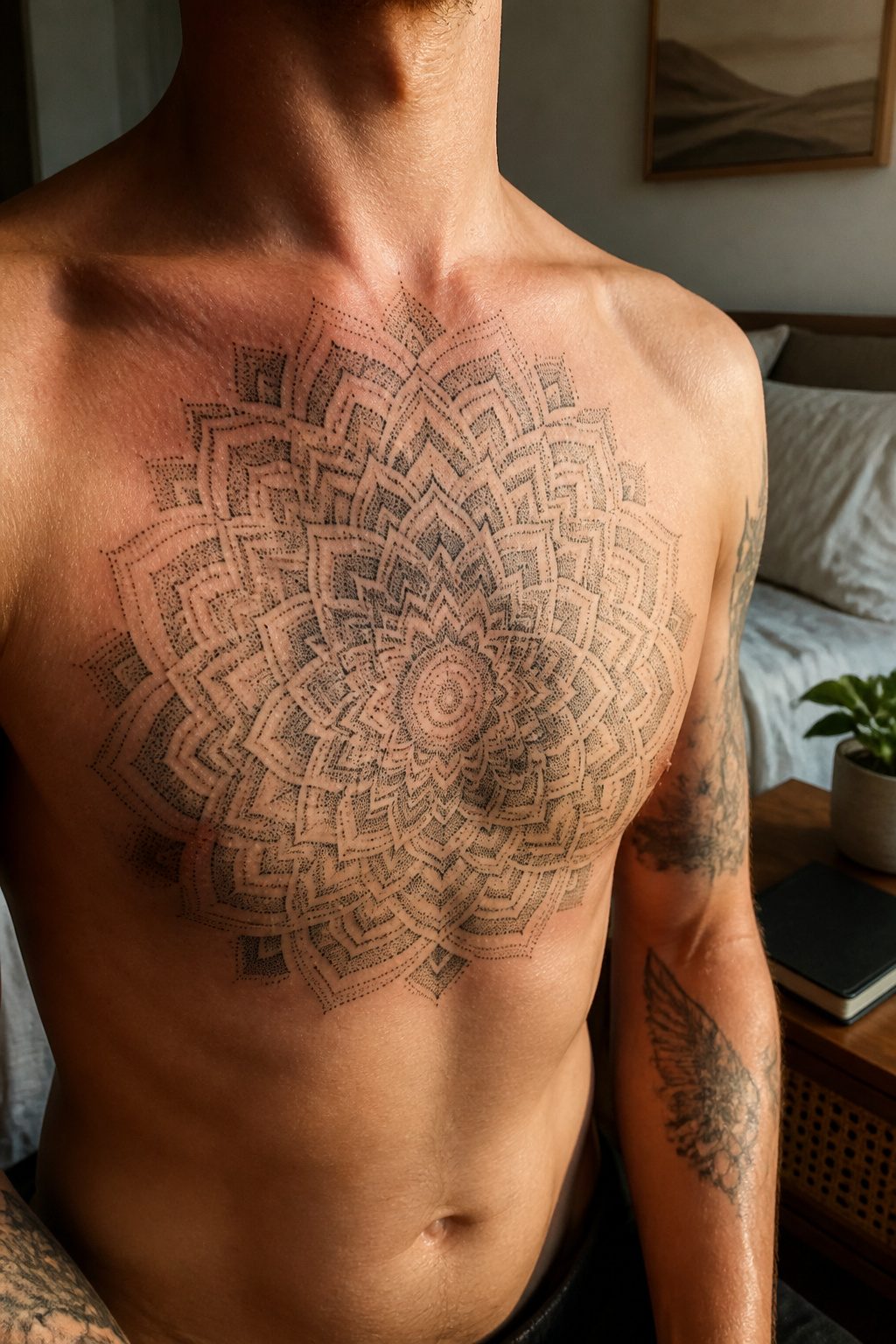
Chest pointillism mandalas build the pattern from thousands of individual dots rather than solid lines or smooth shading. The stippled texture catches light differently across the sternum and pec muscles, so the design shifts subtly when you move.
That same texture, though, demands 20 to 40-plus hours of needle time for a full chest piece, since the artist must place each dot by hand while maintaining the mandala’s radial symmetry.
The sternum and collarbone area sits close to bone with thin skin and nerve bundles running underneath.
Most people feel the vibration through the ribs more than on fleshier placements, and the chest’s constant movement with breathing means the session itself can feel longer than the clock shows.
A medium-complexity chest mandala typically spans 6 to 12 hours across multiple appointments, giving the skin recovery days between sittings.
Bilateral symmetry of the chest suits a mandala’s structure naturally. A pointillism technique centered on the sternum lets the pattern radiate outward evenly, the dots softening at the edges where they meet the rounded planes of the shoulders.
The tradeoff is patience: this is not a style for anyone who wants a finished piece in a single afternoon, and the time commitment multiplies with every inch of detail added beyond the central motif.
25. Intricate Mandala Sleeve
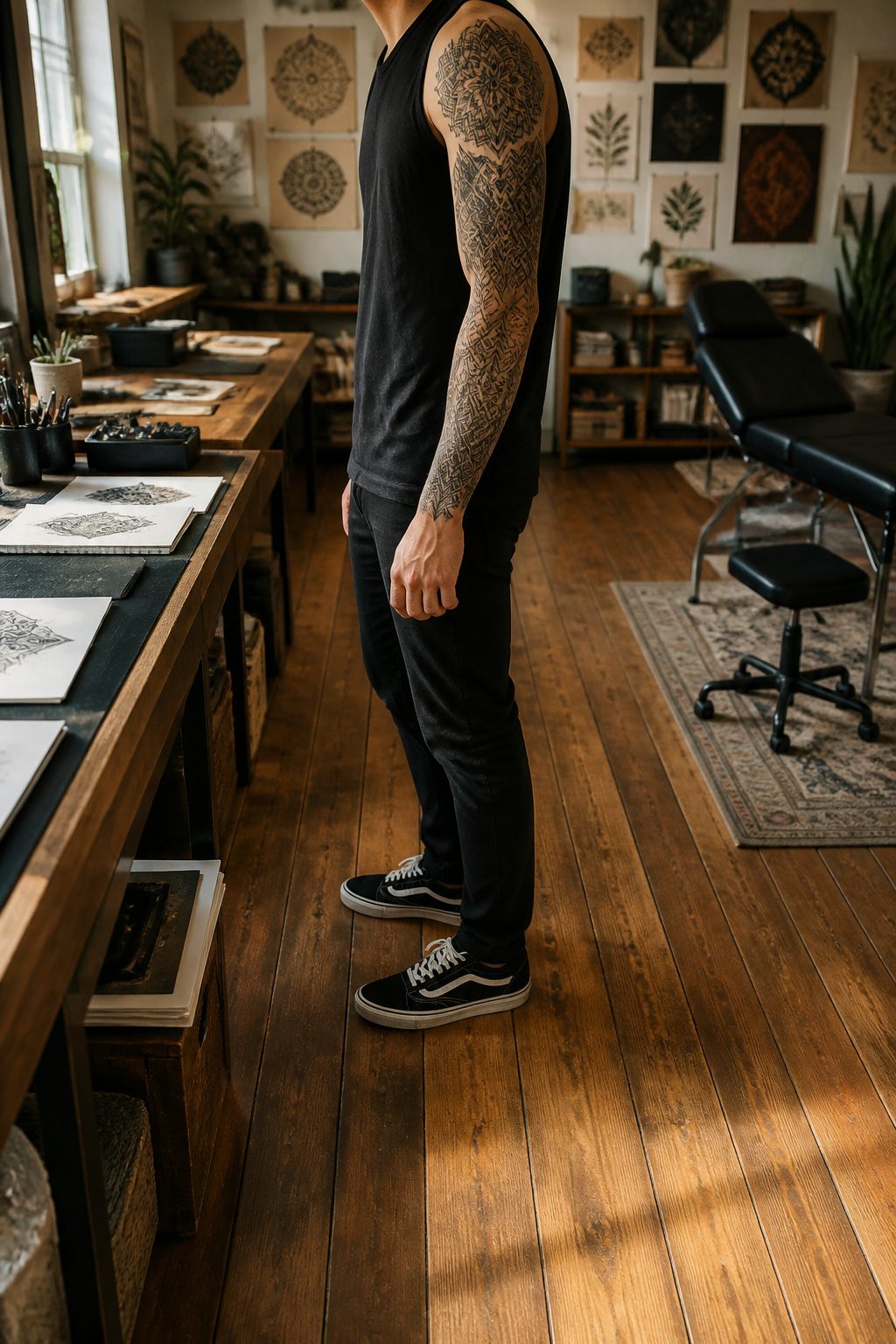
A full sleeve can mean a lot of things. Some people fill an arm with a single mandala that anchors the shoulder and lets the pattern breathe.
The sleeve I keep coming back to is the opposite kind, the one where detail density matters more than coverage itself.
The forearm and upper arm give enough canvas for a central mandala to extend into surrounding geometric work, but the visually striking sleeve compositions I have seen push that further.
They stack secondary mandalas, knotwork, and dotwork into the gaps until almost no skin shows through. The circular form still anchors everything, yet the eye keeps finding new layers the closer it gets.
That approach costs more sessions and more money than a simpler full sleeve, and it heals harder. Dense black packing can sit scabby for weeks.
The result also ages differently; fine lines inside a crowded field tend to blur together over time where a more open composition would keep its readability.
For collectors who want the arm fully wrapped, two paths split here. A single large mandala with breathing room reads cleaner from a distance.
The dense sleeve only works if someone is willing to study it up close, and if the artist has the patience to build that much complexity without the design collapsing into noise.
26. Mandala Tattoo with Shading
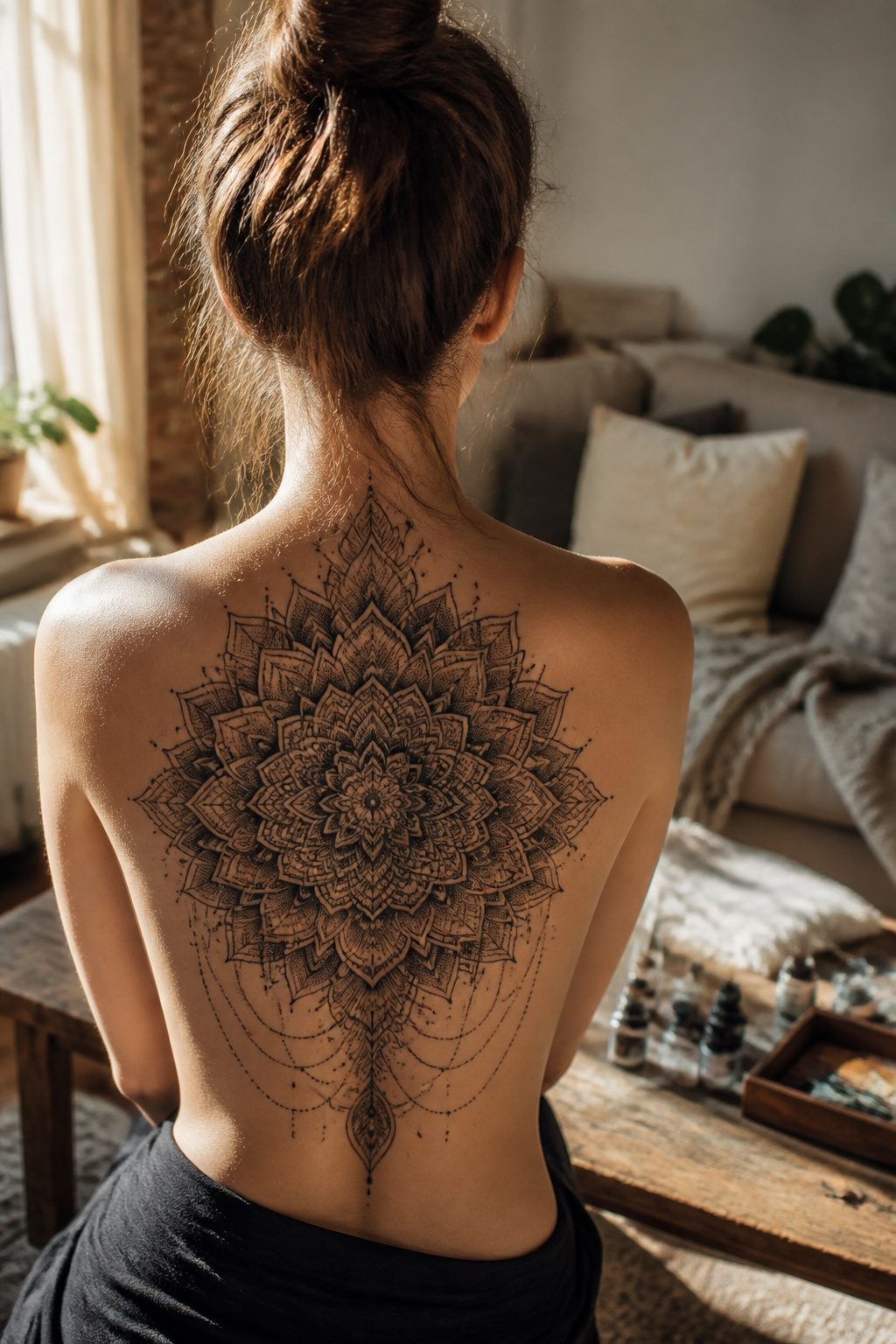
Shading turns a mandala from a flat diagram into something that casts its own shadow.
The Thai.tattoo hand piece shows how this works in practice: the artist uses only black ink, diluting it with water to build a range from solid black through light gray.
That graywash approach gives the circular form depth without ever introducing a second color.
Black-and-gray shading is the broader category, and it covers more than the water-diluted method. Whip-shading, seen in the hip piece with flowers, moves the needle in a loose oscillation to lay down soft tonal areas without hard edges.
The dotwork variation shades by spacing dots so they never touch, letting the eye blend them from a distance. Each technique asks something different from the skin.
Graywash heals softer and faster because the diluted ink sits more gently; dense whip-shading or packed dotwork demands more sessions and more careful aftercare to hold its contrast.
For a mandala, the choice shapes the final geometry. Flat linework reads as pattern.
Shading reads as architecture, as something built rather than drawn. The coverup potential matters too: heavier shading packs more pigment, which means more power to push old ink underneath out of sight.
27. Mandala Tattoo on Ribs and Hip
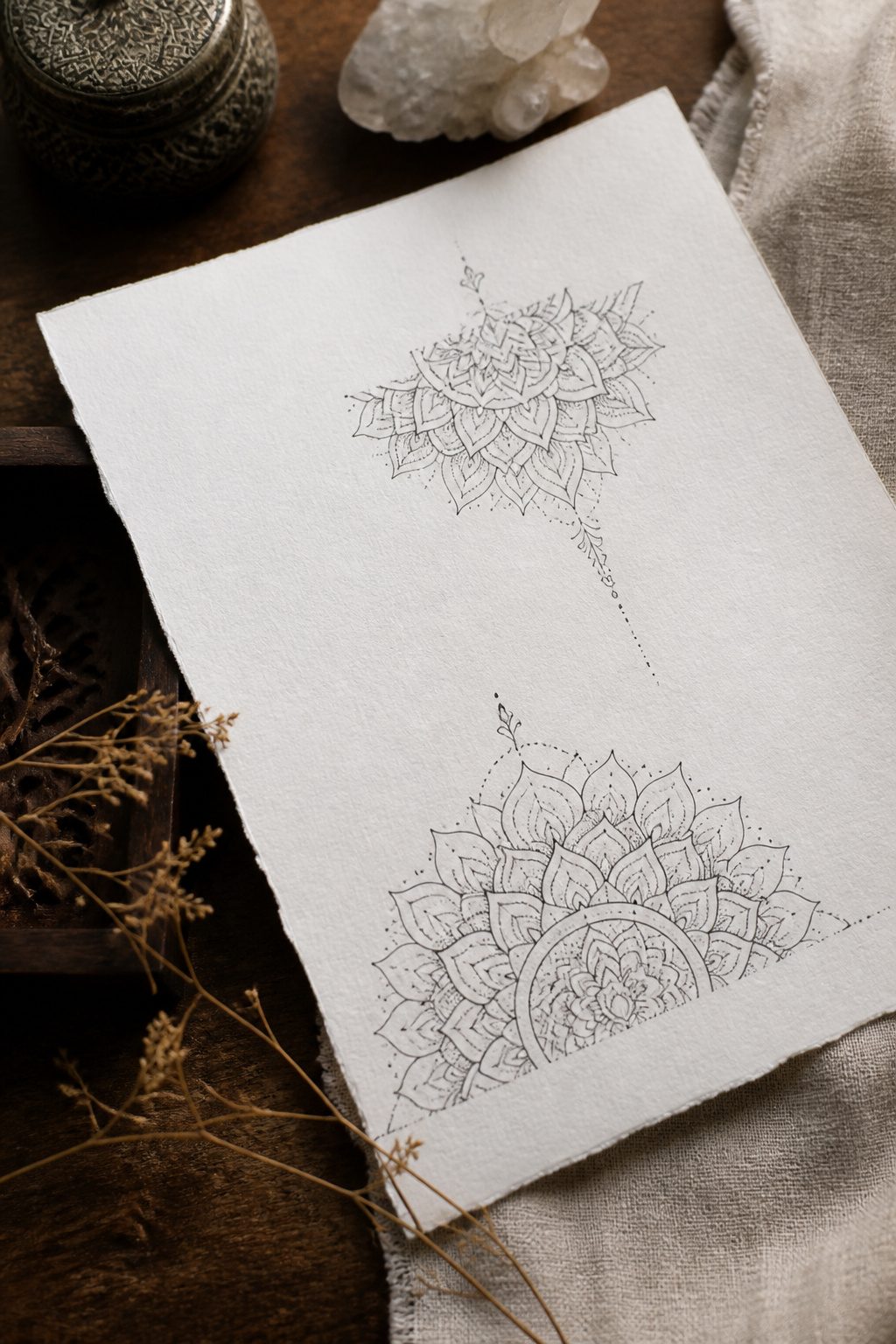
The ribcage and hip are where a mandala either flows with the body or fights it every step of the way.
The curve of the bone and the soft tissue underneath will distort a perfectly symmetrical wheel, so an artist has to crop the pattern to the specific spot, letting the geometry follow the shape rather than sit on top of it.
I have watched this go wrong when someone insists on keeping the full circle intact; the tattoo ends up looking compressed on one side and stretched on the other as soon as they stand straight.
Pain sits differently here than on fleshier ground. The ribs have thin padding over bone, and the hip carries its own nerve density near the surface.
Neither placement is quick work. A rib mandala that extends toward the hip, or a hip piece that wraps toward the back, demands longer sessions and a stillness that becomes its own challenge.
The women I see choosing this placement usually want the mandala’s associations with balance and inner strength to land somewhere private, carried for themselves rather than displayed.
The circular form and its meditative quality read as personal ritual here, not ornament.
Technique matters for survival in this spot. Dotwork shading, built from points that never touch, holds up better over the hip’s shifting terrain than solid blocks of black.
Whip-shading in any floral additions keeps lines from blowing out where the skin stretches most. An artist comfortable with both can build something that ages into the body rather than against it.
What Mandala Means
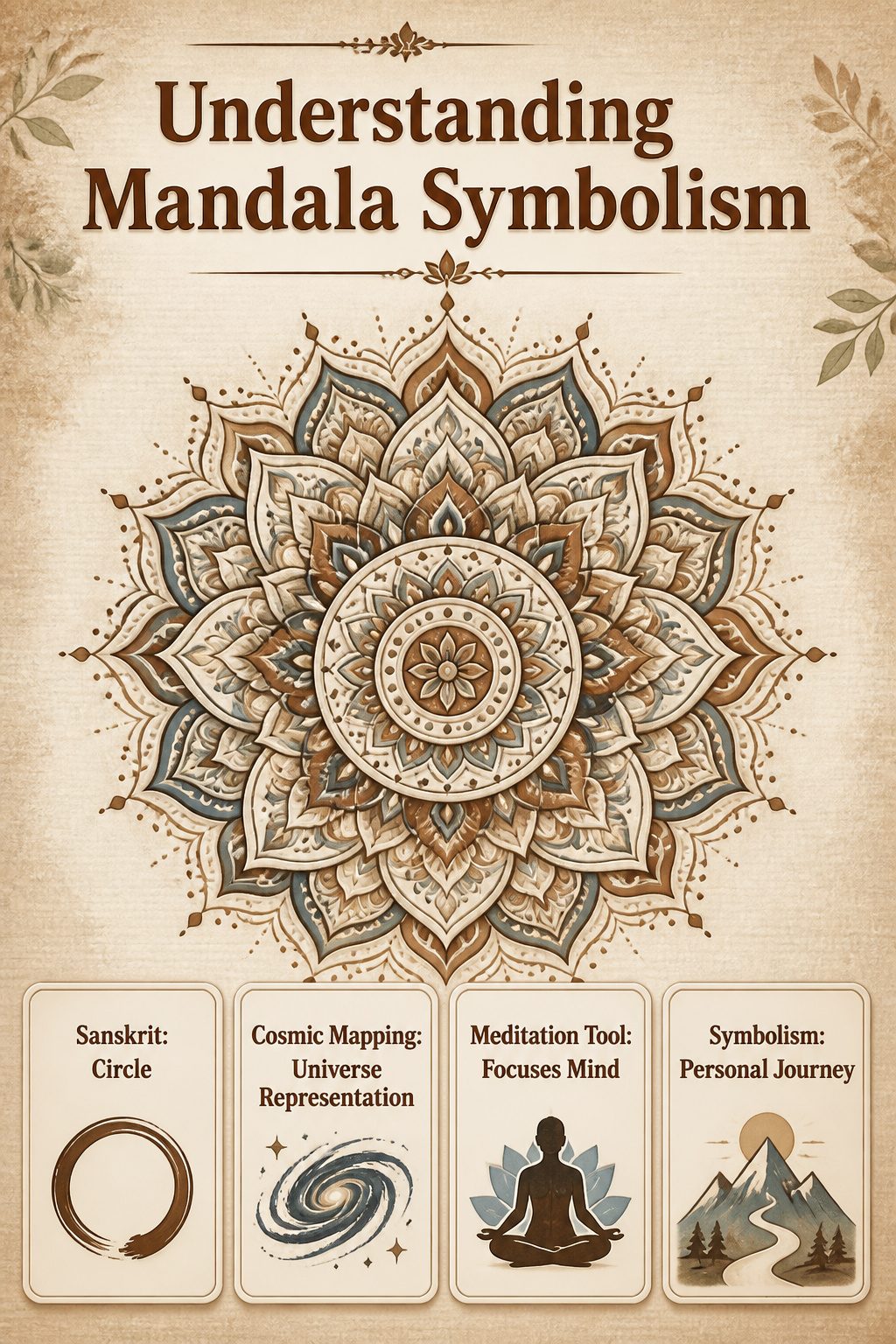
The Sanskrit word mandala translates directly to "circle," though the shape carries weight far beyond geometry.
In Hindu and Buddhist practice, the mandala maps the universe itself: a structured, radiating pattern that holds the cosmic and the personal in the same frame.
Monks have used these forms as meditation tools for centuries, focusing on the layered symmetry to draw the mind toward stillness and center the attention in the present moment.
Some traditions paint mandalas into sand, then spread the grains once the work is complete, a ritual said to release healing properties into the world.
That spiritual lineage dates back to at least the eighth century, and it runs straight into the reason people still choose this image for skin today.
The central point of any mandala can represent your core values or personality; the patterns that radiate outward become the journey, the growth, the transformation. A mandala tattoo does not demand any single belief system to work.
What matters is whether the symbolism, the geometry, and the placement align with what you personally need the piece to hold.
Just make sure that what mandalas represent actually fits into your beliefs before committing to it being in your skin for the rest of your life.
That check, your own check, is what separates a design you admire from one you live with.
Where to Place One
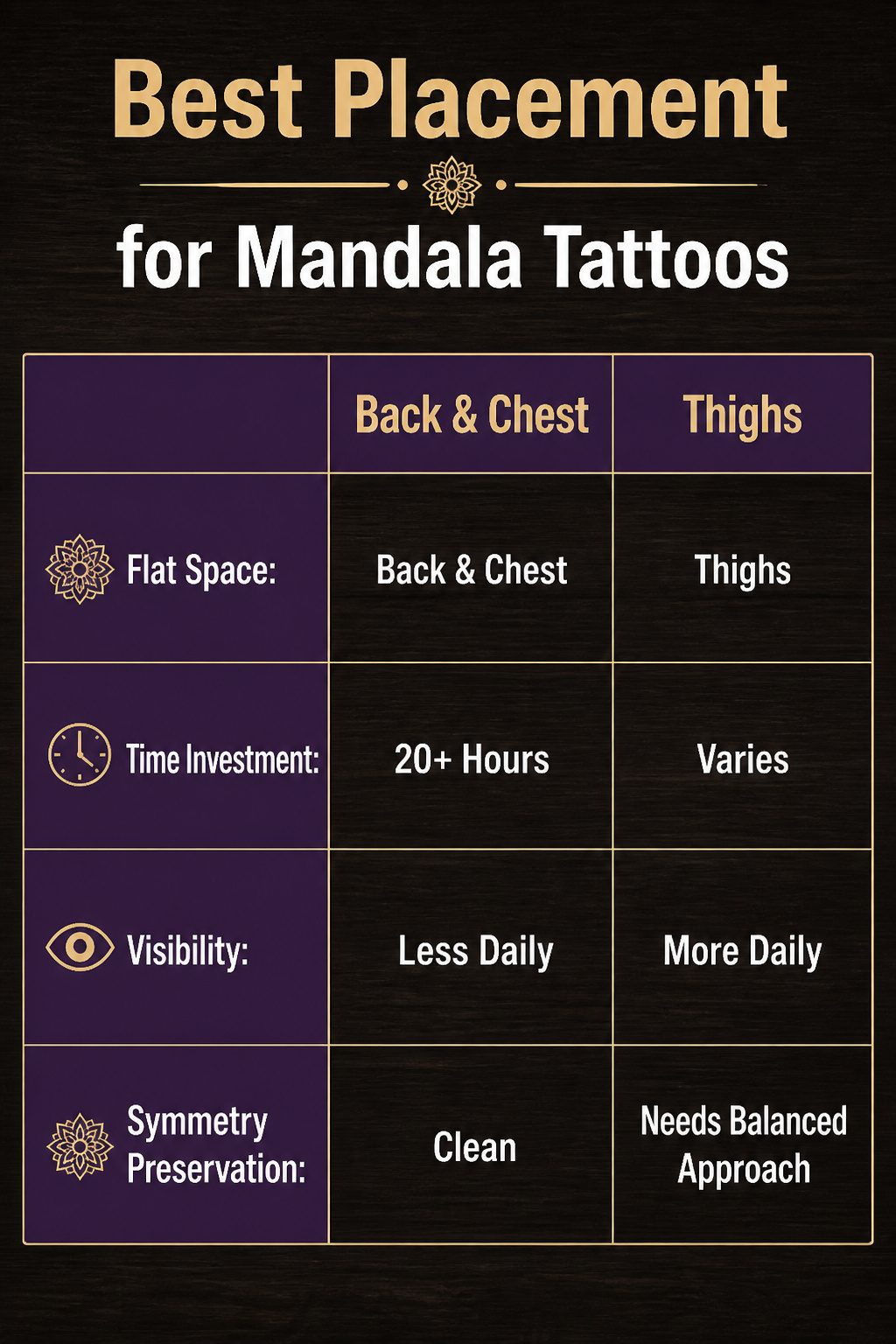
Flat areas win for mandala tattoo ideas because the symmetry reads cleanly. The back and chest give the most room for complexity, with a full back piece running 20 to 40+ hours of needle time.
Thighs heal reliably and carry large standalone work well. Forearms put the design where you see it daily, and the circular form anchors a sleeve naturally.
Wrists and hands suit smaller compositions, though hand placement carries specific cultural resonance tied to South Asian henna traditions.
Size dictates placement more than style does. A cropped half-mandala on top of the thigh can complement the body’s shape better than forcing a full circle where the curve fights the geometry.
A shoulder mandala that wraps the joint moves with the body in ways a static back piece cannot.
The flat plane of the sternum or shoulder blade preserves the radial balance that makes the design readable; rounded surfaces distort the symmetry unless the artist plans for the wrap.
Styles and Techniques
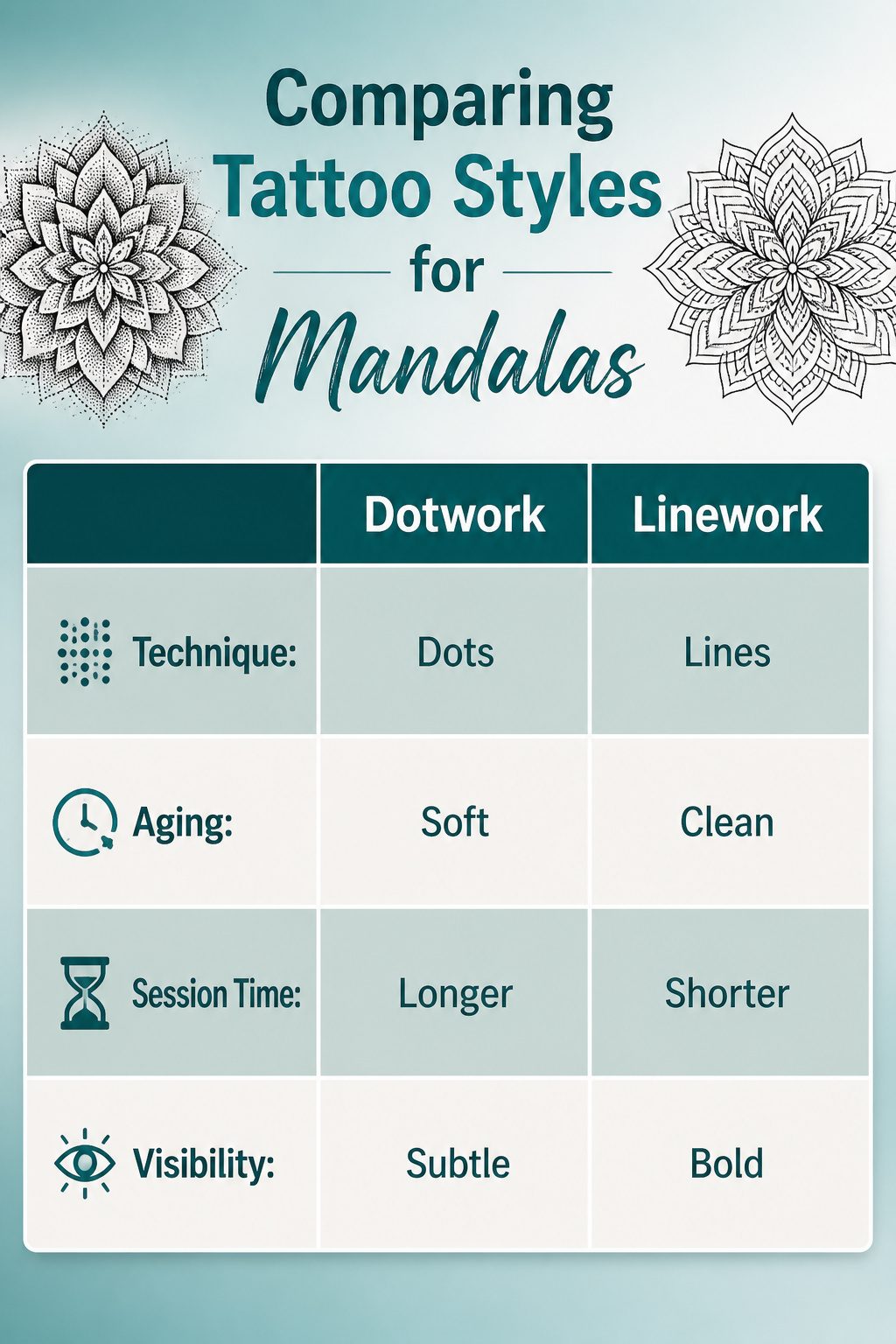
Dotwork builds a mandala from thousands of individual dots, the density of each cluster creating tone and depth without a single continuous line.
The result sits softer on skin than you’d expect, almost velvety, though the session runs longer and the artist’s steadiness matters more than usual.
Linework, by contrast, relies on unbroken strokes to map the geometry, and the best pieces let the weight of each line vary so the pattern breathes rather than flattening into a stencil.
Blackwork pushes that density to its limit, flooding sections with solid ink to make the negative space perform as hard as the drawn lines.
It photographs starkly and ages aggressively; what reads as bold at twenty-five can blur into a heavy mass by forty-five if the original spacing was too tight.
Watercolor borrows from painting rather than tattoo tradition, dropping transparent pigment around or through the mandala structure so the geometry and the color bleed exist in tension.
The technique demands a light hand and a client willing to accept that the "watercolor" effect will settle into something more muted within a few years.
Linework rewards the patient client with the cleanest aging of the four. Blackwork suits someone who wants the piece to read from a distance and accepts the trade.
Watercolor, in my observation looking through portfolios over the years, succeeds only when the mandala itself is drawn strongly enough to stand alone without the color; treat the pigment as ornament, not structure, or the whole thing collapses as it fades.
Lotus and Animal Combinations
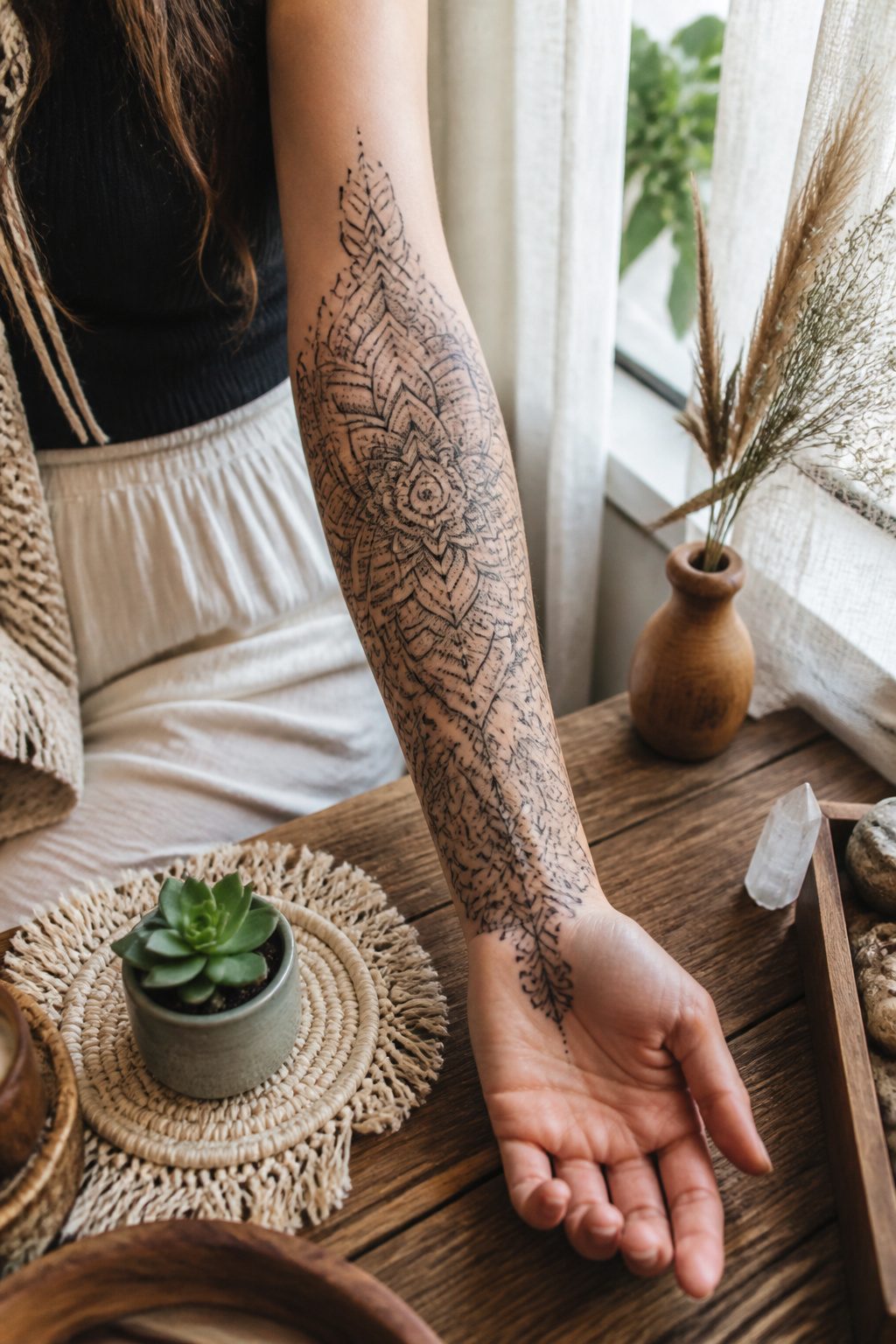
The lotus mandala carries what is probably the most established symbolic load in the category.
Gautama Buddha used the flower to show how the soul stays untouched by the mud it grows through, and the meanings attached to it run from patience and purity to the emptiness of desire and the Bodhi state itself.
A lotus mandala on the forearm, running elbow to wrist, can read as a deliberate reminder of that lineage: the petals built into the radial geometry, the whole thing visible enough that you catch your own eye on it during a rough afternoon.
Animal-integrated mandalas outside the elephant and owl already covered open up a different register. The structure stays radial, but the creature becomes the center or breaks the border.
A wolf, a deer, a snake coiled at the core: each shifts the meaning without abandoning the geometry. The mandala still maps the relationship between cosmic and personal, but the animal does the naming of which personal story it is.
The half-sleeve lotus mentioned above was done by @josefineirene, and the overlap with Buddhist practice is explicit there: the lotus position itself forms a petal shape from the bent knees, so the tattoo and the sitting meditation echo each other across skin and ritual.
That is the kind of layered decision that outlasts the first few months of ownership.
Frequently Asked Questions
What does a mandala tattoo symbolize?
A mandala tattoo symbolizes balance, unity, and spiritual growth. Its circular structure represents wholeness, and the radiating layers can map personal transformation or anchor a core value you want to hold onto.
The Sanskrit root means circle, and that shape carries the weight of completeness in Hindu and Buddhist traditions where the form originated.
How long does a mandala tattoo take?
A simple mandala runs 3–5 hours, medium complexity on a forearm or thigh needs 6–12 hours across multiple sessions, and a large back piece can demand 20–40-plus hours total.
Fine line and dotwork styles add time because every dot or hairline stroke requires deliberate, unhurried placement.
What are the best placements for mandala tattoos?
Flat areas show the symmetry best: back, chest, forearm, thigh, and wrist all work well. The back offers the most room for perfect radial expansion, while wrists and forearms keep the design visible for reminder pieces.
Areas that stay clothing-covered protect color and fine detail from sun damage over years.
What styles of mandala tattoos are there?
Common styles include dotwork, linework, blackwork, and watercolor, plus neo-traditional, minimalist, and pointillism variants. Each handles aging differently: linework stays sharp longer, blackwork reads bolder but limits future additions, and watercolor softens faster than saturated black.
The style choice should match how much maintenance you are willing to plan for.