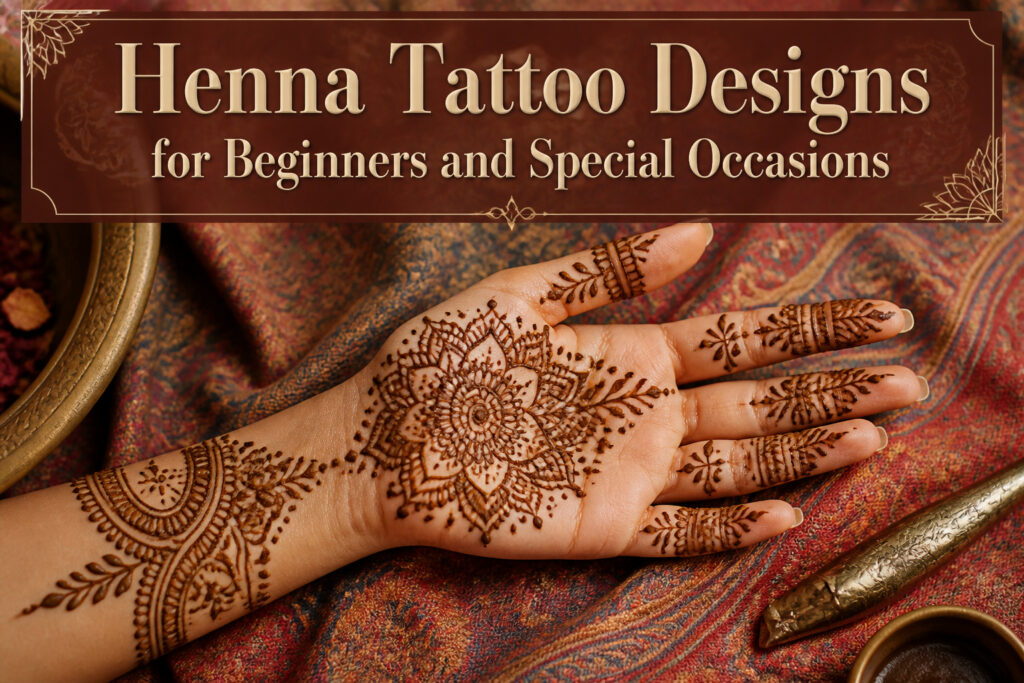
Henna tattoo designs range from a single dotted line to full ceremonial coverage, and the deciding factor is how long you can keep the paste undisturbed. Beginners learn faster on palms, where thick skin grabs the lawsone pigment and forgives shaky hands, but that same density means four to six hours of stillness before the stain sets deep enough to last.
1. 10 Easy Henna Tattoo Designs for Beginners
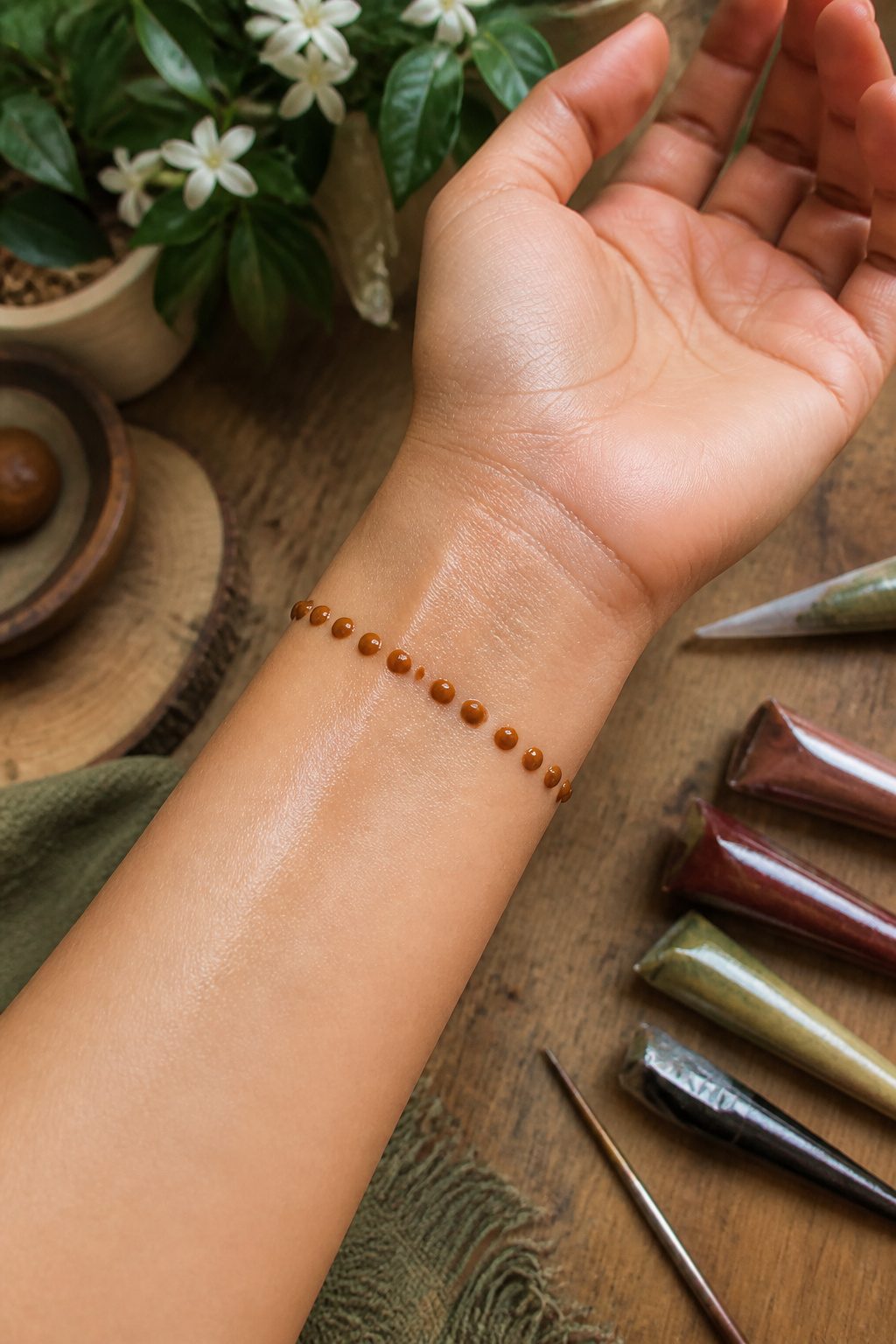
A row of simple dots down a finger or across a wrist teaches cone pressure faster than any video. Too light and the paste barely marks the skin; too heavy and a puddle forms that never dries. Lines come next, straight or curved, followed by basic floral shapes: a five-petal circle with a dot center. These small patterns build the muscle memory that freehand work demands.
Henna paste needs 4–6 hours on the skin for a deep stain. The color develops from orange to deep brown as it oxidizes, and body temperature affects how dark it goes. Palms, fingers, and wrists take the dye best because the skin is thickest there. Beginners should start on these spots rather than the back of the hand where thinner skin stains lighter and mistakes show more.
2. Popular Henna Tattoo Designs and Ideas
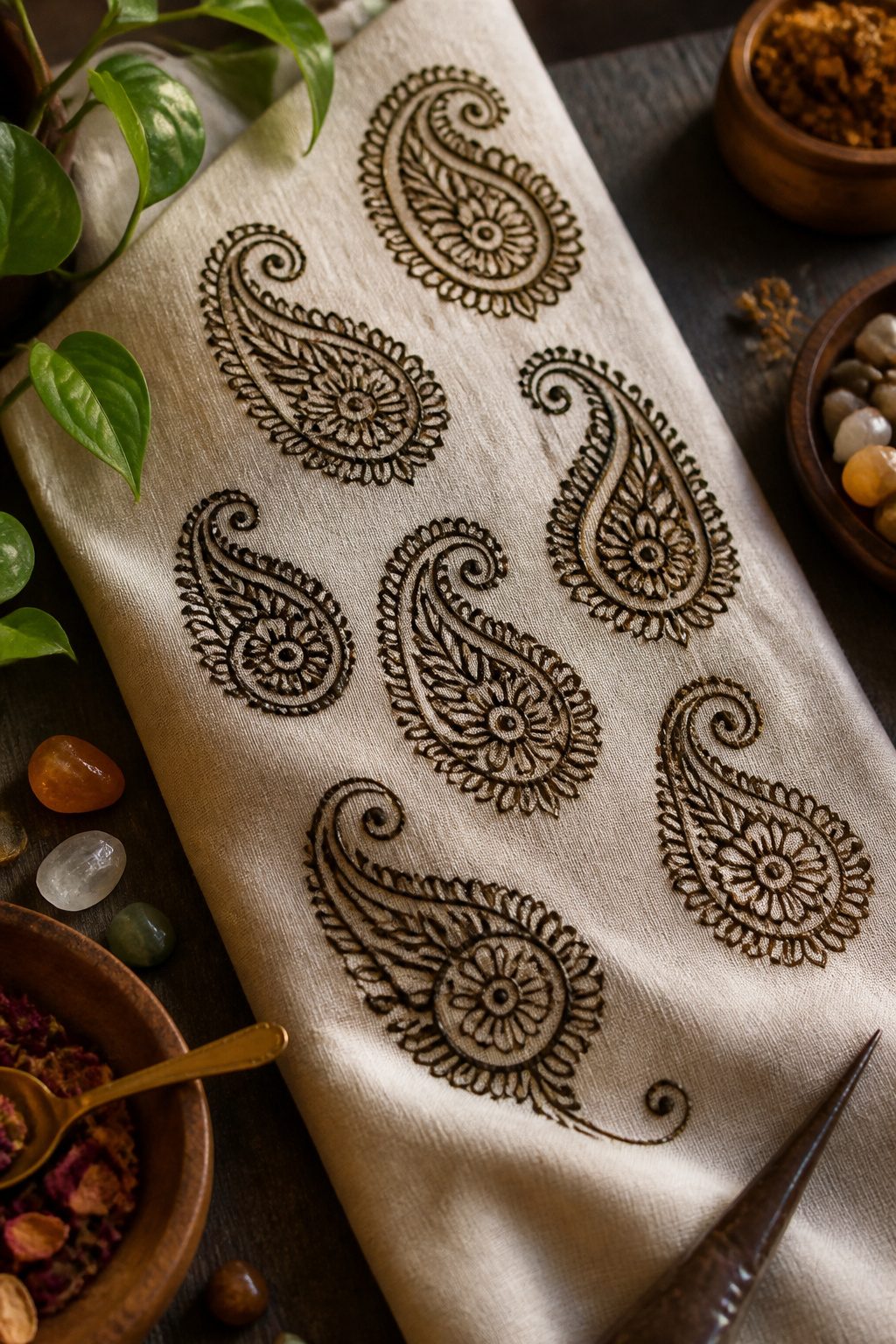
Three motifs show up across nearly every henna tradition, and each one scales from a single finger to full hand coverage without losing its meaning. Paisley carries fertility and abundance, which is why you still see it crawling up brides’ palms from the wrist in thick, teardrop shapes. The same teardrop, miniaturized, works as a fingertip accent with a single dot inside. Mandala patterns build outward from a center point, and the geometry reads as spiritual unity or inner balance; a small one sits fine on the back of a hand, but the design opens up properly when it takes the whole palm. Peacocks signal beauty and grace, and they need space: the tail feathers ask for at least the back of a hand, though a simplified head and neck can curve along one finger.
Vines and leaves, dots and lines, fill gaps or stand alone. Leaves read as vitality, dots as protection. A vine trailing from a knuckle toward the wrist is the usual bridge between a beginner’s comfort zone and fuller coverage.
How long the stain lasts depends on your skin and what you do after. Henna tattoos typically hold one to three weeks. Oily skin fades faster; dry skin and careful aftercare stretch the darker end of that range.
3. Henna Hand Tattoo Ideas
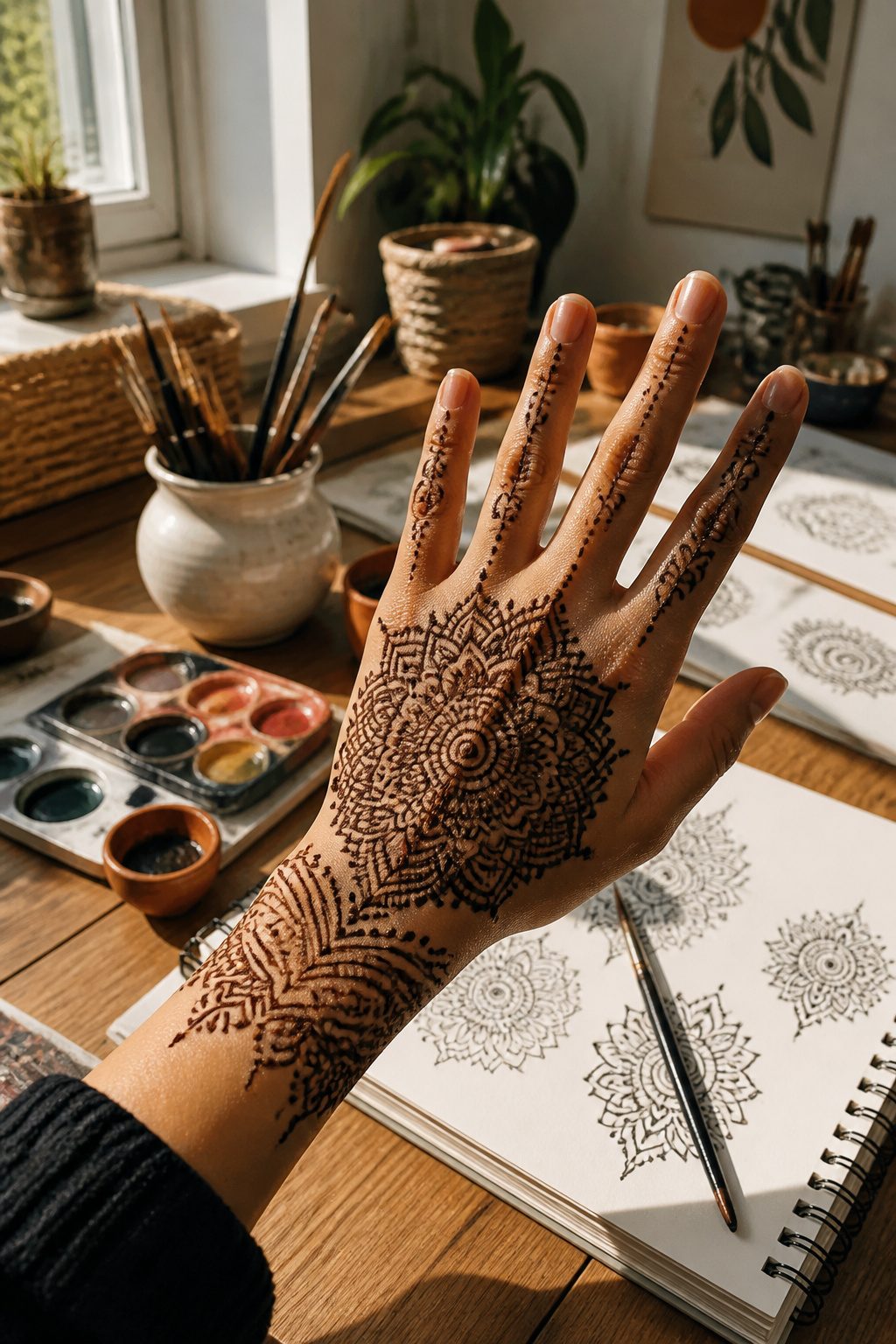
The palm stains darkest because the skin is thicker there, and that density grips more lawsone pigment. I learned this the hard way after my first attempt: a delicate vine across the back of my hand faded to a faint shadow in four days, while a smudged circle on my palm held on for two weeks and looked almost black by day three.
The back of the hand is where larger designs live, and it is the natural home for a mandala. Start with a small circle at center, then ring it with petals, loops, and dots until the pattern fills the space. The flat plane makes symmetry easier to judge, and the design photographs cleanly against the lighter skin there.
Fingers and wrists round out the workable areas. Fingers take simple rings or chains of dots and small leaves; wrists anchor the composition and let the pattern flow toward the forearm if you want continuity. Palms, back of hands, fingers, wrists: each placement changes what the henna can do and how boldly it reads.
4. Henna Feet Designs
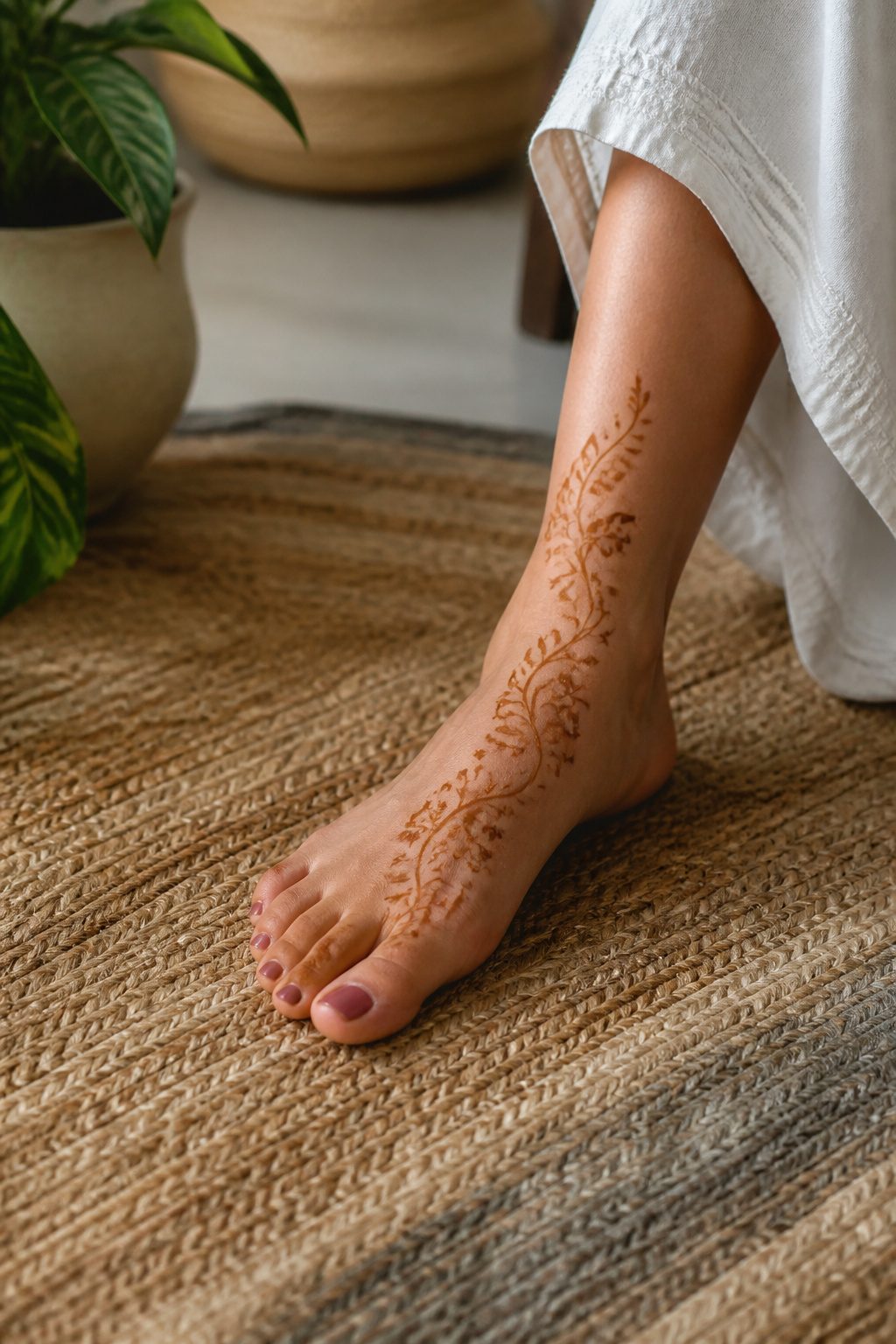
Foot henna carries its own set of practical rules. The tops of feet and ankles hold paste far better than soles, where walking and shoe friction scrub the stain away before it ever sets. Feet also stain lighter than palms, so the same design that reads bold across the back of a hand will settle into softer, more muted tones on the foot.
In ceremony use, henna on the feet and ankles has long carried meaning beyond decoration. South Asian, Middle Eastern, and North African wedding traditions apply it to mark joy, love, and fertility, while the broader dots and lines in many patterns serve as protection against ill will. Brides in particular wear these foot designs to signal blessing and transition.
For beginners, this lighter stain means two things. Simple patterns actually show better than dense ones, since heavy layering can muddy where the color already struggles to darken. Floral vines running from the ankle across the foot top stay visible longer than intricate sole work, and they take less precision to execute well.
5. Henna Arm and Shoulder Designs
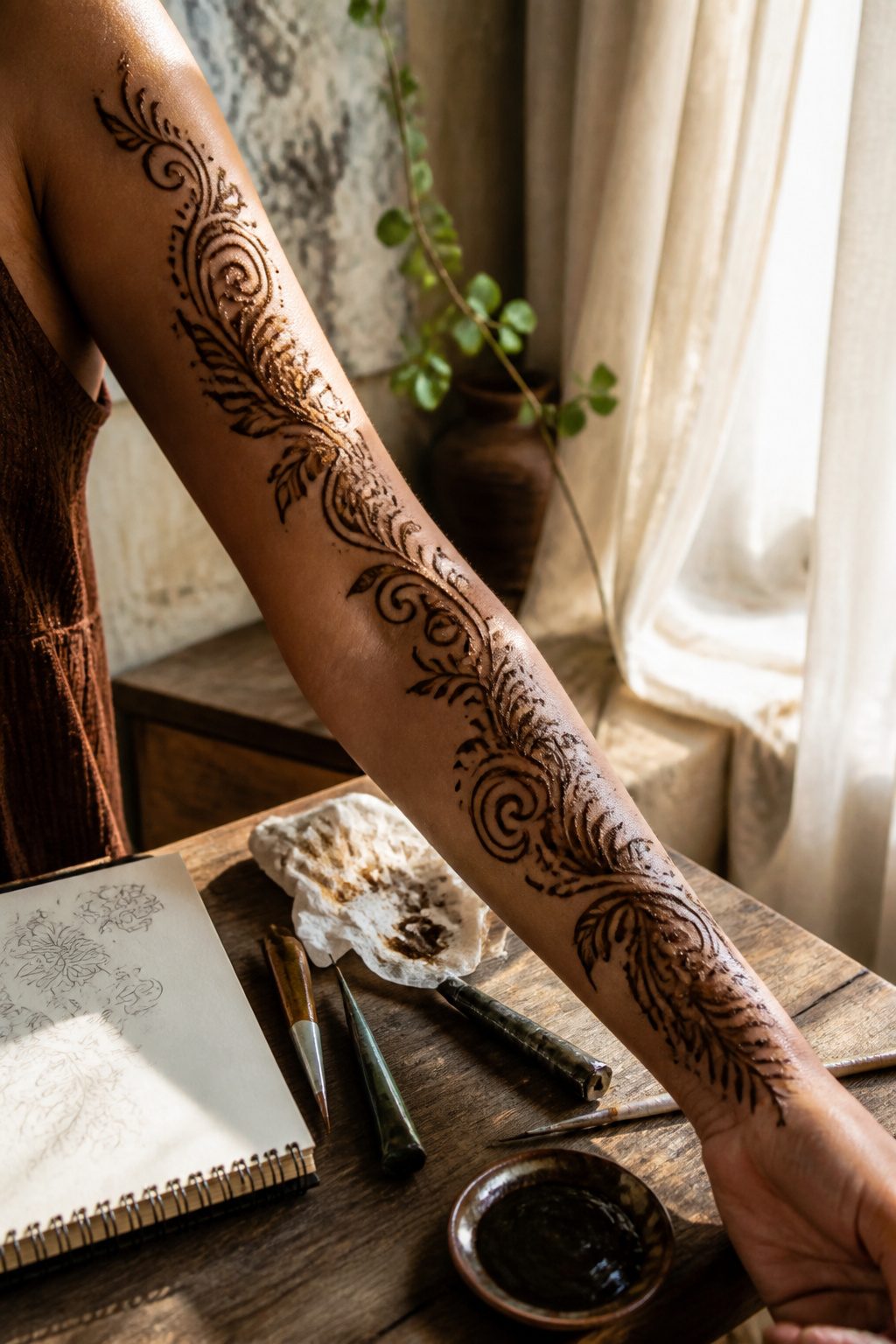
Arms and shoulders give henna a larger canvas for vines that actually flow and geometric bands wide enough to read as geometry, not smudges. The tradeoff is real: forearm skin stains lighter and fades faster than palms, so those bands need bolder lines and more paste saturation to last through an event.
For weddings or corporate settings where open hands feel too visible, a full sleeve running from shoulder to mid-forearm reads as accessory, not statement. The shoulder cap in particular hides under standard dress straps during ceremony then shows at the reception once the jacket comes off, which is why I started placing my own designs there for mixed professional events. A vine trailing from clavicle to deltoid survives about four days on me versus ten on my palms, but the placement buys flexibility that hand work never could.
6. Butterflies, Zodiac Symbols, and Other Motifs
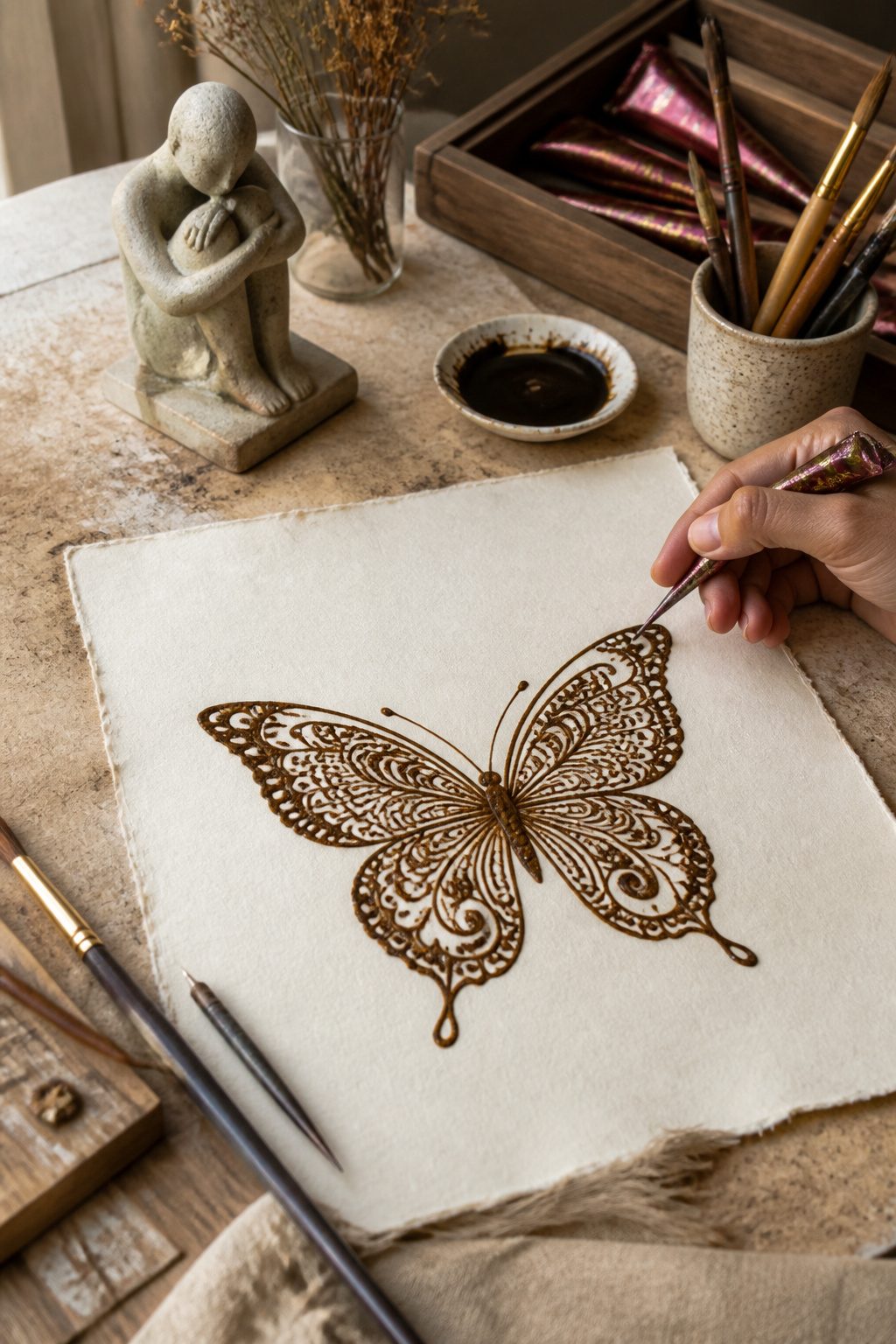
Butterflies and zodiac symbols have slipped into henna practice over the last decade, though they demand a different approach than paisleys or florals. The first time I tried a butterfly on a friend’s shoulder, I learned that the image must be broken into lines and negative space, not filled solid like a pen drawing. Wings work as paired teardrops with a thin body down the center; scales and antennae are single strokes that either read clearly from a distance or muddy into a blob if you overwork them.
Zodiac symbols carry personal weight, which is why clients ask for them, but their geometry varies wildly. A Leo lion silhouette would clog a cone instantly. The glyph itself, the simplified constellation lines, translates better: two or three connected dots and short strokes that read as "Leo" to anyone who knows the symbol and still look intentional to anyone who doesn’t.
Any image can move into henna’s vocabulary if you strip it to outline and spacing. A crescent moon becomes two curved lines with a gap between them. A sun loses its solid center and keeps radiating rays. The planning takes longer than traditional motifs because you’re translating rather than repeating a memorized form, but the paste, the cone pressure, and the wait time stay identical. The mistake is treating non-traditional symbols as exceptions to the rules rather than shapes that still obey them.
7. White Henna Tattoo
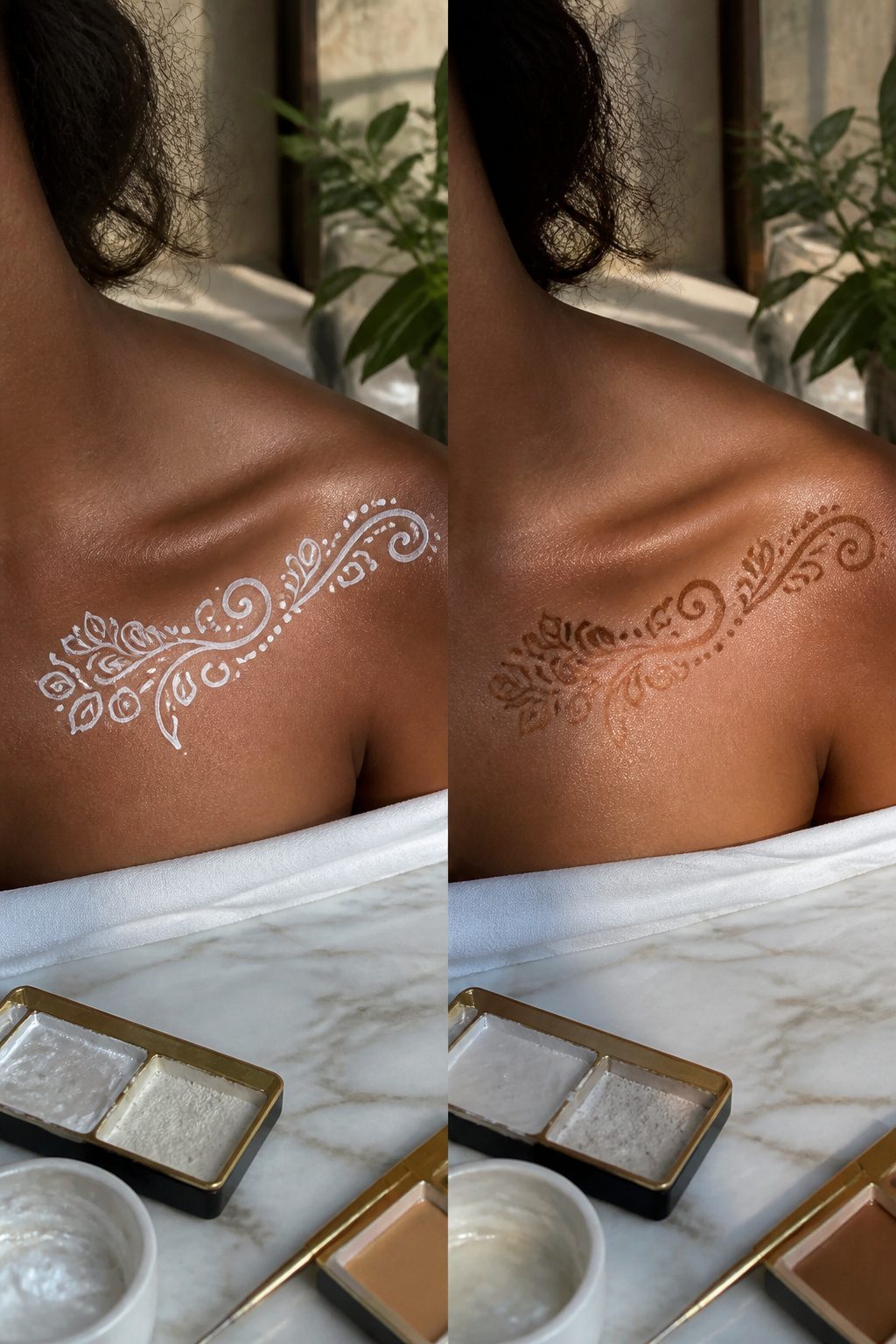
White henna caught my attention the first time I saw it paired with a dark evening gown. The paint sits on top of the skin rather than staining it, which means the whole design rinses away in 4 to 8 hours depending on how much you move that patch of skin. That temporary lifespan is exactly why some people choose it for events where they want the look without the two-week commitment.
The paint is acrylic, not Lawsonia inermis, so calling it "henna" is more about the style of application than the chemistry. That distinction matters for anyone with sensitivity to cosmetic-grade body paints. The safety note is straightforward: treat it as makeup, not as the traditional plant stain.
Where white body paint actually solves a problem is on deeper skin tones. Traditional henna turns reddish-brown, and the contrast can be subtle against darker complexions. The white formula reads clearly from across a room. It also works for anyone who wants a modern, graphic look that photographs well under artificial light without the overnight oxidation wait.
8. Sun and Moon Henna Tattoo
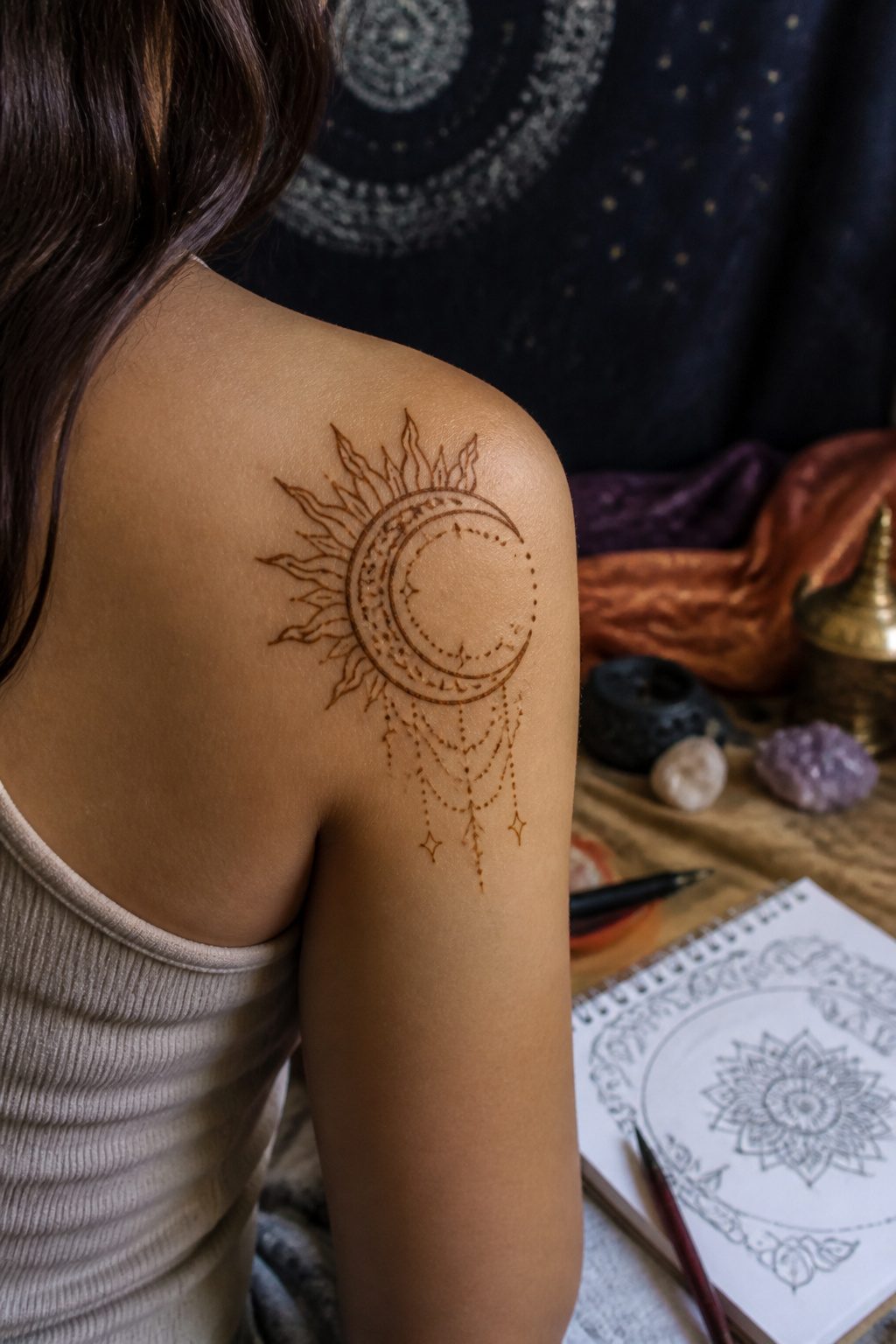
The sun and moon pairing carries a clear energy split: the sun reads as masculine, active, outward, while the moon pulls feminine, receptive, inward. That tension is what makes the design work on skin. Both shapes are fundamentally circular, which is why they settle so naturally onto curved body areas like shoulders or upper arms. The body does half the composition work for you.
Circles are where beginners stumble hardest. A sun with wobbly rays still looks like a sun; a moon with an uneven arc looks broken. The fix is mechanical: anchor your wrist and rotate the body part, not the cone. For a shoulder piece, have the person turn slowly while your hand stays fixed. For upper arms, move your feet around them. Freehand circles almost always flatten on one side because wrist rotation limits at about 120 degrees. I learned this watching a dozen attempts go oval before someone finally just spun the chair.
Rays and craters come after the orbit is clean. Add them too early and you commit to a lopsided foundation. Get the two circles right first, even if it takes three wiped attempts. The rest is just texture.
9. Minimalist Floral Chain Henna Tattoo Design
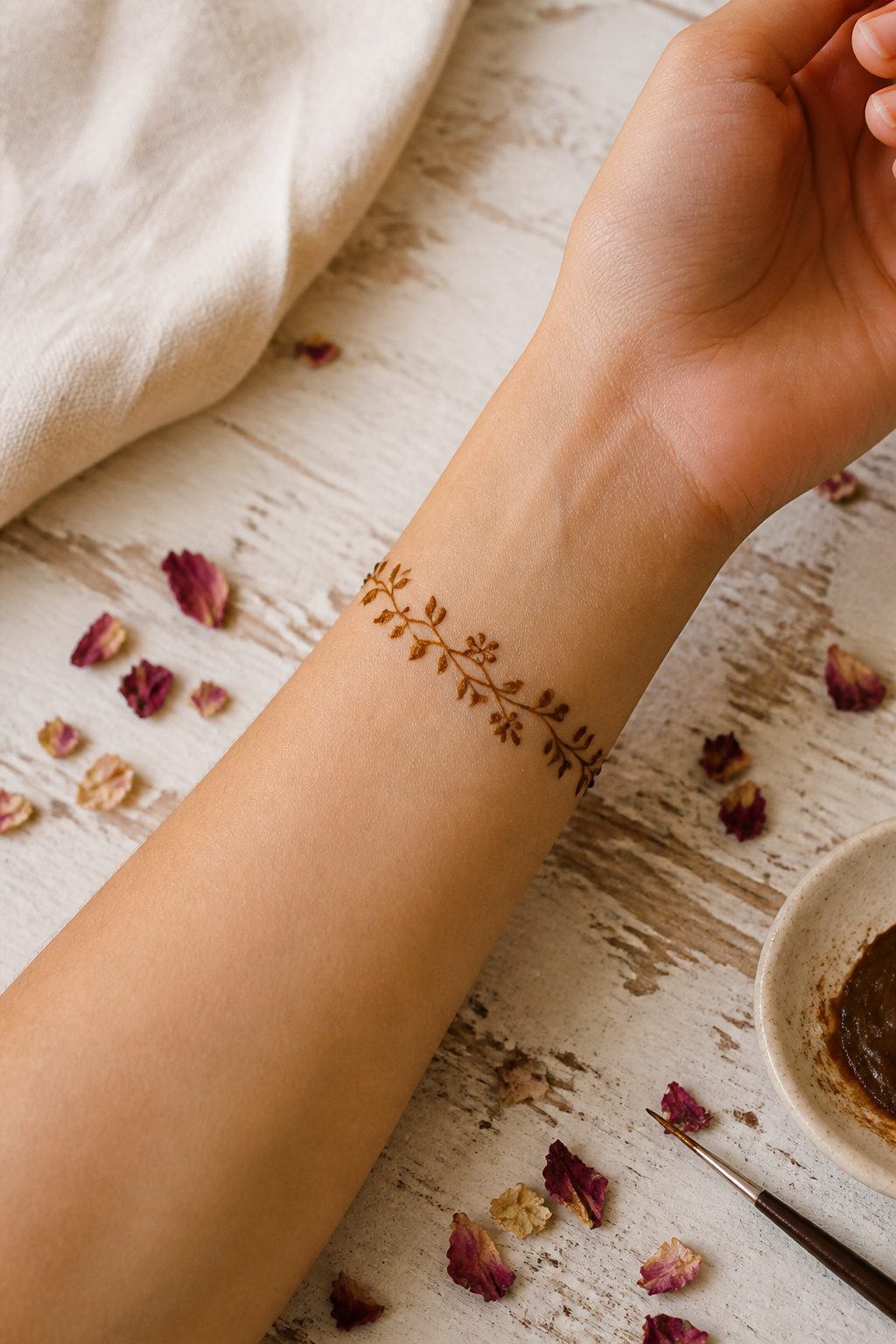
A single vine of tiny flowers or buds connected by thin lines or dots reads as delicate jewelry across a wrist or ankle, and that restraint is exactly what makes it difficult. Spacing and symmetry matter more when there is less design to distract from errors; a gap that is two millimeters off on a dense cuff vanishes, but on a minimalist chain it announces itself immediately. This style is where I first understood cone pressure control, because the line weight has to stay consistent for the chain to look intentional rather than hesitant. The flowers themselves are simple, five-petal shapes no larger than a grain of rice, but the intervals between them must be measured by eye and held steady across several inches of skin. I practiced on paper first, marking dots at fixed distances until my hand learned the rhythm without thinking. Worn alone, the chain sits like a narrow bracelet; paired with other simple henna tattoo designs, it anchors busier patterns without competing.
10. Mandala Henna Design on the Back of the Hand
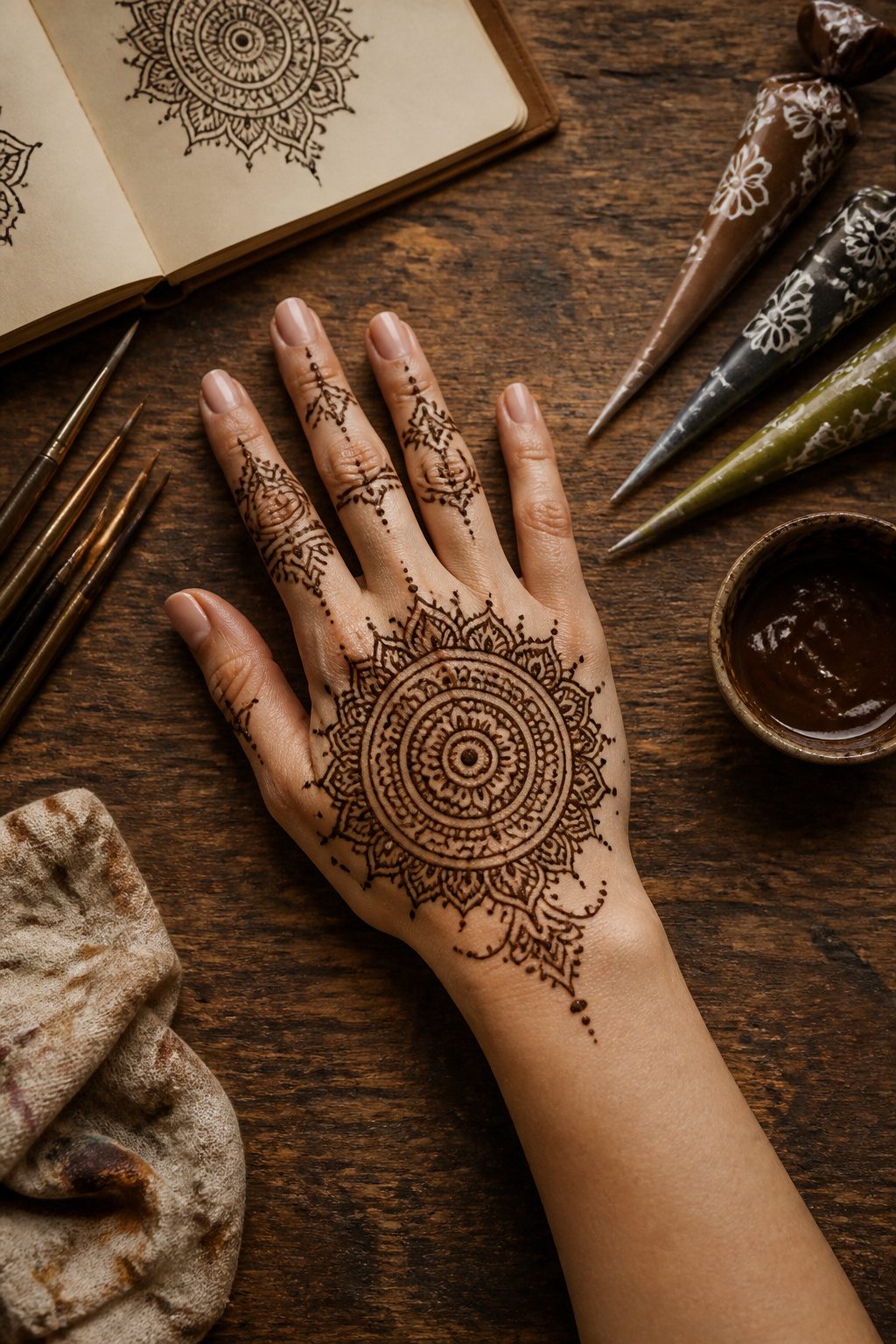
A mandala on the back of the hand builds from a single center point, adding petals, loops, and dots in outward rings. That structure makes it a strong first design for learning symmetry and spacing, since each layer repeats around the last and mistakes show immediately. In South Asian weddings the mandala carries meaning: spiritual unity, inner balance. The geometry photographs cleanly and holds up even when the paste cracks slightly at the edges.
Patience matters more than talent here. The cone moves in tighter circles near the center, widens as the pattern grows, and the hand shifts from flat to curved exactly where the design does. Beginners should draw concentric rings on paper first, tracing the same motion without the pressure of wet paste drying. Three or four paper sessions usually reveal whether your spacing collapses on one side, which it probably will. Fix that there, not on skin.
What Henna Actually Is
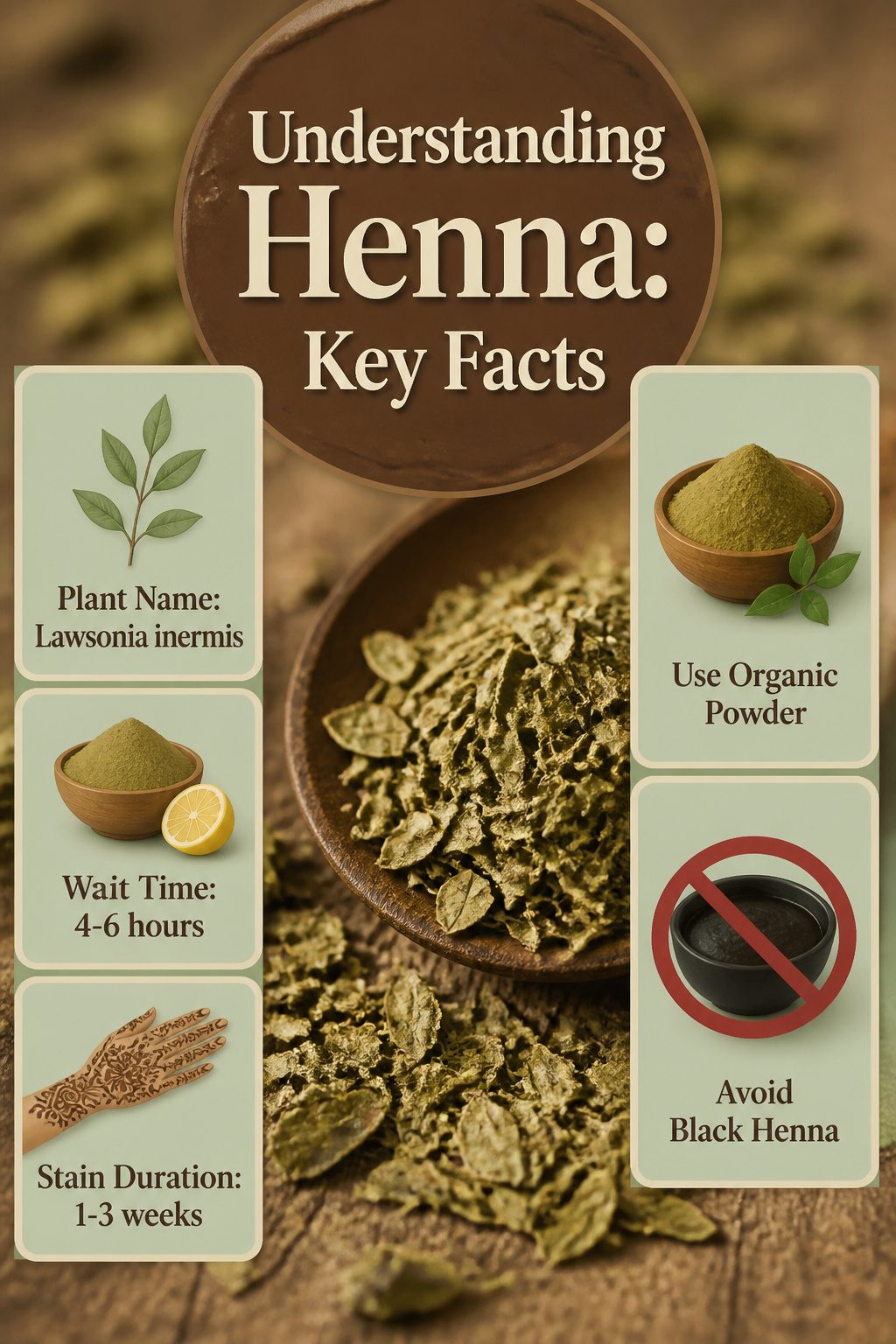
Lawsonia inermis grows in hot, dry regions, and its leaves have been dried and ground into powder for thousands of years. Mixed with lemon juice or tea, that powder becomes a smooth paste that stains skin anywhere from orange to deep brown depending on body chemistry and how long it sits. Four to six hours is the standard wait before scraping the dried paste away, and the mark that remains lasts one to three weeks as the outer skin naturally exfoliates.
The safety question matters because not all henna is the same plant product. Natural henna is generally safe for most skin types, but synthetic versions, especially "black henna," can contain paraphenylenediamine (PPD) and other additives that trigger severe reactions. I look for organic powder with no added dyes and buy only from sellers who list ingredients plainly. The extra ten minutes of reading labels beats two weeks of blistered skin, and that caution is what separates a good session from one you regret before the stain even sets.
Three Ways to Apply Henna
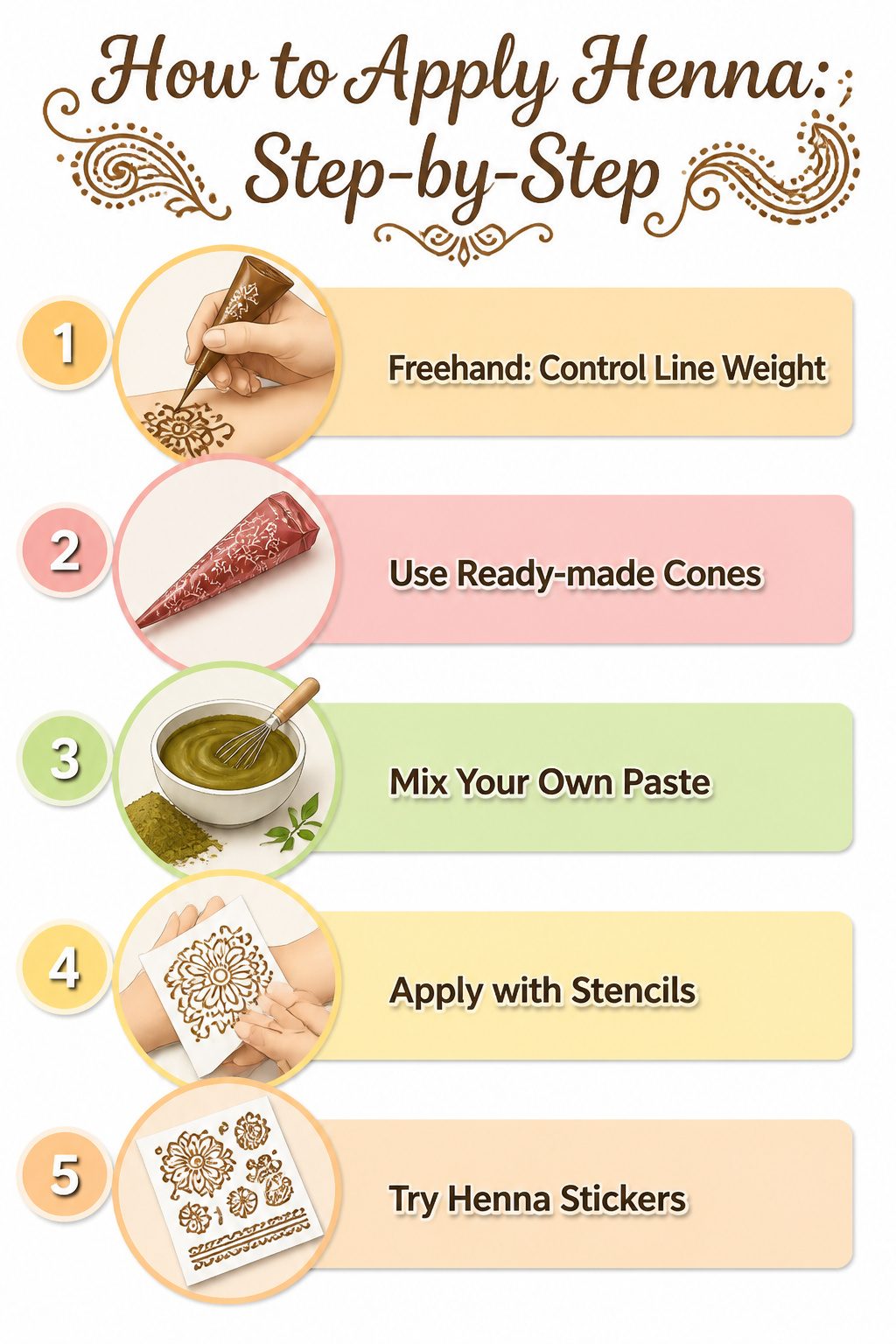
Freehand work with a henna cone gives the most control over line weight and flow, though the learning curve is real: the paste consistency, pressure, and pace all have to work together or the design bleeds. Ready-made cones from a DIY kit skip the mixing stage entirely and include instruction booklets, which is how I finally got a clean paisley after two lumpy attempts with powder I measured myself. Mixing your own paste from pure henna powder does let you adjust thickness for detail work versus fill, but it adds twenty minutes and a bowl to wash.
Stencils printed on plain paper from a laser printer change the equation for anyone who needs repeatability. Each one can be reused five to six times; you hold it to oiled skin for thirty seconds minimum, lift, and trace the imprint with paste. The tradeoff is stiffness: a vine that curves naturally freehand comes out rigid when you’re following a printed edge.
Pre-made henna tattoo stickers are the third route, and honesty requires admitting they are not henna at all but a stain-colored adhesive. They last a day or two versus one to three weeks for real paste, and the color sits on the surface rather than developing from body heat. For a bridal shower or at-home party where someone wants the look in five minutes, they serve a purpose. For anything meant to last through an actual occasion, the extra ten minutes with a cone or stencil pays off.
Safety and Aftercare
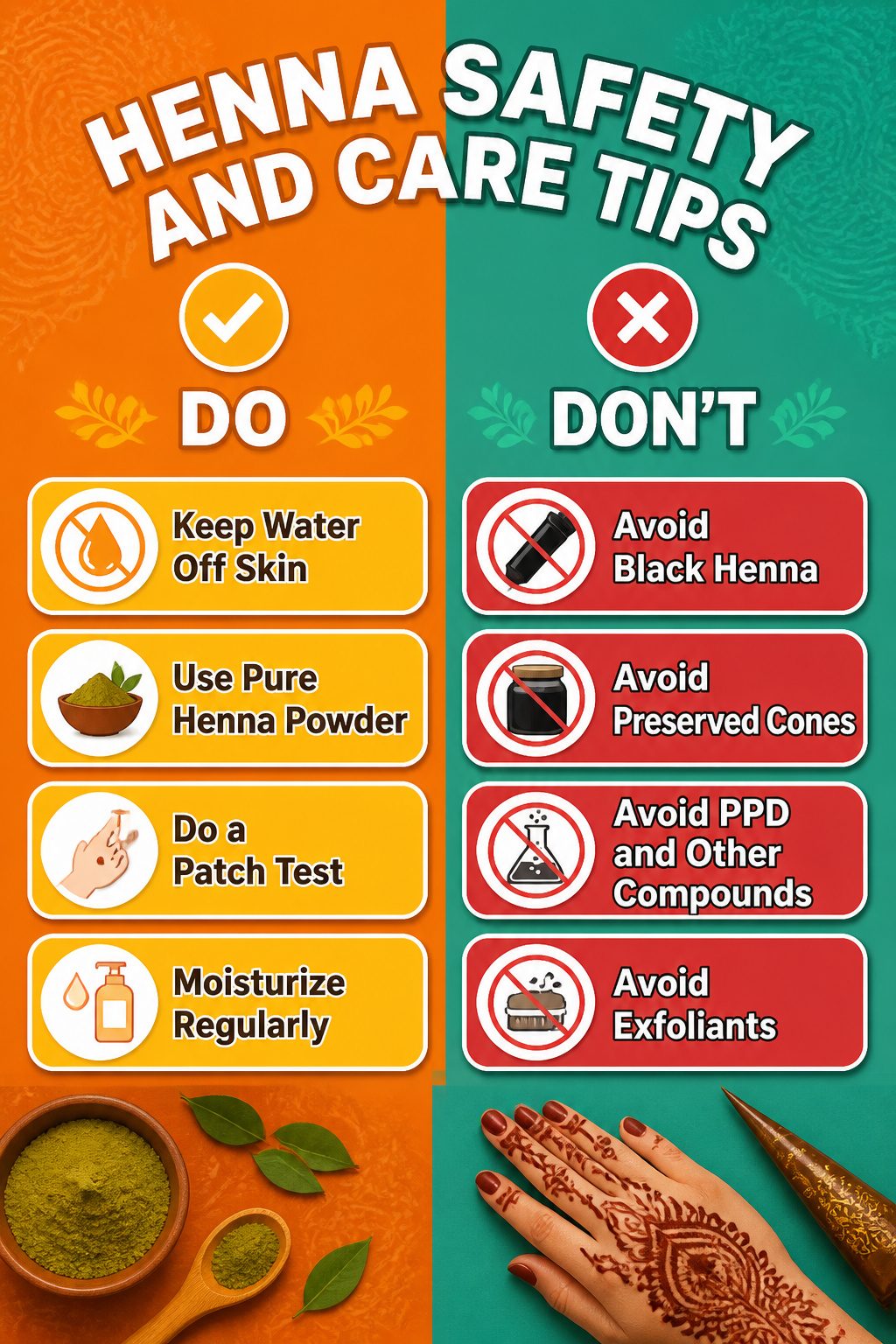
The paste scraped away, water stays off the skin for several hours while the stain keeps darkening. Pure henna powder with no chemical additives is what belongs in the cone; black henna or preserved cones carry PPD and other compounds that have no business near skin. A patch test on a small spot first is worth the wait, especially for anyone whose skin reacts easily.
That first color can look almost neon orange. Mine did. It settles into the deeper red-brown over a day or two, hitting peak vibrancy around day three to seven. Body temperature and individual skin chemistry decide where on that range any one person lands, so two friends using the same paste can end up with noticeably different tones.
Regular moisturizing extends the life, while rubbing dry and skipping chlorine or exfoliants keeps the shedding gradual. The fade is built into the process; skin renews itself, and the henna goes with it. Most last four to eight days, shorter if the washing cycle stays frequent.
Cultural Context and Ceremony Use
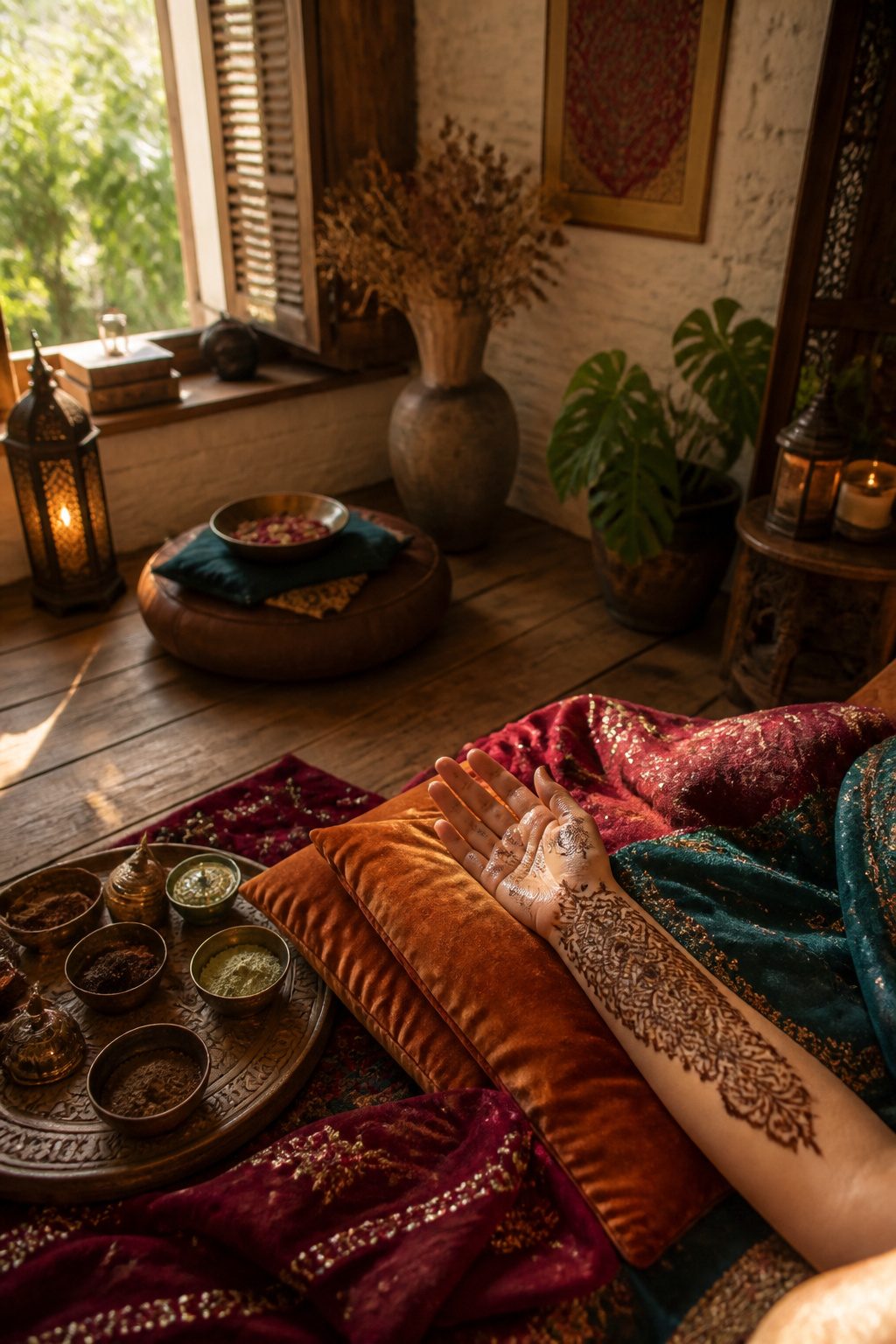
Henna carries weight in South Asian, Middle Eastern, and North African ceremonies that a weekend festival application usually glosses over. In those traditions, the paste marks weddings with joy, love, and fertility; religious observances like Eid or Diwali; and personal rituals of blessing and protection. The paisley stands for abundance, the mandala for spiritual unity, the peacock for beauty, vines and leaves for vitality, and the simple dots and lines for warding off harm.
That history matters because henna is temporary body art with permanent roots, and treating it as pure aesthetic without acknowledgment erases the people who built the practice. The modern split is real: many wear it now purely for decoration, at festivals or on vacation, stripped of any ceremonial tie. There is nothing wrong with appreciating the form, but the distinction between borrowing and honoring is worth keeping in mind when you choose a design and context.
DIY Henna Kits at Home
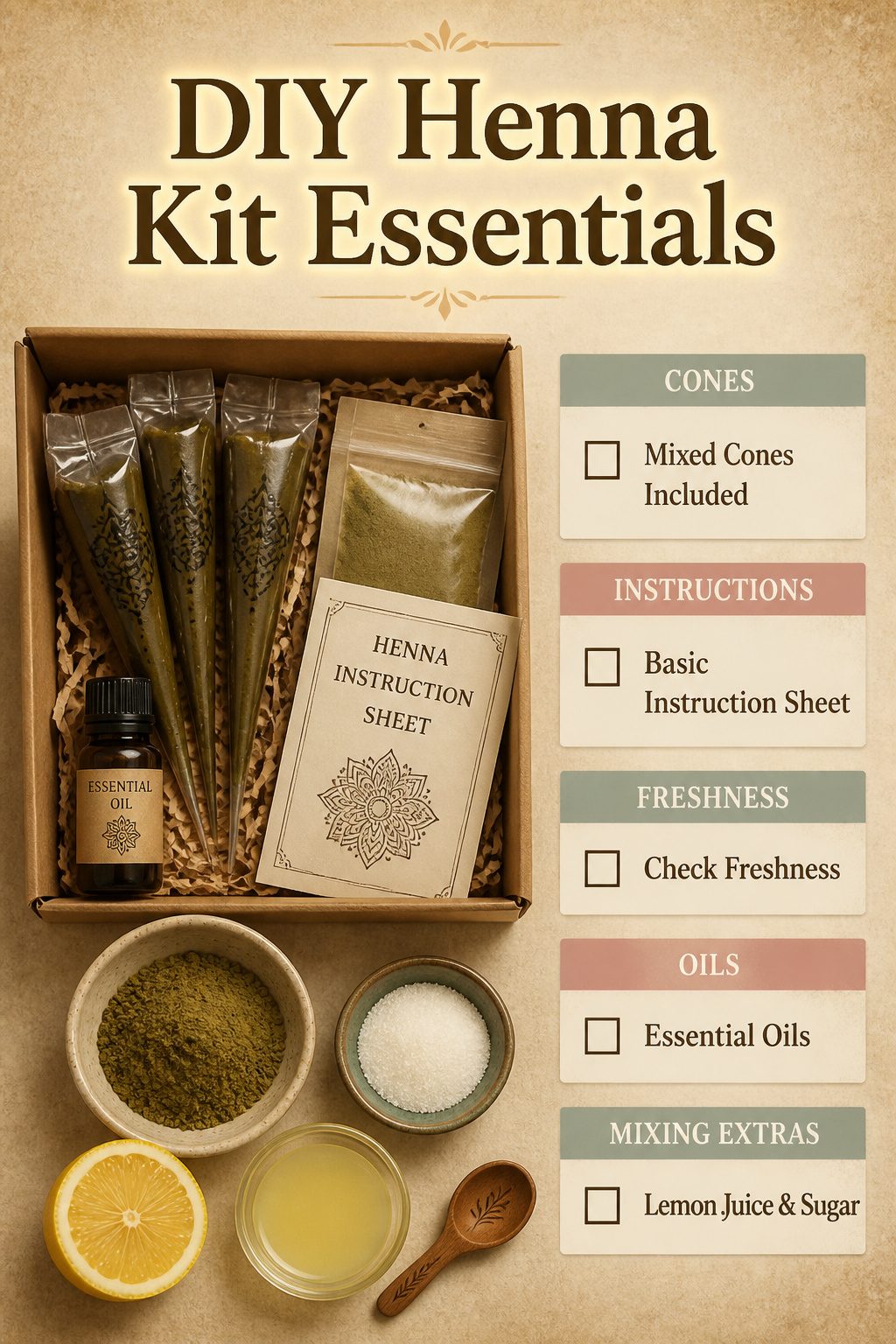
A commercial henna kit usually lands on your doorstep with pre-mixed cones, a basic instruction sheet, and sometimes a small packet of powder plus a bottle of essential oil. The cones are the draw: you cut the tip and start drawing without waiting hours for dye release. The catch is freshness. Those cones may have sat in a warehouse or on a shelf for months, and henna paste loses potency as it ages. You will not know until you test whether the stain still develops to that deep reddish-brown or comes out faint and orange.
Powder to mix yourself takes more setup, a bowl, lemon juice, sugar, and time for the lawsone to activate. The kit shortcuts all of that. For someone testing whether henna tattoo designs hold any real interest, the shortcut is worth the gamble. You spend less, mess around for an evening, and decide from actual results whether to later invest in bulk powder, real essential oils, and the learning curve of mixing your own batch.
Frequently Asked Questions
What is a henna tattoo?
A henna tattoo is temporary body art made by applying paste from ground Lawsonia inermis leaves to the skin. The paste stains the outermost layer of skin, leaving a mark that develops from orange to deep brown as it oxidizes. Unlike permanent tattoos, the color fades naturally as skin exfoliates over one to three weeks.
How long does a henna tattoo last?
Henna tattoos typically last one to three weeks, depending on your skin type and aftercare. Oily skin fades faster, while dry skin and careful maintenance stretch toward the longer end. Most people see peak color between days three and seven, with the stain gradually lightening as the outer skin renews itself.
Are henna tattoos safe?
Natural henna made from pure Lawsonia inermis powder is generally safe for most skin types. The danger comes from synthetic versions, especially black henna, which can contain paraphenylenediamine (PPD) and other additives that trigger severe reactions. Always check ingredients, buy from reputable sellers, and do a small patch test first if your skin reacts easily.
How do you apply a henna tattoo at home?
Clean and optionally exfoliate the skin first, then apply paste with a cone for freehand work or use a stencil for repeatability. Let the paste sit for four to six hours before scraping it off, and keep the area dry for several hours afterward while the stain continues darkening. Pre-mixed cones from kits skip the mixing stage, though freshness varies.