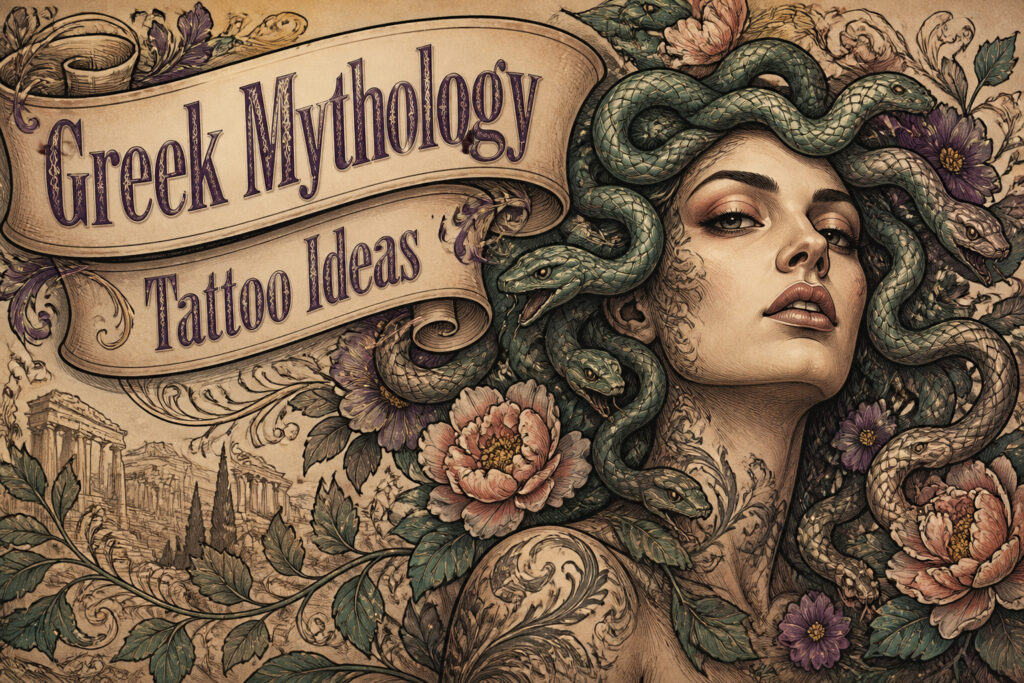
Greek mythology tattoo ideas range from delicate fine-line owls to full-back Zeus compositions in black and grey realism, and the deciding factor is not which god you admire but which story you have actually lived. The phoenix cycles through rebirth; Medusa’s transformation was forced on her, a distinction that reshapes whether the ink speaks to chosen change or survived damage. A Poseidon can mark peaceful passage or surviving the storm, and that choice, not the trident itself, determines whether the design holds meaning past the first year.
1. Zeus Tattoo
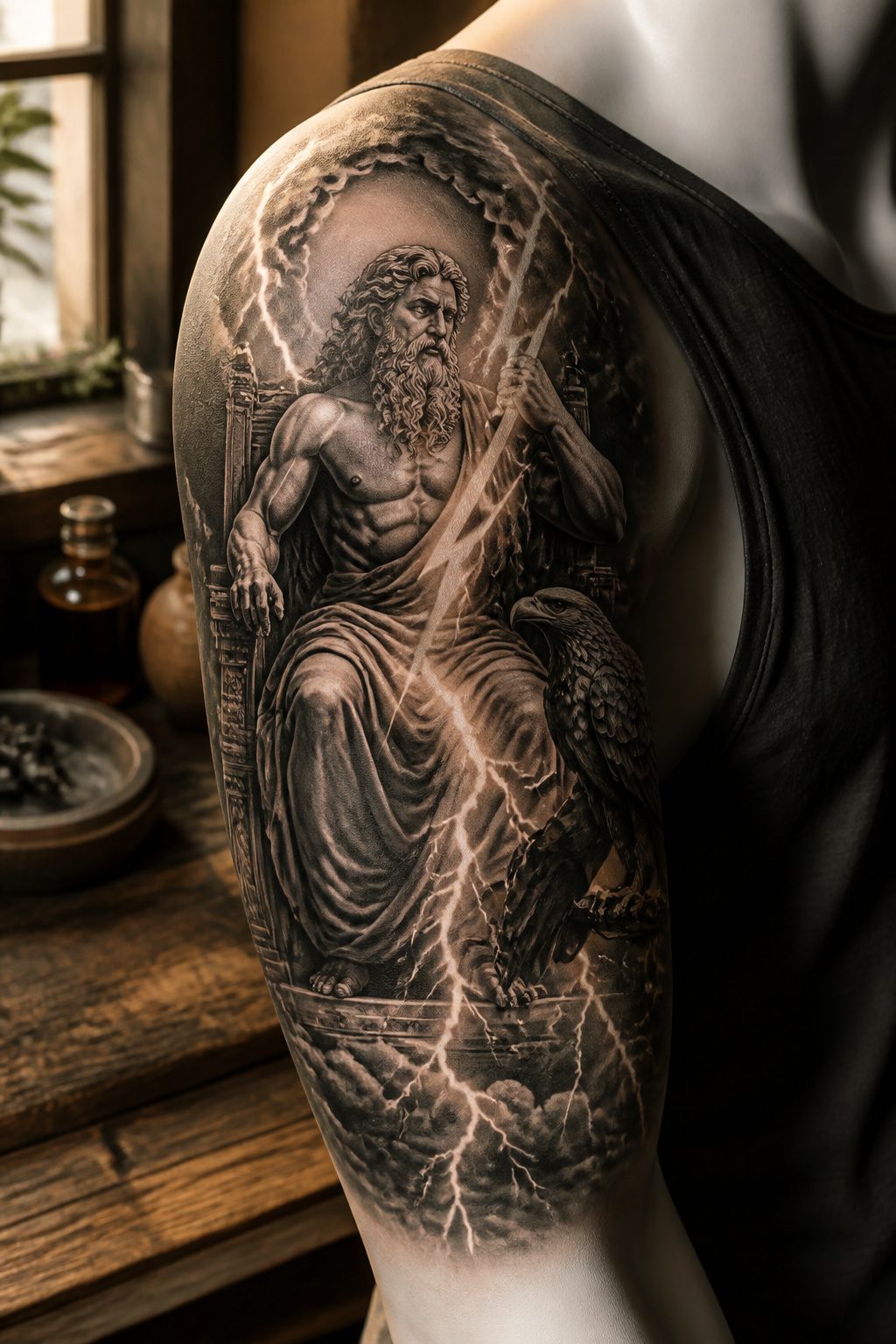
Zeus carries weight as a tattoo choice because the imagery gives you concrete things to work with: the lightning bolt, the throne, the eagle at his side. Black and grey realism handles these well if you want scale. The bolt reads as actual voltage crackling through cloudwork, and the eagle’s feathers hold enough tonal range to keep the eye moving across a chest piece or a full sleeve. Fine-line treatment shifts the same symbols toward something quieter. A single bolt rendered in thin, consistent linework sits cleanly on a forearm without shouting, and a seated Zeus on a throne, stripped to contour and minimal shading, fits spots where a heavy black fill would fight the bone.
Placement follows from that decision. The bolder the piece, the more room it needs for the contrast to breathe. A realism-driven Zeus wants the shoulder, the thigh, the back. Fine-line versions travel smaller: the wrist, the ribs behind, the side of the neck. What convinced me, reading through the portfolios, is that the eagle works as a standalone in either style. In black and grey it becomes a portrait of the bird itself, talons gripping cloud; in fine line it simplifies to silhouette and a few key feather lines, still readable at a distance. The throne matters most for balance, not detail. Artists use it to anchor the figure so the lightning can move, and without that fixed point the composition drifts.
2. Athena Tattoo
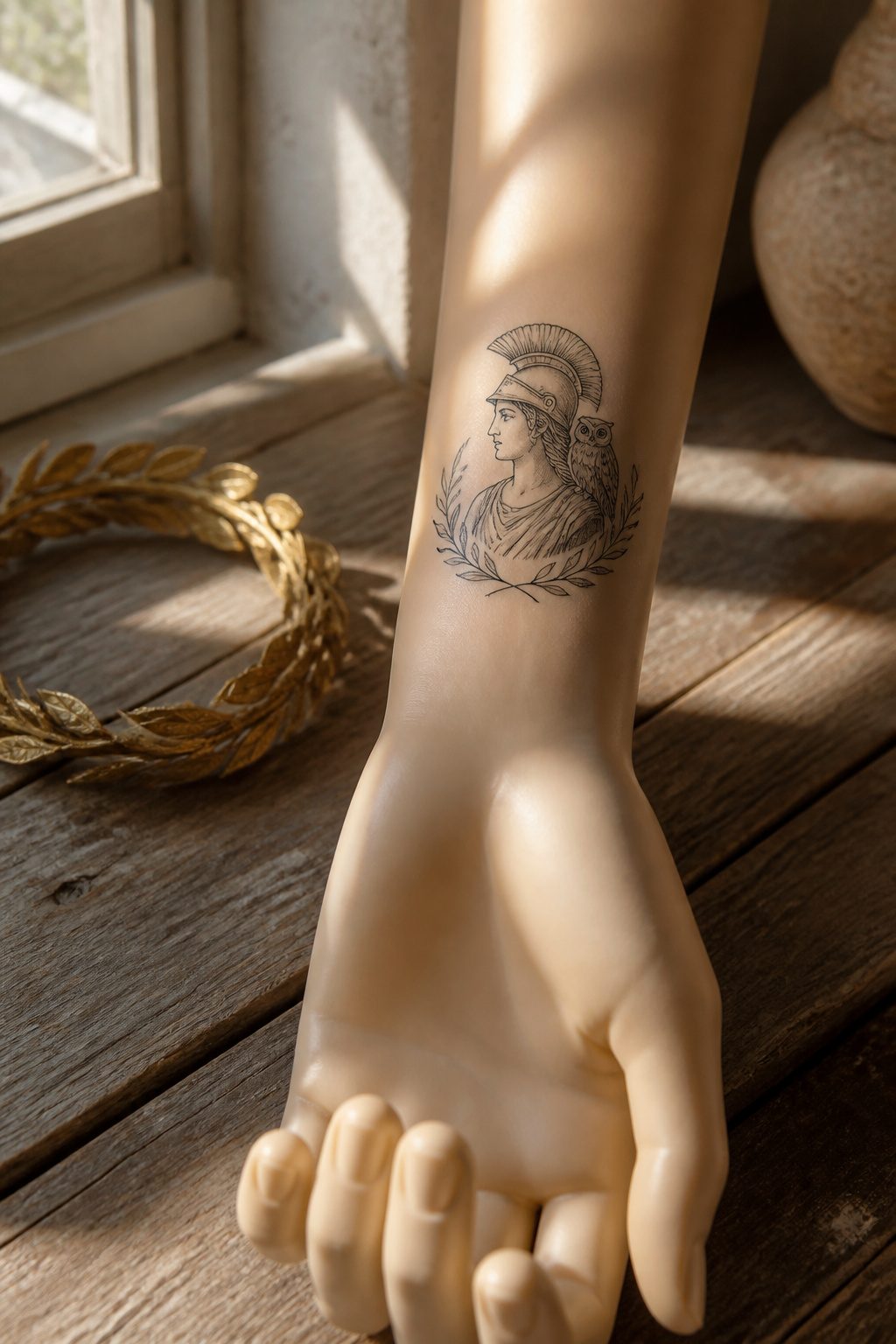
Athena carries one of the more unusual origin stories in the pantheon, born fully grown from Zeus’s forehead after he swallowed her mother Metis. That detail matters for a tattoo because it shapes what the goddess actually represents: intellect as a violent emergence, strategy that arrives complete rather than learned.
The owl (Athene noctua, the little owl native to Greece) sits at the center of most Athena designs I have seen work best. Sources describe it perched on her shoulder, and the Greeks connected its night vision to her ability to see truth clearly. A small owl piece reads as watchfulness rather than predation; scale it down and the meaning shifts from aggression to vigilance.
Her helmet and spear complete the standard iconography, but placement decides whether the design speaks to warfare or to the discipline behind it. A spear held upright tends toward martial display; one resting at an angle suggests readiness without immediate conflict. The helmet works similarly: face-forward reads as confrontation, profile or lifted visor reads as calculated approach.
What distinguishes Athena from Ares in tattoo work is exactly this calculable quality. Ares is the pure aggression of battle; Athena is the planning that wins it. The goddess who helped Odysseus through his ten-year return home was not fighting his wars for him. She was furnishing the cunning to survive them. A design that leans into her patronage of Athens, her weaving, her justice associations, lands on intellect as a form of strength rather than strength as a substitute for intellect.
For someone choosing between Athena and a more generic warrior symbol, the question is whether the tattoo should say "I fight" or "I think before I do." The second option carries more specific weight, and it ages better on skin that will outlast many of its own battles.
3. Poseidon Tattoo
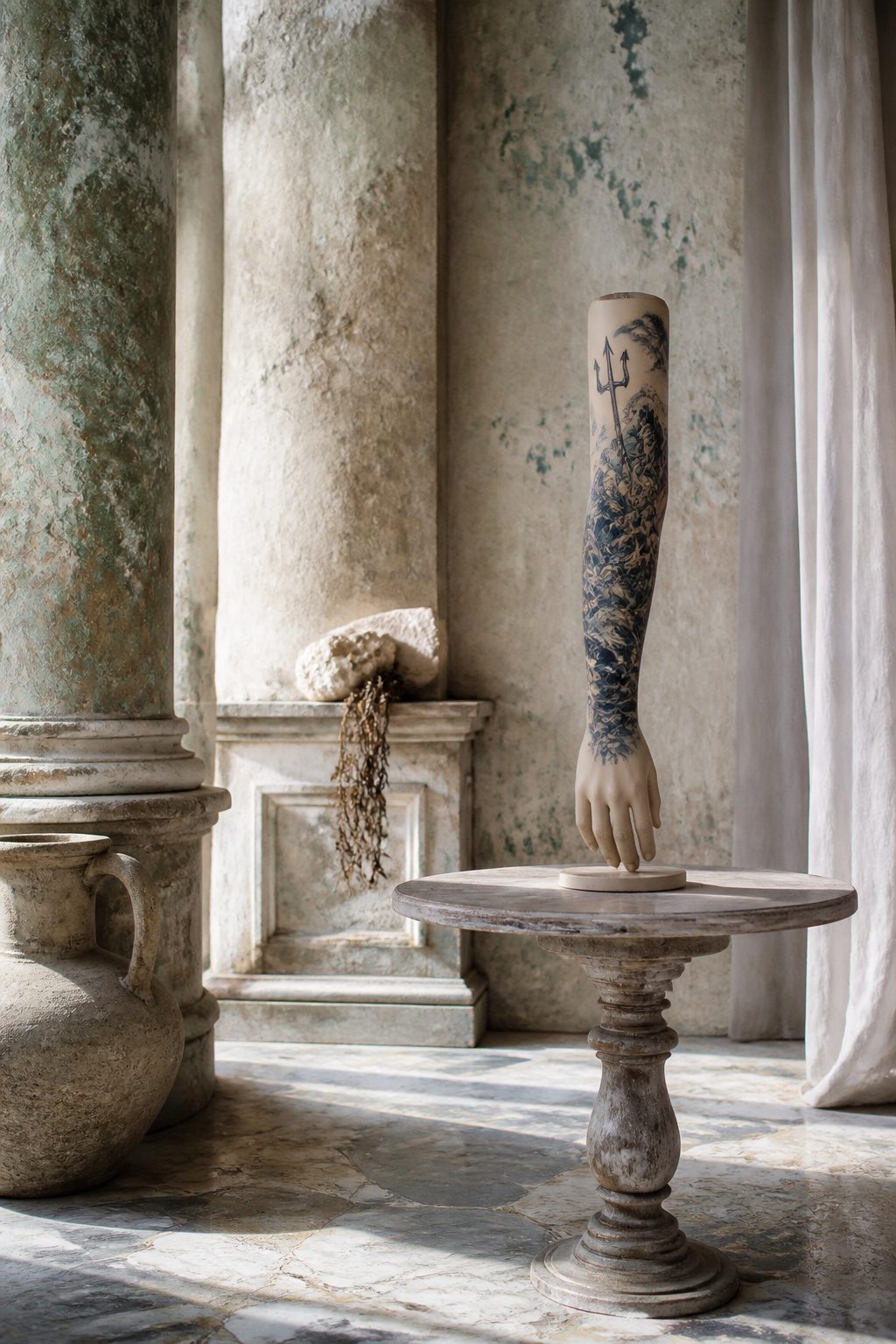
Poseidon carries the sea and everything beneath it, but the tattoos divide cleanly between two moods. Calm-water pieces lean on his trident rising from still waves, sometimes with horses breaking the surface nearby. The horse connection runs back to the myth directly; he created them from ocean foam, so a rearing stallion with seaweed in its mane reads as Poseidon without needing the god’s face at all.
Storm-focused work goes darker. The same trident, but now it splits black waves while the figure’s beard becomes surf. The difference is control, not just weather: calm pieces show Poseidon at rest, master of something tamed, where storm pieces show him as the chaos itself, the earthquake and the drowning together.
A client of mine sat with this choice for two sessions before committing. She worked on boats, wanted the protection angle he carries for seafarers, but could not decide if that meant peaceful passage or surviving what he threw at her. She chose the storm version eventually, trident down, waves curling over the top of her shoulder so the point aimed at her heart. The placement mattered because the image moved; calm Poseidons tend to read as emblems, sitting square on a chest or thigh, while storm versions need the wrap of an arm or a leg to make the water look like it is passing through.
4. Medusa Tattoo
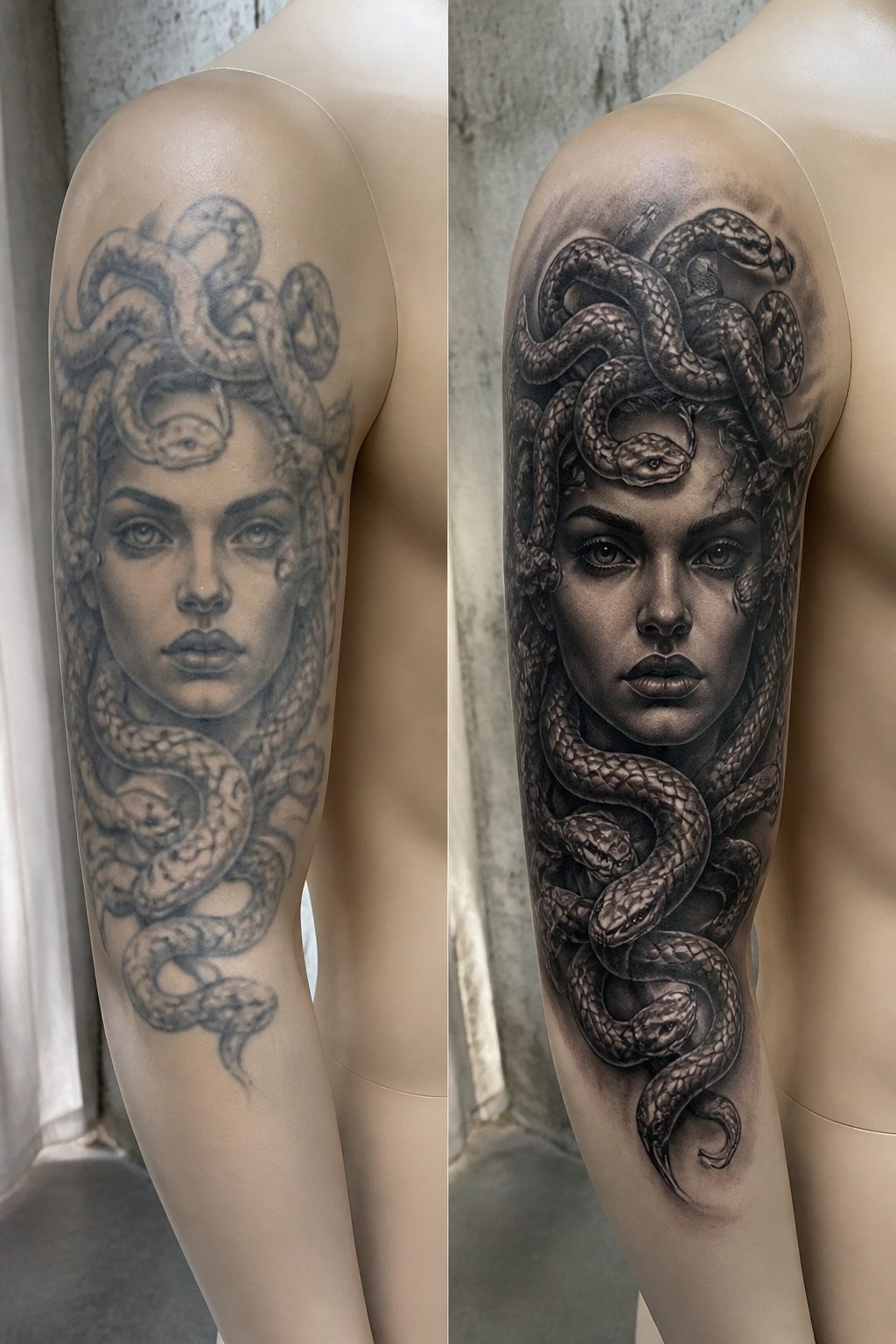
Medusa’s story carries a charge that most mythic figures only approach. The most familiar version casts her as a beautiful priestess in Athena’s temple, assaulted by Poseidon, then punished by Athena with snake hair and a gaze that turns men to stone. That sequence, blame shifting from god to victim, is why her image has been reclaimed: the monster label gets reversed, the danger reowned.
Artists face a real tension in rendering her. Lean too beautiful and the snake hair reads as costume jewelry; lean too horrifying and the reclaiming message collapses into the old warning. The tattoos that work best split the difference at the eyes, keeping the face arresting enough to hold a gaze while the serpents do the unsettling work. Black-and-grey realism tends toward this balance better than the more graphic neo-traditional approach, where the face can flatten into mask-like symmetry and lose the ambiguity.
Transformation sits at the center of her symbolism either way. The myth is about change forced from without, which is why it speaks to women who have been through something similar and want the mark of having come through it. The stone-turning gaze becomes, in this reading, a boundary: look at me wrong and you are the one who freezes.
5. Phoenix Tattoo
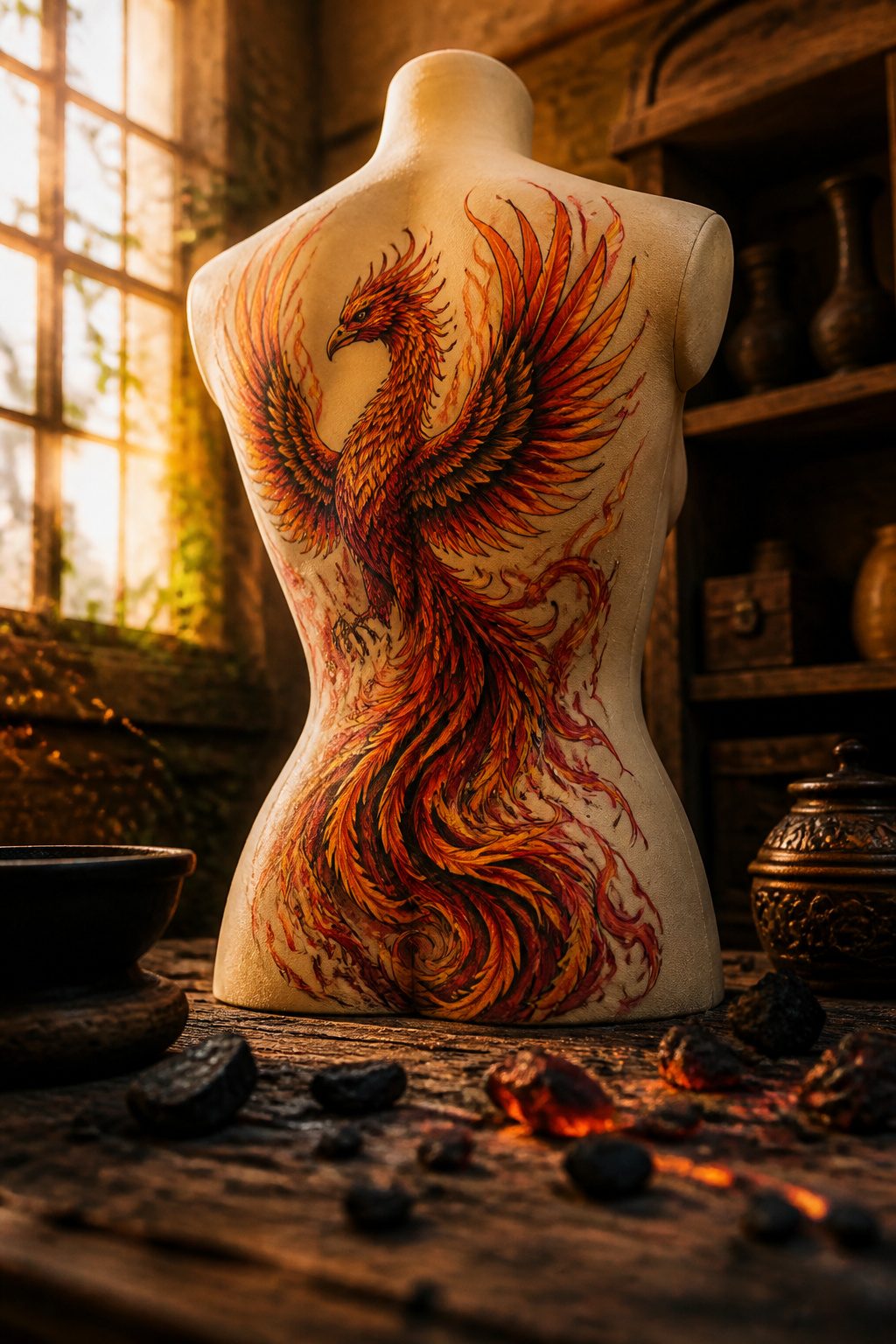
The phoenix entered Greek writing later than Egyptian texts, but the Greeks shaped the version most people tattoo today: a single immortal bird that burns and rises from its own ashes, not the paired sun-bird of Chinese lore or the Persian huma that never lands. That distinction matters for the design. Greek phoenix tattoos work best with flame that wraps the body rather than consumes it, since the rebirth is the point, not the destruction.
Feather detail is where ink longevity gets tested. Fine individual barbs in red or orange fade fastest on most skin, so a solid silhouette with negative-space feather texture holds color longer than open linework. Flame edges blur too if they’re too soft; a crisp boundary where the fire meets skin tone keeps the shape readable for years. Black-and-grey with a single warm accent, usually amber, solves the fading problem without losing the fire reference entirely.
The cyclic meaning reads clearly even small, which is why wrists and ribs carry so many. Larger pieces on a back or thigh can show the full arc, ash at the base and wings clearing smoke, but the symbol works at any scale because the story is already in the viewer’s head. You don’t need a caption.
6. Ares Tattoo
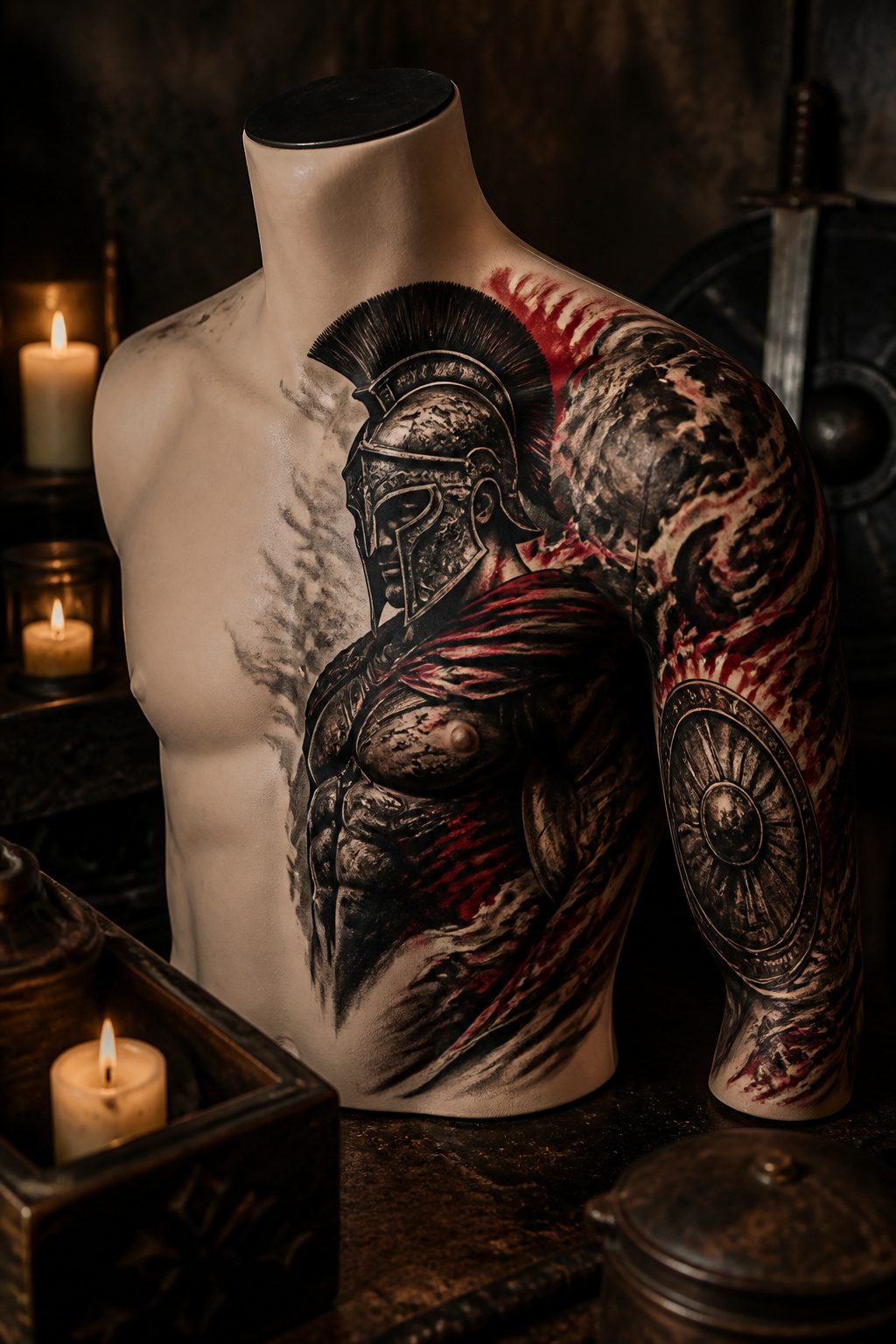
Ares sits at the opposite pole from Athena, and that tension is exactly why the tattoo works. Where Athena stands for strategy, counsel, and the kind of warfare that protects cities, Ares embodies the part of battle nobody plans: rage, bloodlust, and the chaos that spills past any border. The sources draw the line clearly: Athena burst fully armed from Zeus’s forehead as pure intellect, while even Zeus called Ares the most hated god on Olympus for loving violence on its own terms.
The helmet and spear imagery for Ares shifts accordingly. Darker palettes tend to suit him, heavy blacks and deep reds rather than the clean lines you might pair with Athena’s owl or aegis. A spear alone reads as generic warrior; the Ares version needs something twisted or burning to signal that his chariot was pulled by fire-breathing horses, that he was wounded and humiliated and came back anyway. The chaos is the point, not a flaw to smooth over.
Someone chooses this symbol when they want to own the ungoverned part of themselves: the anger that got them out of something, the impulse that wrecked a careful plan but landed them somewhere true. It is not a comfortable tattoo. That is precisely why it lasts.
7. Dionysus Tattoo
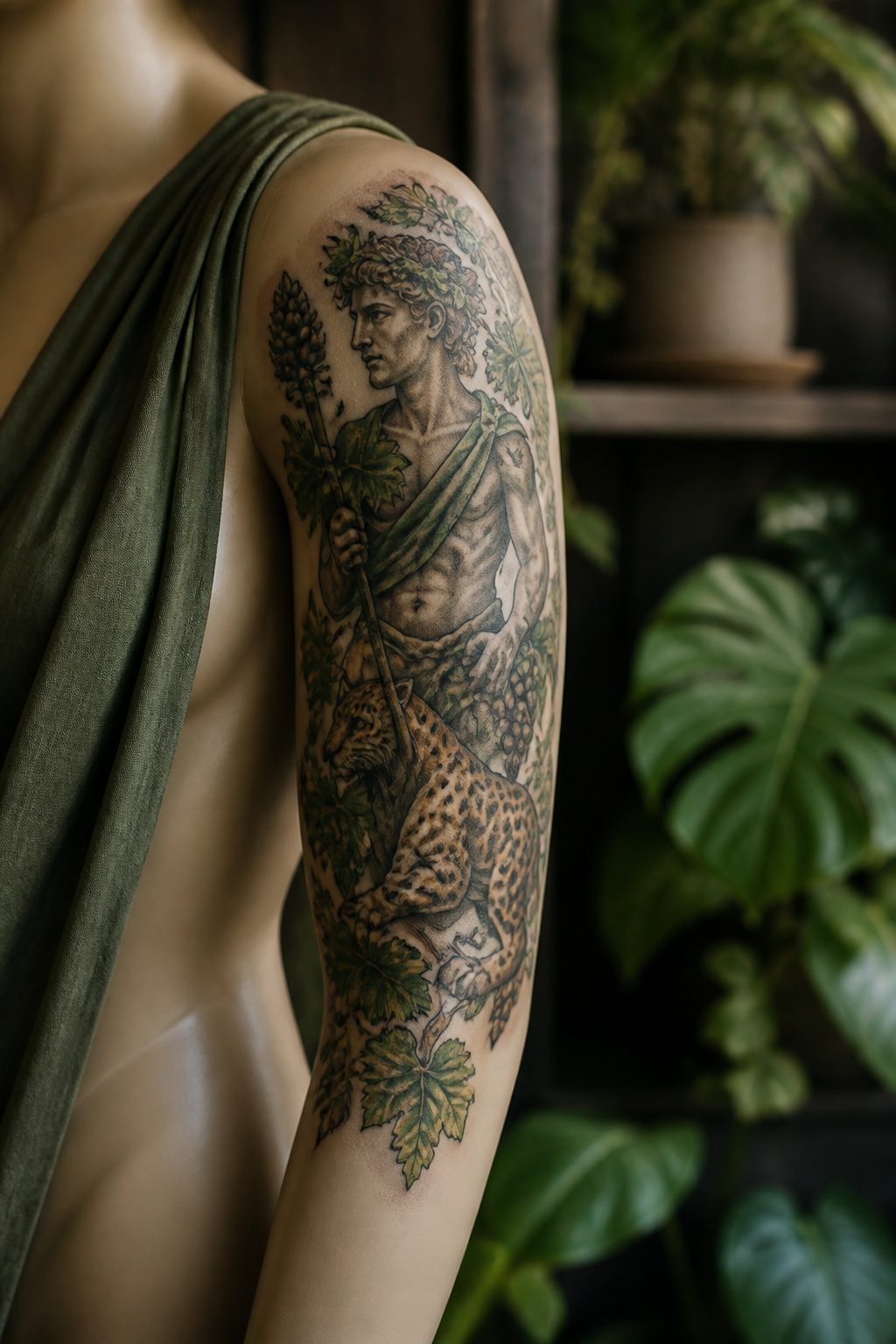
Dionysus carries the rare title "twice-born," a detail that surfaces again and again in the source material and gives the god his real weight as tattoo subject. Zeus rescued the unborn child by sewing him into his own thigh after Semele was burned to ash by his divine form, and that cycle of destruction and remaking is what the image actually holds.
The thyrsus, grapevine, and leopard are the three markers that keep a Dionysus piece from reading as generic wine culture. The thyrsus, that pine-cone staff wrapped in ivy or vine, signals ritual and ecstasy rather than simple drinking. Grapevine can wind through a larger composition or stand alone as scar tissue becoming fruit, which is the visual move that saves it from cliché. The leopard, often depicted as his mount or companion, carries the same duality: wildness that serves rather than destroys.
The appeal here is transformation marked visibly on the body, not celebration. Someone who has rebuilt after burnout, after a marriage ended, after a body changed permanently, the twice-born narrative fits without needing to explain itself. The image does the work that a wine glass or a party scene would cheapen.
8. Apollo Tattoo
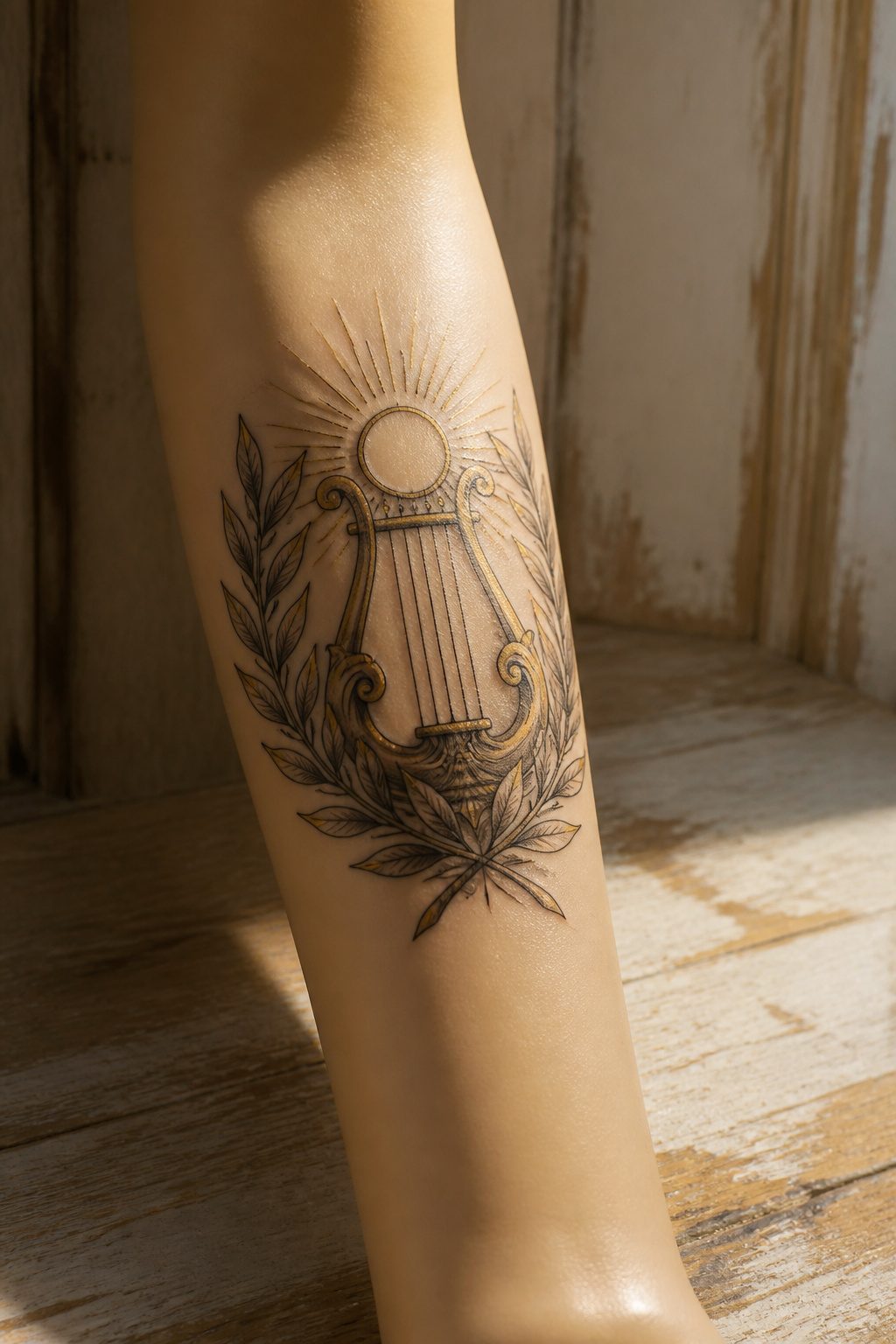
Apollo carries more weight than most solar figures because light in his mythology is inseparable from truth and healing, not just the daily return of the sun. The lyre, laurel wreath, and solar disc give you three distinct ways in, and each reads differently on skin. A lyre centers the music and prophecy side, the laurel nods to victory earned through pursuit rather than combat, and the sun itself risks looking interchangeable with Ra or Sol Invictus unless you pair it with one of his other symbols.
The difference matters if you want the piece to hold meaning past the first year. Solar deities in other traditions often embody cyclical renewal or raw power; Apollo’s light is specifically clarity and the pursuit of it, which makes the tattoo a commitment rather than a mood. A client of mine put it well: she wanted the laurel not because she won something, but because she was still running. That is the distinction. The design works when it names an ongoing search, not a finished one.
9. Hades Tattoo
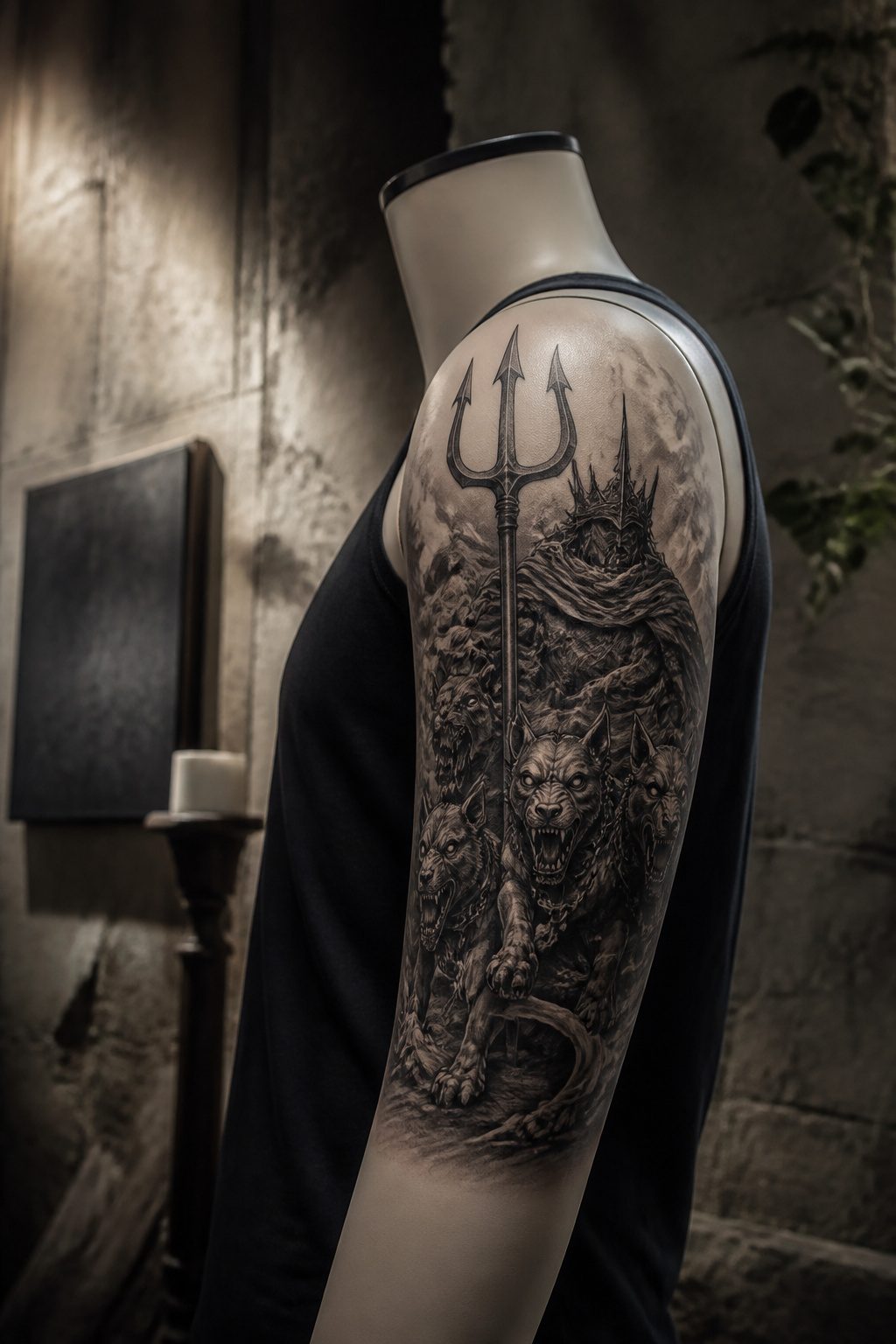
Hades carries a heavier reputation than he earned. Disney painted him as a villain, but the myths show a god who never chased power, who ruled the dead with fairness rather than cruelty. That distinction matters when his image lands on skin: the tattoo can read as menace, or it can read as acceptance of the full cycle.
The bident, his two-pronged scepter, offers a cleaner symbol than Zeus’s thunderbolt or Poseidon’s trident. It is less borrowed by sports teams and energy drinks, so it still carries weight in a tattoo. Cerberus, the three-headed hound, works as guardian imagery, not aggression; the dog keeps the living out and the dead in, a boundary-keeper rather than an attacker. The pomegranate seeds that bound Persephone to the underworld for part of each year turn the design toward seasonal truth, the winter that follows every summer.
Dark styles risk tipping into pure gloom. What saves them is the same thing that saved Hades in the stories: balance. A living person choosing this god on their body is not claiming death-wish. They are marking that the endpoint exists, that it shapes how the years before it are spent. The underworld was not hell in the Greek telling; it was simply where everyone went. A Hades tattoo done well holds that even tone, neither romanticizing nor fearing what comes last.
10. Siren Tattoo

The Greek siren and the Disney mermaid share a tail, but that is where the resemblance ends. Homer’s original creatures were bird-bodied women whose song pulled sailors onto rocks, not red-haired princesses trading voice for love. That difference matters for a tattoo that carries weight.
Shipwreck imagery adds the narrative the siren deserves: broken hulls, drifting oars, a figure still singing while the water floods in. Song itself can be woven through, notes trailing off into foam or blood. The danger is not hidden; it is the point.
For women especially, the siren lands differently than the mermaid. She is not waiting to be rescued. She is the threat and the beauty both, which is a older and more honest symbol than anything the later stories softened. A siren tattoo done well keeps that edge sharp.
What Greek Symbols Actually Mean
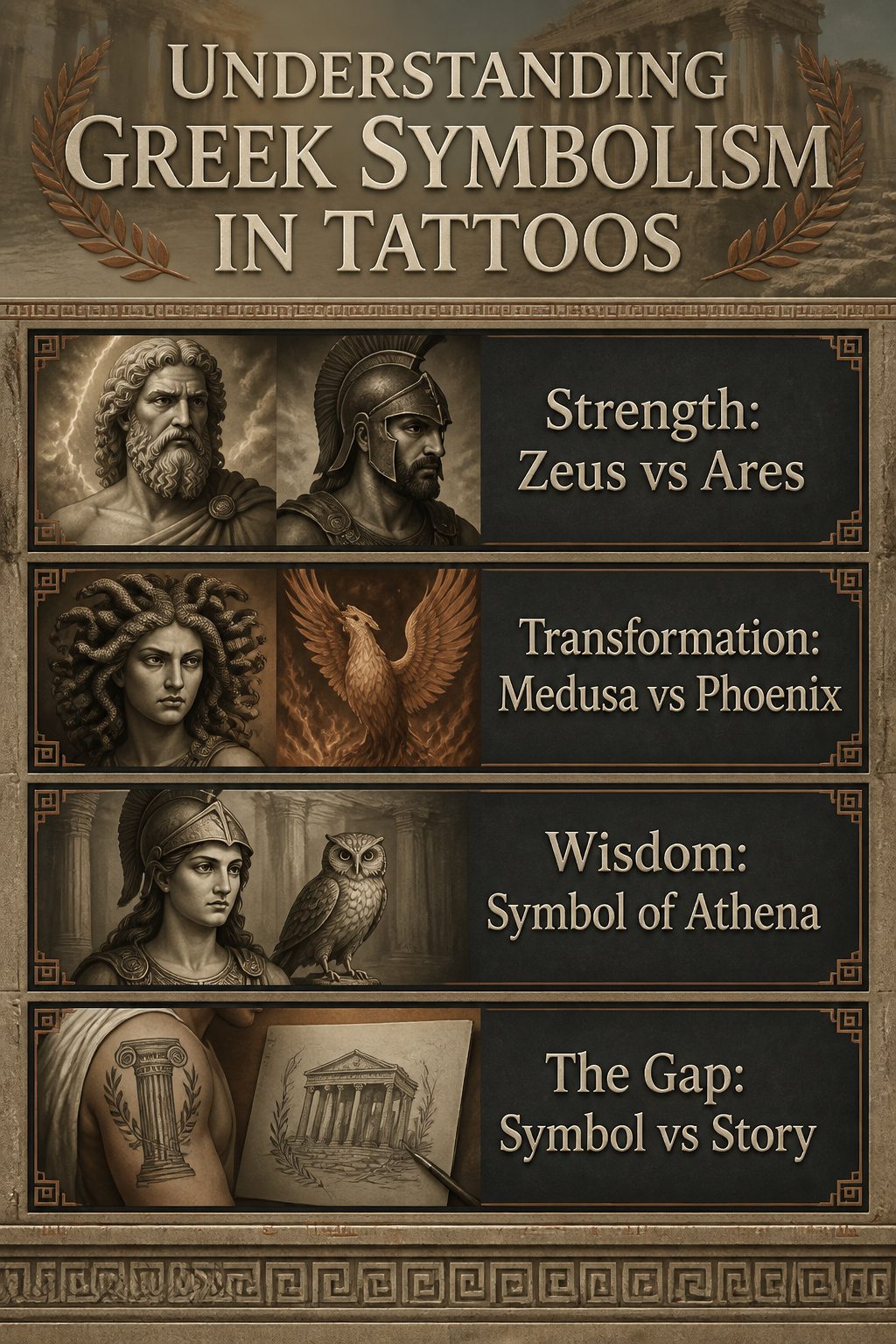
A Greek mythology tattoo works best when the figure matches something you have actually lived, not just a mood board you liked in March. The sources cluster around a handful of themes, and how you weight them against your own timeline matters more than the detail count in the linework.
Strength runs through Zeus and Ares, but the sources split on what kind. Zeus carries the authority of command, the king position on Olympus; Ares is the raw combat the sources barely trust, more a symbol of force without strategy. Athena’s wisdom is the counterweight, born fully formed from Zeus’s head, which the sources read as intellect without the mess of passion. That distinction matters if you are marking a decision that cost you something to reach.
Transformation shows up in Medusa and the phoenix, though the sources handle them differently. Medusa’s change was involuntary, a curse, which reads as resilience through damage rather than chosen renewal. The phoenix cycles. The sources note both but do not flatten them into the same ink.
Love, when it appears, is mostly absent from the top-ranking pages except by implication. Dionysus carries ecstasy and ritual, Apollo carries pursuit and loss. The reader who came for Aphrodite specifically will not find her in these sources, which says something about which symbols tattooers are actually asked to render.
The practical gap is between symbol and story. An owl for Athena signals wisdom to anyone who recognizes it, but the meaning deepens when you can say which wrong call it commemorates. The sources keep returning to this: the tattoo lasts because the myth gave language to an experience that otherwise sat unspoken.
Styles That Hold Up
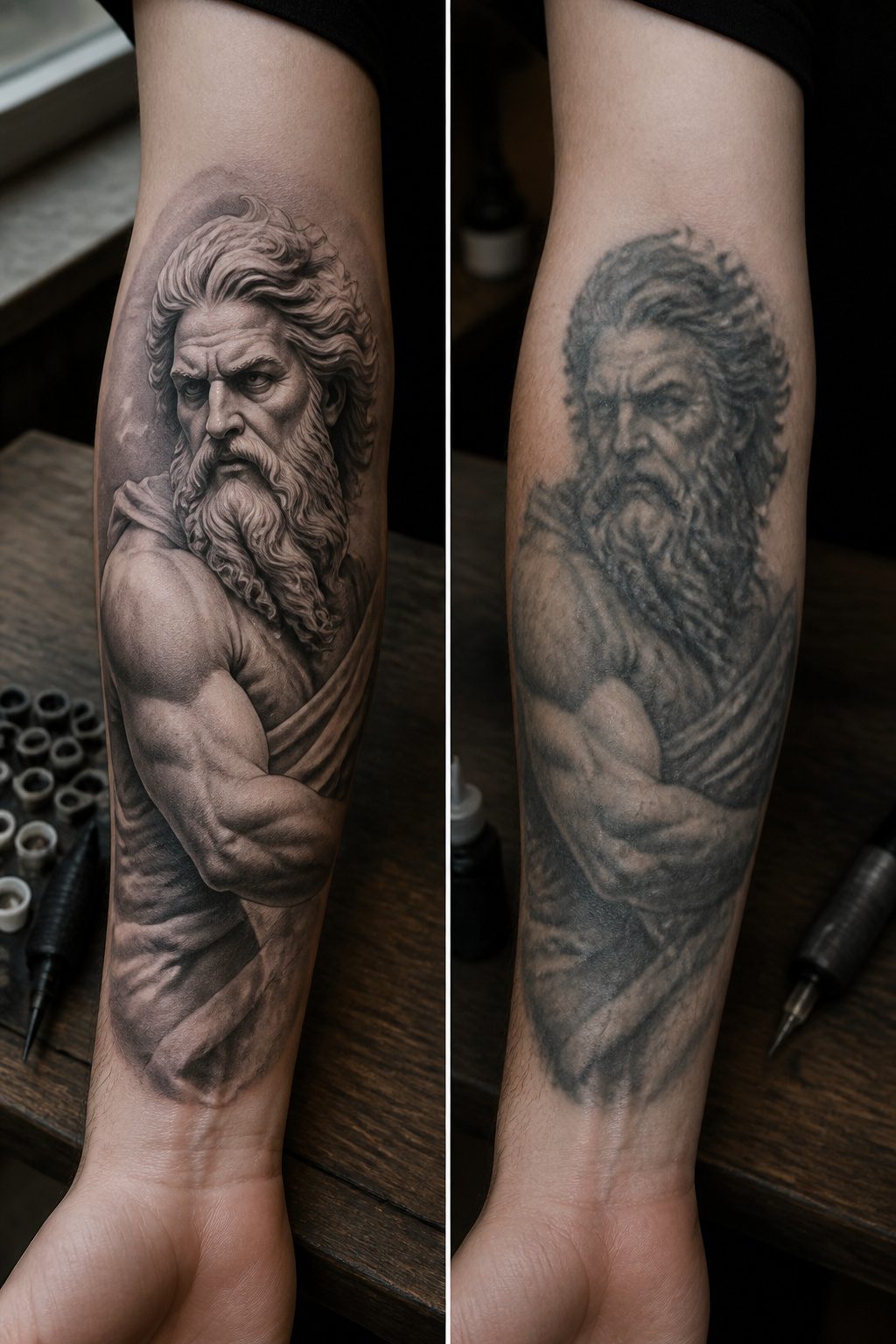
Black and grey realism carries the weight of marble sculpture onto skin, demanding an artist who can build tone without leaning on color. The style suits broad-shouldered figures like Zeus or Athena, where shadow does the work of drapery and the eye reads authority in the gradient from light to dark. I have watched these pieces soften over five to seven years; the contrast holds, but fine edge work begins to feather, so placement on flatter skin preserves the intended severity.
Micro-realism asks more of the hand and more of the body. The technique renders texture at miniature scale, armor plates and facial expression compressed into inches, and it needs the steady topography of an inner forearm or rib panel where the skin moves least. Figure choice here favors the compact: a single Medusa head, a winged heel in profile. The detail is astonishing at two years, yet the same density that impresses also blurs fastest; sun exposure accelerates the loss, so the collector commits to coverage or to refresh.
Fine-line tattoos take the opposite wager, stripping the myth to contour and gesture. Apollo’s lyre, a siren silhouette, read as symbol rather than portrait, and they age with their lines intact because there is less pigment to drift. The risk is different: an inexperienced hand leaves the drawing tentative, and Greek figure work without weight of line can look tentative from day one.
Where to Place the Work

The back gives the widest stage for Greek mythology tattoo ideas that need room to breathe. Epic scenes, the fall of Icarus or Athena’s birth from the head of Zeus, read as actual narrative there rather than compressed symbols. A full back piece lets the artist use the spine as a central axis and the shoulder blades as framing devices, something the arm simply cannot offer.
Arms work better for single figures or paired deities. A sleeve builds chronologically as the eye travels, which suits the twelve labors of Heracles or the progression of the seasons with Demeter and Persephone. The cylinder of the arm forces a vertical composition that the back does not, and that constraint can be useful. Sleeves age faster than back pieces because the skin gets more sun and more movement; line thickening shows earlier on the inner forearm than between the shoulder blades.
Chest pieces split the difference. They carry weight, literally and visually, but the pectorals limit width. A single broad figure like Poseidon works; a sprawling battle of Titans does not. The chest also changes with muscle gain or loss more dramatically than the upper back, which matters if the wearer trains or ages into softer tissue.
Single-figure tattoos survive placement shifts better than narrative compositions. A Medusa head on a forearm still reads as Medusa when the skin loosens. A scene with multiple figures, spaced across the back for balance, can collapse into visual noise as bodies change. The simpler the design, the more forgiving the location.
Frequently Asked Questions
What are the best Greek mythology tattoo ideas?
The strongest choices include Zeus for authority and command, Athena for intellect and strategy, Poseidon for mastery or chaos depending on the water treatment, Medusa for reclaimed transformation, the phoenix for cyclic rebirth, Ares for ungoverned combat energy, Dionysus for destruction and remaking, Apollo for ongoing pursuit of clarity, Hades for acceptance of the full cycle, and the siren for danger that is owned rather than hidden. Each carries specific weight based on which attribute you are marking.
What do Greek mythology tattoos symbolize?
They cluster around strength in distinct forms, Zeus carrying authority and Ares carrying raw force without strategy, with Athena as the counterweight of intellect born complete. Transformation appears through Medusa as resilience through damage and the phoenix as chosen renewal. Dionysus holds destruction and remaking, Apollo the pursuit of truth rather than its arrival, and Hades the acceptance that endpoints shape what comes before.
What styles are popular for Greek mythology tattoos?
Black and grey realism suits broad figures like Zeus and Athena, building authority through shadow and gradient. Micro-realism compresses texture into small areas but blurs fastest under sun and movement. Fine-line strips the myth to contour, letting symbols like Apollo’s lyre or a siren silhouette read cleanly and age with lines intact because less pigment drifts.