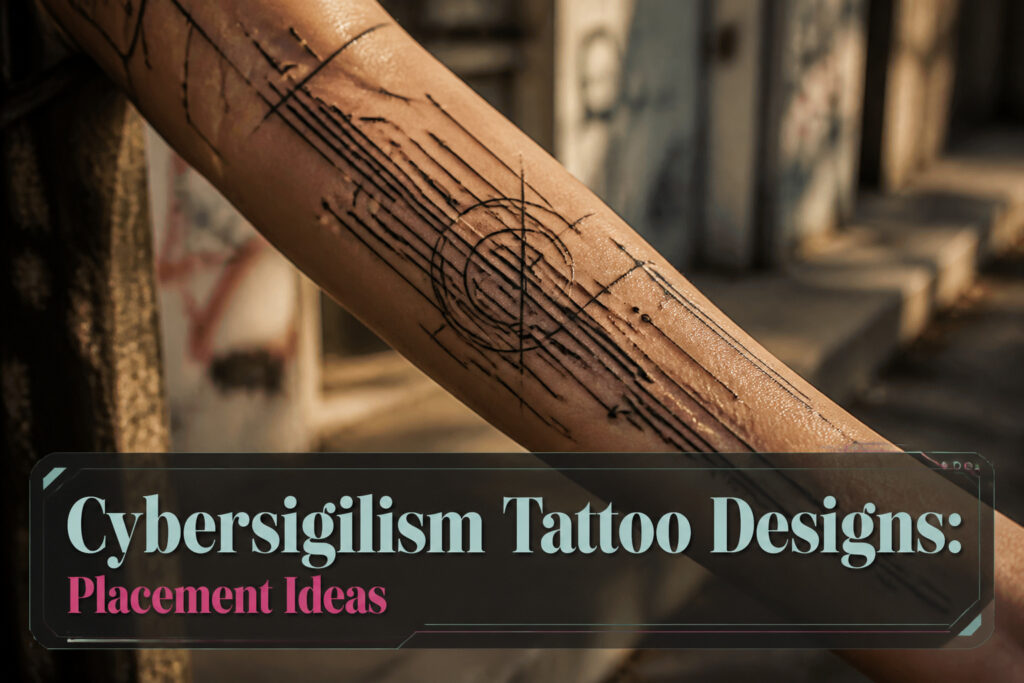
Cybersigilism tattoo designs fuse personal sigil magic with the sharp, circuit-like linework of digital aesthetics. The catch is that a symbol pulled from a flash sheet moves nothing; the work that earns the name starts with an intention built between wearer and artist, a process Aingel Blood pioneered in Berlin’s late-2010s electronic underground. Most placements run 1RL to 3RL needles across the forearm, spine, back, hand, neck, or chest, each with its own structural logic and maintenance cost.
1. Personal Sigil Tattoos
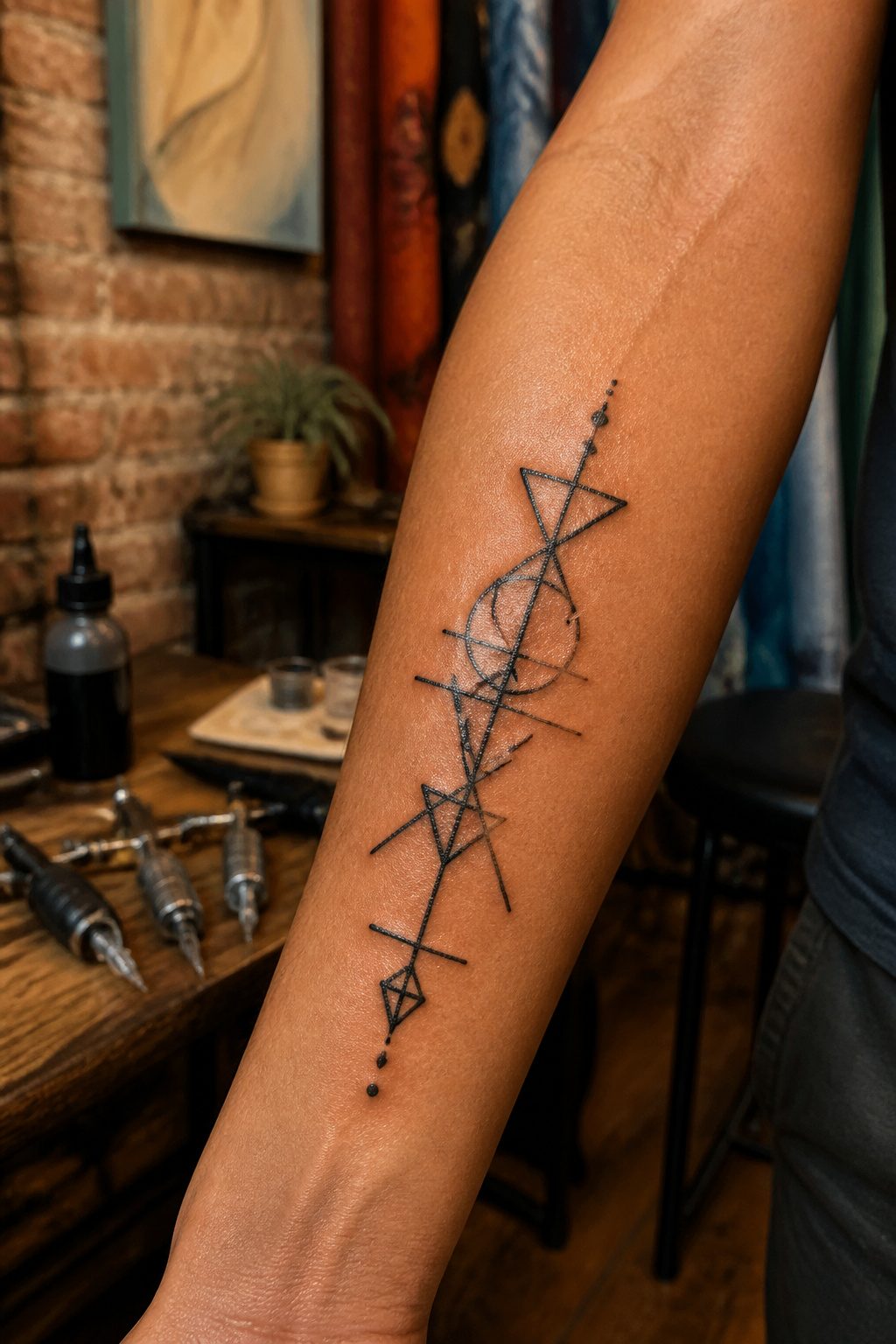
A stock cyber sigil pulled from a flash sheet sits on skin the same way a screensaver sits on a monitor: it moves nothing. The work that earns the name starts with a symbol built to hold one specific intention, nothing generic.
Aingel Blood,, the trans ritual artist who has spent years building what is probably the most recognized cyber sigilism tattoo portfolio, made this the center of the style. The method is closer to old magical practice than to picking art off a wall. A sigil encodes a belief or want into shape, the way practitioners once condensed desire into symbols meant to bypass conscious resistance. Blood’s approach keeps that function but renders it in the sharp, mechanical-versus-organic lines that mark the style.
Commissioning one means finding an artist who will interview you the way a ritualist would, not the way a retail clerk would. The intention gets sketched, abstracted, sometimes broken and reassembled until it carries weight for the wearer alone. Two paths sit in front of you: bring a finished symbol and ask the artist to translate it into cyber sigilism’s visual grammar, or hand the artist the intention and let the symbol emerge from collaboration. The first risks a design that looks correct but feels borrowed. The second takes longer and demands trust, but the result is the one that cannot be mistaken for decoration.
This is why the style emerged when it did, in the second decade of this century. The tools for both tattooing and digital life had matured enough that people began wanting permanence that matched the personal data they already lived inside, not mass culture they wore on top of it.
2. Forearm Tattoos
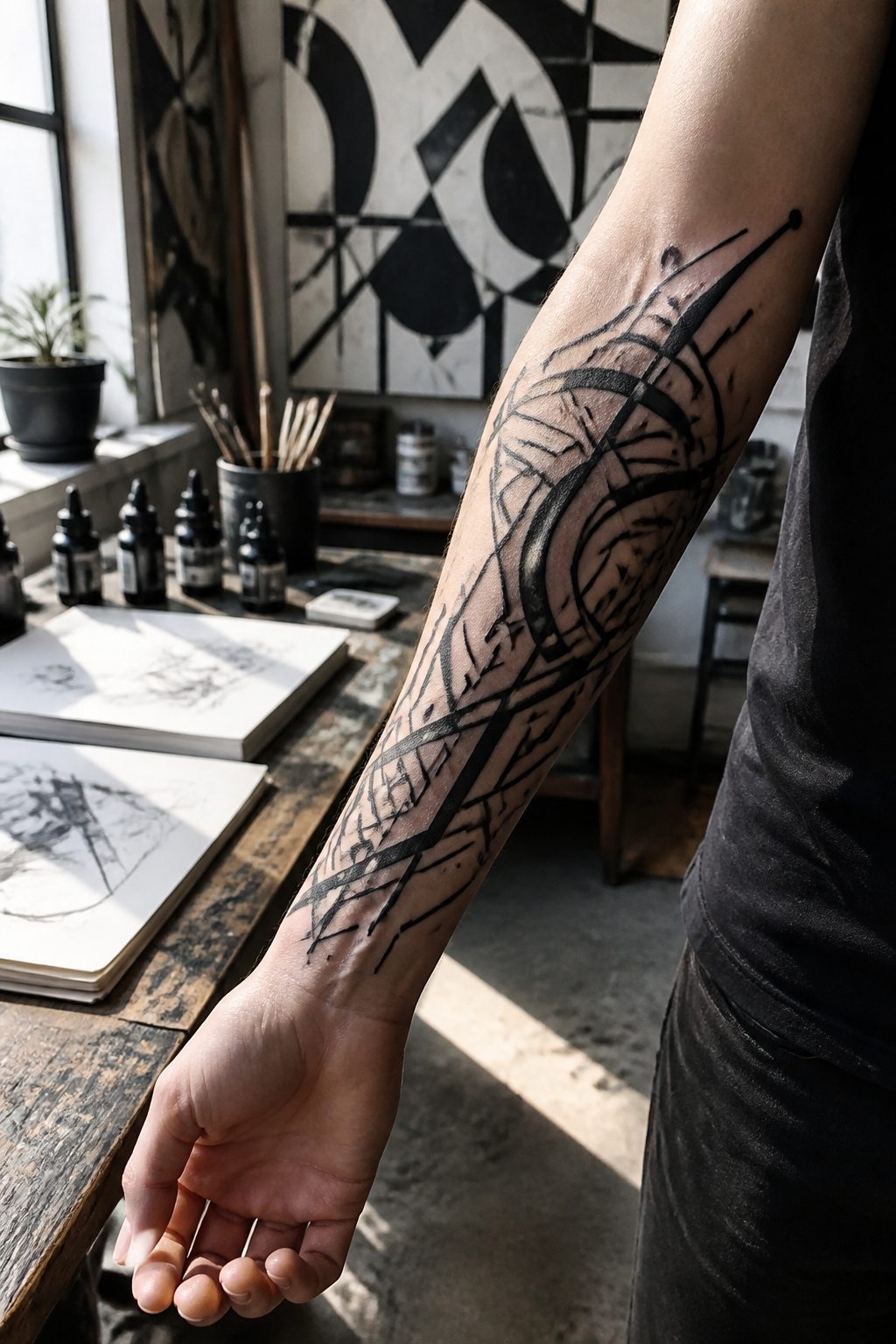
The forearm is the most popular placement for cybersigilism tattoo designs, and the reason is practical before it is aesthetic. The surface is flat enough to hold the style’s long, continuous lines without the warping that comes from heavy muscle movement or bony prominences. That linear precision reads cleanly from wrist toward elbow, letting an artist build extended compositions that feel architectural rather than scattered.
I have watched this placement win out for visibility in a way that does not demand the commitment of a hand or neck piece. The inner forearm keeps the work personal; the outer forearm turns it into something bolder. Either way, the natural line of the arm guides the eye along the design the way a corridor draws you through a building. Four separate studio guides rank this placement first, and the consistency is not surprising. The forearm ages well, shows well, and gives cybersigilism the room it needs to breathe.
3. Spine Tattoos
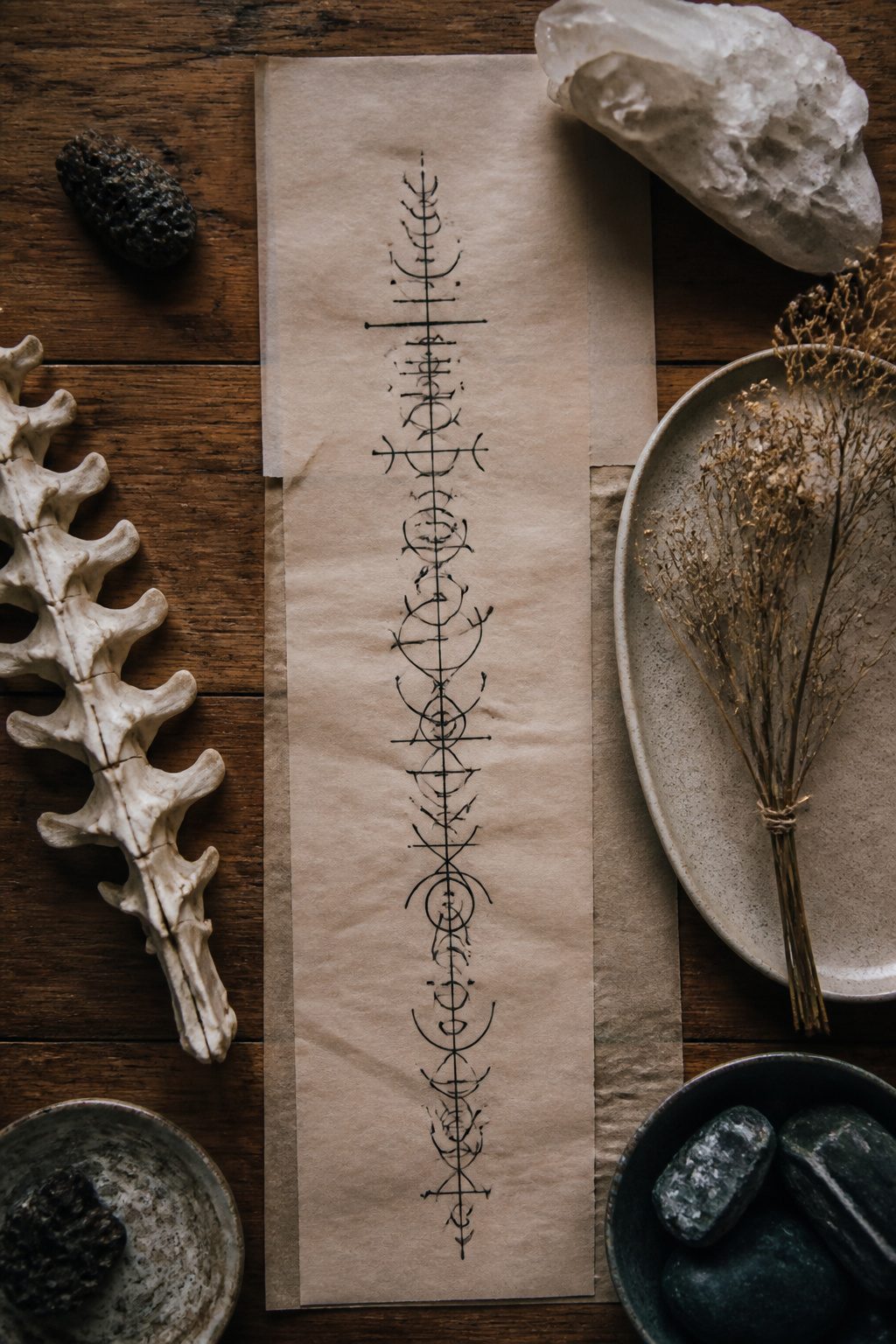
The spine’s natural column draws a continuous line from the base of the skull to the tailbone, and cybersigilism tattoo designs exploit this geometry with vertical compositions that read as a single interrupted structure. Bone sits close to skin across most of the back, which changes how the needle deposits ink and, more visibly, how the finished piece ages. A line that reads as a hair-thin circuit on the fleshy lower back can blur where it crosses vertebrae, and artists working this placement typically pull the skin taut in sections rather than stretch the full column at once.
Movement completes the design. Standing straight, the composition holds as architectural and fixed; bending forward, the same lines elongate and the angles shift, so the sigil appears to recalculate itself. The effect differs from wrapping a limb, where the tattoo simply follows a cylinder. Here the body axis becomes the signal path, and posture becomes the input that changes the output. Collectors who choose this placement are committing to the longest single session the style demands, and to a piece that will not read correctly unless they stand a certain way. The trade is worth it for the one placement where cybersigilism’s vertical logic meets the body’s own.
4. Back Tattoos

The back is where cybersigilism tattoo designs reach their full architectural scale. An artist can layer interlocking symbols, radiating forms, and dense linework across the full canvas in ways smaller placements simply cannot support, and the negative space between elements becomes as intentional as the ink itself.
A full back piece runs 20–40+ hours, typically broken into shorter sessions than bolder styles demand. The precision of fine geometric work exhausts both artist and collector quickly; maintaining that focus across a long sitting is not realistic for either party. I have watched compositions grow across months this way, each session adding another plane of the design.
Smaller back placements, the shoulder blade or upper center, still read well but function more like framed portraits than immersive environments. The geometry stays flat, readable, contained. For readers weighing whether to commit, the question is really whether you want the tattoo to sit on your body or to reshape how the eye reads your silhouette.
5. Hand and Neck Tattoos
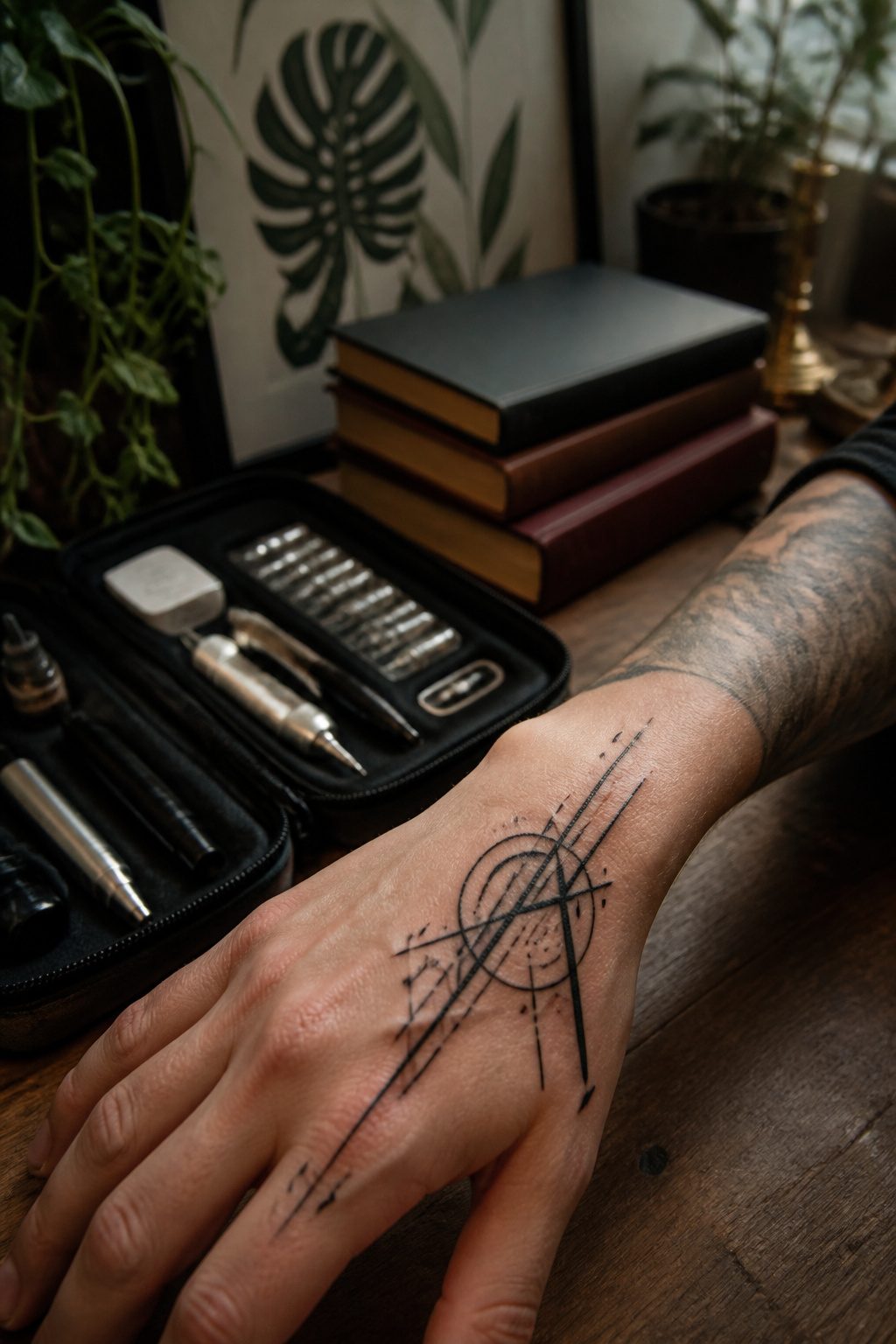
Bold geometric forms hit differently when they sit somewhere you cannot hide. The hand and neck are the first placements most people picture for cybersigilism tattoo designs, and that visibility is exactly the point: the style’s stark, angular linework reads as a deliberate signal rather than a background decoration. A hand piece moves through every gesture, and a neck piece frames the face; both demand that the geometry be precise because the skin there turns over faster and sees more sun, which means the sharp edges you paid for will soften sooner than they would on a shoulder or a back.
The tradeoff is straightforward. These spots announce themselves in every professional room and social setting, and the commitment is permanent in a way a forearm piece simply is not. I have watched collectors with extensive prior tattoo experience treat the hand or neck as a capstone decision, not an entry point, and the sources back that sequencing. The precision required is higher too: long continuous lines must be set with exact needle control over bone and tendon that shifts constantly. Touch-ups every 2–4 years are the expected maintenance, not the exception.
What makes the placement worth that cost is the aesthetic match. Cybersigilism’s digital-mystical hybrid looks engineered, almost circuitry-like, and the hand or neck functions like an interface between the person and the world they move through. The starkness suits the architecture of the body at those joints: the collarbone’s horizontal line, the wrist’s radial symmetry. Where a softer style might fight the bone, cybersigilism’s geometry collaborates with it.
6. Chest Tattoos
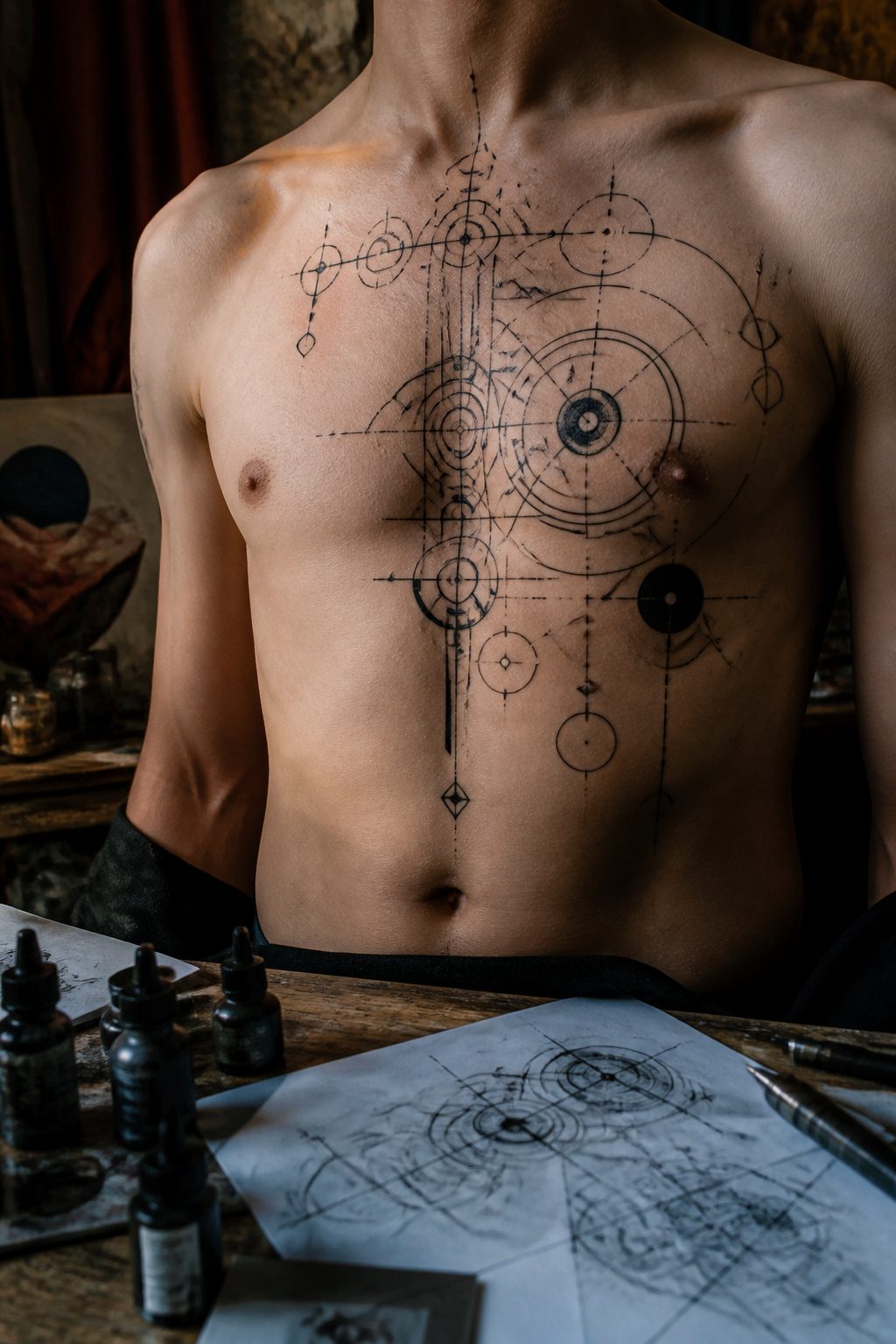
The chest’s natural symmetry makes it an almost too-obvious home for cybersigilism tattoo designs, and that is exactly why it works. Paired compositions can mirror across the sternum like a screen folding open, each half completing the other’s logic in a way the body itself suggests. What convinced me, looking through portfolios for this piece, is how the sternum’s slight irregularities become the design’s hidden engine rather than its flaw. One side of the bone sits marginally higher than the other in most people, and a tattoo artist mapping a sigil has to account for that drift or the linework looks off by millimeters that read as miles.
The technical move is building intentional asymmetry into the mirror: letting one side carry slightly more weight, thicker nodes where the bone curves, so the whole thing registers as balanced to the eye rather than literally identical. Centering matters more here than almost anywhere else on the body. The chest is where a design becomes architecture; it frames the sigil at the body’s midpoint, visible above most necklines, and the viewer’s eye travels straight to it because that is what human vision does with bilateral shapes placed at the vertical center. A sigil that should read as a system reads, in this placement, as a core.
What Cybersigilism Means
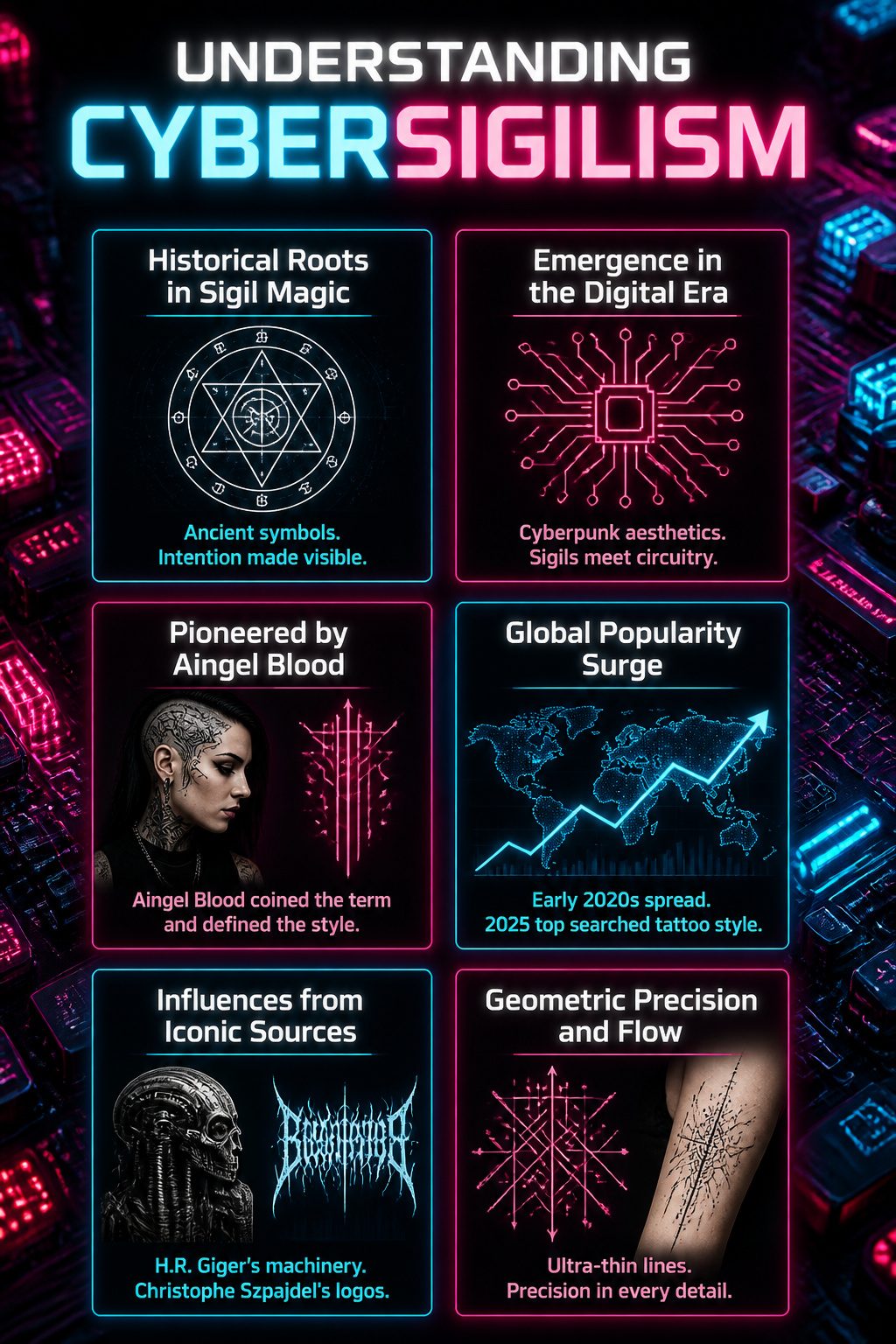
Sigils have been around for millennia, symbols carved or drawn to hold specific intention, to summon, to protect, to bind a wish to a form. Cyberpunk came later, all neon grids and circuit-board logic and the visual hum of a screen that never fully sleeps. The two traditions seem opposed at first glance: one hand reaching backward toward occult practice, the other pressing against a future that feels increasingly rendered rather than built.
Aingel Blood, a tattoo artist working in Berlin’s late-2010s electronic music underground, saw the overlap before most. The term cybersigilism is hers, coined to describe what happened when she started translating sigil methods into the angular, high-density linework of digital interfaces and biomechanical art. The style spread through social media in the early 2020s and by 2025 had become one of the most searched tattoo styles globally.
The visual language borrows from sources as varied as H.R. Giger’s skeletal machinery and the needle-thin band logos Christophe Szpajdel designed for extreme metal acts. What holds it together is the premise: a symbol can be personally charged and technologically precise at the same time. The lines are thinner than almost any other tattoo style, the geometry sharper, the negative space as deliberately placed as the ink itself.
How These Tattoos Look
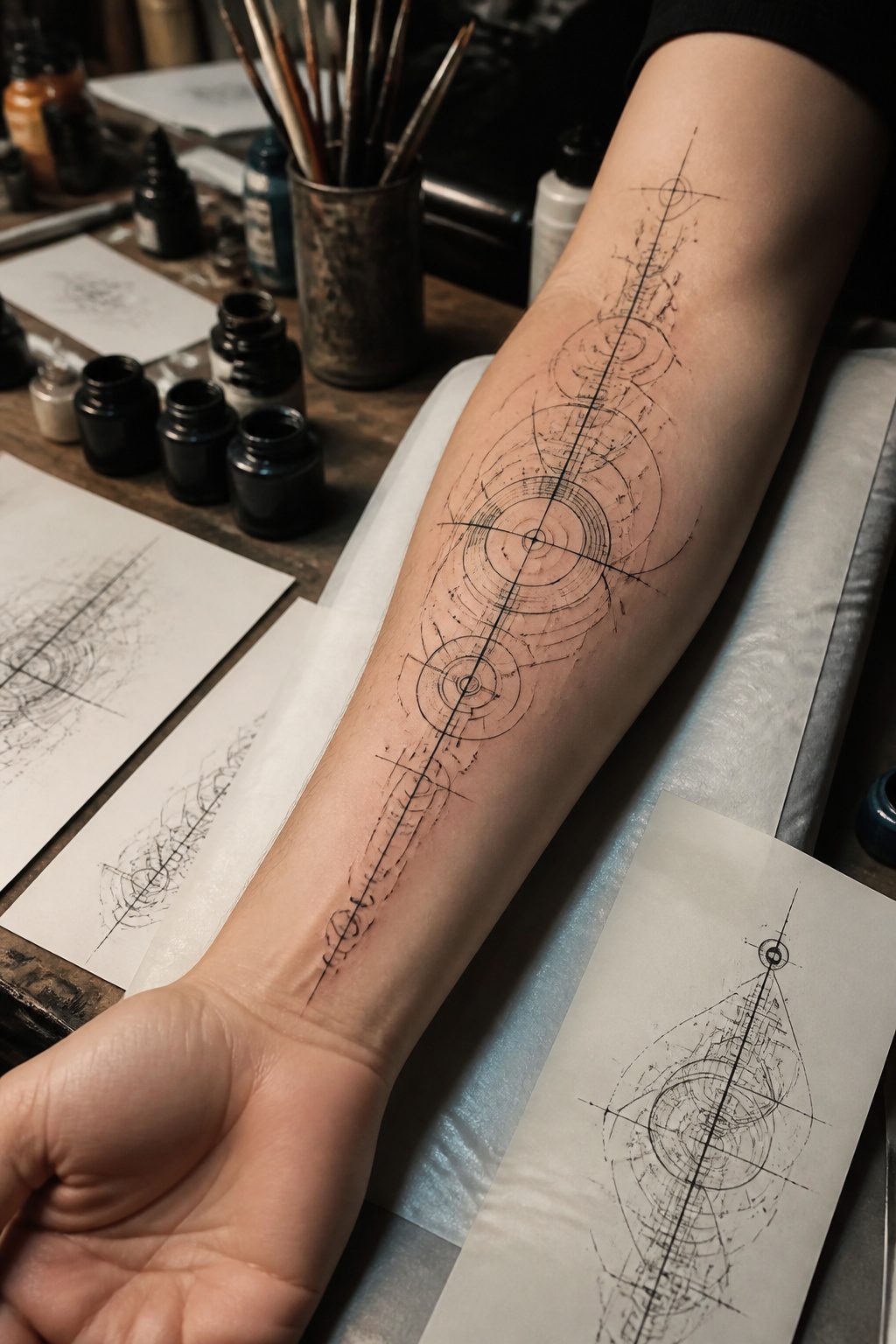
Ultra-fine linework is the first thing you notice, and it is what separates cybersigilism from every other blackwork style. Artists work with 1RL to 3RL needle groupings, the smallest standard configurations available, to lay lines that read as thread or filament rather than stroke. A deviation of even a millimeter shows immediately against the geometric ground, so the hand has to be steady and the stretch exact.
The visual vocabulary mixes three things that do not usually share space: the sharp, spiky nodes and S-curves of circuit traces; the flowing, organic contours of muscle and bone; and the symbolic density of sigils, runes, or distorted traditional icons. Negative space functions as structural material, not background. Without adequate breathing room between those micro-lines, the design collapses into blur within a decade as sub-dermal ink naturally expands. The precision is not decorative. It is what keeps the tattoo legible at fifteen years instead of five.
Where the Style Comes From
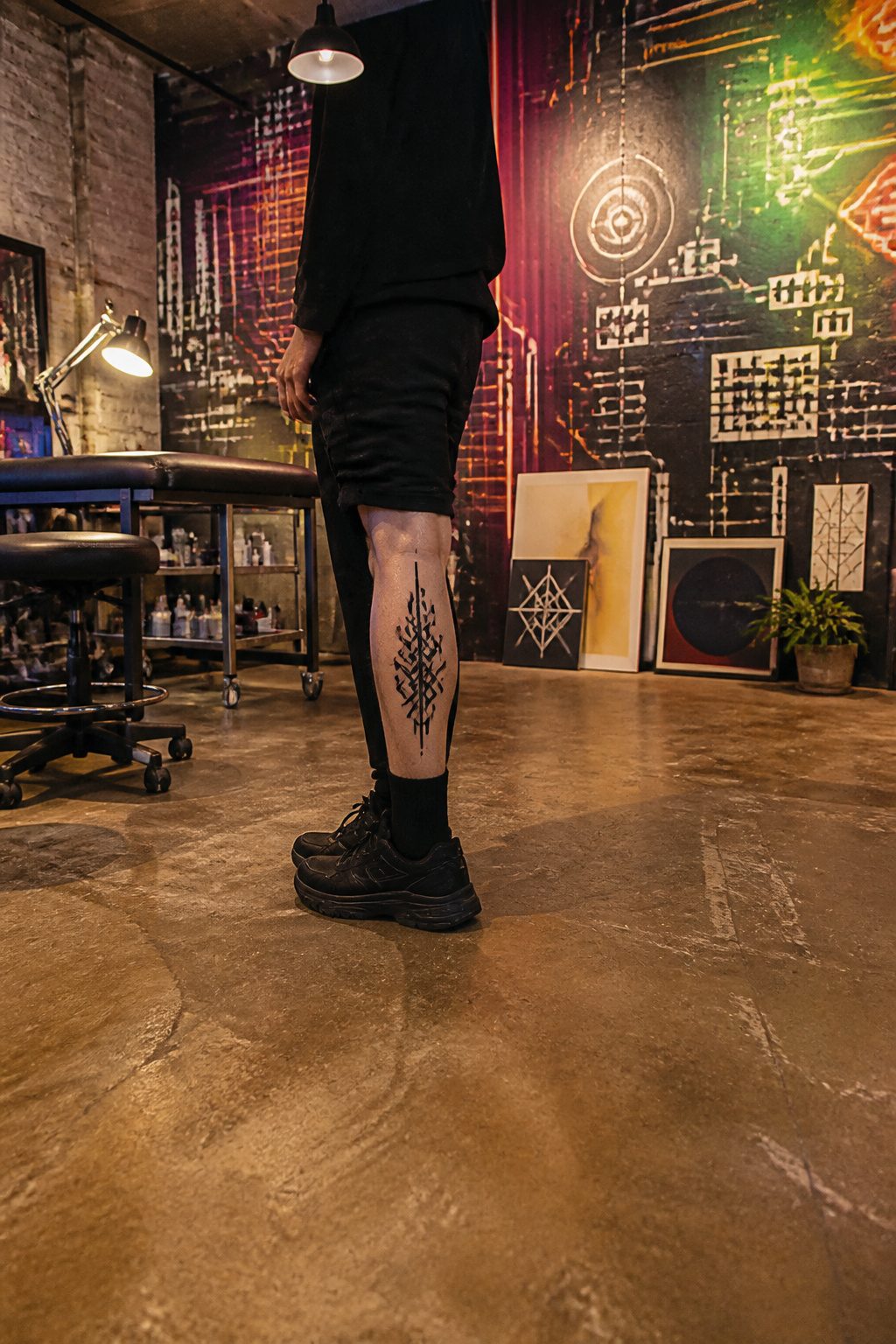
The late-2010s Berlin techno and rave scene is where cybersigilism tattoo designs first took shape. Club culture there treated body modification as another form of self-customization, not far from how ravers already built their look through hardware, makeup, and hair. That ethic of patching and upgrading the self carried straight into the aesthetic: sharp black lines that look like circuit boards or ritual symbols, depending on the light.
Social media carried it out of those clubs and into global Gen Z and queer communities, where artists like Aingel Blood, who helped name the movement, described the practice as "internet mysticism." For trans people especially, these digital-style sigils became a way to reclaim bodily autonomy after procedures like top surgery, a form of character customization that exists outside regulated systems.
The music stayed tied to it too. Polish rave scenes, Sigilkore, and Krushclub kept the visual language alive on album covers, where spiked, illegible logos rejected commercial readability. Pop culture visibility came later, with Billie Eilish and Grimes wearing the look, but by then the aesthetic had already lived a full life in underground spaces.
How Artists Build the Design
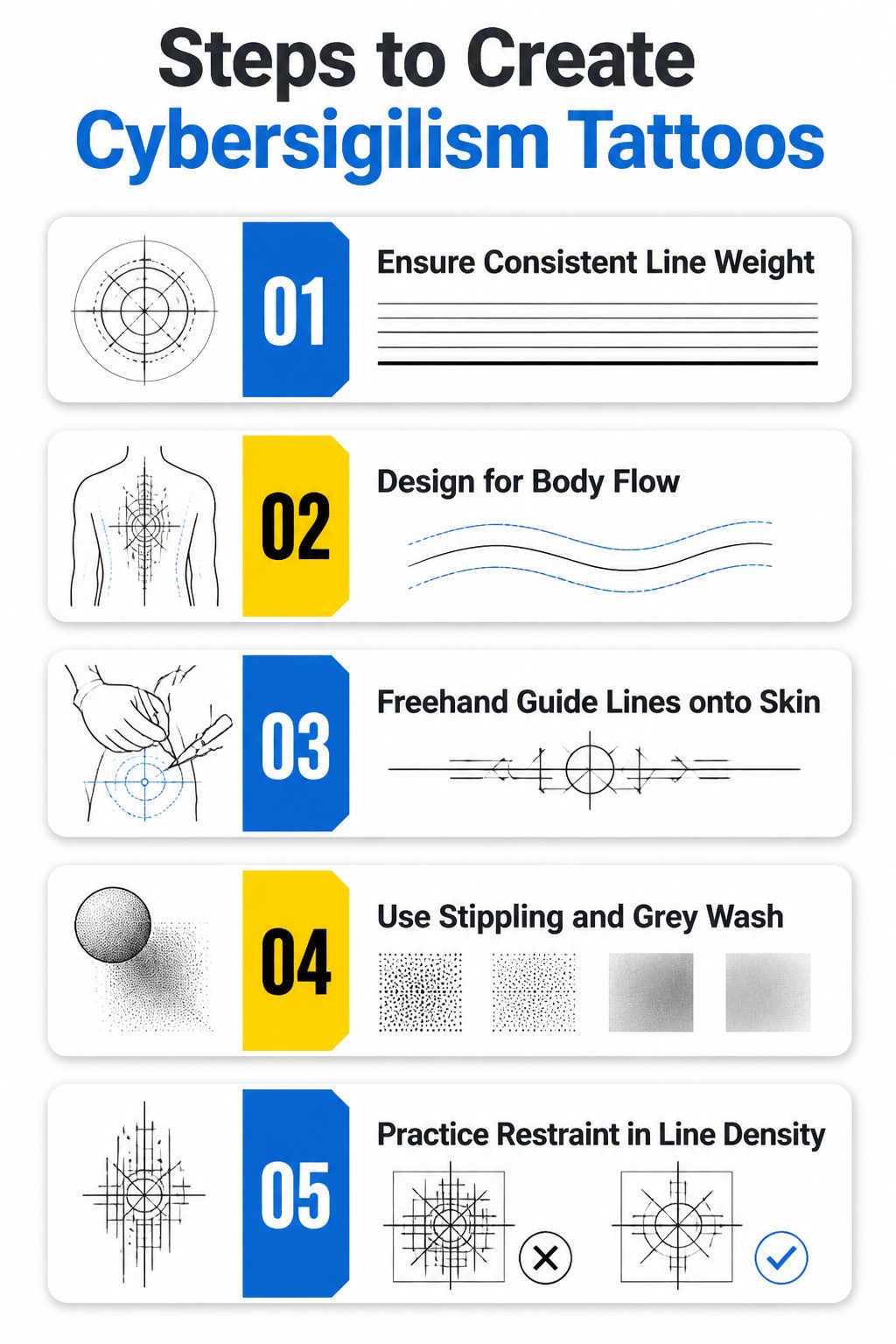
Fine-line work is where cybersigilism tattoo designs live or die, and the gap between an artist who can execute them and one who cannot is wider than most people expect. Consistent line weight and precise angles are the baseline, but the real test is long, straight lines drawn freehand without stencil support, a skill that separates practiced hands from those who simply own a machine.
Body flow matters just as much as needle control. An angular, architectural composition has to be designed with the body’s curves and planes already in mind, not just placed on top of them. The geometric logic needs to hold together as a unified whole, with every form relating to the others and to how the skin actually moves. That is why experienced artists freehand guide lines directly onto the body to match individual muscle movement.
Stippling and grey wash, a distillation of black ink with water, sometimes add dimension or shadow, though restraint is the harder discipline. Packing too many micro-lines into small areas is the common mistake; negative space is what keeps the style readable over decades. Fine lines are sensitive during healing, and the aftercare is unforgiving. Avoid picking, over-moisturizing, or early sun exposure if you want those line weights to survive.
Frequently Asked Questions
What is a cybersigilism tattoo?
A cybersigilism tattoo blends fine-line blackwork with geometric forms that fuse digital aesthetics and personal symbolism. The style uses ultra-thin needles to create lines resembling circuit traces or ritual marks, encoding individual intention into angular, high-density compositions. Artists like Aingel Blood pioneered the approach in late-2010s Berlin, treating each piece as personal sigilcraft rather than off-the-shelf decoration.
How long does a cybersigilism tattoo take?
Small pieces run 3–5 hours, medium forearm or back work needs 8–15 hours across multiple sessions, and full back compositions demand 20–40+ hours total. Sessions stay shorter than bolder styles because the focus required for fine geometric linework exhausts both artist and collector quickly. The precision simply cannot be sustained in marathon sittings.
Where is a cybersigilism tattoo best placed?
The forearm ranks as the most popular placement for its flat surface and controlled aging, followed by the spine, back, hand, neck, and chest. Each location shapes how the geometry reads: the spine turns posture into part of the design, the back allows full architectural scale, and the hand or neck makes the tattoo function as a visible interface with the world. Bone proximity, skin turnover, and daily sun exposure all factor into how crisp those fine lines stay over time.